
Take It or Leave It
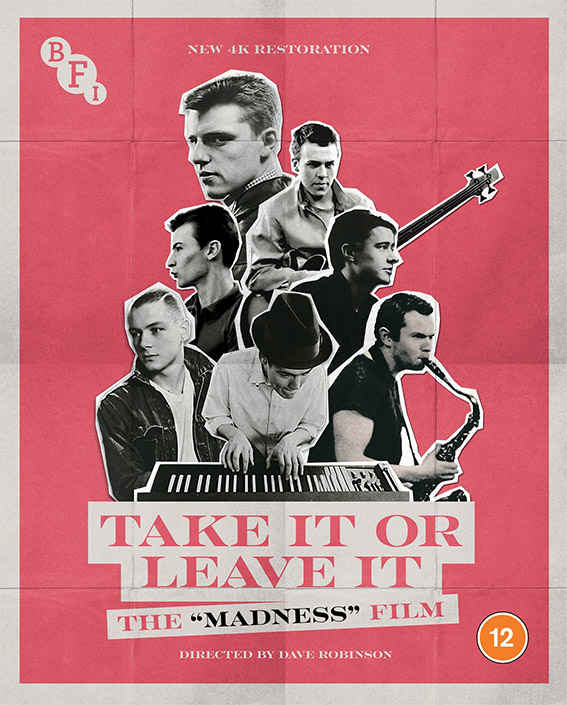
The rise of Madness, made in 1981 at the height of the band’s popularity. TAKE IT OR LEAVE IT is released in dual-format Blu-ray and DVD by the BFI. Gary Couzens listens to the heavy heavy monster sound.
Hey you, don’t watch that – watch this! This is the heavy heavy monster sound, the nuttiest sound around. So if you’ve come in off the street and you’re beginning to feel the heat well, listen buster, you better start to move your feet to the rockingest rocksteady beat of Madness. One step beyond!
– “One Step Beyond”
That opening, delivered by then-bassist Chas Smash rather than vocalist Suggs (who gets to shout the title a few times in what is basically an instrumental), was a statement of intent. “One Step Beyond” was Madness’s second single, first to reach the top ten, and the title of their first album, all of those happening in 1979. For another three years, Madness were at their peak as a singles band, with fifteen of the next sixteen also making the top ten. They also capitalised on the burgeoning medium of the promotional video. It’s not true that Queen’s “Bohemian Rhapsody” was the first video as some claim, but its success, played every week on Top of the Pops for the nine weeks it was at number one, certainly kickstarted a boom in the visual side of the music industry. Several of Madness’s videos were directed by Dave Robinson, also the head of their record label, Stiff Records, of whom more in a moment. The band were: Graham “Suggs” McPherson (lead vocals), Chris “Chrissy Boy” Foreman (guitars), Mike “Barso” Barson (keyboards), Mark “Bedders” Bedford (bass from 1978), Lee “El Thommo” (aka “Kix”) Thompson (saxophone), Carl “Chas Smash” Smyth (bass before 1978, then trumpet), and Dan “Woody” Woodgate (drums).
Madness were part of the two-tone movement, along with the likes of The Specials (who get a mention in this film), Bad Manners, The Selecter, The Beat and others. Madness were all-white, all-male and Londoners unlike some of these other bands, but their sound like theirs fused elements of Jamaican music (ska, rocksteady, reggae) with punk and new wave. For a sample of several of these bands, including Madness, see the concert movie Dance Craze, which has also been released by the BFI in 2023. This was music you could and were expected to dance to, and Madness added their cheeky, gang-of-lads personas (especially with their nicknames) to the mix. As with other bands, the upbeat music didn’t preclude social comment, often influenced by fellow Londoners from a decade earlier, The Kinks. “Cardiac Arrest”, for example, is not an upbeat song, and it broke that run of top-tenners, reaching a mere number fourteen, and having a few complaints about taste. “Grey Day” is certainly in a more melancholic mode than usual.
By 1981, with all those hits, and two further albums (Absolutely and 7), you can understand why a feature film was the next logical step. The band weren’t quite at their peak, as it was the following year they had their only number one, “House of Fun”, and the run of top tens continued to the end of 1983. There were plenty of precedents for bands to appear on the big screen, playing versions of themselves. The gold standard would be The Beatles with A Hard Day’s Night (1964) but others which followed in its wake included the notable Catch Us if You Can (1965), featuring the Dave Clark Five and directed by John Boorman in his feature debut, and the rather less notable Freddie and the Dreamers vehicle Cuckoo Patrol (1967). More recently, and in colour rather than black and white, there had been Slade in Flame (1975) with the former real band (then also having had a great run of hit singles, including six number ones) playing the fictional latter band. So, in 1981, it was Madness’s turn, and the film was shot in March of that year.
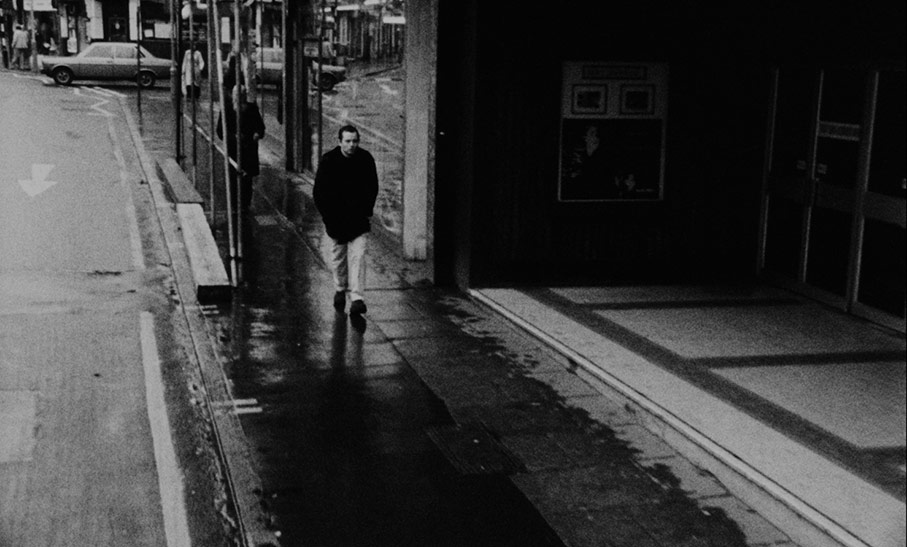
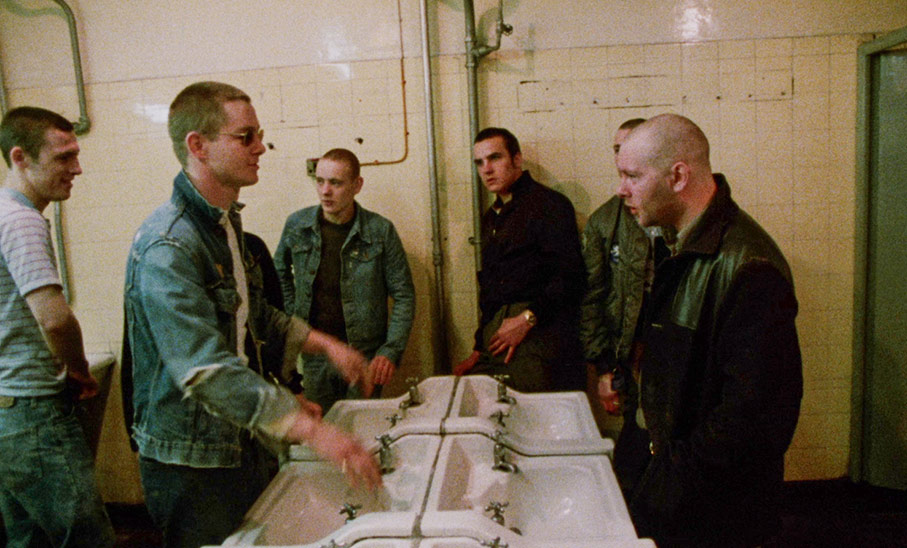
After the opening credits, we go back to Camden Town in January 1976 – wet, and in grainy, contrasty black and white. Barso, El Thommo, Chrissy Boy and drummer John Hasler (who later became Madness’s manager) are in a band, but their enthusiasm isn’t matched by their then ability. Fourteen minutes later, we return to colour as we jump forward to June 1977, when the band is called The Invaders, fronted by latterday Ted Dick (Gerard Kelly). As they perform at a friend’s party, Suggs and Chas Smash approach them to become respectively the singer and bassist. Eventually the band comes together, though there are conflicts and temporary departures, and Suggs is sacked when he skips band practice to go to the Cup Final. With John’s help, they get bigger and better gigs, even if they do attract the attention of skinheads. Eventually, they are taken on by producer Clive Langer (playing himself) and cut their first single. The film ends with that single, “The Prince”, reaching number sixteen in the charts and Madness on their way.
This isn’t a documentary, but as you can see from the synopsis, many of the people concerned turn up as themselves, and the band gets a co-writing credit as many of their scenes were improvised. This isn’t necessarily a good thing, as with seven principals on screen, they don’t always distinguish themselves from each other. As director, Robinson doesn’t really shape the material, maybe due to the difficulties in getting performances out of non-actors, with many scenes playing out in longish takes, often handheld. Key scenes don’t land as they should and in some cases are relegated offscreen. Many a first-time director benefits from an experienced cinematographer, and in this case it’s Nic Knowland, who began his career in 1968, his documentary background giving the proceedings a gritty realism which shapes the film more than the direction does. There are professional actors in supporting roles, and Simon Bates becomes the third Seventies DJ to make an appearance on a BFI release this year (after David Hamilton in Nuts in May and Tommy Vance in Pressure) towards the end as he reads the chart rundown wherein the band reach the top twenty for the first time.
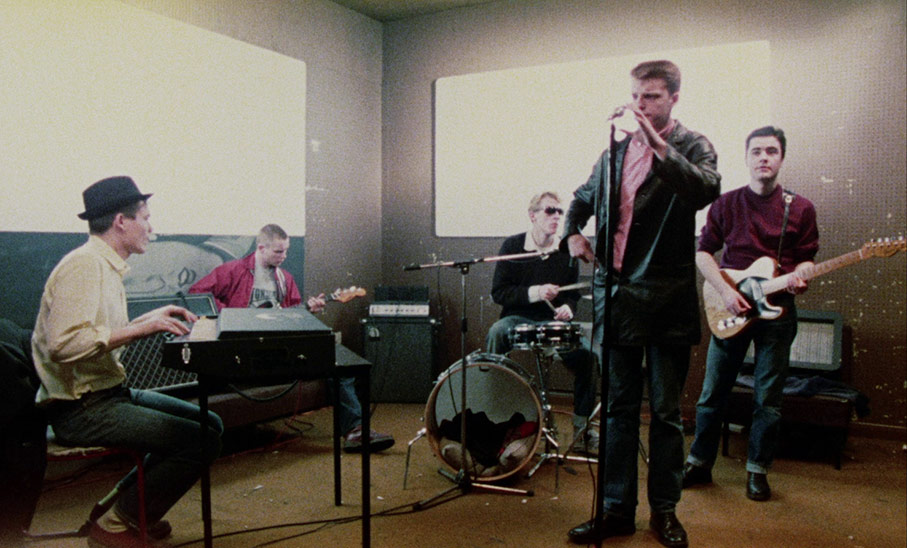
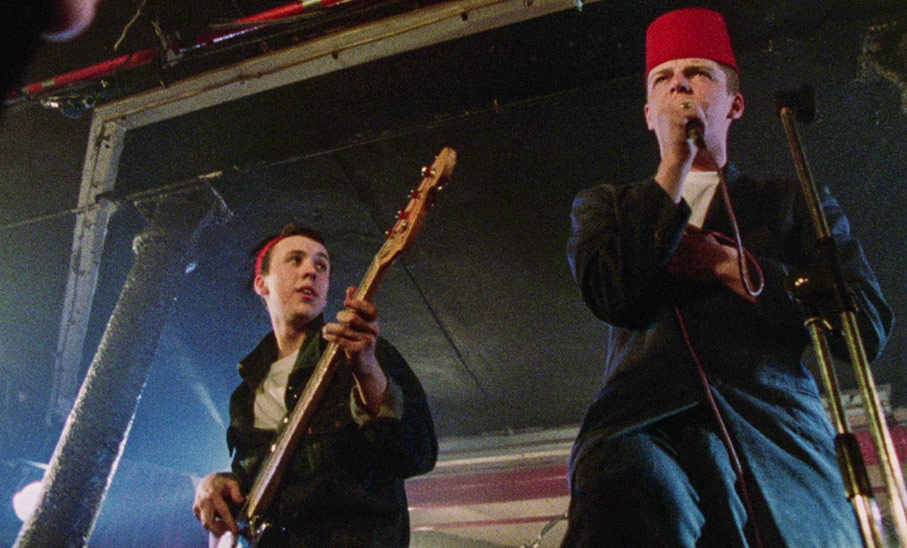
That said, the selling point of this film is the music, and we hear a lot of it, both diegetically in live performances and on the soundtrack. Take It or Leave It opened on 15 October 1981, its main London venue the Gate Three in Camden (which is now the Camden Plaza, no relation to the previous Camden Plaza elsewhere in the district), so very close to the band’s original stamping ground.
sound and vision
Take It or Leave It is released by the BFI as dual-format, a Blu-ray and DVD. This review is based on a checkdisc of the former. The film had an A certificate, the equivalent of today’s PG, on release in 1981, with one use of “fuck off” redubbed. You can see why: a AA certificate (then) would have excluded the under-fourteens which would have removed a significant part of the intended audience. This clearly wasn’t intended to be as gritty as Slade in Flame, say, seven years earlier, even if that film was also an A (now 12). With the strong language reinstated, Take It or Leave It is now a 12, as you’d expect the audience now to be those who were there at the time than today’s youngsters. The disc is encoded for Region B only, so the DVD will be Region 2.
The film was shot in Super 16mm (black and white for fourteen minutes of what was the first reel, for the celluloid-enabled, otherwise colour) and blown up to 35mm for cinema release. The transfer of this Blu-ray is derived from a 4K restoration from 35mm print materials, the original negative being no longer available, and is in the ratio of 1.66:1. That’s the native aspect ratio of Super 16mm, though it’s very likely that UK commercial cinemas of the time would have projected it in 1.75:1. Given the 16mm origins, the images are a little soft and there is plenty of grain, and the black and white material is presumably intentionally very contrasty, with blacks and whites and not many greys in between.
Take It or Leave It was an earlyish British beneficiary of a Dolby Stereo soundtrack (left, centre, right, monophonic surround), though how many cinemas it played in at the time could show it in anything other than mono is a good question. That’s the basis of the soundtrack here, rendered as LPCM 2.0 and playing in surround. The surrounds are used mainly for the music which would have been the selling point. Although it’s 2.0 with no dedicated LFE channel – as was the original analogue Dolby track – the subwoofer does pick up a fair amount of Chas Smash and Bedders’s bass contributions. Optional English subtitles for the hard of hearing are available on the feature only, and I spotted just one minor typo: “ply” for “play” at 44 minutes.
special features
Commentary by Dave Robinson and Chrissy Boy
Newly recorded for this release, this features Robinson with Chrissy Boy. This does overlap with the making-of, in which Chrissy Boy doesn’t take part in, though two of his bandmates do. This commentary may have been better with a moderator as they both ramble at times, though memories of forty-five years ago do seem present and correct. Robinson does talk about the logistics of making the film, such as asking the band deliberately to play badly in the early scenes as they were starting out. Some of the scenes, such as those on the London Underground, were shot without permits, guerilla-style. There are interesting things to be had here, but could have been tighter.
Plastering and Pianos: The Making of Take It or Leave It (33:16)
A new piece, with Suggs, Bedders and Robbo (Dave Robinson) interviewed at the BFI Southbank. Suggs in particular talks about how the record company – and Robinson in particular – wanted a new album out around the end of the 1970s while the band was still hot. They had already embraced the nascent medium of video and were wondering if they could extend the visual aspect of the band from a three- or four-minute promo to a full-length feature, and Take It or Leave It is the result. Robinson says he played into the band members’ personalities – basically wide boys out for the main chance, many of them from single-parent families and comprehensive-school-educated, often given to breaking into gigs without paying. Suggs was more than once sacked from the band before being reinstated, and Madness were banned from Top of the Pops four times. Robinson does talk about some technical issues, such as the black and white stock for the opening quarter-hour coming back from the lab “overcooked” so it had to be reshot. Robinson was a big fan of Mean Streets, and tried to capture some of the feel of that film in much more family-friendly terms, such as the emphasis on reds in some of the interiors of pubs.
Restoration demo (0:30)
Before and after from the surviving 35mm print to the new 4K restoration, as demonstrated by a diagonal wipe across the screen.
Original trailer (2:13)
Restoration trailer (1:28)
The original trailer begins with what will be a nostalgic trigger for those of us of a certain age: “U trailer for an A film” before embarking on a selection of scenes from the film with the music. Over four decades later, the new trailer trades on the nostalgia of the likely audience, with some critics’ quotes.
Shooting schedule (3:11)
As it says, in a self-navigating gallery, showing off Dave Robinson’s very neat handwriting, dated 18 March 1981. This will certainly be of interest to anyone wanting to have nuts and bolts of making a low-budget film, even one from forty-five years ago.
Image gallery (2:12)
Also self-navigating, a selection of stills provided by Dave Robinson, all in colour.
Music videos (27:45)
This is not a comprehensive selection of Madness videos (as there would be a lot of them needing to be licensed), but a sampling of nine, with a Play All option. At least three were directed by Dave Robinson. In order, they are: “One Step Beyond” (2:36), “Bed and Breakfast Man” (2:32), “My Girl” (2:56), “The Prince” (3:43), “Madness” (2:40), “Night Boat to Cairo” (3:35), “Baggy Trousers” (2:30), “Embarrassment” (3:15), “Grey Day” (3:48). All are presented in 4:3, as their primary outlets were on television, on Top of the Pops and others, except for “The Prince” and “Madness”, which are in 1.66:1 and made up of footage from Take It or Leave It.
Booklet
The BFI’s booklet, available with the first pressing of this release, runs to twenty-eight pages plus covers. We begin, following a spoiler warning the film doesn’t really need, with Andrew Pulver and “Sign of the Times”. This begins with the film’s premiere at the Gate Three on 14 October 1981, the day before the film’s release, with several of the great and good of the music scene in attendance. Given that the area is very different today (and that cinema no more), Pulver sees the film as “a dispatch from another time and place, a madeleine for the grubby postpunk era when London seemed like the centre of the world”. A time and place that was only a few years old when the film was shot, in a good time for music-related films made in the UK. The shooting window came free at short notice when a tour had to be cancelled. Pulver points out that the film is a sanitised version of some of the band’s stories, which includes some actual criminality, in search of the A certificate to let in the under-fourteens. Behind the film was Dave Robinson, whose company put up a lot of the £400,000 budget, with the band contributing £20,000 each. The film was shot in fifteen days, despite setbacks such as the black and white footage having to be reshot and Robinson breaking his foot. Pulver covers the film’s release, which wasn’t a successful one, never playing in a big West End cinema (so very likely never on its first release in Dolby Stereo) and “dribbling” around the country in ABC cinemas – as it happened, locally to me in screen three of my local in Aldershot, a year later. However, Pulver does make a case for this then-under-regarded film standing up well today, 4K restoration and all.
Dave Robinson is up next, with “‘I Wanted to Capture Some of That Same Energy’”, giving his account of the film, and repeating from the commentary and interview that visually Mean Streets was an influence. He found that the band got their scenes on the first or second takes, so the sound crew didn’t have fresh batteries because they assumed the “real” takes would follow. But they didn’t. This is followed by Neil Tennant’s review of the film from the 1-14 October 1981 issue of Smash Hits.
After the cast and crew listing, and notes on and credits for the special features, Johnny Mains contributes “‘I Like to Stay in and Watch Madness Videos on My Own Every Now and Again’”. This is a look at the band’s use of video – given that there were only so many times they could appear in person on Top of the Pops – from the start up to the point when the feature film was about to be made. Several of them were shot by Dave Robinson, who had decided that he’d save money by making them himself, it being easy enough to do. The booklet also includes a large number of stills.
final thoughts
While it’s not another A Hard Day’s Night, Take It or Leave It is a respectable entry in the formation-of-a-band genre, capturing one of the major singles bands of the late 1970s and early 1980s at somewhere close to their peak. Needless to say, those of an age to remember that time and this band are likely to be the market for this, as they would have been for the related release of Dance Craze three years ago. As always, the BFI present the film well in this 4K restoration.
Take It or Leave It
UK 1981 | 87 mins
directed by: Dave Robinson
written by: Madness, Philip McDonald, Dave Robinson
cast: Suggs, Mark Bedford, Lee Thompson, Carl Smyth, Dan Woodgate, Chris Foreman, Mike Barson, John Hasler, Simon Birdsall
distributor: BFI
release date: 19 October 2026