
Nuts in May
“We want to see the zoo, she said, we want to see the zoo…” Mike Leigh’s NUTS IN MAY, having had a 4K restoration, comes to Blu-ray from the BFI. Gary Couzens heads off to the countryside.
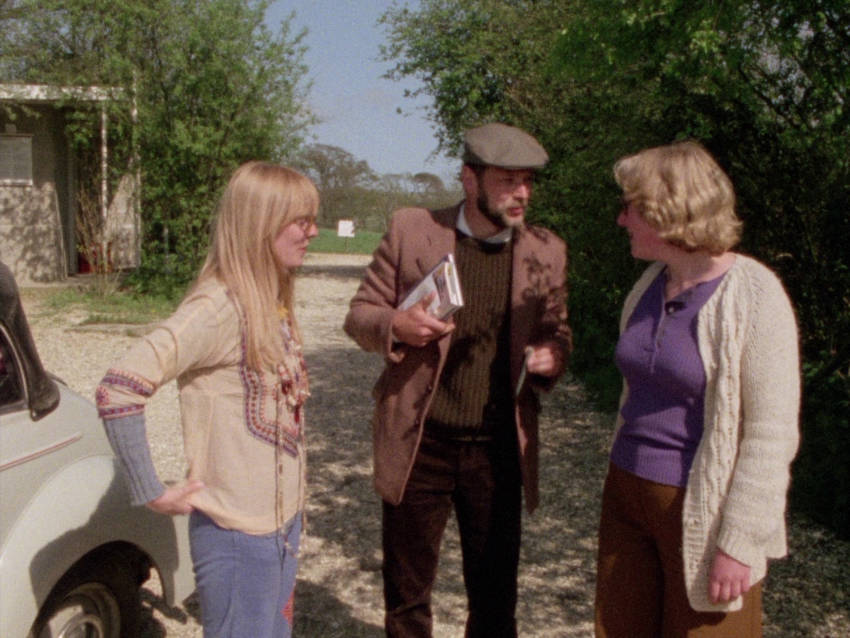
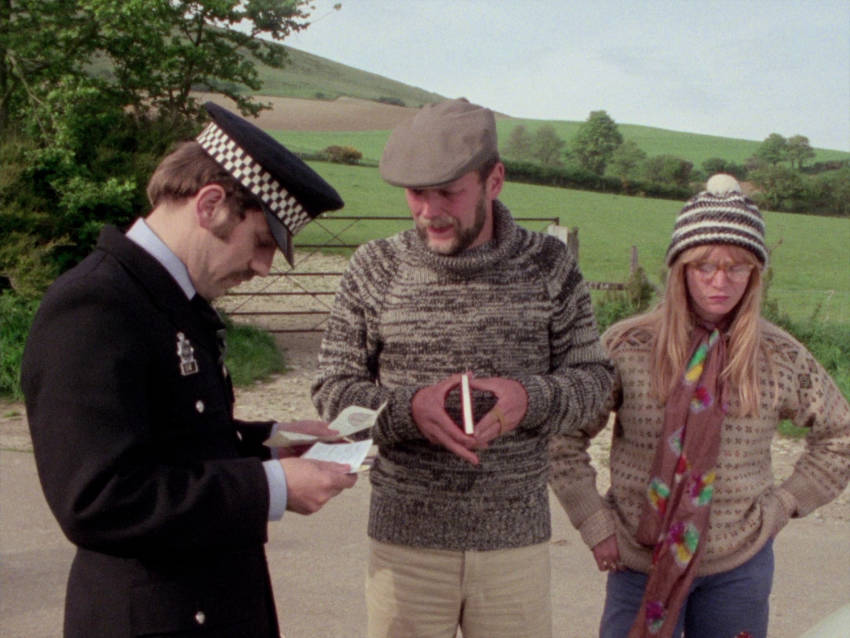
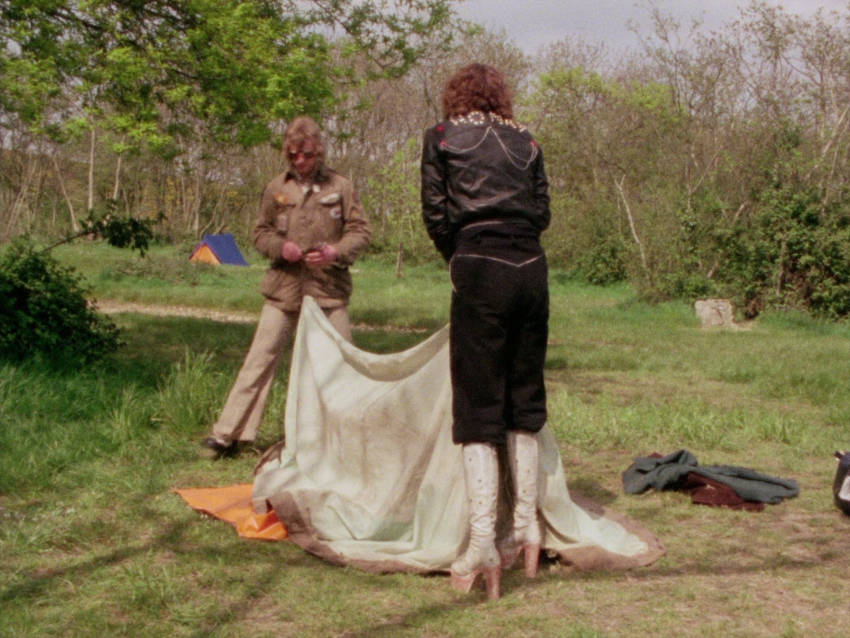
Nuts in May is one of Leigh’s funniest comedies. It was first broadcast as the twelfth of the sixth series of Play for Today on the decidedly unseasonal date of 13 January 1976. The Pratts (okay, not a subtle character name), Keith (Roger Sloman) and Candice Marie (Alison Steadman), are a Croydon couple on a camping holiday in Dorset. Leigh has a lot of fun at the expense of Keith’s tight-arsed control freakery and Candice Marie’s pixilated hippiedom, of two urban creatures entirely at a loss in the countryside. However, there’s a darker side to them and to this film, and it’s brought to the fore by some noisy neighbours, Ray (Anthony O’Donnell), who lies around smoking and playing his radio loud. The arrival of Finger (Stephen Bill) and Honky (Sheila Kelley), a biker couple from Birmingham, only adds to Keith’s spiralling frustration.
The film should be dated – it springs from some of the same 1970s concerns as the sitcom The Good Life, which began the same year it was made, 1975. Yet, Keith and Candice Marie’s vegetarianism and concerns about organic methods of food production, unusual to the point of being eccentric at the time, are now far more widespread.
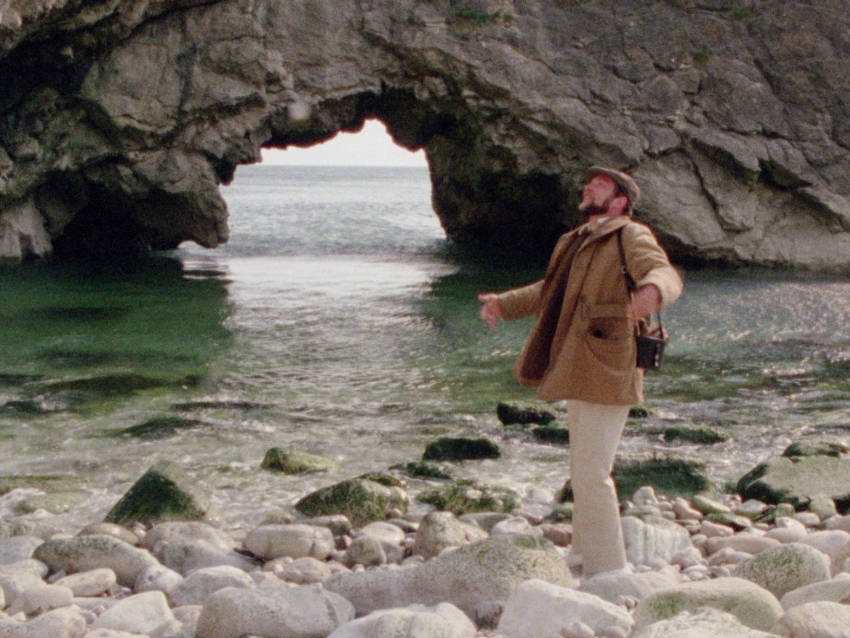
Nuts in May was Leigh’s third feature-length film and his second for television, following Bleak Moments in 1971 and Hard Labour, a previous Play for Today broadcast on 12 March 1973. The play isn’t as lightweight as it first appears, but it’s the first real example of mixing comedy with pathos in Leigh’s work, as its predecessors tended towards the bleak, even in the title of the first of them. It had its origins on stage, in the play Wholesome Glory, staged at the Theatre Upstairs at the Royal Court from 20 February 1973. That play was developed, as was all Leigh’s work, from improvisations and workshops with the cast, hence the “devised and directed” credit on his television work. Set in Keith and Candice Marie’s flat in Croydon, Wholesome Glory introduced the two characters, as well as Keith’s brother (played by Geoffrey Hutchings), who doesn’t appear in Nuts in May due to the actor’s unavailability but is bullied into joining in with “The Zoo Song” in the stage play’s second act. The film was commissioned by David Rose, a longstanding producer then based at BBC Birmingham, for which Leigh had made the first of his two Second City Firsts half-hours, The Permissive Society. Rose had a slot available for a film-shot Play for Today. He mentioned to Leigh that most of what he commissioned tended to be set in the industrial Midlands and North, so how about something set in Dorset, the county of his birth? Leigh took the opportunity to take his couple out of their comfort zone and on holiday. Whether Nuts in May was what Rose was expecting is a good question. The BBC’s regional structure enabled a wider range of filming locations (for example, Salford in Hard Labour, Oldham in The Kiss of Death(1977), Grown-Ups (1980) in Canterbury, Home Sweet Home (1982) in Hitchin and Four Days in July (1984) in Belfast) when his cinema films were often confined to London for budgetary reasons.
The story progression of Leigh’s work typically leads up to a major event around two thirds or three quarters of the way through, which results in a catharsis. In this way, the pain that his characters are in, and which Leigh is clearly empathetic with, is let out and there is the possibility of healing and a better future. Nuts in May is a more satirical work, with Leigh merciless at his protagonists’ expense – as he is in Abigail’s Party too – but the film does follow this pattern and we have a confrontation with two of the characters coming to blows and one left seemingly close to a breakdown. It’s the first major catharsis in Leigh’s work. Leigh has been accused of caricaturing the people in his work. That’s true in a number of cases, where his empathy clearly left him, most notably in Who’s Who (a later Play for Today, broadcast 5 February 1979) and High Hopes (1988). Keith and Candice Marie are just on the right side of this, as is Beverly in Abigail’s Party. Roger Sloman and Alison Steadman give pitch-perfect performances. Steadman, who had appeared in Hard Labour, had by then begun a relationship with Leigh which turned into a marriage. This lasted from 1973 to 2001 and produced two sons, the younger of whom, Leo Leigh, is now himself a film director.
It’s interesting to note that the Plays for Today which are now more celebrated, and indeed available to buy on disc or streaming, often had smaller viewing figures than others which are now much more obscure. That’s the case with Nuts in May, which attracted 9.44 million viewers on its first broadcast. That would be a stellar result nowadays, but the one the week before, The Other Woman, written by Watson Gould, had 10.71 million. That’s an interesting play in many ways, and is available to buy to stream, but it’s fair to say that it’s a long way from the best known Play for Today. It also beat John Mortimer’s Rumpole of the Bailey the week before, the basis of the later TV series, which had a mere 6.57 million. Others in series six of Play for Today which had eight-digit audiences included Trevor Griffiths’s Through the Night (2 December 1975, 11.67 million) and John Hopkins’s A Story to Frighten the Children (3 February 1975, 12.57 million). The same is true of Abigail’s Party, whose famously huge audience – due to one of the nation’s three channels, ITV, being on strike and, in Leigh’s words, “something highbrow” on BBC2 – was not on its original broadcast, when 9.09 million saw it, but on a repeat showing. However, Nuts in May has gone on to become the third most often repeated Play for Today, with Abigail’s Party in first place. (In between them is Jack Rosenthal’s Bar Mitzvah Boy.) Whether Nuts in May is Leigh’s best work is up to you – amongst his television films I’d pick the much less often seen Grown-Ups – but its place in it, and in British popular culture generally, is secure.
sound and vision
Nuts in May is released by the BFI on Blu-ray, a disc encoded for Region B only.
The BFI resubmitted Nuts in May to the BBFC for this release, and it retained the PG certificate it had previously had. However, the hard-of-hearing subtitles reveal one “fucking” in the dialogue at 66 minutes, and that was also the case with the transfer on the 2009 DVD in the Mike Leigh at the BBC set. Clearly the Board don’t watch English-language material with hard-of-hearing subtitles on. Strong language was almost never allowed in scripted TV drama in the 1970s, something that was only slowly beginning to change at the end of the decade, and this example is so muffled even now (let alone if you were listening through television speakers in 1976) that you can easily see that no one apparently noticed it. (The first official “fuck” in a Mike Leigh film was in Meantime in 1983.) On the other hand, discriminatory language can often be found in 1970s TV drama, even before the 9pm watershed, which can cause issues when it is repeated today. The transfer of Nuts in May begins with an advisory, “contains racist attitudes and language” – presumably the Irish joke Ray tells at one point. (Leigh admits that this would likely not have been acceptable in 2009 when he recorded his commentary, let alone now.) Meanwhile, The Chiffy Kids: Pot Luck is a U. The Country Comes to Town and Winter on the Farm were both U in cinemas on their first releases, and as they are documentaries have been exempted for classification on this disc, as have Spring Comes to England and Play Safe: Camping and Fishing.
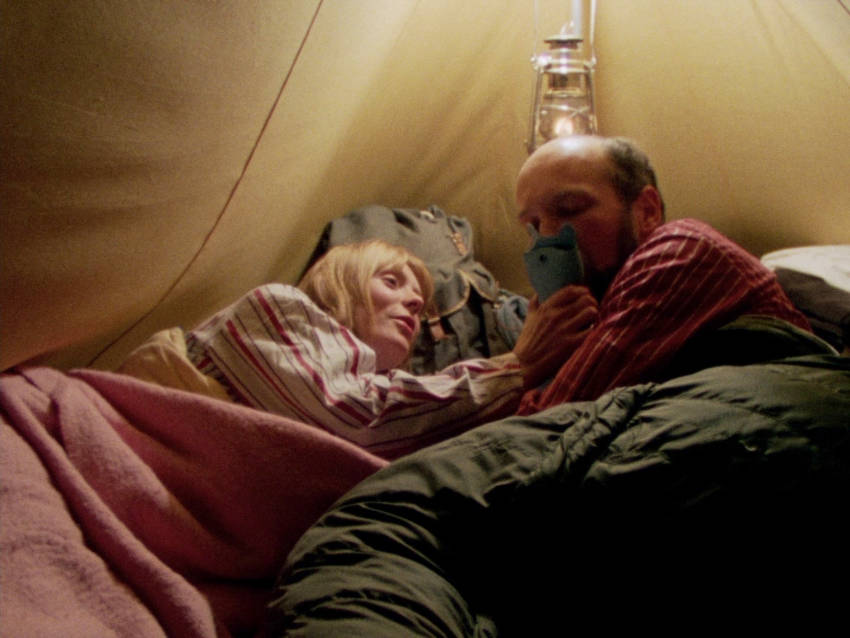
Nuts in May was shot in 16mm colour and the transfer is derived from a 4K scan of and restoration from the original negatives. The aspect ratio is the intended 1.33:1 and as the production was made for television then broadcasting in the PAL standard, it was shot at twenty-five frames per second rather than the cinema twenty-four. For that reason, the Blu-ray transfer is 1080p50. The film was shot in March, so not in the height of summer (1975’s was a hot one, if not as hot as 1976’s) but the colours are strong and the grain, inevitably there due to the 16mm origins, is natural and filmlike.
The soundtrack is the original mono, remastered from the master tracks and rendered as LPCM 2.0. Nothing untoward here, with dialogue and sound effects well balanced. There is no music score, with the only music being diegetic. English hard-of-hearing subtitles are optionally available for the feature and for Mike Leigh Remembers, and I didn’t spot any errors in them. Unlike the previous DVD, the subtitles here identify the track that’s playing on Ray’s radio when Keith and Candice Marie first meet him. (In case you’d like to know, it’s “Magneto and Titanium Man” by Wings, from the album Venus and Mars, which had recently been released – November 1974 – when Nuts in May was shot. David Hamilton makes an uncredited appearance as the DJ on the radio.).
special features
Commentary by Mike Leigh
This was recorded in 2009 for the six-DVD set Mike Leigh at the BBC. Given that only Nuts in May has been upgraded to Blu-ray, this set remains essential, as it contains almost all of Leigh’s work for the BBC*. Leigh’s commentary is very scene-specific and there are long gaps, noticeably when particularly well-known scenes are playing out on screen. This is an occupational hazard when two commentaries or interviews are recorded years apart, not intended to be on the same disc release as each other. So there is a lot here that’s conveyed more concisely in Leigh’s 2026 introduction. Some of it isn’t, so this commentary is worth a listen for that.
Mike Leigh Remembers…Nuts in May (14:34)
This item was made for BBC4 and broadcast on 10 January 2026, before a showing of Nuts in May in the current restoration. It’s a good overview of the film and its origins, with a still of the Wholesome Glory stage production, which is worth having. Some of this is inevitably familiar from other extras (an occupational hazard of disc curation, as I say above) but there is some that isn’t discussed elsewhere. One of those is the story where Candice Marie’s name comes from. The answer is that Leigh had a couple of dates with a woman in the 1960s and her cousin or sister (he doesn’t remember which) had just had a baby daughter who was named Candice Marie. So, to the now-middle-aged Candice Marie out there who might be watching, he gives his regards. He ends with his regret that he couldn’t end the film with an overhead shot Keith and Candice Marie standing on the penis and testicles of the Cerne Abbas Giant. Nowadays that would be routinely captured with a drone, but on the budget a balloon wasn’t possible, let alone a helicopter. But we get an overhead shot of the chalk hill figure, to show what might have been. You may want to watch this after Nuts in May, if you are yet to see it.
Director and Cast Q&A (43:34)
Playing, like the commentary, over the feature as a different audio track, this was recorded at the BFI Southbank in October 2021 as an introduction to and a Q&A after a showing of Nuts in May at that month’s Leigh retrospect. Leigh does comment about the short animated film shown beforehand, Winsor McCay’s How Mosquitoes Operate. After the showing, assembled on stage with Leigh are the entire principal cast: Alison Steadman, Roger Sloman, Anthony O’Donnell, Sheila Kelley and Stephen Bill. Leigh talks about the inception and production of the film, with the others giving anecdotes of the production. That included Kelley and Bill travelling to the location by motorbike, staying in character as Honky and Finger. Leigh says that his films have dummy titles during production, and this one was known as The Plastic Tadpole. He also wanted to call it Eaten by a Pig, for reasons you’ll have to watch the film to the end to find out. Questions from the audience follow at the twenty-eight-minute mark, from microphone stands at either side of the auditorium, a reminder that this was recorded at a time of social distancing due to Covid. We end with a rendition of the Zoo Song with the audience joining in, and by coincidence that’s the scene we’re at when the audio switches back to that of the feature.
BFI London Film Festival 2024 Screen Talk: Mike Leigh (48:02)
Mike Leigh sits down to discuss his career as his then-latest film Hard Truths is shown at the Festival. His interviewer is Amy Raphael, who is particularly well qualified for the task, as she is the author of one of the essential books on the filmmaker, Mike Leigh on Mike Leigh (2008, updated 2021), based on a lengthy interview with him. Leigh is open about difficulties his career is having. It was never easy, as pitches to financiers would be without a finished script or any title. At least with his historical/biographical films (Topsy-Turvy, Mr Turner, Peterloo) he could indicate the real-life people or events the film would be based on, but inevitably they would be more expensive to make. Amazon put up a lot of the money for Peterloo, his highest-budget film to date, but pitches to Netflix always drew a blank. Hard Truths was an intentionally smaller-scale contemporary work, but he does regret the lack of opportunities to make present-day films on a larger scale. Hard Truths was turned down by Cannes, Venice and Telluride, making Leigh think he had made a shit film (his words) but Toronto took it, to great acclaim.
Given that Hard Truths was his new film, there’s much talk about that, the film being inspired by a wish to work with Marianne Jean-Baptiste again in an acting capacity for the first time since Secrets & Lies. While going through his earlier films (in particular defending Naked against the charge of misogyny) he talks about his collaborators, particularly cinematographer Dick Pope, who had shot everything from Life is Sweet to Hard Truths and contributed considerably to the different visual styles of Leigh’s films, who was to die later in the month this talk took place. Thirty-five minutes in, questions are taken from the audience, which take the form of on-screen captions. As always at BFI screen talks and the like, there are extracts from some of Leigh’s films which are edited out for licensing reasons. We do see the clip from Naked, as that’s a film the BFI have out on Blu-ray, but you’ll have to imagine the extracts from Hard Truths, Secrets & Lies, Vera Drake and Another Year.
The Country Comes to Town (21:18)
As so often on a BFI release, included in the extras are archival items with no direct connection with the main feature but have a thematic one. In this case that’s all things rural England, beginning with this short documentary from 1933, directed by Basil Wright. It begins with setting out its stall with its vision of an English countryside between the Wars: quiet village streets, a pub, carts rattling across bridges. But this is a countryside changed by “101 revolutions” that visitors don’t see, scientific progress transforming the way it carries out its role. Made for the Empire Marketing Board, The Country Comes to Town looks at how the milk, vegetables and fruit make their way from the farms to our tables. Wright seems to have taken note of the works of Robert Flaherty and Alexander Dovzhenko in the way he films all this. This and the next item were co-produced by the great documentarian John Grierson, so maybe there’s something on him in this too.
Spring Comes to England (14:57)
A year later, made by the same organisation, directed this time by D.F. Taylor (who later became John Grierson’s brother-in-law), Spring Comes to England begins in the far-flung extreme of that country, the Isles of Scilly, where the warm climate favours the daffodils we see being picked. However, soon after we learn of how the threat of eel worm on the flowers can be combated. The flowers are picked, assembled into bunches, packed in crates on the way to Penzance on the mainland and after that the stalls in London markets. Meanwhile, Cornish farmers pick cauliflowers and broccoli, seaweed used as fertiliser. Lettuces thrive in the Lea Valley and inside Chislehurst Caves, mushrooms are grown all year round. All practices which go back centuries, kept up to date with the aid of science.
Winter on the Farm (14:22)
The two previous documentaries were shot silent, presented with music and a narration. Winter on the Farm, made in 1941 by the Ministries of Information and Agriculture, directed by Ralph Keene, adds some direct sound to the mix, with conversations likely staged for the camera between the farm workers we see. We’re at Upton Manor Farm in Uploders, Dorset, in what was the first of three farming films, which moved to other parts of the country for Spring on the Farm and Summer on the Farm. The production company, Greenpark Productions, was set up by Walter Greenwood, author of Love on the Dole. Winter on the Farm takes us through a day on the farm, part arable land and part grass, supporting sheep and cattle. The hundred and twenty of the latter produce eighty gallons of milk daily. Among those working are some land girls, who in another life before the War had been city shorthand typists. The cinematographer was Erwin Hillier who often shoots against the light, showing some of his moves a few years before his work with Powell and Pressburger.
The Chiffy Kids: Pot Luck (19:04)
The BFI’s dedicated Children’s Film Foundation releases are DVD-only, but every so often one of the films has a HD upgrade to become a Blu-ray extra. That’s the case with this one, which was originally on Bumper Box Volume 4 back in 2022. Other Chiffy Kids adventures have appeared in Volumes Five and Six. Serials formed part of the CFF’s repertoire, often short episodes being curtain-raisers to the main feature in the 50-60-minute range. The Chiffy Kids was not so much a serial as a series of brief adventures, twelve of them all told, of which this one, from 1976, was the first. In this case the main title is The Chiffy Kids with the episode title Pot Luck sharing a card with the writing credit. The song over the opening credits identifies the ensemble of three boys and two girls, the youngest and smallest of the latter being the one we allegedly all adore, called Magpie. Our five have adventures camping in the countryside, though I suspect parents would frown upon tying up Magpie and putting her in a cooking pot and dancing around it pretending to be cannibals. To get her revenge, she pretends to be a ghost. Adult interest is provided by Harry H. Corbett as Hungry Herbert, a farmworker who (boo hiss!) steals the children’s sausages.
Play Safe: Camping and Fishing (1:04)
From 1978, directed by David Eady, this is one of those public-information films which got away with content worthy of a horror film and served it up to a young audience. It’s in the form which goes back to the Lumière Brothers and L’arroseur arrosé, shown as part of their first presentation to the public in 1895 – anticipation followed by the expected outcome. Or not always – here we have two near misses but third time unlucky. Implied carnage ensues. So, children, don’t play near electricity pylons, Keep tent poles and fishing lines away from them, and especially the tall masts of boats, or you may not live to see teatime.
Booklet
The BFI’s booklet in the first pressing of this release runs to thirty-two pages plus covers. Preceded by a spoiler warning, it begins with an introduction by Mike Leigh, which begins by differentiating some very sensible vegetarians from a “pious, self-righteous, humourless, somewhat reactionary veggie faction”, epitomised by Keith and Candice Marie. This is an overview of the film’s making and Leigh is clearly bemused that a tiny low-budget TV film should still have a life fifty years later.
Next is “This Blessed Plot” by John Wyver, who begins by referring to Leigh’s comments in his 2026 introduction elsewhere on the disc. Wyver, a prominent television historian, places Nuts in May in the centre of a decade where British cinema was alive and well on television. Leigh wasn’t the only director who had made at least one cinema feature but who worked on the small screen for the rest of the decade and, in some cases, well into the next. (See also Ken Loach and Stephen Frears, for example.) Wyver tracks Leigh’s career from Bleak Moments, made mostly with money from Albert Finney’s company Memorial Films and a small grant from the BFI Production Board, via his stage work and his first being entrusted with a Play for Today film slot, namely Hard Labour. This is a more detailed piece on the making of Nuts in May than Leigh’s in the booklet, including details of Leigh’s method of taking the work shaped with his cast in improvisations and producing a final script which is what is then shot, though he did make some use of some of the locations, such as Corfe Castle. He also compares Nuts in May with other back-to-the-land television of the time, not just The Good Life but also the post-apocalyptic Survivors, which also began in 1975. The notion of English character being rooted in its landscape and rural values has a long tradition, which Nuts in May is a part of. The play was edited to its present eighty-one minutes and broadcast, though a since-lost two-hour workprint version was shown during a Leigh retrospective at the then National Film Theatre in 1993. It’s quite possible that, with a greater acceptance of vegetarianism and a greater awareness of climate crisis, that Keith and Candice Marie might be seen more sympathetically nowadays.
“Back to the Land in Nuts in May” by Dr Adam Scovell points out that Nuts in May, while on the surface more light-hearted than other Leigh works, asks more pertinent and still relevant questions than they do. Scovell adds that Nuts in May is not the simplistic view of the countryside curing urban ills that many took it to be, but that social pressure is let out in the open air, the five principals all being urban dwellers. The darker side of rural parts is visible in other notable television films, such as Jonathan Miller’s M.R. James adaptation for Omnibus, Whistle and I’ll Come to You (1968) and John Bowen’s proto folk horror Robin Redbreast (also a Play for Today, from 1970) and later examples such as David Gladwell’s Requiem for a Village (1976) and Ben Wheatley’s 2012 film Sightseers as well as in literature. Maintaining a rural way of life is the result of much toil, as shown in other films like Kevin Brownlow and Andrew Mollo’s Winstanley (1976) and Peter Hall’s Akenfield (1974). This is a more thematic take on the film, complementing the other two pieces.
The booklet also includes credits for the special feature, with notes on The Country Comes to Town by Scott Anthony, Spring Comes to England, Winter on the Farm and Play Safe: Camping and Fishing by Ellen Cheshire and The Chiffy Kids: Pot Luck by Vic Pratt.
final thoughts
Nuts in May is one of the two big beasts among Mike Leigh’s television work, the other of course being Abigail’s Party. They are the two which have had the most impact on his career and on popular culture as a whole, though as I say above, there are others equally as good if not better which should not be neglected. As Abigail’s Party was his only feature-length TV work shot on video, it’s Nuts in May which was the best candidate for a high-definition upgrade, which it has now received. With some very informative extras (and make sure you get one of the first pressing, with the booklet) it’s an essential release from the BFI.
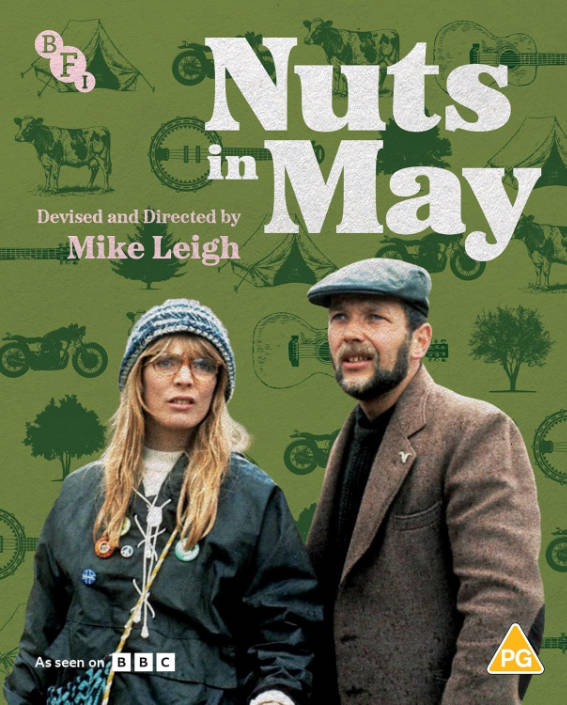
Nuts in May
UK 1976 | 81 mins
devised and directed by: Mike Leigh
cast: Roger Sloman, Alison Steadman, Anthony O’Donnell, Sheila Kelley, Stephen Bill, Richenda Carey
distributor: BFI
release date: 17 August 2026