
Stavisky…
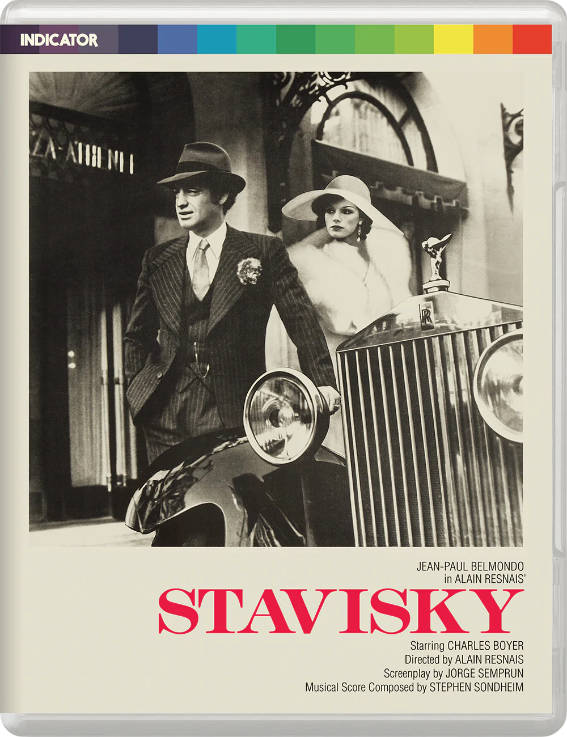
Alain Resnais’s 1974 film about a real-life swindler who became headline news, STAVISKY…, is released on Blu-ray by Indicator. Review by Gary Couzens.
Stavisky… (with an ellipsis in the title, of which more below) was Alain Resnais’s sixth feature film. It followed the longest hiatus in his career, six years after Je t’aime je t’aime (1968). It was written by Jorge Semprún, who had previously written The War is Over (La guerre est finie, 1966) and so became the first writer to work with Resnais twice. It’s also the first of Resnais’s features with a factual basis, though in many ways it covers familiar Resnais ground.
This film may be based on fact, though as the opening caption says, not always rigorously. You could say it prints the legend. But those real events would have been assumed to be known by the audience at the time of release, many of whom would have been old enough to remember the real Stavisky. So this review contains spoilers. If you haven’t seen the film before, you can skip to the sound and vision section and come back once you have.
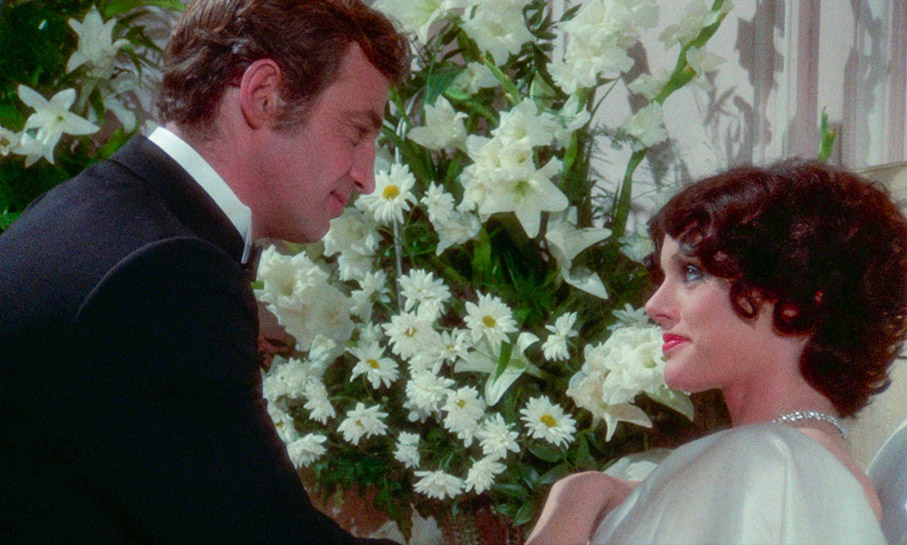
Serge Alexandre Stavisky (1886-1934), was Jewish, born in Slobodka, then in the Russian Empire, now in Ukraine. He moved with his parents to France. Working a variety of jobs, he eventually ran a chain of pawnshops and financed them by selling bonds which turned out to be worthless. His attitude seems to have been that you had to put on a front to attract those likely to finance you, and he lived largely on credit. He was first put on trial for fraud in 1927 but was bailed nineteen times. He had friends in high places, including Prime Minister Camille Chautemps, and the breaking of the Stavisky Affair at the end of 1933 had serious implications for his Radical-Socialist government. The resulting scandal was headline news, and was covered in the British and American press. Stavisky fled from the police and was found dead in a chalet in Chamonix on 8 January 1934, having apparently shot himself in the head. There was speculation that Stavisky had faked his death and lived on, but this remains a conspiracy theory and Stavisky would now be long dead whenever he actually died. Resnais’s film is not the first version of this story. Hollywood tackled it in 1937 as Stolen Holiday, with Claude Rains in the lead role, here renamed Stefan Orloff, with Kay Francis as his wife. In that version, Orloff/Stavisky was shot by the police who made the death look like suicide. The BBC Home Service produced a radio version of the story, called simply Stavisky, broadcast 1 August 1967, with Martin Starkie in the title role.
That paragraph is undoubtedly spoilery for Resnais’s film, but some knowledge of the case is useful, especially now when Stavisky and his activities are more than ninety years in the past. The film does assume such knowledge and there aren’t any captions to orient us in time and place, other than some on-screen signage for the latter. The majority of the film takes place in the last six months of Stavisky’s life, and we know it’s 1933 from the cheque Stavisky writes ten minutes in. Resnais’s characteristic use of time, which leaked into mainstream cinema into the 1960s (and is still there – see many of Christopher Nolan’s films, for example), is to the fore here. A more-or-less linear six months is punctuated with flashbacks to Stavisky’s youth and his arrest and trial, which resulted in his father’s suicide due to the family dishonour. Some of these flashbacks are narrated by other participants, because we also have flashforwards to the parliamentary enquiry following Stavisky’s death and to his funeral. Also in the film is a subplot, three scenes at the beginning, in the middle and near the end, of Leon Trotsky (Yves Peneau) who arrived in France seeking political asylum. This is tied in to the main story at the end when the Stavisky scandal highlighted the man’s being a Ukrainian Jew and a confidant of the left-wing government. This made Trotsky’s position, under orders not to engage in political activity while resident in France, untenable and he was expelled. He relocated to Norway and then Mexico, where he was assassinated in 1940.
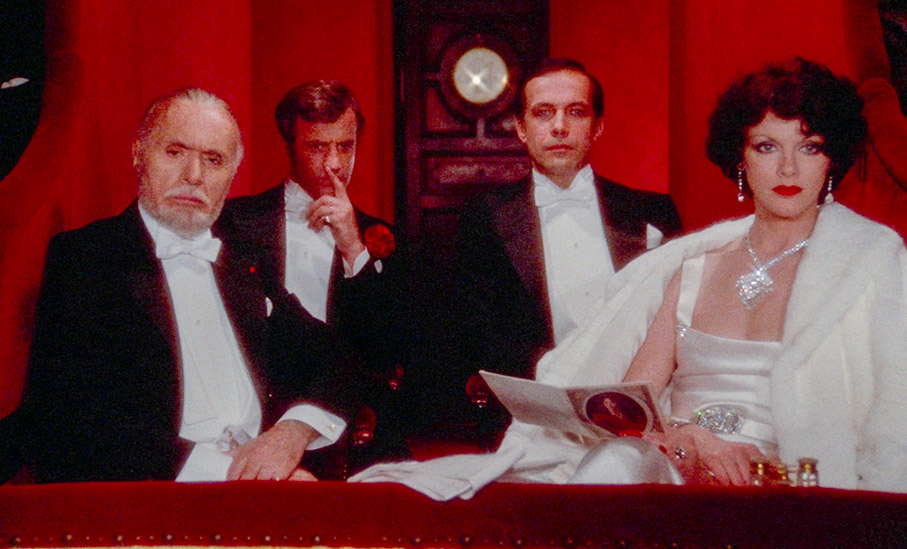
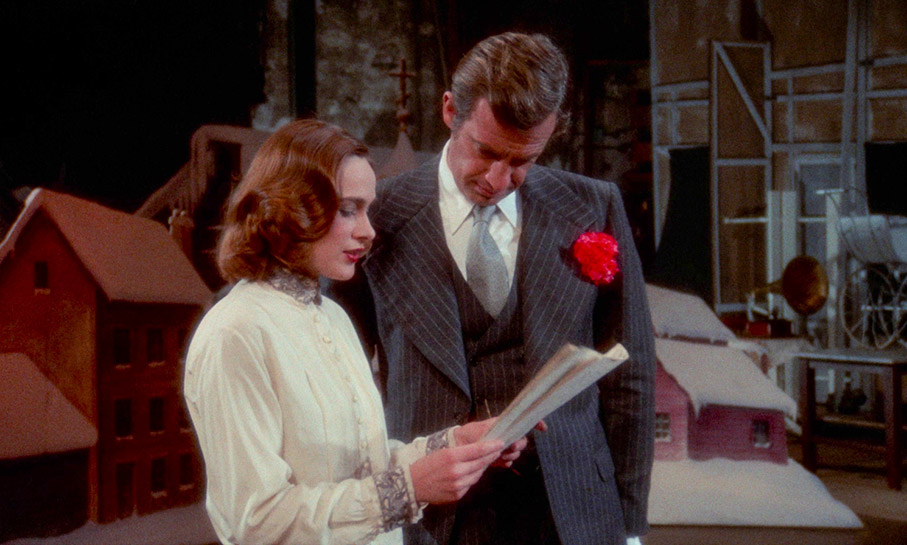
Stavisky was clearly a charismatic individual, and that comes across in Jean-Paul Belmondo’s performance in the core narrative, even if he doesn’t physically resemble the actual man. The main narrative shows him, using the name Serge Alexandre, as a “financial consultant” but also a money-launderer, his work as a theatre manager and a gambler and his generally extravagant lifestyle. With him is his wife Arlette (Anny Duperey), her beauty being yet another bargaining chip for her husband. Stavisky… does require close attention but still holds us for the nearly two hours it’s on. Charles Boyer was another actor Resnais had wanted to work with. Gérard Depardieu, who would later work with Resnais in lead roles in My American Uncle (Mon oncle d’Amérique, 1980) and the English-language I Want to Go Home (1989, and one of the director’s least successful works) has a small role as an inventor Stavisky impulsively finances. The film also has the distinction of being one of just two feature films with an original music score by Stephen Sondheim. (More anpiy that in the Sondheim interview on this disc.)
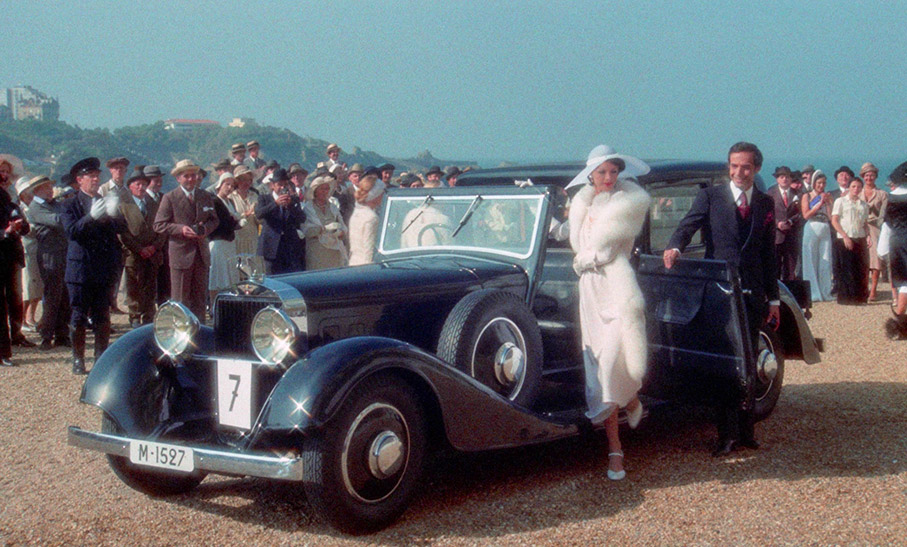
The project began with Belmondo and Semprún, with Resnais coming on board. Resnais, who had seen a waxwork of Stavisky in a museum as a child, saw the potential of the idea, with Stavisky as an actor and role-player. As he admits in his interview on this disc, Resnais was a formalist, with narrative structure and form an important part of his work, said form varying from one film to the next. The film was shot in the autumn of 1973 with locations in Paris and Biarritz. Visually, Resnais and his cinematographer Sacha Vierny took inspiration from the films of the period where the film was set. That doesn’t mean Academy Ratio black and white (no doubt uncommercial in the mid 1970s), as the 1930s was the decade where three-strip Technicolor came to be, with the first feature in the process being Becky Sharp in 1935. Vierny had been a regular Resnais collaborator, and Last Year at Marienbad (1961) was a particular showcase for his camerawork, in that case black and white Scope. His cinematography here is a standout, going for particularly saturated colours, especially blues and reds, the latter featuring significantly, even in Arlette’s lipstick. (Blue was the colour that was added to the three-strip Technicolor palette. The earlier two-strip version didn’t register the colour well, so cinematographers, production and costume designers generally avoid it.) Going by the shots of the clapper board in the stills gallery here, the film was known as Alexandre during production. Resnais’s preferred title was Biarritz-Bonheur, after the luxury department store seen in the film, However, the distributors insisted on the title Stavisky. As a compromise, the ellipsis was added to the title, intended to suggest that the film should not be taken as a strict history.
Stavisky… premiered at the 1974 Cannes Film Festival in competition. The Palme d’Or went to Francis Ford Coppola’s The Conversation, though Stavisky… was given a special mention for Charles Boyer’s performance. He also won Best Supporting Actor by the New York Film Critics’ Circle. Amongst the film’s fans was the late Monte Hellman who included it in his top-ten list for the 2012 Sight & Sound poll. In the UK, Stavisky… was shown on BBC2 on 18 May 1975 in its Sunday Cinema slot, four days before the film opened at the Curzon Cinema in Mayfair, London, an unusual but not unique occurrence.1 After six years away from the big screen, Resnais was back in the saddle, and just three years elapsed before his next film, his first in English, Providence.
sound and vision
Stavisky… is spine number 483 of Powerhouse’s Indicator series, a Blu-ray encoded for Regions A and B. The film had an A certificate in 1975 and for homeviewing it is a PG.
The film was shot in 35mm colour and the Blu-ray transfer, derived from StudioCanal’s 4K restoration from the original negative, is in the intended ratio of 1.66:1. As I mention above, Sacha Vierny’s cinematography is excellent, and this transfer preserves the strong, intentionally saturated colours. Grain is natural and filmlike.
The sound is the original mono, rendered as LPCM 1.0. Nothing to report here: all well and good, with dialogue, sound effects and music well balanced. English subtitles are optionally available for this French-language film, on by default on the feature and all the Francophone extras.
special features
Pour le cinéma set report (15:31)
This is an extract from the French television programme Pour le cinéma, broadcast on 15 May 1974, the day of the film’s premiere at Cannes. The extract is in black and white, presumably (from the scratches) a film telerecording of a colour video original. Please note that the 1930s still photographs include one of Stavisky’s corpse. Charles Boyer is interviewed and he says that he met Stavisky at the time, but only heard of the scandal in the American press when he was working there. Jean-Paul Belmondo says that he had studied Stavisky before playing the role and emphasises that they are filming the official version, as there were conspiracy theorists speculating that Stavisky was still alive. (He’d have been eighty-seven when the film was released.) Although we see Resnais on set, oddly when he’s interviewed it’s voice only over behind-the-scenes footage. Contradicting Belmondo a little, he emphasises that his film is about the myth and the legend.
Cinéma set report (4:30)
Also from French television, and again a black and white telerecording of a colour original, this dates from 1973 and the time of the film’s production, and interviewees here are Resnais, Belmondo, Boyer, Duperey and François Périer. Boyer says that he met the real Stavisky once and heard about the scandal in the newspapers when he was in the USA, showing that the affair was international news at the time. Belmondo has read about Stavisky and he emphasises that in this film they were showing the official version – that Stavisky was dead and hadn’t lived out the rest of his life in obscurity. Resnais rather contradicts this by saying that his approach to the subject was to film the myth and the legend, and he couldn’t think of anyone except Belmondo to play him.
Location report (5:09)
Another short item, this one again from 1973 during the shoot, broadcast as part of the French news programme JT Acquitaine, in colour this time. This has behind-the-scenes footage of the shoot on the Concours d’Elegance, recreating the event which took place on that very spot forty years earlier. For those unaware, the narration gives us brief details of the Stavisky case. Belmondo is interviewed, saying that the film is “more romantic than realistic”.
Interview with Anny Duperey (2:49)
A very brief interview with the actress, shot in a Cannes cafe as she eats what looks like a gateau, shot from behind the (unidentified, female) interviewer. This was Duperey’s first Cannes for a film she was in, though she had visited the festival before. This was broadcast, again on the day of the premiere, for the television programme Couleurs du festival de Cannes.
Cannes press conference (5:07)
And after the premiere, the press conference, featuring Resnais and Belmondo. At first, Resnais’s comments aren’t in synch with the picture, though this changes later on. Belmondo says seeing his image projected on screen is something he finds unpleasant, so therefore he must spend his life doing unpleasant things. Resnais said that he had only recently seen the finished film himself, so it was unusual for him to have done so without anyone else’s reactions to it.
The Guardian Interview with Alain Resnais (86:25)
Resnais is interviewed at the National Film Theatre on 26 October 1980. This took place during the London cinema run of My American Uncle, which meant, says the (unidentified, male) interviewer to the audience at the start, that they couldn’t show any clips from it. They would have needed a 35mm print to do that (those were the days) but there were only two of those in the country and both were required for showing at the Academy Cinema in Oxford Street. So they had to make do with the trailer instead. Resnais could speak excellent English but opts to talk in French, with the interviewer translating for the audience. After seventeen minutes of conversation, and that trailer (edited out of this recording), the rest of this is devoted to questions from the audience. Given that My American Uncle is the brand new Resnais film, much of the interview is devoted to it, beginning with Resnais’s meeting with Dr Henri Laborit, who appears at intervals in the film expounding his theories of human behaviour, which the fictional parts of the film are meant to illustrate. Resnais says he doesn’t like any of his own films, only seeing the mistakes when he watches them. Given the difficulty of some of his work, he says that he always sets out with the public in mind, and isn’t wilfully obscure. If we didn’t know already, he says that he is very much a formalist, and form and structure are very important to him. Stavisky… comes up at sixty-one minutes. Resnais’s reading of the man was that he had a fear of death and growing old and his undoing was due to being unable to accept that. One of Resnais’s motives for making the film was to work with Belmondo and Boyer and to collaborate with Stephen Sondheim.
The Guardian Interview with Stephen Sondheim (103:53)
In the same venue nearly seven and a half years later, 19 February 1988, Stephen Sondheim talks to a different unidentified male interviewer. This is introduced by a clip from the “Gee Officer Krupke” song from West Side Story (edited out of this recording), showcasing Sondheim’s lyrics. However, he doesn’t think the film works. He also isn’t kind to Richard Lester’s 1966 take on A Funny Thing Happened on the Way to the Forum, based on Sondheim’s stage musical, feeling that Lester threw away the plot with his emphasis on throwing in as much farcical material as he could, being “all about style”. Sondheim’s introduction to filmmaking was spending time on the set of Beat the Devil during its Italian shoot. However, his initiation to all things cinematic was seeing Snow White and the Seven Dwarfs at age seven and later catching up on a lot of foreign cinema on cable channels. He wrote only two scores for films not based on his own work, and Stavisky… was the first, due to Resnais calling him after seeing Follies on stage. Sondheim wrote his score to a reel-to-reel tape recording of the film. His other score credit, Reds, also came about from a call from Warren Beatty, though he wasn’t able to complete work on it, so he is co-credited with Dave Grusin. Questions from the audience begin at fifty-five minutes. While Sondheim and the interviewer are clear enough on this recording (maybe not to the audience – a man tells Sondheim to “speak up” at one point), as so often that’s not the case with the audience, but the interviewer does fill in as necessary. Sondheim does say that he writes musicals for those who don’t like musicals. In answer to a question as to why he doesn’t orchestrate his own musicals, he says that time is the issue and he doesn’t know enough anyway.
Theatrical trailer (2:40)
The original French trailer, which presumably played in British cinemas which would show the film. For the latter, it’s clearly pitched at an arthouse audience the film would have received, not being afraid to have a fair amount of subtitled dialogue.
Image gallery
Fifty-five images, advanced via the NEXT button on your remote, not self-navigating. They include publicity and production stills (mostly colour, some black and white), costume design sketches, British lobby cards, posters and a synopsis.
Press kit gallery
The French press kit, in seventeen images, two pages per image, with one page noted as missing.
Script gallery
The dialogue and spotting list, in fifty-six images, again two pages per image.
Booklet
Included with the limited edition of this release, the booklet runs to thirty-six pages including the covers. Unusually there is no new essay here, the lead position taken by “Stavisky… Production Stories” by Jonathan Rosenbaum, derived from pieces in Sight & Sound and Film Comment from 1974 and 1975 respectively. This is inevitably of the moment, as is based on Rosenbaum’s visit to the production and his interviews with some of the participants. Jorge Semprún is quoted as saying that the film’s mood would be more Lubitsch than Losey – the mind boggles. Semprún also says that the film’s construction is relatively simple, no flashbacks, one flash-forward…actually there are more of both than that. It was the most expensive film Resnais had made to that point, largely due to the period/historical setting, even though Jean-Paul Belmondo put up much of the budget. Rosenbaum observes Resnais at work and it’s clear that – unlike Hitchcock, say – he doesn’t preplan that much, as both Resnais and Semprún anticipate things which are not borne out in the finished film.
“Stephen Sondheim and Stavisky…” is an unsigned profile of the composer and lyricist and his work in cinema, which included an Oscar for “Sooner or Later (I Always Get My Man)” for Warren Beatty’s Dick Tracy (1990). The piece begins with his stage career, which won him eight Tony Awards (a record for a composer). The essay draws on various sources, including a contemporary interview with Resnais about his choice of Sondheim for Stavisky… He recalls that Semprún said that he (Resnais) wanted to make a film with Belmondo and Boyer with music by Sondheim and didn’t care what it was about – an exaggeration, says Resnais, but with some truth to it. The piece also draws on Jonathan Rosenbaum’s set report with a quote from the director over his choice of composer. Resnais also said that some scenes were conceived with Sondheim’s music in mind. Finally, we have a discussion of the score itself by musicologist Roger Hickman.
Next up is Indicator’s usual summary of the contemporary critical response to the film. It seemed to have divided the critics. Philip French was mixed, but Derek Malcolm were very much positive. Pauline Kael was in the anti camp, as were most French critics. Also quoted is Resnais’s reply to some of them. The booklet also features plenty of stills.
final thoughts
Stavisky… was no doubt greeted with some anticipation at the time as it had been Resnais’s first feature film in six years. With hindsight it falls into the middle rank of his work. Some knowledge of the case and the period would be of use – which is why I’ve included it in this review, at the risk of spoilers – but without it the film makes demands which may or may not be paid off in the nearly two hours it takes to watch the film. There’s no doubt about the quality of the presentation of Indicator’s release, including the extras on the disc and in the booklet.
Stavisky…
France / Italy 1974 | 120 mins
directed by: Alain Resnais
written by: Jorge Semprún
cast: Jean-Paul Belmondo, François Périer, Anny Duperey, Michael Lonsdale, Roberto Bisacco, Claude Rich, Charles Boyer
distributor: BFI
release date: 20 July 2026
related reviews (directed by Alain Resnaus):
- Other examples from the 1970s of films broadcast on television before, or simultaneously with, their cinema release, include Peter Hall’s Akenfield (simultaneous ITV broadcast and cinema release on 25 January 1975), Philippe Mora’s documentary Brother, Can You Spare a Dime? (world premiere on BBC2 on 23 March 1975, cinema release 27 March), Eric Rohmer’s The Marquise of O… (on BBC2 on 23 October 1976, its opening Saturday in cinemas) and John Carpenter’s Dark Star (broadcast on BBC2 on 29 December 1977, cinema release 23 February 1978 – two weeks before the release of Assault on Precinct 13, as it happened).[↩]