
Cornish patsies
Putting (or not in his case) the ‘sync’ in idiosyncratic, director Mark Jenkin is a filmmaker who still shoots on film with a clockwork camera from the 1950s. His work is unmistakable and unique. Camus celebrates the medium as much as his ROSE OF NEVADA and suggests that Jenkin is cinematically something quite extraordinary.
“If you’re going to make films, you need to feel passionate about it. When I went back to shooting film I was like a teenager again, writing, directing, doing camera, sound. I had to take complete control over everything.”
Interview with writer/director (and a few more titles besides), Mark Jenkin1
Mark Jenkin, forgive my audacity, is not only a man and not only a filmmaker. He is a genre. And his genre is as far from generic as any filmmaker can be. A bold statement? Let me present my case.
I too made short 8mm films as a teenager and cut them with rudimentary kit. Nothing was more exciting than the potential of unexposed film. I was, and still am, obsessed by film and filmmaking. Frequent visitors to this site may have noticed. In 1983 I began my professional film career as a trainee assistant editor at the BBC and developed a profound love of 16mm film. The TV films I worked on were almost never projected and were laboured over on a pic-sync, a device with a screen a hair’s breadth over the size of a pack of cards. Little better was the soft but larger picture on the screen of a flat-bed editing table called a Steenbeck. The finished programmes were shown on standard definition cathode ray tube TVs having locked in and mundanely discarded a level of intrinsic detail that only arc-light projection could coax into view. Often seemingly unsharp on normal TVs at the time, it was only through projection that the promise of high definition from 16mm celluloid was evident. I was also passionate about 35mm. What film nut wouldn’t be? The most common photochemical photography offered 35mm film cannisters of 24 and 36 frames. In movie terms, that’s a second and a second and a half. 35mm, of course, was the go-to format of the movies, light years beyond my reach except for still photography. Those who worked with the smaller 16mm gauge nicknamed 35mm ‘stair carpet’ and those who worked with the standard movie gauge called 16mm ‘shoe laces’… I once had to use a 16mm shot scanned into a 35mm film and as long as the shot was correctly exposed, it stood up on its own merits, technically and artistically.
To see a standard Academy aspect ratio film (1.37:1) in 2026 shot on 16mm with all the sparkle, grit and dust proudly preserved in the digital wrapper in which it was inevitably distributed, was an extremely potent and intensely personal pleasure. Jenkin even kept in some flare outs, sprocket invasions and flash frames. Tsunamied by digital formats and resolutions in the modern filmmaking environment, you generally tend to forget the level of detail contained even in a single frame of 16mm which clearly and happily will settle into a high definition transfer and may even surprise us further in a 4K iteration. The colours are so vibrant, the image exhibits only a hint of grain, and the inherent softness of film is so present and oh so correct. It’s soft in the sense of ‘a feel’, having rounded edges rather than ‘out of focus’ bokeh2 softness. This aspect is the very essence, the DNA of celluloid. As digital cinematography crept past photochemical in the second decade of the 21st century, people in the know used to say “If you want the look of film, shoot it on film.”
From the evidence, it seems that Jenkin adores 16mm even more than I do. Shooting 16mm in the manner that has become the director’s trademark, means no useable sound is recorded. The classic Bolex camera’s clockwork mechanism is too loud for that. So just like the Italian filmmakers of the 50s and 60s, sound comes way after actual production although the Italians weren’t as post-sync disciplined as Mark Jenkin. I would have thought the actors would be recorded as reference for the ADR (automated dialogue replacement) sessions but it seems that Jenkin records himself performing the lines on the first assembly just to get the rhythm of the piece in place.
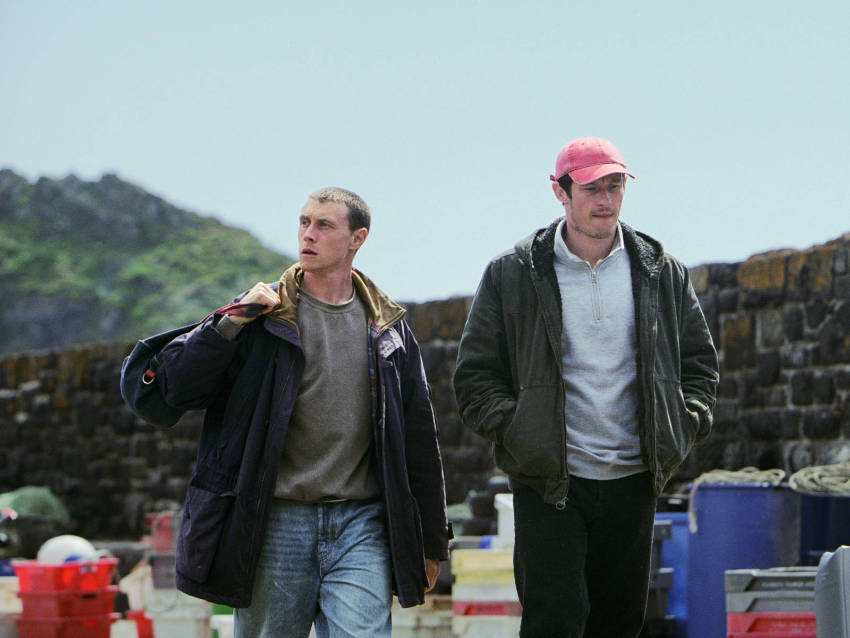
The first shot of Jenkin’s film brought a huge smile to my face. The quality was all I’d hoped for and its apparent sharpness was almost shocking. I knew I was sitting quietly alone with a truly cinematic work of art and just overjoyed to be in its company for a few hours… I have no knowledge of what level of digital alteration of the image took place in post if any but if Jenkin is as authentic as he seems to be, it was probably graded the ‘old-fashioned’ way if ‘colour timing’ is even practically possible nowadays. Apparently, his footage was pushed to its very limit in terms of the colours it could reproduce. This is evident from frame one.
Rose of Nevada starts with a series of shots, mundane in subject matter but with an evocative central idea forming through the images’ cumulative effect. Have you ever walked on a beach or around a harbour of a fishing village? Invariably you’ll find discarded buoys, protective rubber tyres which once kept a boat’s flanks free of stone quay impact marks. You won’t have to look far to discover discarded netting, old rusted pulleys and, half locked and buried in the sand, rusted hulls and hulks of boats long since worn smooth by the elements. The one element of Jenkins’ extraordinary film that courses through this first bright and colourful sequence, is quite invisible… But you really feel it. It is time. The phrase to ‘weather the storm’ suggests survival, an ability to bear hardships with fortitude. Jenkin presents weather and time as an inevitable partnership and how these natural, all-powerful forces can dismantle and ossify what was once vital to people’s livelihoods. In this milieu of sharp, sea-scented imagery sits a boat with telling evidence of being rapidly abandoned. A photo of a loved one is cellotaped to one of its flimsy walls, the cramped living conditions, ruffled and sparse. There’s rust and wear but there’s also a name plate, the name of a fishing vessel lost at sea thirty years ago and somehow it has returned to the small Cornish village whose inhabitants were traumatised by the loss of two lives connected to the disappearence of the vessel. Ironically and tragically, you could say the place is drowning in grief. What was once a bustling fishing town with full to bursting pubs and a shining white fronted Post Office, is now a ghost town, run-down, mostly derelict and populated by a sparse number of villagers who’ve remained and retained, woven through their lives, the impact of the tragedy. The name of the boat is Rose of Nevada.
Sensing a profitable opportunity with another damaged but repairable boat available for fishing duties, two men are drawn to this small, battered 30 year-old relic. Nick is married and trying to provide for his wife and young daughter while his small, sea-salt corroded house is falling to pieces. The other is Liam, an itinerant homeless labourer looking for work to offset the aimlessness of his life. They join an experienced fishing captain staying at sea for days maximising their catch and return to the village which has undergone a startling transformation. Now well populated, lively and full of hope and small town ambition, this once pitiable place, so crushed by communal grief, is now urgent and alive. Nick and Liam don’t quite understand where they now find themselves. It’s the same town but 30 years ago, before the deaths of the two men ripped the heart from its chest. Unknowingly, Liam and Nick suddenly find themselves to be incarnations of the dead men and while one accepts the new/old reality, the other rebels. Nick, like any sane man, cannot bring himself to believe his overwhelmed senses.
A full synopsis, in this film’s case, is not helpful. For Rose of Nevada, less is infinitely more. The exquisite joy of the film is not so much connecting the dots of the surrealistic and supernatural narrative. It’s holding those dots in your mind and waiting for signposts and pay offs to reveal themselves. It’s like unbidden thoughts evoked by a gifted filmmaker, many of which fire simultaneously as if your mind is suddenly in tandem with the artist’s own. There’s a word for this experience.
Cinema.
We get plenty of mystery and unresolved events which can sometimes be explained by dreams or hallucinations but no such hoary, clichéd idea containers are needed. This film shouldn’t make sense, it should feel sense. It’s an emotional work that defies logic on its own terms but with undercurrents of profound grief and loss and the effect time has on those affected. As human beings we have very different responses to time and can often be brought up short by facts which feel impossible. Sharks were swimming in the world’s oceans before Saturn had its rings. But my favourite example of how we distort time in our minds is that Ghostbusters is as far from the reign of Adolf Hitler as we are now from Ghostbusters… Rose of Nevada is a film about time, our responses to time and the inbuilt examination of time that the filmmaker believes is only available to the primate known as ‘homo sapiens’. At this time in our evolving history, the Latin for ‘wise man’ needs some serious updating. Despite the size of our brains, we’ve lost our collective wisdom along the way and being led by ‘homo narcissisticus’ isn’t helping. From one Republican elephant to the real thing… While pachyderms may have a working memory, zoological studies, to my knowledge, have not been able to prove that any other living creature has a relationship with time as we have. As Jenkin says in that Sight and Sound interview, “Humanity’s greatest gift is that we can jump around in time. We’re really the only living thing that can do that which is probably our biggest curse as well… …I think we had to invent cinema to try and make sense of the way our minds worked. That’s what cinema can do so beautifully.”
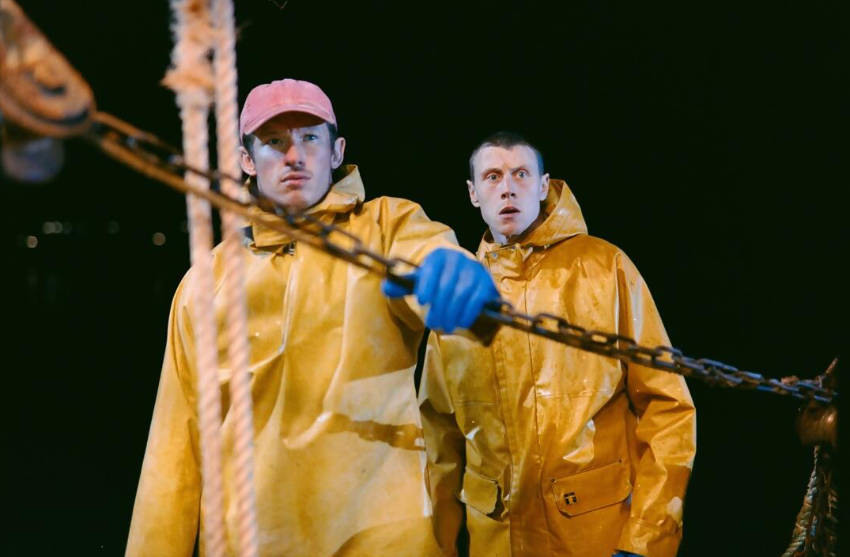
Nic Roeg would have loved Mark Jenkin.
The small cast are indistinguishable from the parts they play. That’s as it should be. George MacKay plays Nick, the anxious family man whose attempts to fix a hole in the roof fail to the nth degree. As he falls through the tear, boot clumping (upside down? Go with it) into the kitchen, you think back after having seen the film and you start to recall your science fiction lore, a rip or tear in the fabric of time. I have not stopped thinking about the film or its rich imagery and possible meanings and it’s been four days now. Nick is a loving but concerned husband who always seems to be anxious and fearful of what’s coming. The homeless Liam, on the other hand, is gifted a purposeful life by his new circumstances. He now has a wife, (played by Slow Horses’ Rosalind Eleazar) and a young daughter whom he met as a 35 year old just yesterday. Liam goes with the flow. Nick swims against it. The mysterious multi-named fishing captain, played by Francis Magee, seems to exist in both worlds alarmingly easily. With a thin clamped rollie forever in his mouth and wearing a traditional smock and flat cap, he’s everyone’s image of a salty Cornish sea-dog but he’s a good mentor to the boys who soon get the hang of gutting, icing and stacking the catch. Jenkins’ partner, Mary Woodvine, plays the older and younger Mrs. Richards, the former still traumatised by the loss of her son and the latter, the hopeful mother whose son in her reality is refusing to acknowledge that reality. And no Jenkin film would be complete without the participation of Bait’s and Enys Men’s Edward Rowe. In Nevada, he plays Mike, the owner of the titular vessel whose decision to put it back to work triggers the seemingly supernatural events.
David Lynch’s startling debut feature Eraserhead probably seems an incongruous comparison to a film about time travelling Cornish fishermen but the comparisons, like the fishing nets, are bountiful. Jenkin was also the sound designer (as well as writer, director, cinematographer, editor and composer) and he is playing in Lynch’s sound designer Alan Splet’s sand pit, no question. Rare is a scene without some kind of industrial barrage of inharmonious sound providing an aural emotional subtext to further clarify or indeed muddy the waters. Both films share leaps of dream logic. You often find yourself momentarily confused but in an instant, you’re set free on an emotional level, able to provide motivations for characters that are clearly wide open for interpretation. It’s such a dense piece of work which is why the disparate number of readings of this film seem limitless. I’m not for nor against the subtextual study of film at the microscopic level. Go for it. Jenkin almost certainly intended the lion’s share of ideas that anyone could glean from this extraordinary work. But I’ve never been able to take film symbolism seriously after a scene in an Ingmar Bergman parody where one character offers another a large familiarly shaped vegetable. “Phallican symbollen?” he asks.
This is the most pleasurable, easiest ‘difficult’ film I’ve seen in a long time because like 2001: A Space Odyssey, understanding the narrative is not the point of the film experience. You feel your way and the feeling is exhilarating. I was also reminded of the work of Scottish director Bill Douglas whose extraordinary trilogy (My Childhood (1972), My Ain Folk (1973) and My Way Home (1978)) used incredible close ups to convey the most buried emotional states and was as raw in technique as Jenkin’s work seems to be. Jenkin anchors his own sophistication via a medium that seems anything but. That 16mm aesthetic is also so personal to me, just what’s coming in to my eyes was like the most satisfying nourishment regardless of what my mind and heart were welcoming. It would have been the easiest thing in the world to digitally remove the scratches and sparkle from the film but it’s Jenkin’s world and as passionate cinema advocates at Outsider, we are damn lucky to have him. Try to catch Rose of Nevada on the big screen. The spell it casts is all the more powerful without distraction.
Rose of Nevada
UK 2025 | 114 mins
directed by: Mark Jenkin
written by: Mark Jenkin
cast: George MacKay, Callum Turner, Emily Daglish-Laine, Rosalind Eleazar, Francis Magee
UK distributor: BFI
UK release date: 24 April 2026
- Sight and Sound, May 2026, Vol 36, Issue 4[↩]
- https://en.wikipedia.org/wiki/Bokeh[↩]