
Rose of Nevada
Time slips in Mark Jenkin’s follow-up to Bait and Enys Men, ROSE OF NEVADA, released in dual format by the BFI, also with the other two as a Blu-ray box set of the Cornish Trilogy. Review by Gary Couzens.
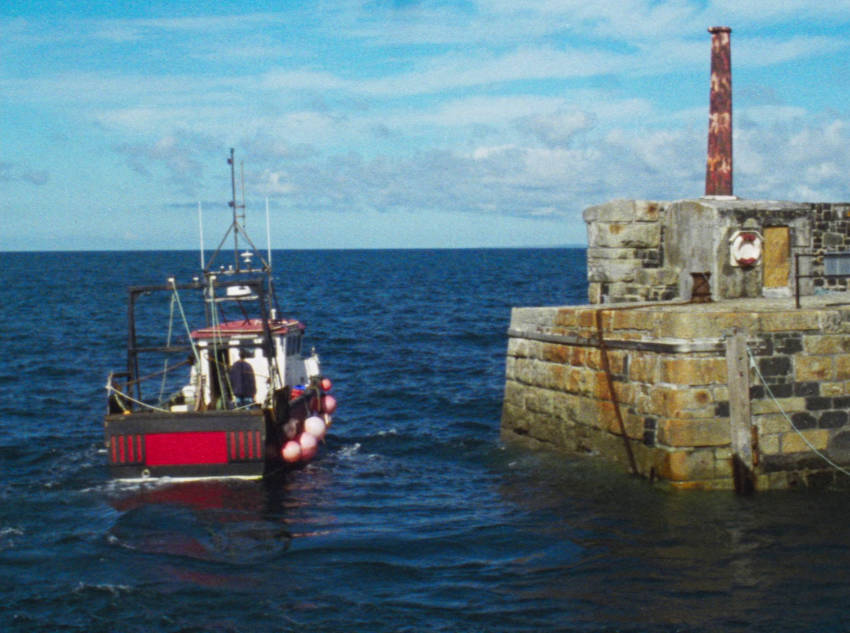
Cornwall, the present day, a fishing village which has certainly seen better days. There’s a food bank where the post office used to be, and the locals need to use it. Then one day, a fishing boat, Rose of Nevada, appears in the harbour, having been lost some thirty years. Nick (George MacKay) lives with Emily (Mae Voogd) and they have a daughter. When his roof falls in, the lack of jobs in the area means that he can’t afford the repairs, so he takes a job on the fishing boat, captained by Murgey (Francis Magee). Also on board is Liam (Callum Turner). The fishing trip is successful, but when the boat returns to shore, everything has changed in the village. It soon becomes clear that they have travelled back in time three decades, to 1993. Not only that, but they are taken to be two men, Luke and Alan, who were lost on this very boat.
With his “official” first feature, Bait in 2019, Cornish-born, -bred and -based filmmaker Mark Jenkin became one of the most distinctive filmmakers working in Britain. (“Official” is because Jenkin made four feature films before Bait, namely Golden Burn (2002), The Rabbit (2004), The Midnight Drives (2007) and Happy Christmas (2011). Also, at forty-four minutes, Bronco’s House (2015) is only a minute shorter than the definition of “feature” used by the Internet Movie Database. However, as these had not then been commercially released, Jenkin and his producers Kate Byers and Linn Waite were eligible for the BAFTA for Outstanding Debut, and in fact they won that award.) One of the reasons I’ve said “filmmaker” rather than “writer/director” (though he is those things) is that Jenkin’s methods are unique to him and have been particularly highlighted in the coverage of his films. He shoots his feature films on a small clockwork-wound 16mm Bolex camera without sound, which is added afterwards. Such proudly analogue working practices add to the hand-made feel of his films, though as with any other feature film, there is a big team of actors and crewmembers behind them. Jenkin shoots his own films and edits them, and also does his own music scores and sound design. The occasional scratches and lens flares are all part of the aesthetic. The gritty, grainy visuals often concentrate on textures, such as waterlogged wood, moss on rocks, rusting winches, ropes, even something as simple as raindrops on a waterproof jacket. In this film, faces seen in close-up, especially George MacKay’s, become another texture.
The black and white Bait and its colour successors Enys Men (2022) and the present film form a loose “Cornish trilogy” (as the simultaneously-released Blu-ray box set calls it, see below). The films are all standalones which can be watched in any order, but if you do watch them chronologically you can sense a refinement in Jenkin’s methods and themes and not least his recurring collaborators. The lead actors in Bait and Enys Men, Edward Rowe and Mary Woodvine respectively, appear in supporting roles in Rose of Nevada, and their old-age makeup in the present-day scenes is very convincing. Woodvine, who is Jenkin’s partner, has a story credit here. And, to keep it in the family, her son Isaac Woodvine has a small acting role. (Her father, the late John Woodvine, made his final screen appearance in Enys Men.) Particularly in Bait and Rose of Nevada, there is a strong subtext of the economic decline of Jenkin’s native county, with incomers and their second homes forcing out locals and their traditional industries – in this case, fishing, one of the most dangerous non-military occupations there are.
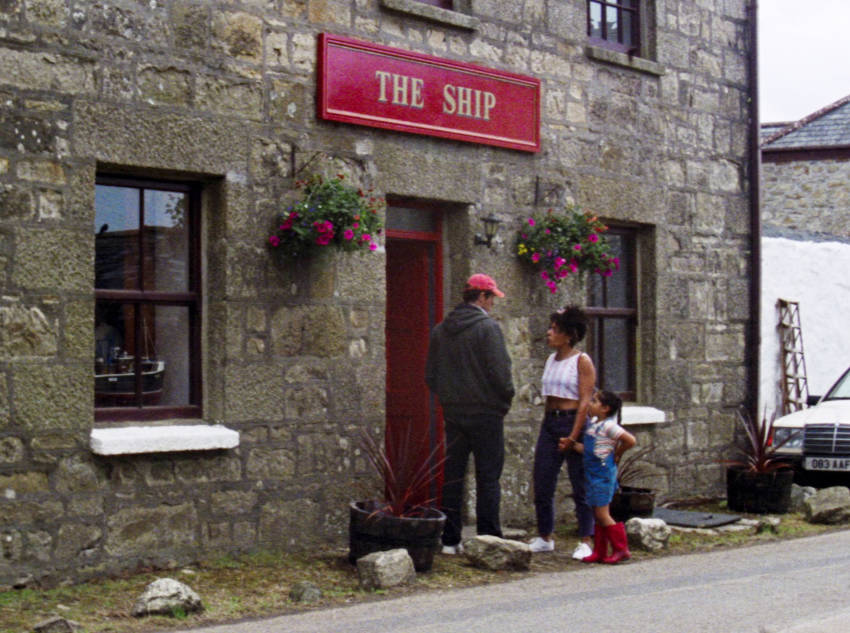
Jenkin began writing Rose of Nevada when the Covid lockdown shut down production of Enys Men – for the best part of the year, as it needed to be shot in the spring. Mary Woodvine was a sounding-board and her contributions made the story grow from a simple image (the returned boat in the harbour) into something that would sustain an entire feature. As a result, she has a joint story credit on the film with Jenkin. Like its predecessors, Rose of Nevada has a measured pace, and if it may seem difficult at times, that’s because of our ingrained viewing habits. Jenkin is an avowed admirer of Nicolas Roeg’s films. That’s not so much due to Roeg’s trademark use of cutting across time and space, though there is some of that in Rose of Nevada, but in the way that Roeg shows rather than tells, more than many other filmmakers do. Things are conveyed visually rather than via expository dialogue as much as possible. That’s inherent in the production design as much as anything else. The indications that we are in a different time are at first visual. The pub’s sign is freshly painted, not the drab version of thirty years later. The pub itself is thriving in the past, all but empty in the future. There’s a post office, which you sense is a community hub, where a food bank will later be.
The success (in arthouse/indie terms) of Bait and Enys Men has resulted in a bigger budget, which isn’t necessarily visible on screen as studio sets combine with an actual boat (not always at sea) seamlessly. Jenkin has brought in two well-known actors, George MacKay and Callum Turner. It’s MacKay’s performance on which the film turns. It’s minimal, tamped down as much as his hair is closely-cropped, often conveyed by small inflections of his face. So when, late on, tears appear in his eyes, it’s all the more powerful. Turner is more extrovert, as Liam settles happily into Alan’s place as Jess’s father and Tina’s husband, even though he knows he’s neither of those. That includes taking Alan’s place in Tina’s bed. In the end he’s not the one out of time.
sound and vision
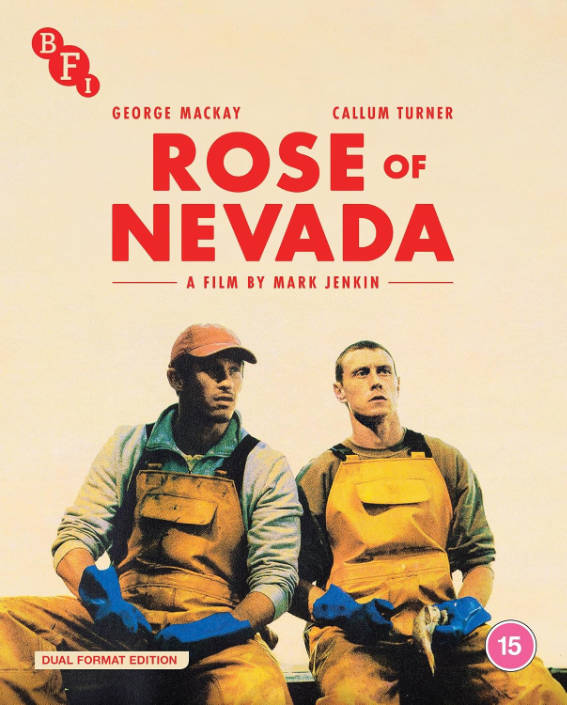
Rose of Nevada is a dual-format (Blu-ray and PAL-format DVD) release from the BFI, the discs encoded for Regions B and 2 respectively. This review is based on a checkdisc of the former. Released at the same time is Mark Jenkin: The Cornish Trilogy, a box set of the BFI’s Blu-rays of Bait, Enys Men and the present film. Rose of Nevada has a 15 certificate. Among the short films, A Dog Called Discord is a U. The others do not appear on the BBFC website at the time of writing, though David Bowie is Dead and I Saw the Face of God in the Jet Wash are likely 12s for occasional strong language. Between the Tides was a U on its original cinema release, but as it’s a documentary it’s been exempted from classification for this release. There’s an advisory in the booklet, but not on the disc, that A Dog Called Discord contains a sequence with flashing images.
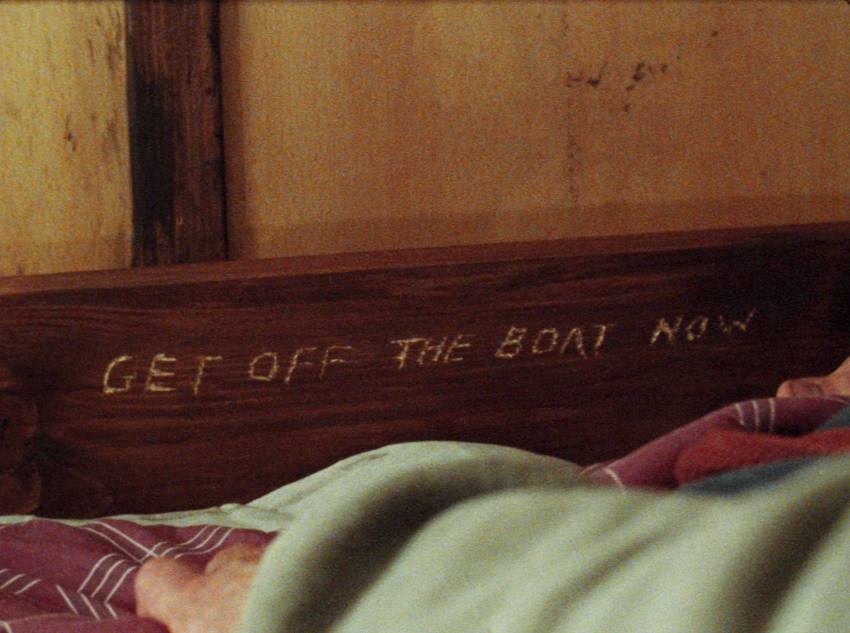
Rose of Nevada was shot in 16mm colour, with the transfer notes in the booklet specifying that it was on Kodak Vision3 negative stock with a Bolex H-16. The transfer is in the oddly precise ratio of 1.35:1, which no doubt was the one used for digital cinema showings. If, as I did, you saw one of the two 35mm prints struck (one in the UK and one in the USA) it would have been shown in Academy Ratio (1.37:1) but that’s a nit to pick so small as to be insignificant. As always with Jenkin’s films, the very analogue working methods become a feature in the film, not a bug, so the occasional scratches and lens flares are part of the aesthetic. Given the 16mm origins, the film has a very gritty, unslick look, with some bold colours and plenty of grain.
The soundtrack is DTS-HD MA 5.1, reflecting the multichannel sound of the theatrical presentation. There is a lot of use of the surrounds, from the outset with the sounds of waves and wind and creaking ropes. After the second line of dialogue (“She’s back”) the music score takes over the surrounds. Dialogue is clear and the music and effects are well balanced, including several uses of directional sound.. There are also audio-descriptive sound options in Dolby Digital 2.0 for the main feature and also I Saw the Face of God in the Jet Wash. English hard-of-hearing subtitles are available on the feature and all four of Jenkin’s short films. I didn’t spot any errors in them, and they do make a good stab at capturing the Cornish dialect in the main feature.
special features
Commentary by Mark Jenkin and Mark Kermode
Given that Mark Kermode has been a longtime supporter of Jenkin’s and they have done commentaries before and will no doubt do again, and that they live not far away from each other in Cornwall, it’s no surprise that the two Marks are on commentary duties for this release. If you didn’t know all that, their rapport is very evident. Inevitably much of this overlaps with other extras both on the disc and in the booklet, but there is quite a bit to be going on with otherwise. At the start start, Jenkin says that these days he calls himself a filmmaker – not just a writer and director, but a cinematographer, editor, score composer and sound designer as well, so “filmmaker” seems apt. At the end as the credits roll, he says that for all the attention on himself – sometimes the only person doing introductions and Q&As – it still takes hundreds of other people to make a film like this. There are a lot of production nuts and bolts, with Jenkin going through some scenes pointing out which shots were at sea, which in the “studio” (inside a warehouse with constructed sets), and which were with the boat anchored in Hayle harbour, sometimes carefully composed so you don’t see the frontage of the big Asda on the seafront. Jenkin also points out some details that even Kermode on his fourth viewing hadn’t spotted: the clip from The Dead Zone (a favourite film of Jenkin’s) on the television gives a subliminal clue to Rose of Nevada, and Isaac Woodvine (son of Mary) is playing the son of the character his own father played in Bait. Some other production details you might have not known come up, such as the fact that even the sight of a cassette (Jenkin’s own copy of The Charlatans) has to be licensed. The commentary ends with Jenkin talking about his new film, Mineral Point, which at the time was in first-draft script stage. It’s a road movie which he has written to take place across six states of the USA, but he expects that once producer Denzil Monk has seen it and commented, it will take place in one state for budgetary reasons. But that’s for a year or two’s time and no doubt Kermode and Jenkin will reunite to do a commentary track on that. (Present-Day Jenkin gives Future Jenkin a nod at one point. As “Alan” and Tina sit in front of the television, the film on later is announced as…Mineral Point.)
Short films by Mark Jenkin (61:41)
Four of them, with a Play All option.
David Bowie is Dead (16:35)
2018, 8mm in both black and white and colour. Jenkin began the film as far back as 1993, so there are shots of a London now gone, plus an early-twenty-first-century trip to Dublin. These capture moments, impressions, something that could be lost forever if Jenkin hadn’t been there with his camera. All of this to a stream-of-consciousness voiceover.Vertical Shapes in a Horizontal Landscape (5:16)
A short piece in 8mm colour from 2018. Jenkin starts at the house of his friend, the distinctive in a different way filmmaker Andrew Kötting and his daughter Eden, and goes on a pilgrimage to the late Derek Jarman’s cottage at Dungeness. All this to a voiceover, capturing impressions and digressions. If it’s in a way a homage to Jarman, that’s intentional, as you can see the man’s influence in Jenkin’s work, particularly his short films.A Dog Called Discord (22:46)
Shot in 8mm and 16mm, colour and black and white, this short was made for the 2023 Film on Film Festival at the BFI Southbank. It played on opening night, as a curtain-raiser for what should have been a 35mm nitrate print of Mildred Pierce, but due to a projector fault the feature was shown in a newly-struck archive print. Jenkin in his voiceover describes how he was given an old reel of film. When he developed it, he saw what was on it: a dog running around in a field, often straight at the camera. He did some detective work and found out where the film had been shot, the dog being called Dis, short for Discord. Now long gone, due to film being a kind of time travel, Discord lives again. This is interspersed with comments from BFI staff, identified in the hard-of-hearing subtitles if not on screen, though they are listed in the credits.I Saw the Face of God in the Jet Wash (17:03)
The newest short here, made in 2025, again in 8mm mixing black and white and colour. This is along similar lines to the other shorts here, with a voiceover accompanying the footage. In a sense it’s a diary of a filmmaker engaged at the time with other projects, which he refers to as The Film About a Woman Living Alone on a Small Island and The Feature Film About the Fishermen with No Boat. Wonder what those are?
The Jenkin Way (16:40)
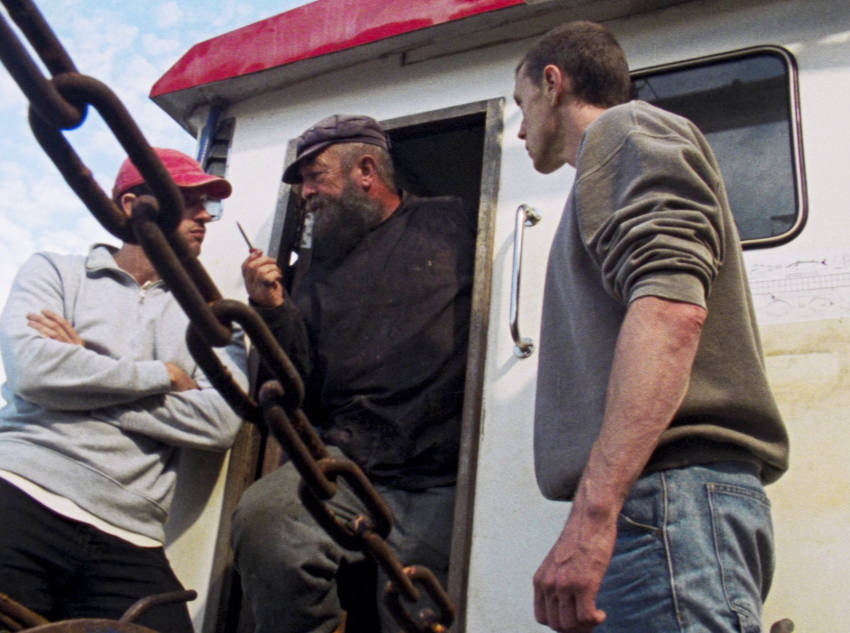
Made by the film’s production company, this is the official making-of for Rose of Nevada. Jenkin, interviewed at the BFI Southbank, says that to him all films are time travel. A larger budget and more resources for Rose of Nevada gave him the temptation to change his working methods, but it’s one he resisted. After a while, he doesn’t notice the inevitable artificiality with which he is working, for example quite accepting that someone can appear in four different locations shot over a few weeks to make one seemingly continuous ten-second sequence. Callum Turner says that having only twenty-seven seconds to play with enabled a certain rigour, which isn’t there when you can have digital cameras running indefinitely. Also interviewed are, in order of appearance, producer Denzil Monk, George Mackay, Edward Rowe, Francis Magee and Rosalind Eleazar. Jenkin ends by saying that you’re only as good as your next film, but luckily “the next one will be brilliant”.
Rose of Nevada Q&A (37:26)
Mark Jenkin participated in several Q&As on the release of Rose of Nevada, with or without cast members. This one followed a showing at the BFI Southbank on 25 April 2026, with George Mackay (with notably longer hair than he has in the film) and Callum Turner, moderated by Rógan Graham. Jenkin says that the camera he uses is as old as him (both born in 1976) and when he broke a spring in the clockwork mechanism due to winding too forcefully, it was almost like a bereavement. He talks about the look of the film as derived not from the cinematography but from the production design (shout-out to Felicity Hickson in the audience) and costume design. He talks about the film’s origins during lockdown (another shout-out, this time to Mary Woodvine in the audience). He says he always has to think if his ideas or good ones, or simply new ones. After twenty minutes, questions are taken from the audience (presented as on-screen captions). Asked about the Fortean aspects of the film, Jenkin says that Cornwall has an obsession with the past, maybe a characteristic of a defeated (Celtic) people. Someone also suggested that Bait was shot in a dying format (16mm film) to evoke a dying way of life, something Jenkin liked enough to use in later interviews. The two actors talk about the different working environment a Jenkin film has, with none of the dialogue recorded live. Mackay says that he used the shoot to practise his Cornish accent, ready for the dubbing session later.
Mark Jenkin in conversation with Rowan Woods (14:56)
This is a one-on-one chat with film and television curator Rowan Woods, illustrated with clips from Rose of Nevada and one from Enys Men. Jenkin says that he set the film as far back (some thirty years) as he did to show some change but not making it a full-on historical piece, though he was a little askance at having it described as period. He speaks out that some changes have been normalised, such as the post office, once a thriving community hub, now being a food bank, in one of the world’s biggest economies. He describes his working methods, saying that the storm sequence – mostly shot in close-ups – became greater than the sum of its parts when it was edited and had sound added. He also talks about his short films, which he usually funds himself. If a feature film can take years to come to fruition, making these is how he can still call himself a filmmaker.
Between the Tides (20:36)
A British Transport Films production from 1958, this is a favourite of Mark Jenkin, who showed it in a season at the BFI Southbank accompanying the release of Enys Men. Released as a short subject, supporting Monsieur Hulot’s Holiday among others, it was Oscar-nominated in 1960 as Best Live-Action Short Subject. (Also nominated that year was Richard Lester’s The Running Jumping and Standing Still Film, Skyscraper, co-directed by Shirley Clarke, and Disney’s Mysteries of the Deep. The winner was Jacques-Yves Cousteau’s The Golden Fish (Histoire d’un poisson rouge).) Directed by Ralph Keene and narrated by Stephen Murray, Between the Tides, shot in Technicolor (not three-strip, as that had been discontinued a few years earlier), takes us up close to a beach on England’s southwest coast and the life there, exposed as the tide goes out and before the next one comes in.
Helping the Earth: Cry (0:55)
The full version of a hand-painted-animated public information film shown in cinemas, which in Rose of Nevada is seen on a television set. A young girl’s voice talks about global warming and wonders what the world will be like when she’s Daddy’s age. Will animals have died, rivers dried up, seas risen? But it’s not too late yet…
Stills gallery (4:55)
A self-navigating gallery of stills, shown as multi-image contact strips. You have the option of viewing these with or without photographer credits.
Theatrical trailer (2:03)
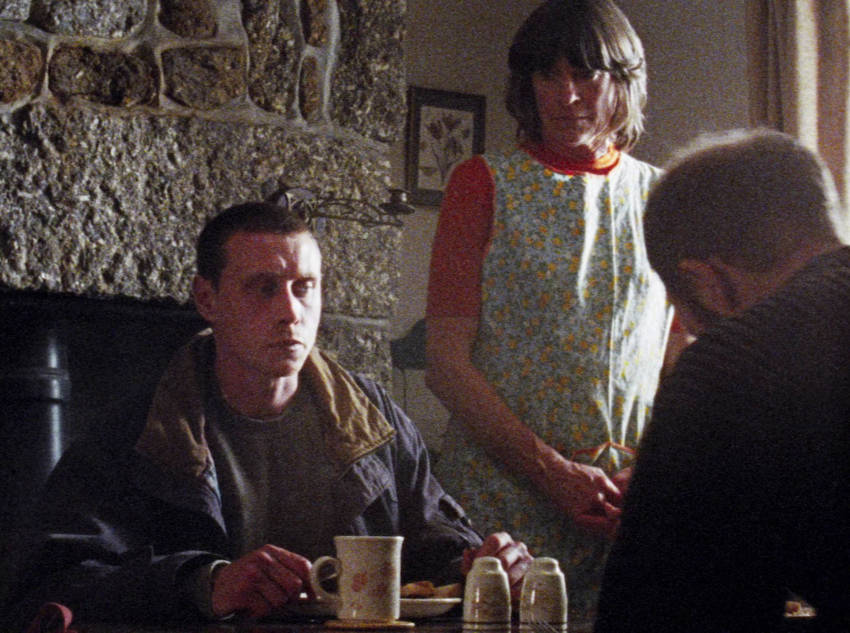
A trailer which plays up the film’s mysteriousness, making sure to tell you who directed it and who stars in it. There are three critics’ quotes at the end, one from Mark Kermode.
Booklet
The booklet available with the first pressing of this release runs to thirty-two pages plus covers. With a spoiler warning upfront, it begins with Jenkin’s director’s statement, which begins by his stating that this is a film about sacrifice and is one he thinks about every day.
“Then Home to Mother: On the Biblical Nature of Rose of Nevada” by Rafa Sales Ross, is as the title suggests a reading of the film as allegory. Not for nothing is the first line of dialogue, by Mike (Edward Rowe), “Jesus Christ!” as the boat of the title reappears in the harbour after some thirty years. I won’t say more to avoid spoilers, but after this reading, Sales Ross then considers Jenkin’s working methods, beginning with the rules he set himself on Christmas Day 2012, his own Dogme 95-like vows of chastity. (Back then, Jenkin made his films in black and white, but he has broken that rule since, as well as his one of keeping his running times under eighty minutes. His thirteenth rule was to break one of his thirteen manifesto rules, it has to be said.) She then returns to Biblical motifs at the end of this essay.
The next two pieces tackle Jenkin’s use of sound. In “Sound as Signifier”, Jason Wood invokes a film Jenkin admires, one of the classic films specifically driven by its soundtrack, Francis Coppola’s The Conversation, and its use – citing Philip Brophy – of “noise” in the loosest sense to convey shifting mental states. Along with his analogue methods of shooting the film, Jenkin’s construction of the sound is as analogue as possible, like the visuals becoming digital late on, especially if you see the film as a cinema DCP or on a Blu-ray or DVD like this one. Even if he played an actual guitar on the soundtrack, by the time it is married to the film, it has gone through particular processes, such as tape loops and via a synthesiser. And after that, we have a piece by Gwenno Saunders, the Welsh-Cornish singer and musician who often records under her given name only, singing in Welsh, Cornish and English. She performed a live score for a showing of Bait and her song “Kan Me” features in Enys Men. Her piece discusses time as it is seen in Rose of Nevada, and the memories we accrue as we age. She’s clearly fascinated by Jenkin’s film, writing this after seeing it a fifth time. She thinks she has it figured out by now, but then picks up another clue…
After a cast and crew listing, we have “Everything Flows: Four Short Films by Mark Jenkin”, which is an extended essay on the films included as extras, instead of the usual notes you would expect to see in the credits listings in the booklet. Those do appear as well, and include notes by Orianne Bastar on Between the Tides and Jez Stewart on Helping the Earth: Cry.
final thoughts
Rose of Nevada is a film which stands up to multiple viewings. It confirms Mark Jenkin as a major British filmmaker at work nowadays, and if you buy this Blu-ray or the Cornish Trilogy box set, the film is very well put into context with the extras the BFI have provided. That very much includes the booklet, so do pick up one of the first pressing of this release, or of the box set.
Rose of Nevada
UK 2025 | 114 mins
written and directed by: Mark Jenkin
cast: George MacKay, Callum Turner, Francis Magee, Edward Rowe, Rosalind Eleazar, Mary Woodvine, Adrian Rawlins
distributor: BFI
release date: 24 August 2026