
Bearing gifts
Long awaited, trailing some controversy over casting and leaving out some aspects of the source material, Christopher Nolan’s THE ODYSSEY opened last weekend. Against all expectations, Camus is staggered by its sheer, vast cinematic ambition and emotional clout…
“By the way, I don’t think I’d be doing my job right if I wasn’t petrified every time I put a film out, because you’re trying to challenge yourself, you’re trying to take risks.”
“No spoilers ref The Odyssey, mind.”
No spoilers… for an epic poem brought into existence on parchment 2,300 years ago, existing many hundreds of years before that, passed down through generations of Greek oral storytellers – shades of Fahrenheit 451? That’s a big ask. The Odyssey has permeated western culture for hundreds of years. In 2018, when BBC Culture asked experts all over the world to name literature’s most enduring narrative, guess what came top of the list? How can anyone ‘spoil’ that particular story? So, what are the most famous aspects of this great narrative? If I mentioned the cyclops, would that resonate? One-eyed chap, 60 feet tall, monstrous, fond of the odd human snack but a good-natured and tender shepherd at heart. How about the sirens that lured ancient mariners to their deaths with their songs and promises of personal wishes fulfilled? Surely, soldiers hidden inside a wooden horse must ring a loud bell. When Christopher Nolan confirmed an adaptation of the Homeric poem was to be his next film, I have to say I was underwhelmed. The tale felt like it had been done to death. But then I remembered the line in Stephen Sondheim’s sublime musical, Sunday in the Park with George. Artist George Seurat has painter’s block and is bemoaning his fate to his girlfriend Dot at the start of the number ‘Move On’. As is Sondheim’s wont, the pitter patter of overlapping voices practically buries this pertinent nugget of wisdom.
George: I’ve nothing to say.
Dot: You have many things.
George: Well, nothing that’s not been said.
Dot: Said by you, though, George.
The Odyssey? By Christopher Nolan? I should have known better. I’ll come right out and say it. It is an absolutely staggering achievement. There is not a dud scene that wasn’t narratively necessary in the whole three hours, which incidentally I was never aware of. The film simply flew by. There’s a good reason the story is a gold-plated classic and Nolan’s interpretation is earnest in the very best way, unironic, wildly exciting, emotionally affecting and layered with subtextual comment on the world we live in today. Let’s deflate the overblown balloon of anti-woke internet pre-judgement. It is a work of fiction set in a mythical world of gods and monsters. Nolan’s cast simply has to convince, and they all do that job superbly. More on that a little later. Boiled down to its essence, The Odyssey is one of the seven basic stories in fiction. Christopher Booker’s book on that subject calls this one ‘Voyage and Return’, no spoiler intended.
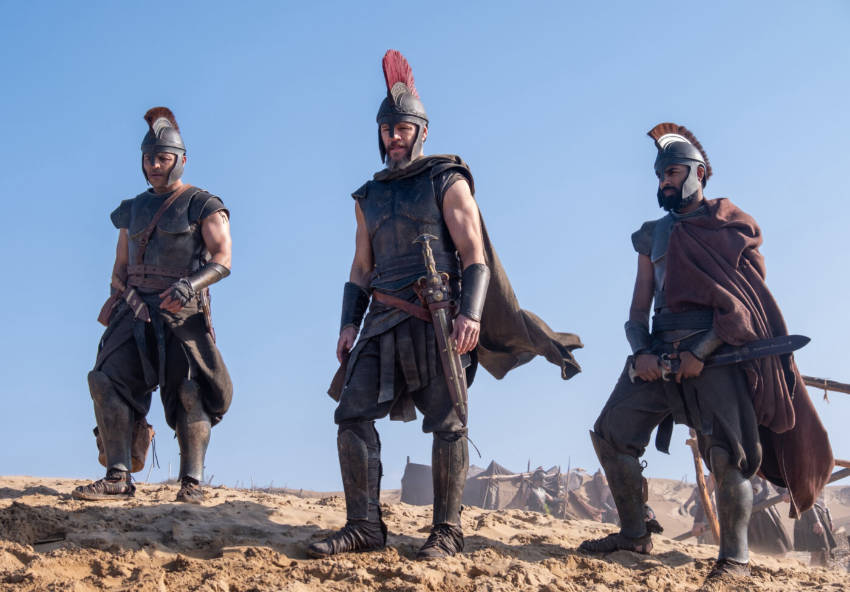
Odysseus, a general in the Greek army and the King of Ithaca, is trusted by his military superior, Agamemnon, to open the gates of Troy from inside the fortress for the entire Greek army to surge in and sack the fortified Turkish city. The Greeks build a huge wooden horse which the Trojans believed would please the god Athena if it was taken into the fortress. Hence the phrase “Beware Greeks bearing gifts.”2 Christmas in Athens must be a hoot. Of course (spoiler?!!!) the horse is full of Greeks, led by Odysseus, who all manage to slip out at nightfall and achieve their mission. But this event changes Odysseus who once lived by a code known as Zeus’s Law which in the Bible is known as the ‘Golden Rule’. You could boil it down to two words… “Be nice.” In ancient Greece, given the populace’s fondness for gods, you could add “…in case who you meet happens to be a god walking the Earth.” But warriors and kings have little time for such luxuries for their world is changing, becoming less welcoming by the day. Back at Ithaca, Odysseus’s wife, Penelope has reluctantly installed a coterie of potential suitors but keeps faith that her beloved husband will return. One of the suitors, Antinous, is scheming to take Penelope’s hand by any means necessary. The king’s son, Telemachus, sets off to find out what happened to his father. Let’s also say that Odysseus’s journey home is a mite fraught and leave it at that.
Would it surprise you to know that Nolan tells the tale with a dizzying but hugely effective flashback upon flashback structure but we are never misled or not sure of our temporal focus. When we see a character interact with Odysseus, someone who’s dead and in Hades and looking like it, editor Jennifer Lame slots in a perfectly timed shot of the character looking a little more alive in an earlier scene, so we know who’s talking. This is a common practise throughout the film, and you could judge this nudging the audience as somewhat condescending… “How could you not recognise so-and-so?” but it was, for a first-time viewing, extremely helpful. The length and greyness of Odysseus’s beard over twenty years away from his home in Ithaca is a good marker to keep the audience on the right narrative path. Odysseus often has scenes with gods and nymphs (steady, not what you think). In Greek mythology, they are minor nature deities. You have no information to help you understand who these characters are, but this is not important. The fact they are played by Charlize Theron and Zendaya should tell you they may not be of this Earth. Also, a big clue is sometimes when we cut back to a two shot, they are simply not there anymore. Gods, as is their wont, move in mysterious ways.
The aspect that runs through the original story that modern audiences may not be able to relate to is the constant human need for sustenance and water. On board a ship, you can only carry so much of both so a voyage is laced with the continual worry that out there in the unknown, there may be not enough of either to sustain the travellers. That aspect is very smartly handled in the film, particularly successful in giving its importance to be understood by audiences, most of whom have never known crippling thirst or fat and muscle consuming hunger. Also, in the original story is what passed as a joke 3,000 years ago which some people have brought up as a sign of Nolan’s unfaithfulness to the text. The joke involves Odysseus giving his name as ‘nobody’ to the cyclops. ‘Ody’ sounds like the Greek ‘outis’ which means nobody. When the one-eyed creature asks for help from the island’s other monocular inhabitants, the creature cries “Nobody is hurting me!” Assuming madness, the others ignored him which allowed Odysseus and his men to escape. Granted, the ‘joke’ has aged badly and I for one am not sorry to lose it.
As mentioned, the cast is uniformly excellent. Matt Damon plays Odysseus as an intensely troubled soldier desperate to get back to his loving family but assailed from all sides by the gods and monsters of his world. Along the journey he is drugged by eating lotus leaves to forget his past by Charlize Theron’s Calypso who offers him immortality if he’d just stay with her. Talk about cognitive dissonance… Stay with one of the most beautiful women on (or off) the planet and live forever (!) or get back to Anne Hathaway playing Penelope and die a mortal man. With all due respect to the allure and beauty of Ms. Hathaway, both of which are considerable, that is a really tough call. Odysseus, unlike many, makes the right choice. Sorry, Charlize. I’ve never seen Hathaway give such a strong heartfelt performance. She anchors the Ithaca scenes with great loss and yet great hope, weaving a shroud in her emotional isolation. Tom Holland plays Telemachus. And as Odysseus’s and Penelope’s son, he gets a chance to play a grown up and excels in the role. It’s really nice to see an actor usually hemmed in by his boyishness, take a step into adulthood and delivering an emotionally authentic performance. I mean, he is 30 years old so this should be in his wheelhouse. Holland’s new wife, Zendaya, plays a god (no surprise there) and is unexpectedly convincing as such. Nolan ekes out a very different performance from the actress whose many scowls in the Dune franchise tended to make some less kind critics think that that’s all she had in her repertoire. Not so. Robert Pattinson as Antinous gives some weight to the cliché that villains can be more alluring than heroes. His murderous and ambitious goals cannot possibly end well with he and Penelope skipping into the sunset together. And the cowardice he exhibits is a delight to watch as his world falls around his ears.
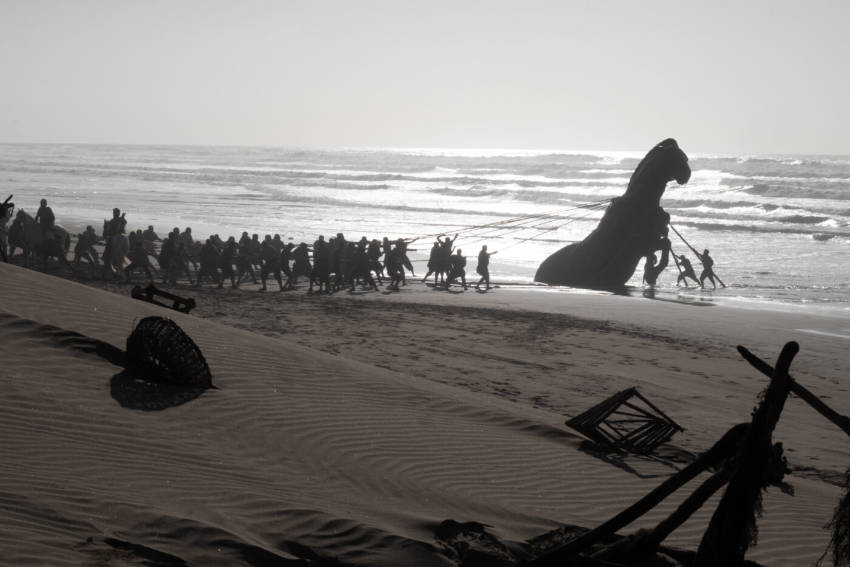
Let’s briefly talk about Elliot Page. Ellen Page starred in Nolan’s Inception as the architect introduced to the lucid dream world. She was the character that created that extraordinary fold over of the Paris cityscape. Nolan obviously valued her work. Ten years later, Page had corrective surgery and thusly then identified as a trans man, Elliot Page. Nolan hired him for a pivotal role of the Greek soldier, Sinon, offering the wooden horse as a gift to the Trojans. He reappears as the afore mentioned dead soldier in Hades, and I suspect Nolan cast him as someone with a very striking face which he certainly has, to be recognised under all that dark, post-death pallor. That’s all there is to this storm in a teacup online. All that bullshit that a trans man was cast as Achilles was just stoking up what the internet does best… Outrage and fake news. Can we just watch the film? The other concern was a black actress cast as a traditionally white (fictional) character. Newsflash: The Odyssey is a myth. Lupita Nyong’o just has to convince as a wronged beauty, and she certainly has that role down pat. There is a slight difference in this casting choice as the one that also has a small corner of the internet up in arms… In short, ‘Black Snape’. Papa Essiedu is a fine actor. I think Harry Potter author J. K. Rowling’s initial objection to his casting was very simply that it made her hero’s father’s bullying (flashbacks in later books) seem like overt racism. I think Essiedu’s casting creates a layer of meaning that was never intended. The jury’s still out on that one and how the HBO adaptation will deal with James Potter magically hoisting Snape into the air… The racial subtext of a white man hoisting a black man up doesn’t take a wizard’s mind to see that those optics are all horribly wrong. My guess is this is one scene that HBO will steer well clear of.
The original score by the hugely successful Swedish composer Ludwig Göransson is perfectly integrated into the world Nolan has created and drives the narrative as if The Odyssey needed any more wind in its sails. It’s a subtle score consisting of period instruments, bronze impacts, ethereal voices and has more than a touch of Hans Zimmer about it but that can’t be surprising. Nolan’s composer of choice was committed to Dune and recommended his good friend Ludwig in his stead to score Tenet. I’ll say this about Nolan; he sticks with his composers. The score as a stand-alone entity is certainly emotive and evocative but not exactly tuneful. And there’s two hours of it! It’s more of a sonic sound scape in the manner of a certain German practitioner of the art.
When I first saw the trailers, I felt the cinematography looked muted which is why it’s a good idea to judge it only by seeing the whole film. Nolan’s go to cinematographer Hoyte van Hoytema’s work in the film is remarkable. From the lighting of the cyclops’s cave, with a huge fire as the only light source to the flames engulfing Troy, there is drama inherent in the nature of the light. Naturalism rules in the outdoor sequences but when conversing with deities, there’s a glow to the shots which is telling the story without words. There were only a few times I felt the framing was subtly compromised from its original IMAX 1.43:1 aspect ratio. That’s quite a responsibility for the cinematographer, making sure 1.43:1 will yield a satisfactory 2.39:1 widescreen format framing. I guess every shot was positioned separately in post for the widescreen version to Nolan’s satisfaction. I find it quite surprising that the marketing is pushing The Odyssey as the first feature film shot completely in the IMAX film format. There are only 41 genuine IMAX film projectors in the world. That’s what you might call ‘niche’. The rest of us have to put up with the afore mentioned 2.39:1 widescreen version. Or the IMAX digital version or heaven forbid, what’s pretending to be IMAX, cinemas branded with the name but projecting a 2K version of the film on screens slightly bigger than a standard screen but nothing like the size of a true IMAX screen. It’s no wonder these cinemas are known as LieMAX.
My admiration for the filmmakers is boundless. The sheer effort it took to place these astonishing images in front of an audience without copious amounts of computer-generated imagery is astounding. The fact that it works emotionally is a small miracle amid the spectacle. It’s an epic that truly deserves that word.
Afterword
In case you are in any doubt about Nolan’s penchant for realism, have a look at this behind the scenes’ featurette.3 You won’t find a single green screen. They went to these places, physically enhancing them. They built seemingly everything for real and by God, you feel it when you’re watching it. The sheer will a project like this takes, is one of solid iron and Nolan pulls it off. I’m not too sure how many directors could do the same these days.
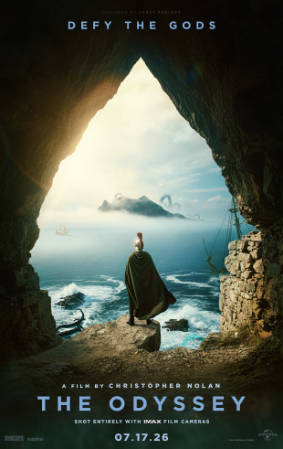
The Odyssey
USA / USA 2026 | 172 mins
directed by: Christopher Nolan
written by: Christopher Nolan; based on The Odyssey by Homer
cast:Matt Damon, Robert Pattinson, Corey Hawkins, Jarreth Merz, Niko Nicotera, Tom Holland, Elliot Page, Travis Scott
UK distributor: Universal Pictures Int (UK)
UK release date: 17 July 2026
- https://www.theguardian.com/film/ng-interactive/2026/jul/17/christopher-nolan-interview-oscars-the-odyssey[↩]
- From Virgil’s epic poem, The Aeneid, “Timeō Danaōs et dōna ferentēs.” Translated literally, it means: “I fear the Danaans (Greeks), even those bringing gifts.”[↩]
- https://www.youtube.com/watch?v=YMHESCB06lM[↩]