
You can’t always get what you want
After witnessing the death of his governess as a child, the now adult Archibaldo develops a taste for murder when reunited with the music box he believes caused her demise in Luis Buñuel’s blackly comic 1955 THE CRIMINAL LIFE OF ARCHIBALDO DE LA CRUZ [ENSAYO DE UN CRIMEN]. Slarek finally catches up with one of his favourite filmmaker’s most intriguing and enjoyable Mexican films on Second Run’s new Blu-ray.
Dreams are funny things. For most of us, they are vivid enough to feel like reality when we’re in them but once we wake they fade from memory in what seems an instant. But some aspects linger, and there are certain types of dream, apparently shaped by the worries and anxieties of daily life, that I experience frequently enough to have me concerned for what is triggering these nocturnal flights of discomforting fancy. Normally I’d add a “maybe it’s just me” codicil here, but research suggests I’m far from alone on this score. A common one involves a stressful inability to complete a seemingly simple task. Maybe I’m on holiday and have arranged to meet my partner at a specific spot and just can’t seem to get there, or I’ve embarked on a long cycle ride down a familiar route (one that bears little resemblance to any I have actually taken, of course), but when I elect to head home before it gets too dark I just can’t make any progress in that direction.
Given that the dream world was always at the core of the Surrealist movement, it’s hardly surprising that its premier filmmaker, Luis Buñuel, intermittently drew on this apparently common subconscious (or should that be unconscious?) trope throughout the course of his distinguished career. Examples range from the guests who find themselves repeatedly unable to leave a dinner party in The Exterminating Angel (El ángel exterminador, 1962) to the sexual frustrations experienced by the middle-aged man who falls for his teenage secretary in the director’s final feature, That Obscure Object of Desire (Cet obscur objet du désir, 1977). Back in the mid-1950s, only a filmmaker with his cheerful contempt for censorial voices and societal notions of taste would take this concept and apply it to a would-be serial killer whose intended victims die unexpected, sometimes accidental deaths before he can murder them as he had planned.
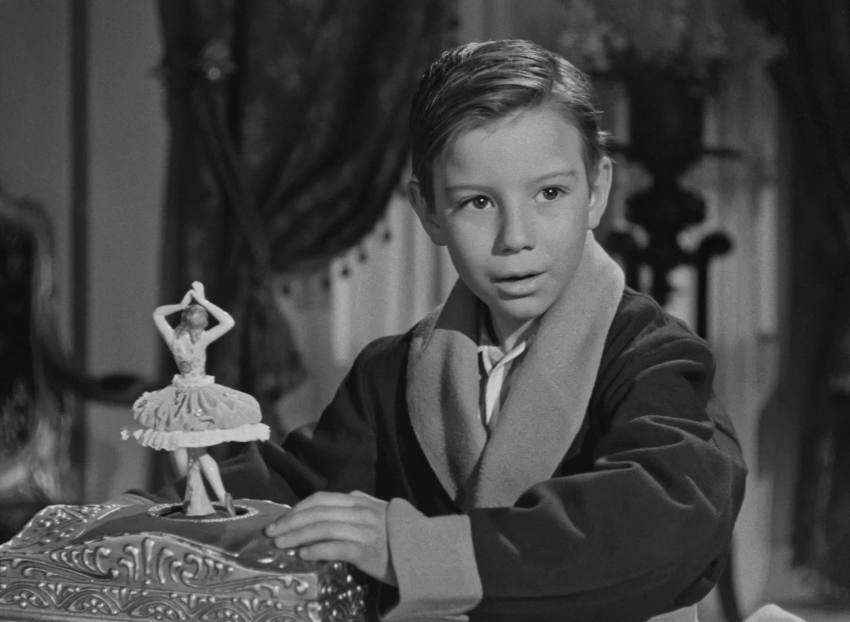
The seed for his later homicidal bent is sewn in the initially self-narrated opening scene, when the titular Archibaldo (Rafael Banquells Jr.) is still the spoiled young brat of wealthy parents, whose plush home is located what they believe is a safe distance from the violence of the unfolding Mexican revolution. Archibaldo’s every barked whim is indulged by his doting mother (Eva Calvo) but challenged by his exasperated governess (Leonor Llausás), who clearly thinks the boy could do with a slap. To mollify the child when he objects to her having a night out at the theatre, his mother gives him a music box that he has had his eyes on for some time and that instantly delights him. As she departs, she instructs the governess to tell Archibaldo a story about it, and does so in a manner that suggests the confused woman should just make something up. The governess thus concocts a tale for the attentive Archibaldo about a king who is given a magical music box by a genie, a box that has the power to smite his enemies when played. When the traitorous prime minister poisons his mind against his Queen, he winds up the box and the Queen promptly drops dead.
The governess is interrupted at this point by the sound of gunfire in the street, confirming the claim made by Archibaldo’s father (Enrique Díaz) to his wife that the revolutionary forces are getting near enough for them to have to cancel their theatre date. As the governess goes to the window to investigate, the young Archibaldo is gleefully considering the tale that she has told him and elects to give it a try, making the governess the target of his death wish. As he winds up the music box, a stray bullet from the gunfire outside pierces the window and kills the governess on the spot. As blood runs from the wound on her neck, instead of reacting in horror, the young Archibaldo beams a gleeful smile, especially when his eyes fixate on the dead woman’s now exposed and stockinged legs. As the Freudian favourites of sex and death collide, the voiceover returns to confirm how excited this incident has made him. On the basis of this scene alone, even considering who was in the director’s chair, it’s retrospectively hard to believe this was made and released in 1955.
It turns out that this was a flashback illustration of a childhood memory being related by the adult Archibaldo (Ernesto Alonso) from his hospital bed to attending nun Sister Trinidad (Chabela Durán), who instantly regrets she asked whatever question prompted him to confess this in the first place. When she leaves his room to get his medication, Archibaldo hops out of bed and opens a case containing a collection of cut-throat razors (that’s straight razors for any American readers), and when I say case, they’re not lying in a clutter in an old box but laid out neatly in a row in the sort of display case you might have found in a Victorian gentleman’s grooming shop. After gleefully selecting one of the razors, Archibaldo confronts the surprised Sister Trinidad, and in a moment that has its religion-baiting director written all over it, he asks her if she has a good relationship with God and whether she be fine with dying now and spending eternity in bliss. Although unsettled by the question, Sister Trinidad eventually admits that she would, which prompts Archibaldo to produce the razor and smilingly inform her that he intends to fulfil her desire on this matter. As he advances towards her, the startled nun flees through the room’s ensuite bathroom, locking the door behind her and leaving through a second exit that leads directly into the hospital corridor. As the frustrated Archibaldo is forced to abandon his pursuit, the terrified Sister Trinidad flees down the hallway and straight into an open elevator shaft, where she plummets to her death.
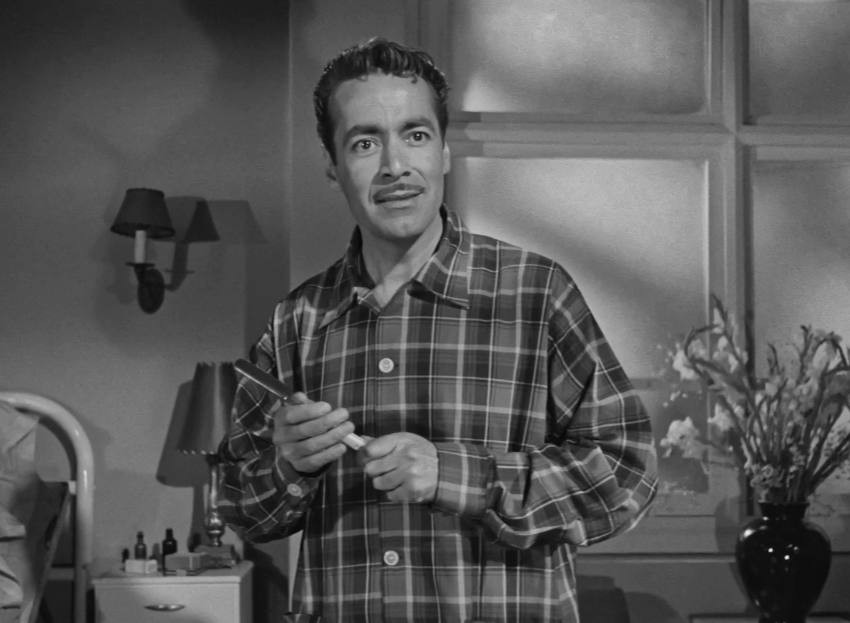
Tasked with investigating what looks set to be ruled as a tragic accident is an unnamed judge (Armando Velasco), whom we meet while he is in the process of interviewing a senior hospital doctor (Roberto Meyer) in an attempt to establish what led to Sister Trinidad running through the broken elevator door. His next interviewee is none other than Archibaldo, whom we learn was being treated for extreme anxiety after some sort of tragedy with his wife, and who tradition dictates will act all innocent and say nothing about his murderous intentions. Being a Buñuel film, that’s not how it plays out. Archibaldo comes in, sits down, and in a friendly conversational way assures the judge that Sister Trinidad was murdered and that he was the one who killed her. What’s more, he claims that Sister Trinidad was not his first victim. Unsure where Archibaldo is going with this, the judge asks his assistant to take notes and warns Archibaldo that anything he says may be used in evidence against him, which appears not to bother Archibaldo one iota. His story then unfolds in flashback, one in which a chance event reunites him with the fateful music box from his youth, a box whose mysterious power seems to repeatedly undermine his desire to experience the nefarious thill of committing a violent murder by dispensing with the intended victim in alternative ways before he can get to them.
What may sound like a setup for an Italian giallo thriller1 initially plays like an offbeat relationship drama laced with a whisper of black comedy that becomes darker and more pronounced as the film progresses, while common movie serial killer tropes either dispensed with or turned on their head. We quickly discover that our Archibaldo is no angry loner with a childhood trauma-inspired grudge against the opposite sex but an overprivileged product of the Mexican upper middle class who whiles away his time making pottery in the studio attached to his well-appointed house, the fumes from which have drawn complaints from his neighbours that Archibaldo couldn’t care two hoots about. It’s also revealed that he is (or was, but for ease of grammar I’ll treat the flashback timeline as the present) courting pretty young Carlota (Ariadna Welter), who is meanwhile having an affair with the married Alejandro (Rodolfo Landa), an architect in the employ of Carlota and her mother (Andrea Palma). At this stage it seems unlikely that Archibaldo is aware of this is affair, and he certainly seems intent on marrying Carlota. It’s while browsing for rings in the jewellery section of a large antiques store that he discovers that the music box from his childhood has come into the shop’s possession, and has to use all his powers of pleading persuasion to convince the woman who was planning to buy it to let him purchase it instead. Polite though he may have been throughout this encounter, his upper middle class sense of entitlement is neatly illustrated when he returns home carrying the store-wrapped music box, where he gleefully tears off the wrapping and casually tosses it over his shoulder onto the floor for his butler Esteban (José Peña) to dutifully pick up and dispose of.
Things complicate further for Archibaldo when he runs into the effervescent Patricia (Rita Macedo), who recognises him from a gambling den the two used to frequent and who lives a decadent life at the expense of her considerably older boyfriend Willy (José María Linares-Rivas). But there’s more. A few days later he is drinking alone in a lively nightclub when his gaze fixates on a woman named Lavinia (Miroslava), a tour guide holding court for a small group of visiting Americans at a nearby table. To his surprise, she engineers a much needed break from her duties by joining him at his table and asking him to pretend to be her friend. She’s picked Archibaldo not just because he’s sitting alone or because he was already eyeing her up, but because she remembers him from the antiques store as the man who convinced her to let him buy the music box that she had only just decided to purchase. She also tells him that she sidelines as a model, which prompts Archibaldo to request that he sit for her, an offer that she unwisely agrees to take him up on.
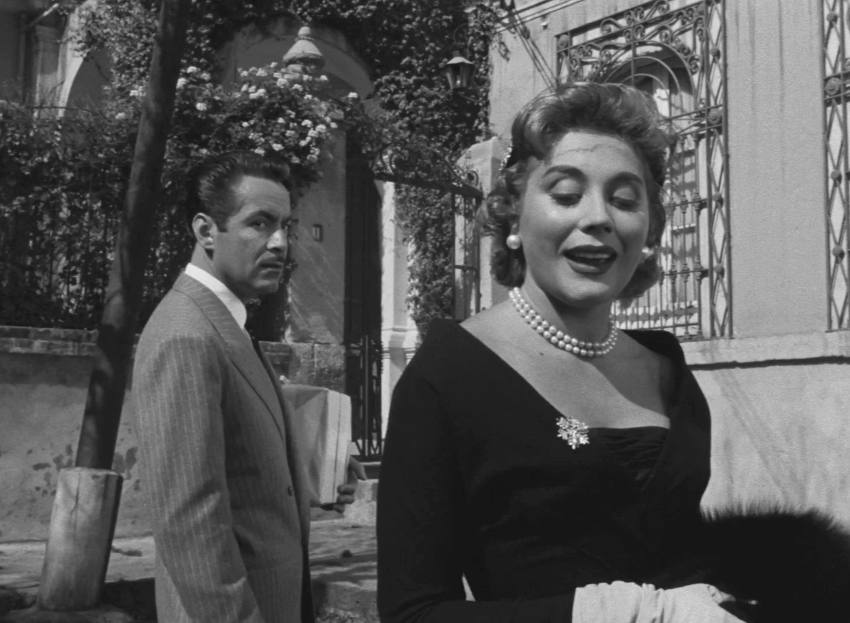
Just who Archibaldo later targets and what fate ultimately befalls them is not for me to say (there is one spoiler ahead on this score, but I’ll post a warning immediately beforehand) but the fact that his murderous plans will go unexpectedly and even peculiarly astray has already been signposted by the incident involving the unfortunate Sister Trinidad. On paper, Archibaldo is a monster, or at least a potential one, an early model Patrick Bateman for whom the act of murder is – theoretically at least – an end in itself, with no even spurious justification for the act beyond the satisfaction he believes it will bring him. Unlike Bateman, however, there’s something strangely likeable about Archibaldo, from his upbeat chirpiness and almost childlike fascination with both his beloved music box and his collection of razors, to his hapless failure to commit the sort of crimes that should be rights cast him as an irredeemable villain. Much of this is down to lead actor Ernesto Alonso’s cheery, easy-going portrayal which, together with blackly comic aspect of his inability to directly inflict even a whisper of real harm and the way his plans are overturned by the witty finger of fate, shapes him into an oddly engaging figure whose fate I found myself caring for even as I was fearing for that of those he targets.
While Buñuel remains widely celebrated as a surrealist, he was also one of cinema’s most endearingly playful disruptors, repeatedly challenging established norms in his characters, their motivations, their arcs, and even the manner with which their stories are told. All of those elements are on display here and seamlessly integrated into the smoothly structured narrative, and a few now even feel ahead of the game. A prime example comes in the shape of the smoky visions that Archibaldo has of himself committing his planned murders to the sound of a distorted, sinister fairground take on the music box tune, sequences that play like a monochrome visualisation of the famed murderous red mist of psychopathic legend. Elsewhere, there is a throughline from early imagery to Archibaldo’s later actions (spoilers ahead, hop to the last paragraph of the main review to avoid), notably when he first catches sight of Lavinia in the nightclub through a wall of dancing candle flames, which visually anticipates his later plan to murder her and cremate her body in his pottery kiln.
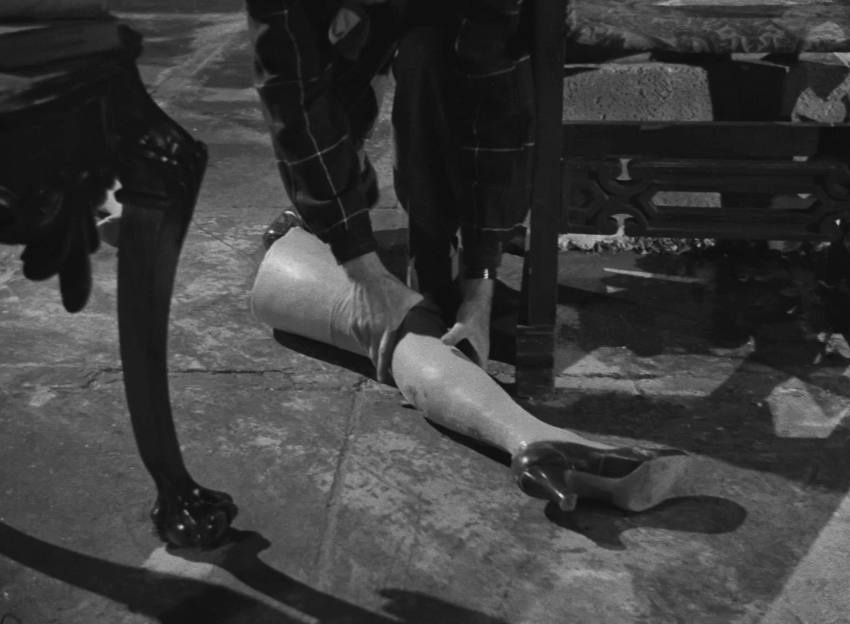
Perhaps the scene in which Buñuel’s surrealistic leaning is most pronounced has him track down and purchase a mannequin that was modelled by Lavinia and that looks uncannily like her. It’s something he surprises her with when she visits his house for the first time, but instead of being startled and seeing it as a sign that Archibaldo may have a psychological issue or two, she laughs in delight and refers to it as her sister, even swapping clothes with it when Archibaldo leaves the room to successfully trick him into confusing the two of them. Now keen for the mannequin to stay dressed in Lavinia’s clothing (that’s another big red flag, girl), Archibaldo presents Lavinia with a range of garments that he purchased for the figure, including a brassiere that he was earlier cupping as if there was an invisible breast beneath. When his plans are once again frustrated by an unexpected interruption, he responds by dragging the mannequin to the kiln for cremation in Lavinia’s place – a journey on which it briefly loses a leg – and has to watch this plastic effigy of his intended victim dissolve in the flames in her place. By this point, the question of whether Archibaldo has ever had either a genuine romantic or sexual relationship with a woman remains teasingly unanswered, his first and possibly only true love being the ballerina figure that rotates atop the music box when it is wound up and played.
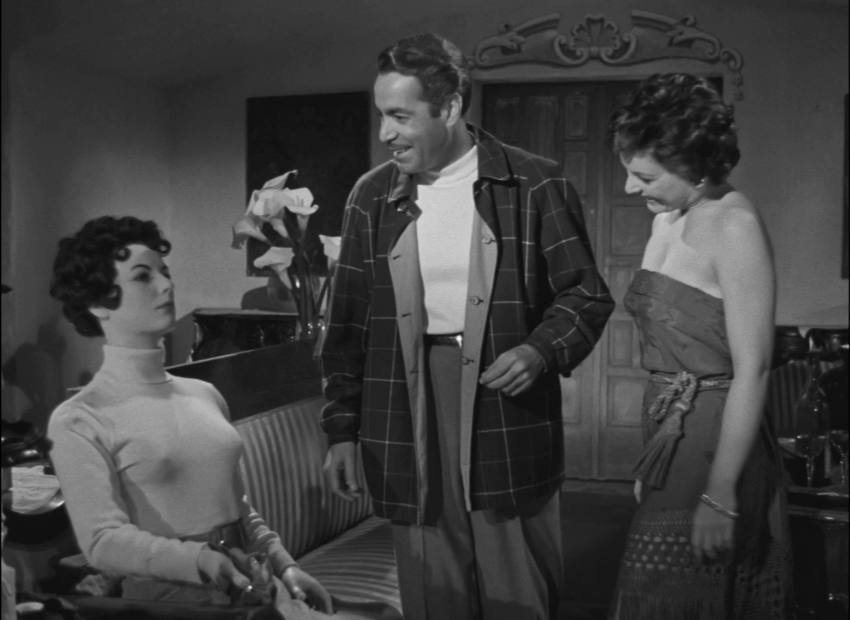
Whether The Criminal Life of Archibaldo de la Cruz (whose original Spanish title, Ensayo de un crimen, actually translates as ‘Rehearsal for a Crime’) is top tier Buñuel is up for debate, but three viewings in I was completely sold. It’s a richly entertaining, surrealist-tinged blend of crime drama and black comedy that for me is one of the highlights of the director’s uneven but always fascinating and often fruitful Mexican period. His penchant for filming even surrealistic elements as straight drama devoid of attention-grabbing camera moves or edits really pays off here, and while the ending can feel just a little too pat on an unprepared first viewing, the news that it was always scripted and intended by Buñuel and not a studio imposed compromise prompted me to re-evaluate what it might be slyly implying. In the end, it’s yet another unexpected turn in a tale that rejects convention and plays inventive and occasionally taboo-testing games with expectations, and the result is a real treat for fans of Buñuel at his most playfully mischievous.
sound and vision
Rather than paraphrasing the text that is displayed at the front end of the film about the restoration, I thought it more prudent to simply quote it verbatim, or at least as it is translated by the English subtitles:
The Restoration of The Criminal Life of Archibaldo de la Cruz is part of a project for the preservation of Mexican Cinema undertaken by Cineteca Nacional México. The film is owned by the Film Production Workers Union, and was restored by Laboratorio de Restauración Digital. The film was scanned from the original 35mm acetate negative. 129,589 frames were cleaned and restored. The sound was mastered from a composite positive print using the original optical sound negative to fill in any missing audio.
The results are generally impressive. Framed in its original aspect ratio of 1.37:1, the image here is clean and the detail is clearly defined, and while the contrast and brightness feels just a tad toned down, this does result in decent (if not always inky deep) black levels and ensure there are no burn outs on the whites. Overall, the tonal range is pleasing, and the daytime and late film nighttime exteriors are absolutely spot on. As you would expect with a modern restoration, the picture sits solidly in frame and is free of obvious signs of wear or damage.
The Linear PCM 2.0 mono track is also on point, the expected age-related restrictions in the tonal range not harming the clarity the dialogue, sound effects and music. If you crank the volume up, some slight age-related crackle can be heard in the quietest shots, but for the most part is lost beneath the ambient sound.
Optional English subtitles are activated by default.
special features
David Wilt on The Criminal Life of Archibaldo de la Cruz (26:44)
Recorded on his laptop camera as he reads from a script on its screen, this assessment of the film and Buñuel’s Mexican period by Mexican film scholar David Wilt is a really useful companion to the film, providing biographical info on the director and a few specifics about the more notable films from his Mexican period. Wilt examines how some of Buñuel’s favourite themes manifest in The Criminal Life of Archibaldo de la Cruz, which include multiple dysfunctional couples, criticism of religion, and surrealistic scenes that feel almost like fantasy. There’s also info on the lead actors, producer Alfonso Patiño Gómez, screenwriter Eduardo Ugarte, and source novel author Rodolfo Usigli, all of which was new to me and greatly appreciated.
Listed as separate special features are three video essays by Cristina Álvarez López, which were created for a film season titled Luis Buñuel: Aesthetics of the Irrational that played at the Institute of Contemporary Arts (ICA) in London between 12 November and 6 December 2015. Each is focussed on a different stage of Buñuel’s film career and consists of a montage of clips from three of his films from the period in question to illustrate the chosen topic of each. A few relevant textual quotes are included but there is no verbal commentary – López lets the clips and their juxtaposition do the talking. Essentially, these work best as introductions to key themes of Buñuel’s cinema and were likely aimed at relative newcomers to the director’s work. On that score, all three are of value.
Bunuel and Surrealism: Revolt Into Love (4:52) looks explicitly at the surrealistic aspects of Buñuel’s cinema, and while there is a huge well to drink from here, the extracts are confined to his early films Un Chien Andalou (1928), L’Age d’Or (1930) and Las Hurdes (1933). Related textual quotes from Buñuel (1958) and André Breton (1930) are also included.
Buñuel in Mexico: The Logic of Delirium (4:48) explores the controlling power of desire, religion and madness in the director’s films using extracts from Él (1953), Viridiana (1961) and Simon of the Desert (Simón del Desierto, 1965), plus textual quotes from Jean-André Fiesci (1972).
International Buñuel: Interruption as Method (5:28) is all about Buñuel’s fondness for interruption as a narratively disruptive tool, and features clips from The Discreet Charm of the Bourgeoisie (Le Charme discret de la bourgeoisie, 1972), The Phantom of Liberty (Le Fantôme de la liberté, 1974) and That Obscure Object of Desire (Cet obscur objet du désir, 1977), with textual quotes from Jonathan Rosenbaum (1972).
Buñuel’s personal script (BD-ROM)
This is interesting, although will likely be considerably more so if you’re fluent in Spanish, which I unfortunately am not. What we have here is Buñuel’s personal script from the shoot, presented not as pages in an on-screen gallery but as a PDF file and a folder full of JPEGs (take your pick) on the disc as a BD-ROM feature. That’s something I’ve not seen on a Blu-ray release for some time and does mean that if your computer doesn’t have a Blu-ray drive you probably won’t be able to access this one. For those of us who have, the convenience offered by having the script on PDF (I was able to transfer it to my iPad to skim through at my leisure) is something I personally found preferable to having the pages displayed on a TV screen. Although the Spanish text and Buñuel’s scribbled notes went over my linguistically limited head, there are still elements that grabbed my attention, not least the number of night shoots where the word ‘night’ (or at least it’s Spanish equivalent) is crossed out to be replaced by a handwritten ‘day’, signifying a change that may or may not have been forced on the director by circumstance.
Booklet
Leading the way here is an essay by Jordi Zifra, a professor at the Universitat Pompeu Fabra in Barcelona, and director of the Centro Buñuel Calanda, a foundation dedicated to the preservation and dissemination of the work of Luis Buñuel. It’s a detailed, meticulously researched and hugely informative piece that covers the origin and development of the project, as well as original novel author Rodolfo Usigli’s falling out with Buñuel and unhappiness with the finished film. It also delves into the film itself with the sort of perception and knowledge of the filmmakers that leaves my humble assessment looking seriously anaemic. It includes quotes from Buñuel, Usigli and Usigli’s former wife Argentina Casas, and the information provided about the ending and Zifra’s own assessment of it was what prompted me to give it a second and third look with his words in mind.
Also included is a welcome introduction to the above-detailed video essays, as well as a brief but educational essay on the thinking behind them by their creator, Cristina Álvarez López.
final thoughts
For reasons I cannot fathom, despite being a longtime fan of Buñuel’s cinema I’d somehow never caught The Criminal Life of Archibaldo de la Cruz before the arrival of this Blu-ray, and three viewings in I’m with those who believe it’s one of the best of the director’s Mexican films. A blacky comic gem of a premise develops as an oddly beguilingly, off-the-wall relationship drama with a would-be serial killer at its centre and satirical and surrealistic elements that have the director’s stamp all over them. A handsome restoration and transfer, a small but well-targeted set on on-disc special features, and an excellent booklet essay by Jordi Zifra, make this an absolute must-have for fans and students of this distinctive filmmaker’s work.
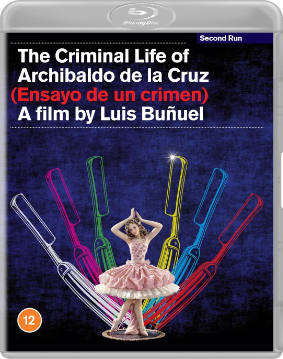
The Criminal Life of Archibaldo de la Cruz [Ensayo de un crimen]
Mexico 1955 | 91 mins
directed by: Luis Buñuel
written by: Luis Buñuel, Eduardo Ugarte; from the novel Ensayo de un crimen by Rodolfo Usigli
cast: Ernesto Alonso, Miroslava, Rita Macedo, Ariadna Welter, Andrea Palma, Rodolfo Landa, José María Linares-Rivas
distributor: Second Run
release date: 8 June 2026
- If the plot seems to anticipate the Italian giallo thrillers of the 1960s and 70s, check out the original poster, which may be the most giallo-looking poster for a film that is not a giallo at all: https://en.wikipedia.org/wiki/The_Criminal_Life_of_Archibaldo_de_la_Cruz#/media/File:Ensayodeuncrimen.jpg[↩]
