
Green Finch
In April 2026 a decidedly ‘not’ new version of David Fincher’s ALIEN3 started streaming rebranding itself from the 2003 ‘Special Edition’ to ‘The Assembly Cut’. Camus has always had a soft spot for the less regarded of the franchise but now he has two versions to choose from… The Assembly Cut or the fan-made Legacy Cut…
“I think that what we have done is to capture a snapshot of the film in the state it was in before it really got interfered with in post-production before it got taken out of Fincher’s hands. What you are seeing [in The Assembly Cut] is a reconstruction of the direction (in which) the film was going. So this is the first cut of the film after development hell and after production hell but before post-production hell.”
Charles de Lauzirika
Preface
Due to the subtle hype of the recent release of The Assembly Cut, I got suckered into believing that this was a ‘new’ version of Alien3. I’m sure that wasn’t the intention (ahem) so why rename it? When I saw shots I believed I’d never seen before, I was convinced I was seeing cut material released from being sealed in film cans since 1992. Not so. I had seen what was then known as 2003’s The Special Edition six years ago (so evidently I’d seen what I thought I hadn’t) and even at that time I responded well as emails to Slarek will attest. It’s always a thrill to see a famously maligned work reinstated to some degree. For completists’ sake, there is also a Legacy Cut out there, finished last year, fan made, in 4K can you believe, using both official cuts as sources and ‘new’ material with an overall re-grade especially to improve the rod puppet composite work that was clearly lacking in the original iteration post-produced in the dark ages known as the photo-chemical era. There’s a brief comparison of both versions at the tail of the following review.
No disrespect intended to David Fincher, one of my most admired filmmakers, but the title of this review was simply to imply that as a first time director, he was at the mercy of a crushing persistence of studio interference. I even read a comment from a 20th Century Fox executive that described Fincher as a ‘shoe salesman’ after finding out their new hot shot director had made commercials for Nike. As far as the Alien franchise was concerned, directors having made commercials seemed to be de rigueur. Ridley Scott had shot a thousand of them before taking on The Duellists and Alien. I’m not going to go into the sheer hell of Alien3’s genesis, its elongated pre-production and the number of directors and writers it chewed up and spat out along the way but I will say that whoever got the gig was playing a game rigged from the start. The intellectual property (what a highfalutin, pompous term that is) had already enjoyed great success with a ‘Boo!’ horror movie (beautifully designed and dread inducing) and an out and out balls to the wall action movie with an added and wildly impressive alien queen. Where could the third one go? Google ‘alien’ and ‘Vincent Ward original screenplay’ and imagine what an Alien3 film might have been (commercially unviable perhaps but potentially and artistically resplendent – the alien as Satan). After seeing Alien3 in 1992, I thought aliens on Earth would have to be the thrust of the next movie iteration. If there was to be a next one. It took until late 2025 for that idea to bear fruit in the TV series Alien: Earth. What resulted from all this pre-production umming and ahhing was a vulnerable and lace-thin compromise. With elements from many story ideas lumped together, the need to use sets built for other iterations of the script and taking the star’s dictum – understandable after the sequel – “No guns,” poor David Fincher had a lot to overcome. Imagine being a first time director having no completed screenplay to shoot. As one of the production executives, Jon Landau said in one of the DVD ‘Making of’ featurettes, “We set out to make a release date and not a movie.” You got the feeling that Alien3 really didn’t know what it wanted to be. Fincher disowned the project in post-production and the theatrical release was not received well despite making a significant dent at the global box office with a profit of about $30 million.
In 2003, renowned ‘Making of’ filmmaker, Charles de Lauzirika, pieced together an earlier cut of the film with Fincher’s blessing (as long as it was in no way called ‘the director’s cut’ as no such version ever existed). It had technically unacceptable sections but was released as part of the Alien Quadrilogy box set. Since 2010, it has since been significantly cleaned up with cast members rehired to perform additional dialogue and added effects which one presumes means a few digitally aided effects shots, technology unavailable to the filmmakers at the time. There’s one shot of the ox-burster young alien walking away which I was convinced was CG because it looked so good. I later learned it was a full size puppet performed on the set with a whole army employed to matte and rotoscope out the human puppeteers. It seems I was wrong about that and my first instincts were correct. See the first footnote.1
The Assembly Cut exists in its own right as a close to two and a half hour, completely different movie. And I cannot tell you what a thrill it is to see this version (again) as a standalone interpretation of what might have been or what was on the way to becoming. Fincher was so badly burned by his experience that even now he playfully refuses to engage with anyone on the subject or even mention the film by name. But original editor Terry Rawling’s assembly, on which I’m sure this cut is based, lives on. In editor’s jargon an ‘assembly’ is a cut version of a film including all of what was shot based on the screenplay. First assemblies are inevitably long. The first assembly of Michael Cimino’s Heaven’s Gate was five hours and 25 minutes… I imagine that that one’s not coming to any streaming channels too soon. And why did United Artists big wigs not blanche at a presumably 325 page screenplay? Yes, I’m being facetious. But do read Final Cut: Dreams and Disaster in the making of Heaven’s Gate. It’s quite a story. But the theatrical cut of Alien3 virtually screamed out that additional material had been brutally excised. It’s just so satisfying to get a glimpse of Fincher’s process and what might have been even if the most beautifully carved and ergonomically superior barge pole had been offered for him to retouch it after all these years. I do not blame him for passing on that opportunity.
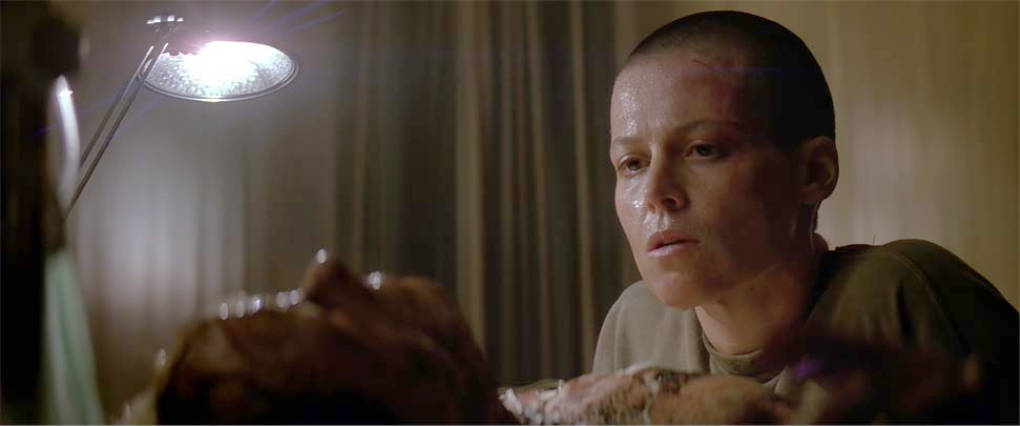
So what’s the compromise… sorry. What’s the story? After Aliens, marine Corporal Hicks and nine-year-old Newt die in the crash landing of the Sulaco on the prison planet Firorina – nicknamed ‘Fury’ – after an alien facehugger makes its presence felt in the evacuation ship in more ways than one. Given the speed and impact of the crash (at that velocity, water may as well be a brick wall) it’s a leap of faith that Ripley managed to survive it. The deaths of the sequel’s survivors were always going to be controversial but almost inevitable if Ripley was to take front and centre stage again… And besides, Newt (Carrie Henn) would have been six years older and unrecognisable as Ripley’s nine year old daughter substitute. Ripley, covered in black grime and lice, is found washed up on a coal blackened shore by Clemens, a former inmate and now the prison planet’s doctor. He befriends her while the universally bald inmates start to suffer mysterious deaths from a creature born from a dead ox. Don’t worry, it makes sense. Believe it or not, there’s even a scene with a little humour between Ripley and Dillon that starts with Dillon asking if Ripley misses the doctor… Apparently religiously committed, the dodgy, devout and very criminal inmates now have to find a way of trapping or eliminating an alien threat that threatens to wipe them all out. Meanwhile, our heroine is dealing with a very personal crisis that needs resolving… And it’s not going to end well. That’s all you need to know.
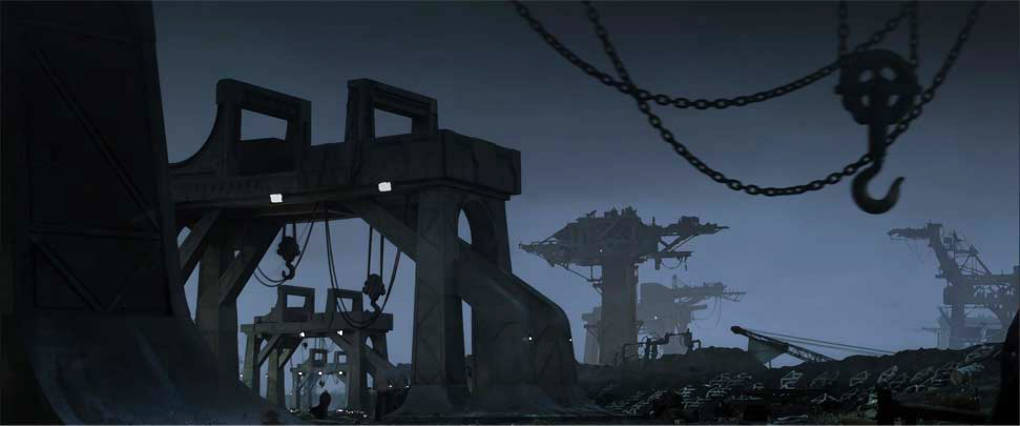
There is a clue in the first moments as to the origin of this particular cut. The original Alien and Alien3 editor, Terry Rawlings, loved his dissolves, the blending of an outgoing shot into an incoming one, the longer the better. Editors tend to use dissolves either to indicate the passage of time or for some bespoke aesthetic reason. They are extensively used by amateur filmmakers to hide dodgy cuts or to minimise the thought necessary to achieve the result they desire without a dissolve (also known as a mix). I tend to avoid dissolves professionally unless there is a better than great reason to employ them. At the opening after the crash, (which, as I mentioned earlier, would have pulped all three survivors into a lifeless mulch) there are several gorgeous shots (dark, industrial, foreboding, yes, those adjectives too) of cranes on cliffs overhanging a beach. Revise what images the word ‘beach’ may conjure up. Only a masochist would go on holiday here. Rawlings (I presume if this cut is based on his work) chose to use several two second dissolves without a cut until we see a lone figure, Clemens and his point of view of a body in the surf. You could say those short transitions lent the towering machinery some sense of awful grandeur, an atmospheric claustrophobia. I think Terry just loved his dissolves. The entire once-deleted scene of the oxen pulling the evacuation pod about is also welcome. The first knee jerk executive decision on most films in trouble is to get to the action as quickly as possible. You could argue that the moody opening wasn’t a thousand per cent necessary but the essence of those shots is in the word ‘moody’. Whatever film you’re making, you have to set up the world of the narrative and in Fury 161, this was literally a new world. It helps to get a sense of what its character is. In the Assembly Cut, this is established elegantly, leaving the Theatrical Cut rushed and wanting.
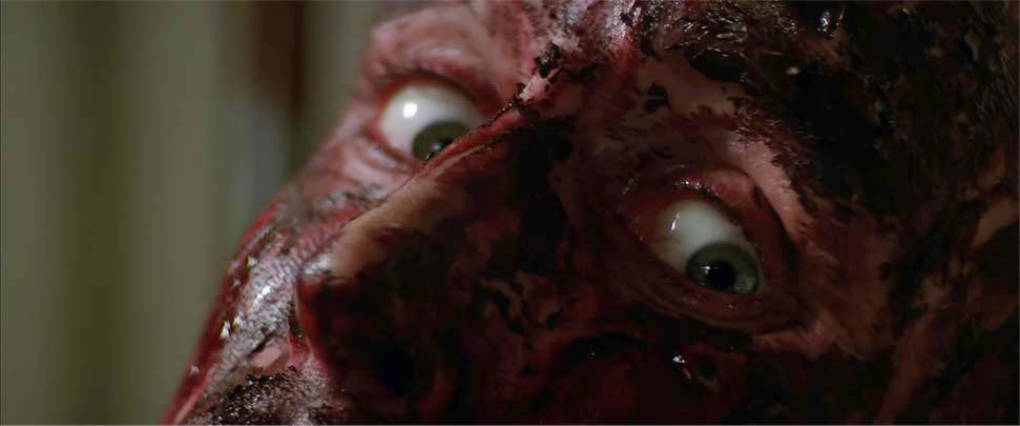
One thing the extra 30 minutes does is delineate characters who before had mere seconds of screen time. Yes, it was unhelpful to audiences to have mostly white bald men in similar clothing so you never really recognised or invested in anyone except the leads. But here, blood-splattered Golic is well defined and even has an arc. OK, you still don’t have a lasting impression of them except as a group of scared men but now it’s satisfying to recognise a few faces among the inmates of this far-flung correctional facility. Let’s start with Golic and his relationship with Aaron, or 85 as he is known due to his low IQ. I’m not sure the characters have any dialogue scenes together but there is a connection. It would have been made obvious if Fincher had snared his first choice for Clemens, the doctor/inmate now played very sympathetically by the ever-dependable Charles Dance. Richard E. Grant was unavailable shooting the equally difficult shoot of Hudson Hawk. But imagine getting Grant, Paul McGann (Golic) and Ralph Brown (Aaron/85) reunited in a scene in Alien3. Have you twigged? Fincher was a big fan of a certain cult classic. Withnail, Marwood (or ‘I’) and Danny the drug dealer, all in an alien movie together. That would have been priceless. Fincher would not have resisted Grant’s response to the alien… “The fucker will rue the day!” You cannot mistake Pete Postlethwaite with anyone else and with just one well-chosen expletive, Danny Webb makes his mark. The ever-dependable Brian Glover plays the warden, Andrews with well-polished command and control until something nasty red rains on his parade. There’s Fincher regular (or soon to be regular), Holt McCallany as Junior, the principal would-be rapist. He went on to play the Mechanic in Fight Club and Bill Tench in Fincher’s superb series Mindhunter. In this cut of Alien3 he too gets an arc, one of sacrificial redemption after the sin of attacking Ripley. It’s great to see Clive Mantle on the big screen after his Nuclear Man got completely cut out of Superman IV. He’s fondly remembered by this particular writer for his work on the Radio 4 comedy series, In One Ear. And speaking of ears, I remember he once tried to quiet some hotel guests down and ended up in casualty getting one of his own ears sewn back on. He’s probably best known as, ahem, Casualty’s Dr. Barratt. Finally, with hardly any screen time in the Theatrical Cut, there’s Niall Buggy. I didn’t even clock him in the Theatrical Cut but here he drops a load of plates shocked by Golic’s gory appearance and it suddenly dawned where I’d seen him before… so memorable as alcohol-haunted TV Host Henry Sellers in an episode of Father Ted. Lastly, take a look at the character in wide shot holding on to Newt’s corpse’s legs before dropping it into the furnace. Blink and you’ll miss him. It’s one of the special effects artists standing in for an actor who didn’t turn up. His name is Philip Sharpe and he also happens to be a very good friend of mine and he worked on the film directly with Fincher a lot of the time. Maybe his recollections can follow this review in another article.

Can I just say that Fincher shoots the very best close ups? Sprinkled throughout the autopsy early on are sublime shots of scalpels, bone saws and bloody aprons that for some reason always seemed so horribly compelling to look at. On subsequent viewings of the film, I used to look forward to those short, effective close ups. There is one that has, however, always bugged me. In the opening montage intercut with titles, there’s a shot of presumably alien acid dissolving a surface or floor of the space craft. There’s not been a lot of effort to disguise the fact that the surface is plain polystyrene responding to one assumes real acid. I can’t imagine Fincher signing off on that particular shot. At least paint the bloody thing. This shot is mentioned in the commentary of the Special Edition, aka Assembly Cut. I cover that later.
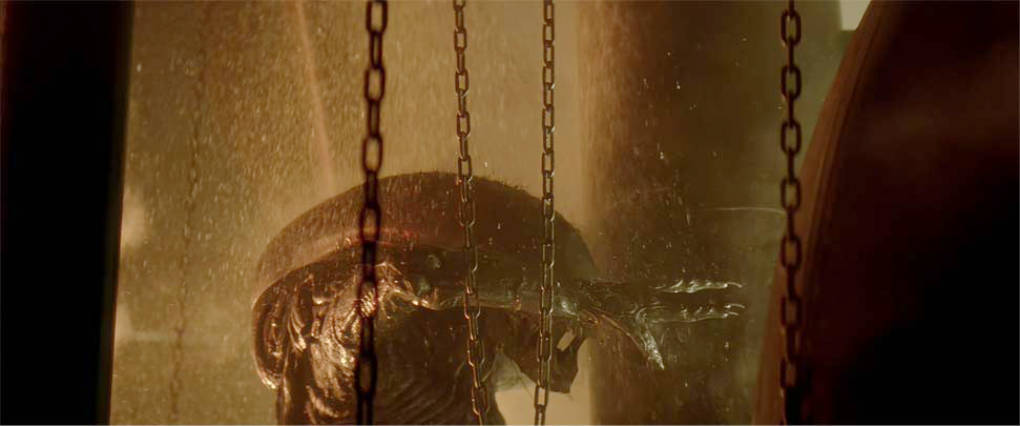
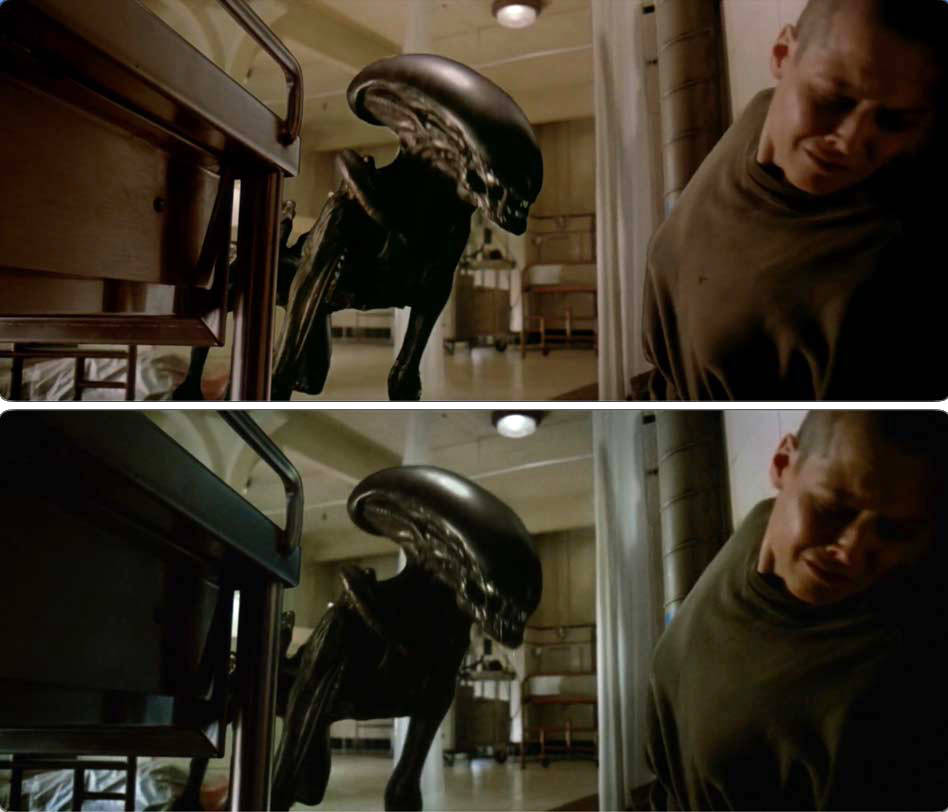
The alien man-in-a-suit works very well, fast cut and full of action wreathed in smoke and particulates. There is no other practical way to shoot the alien unless you want the creature to do something new. Even in the original Alien, you very rarely see the creature in full and when you do, its ‘man-in-a-rubber-suit’ reality pulls you up short. In Alien3’’s case, the alien was to move like a jungle cat in some instances and able to defy gravity the way an insect clings to walls and ceilings. Something new was required to get that insectoid movement Fincher wanted to capture. While the real-time animation of the miniature rod puppet is expertly executed, visual effects had not sufficiently evolved which meant compositing photo-chemically was always going to be the real challenge. By shooting against bluescreen and rotoscoping out the puppeteers, you get the isolated alien and while in some shots it zooms through frame so fast allowing you no chance question the result, it’s when you see longer shots where the matte lines become visible and the creature often has a different contrast to the rest of the elements shot practically. For the 4K Legacy Cut version of Alien3, the immersion of the visual effects has been partially remedied… The young visual effects artists on the always entertaining YouTube channel, Visual Effects Artists React** were gently critical of Alien3’s visual effects (the word they use, I believe, is ‘janky’) but then they grew up with digital ruling the roost and never had to have the mindset that could deal with a film-only optical workflow. The effects artists whose shoulders the boys at Corridor Crew proudly stand on toiled in a completely different professional environment, a fact the young guys, to their credit, acknowledge all the time.
Fincher is a fascinating director and of course continues to be. His oft-reported multi-takes approach owes more to orchestrating camera movement and performance synchronicity than it does to Kubrickian meticulousness. There are interesting studies of how Mindhunter draws you in and of Fincher’s direction by Thomas Flight here*** and the second by Nerdwriter1 here,**** both well worth a look. The real camera movement in his first feature that stands out is the rapid POV of the insectoid/big cat alien and we see a lot of such shots. I’m sure this wasn’t Fincher’s homage to Spielberg as in “if you can’t show the star of the show, then show its point of view or something associated with it.” The problem with the Theatrical Cut was that bald men in similar clothes running around corridors can get an audience lost and disassociated with the jeopardy. Spending more time with the characters reaps benefits in making the action more compelling.
Eliot Goldenthal’s first class haunting score is dark, cold, somewhat epic and serves the film very well. There’s just a spotting hic-cough (spotting is when a composer and director agree on what scenes need music and what scenes don’t). There’s a moment in the climax where you are supposed to think that the threat is over but if you’ve been watching movies all your life, you know that this cannot be it… There has to be a more satisfying conclusion just around the corner. Well, the score tries to convince us that it’s the real ending when we know that it isn’t. The success fanfare starts oddly way too late and the more the score is saying “It’s over,” the more convinced I was that it wasn’t. That’s the only time the score felt off. For the real human climax of the film, Goldenthal’s work is sublimely moving. I also enjoy it when filmmakers screw with their studio’s logo and fanfare. Maybe The Simpsons Movie will always be the funniest but what is done to the last bars of the 20th Century Fox logo at the start of Alien3 is a grim descent into hell. There’s no way the editing can be assessed with so many fingers in the pie but as an acceptable rendition of Terry Rawlings’ work, this has to be close. Making the alien scary is difficult enough but if you want to see Rawlings hitting a home run, re-watch Brett’s walk through the industrial belly of the Nostromo looking for the goddamn cat up to the grim moment he’s hoisted aloft by the barely seen creature in the original Alien. This is Rawlings’ firstassembly, one that stayed locked in place. I still remember the clarity and suspense of the water drops sound effect spattering on the peak of Brett’s cap. That’s a 47 year old locked in sensory memory that is never leaving me. If I had a gripe, it would be that having his brain smashed in by an extendable alien jaw might not allow him to cry out as he is hoisted aloft. Brett is dead. And he can scream all he likes…
If you’re an Alien fan and happy to take in sequels, then you have already seen The Assembly Cutmasquerading in 2003 as the Special Edition. There are bootleg cuts out there too but unofficial and of varying quality. But, as I mentioned, there is another significant cut out there… 4K no less, free and the cut that probably had me believing Alien3 had had yet another makeover. Because it had… To quote Google “Alien3: The Legacy Cut (2025) is a highly regarded, fan-made 4K restoration and edit, developed over five years by Project A34K (geddit?) to blend the best elements of the Theatrical and Assembly cuts. It features extensive, frame-by-frame visual effects improvements, updated audio, and refined pacing, focusing on improving the rod-puppet creature effects.” So, is it worth the hype? Spoilers ahead.
For an Alien fan, the Legacy Cut has much to delight with a small caveat. While I’ve not played both the Assembly and the Legacy Cuts side by side all the way through, I’ve certainly examined lots of parallel scenes and the differences are many. You get a thrill when you come across shots that were never in either official cuts of the movie. I saw at least one effects shot that was cut out (the alien scuttling out of its containment after killing Golic) but for the most part subtle grading on the rod puppet shots mean they integrate much more realistically than in the Assembly Cut. Certain rod puppet shots have been shortened for perhaps good reasons and drool has been added, one assumes digitally, something extremely difficult to add to the rod puppet shots if not impossible in the pre-digital era. The alien erupts from out of a dog not an ox and the creative decision that forced this change was so that the alien would be imbued with its host’s speed and aggression. Oxen tend to be slow so you can understand this change. Perhaps the most surprising feature of the Legacy Cut is the inclusion of the alien queen erupting out of Ripley on her suicide fall which Fincher and Rawlings always felt took something away from her sacrifice. Seeing Ripley fall in the Assembly Cut featured a double printing of frames that gave her fall a juddery look which always bugged me. The less than visually stellar molten lead effect she gets swallowed by is completely re-done in the Legacy Cut and features what appears to be a digital double of Ripley falling into the molten lead clutching her alien offspring.
The small caveat I mentioned earlier is in no way meant as a criticism of the evidently talented fans who have made the Legacy Cut possible. To have a 4K version of this blighted production at this high a standard with new surprises is a potent thrill. But Fincher’s retrospective view on the project after he signed on the dotted line was that, and I quote, “I signed up, naïve and went off to Pinewood to be sodomised ritualistically for two years…” It is a film he walked away from. Considering his words, perhaps he limped away from it. There is no ‘director’s cut’ and probably never will be. There are no credits on the Legacy Cut that point to the people who made the creative decisions across the board during its new 2025 post-production. I’m not saying that there should be but Alien3: The Legacy Cut is a dream for fans made by fans with such respect, love and devotion but it has no artistically authentic provenance. It’s not Fincher’s cut. And can never be. And that will always be the sticking point in being able to appreciate what might have been. But hats off to those at Project A34K who made this cut possible. How the team got access to original rushes or 4K scans of never officially used shots and scenes points to a level of co-operation from 20th Century Fox (or subsequently from Disney) that seems miraculous. Add that the team seemed to be allowed to make their version of a movie from an well-known IP freely available***** – again, another small miracle… Hollywood doesn’t do free, especially regarding a variant cut of a film from an established franchise.
Lastly, one more thing in the same spirit of mild frustration we all have at Outsider when we’ve come up with personal observations in one of our reviews only to find the same observations in the extra features of the disc we are reviewing, Slarek pointed me to two Alien3 related YouTube videos by the same person under the name of Alien Theory and his take on The Legacy Cut is almost identical to mine. But I offer that video here****** for completist’s sake.
Assembly Cut Commentary Highlights
Slarek discovered that the Assembly Cut (known in the Blu-ray as the 2003 Special Edition (Restored Workprint Version) was in both our Blu-ray collections and had been for fifteen years in my case and finding out that there was a commentary sent me scuttling to the impressive 2010 Alien Anthology Blu-ray Box Set. I was hoping to get horse’s mouth information from a variety of sources which I did to a degree but not the confirmation that Terry Rawlings was actually responsible for the Assembly Cut, which seems a reasonable assumption. I imagine Charles de Lauzirika shepherded and oversaw the post-production refinements and let it into the world but these are suppositions. I imagine the commentary was taken from the original Theatrical Cut and outtakes placed over some ‘new scenes’. Most of the new material has no commentary.
Commentaries cut and pasted from several people’s (one assumes) full commentary tracks, while entertaining and informative, always leave you wanting more. Editor Rawlings doesn’t get much of a chance to really fill out his own story of the film, one at which he was present for the whole time but contributions from the others are lively and in some places, pretty dark.
From Editor Terry Rawlings
He was thrilled to be working with Fincher and also frustrated that the Front Office at Fox never let Fincher complete the film in the UK. He loved the cinematographer Alex Thomson who had worked on Ridley Scott’s Legend which Terry also cut. He mentions executive producer Edward Swerdlow in a less than glowing light, one of the two producers who apparently dogged Fincher on set for a lot of the production. The director and editor would make a list of scenes and shots needed to make the story work, labelled them A to H and the Front Office would peruse this list and name the ones they were prepared to commit to… “A, D and F!” What a way to make a movie.
Special Effects talent, Boss Films’ Richard Edlund and Studio ADI’s Alec Gillis and Tom Woodruff Jr. (the latter starring as the alien)
Ha! So there was some embarrassment at the obvious Styrofoam floor shot! Apparently there was another take with the white dirtied down with dust. What space ship is made of Styrofoam, they ask. Edlund said it was less like filmmaking and more like crisis management. Fincher simply didn’t know what was coming next.
There was some talk of the film being released as a Christmas movie. Can you imagine? It starts with almost everyone dead and gets worse from there. Gillis and Woodruff Jnr. took the mock up of Newt’s autopsied corpse, dressed it in the snow and made a Christmas card for Fincher out of this grisly image. Nice. To save Charles Dance’s back, they created a Sigourney Weaver dummy. They also answered why so many American filmmakers come to the UK. A British accent is good for any movie and British designers and set builders are some of the best in the world. Woodruff Jnr., in the alien suit, remembers when the crickets got in and made his long, long shooting days a living hell. The charming Charles Dance had to have a replacement head made so the alien could smash his skull in. That involved maintaining a scared expression while being covered with alginate gel. Dance seems to be the one man on the crew that everyone loved and respected. It took 70 takes to get the eruption of the ‘Bambiburster’ alien from the animatronic ox. That’s a lot of work to throw away as the dog subsequently replaced the ox.
Cinematographer Alex Thomson
Fincher showed no weakness, he was confident and wouldn’t be swayed. He clearly was eventually ground down by the suits. But what is the point of employing a director if you don’t let him have creative freedom? Thomson enforces the opinion of the FX team that Charles Dance was a gentleman who knew everyone’s name including the tea boy’s. Thomson’s contribution includes a lot about the lighting (naturally) and his insights are well worth listening to, especially for budding camera people.
Actor Paul McGann (Golic)
McGann never mentioned the Withnail connection which I was disappointed by. Maybe in his longer commentary? He mentions that there were “characters moving around watching Fincher and watching us.” He notes how energetic Fincher was at the outset and how exhausted in LA he was at the end. He also appreciated Fincher’s cineaste credentials (he’d describe his shots in terms of older, revered director’s styles), and his love of actors, the latter not a trait of all directors. He got the impression that Sigourney Weaver was more at home on stage than in this film lark. He’s thrilled that Fincher had been vindicated and that Alien3 in whatever version is now more appreciated. And from an actor’s point of view, he notes with some insight that performances, good or bad, are created in the cutting room. Hear, hear.
Lance Hendrickson
Poor Lance. He saw the film and was shocked by how grim and depressing it was. He’s not wrong there, Ted. He has very little commentary time.
Postscript:
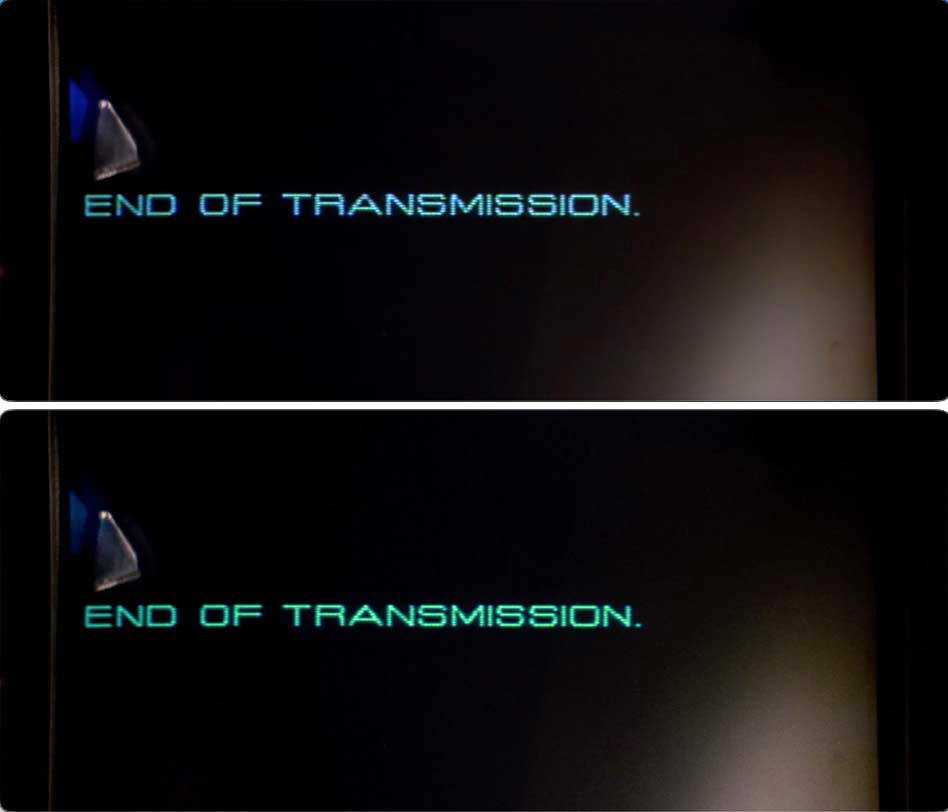
Here are a couple of selected frame grabs, Assembly Cut on top, Legacy Cut below. As you can see, an overall teal grade dominates the Legacy images. Yes, the images are darker because of it but the rod puppet effects shots benefit immeasurably from this tweak. Notice the added CG saliva. The people at Project A34K who lovingly assembled this cut obviously are connoisseurs of David Fincher’s work perhaps reacting to the director’s quote “It’s not a love of green so much as a hatred of pink.” This stemmed from Sony television sets that were designed to emphasise a rosy, ‘healthy’ colour palette (perfect skin, perfect life), something Fincher reacted and continues to react strongly against.
Alien3: The Assembly Cut
UK / US 1992 | 144 mins
directed by: David Fincher
written by: David Giler, Walter Hill, Larry Ferguson; Vincent Ward (story); Dan O’Bannon, Ronald Shusett (based on characters by)
cast: Sigourney Weaver, Charles S. Dutton, Charles Dance, Paul McGann, Brian Glover, Ralph Brown, Danny Webb
UK distributor: Twentieth Century Fox
Theatrical Cut UK release date: 21 August 1992
- So I saw the shot, was convinced it was a computer generated character and then saw footage of the puppeteers manipulating a full size puppet and marvelled… Until I watched Wren on Visual Effects Artists React inform me that it actually was a CG character ‘fixed’ in 2003. Phew. Ah! There are my marbles…[↩]