
Mississippi Mermaid
François Truffaut’s 1969 thriller MISSISSIPPI MERMAID [LA SIRÈNE DU MISSISSIPI], starring Jean-Paul Belmondo and Catherine Deneuve, is released on Blu-ray by Radiance. Review by Gary Couzens.
Louis Mahé (Jean-Paul Belmondo) owns a tobacco factory on the French overseas department of Réunion, in the Indian Ocean. He places an ad for a mail-order bride and along comes Julie (Catherine Deneuve). Louis is enraptured by Julie’s beauty, but it soon becomes clear that there is more to her than at first appears. And when she disappears without trace, taking most of Louis’s money with her, Louis is determined to track her down.
Mississippi Mermaid (La sirène du Mississipi – sic, but apparently not an error as the French rendition of the US state and river is without one P) is a lightweight diversion in François Truffaut’s career. It came about because when Truffaut travelled to New York to negotiate with Cornell Woolrich over the rights to The Bride Wore Black (La mariée était en noir, 1968), he came away not only with those but that of another novel under the William Irish pseudonym, Waltz into Darkness (1947). Woolrich died in 1968, so did not see the finished film. While Truffaut had had plenty of acclaim over the past decade, his films were not always especially commercially successful. That was true of the rest of the New Wavers: in fact, Truffaut was to have by far the biggest box office hit of all of them, at least in France, with The Last Metro (Le dernier Métro, 1980). In between the two Woolrich/Irish adaptations, Truffaut had run for cover somewhat by returning to his alter ego Antoine Doinel (played again by Jean-Pierre Léaud) in Stolen Kisses (Baisers volés), a film made during “les événements” of 1968 but almost entirely apolitical. The Bride Wore Black had been an intentional genre piece to earn Truffaut’s production company some much-needed funds, and much the same was true of Mississippi Mermaid. As such it wasn’t unsuccessful, at least in France if not elsewhere.
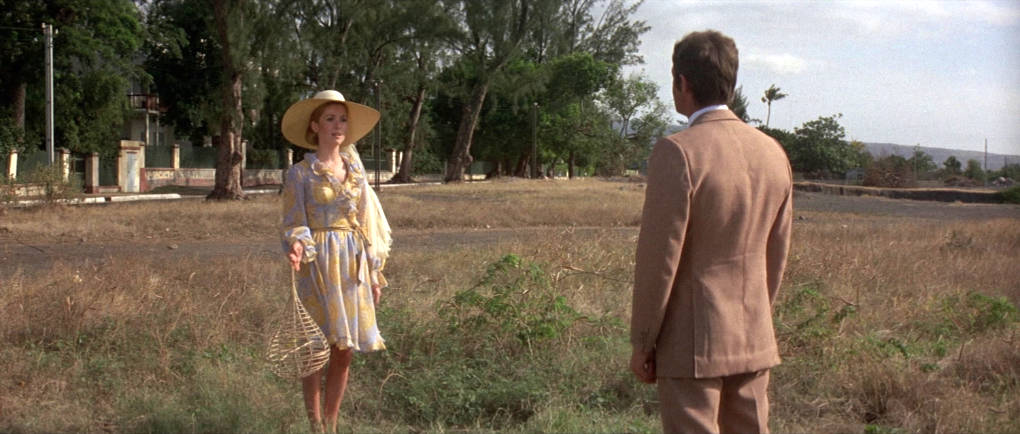
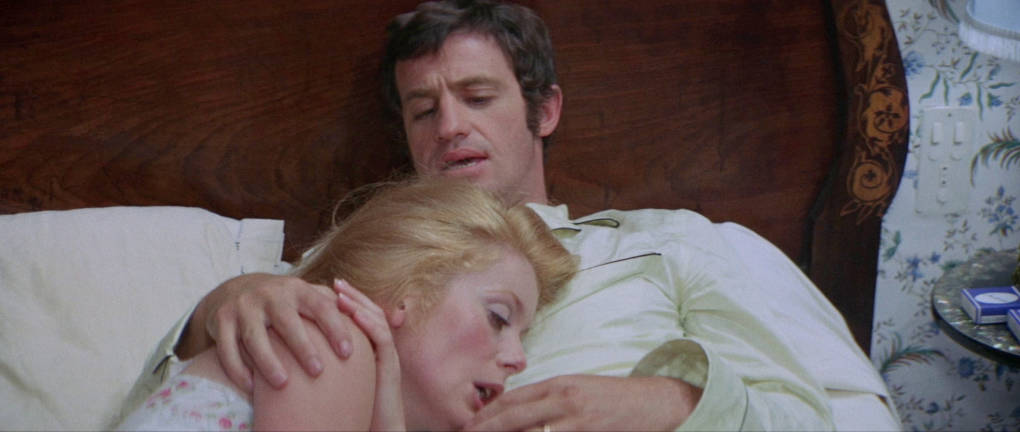
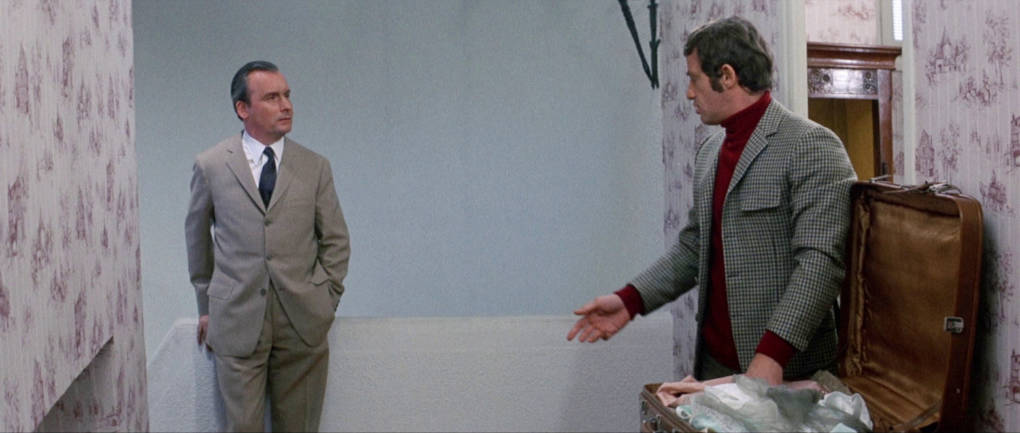
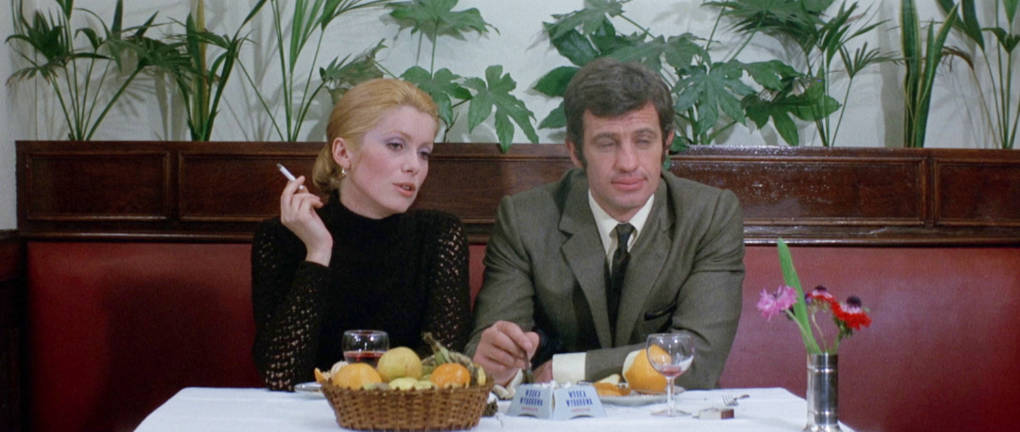
In plot terms, Mississippi Mermaid is prime film noir, showing the corruption of a man’s soul with the help of a femme fatale. But in Truffaut’s hands it’s an indulgence: two glamorous stars at the peak of their glamour, lush widescreen photography, occasional bursts of action, a couple of brief Deneuve topless scenes to give the film an air of late-sixties sauciness, not to mention some in-jokes. (Michel Bouquet’s private detective, Comolli, is named after the then editor of Cahiers du Cinema.) The higher than usual budget allowed for shooting overseas, including on Réunion. After Truffaut had fallen out with Raoul Coutard on The Bride Wore Black, Denys Clerval had taken his place as cinematographer on Stolen Kisses and he returned for Mississippi Mermaid, their final collaboration.
Deneuve is perfectly cast as a Hitchcockian ice queen with passions under the surface, and even has the blonde hair for the part. She was dressed by Yves Saint-Laurent, who had previously provided her costumes for Belle de jour in 1967. Belmondo seems miscast, though. He was ten years older than Deneuve and, while he certainly could play vulnerability on screen, the plotline makes him seem weak rather than morally conflicted. So as such the film never really catches fire.
The film is dedicated to Truffaut’s acknowledged mentor Jean Renoir. After the opening credits, and a map helpfully pointing out Réunion’s location (if we didn’t know already) we have an extract from Renoir’s La Marseillaise (1938) before the dedication appears and the film starts.
Truffaut had been a famous Hitchcock devotee from his days as a critic, and he conducted a book-length interview, published in 1966, which stands as one of the great film books of its type. Yet this was not the only case where master and pupil had sensibilities which did not match. Truffaut was far warmer and less cynical and ruthless than his idol, and his films where he is emulating him to some extent are not among his best. (Compare the pair with Cameron Crowe, who also produced a book-length interview with his own idol Billy Wilder, published in 1999. There the difference in sensibilities was if anything even greater. While Crowe was not on Truffaut’s level, he did have a good run as a director, in particular from Say Anything in 1989 to Almost Famous in 2000, but his strength was more as a writer.) Mississippi Mermaid is an agreeable divertissement for the two hours it’s on, but it tends to fade rapidly in the memory. It’s not one of Truffaut’s most lasting works but it’s certainly worth a look for his admirers.
Waltz into Darkness was filmed again in 2001 as Original Sin, directed by Michael Cristofer and starring Antonio Banderas and Angelina Jolie. This film retains the nineteenth-century setting of the novel, though is set in Cuba under Spanish rule. It had mostly bad reviews, but as I haven’t seen it, no further comment.
Released in France on 18 June 1969, Mississippi Mermaid was the sixteenth highest-grossing film in France in 1969, but was generally regarded as a disappointment. That was reflected in its fate in the UK. Up to that point, Truffaut’s eight previous features had all seen the light of British projector lamps in a reasonable time period, if mainly in arthouses due to being in French with subtitles. The English-language Fahrenheit 451 may have played wider, but I’ve been unable to trace a showing of it in my then local cinemas between 1966 and 1968. Mississippi Mermaid broke that streak. Although it was submitted to the then British Board of Film Censors in 1970 in a version shortened by fourteen minutes (of which more below), it wasn’t released until 29 April 1974 (a Monday) when the Everyman cinema in Hampstead premiered it, in not only that shortened version but one dubbed into English as well. The film received its television premiere on Channel 4 on 2 September 1989 as part of a Truffaut season. Given the channel, it may well have been presented in French with subtitles and may have been at least partially letterboxed (I didn’t see it, so I don’t know) but given that it was in a two-hour slot including commercials, it would seem to have been the shortened version. Mississippi Mermaid finally received British commercial distribution at full length, with subtitles and in its intended aspect ratio, with the DVD release of 2003, which was the first time I saw it. And now it is on Blu-ray.
sound and vision
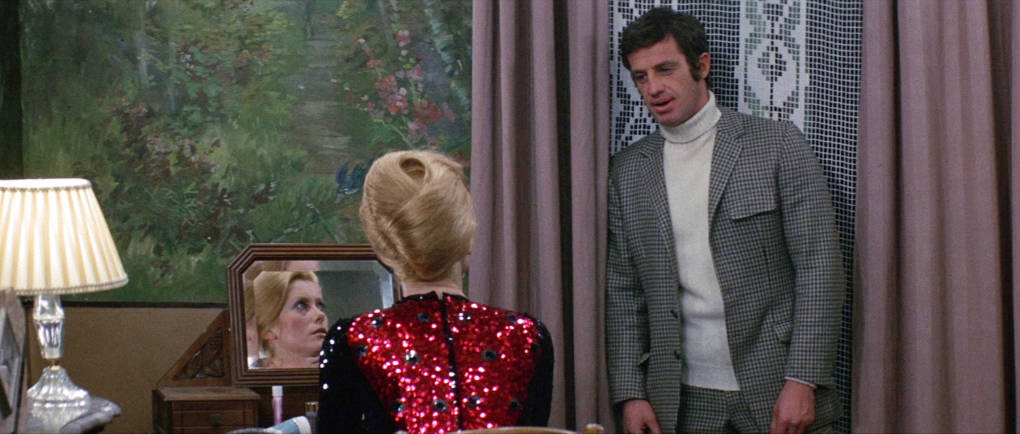
The film was shot in 35mm colour and with anamorphic lenses, in the Dyaliscope process. The Blu-ray transfer is in the intended ratio of 2.35:1. Truffaut had shot his first three features and the short Antoine et Colette (part of the portmanteau film L’amour à vingt ans (Love at Twenty) from 1962) in Scope but with The Soft Skin (La peau douce, 1964), and a more intimate story, he had opted for the European spherical standard of 1.66:1 and used that for most of the rest of his career. Mississippi Mermaid is an exception by being again in Scope, the final Truffaut film to be so shot. As per my comments on The Bride Wore Black, this Is an Eastmancolour film from the late 1960s, and as with many such films colour is somewhat heightened, with skin tones tending a little to orange. No doubt the sunlight in Réunion contributed to this. Grain seems natural too.
The soundtrack is the original mono, rendered as LCPM 2.0. As usual, this is a product of French cinematic expertise, and dialogue, music and sound effects are on point. It might have been of historical interest to have included the apparently American-English dub, but perhaps mercifully Radiance haven’t done so. English subtitles are optional for the feature and the two French-language interviews among the extras. I spotted no errors in them, but there’s an oddity thirteen minutes in to the feature, with a smiley at the start of one subtitle.
special features
Commentary by Glenn Kenny
Newly recorded for this release, this commentary begins with critic Kenny talking about how he first became interested in this film as a precocious cineaste of age nine in 1970, when it had its first US release. His commentary tends to be scene-specific, though he does discuss the original novel, reading from it at times. Kenny also discusses the film’s production, shot in November 1968 but showing no sign of the political ferment of its day, an observation that concurs with Ginette Vincendeau’s (see below). The film, for all its extensive location work, is notably hermetic, having a relatively small cast and little or no interaction with wider society in any of its locations. Kenny does discuss Truffaut’s love for devices often found in silent cinema, such as long fades to and from black, box-irises, superimposing the sender’s face when letters are read on the soundtrack, and so on. (This is something Truffaut expanded upon, with his new cinematographer Nestor Almendros, in The Wild Child (L’enfant sauvage, 1970), his next film.) Truffaut had his own influence, as Kenny identifies a very Truffaut shot in Kramer vs Kramer in 1979, though that is no doubt intentional as that film was shot by Almendros. A serviceable commentary if not an outstanding one, which may have more to do with what there is to chew on in this particular film.
Interview with François Truffaut (34:55)
Truffaut is interviewed in 1981 by an unidentified male for the Belgian television programme Cinescope. This is more a career overview than one dedicated to the film in question on this disc, so it is quite wide-ranging. The interviewer begins with one of Truffaut’s then most recent films, which became one of his less-seen ones, The Green Room (La chambre verte, 1978), a historical piece derived from the Henry James story “The Altar of the Dead”. As well as co-writing and directing, Truffaut also took the lead role, one of two films where he did that. (The other was The Wild Child, though he gave himself small roles, cameos and voice roles in other films.) He says that the film told an intimate story, and he was unsure that another actor would have understood the role. Truffaut says that he had a very realistic concept of cinema, with words paramount. However, even though many of his films were adapted from literary sources, including this one, he didn’t want his films to “look like novels”. He wanted to engage his audiences and to take them to a “crazy place”, not least in his films which dealt with amour fou, The Story of Adèle H (L’histoire d’Adèle H, 1975) and Jules et Jim among them.
He talks about another then-recent film, 1978’s The Man Who Loved Women (L’homme qui aimait les femmes), and in particular the casting of Charles Denner in the lead role as a womaniser. Truffaut says that he couldn’t cast a conventionally good-looking man in the role and indeed would find it hard to find an interesting role for such a man. “I make films to make my teenage dreams come true,” he says, though his ambitions at that age were to be a writer rather than a film director. Also discussed are The Four Hundred Blows and indeed the whole Antoine Doinel series, though he expresses himself disappointed by the final one, Love on the Run (L’amour en fuite, 1979) and what he describes as the “fairytale aspect” of what he calls his detective films. One of those was Misssissippi Mermaid, so he talks about that. Catherine Deneuve asked about nudity and sex scenes and he assured her that there would be none. (Do her two brief topless scenes count?) Finally, he talks about politics, and the general lack of it in his films. Even in a period piece set during the Nazi occupation of Paris, his concern was to show people living their lives and going about their work. He defines himself as “far centre”.
Interview with Jean Renoir (6:01)
From 1969 (and so in black and white) and the French television programme L’invité du dimanche and seemingly part of a longer interview which ends abruptly, this begins with Truffaut and a male interviewer before we go to Renoir. Truffaut says that he visited Renoir, who in his turn says that he met the younger man via the critic André Bazin when Truffaut was working as a critic. Renoir always knew Truffaut would go on to direct, and talks about how the New Wave’s techniques (lightweight cameras taken out into the streets, shooting without direct sound) invigorated French cinema. He calls Truffaut a poet.
Appreciation by Ginette Vincendeau (17:58)
Newly recorded for this release, longstanding critic and authority on French cinema Vincendeau discusses the film at hand. It followed Stolen Kisses and was equally apolitical. Given its common source author with The Bride Wore Black, it is another genre piece, though less ruthless than Woolrich (whose novel is much more violent and indeed misogynistic than the film), or indeed Hitchcock could be. Truffaut’s film falls rather uneasily between the two of them. One of the problems for Vincendeau is Belmondo, whom she sees as miscast, playing against his usual macho, active, physical type. A larger budget enabled not just the two big stars but shooting in Réunion, and the film was shot largely in sequence. Deneuve is a Hitchcock blonde outside that man’s work and one consequence of the film was that she and Truffaut had an affair, not the only time that had happened with one of his leading ladies. Vincendeau also talks about the film, and Deneuve’s character, as a reaction to feminism, which was certainly of its time. In the newspaper article which reveals Comolli’s death there is a prominent headline talking of French women being given the Pill for the first time.
Theatrical trailer (1:35)
Another American trailer, with an English-language voiceover but no on-screen dialogue, presumably so as not to deter anyone with subtitles. I don’t know if the film was released dubbed in the USA as it was in the UK.
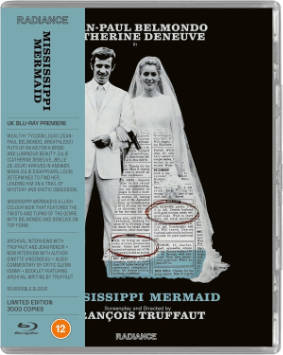
Booklet
Radiance’s booklet with this limited edition of the film runs to twenty-eight pages. (When this edition sells out, the later standard edition will not include the booklet.) It begins with an article by Truffaut from 1980 (translated by Tom Mes), “William Irish’s Slippers”. Truffaut talks about his love for hardboiled crime fiction, though he was restricted to what was available translated into French. (He never did really learn English.) On the other hand, while in New York in 1962 to promote Jules et Jim, he spoke about his plans to film Fahrenheit 451 and found that no journalist had heard of Ray Bradbury. He talks about writers of popular fiction who write fast and for the money reveal more about themselves than you might expect, and he offers Cornell Woolrich as a case in point. Woolrich published mostly a novel a year, plus short stories, for some forty years. His mother never read his work, as he promised her that his next one would be better and worthy of her attention, but he died before he satisfied himself of that, if he ever did. Truffaut, like many in France, knew of him and other writers first not from the translated novels but their film adaptations from the 1940s onwards. Love was a theme in Woolrich’s work, though often dark, perverse and “broken” variations on that theme.
The rest of the booklet comprises letters written by Truffaut to various people talking about Mississippi Mermaid. Recipients included Robert Hakim (who was to produce the film but in the event didn’t), Charles Bitsch, whom Truffaut had helped out on one of his films, and Roger Diamantis, who had written a thesis on Truffaut’s films, which in the event remained unfinished, and Truffaut declined the request for an interview.
final thoughts
Mississippi Mermaid
France / Italy 1969 | 123 mins
directed by: François Truffaut
written by: François Truffaut; from the novel Waltz Into Darkness by Cornell Woolrich (as William Irish)
cast: Jean-Paul Belmondo, Catherine Deneuve, Nelly Borgeaud, Martine Ferrière, Marcel Berbert
distributor: Radiance
release date: 29 July 2024