
Loud and clear
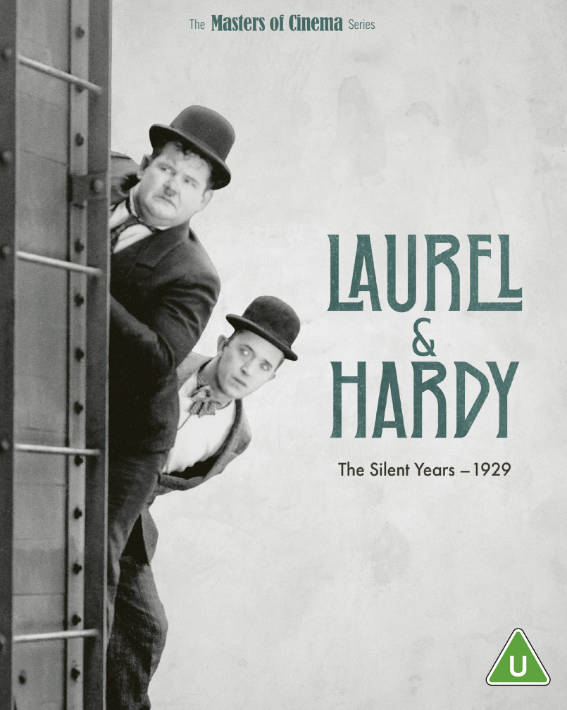
The third and final collection of silent short films from cinema’s most divine comedy pairing, LAUREL & HARDY: THE SILENT YEARS – 1929 from Eureka is out now on two-disc Blu-ray. Devoted Stan and Ollie fan Slarek takes a deep and passionate dive into another glorious release, one that sees the boys cement their partnership and comedic style and make a smooth transition into the talkies.
the films 6-10 (+1)
DOUBLE WHOOPEE (Sound Version)
It was only when I loaded this disc that became aware that Double Whoopee was released in two versions, one of them silent with intertitles and one with a synchronised soundtrack and spoken dialogue. Surely this makes this Stan and Ollie’s first venture into the then brand new realm of sound cinema. Erm, not quite. This sound version was produced in 1970 by voice artists Chuck McCann and Al Kilgore as a TV pilot for an “all talking” series of Stan and Ollie’s silent shorts, with the voices of all of the characters performed by McCann and Kilgore. As it turns out, this was the only one of their films to get this treatment, and I kind of get why.
Opinions are going to differ about this version and I’ll say up front that I’m delighted that it’s been included in this comprehensive set, but for this humble and longtime Laurel and Hardy fan, creating a synchronised soundtrack for a silent film without the involvement of any of those who made it is the audio equivalent of colorising the picture. The first problem is that the voices coming out of Stan and Ollie’s mouths clearly do not belong to Stan and Ollie. I have to admit that I know precious little about Al Kilgore, but I’ve been aware of Chuck McCann’s considerable talent as an impersonator ever since I first saw him in the 1970 Harry Hurwitz film The Projectionist way back when I was in film school. He does capture the essence of Stan’s delivery but it still sounds like an impersonation, and there’s something off about the voice given to Ollie, who speaks here in a higher pitch than he ever did on screen. The second problem is that Double Whoopee was shot and edited as a silent film, and in the sound version dialogue has been added every time a character appears to be talking, often in shots where that dialogue would likely have been cut down or differently paced had this film been shot with synchronised sound. At times it reminded me a little of English dubs of Hong Kong martial arts movies, specifically where sentences are shorter in English than in Cantonese or Mandarin, requiring the dubbing artist to awkwardly add a few extra words to cover the fact that the characters mouths are still moving. The music score, however, was compiled from existing material under the supervision of historian Miles Kreuger of the Institute of the American Musical, and it’s wonderfully true to the period, both in content and its sonic quality. A fascinating experiment, sure, but one that doesn’t really work for me but that I have no doubt that others will get more out of it, and as I stated above, I salute its inclusion.
BACON GRABBERS
Here Stan and Ollie are working as bailiffs for something called the Attachment Squad of the Sheriff’s Office, their job being to serve papers on individuals who have defaulted on payments and then collect the goods for which that payment is outstanding. Such officers were known as ‘Bacon Grabbers’ in the America of the day, hence the otherwise bemusing sounding title.
The film begins in the workplace, where the boys are woken from their snoozing by the Sheriff (Eddie Baker) and tasked with retrieving a radio purchased on credit by a “tough guy” named Kennedy (Stand and Ollie regular, Edgar Kennedy) who hasn’t made a payment on it for two years. Even getting out of the office proves a challenge for our two favourite buffoons (Stan’s hat gets impaled on a message spike, they exit through the wrong door, Ollie leaves his hat by mistake and then forgets the paper they are supposed to serve, they make a complete mess of the Sheriff’s desk when they return to try and find it…), and once they get outside, Ollie’s exasperation with Stan sends a glass lampshade crashing down on his head. They then get into their violently shaking Model T Ford, where a dopey move on Stan’s part causes the vehicle to leap forward and into the back of a small truck. It’s driver (Charlie Hall, of course), gets out of his vehicle clearly ready for conflict, but with no damage done to his vehicle he offers only a mocking quip before departing, leaving Ollie to fix a water leak in the front grille of their car by stuffing a handkerchief into the radiator cap.
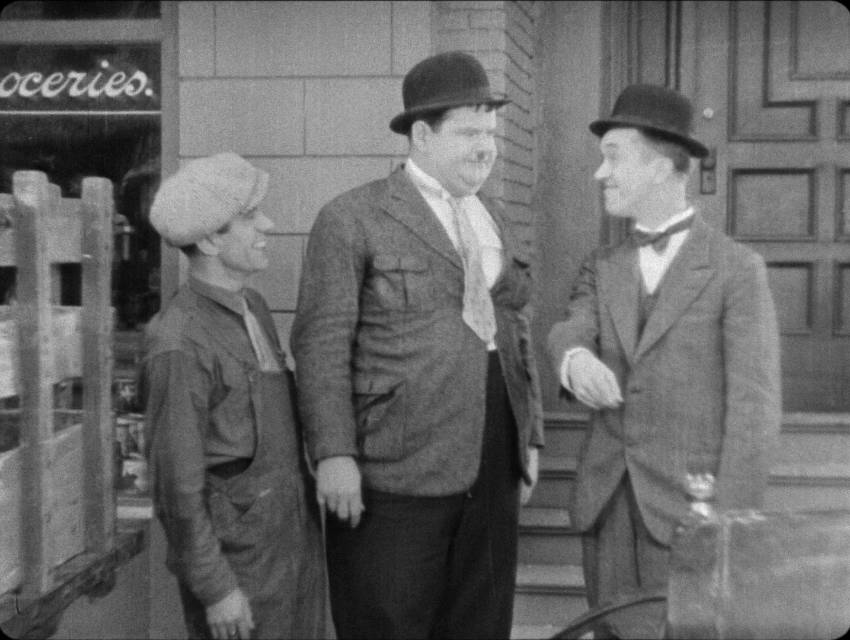
When they reach the Kennedy house, Ollie cautions Stan not to reveal that they are from the Sheriff’s Office in order to make it easier for them to serve Kennedy with the repossession paper, but that’s like telling Father Dougal not to press that big shiny red button in the airplane cockpit. Kennedy is thus alerted and a farcical chase begins in which the boys repeatedly try to serve him with the legal paper, bungling it every time in comically manic fashion. They have no better luck when, almost by accident, they do finally slap the paper in Kennedy’s hand. “Well boys, that’s service,” he exclaims with a cheery smile, then adding “Now try and get the radio!” before slamming the front door firmly shut in their faces. A whole series of gags then follow built around their comically preposterous attempts to break in through an upstairs window using a stolen builder’s ladder that is too short for the task, which eventually attracts the attention of a beat policeman (Harry Bernard) and builds to a double-twist gag ending involving the sort of unstoppable steam powered road rollers that seemed to be everywhere in the world of silent and early sound comedy America.
It’s another fun ride, which for me peaks in the fast paced but repeatedly bungled attempts to place the paper in Kennedy’s hand, and when it finally happens I had to watch it again to confirm exactly how this had been achieved. The legacy of Stan and Ollie’s earlier, more slapstick-oriented films, meanwhile, is evident in the sequence where an unstable Ollie is stumbling back and forth with the ladder on which a terrified Stan is perched wedged into his trousers while an excitable dog is pulling at his braces (that’s suspenders for American readers, a word that has a very different meaning in the UK). Always great to see regulars Charlie Hall and Edgar Kennedy in support, and making her third appearance in this set in the final scene is Jean Harlow as Kennedy’s wife.
ANGORA LOVE
What sounds like the title of an Edward D. Wood movie actually refers to a prize goat named Penelope that a pet store owner (Ford West) ties up outside his establishment while he sets the shop up for the day. When Penelope chews through the string holding her in place and wanders off, the store owner assumes that she’s been stolen, something he communicates to a passing boy (Buddy Moore) and then to a beat policeman (Harry Bernard). Elsewhere in the neighbourhood, meanwhile, Stan and Ollie have just emerged from a bakery, where Stan has just spent their last dime on doughnuts, or as an exasperated Ollie describes the product, “a pastry with a hole.” As they stand and eat, they are joined by the missing goat, which Stan warms to and feeds but which irritates Ollie. When the boy from earlier spots them, he announces that he’s going to report Penelope’s theft at what he assumes is their hands, and they thus attempt desperately to lose the animal but to no avail. Two days later, they’ve still failed to shake Penelope and end up smuggling her into their boarding room past a landlord (Edgar Kennedy) whom they claim would do violence against them if he knew they had brought this animal into his establishment.
Such is the setup for a whole string of gags built around the boys trying to hide the presence of the goat from the landlord, and if you dislike Stan and Ollie’s comedy because of what you regard as the stupidity of their actions, you’ll find plenty to wind you up here. Why, you might logically ask, if they are trying to lose the goat would they not leave it outside the hotel for the night and hope that it buggers off by the morning instead of adopting it as a pet, especially as they are aware that the animal is believed to be stolen and that they will likely be arrested as the thieves if caught? Their decision to smuggle the goat into their room seems doubly bonkers when Ollie reveals that they have to be quiet as their room is located directly above the one in which their angry landlord sleeps, news that effectively sets up a good many of the gags that follow. But as Neil Brand perceptively remarks in his commentary for this film, Stan and Ollie behave the way they do because they are essentially children in the bodies of adults, and they thus act impulsively and illogically the way kids tend to do. This also accounts for their sheepish response to being told off by the landlord and ordered to bed, one that they share with all the innocence of two pre-teen brothers who just keep landing in trouble.
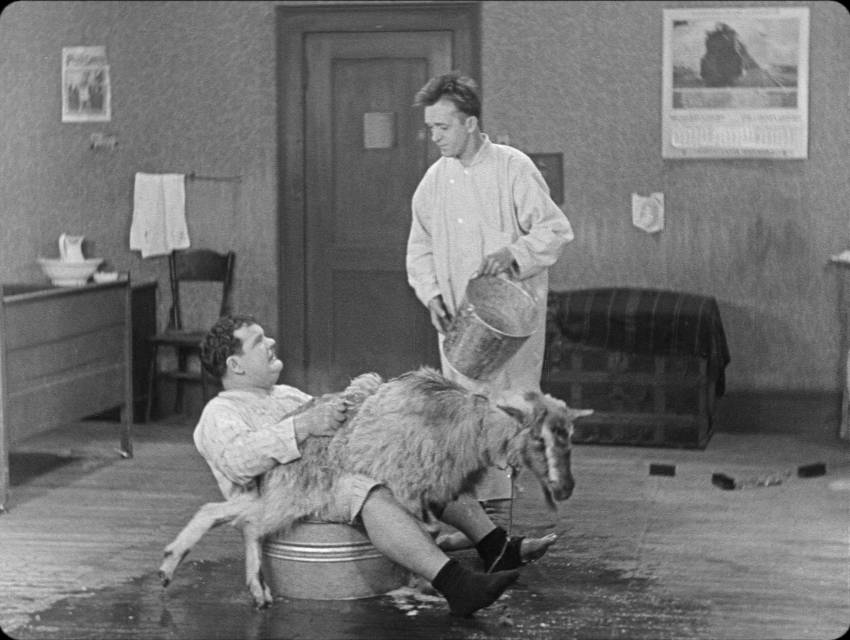
It’s an absolute blast. This was the final legitimately silent Laurel and Hardy short, and it lays the groundwork for the sound era films that were soon to follow, which is a tad ironic, as in order to cash in as quickly as possible on the public enthusiasm for the new sound cinema, The Roach Studios delayed the release of this final silent work until after several of their sound shorts had hit cinemas. Signs of things to come are everywhere here. The boys are dressed in their matching Derby Hats and shade-coded suits, light for the slim Stan and darker for more rotund Ollie, whose ill-fitting jacket is held closed with a single button that stretches the material on both sides. Early on, Ollie steps into a puddle and sinks into an insanely deep, water-filled hole that has no earthly reason to be there, which prompts the first of several long-suffering looks at the camera in his signature complicity with the audience and a look of complete confusion on Stan’s part, which is also delivered directly to camera. A favourite gag that harks back to the 1928 Leave ‘Em Laughing sees both shoeless men tread repeatedly on the same sharp tack, which they immediately toss back to the floor in annoyance, where it sits ready for the next time they unknowingly approach it. There’s even a climatic tit-for-tat battle involving Stan, Ollie, the landlord, a guest looking for some nookie who has the wrong room (an uncharacteristically mock-sophisticated Charlie Hall), a policeman (Richard Belfield) that the landlord called to report a murder that he was about to commit, and several buckets of water, a few of which inevitably hit the wrong man when the intended target steps out of the line of fire.
Rubbing shoulders with the familiar gags are a few that the film absolutely makes its own, including the hilariously energetic and dance-like stretches that Stan performs with a set of exercise springs (that they will eventually pull the door they are attached to from its frame is inevitable from the moment Stan hooks them on), which are matched for comic value by the dainty, almost balletic alternative that Ollie then demonstrates. The film gets good mileage from a goat that eats everything from wallpaper to the stuffing in chairs and mattresses, and that smells bad enough for the boys to repeatedly fall on their faces and nearly flood the apartment trying to give it a bath. But the gag that really surprised me and which dates the film as a product of the pre-Hays Code period of American comedy cinema comes when the landlord stands in their doorway and berates them for their rambunctious behaviour, sternly reminding them that he runs a respectable hotel. As he says this, a woman walks down the corridor behind him, followed closely by a sailor wearing a beaming smile and tipping his hat forward in a manner that announces he’s about to have a good time with a sex worker. It’s just one of several really well executed gags in a smartly shot and edited swan song to the duo’s silent period.
UNACCUSTOMED AS WE ARE
UNACCUSTOMED AS WE ARE (sound version)
Ollie decides to surprise his wife Barbara (the wonderful Mae Busch) by bringing his friend Stan home for dinner. In the corridor on the approach to his apartment, Ollie has a polite but suggestive exchange with his pretty female neighbour, Mrs. Kennedy (Thelma Todd), then describes to Stan in detail the delicious steak dinner that awaits. When they enter the apartment, however, it quickly becomes clear that Barbara is fed up with Ollie bringing various friends to their home and expecting her to cook for them. After rowing noisily with Ollie about this, she announces that she is going home to mother and storms out, popping back briefly to kick Stan up the arse.
Determined that his friend should still be able to enjoy a good meal, Ollie elects to cook it himself but foolishly asks Stan to light the gas stove, which backfires when Stan turns on the gas but can’t find a light. An irritated Ollie takes charge of the task himself, walking into a gas-filled kitchen with a lighted match, which results in him being launched back into the lounge by the resulting explosion. The commotion attracts the attention of Mrs. Kennedy, who clearly has a bit of a thing for Ollie and offers to help them out with the cooking, but the still fiery gas oven sets her dress alight. The boys try and fail to quench the fire on her clothing (for the safety of the actor, it’s just smoke), prompting a panicking Ollie to pull off her dress and Stan to wrap her in a tablecloth to cover her embarrassment. Surprisingly, she’s still keen to lend a hand and just needs to put on some fresh clothes, but just as she is about to leave the apartment, she sees that her policeman husband (Edgar Kennedy) has arrived home, and warns Stan and Ollie that he will kill all of them if he finds her like this. Foolishly of the opinion that honesty is the best policy, Ollie confidently announces that he will explain all to Mr. Kennedy, but just as he is about to cross the hall, he sees his wife returning and realises that she is unlikely to buy the true story of how her pretty young neighbour has ended up half-naked in their apartment in the short time that she has been away.
Unaccustomed as We Are is a pivotal film in the Laurel and Hardy canon, being their first with a synchronised soundtrack, but it still qualifies for inclusion in this set because a silent version was also produced for distribution to cinemas that were not yet equipped to screen these new-fangled talkies. The silent edition is essentially the same film, but with a few small edits to the action and some of the key lines represented by intertitles. Both versions are included in this set, and while the silent version precedes the sound original on the Blu-ray menu, I’m going to talk about the sound version first, as the film was made with a synchronised soundtrack and was always intended to be seen that way, something the silent version only serves to underline. I’ll get to why in a minute.
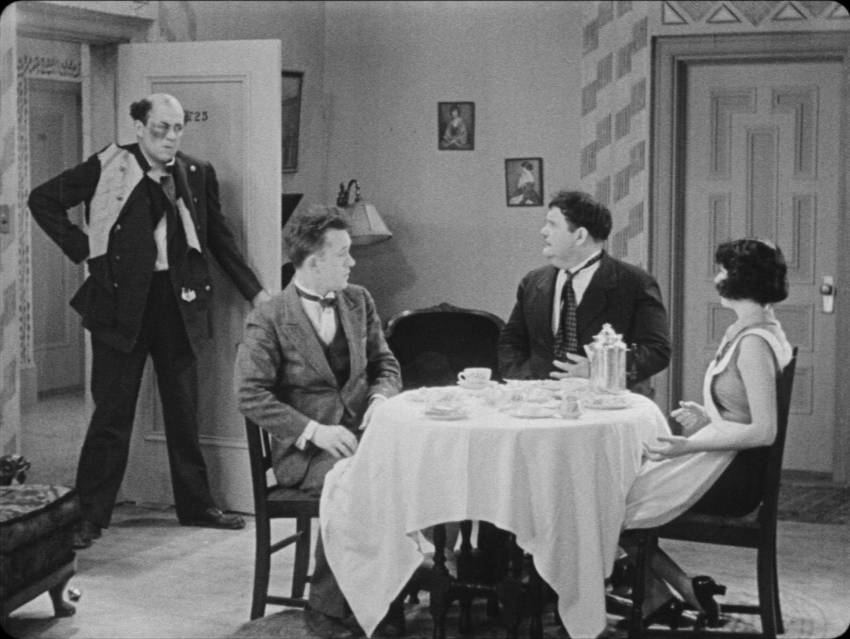
What strikes you immediately is how confidently the duo adapted to sound cinema and how instantly recognisable their verbal comedy is here. There are no hesitant uncertainties in their delivery or a crutch-like reliance on the visual gags that were so much part of their silent films. Honestly, if you didn’t know it you’d probably never guess this was their first foray into sound cinema, so effective a template does it set for the films that were soon to follow. The dialogue is delivered with the assurance of performers who’d been working in sound cinema for some time, which in essence they had – we just never got to hear what they were saying until this point. This is especially true for the stage trained Mae Busch, whose angry rant at Ollie, which transforms (in a very funny audiovisual gag) into a dance that starts to synchronise with a gramophone record that the distracted Ollie plays, runs for an almost pause-free 85 seconds, and at one point does battle with Ollie’s simultaneously delivered protestations. We even get the first incarnation of what would become one of Ollie’s catchphrases when he says to Stan in annoyance, “Why don’t you do something to help me?” (though here without the characteristic emphasis on the word ‘help’).
A whole slew of familiar Stan and Ollie traits are on display: Ollie’s long-suffering looks at the camera when things go wrong; Stan’s similarly directed expressions of confusion and concern; Ollie’s smiling prissiness and finger-wiggling wave when talking to a woman he is attracted to; Stan struggling to grasp the obvious even when it is spelt out; loud crashing violence delivered off-screen that we then see the bruised and battered consequences of; attempts to help on Stan’s part that end up injuring Ollie; Stan almost busting into tears in moments of extreme stress… the list goes on. It’s been a long time since I last saw this film, and revisiting it was a genuine joy, particularly given its significance in the Laurel and Hardy canon. What does knock it down a few notches for some is a degree of cinematic stiltedness, restricted as it is to four rooms, with much of it filmed from the viewpoint of an audience member watching the whole thing being performed on a stage. In some ways, however, director Lewis J. Foster’s hands were tied, as in order to record a clean soundtrack, the noisy film cameras (and there were four shooting at all times on this film) had to be encased in soundproofed booths that could not be easily moved to get alternative angles. When closeups are demanded – as with a clear shot of the tack that Stan and Ollie are about to step on – they’re very well done.
My issue with the silent version stems from the fact that the demands of sound and silent comedy are very different, and the silent version of Unaccustomed as We Are plays like what it is, a sound era film with the soundtrack missing. Without recourse to dialogue, Stan and Ollie’s silent films would keep intertitle-assisted verbal exchanges short and would be driven primarily by visual gags. This ensured that even the least successful of the duo’s silent films moved at a lick, a pace that was considerably slowed when the arrival of synchronised sound allowed for longer and gag-peppered verbal interaction. Two minutes of Ollie building Stan up for a juicy steak dinner and preening politely to Mrs. Kennedy works a treat in the sound version because the dialogue and its delivery is amusing, but on the silent version this is effectively dead air, a long held wide shot of Ollie silently conversing with Stan or his neighbour, with only the occasional intertitle filling us in on some of the basics of what is being said, in the process missing out on several of the verbal gags. A couple of key ones in the scenes that follow are removed completely. When Ollie first enters the apartment lounge and coos out “Yoo-hoo!” to his wife, in the silent version she enters the room immediately, but in the sound original she responds angrily from the bedroom, “What do you mean, ‘Yoo-hoo’?” to which Ollie reacts with a startled look at the camera and Stan responds to with concerned confusion. When his wife enters the lounge in this version, the groundwork for the ensuing conflict has thus already been laid. Later, when Mr. Kennedy is talking to the boys whilst they are trying to smuggle Mrs. Kennedy out of their apartment in a trunk and they pick it up to leave, Kennedy pushes it sharply to the floor, prompting his wife to squeal and give away the fact that Ollie is hiding a woman in there. In the silent version, the push to the ground cuts sharply to a shot (one that reoccurs a short while later in both versions) of Mrs. Kennedy inside the trunk, motionless with her mouth closed and not remotely startled, and somehow this alerts Kennedy to her presence. It just doesn’t work as a gag the way the sound version does. I’m glad that the silent version was included but far prefer the sound original on every score.
BERTH MARKS
Ollie and Stan have arranged to meet at the Southern Pacific rail station to catch a train to Pottsville, Pennsylvania, where they have a booking for their musical vaudeville act. After running round in circles trying to find each other, their clumsiness causes Stan to drop all of their sheet music, which they try to retrieve but ultimately have to abandon in order to catch their train. On board, they are shown to their sleeping berth by the conductor and make an absolute dog’s dinner of trying to get up into it, and once inside, they then get into a complete tangle with their clothing and each other whilst trying to undress for bed. Meanwhile, the knock-on effect of a wrongly targeted assault has led to all of the passengers in one car tearing each other’s clothing to shreds.
Stan and Ollie’s second sound film is presented here only in the silent version created for distribution to provincial cinemas not yet equipped for sound films. I had presumed that this meant that the soundtrack (which this early in the sound era was still supplied on a phonograph disc) has been lost, but one small section of it is played on the accompanying commentary track by by Chris Seguin and Kyp Harness, so now I’m not sure what the story is here. What I did learn from that commentary is that Berth Marks is, Segiun claims, ‘universally’ regarded as the worst of Stan and Ollie’s sound era comedy shorts, a assertion that is slightly contradicted by the film’s current 6.9 user score on IMDb and the positive comments about it you’ll find there. That said, I do get where that negativity is coming from. It certainly starts well, with location shooting at a real train station and a verbal gag involving an unintelligible train announcement, the sound for which is played on the commentary track and is far, far funnier than its intertitle equivalent. Once aboard the train, the incident that kicks off what develops into tit-for-tat pandemonium is rather neatly devised. Stan accidentally walks into a private compartment, startling a woman in her underwear, and her husband (a brief appearance by a typically pissed off Charlie Hall) comes out to give the interloper what for, but Stan has moved on and the husband tears open the back of the jacket of a man who is standing nearby. The man then turns around but Charlie has departed and another man just happens to be passing, so he follows him into the washroom and rips open the back of his jacket in retaliation. The film cuts away before the conflict really escalates, and by the time we come back to it, the carriage is a whirlwind of clothes-ripping violence, an image that genuinely made me laugh out loud.
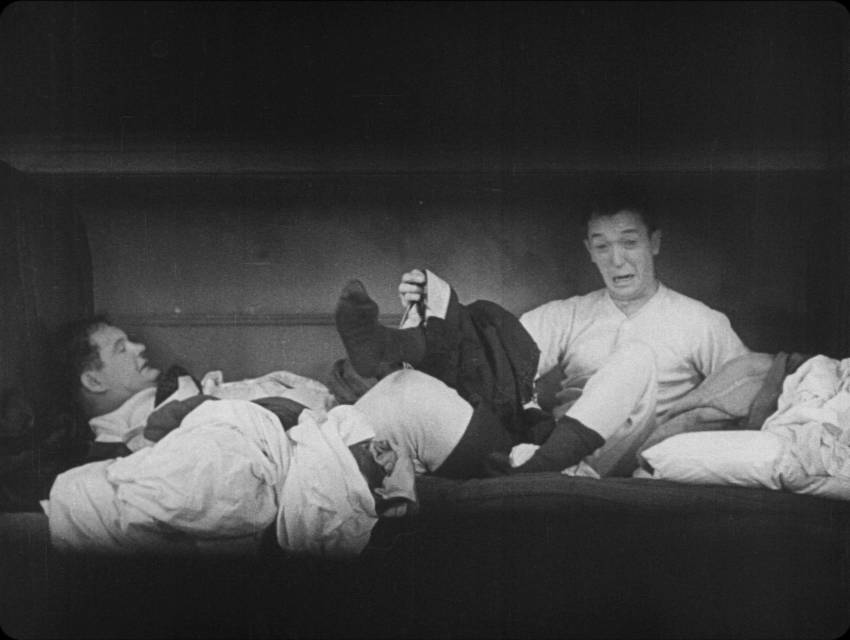
The problem for Stan and Ollie is that once they reach their berth, a mere two gags are stretched to increasingly exasperating length for the next 12 minutes, almost the entire second half of the film. The first has them trying and repeatedly failing to clamber into the top bunk, first by Ollie (sometimes unwillingly) assisting Stan, and it’s only when Ollie also tries to scramble into the berth that I realised that they were going to share it and that Ollie wasn’t preparing to enter the one below. As is noted in the commentary, this whole routine is effectively a rerun and expansion of the cemetery wall climbing sequence from the 1928 Habeas Corpus, which was frankly funnier and lot less drawn out. The second gag has them trying to undress in a space that would make a Japanese capsule hotel pod look roomy, tying themselves in knots by accidentally intertwining their limbs and their clothing. Hardly original but nonetheless quite fun, it goes on way too long, to the point where their tomfoolery genuinely starts to come across as infuriating stupidity, and almost had me yelling, “Oh, come on guys!” at the screen.
One small point of note. Just before Stan accidentally enters the compartment that triggers the tit-for-tat battle, he gets the neck of his bass fiddle caught on a sleeping berth curtain, which a frustrated Ollie sharply yanks in an effort to detach. Instead of disconnecting, it pulls the curtain off its rail, revealing a startled woman that I initially thought was almost topless but have since realised was wearing a nightdress that doesn’t show up so well in black-and-white (another little bit of pre-Hays Code daring). Apparently, the woman in question is none other than future star Paulette Godard making her brief screen debut.
Double Whoopee (sound version)
USA 1929 / 1970 | 18 mins
directed by: Lewis R. Foster
written by: Leo McCarey (uncredited), James Parrott (uncredited), Charley Rogers (uncredited); H.M. Walker (titles)
cast: Stan Laurel, Oliver Hardy, Chuck McCann (voices, 1970), Al Kilgore (voices, 1970)
Bacon Grabbers
USA 1929 | 20 mins
directed by: Lewis R. Foster
written by: Leo McCarey (uncredited); H.M. Walker (titles)
cast: Stan Laurel, Oliver Hardy, Edgar Kennedy, Jean Harlow, Harry Bernard, Eddie Baker, Charlie Hall
Angora Love
USA 1929 | 22 mins
directed by: Lewis R. Foster
written by: Leo McCarey, Charlie Hall (uncredited), Oliver Hardy (uncredited), Charley Rogers (uncredited); H.M. Walker (titles)
cast: Stan Laurel, Oliver Hardy, Harry Bernard, Charlie Hall, Edgar Kennedy, Charley Young, Richard Belfield
Unaccustomed as We Are
USA 1929 | 23/22 mins
directed by: Lewis R. Foster, Hal Roach (uncredited)
written by: Hal Roach, H.M. Walker, Oliver Hardy (uncredited); Stan Laurel (uncredited), Leo McCarey (uncredited), Charley Rogers (uncredited)
cast: Stan Laurel, Oliver Hardy, Edgar Kennedy, Mae Busch, Thelma Todd
Berth Marks
USA 1929 | 21 mins
directed by: Lewis R. Foster
written by: Leo McCarey (uncredited); H.M. Walker (titles)
cast: Stan Laurel, Oliver Hardy,
Harry Bernard, Sammy Brooks, Baldwin Cooke, Eleanor Fredericks, Paulette Goddard, Charlie Hall
Now I’ll Tell One
USA 1927 | 10 mins (incomplete)
directed by: James Parrott
cast: Charley Chase, Stan Laurel, Oliver Hardy, Edna Marion, Dorothy Coburn, Will Walling
distributor: Eureka – Masters of Cinema
release date: 20 July 2026