
Loud and clear
The third and final collection of silent short films from cinema’s most divine comedy pairing, LAUREL & HARDY: THE SILENT YEARS – 1929 from Eureka is out now on two-disc Blu-ray. Devoted Stan and Ollie fan Slarek takes a deep and passionate dive into another glorious release, one that sees the boys cement their partnership and comedic style and make a smooth transition into the talkies.
“If you haven’t heard of them or haven’t seen them, they’re comedy geniuses.”
Comedian and actor Steve Martin on Laurel and Hardy1
introduction
As a lifelong fan of the sublime comedy of Stan Laurel and Oliver Hardy, when I first read about Eureka’s 2024 Blu-ray release Laurel & Hardy: The Silent Years – 1927, I was understandably excited, but honestly never dreamed that the set would be as comprehensive and thrilling as it turned out to be. Featuring superb restorations from often damaged material of their earliest work together, supplemented by a generous range of compelling special features including an expert commentary on each of the films, this really was one of my favourite releases of that year. What I didn’t anticipate was that this was to be the first of a trilogy of Blu-ray releases covering all of the duo’s short films from the silent era. A year later we were treated to the equally excellent Laurel & Hardy: The Silent Years – 1928, and now two years on from that first release, we have the third and – I presume – final collection in the shape of, yes, you’ve guessed it, Laurel & Hardy: The Silent Years – 1929.
As it was with the previous two releases in this series, my review has been delayed by a raft of real-world issues, from a high workload in a day job that I really should have retired from over a year ago to the hellscape of bureaucracy, misinformation, and unhelpful and opaque officialdom that is making life for my partner a nightmare at the moment. To say that I’ve been stressed in recent months is a bit like pointing out that the weather has been a little warm of late. Just sitting down to watch everything in this set swallowed up a considerable amount of time, containing as it does their final nine silent films and both the sound and silent versions of their first official talkie, Unaccustomed as We Are, all of which are once again accompanied by expert commentaries. Other special features include four more short films, two of which also have commentaries, plus a substantial video essay, two comedy radio sketches, and more.
As anyone who has read my reviews of the previous releases will be aware, I am too much of a fan of this comedy duo to just write an overview of the set, and once again have covered the films individually, devoting at least three paragraphs to each and often more. Yet despite the pressure this put me under and the free time it swallowed, I once again enjoyed every second of watching and writing about this superb release. As a result, this is once again a lengthy review that I’ve elected to lay out over three pages for ease of navigation, the films themselves being covered on pages 1 and 2 and the technical specs and special features (and there a lot of them) on page 3.
the films 1-5
LIBERTY
Following a patriotic tribute to champions of American liberty George Washington, Abraham Lincoln and John J. Pershing, we are introduced to two of their heroic successors as they run from the law after escaping from jail, an opening sequence that I’d love to think had even the smallest influence on Joel and Ethan Coen’s O Brother, Where Art Thou? but probably didn’t. After dashing through woodland, they’re met by two accomplices who are waiting at a pre-arranged spot with a car and a change of clothes, which Stan and Ollie hastily struggle to clamber into as the four men drive away with a motorcycle cop hot on their tail. The boys eventually lose their pursuer by exiting the moving car and ambling over to the roadside in a move so smoothly executed that I had to immediately rewatch it to work out how it was done. It’s then that they realise that not only do they have each other’s hats (a popular Stan and Ollie gag), but are each wearing the other’s trousers (or pants if you’re American), making Ollie’s far too tight and Stan’s so baggy that he has trouble holding them up. All they have to do is exchange them, but where to do so in the middle of a busy city without attracting unwanted attention?
This provides the fuel for a speedily paced first half in which the boys pick a series of inappropriate places to try and swap their trousers. A side alley looks hopeful, but they pick a spot directly beneath a window that is opened by a woman whose shocked scream alerts a beat policeman who is having a smoke break just around the corner. A short while later, a young couple (the female half of which is played by an early career Jean Harlow) are shocked to find these two men with their trousers down in the back of the taxi they have just hailed, a near-the-mark gag that would have been quashed at the writing stage a few years later under the oppressive weight of the Hays Code. When they give it another abortive go between some crates outside the back door of a fishmonger, a live crab inadvertently falls into Stan’s oversized garments, causing him to twitch violently and launch him into Ollie into a stack of gramophone records on display outside a music shop, winding up a shop owner played by Stan and Ollie favourite, James Finlayson.
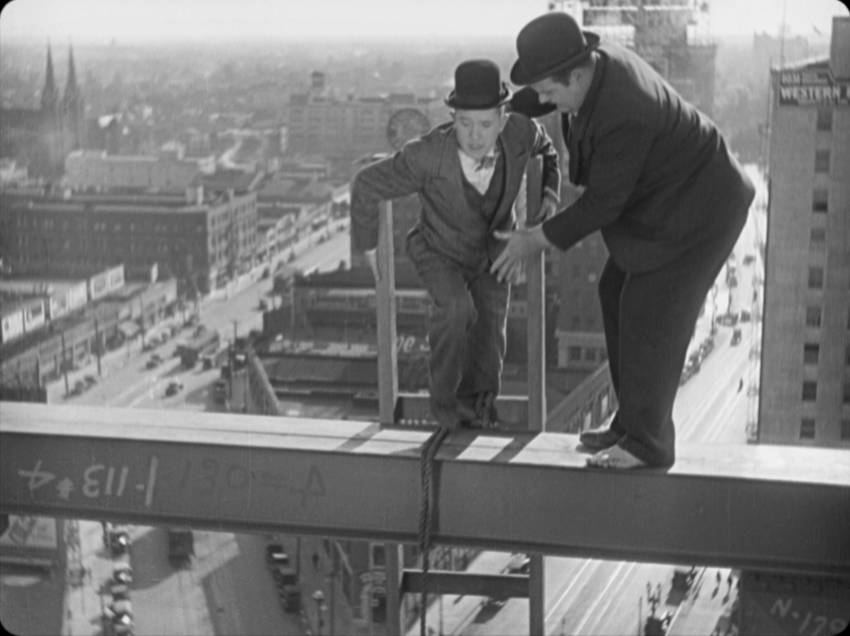
All of this serves as a build-up to a second act where their long-awaited successful exchange of garments strands them on the top of an under-construction skyscraper, where they make terrified attempts to edge their way across girders that are high enough to induce vertigo and assure a messy death should they slip and fall. Of course, now the crab more firmly wedged inside Ollie’s trousers, where its intermittent pincer nips of his behind increase his unsteadiness. The fact he mistakes them for tomfoolery on Stan’s part that he claims this is not an appropriate time for prompted a small double-take on my part.
Favourite Stan and Ollie director Leo McCarey comes close to overplaying the terrified balancing gags once the boys hit the skyscraper building site, but scores nonetheless by borrowing a trick from Harold Lloyd and having the girder set specially constructed on the roof of an existing tall building, resulting in a background cityscape that is always (and crucially always feels) for real rather than being faked through back-projection. This creates a most convincing sense of palpable danger, which peaks with a genuinely nerve-wracking close-up of the foot of a ladder on which Stan is perched as it edges towards a lethal drop. Faster paced it may be than the sound films for which they remain best known, but there are still plenty of signifying traits on display, from their character-defining bowler hats to Ollie’s signature long-suffering look at the camera when he Stan twitching launches him into the music shop display. Inventive and funny, and even a little hair-raising, this is Stan and Ollie on top silent short form.
WRONG AGAIN
Here, the boys are working as unlikely and incompetent stable hands at a fashionable riding school when they learn that the famous Blue Boy has been stolen from a millionaire (Dell Henderson), who is offering a $5,000 reward for its safe return. They realise that a horse named Blue Boy has just been deposited at the stable, so they head to the millionaire’s mansion with the horse to claim their reward, unaware that the Blue Boy in question is the renowned Gainsborough painting of the same name and that it has just been recovered by a no-nonsense third party, who has already informed its wealthy owner of its imminent return. When they arrive at millionaire’s property, he’s upstairs having a bath and throws the front door key down to Ollie, telling him to take what he thinks is the painting into the house. Bemused but putting this peculiar request down to the eccentricities of the rich, Stan and Ollie lead the animal into the living room and wait for the owner to come downstairs with their reward.
Unsurprisingly, the two men don’t just sit still on the couch and take in their surroundings. Ollie trips over a statue of an androgynous nude and breaks it into three pieces, which he then reassembles whilst bashfully covering the figure’s midsection with his coat and unknowingly fits that piece back-to-front, in the process creating a surrealist sculpture of a figure whose buttocks are where its crotch should be. Things take an absurdist turn when the owner calls down from upstairs, still under the impression that the boys have delivered his beloved painting, and asks them to put Blue Boy on the piano. Once again bemused by the man’s eccentricity, they struggle to comply and almost accidentally succeed, giving rise to an image that has more than a whiff of early Luis Buñuel about it. This leads to an extended gag in which the rear supporting leg is knocked off the piano, which Stan and Ollie then struggle to prevent from collapsing and raise high enough for them to wedge the dislodged leg back into place.
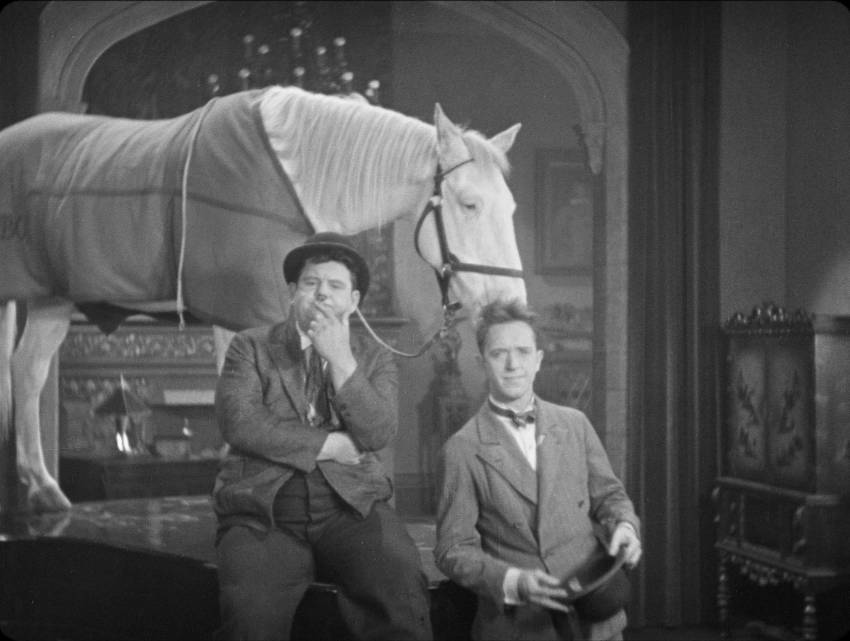
In its pacing, content and characters, Wrong Move more clearly points the way to the duo’s sound era than Liberty, enjoyably frantic during the whole piano sequence but repeatedly slowing things down to linger on Stan and Ollie as they react to the oddness of their situation (Stan’s confused reaction to the peculiarity of the rebuilt statue is priceless). In these scenes, director Leo McCarey clearly demonstrates an understanding of what differentiated this duo from their comedy contemporaries, particularly in the moments when the two men seem to be sharing their confusion, embarrassment or exasperation with the audience. This is especially true of the scene in which Ollie uses a rotating hand gesture to explain to an initially befuddled Stan that the rich do everything the opposite way to normal people, which could easily be a sequence from one of their later sound films.
McCarey does risk overplaying the sequence in which the boys try to replace the leg on the piano, but ultimately makes it work through some frantic pacing and the simple fact that it’s not immediately evident how the gag is being technically executed. When the leg becomes dislodged, Ollie scrambles underneath the piano to support it with his back, and while it’s clear that some sort of mechanism must have been employed to raise and lower the piano as he and Stan repeatedly stumble in their attempt to lift it up. We’re talking about a really heavy object with a bloody horse on top, and I have little doubt that a wrong move on the part of the operators could have dealt poor Ollie a serious injury.
Overall, it’s an entertaining brew in which the faster paced slapstick of their earlier films can be seen transitioning into the slow-burn comedy and surrealistic elements of their later talkies. It’s also one of two films in this set that revives that favourite slapstick gag of a shotgun blast to the buttocks doing little more than causing momentary pain and a smokey hole in the target’s trousers. Seriously, do not try this at home.
THAT’S MY WIFE
One of only two films in this set in which one of the boys is married kicks off with Ollie’s wife (Vivien Oakland) announcing that she is going to leave him, and the reason is sitting on the sofa reading a paper, smoking a cigar and looking confused. It’s Stan, of course, who apparently popped round for a quick visit two years ago and just never left and is now driving Ollie’s wife to distraction. It says something about Ollie’s relationship with Stan – and indeed with his wife – that when the ultimatum “Either he leaves or I leave” is delivered, Ollie seems unable to make a decision. When his frustrated wife heads for the door, however, he does try to persuade her to stay, as if she leaves he won’t get a dime from his rich Uncle Bernal (William Courtright), whose financial assistance is dependent on the happiness and stability of his marriage. Mrs. Hardy doesn’t care and makes a destructive show of leaving anyway, which leads to a typically daft bust-up between Stan and Ollie that ends with Stan issuing a similar ultimatum to Ollie before deciding that he will leave as well. He’s upstairs busy packing when, to Ollie’s horror, Uncle Bernal knocks on the door. Desperate to convince him that all is well in the Hardy household, he begs Stan to bury the hatchet and dress up in Mrs. Hardy’s clothes and a wig and pretend to be his wife. What, you may wonder, could possibly go wrong?
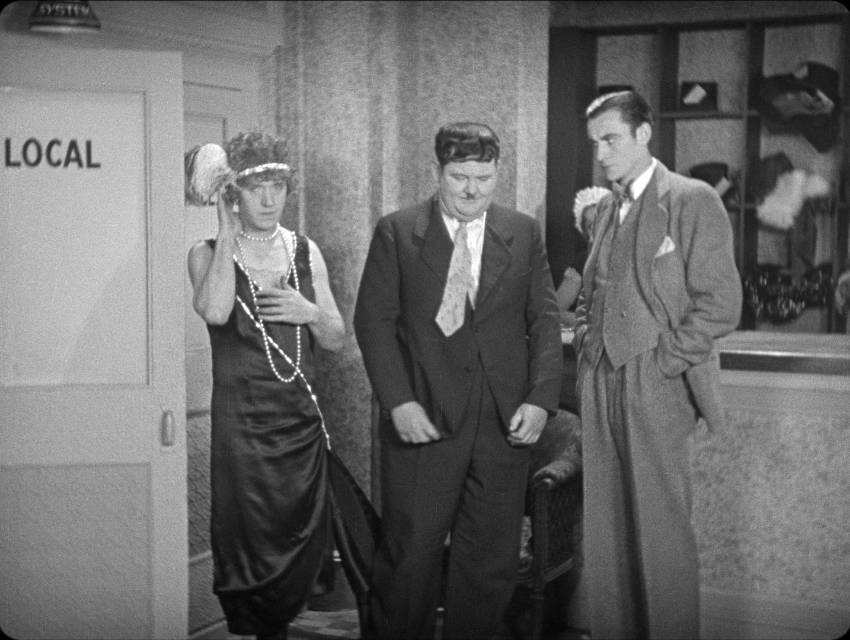
There are several familiar Stan and Ollie touchstones here, from Ollie’s timidity in the face of his angrily forceful and frustrated wife (how these two ever ended up marrying is anybody’s guess) to getting Stan dressed up and wigged in an effort to convince others that he is a woman, an idea that the pair had already successfully road tested in the 1927 Duck Soup and Why Girls Love Sailors. Ollie flashes the odd look of humiliated exasperation at the camera and Stan gazes at the audience in childlike confusion, and we know from the moment that Ollie persuades a most reluctant Stan to go along with this hair-brained scheme that it is destined to fall apart, a process that’s accelerated by Uncle Bernal’s insistence that they all go out dancing at the Pink Pup nightclub. Here, Stan is targeted by that silent comedy favourite of the lascivious drunk (played by Stan’s fellow Lancastrian, Jimmy Aubrey), and when a crooked waiter elects to hide a stolen necklace by dropping it down the back of Stan’s dress, we get a string of gags that has the boys being awkwardly exposed whilst wrestling to retrieve it. This is effectively a reworking of the trouser gag from Liberty (complete with a sequence where their actions are misinterpreted as a sexual liaison when they are caught wrestling in a nightclub phone booth), while the waiter who repeatedly trips and falls face-first into a tray of something white and fluffy has been recycled from the 1928 Their Purple Moment.
The pre-Hays Code boundary nudging is evident again here. The sequences of Ollie and the cross-dressed Stan grappling each other like amateur wrestlers certainly have a risqué element, particularly as Ollie often has his hand plunged down the back of Stan’s dress, a garment that was earlier filled out with what has to be the lightest hand dumbbell on the planet, which Ollie inserts into the dress to give Stan a fake pair of female breasts. That it falls out, prompting Stan to cover his chest to hide its sudden size reduction, then causes two accidents (Stan slips on it first, ramming his chin into a table, which sends it scooting across the room to trip up the pie-in-the-face waiter) demonstrates how a single object can be the source of several gags. Nothing too surprising here, but still good fun, and the boys are on fine form.
BIG BUSINESS
The season of goodwill has arrived in sunny California, and Stan and Ollie are touring a suburban neighbourhood in their open-backed Model T Ford, attempting to sell Christmas trees to disinterested residents. As you might expect, they’re not going to win any Salesman of the Year awards, insulting a single woman (Lyle Tayo) by asking if her husband would buy one if only she had a husband, and ignoring a “Positively no peddlers or solicitors” sign, a move that earns Ollie a couple of sharp hits to the noggin with a hammer. Their third potential customer (Stan and Ollie favourite James Finlayson) is also a polite no sale, but as the boys turn to head back to their vehicle, Stan realises that a branch of the tree they were attempting to flog has become caught in the door when it was closed. Ollie thus rings the bell again to prompt the now slightly irritated Fin to reopen the door and allow Stan to free the tree, but when he closes it again, this time it’s Stan’s overcoat that gets trapped. Another doorbell ring and increasing agitation on Fin’s part frees the coat but once again traps the tree, and the subsequent fourth doorbell ring brings the by now thoroughly fed-up Fin back onto the porch, where he hurls the tree across the yard and sends these two hapless salesmen on their way.
All the boys had to do now for a peaceful life was get back into their car and drive away, but it’s here that Stan has a sudden “big business idea,” which prompts him to re-approach the house and ring the doorbell again to see if Fin would like to make an advanced booking for next year. Fin responds by grabbing a set of lopping shears, which he uses to cut the Christmas tree into three before defiantly slamming the door in Stan and Ollie’s faces. Initially startled, Stan then responds by taking out his pocketknife and prizing the house numbers off of Fin’s wall and carving a chunk out his door frame. A furious Fin goes to punch Stan in the face, to which Ollie responds by soundly tweaking his ear, bopping him in the stomach, and using Stan’s knife to cut one of the few remaining hairs from the top of his head. The angry Fin reacts by pulling Ollie’s watch from his pocket and smashing it on the ground and storming back inside. How do you think Stan and Ollie will respond to that?
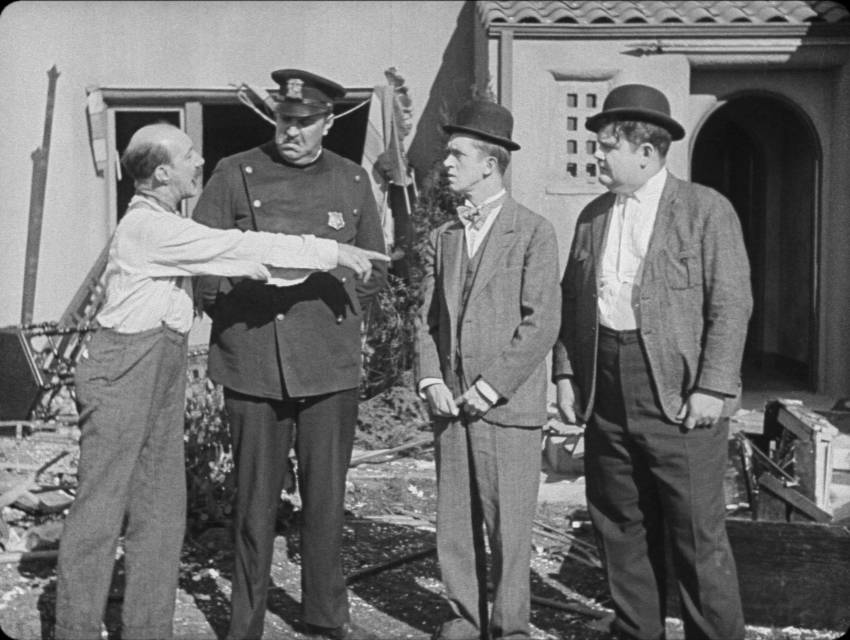
What follows is 10 minutes of gloriously excessive tit-for-tat destruction, as Stan and Ollie set about wrecking Fin’s home and Fin starts pulling apart their car, all of which draws a small but fascinated crowd. This was, of course, a favourite Stan and Ollie scenario, one around which the 1928 Two Tars was effectively built and that would later be recycled for the 1935 Tit for Tat, as well as making brief guest appearances in a whole range of Stan and Ollie shorts. It follows the familiar and much beloved formula, starting with small reactive gestures that build severity and scale, with each party taking their turn while the other watches on without once trying to intervene, the whole thing becoming more manic until both parties are engaged in a whirlwind of simultaneous destruction. The inevitable arrival of a policeman is particularly funny here, with the patrolman in question (Tiny Sandford) sitting in his car, curiously observing the mayhem and taking notes rather than doing anything to stop it. By the time he does approach, both the house and the car are utterly wrecked, and even then, he fails to intervene, standing instead with his hands on his hips watching Ollie smash vases thrown through the window by Stan in the manner of a baseball pitcher and batter (Ollie does a hell of a job here) and seemingly just waiting for one of them to spot him. It all ends with sob stories that have even the policeman and the watching crowd in tears, and both parties shaking hands in a show of mutual forgiveness, a ruse on Stan and Ollie’s part that ends with them being chased down the road by the furious cop. We even get one of the first examples of Fin’s signature one-eyed accusatory squinting stare, as well as a humbled Stan making a pathetically token effort to correct the damage he has caused when he realises that the jig is up. An absolute joy.
DOUBLE WHOOPEE
At a plush hotel, everyone is preparing for the arrival of a foreign prince (Hans Joby, parodying Erich von Stroheim’s character in the 1922 Foolish Wives) and his prime minister (Charley Rogers), and are on full alert as the royal car pulls up outside. While the Prime Minster is fussily dusting off the prince’s white officer’s uniform, who should amble up and enter the hotel but Stan and Ollie, who are mistaken by everyone for the royal party, in part because of Ollie’s smiling air of self-importance. After making a clumsy production of signing in, they hand a letter to the manager (William Gillespie) that reveals they are in fact the new footman and doorman sent by the employment agency, “the best we could do at short notice.” The frustrated manager sends them off to be dressed in their uniforms and greets the real prince, who then falls into a greasy elevator shaft when the car is called by Ollie to the floor above. The prince, his sparkling white uniform now covered in grease and dirt, is helped out of the shaft by the hotel staff, but falls almost straight in again when the car is again called to the upper floor, this time by the newly uniformed Stan.
Unsurprisingly, neither the two men are exactly brilliant at their job. Stan inadvertently rips the shirt off one of the guests (quite why and how is a question for the ages), and Ollie repeatedly opens the wrong door for visitors as they exit the hotel. When Ollie tests out the whistle he has hanging from his chest, it instantly summons a cab whose driver (Charlie Hall) is less than happy that there is no fare and that he’s lost his place in the taxi rank as a result. He warns Ollie not to “blew” that whistle again, instantly gearing us up for the next time this will happen. When Ollie opens the wrong door again, Stan strides through and lands a tip for then opening the correct door for a guest, which kicks off an argument between them that attracts the attention of a beat policeman (Tiny Sandford once again), to whom Stan tearfully complains and who thus puts Ollie firmly in his place. When a curious Stan then blows the whistle on Ollie’s chest, this again summons the cab, whose driver then gets out and punishes Ollie by ripping bits off of his uniform. This prompts Stan to respond in kind, and the developing conflict is only prevented from exploding into a full-on tit-for-tat war by the return of the policeman, whose uniform the cab driver inadvertently vandalises, prompting him to flee and the cop to give chase.
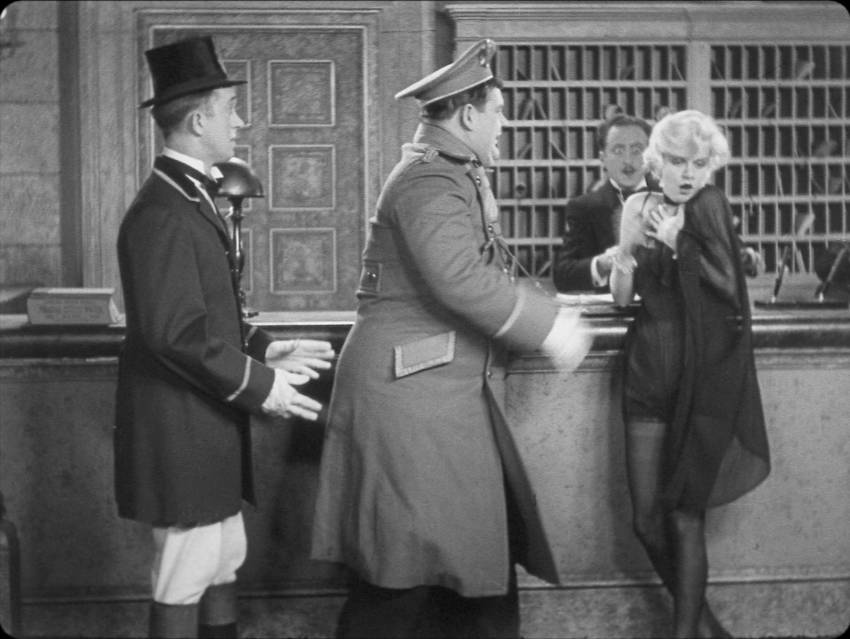
On the commentary track, David Kalat suggests that this film plays almost as a follow-up to the 1928 From Soup to Nuts, in which the boys played bumbling waiters at a high class gathering, again sent by an agency bearing a note that proclaimed they were “the best we could do at short notice.” As with that film, here it’s all about the mistakes the two will make and the chaos that they will inadvertently provoke, which climaxes in an eye poking, shin kicking, chest hair pulling battle involving an increasing number of characters and ending in an almost inevitable third tumble into the world’s most health and safety unconscious elevator shaft. Making far more of an impression here than in her bit part appearance in Liberty is a radiant young Jean Harlow as a glamorous guest whose dress is ripped from her body when Stan shuts it in the cab door, and who is thus escorted into the hotel by a smilingly simpering Ollie dressed only in black underwear and stockings. The erotic overtones of Harlow’s casual walk to the reception and the fact that she was in her late teens at the time would have doubtless triggered the ire of the Hays office had the film been made just a few years later. Do you see a small pattern emerging here?
Liberty
USA 1929 | 19 mins
directed by: Leo McCarey
written by: Leo McCarey; H.M. Walker (titles)
cast: Stan Laurel, Oliver Hardy, Tom Kennedy, Sam Lufkin, James Finlayson, Jean Harlow (as Harlean Carpenter)
Wrong Again
USA 1929 | 21 mins
directed by: Leo McCarey
written by: Lewis R. Foster, Leo McCarey; H.M. Walker (titles); Oliver Hardy, Stan Laurel, Charley Rogers (uncredited)
cast: Stan Laurel, Oliver Hardy, Harry Bernard, Josephine Crowell, William Gillespie, Charlie Hall, Dell Henderson
That’s My Wife
USA 1929 | 20 mins
directed by: Lloyd French
written by: Leo McCarey; H.M. Walker (titles)
cast: Stan Laurel, Oliver Hardy, Jimmy Aubrey, Harry Bernard, Dorothy Christy, William Courtright, Charlie Hall
Big Business
USA 1929 | 20 mins
directed by: ames W. Horne; Leo McCarey (supervising)
written by: Leo McCarey; H.M. Walker (titles)
cast: Stan Laurel, Oliver Hardy, James Finlayson, Charlie Hall, Retta Palmer, Tiny Sandford, Lyle Tayo
Double Whoopee
USA 1929 | 20 mins
directed by: Lewis R. Foster
written by: Leo McCarey (uncredited); James Parrott (uncredited), Charley Rogers (uncredited); H.M. Walker (titles)
cast: Stan Laurel, Oliver Hardy, Jean Harlow, William Gillespie, Charlie Hall, Hans Joby, Tiny Sandford
distributor: Eureka – Masters of Cinema
release date: 20 July 2026