
La travestie
Lawyer Nicole (Zabou) adopts a male identity in psychological drama LA TRAVESTIE from 1988, released on Blu-ray by Powerhouse in the Indicator series. Review by Gary Couzens.
Le Puy-en-Valey, central France. Nicole Armingault (Zabou – née Isabelle – Breitman, credited monomymously as Zabou) is a lawyer. Frustrated by her lack of progress, sidelined by her male bosses, and in the aftermath of an abortion, she cuts her hair, dresses as a man, calling herself Nick, and heads of to Paris. There she meets sex worker Myriam (Anna Galiena) and enters into a relationship with her, one which is cut short…
La travestie is a film which tackles gender fluidity, but it begins with several scenes emphasising its protagonist’s femaleness. We see Nicole dressing in close up, putting on a blouse and fastening a skirt. Shortly afterwards, director Yves Boisset films her briefly full-frontal as she steps out of a shower. Nicole has just had an experience specific to the childbearing sex, namely an abortion. Social indicators follow too: the (female) doctor after the procedure advises her that as she is known to have had several male lovers, so will be subject to gossip in this small town. That’s something you doubt will attach to the men, even though some of them are apparently married. Work, too: her boss takes over a case she has been working on for a couple of months, once again consigning her to more trivial work, unspokenly because she is an “avocate” and not an “avocat”, French being a gendered language. Even the film’s title is gendered – “travestie” rather than “travesti”.
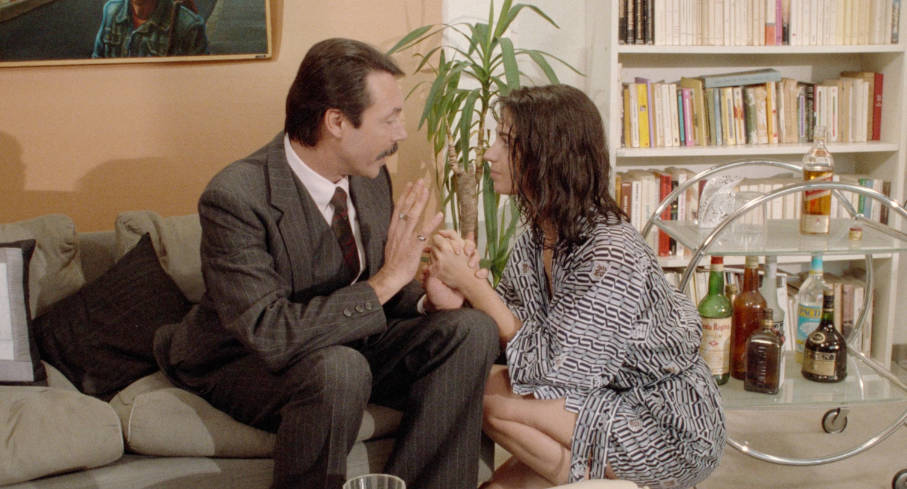
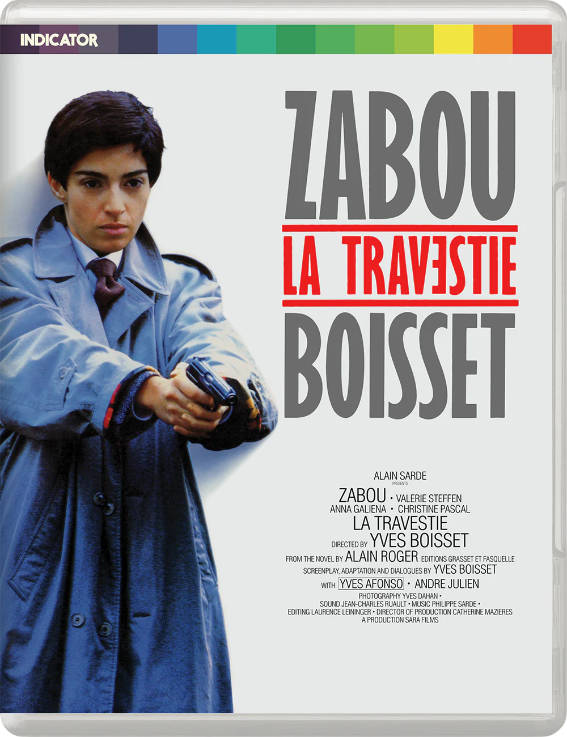
The poster for La travestie (reproduced on the cover slip of Indicator’s edition) puts Nicole’s male persona as Nick front and centre – in a suit and tie under a coat, short hair. “He” is also brandishing a gun, something which does have a bearing on the film’s plot, but this film is not a thriller. Although it has elements of that genre, the film is a story of a search for identity. Nick is one of three personas Nicole adopts in the course of the story, one per act, one per relationship (sexual or otherwise) with another character. The following will avoid spoilers as much as possible, but you may want to skip ahead to the “sound and vision” section if you haven’t seen the film before.
Despite the gender ambiguity, Nicole is not transgender, maybe non-binary, though that’s a term which wasn’t current when the film was made. No doubt due to her slender build and taller-than-average height, Nicole does pass as Nick. In the boarding house she moves into, the owners are surprised after Nick has checked in to see someone they assumed to be a man leaving for a night out in a red dress and heels. She is asked to leave the boarding house as a result. However, due to circumstances you’ll have to see the film to find out, Nicole takes on another identity, using Myriam’s real name of Solange, and takes a job as cleaner, housemaid and babysitter to Anne-Marie (Valérie Steffen). Nicole, who had been it seems exclusively heterosexual before all this started, has become at least bi-curious at this point, and she and Anne-Marie become lovers. Later, having met Anne-Marie’s sister Christine, who lives in a house in Biarritz, events take another turn. While house-sitting for Christine, Nicole takes a phone call from Alain (Yves Afonso), whom Christine met on holiday and clearly left him her telephone number which he is now following up. Pretending to be Christine, she meets Alain in person…
All this identity-switching has its price, and it’s a hard one. The result is that Nicole, finding it difficult to find a niche in a patriarchal society, loses any place at all. In the end she has nothing left, and Nicole is an identity she vows to destroy.
Indicator’s release of La travestie, simultaneous to that of the 1952 film Full House, bears out something I commented upon in my review of that much earlier film. Our knowledge of a country’s cinema, in this case that of France, is not that of that country’s cinemagoers. While British cinemas – those arthouses which showed usually-subtitled fare from other countries – released the work of cinephiles’ usual suspects, but more commercial fare which French moviegoers paid their hard-earned francs to see didn’t come out here. This Blu-ray marks the first commercial release of La travestie in the UK, and its previous showings here may have been confined to one in the BFI’s London Lesbian and Gay Film Festival (now called BFI Flare) on 25 October 1989, apparently with an earphone commentary due to no subtitled print being available.
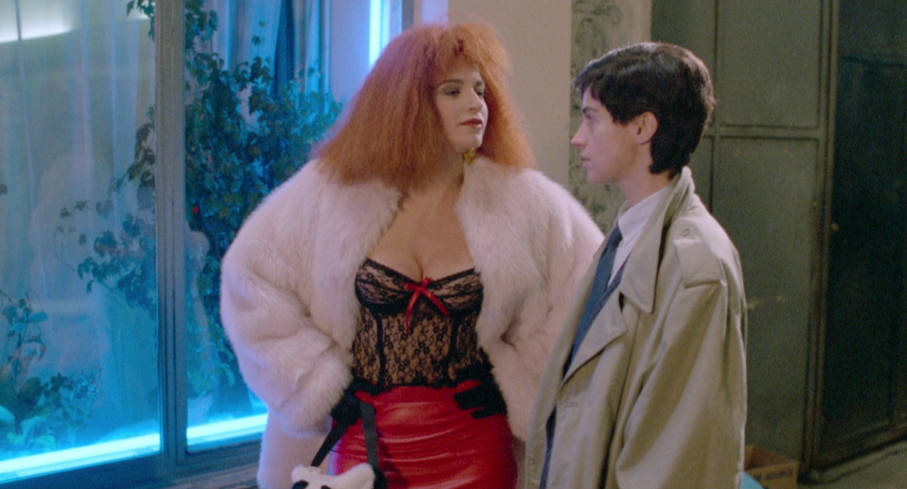
Yves Boisset (1939-2025) was very much a commercial filmmaker, active from 1968 to 2009, though from the mid-1980s onward as much on television as in the cinema. Most of his films weren’t picked up for British distribution, though The Prize of Peril (Le prix du danger, 1983), one of several adaptations, officially or otherwise, of the Robert Sheckley short story of the same title, was one which did. It was distributed in both a complete subtitled version and a dubbed version cut by some ten minutes, which presumably (I only saw the subtitled version) cut some talk and left in the 18-certificate violence. Boisset wrote the script for La travestie (from a novel by Alain Roger, which an opening voiceover says is inspired by a true story and is “the story of a rift”) and directs with fairly anonymous efficiency, with one sequence late on made out of the ordinary by means of a flashing blue light throughout. The film is a showcase for its lead, Zabou, who was the daughter of two actors and first appeared on screen at the age of four. She made this film aged around twenty-eight and holds the screen ably, eliding from one persona to the next. The final scene, which alludes to a very well-known film from twenty-eight years earlier, is dependent on her face, in big close up as the film ends.
sound and vision
La travestie is spine number 506 in Powerhouse’s Indicator series, a Blu-ray encoded for Regions A and B. The film carries an 18 certificate. The cover slip, but not the disc itself also carries an advisory that it contains “a sequence of flashing lights which might affect viewers who are susceptible to photosensitive epilepsy”.
The film was shot in 35mm colour and the transfer, from StudioCanal’s 4K restoration from the original negative, is in the intended ratio of 1.85:1. The cinematography, by Yves Dahan, is for the most part like Boisset’s direction, efficient and naturalistic without drawing undue attention to itself, and the transfer reflects that: sharp and colourful when it needs to be. Grain is natural and filmlike.
In 1988, mono soundtracks were on their way out in cinemas, with almost everything released if not in Dolby Stereo then the low-budget alternative Ultra Stereo. However, there were still films released in mono, including some from high-profile holdouts like Stanley Kubrick (Full Metal Jacket was in mono in 1987) and Woody Allen (whose first Dolby film was Alice in 1990 – still monophonic but with Dolby noise reduction). La travestie was one such, with no Dolby logo in the end credits and the soundtrack rendered as LPCM 1.0. Presumably the reference to the “original stereo soundtrack” in the booklet is an error. Anyway, it’s the product of French technical expertise and there’s nothing untoward to report, with dialogue, music and sound effects well balanced. English subtitles for this French-language film are optionally available for this and the location report in the extras, on by default. They are not hard-of-hearing subtitles.
special features
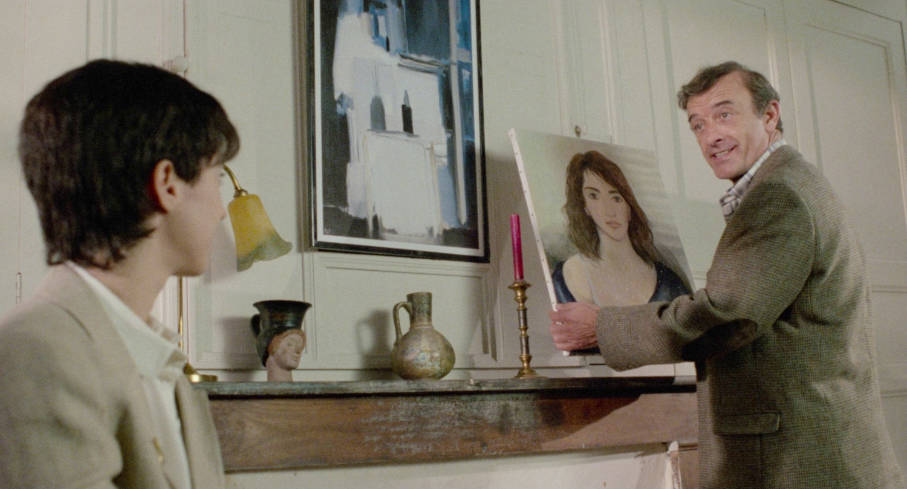
Girls and Boys Come Out to Play (13:36)
This newly-recorded video essay by Alexandra Heller-Nicholas doesn’t come with a spoiler warning but it certainly needs one. As the opening caption says, Heller-Nicholas tackles the subjects of gender and power in La travestie, beginning with the title itself, as calling a film The Transvestite may bring us up short nowadays. She locates the film amongst other dark stories about gender performativity (Psycho, Dressed to Kill, The Silence of the Lambs) though it’s more of a character drama without for the most part the crime and horror angles of those films and it explicitly tackles the position of a woman in a patriarchal society. Heller-Nicholas draws on other writers’ work on the phenomenon of cross-dressing and its meanings, for example Peter Ackroyd in his book Dressing Up, and points to a tradition of female-to-male cross dressing in French history, all the way back to the fifteenth century and Joan of Arc. Adopting an outward masculinity gives Nicole power, but Heller-Nicholas takes us through the female, and feminine, identities Nicole takes on later in the film. This is a dense, thought-provoking piece but do watch it after the film.
Location report (3:46)
Local news from 1987, on the French television show Midi 3 Auvergne. Given that the film was in production then and no one had seen it, the description by the presenter is a little spoilery in calling it a study in madness. We move to the shooting of a scene with Nicole in female guise walking down a cobbled street, and an apology for technical issues causing intermittent white lines on screen. There are brief interviews to camera from Yves Boisset and Zabou.
Image gallery
Thirteen images (not self-navigating) which comprise lobby cards, posters, French and Japanese press kits and advertisements (“sortie 3 août”, so that’s your August the third sorted).
Script gallery
Forty-nine images, two script pages per image – as it says, the shooting and continuity script, in the original French.
Booklet
Indicator’s booklet in this limited release has thirty-two pages including the covers. After a cast and crew listing, it begins with “Zabou dans le Métro: Touring the Paris Spleen of La travestie” by Georgia Humphreys. She begins by locating the film in the context of Boisset’s career, in which he had tried to embed progressive and/or left-leaning angles in stories aimed at the commercial mainstream. La travestie was one of his last films before he concentrated more on television, finding that impulse easier to fulfil on the small screen. The film was not a commercial success and has tended to be overlooked in the filmographies of both Boisset and Zabou. However, says Humphreys, it is an outlier in Boisset’s work that it centres on a woman rather than being a male-skewed political thriller. As Humphreys discusses the themes of the film, she brings up previous well-known examples of French women en travestie: not just Joan of Arc as mentioned above, but the novelist George Sand, who frequently donned male attire at a time when it was illegal to do that in public. However, Humphreys also points out that the film treads a fine line, as it risks conflating gender expression with psychosis. There’s a lot to unpick in this film, but Humpheys does it ably.
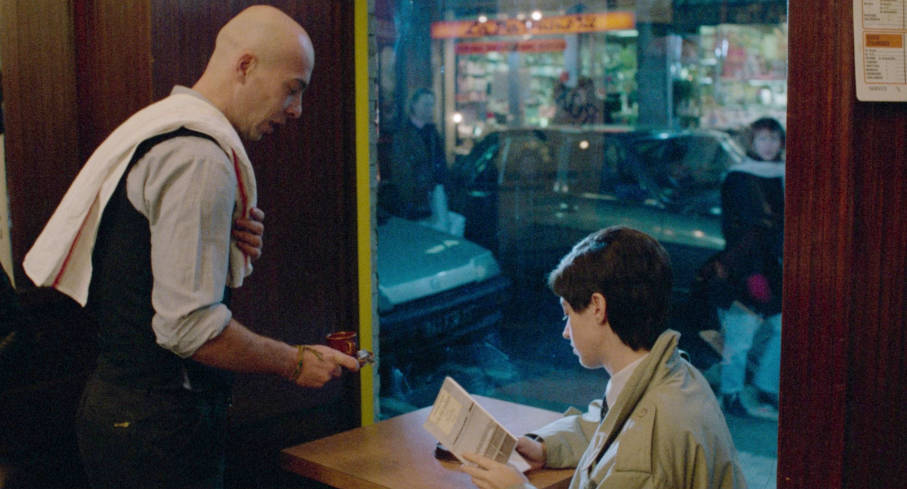
Next up is an unsigned profile of source writer Alain Roger (1936-2025), who was a philosopher as well as a novelist. He published six of the latter, of which La travestie, from 1987, was the fifth. It’s not the only one of his novels to be interested in gender fluidity and bisexuality: another of his novels, from 1977, was called Hermaphrodite. In his novels, the landscapes the characters moved in influenced them, and one reason he was disappointed with the film of La travestie was that it didn’t convey this. However, as per a long quote from a piece Roger had written for the film’s press kit, talking about his experience of having his work adapted (for the first time, as it happened), and he appears to have respected the result, particularly Zabou’s performance – or at least did so enough to be able to contribute to the film’s publicity in this way.
The booklet concludes with a three-page summary of contemporary critical responses, which reveals that the film had a generally cool reception. The booklet also includes plenty of steals. One nitpick: both the cast listing and Georgia Humphreys’s essay misspell Nicole’s surname.
final thoughts
Indicator have recently uncovered some previously underheralded (at least in the UK) areas of French cinema, and that continues with La travestie. It’s one of those films which clearly didn’t set the world alight in its time, but now is of considerable interest, more perhaps now than then.
La travestie
France 1988 | 105 mins
directed by: Yves Boisset
written by: Yves Boisset; from the novel by Alain Roger
cast: Zabou Breitman (as Zabou), Valérie Steffen, Anna Galiena, Christine Pascal, Yves Afonso, Denise Péron
distributor: Indicator
release date: 20 July 2026