
Toomorrow
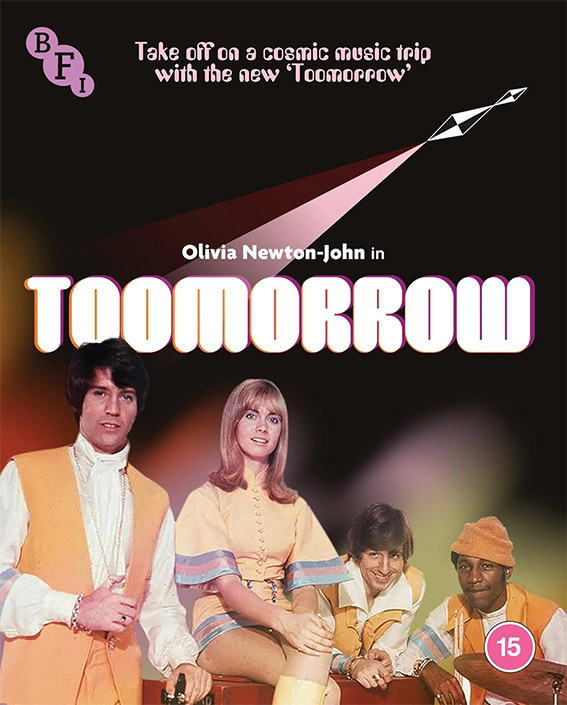
Barely released in 1970 and long unseen, but having picked up a cult following, science fiction comedy musical TOOMORROW, with an early starring role for Olivia Newton-John, comes to Blu-ray from the BFI. Review by Gary Couzens.
London, circa 1970. John Williams (Roy Dotrice) is an alien in human guise. His masters summon him back to their planet and set him to investigate strange vibrations coming from Planet Earth. They believe that these vibrations may have curative powers for their stricken planet. And these sounds come from a pop group made up of Chelsea students called Toomorrow, specifically from their prototype synthesiser, the Tonaliser…
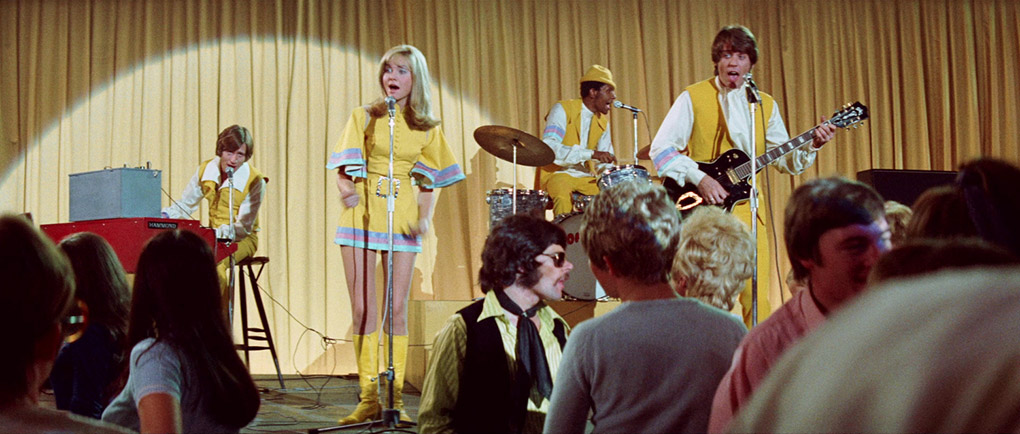
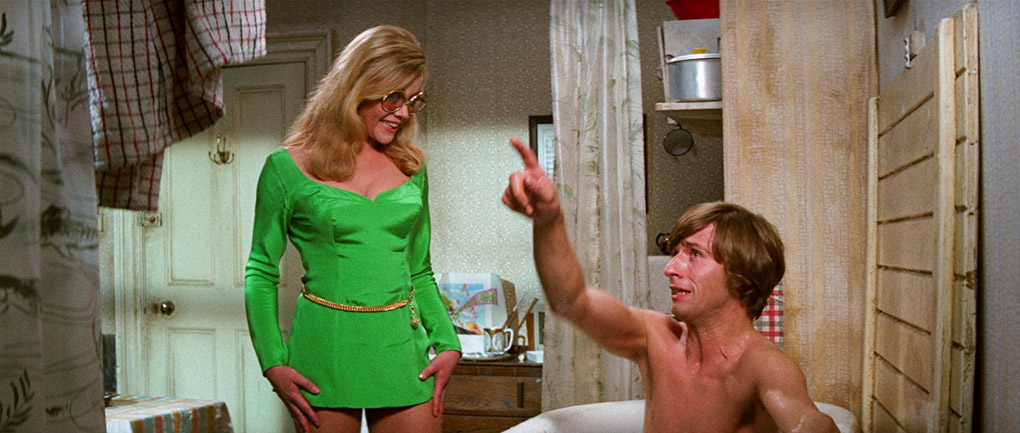
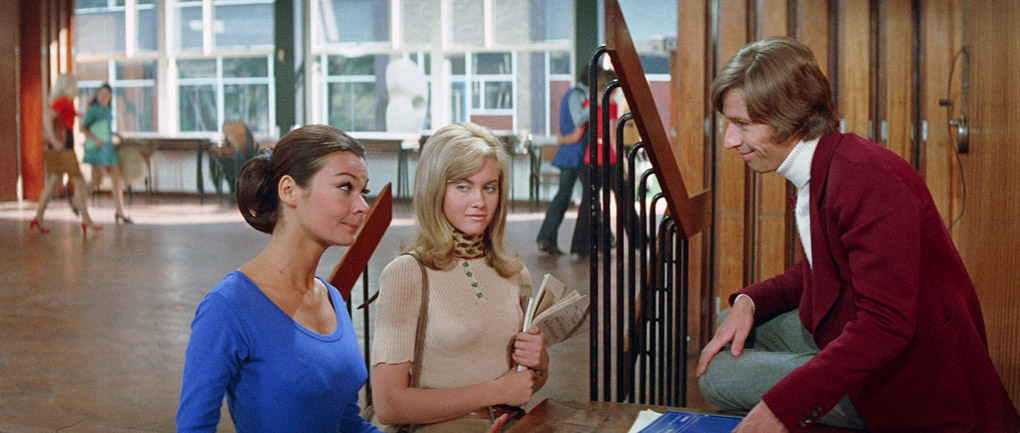
As the opening credits have it, Toomorrow the film stars and introduces Toomorrow the band. They are listed in alphabetical order by forename, so the one who went on to be famous is third. And, as with the Beatles in A Hard Day’s Night and Help!, the Dave Clark Five in Catch Us If You Can, the Monkees (and more of them in a moment) in Head and not forgetting their self-titled TV series, all the way down to Freddie and the Dreamers in Cuckoo Patrol, the four in the band are playing themselves, or rather fictional versions of themselves with the same given names. So we have singer Olivia (Newton-John), drummer Karl (Karl Chambers), keyboardist/synth player Vic (Vic Cooper) and guitarist Benny (Benny Thomas). For a while Toomorrow was a real band, put together by producer Dan Kirshner, aiming to replicate his success with The Monkees with a London-based version of the formula of good-looking young people singing attractive fluff. However, Toomorrow the band is a more diverse take on that formula. If The Monkees were four on-the-surface-clean-cut young white boys, Toomorrow is one quarter female and, due to Karl, one quarter non-white. The film attempts to capture a youthful audience which was by then growing its hair long and flocking to films like Easy Rider (and its zeitgeist-defining soundtrack of rock songs) which their parents didn’t really get. So with the student setting, we have sit-ins, and all of the band having not just love lives but also sex lives. The latter is indicated if not shown in the latter case, as the film stays within the bounds of a (then) A certificate. So the would-be sexiness is on the level of innuendo and a couple of brief shots of rear nudity, both female needless to say. The cast are certainly personable, and Margaret Nolan is fun as an alien with a mission to seduce Vic. Real-life DJ Stuart Henry turns up as the compère at The Roundhouse.
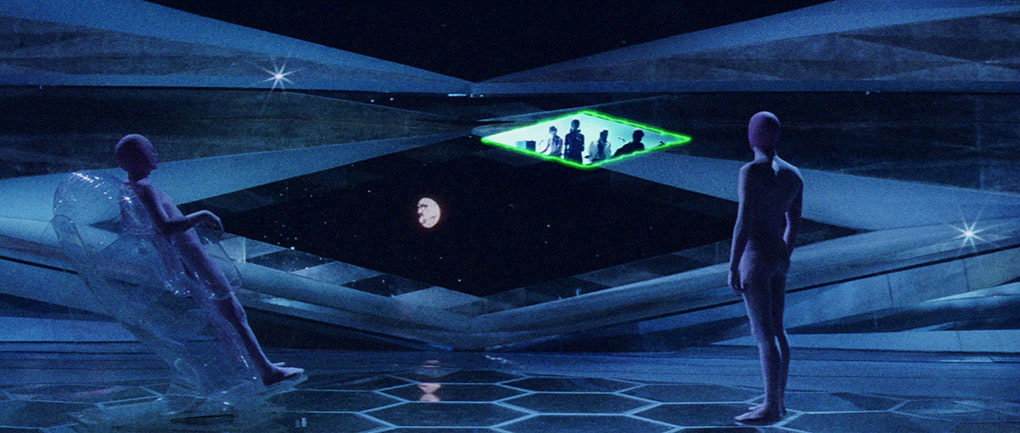
Toomorrow is a bizarre film. While it certainly has its points of interest, as an attempt to capture the flavour, and particularly the music of its time, it misses by a mile. Not to be ageist about it, but writer/director Val Guest was in his later fifties when he made this, though he had shown affinity with musical subjects in, for example, Expresso Bongo back in 1959. Dan Kirshner was younger (mid-thirties) and he joined forces as a producer with Harry Saltzman. Saltzman had had success with the James Bond films he had co-produced with Albert R. “Cubby” Broccoli, with whom he would part company after The Man with the Golden Gun (1974), and he had co-founded Woodfall Film Productions with Tony Richardson and John Osborne. The original script had been rejected, so Guest wrote his own. Guest had begun his career as a writer and gag man for the likes of Will Hay and The Crazy Gang, and had directed his first film with Arthur Askey (The Nose Has It!, of which more see below under the extras). His roots were in comedy, but he had proved himself a craftsman in many genres, including science fiction with The Quatermass Xperiment (1955), its sequel Quatermass 2 (1957) and The Day the Earth Caught Fire (1961). You can’t complain about Toomorrow technically, given Guest’s professional job of directing, Dick Bush’s colourful Scope cinematography and John Stears’s special effects in particular. However, one thing that distinguished the Monkees were the songs written for them by leading songwriters (Neil Diamond and Gerry Goffin and Carole King among them), but Toomorrow’s songs are the work of Ritchie Adams and Mark Barkan, who are not in the same league. The songs, which found themselves on the soundtrack album, are pleasant but pretty forgettable and the cutting edge of pop around the turn of the decade they most certainly are not.
Films which are unavailable for some time, for whatever reason, often find their reputations inflated or deflated in their absence, so they are adjusted up or down when people finally have a chance to see them for themselves. That’s been the case with Toomorrow. After the film was finished, Val Guest, who had been working on the film for some six months more than his contract specified, and who had not been paid for it, took Saltzman to court. There was no money available, as the company concerned had gone bust, and so Guest obtained an injunction on the film. It was released in London, at the Pavilion, on 27 August 1970. It played there for three weeks – not the one that some sources say, as cinema listings show that its last day was 16 September. There are some evidence of sporadic showings after that (in his commentary, Michael Sandoval says that it had some showings in Australia) it was out of circulation for nearly four decades. It had its USA premiere in 2000.
Toomorrow has been of interest to many for Olivia Newton-John’s involvement. It wasn’t her first film: that had been Funny Things Happen Down Under in 1965. That had not set the world alight: it was a spin-off of an Australian television show, The Adventures of the Terrible Ten, and its commercial cinema release was restricted to Australia and New Zealand, cut from 86 minutes to just over an hour to play as a second feature. Its only UK showing on record was in 1965 as part of the Commonwealth Film Festival, there being likely not much of a choice of Australian films to show that weren’t documentaries. It’s not much to conjure with, though Olivia does have a song to herself. After Toomorrow, her solo singing career took off, beginning with her cover of Bob Dylan’s “If Not for You”, top ten on both sides of the Atlantic. Her next film was Grease, which was a big hit and dominated the singles charts in 1978, not least for her duets with John Travolta, “You’re the One That I Want” and “Summer Nights”, number one in the UK for nine and seven weeks respectively.
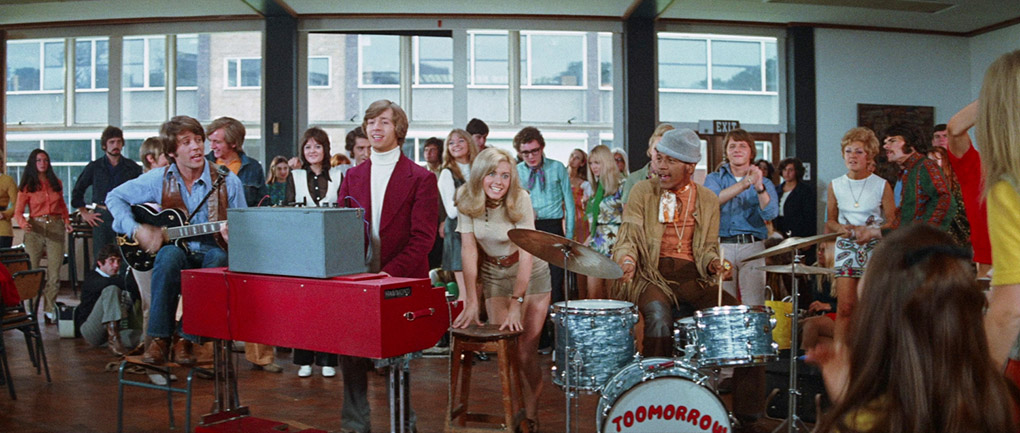
Now that Toomorrow can be seen widely, it’s probably best appreciated for its kitsch value than its own merits – a professionally made, entirely inoffensive and frankly bland film which didn’t capture the youth market then and won’t now. However, fans of its star and of the odder byways of British cinema of the era may well want to take a look.
sound and vision
Toomorrow is released by the BFI (who joined forces with the USA-based Deaf Crocodile) on Blu-ray, the disc encoded for Region B only. The film had an A certificate in UK cinemas in 1970, but now it’s a 12. The disc however has a 15 overall, due to If I Could Turn You On. Current certificates do not appear on the BBFC website at the time of writing, but The Nose Has It! and Chimp-Mates: Alice Goes Pop! were both U on their original releases and are unlikely to be anything different now. Tomorrow Night in London, being a documentary not containing anything which would trouble a U or PG, has been exempted from classification.
The film was shot in 35mm colour with anamorphic lenses and the Blu-ray transfer, based on a 4K scan of the original negative, is in the intended ratio of 2.35:1. The transfer notes in the booklet say that there were some severely scratched shots which were replaced with those from an IB Technicolor (dye-printed and non-fading) print, particularly in reel four of six, not that I spotted any difference myself. As this scan is from the negative, it shows up things which would have been less noticeable in a 35mm projection print three generations away from the negative, such as some shonky rear projection in a car scene sixteen minutes in. That said, the transfer is appropriately colourful and grain is filmlike.
The sound is the original mono, rendered here as LPCM 2.0 and it’s a professional job of work, with dialogue, sound effects and music well balanced. This might have had a stereo soundtrack in cinemas at the end of the decade, but it didn’t, so all out of the centre channel it comes. There are English subtitles for the hard-or-hearing optionally available on the feature only. I spotted a couple of errors: “scintillers” for “scintillas” at 9 minutes, and “Ramesses” for “Rameses” (as in the Egyptian Pharoahs of that name) at 41 minutes.
special features
Commentary by Andrew Sandoval
This commentary was newly recorded for this release. Andrew Sandoval is a writer on music – particularly relevant to this film, a book on the Monkees – rather than one on film, and that does show somewhat in his commentary. Some of the discussion on the film’s production and release (or lack thereof) is a little vague, such as the details of the injunction and lawsuit. He’s also a little shaky on the place of Guest’s films in British film history. (Confessions of a Window Cleaner is “a very humorous film if you ever get a chance to see it”, he being seemingly unaware that it’s by far the best-known of Guest’s post-1960s films, let alone the biggest British hit of its year at the box office.)
However, we have a lot of detail of the story of the off-screen band Toomorrow and all its members, not just the one who went on to be famous. (Credit to him for noting that Toomorrow wasn’t Newton-John’s film debut, though all he says about Funny Things Happen Down Under comes from her autobiography.) There is a lot about manufactured pop groups, whether Don Kirshner had a hand in them or not, and we even hear something about the history of The Roundhouse. Sandoval does seem to run out of material in the last twenty minutes or so, as gaps become longer and he starts being more scene-specific than he was previously. Something of a mixed bag, this commentary is stronger from a musical perspective than a cinematic one.
Tomorrow Night in London (5:12)
Made in 1969, this is a rapid-fire montage of the sights and sounds of London, intended to entice you to spend pounds in a city which was still swinging, more or less. So we see St Paul’s Cathedral and Carnaby Street, the Royal Opera House and a nightclub called Revolution, a pub and a cabaret venue, and a night out at The Talk of the Town, with a certain Bruce Forsyth on the bill. So all cultural bases are covered.
The Nose Has It! (8:03)
A 1942 short written and directed by Val Guest (his debut in the latter capacity) and photographed by Arthur Crabtree (who had previously worked with Guest on Will Hay’s Oh, Mr Porter! (1937) when Guest had been one of the writers). Arthur Askey talks to camera as well as appearing in a few short scenarios about proper hygiene, the need to sneeze into a handkerchief rather than scattering germs to the four winds. It’s all in the aid of the War effort, so men and women can carry on to defeat the Germans without spending a few days in bed feeling sorry for themselves, in their pyjamas or nighties with a growing pile of soggy tissues in a waste-paper bin at their side.
The Guardian Interview: Val Guest (62:20)
Many interviews in the Guardian Lectures series at what was then the National Film Theatre have been recorded and released as disc extras over the years. This, however, was one where the NFT stretched to recording the proceedings on video, on 6 July 1998. Guest is interviewed by David Meeker. Needless to say, this is a career overview for Guest, who was eighty-six and clearly as sharp as a tack. Toomorrow isn’t mentioned at all, though surprisingly The Nose Has It! is. Born in 1911 as Valmond Maurice Grossman, Guest worked in Islington for Gainsborough from 1937, on a salary of £25 a week. In the office next door was Alfred Hitchcock, and Guest tells a story about his penchant for practical jokes. Guest worked with Will Hay as a screenwriter but didn’t go with him to Ealing. He made his directing debut with the short The Nose Has It! (see elsewhere on this disc). He had been the tenth writer asked and, rather miffed by that, Guest insisted on directing as well. Possibly diplomatically, he says that Arthur Askey had to be “handled with care”. He gave Jean Simmons a break on Give Us the Moon. There is also talk of the 1946 Technicolor musical London Town, for which Guest contributed to the script mainly due to his past work with star Sid Field, and which then had just been restored.
Nineteen minutes in, actress Yolande Donlan (Guest’s wife – they made eight films together) joins them on stage. She began in her native USA as a dancer in the Freed Unit at MGM, though didn’t appear in any of their classic musicals. She had a success on stage in Born Yesterday, which was seen by Laurence Olivier, and, now in the UK, she met Guest in 1948 and they married in 1954. Guest talks further about his making films in locations elsewhere to London (for example, Brighton in Jigsaw, Manchester in Hell is a City). Although he went on to make The Quatermass Xperiment (1955) and a number of thrillers, his first films for Hammer were in his then more familiar comedy mode: Life with the Lyons (1954) and its sequel The Lyons in Paris (1955).
Thirty-seven minutes in, Meeker takes questions from the audience. Not all of them are easily audible on this recording, but for most of them Meeker does repeat them for Guest (and us). Guest tells the story of his being awarded a British Film Award for The Day the Earth Caught Fire (1961) from none other than Prince Philip, the Duke of Edinburgh, and the Prince asking him what he was doing next. On being told that this was a police drama set in Brighton (Jigsaw), Prince Philip commented “How bloody dull”. Guest also talks about how he turned down Dr No – given that novel and Thunderball to read, he much preferred the latter, but Dr No was the one which was made first.
The British Entertainment History Project: Val Guest (9:32)
An excerpt from Val Guest’s interview (by Roy Fowler in 1988) for the British Entertainment History Project, a series of career overviews of filmmakers of all disciplines which have done service as disc extras many times in the past. Here, Guest talks specifically about Toomorrow, beginning with his seeing “Livvy” as part of a cabaret act. Don Kirshner wanted her to appear in a love scene, but she was unhappy with that. By that time, she was making her first appearances on British television, including guest appearances on Cliff Richard’s shows. He talks about his suing Harry Saltzman for payment he never received, and which kept Toomorrow out of circulation after its initial release. He says that the whole episode was the worst in his entire career.
If I Could Turn You On (12:43)
One of those extras from the archive that the BFI like to put on their disc releases, not connected to the main feature but tangential to one or more of its themes. Or rather, the late-Sixties vibe the film aimed for, and another connection is this performance from American theatrical troupe The Living Theatre at the Roundhouse. That venue in Chalk Farm provided Toomorrow with its climax, but here, made by the London Film School (credited are Tony Bragg, Bernie Coyne, Bill Hodgson and Bill Koenigsberg) in very contrasty and grainy black and white, we see a very different kind of performance, maybe one that achieves madness or at least aims to. Nudity and limbs being pierced by knives in silhouette, all aiming to outrage the bourgeoisie. Co-founder Julian Beck went on to an acting career, one of his best-known roles being the Reverend Kane in Poltergeist II: The Other Side (1985), made when he had terminal cancer and released after his death.
Chimp-Mates: Alice Goes Pop! (17:03)
The BFI returns to the well of the Children’s Film Foundation once again. As well as the main feature (of values of “feature” which include fifty minutes to an hour, or three reels in old money), on your Saturday mornings along with your orange juice and ice lollies you would have had a supporting programme include one-reelers like this. Made in 1975, this was one of the series Chimp-Mates, in which Alice the chimpanzee is bequeathed to a West London family including siblings Judy (Lynne Morgan), Joey (Marcus Evans) and Josh (Philip Da Costa), so the usual for-kids combination of two boys and a girl. The three play in a band, which includes some work with a twelve-string acoustic guitar and we even have a drum solo. And of course Alice joins in. Very broad and silly, and you hope the young audience weren’t too noisy in the seventeen minutes this was on screen. There were three series of Chimp-Mates shorts made.
Toomorrow: Musical Humanism Through the Stars (11:56)
This is a video essay by Celeste de la Cabra, which begins, “Toomorrow is truly a film which needs to be seen to be believed.” But he means that in a good way, as he continues, “This highly ambitious, highly underseen cult classic uses manufactured pop stardom with sci-fi singularity and humanistic social commentary,” as he sets out to demonstrate just that in the next eleven minutes. If the film is to be believed, music much before the time the film was made and set lacked emotion and heart, though de la Cabra traces the origins of the Tonaliser in the Moog synthesister, which was launched in 1964. (Its younger sibling, the Minimoog, came out in 1970 and was more affordable for bands like the one in this film.) But empathy is all, and in the words of Roger Ebert, cinema is the great empathy machine. However more to the fore is the very-much-of-the-time battle of the generations. Says the lead alien, “Our civilisation is old but is directed by minds that are young. Your civilisation is young but it controlled by minds that are old.”
Booklet
The BFI’s booklet, available with the first pressing of this release, runs to twenty-eight pages plus covers. Following a spoiler warning, we begin with “Toomorrow” by Matthew Hild, writer of a book on Olivia Newton-John. This begins with Don Kirshner’s comments about walking the streets of London with Olivia Newton-John telling her “how incredible she was gonna be”. That may sound a little creepy in hindsight, but he did spot her talent. He was introduced to her by Peter Gormley, a London-based Australian who managed her and Cliff Richard. Kirshner noted her look and sound – the fact that her grandfather (Max Born) was a Nobel Prize laureate in Physics was extra marketing fodder. Much of this essay is devoted to Kirshner’s putting Toomorrow together, uniting the three boys and a girl to make the next hopeful pop sensation, before we get to the making of the film. But his golden touch deserted him, and one of the naysayers was Newton-John’s fiancé Bruce Welch. As with the commentary, this piece is stronger from a musical perspective than a cinematic one, and there’s more about the afterlife of its star than the film itself, and as such is worthwhile.
Next up, in case you were thinking the director of the film was being relatively neglected, is Josephine Botting with an four-page overview of Val Guest’s career. This ends with a personal note as she met Guest when his autobiography was published, published in the year he turned ninety.
Following a two-page cast and crew listing, we have “Daydream Believer: Don Kirshner’s Imaginary Bands” by JT Rathbone. As the title indicates, this begins with The Monkees, and their own rather stranger – and cultier from the outset – film Head (1968) and the preceding TV series. Although Mike Nesmith and Peter Tork were musicians, the four of them had been hired as actors and singers and the actual music was played by session musicians, with the songs provided by some high-class songwriters. Don Kirshner was more involved with sorting out the notes and words. He fell out with The Monkees after they were determined to come up with their own songs and play on them. After having been fired, he went on and created the cartoon group The Archies (in Kirshner’s words “a group that won’t talk back”), who had a worldwide hit with “Sugar Sugar”. These inspired several imitations. A fellow artiste from the same comics that spawned the Archies was Josie, lead singer of Josie and The Pussycats. And another non-human group with their own TV show was The Banana Splits, staple of many an early-1970s childhood on both sides of the Atlantic. There’s a little bit at the end about Kirshner’s next manufactured group, and that’s the one in the film on this disc.
Also in the booklet are notes on and credits for the special features on this disc. Vic Pratt provides more extensive notes on the four short films included, unsurprisingly given that the Sixities musical content and the CFF short show him very much in his element.
final thoughts
Now that it can be seen again, Toomorrow is not a long-lost masterpiece by any means, and you can see why it never set the world alight back in 1970 even if it hadn’t gone out of circulation quickly. As always it’s well-presented on disc and the BFI have as ever provided some well-chosen extras.
Toomorrow
UK 1970 | 95 mins
directed by: Val Guest
written by: Val Guest
cast: Benny Thomas, Karl Chambers, Olivia Newton-John, Vic Cooper, Roy Dotrice, Tracey Crisp
distributor: BFI
release date: 22 June 2026