
The way of all flesh
Obsession, desire and bodily functions are explored over three generations of the same bloodline in Hungarian filmmaker György Pálfi’s provocative, challenging and richly imaginative second feature TAXIDERMIA. A once uncertain Slarek revisits the film after a 19 year gap and falls in love with every outrageous element on Radiance’s excellent new Blu-ray.
‘Technically speaking, these are three separate short films, and our aim for each one was to have it represent a distinct world, a world that emerges through its content and context. At the same time, we had to treat this as a single feature film. My approach was to say: “I am introducing you to a world, to something wonderful, so sit back and relax. And now I’m going to show you a circus. The characters will appear one after another, the firecrackers will go off, and let’s watch together to see if we make it to the grand finale. I wonder, do you recognise this world around you, or is it just me?”’
Director György Pálfi on his second feature, Taxidermia
Take another look at that quote above. It all sounds intriguing and even rather fun, but before you rush out to grab a copy of the film expecting a poetically told and sometimes colourful three-chapter drama, a small heads-up warning is probably due. If you’re someone who switches channels when they’re told that the programme they sat down to watch contains strong language and scenes that some may find offensive, then take my advice and don’t, whatever you do, buy or rent Taxidermia. Seriously, if you’re upset by actors getting naked or fruity with their language or a bit nasty with the violence, then you are definitely not ready for what unfolds here. As someone who has no problem with any of this and delights in seeing taboos busted, I’m not sure even I was ready for it when I first watched the film back in 2007. But then I went in cold, aware only that it had severely divided fans of director György Pálfi’s first feature Hukkle (2002), some of whom appeared genuinely dismayed at the direction he had taken with his follow-up feature. I still haven’t seen Hukkle and knew little of Taxidermia when the Tartan’s DVD landed on my doormat all those years back, and while this can be a great way to approach a film, it can be a little risky when you’re dealing with cinema of the extreme. Unless, of course, you’re genuinely prepared for anything.
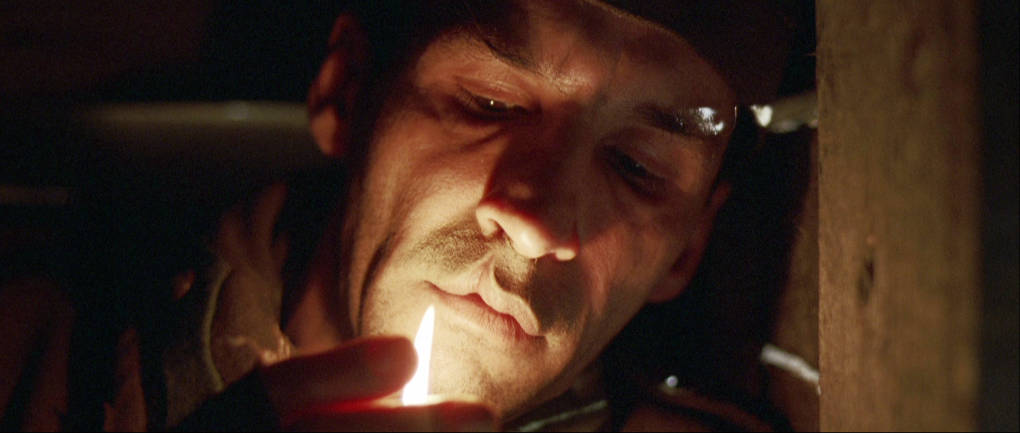
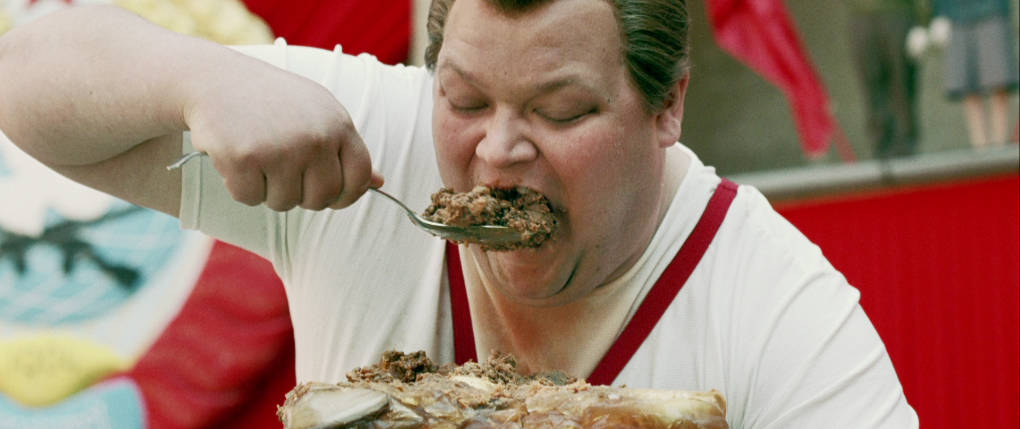
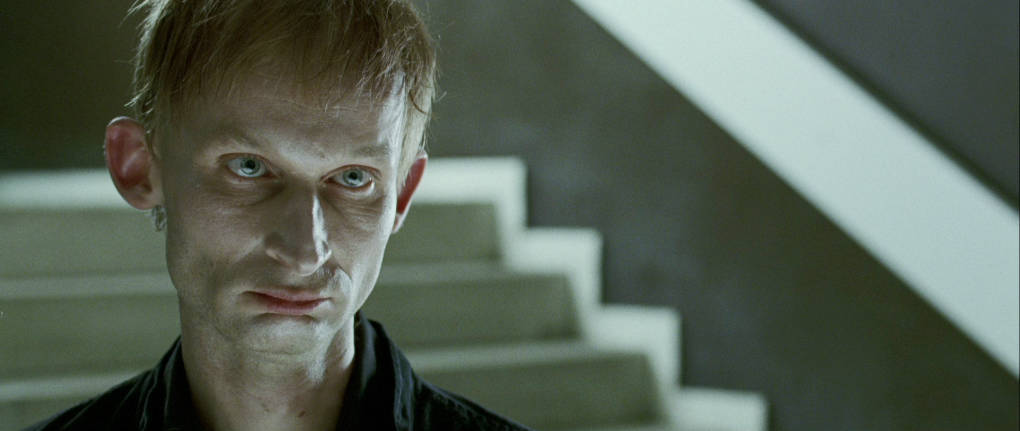
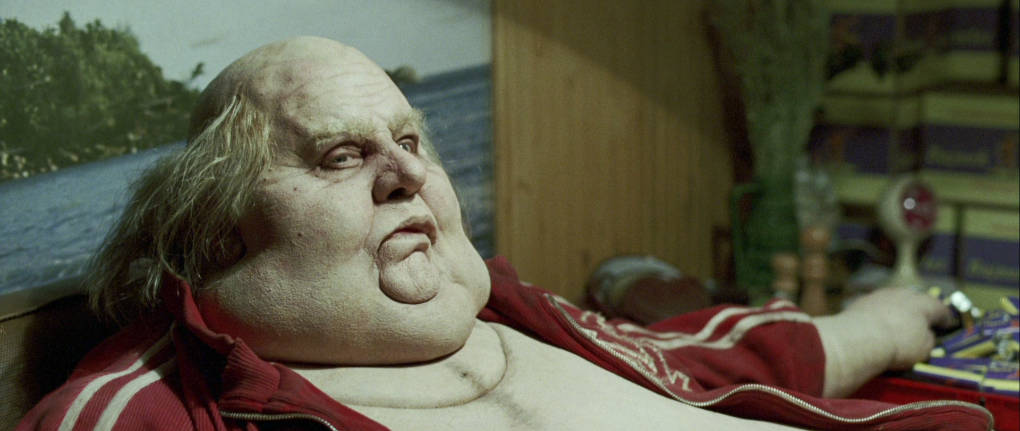
Taxidermia is comprised of three acts that focus on three generations of male individuals of what on the surface appears to be the same bloodline. The first kicks off in the Hungarian countryside in World War 2, where put-upon, cleft-lipped army orderly Morosgoványi Vendel (Csaba Czene) is stationed at an isolated house occupied by his surly commanding officer, where temptation in the shape of the officer’s two comely daughters results in varied and frequent masturbation on Vendel’s part. He’s been warned of the consequences of spying on the girls, and they think he’s creepy anyway, but when cautioning Vendel, the commander failed to include his portly, sex-starved wife Irma, in whom Vendel plants his seed. Or does he? Could this just be a fantasy on Vendel’s part whilst masturbating on the carcass of a slaughtered pig, or is he reliving a true memory of the encounter to pleasure himself later? Given the subsequent responsive action taken by his commanding officer, the latter seems likely. It results in the birth of the pig-tailed baby Kálmán (Gergõ Trócsány), who in young adulthood grows in every direction to become a leading contestant in national eating contests, where he just keeps missing out on the top prize. His marriage to fellow food athlete Aczél Gizi produces a son, Lajoska (Marc Bischoff), who grows to be a thin and weasel-like adult whose work as a taxidermist is interrupted only to take care of his now hugely corpulent father and his disturbingly oversized cats. Once again, a sliver of doubt is thrown into this genetic timeline by the fact that Aczél gets off with Kálmán’s equally portly friend and competition rival Béla (Zoltán Koppány) even before the wedding reception has concluded, making it uncertain just which of the men is really Lajoska’s father.
Now if the above plot summary leaves you wondering what my earlier warning was all about and convinced this will be an easy ride, here are a few sequences you should be aware of:
- A real pig is killed on screen, cooked on a bonfire, and chopped up for eating;
- The sex between Vendel and Irma is explicit and takes place on the open pig’s carcass;
- The masturbation is also explicit and the use of a greased hole in a shed wall as a masturbatory aid results in Vendel’s erect penis being pecked by a rooster;
- Vendel’s fondness for ingesting candle flames results in an ability to ejaculate fire, which is also explicitly demonstrated;
- Vendel has paedophiliac fantasies inspired by Hans Christian Anderson’s The Little Match Girl that cause him to orgasm so hard that his ejaculate shoots off into the cosmos;
- The pig’s tale that Baby Kálmán is born with is cut off by his disgusted father with blacksmith’s pincers in unforgiving close-up.
I should point out that the above list is all from the first of the three stories, and I haven’t included what Vendel’s commander dourly claims makes the world go round, or the colourful word that he repeatedly uses when expressing this view. Anyway, if you get through this then you just might be ready for the mass vomiting that follows each round of the eating competition and its practice sessions, the huge close-up of a pigeon’s anus as it ejects waste onto the pavement, and the skinning of a gorilla’s corpse in preparation for its everlasting preservation. Even if you are, you’ll probably be ill-prepared for the special job Lajoska does for one customer, and you’ll definitely not be ready for the jaw-dropping finale in which he… no, I’m not going to give that one away.
Such content is likely to severely narrow the film’s potential audience, and even then, there will likely be division over whether Taxidermia inventively explores man’s baser instincts or gleefully revels in them. There were certainly times during my first viewing in 2007 when I found myself suspecting that Pálfi was deliberately playing the provocateur, but he does so in the manner and tradition of surrealist cinema of years past, whose shock tactic lineage runs back to 1928 and the eye slicing in Luis Buñuel and Salvador Dali’s Un Chien Andalou. And there’s so much more to Taxidermia than its ability to offend audience sensibilities, and more to argue about, raising questions that the special features on this new Blu-ray edition most usefully help to answer. Revisiting the film 19 years closer to his own eventual extinction, I became acutely aware of the film’s examination of humankind as meat, ultimately no different from the animals we slaughter and consume, as well as the questions it raises about how an artist can become overshadowed by their art, and the lengths to which some might go to mitigate this.
One accusation I did see made at the time of the film’s release was that Pálfi holds his characters in contempt, a middle class disgust at the excesses of the proletariat, who are presented as physically unattractive people with creepy and morally base habits and unattainable dreams. Of the three generations, only Kálmán gets the girl he desires, and even then, that’s only after Béla has had his way with her. The fantasy/reality editing of Vendel’s encounter with Irma, meanwhile, makes it uncertain whether this copulation happened at all, her pregnancy perhaps the result of supernatural forces rather than actual intercourse. But there’s a degree of delight to every disgusting moment and a narrative alignment with the characters and their destinies that creates a peculiar bond of empathy throughout. I found myself genuinely concerned for the risks Vendel was taking in pursuit of masturbatory pleasure, for the wellbeing of Gizi when a demonstration of her ingestive skills for a Communist party dignitary puts her pregnancy at risk, and for the desperate measures Lajoska is prepared to go to in order to make his mark on a world that values his work more than it does its creator.
Despite its extreme content, I would argue that Taxidermia is not an exploitative film, something evident in the real care and invention with which individual sequences are staged and filmed. These range from an extraordinary sideways rotating camera move (it’s really hard to describe unless you see it) that provides a compressed history of the uses to which a wooden bath has been put, to the pop-up storybook that seamlessly transforms into a set with costumed actors, and the sleight-of-hand effects work that enlarges Kálmán’s cats to just beyond what could possibly be right for such animals. There’s a darkly infectious energy and wit at work here in all aspects of the production, with performances that confidently walk a fine line between naturalism and the grotesque, historical detail that parodies without tumbling into outright mockery (the organised Communist era rah-rah at the eating contest is particularly well done), and special effects that take a surrealistic gag just that bit further than you’d have thought anyone would dare (the aforementioned space-bound ejaculation made me laugh out loud). The structure clearly has purpose, in the changing fortunes of the generations, in the relationship between father figures and sons and the expectations of one for the other, and in the connection between meat and human flesh, all of which has only become clearer and more potent for me with the passing of time and subsequent viewings.
If you’re looking for something outside of the mainstream norm, then Taxidermia really should be at the top of your watchlist, although you’ll need a strong stomach and an open mind if you’re going to stay with it until the memorable finale. It’s demented, twisted, inspired and intelligent fun for the tolerant, performed with conviction and precisely directed, and boasting fine work from cinematographer Gergely Pohárnok, editor Réka Lemhényi and score composers Albert Márkos and Amon Tobin. All these years on, it remains a film experience quite unlike any other and is one film that we can be sure will never be the victim of a Hollywood remake.
sound and vision
Without current access to the booklet that ships with the release version of this disc (which itself may have no details on this, of course), I know nothing about the source for the transfer on this Radiance Blu-ray, but whatever it was, the results are most impressive. It’s framed in the film’s original aspect ratio of 2.35:1, and a side-by-side comparison with Tartan’s 2007 DVD release – which was no slouch for its day – provides a clear demonstration of the difference between even a solid SD transfer and a quality HD one. The image is considerably sharper on the Blu-ray, with detail that was blurry on the DVD crisply rendered here, something particularly evident on close-ups of faces and the textures of clothing and buildings. The contrast has been very nicely graded, not feeling overly punchy but also ensuring that the image never feels remotely washed out, even in the first story sequence set in heavy mist. The colour palette differs slightly in each story (I hadn’t twigged why specific colours dominate the second act until I listened to Michael Brooke’s commentary track) and is cleanly and attractively rendered, with bolder colours making their mark without looking over-saturated. There’s also a textural richness to the image here that puts it head and shoulders above the previous DVD.
The Hungarian soundtrack is presented here in DTS-HD Master Audio 5.1 surround and is also in excellent shape, boasting an impressive tonal range and pin-drop clarity, with particularly rich reproduction of the music and the yuckier sound effects (oh, that vomiting). Although dialogue tends to be front and centre, the score makes use of the full sound stage, as do certain ambient sound effects, including the room reverb in the very final scene.
Optional English subtitles kick in by default and unsurprisingly are a lot sharper and less pixelated than those on the DVD.
special features
Audio Commentary by Michael Brooke
Critic, film historian and Blu-ray producer Michael Brooke is one of my favourite disc commentators, and I’m not saying that because he has also contributed two reviews to this humble site, but because of the always impressive volume of information he is able to impart about the film under discussion. In common with horror specialist Kim Newman, Brooke seems to know his subject inside-out, and his clear enthusiasm for the film quickly proves infectious, though in common with Newman, the speed and density of his delivery had me repeatedly pausing the commentary to take notes lest I miss a key detail. He describes Taxidermia up front as “one of twenty-first century’s most original and eye-catching films,” and in the spirit of the György Pálfi quote at the top of this review, examines each of the three stories told here individually, providing historical, social and political details to help us see the characters, their actions and their motivations in their proper context. I was intrigued to learn the prosthetic penis that is so memorably employed in the first story was modelled by a porn star, I genuinely hadn’t twigged that the dominant colours in the second tale were those of the Hungarian flag, and this time around found myself in complete agreement with Brooke when he suggests that the most potentially disturbing sequence is one of the most fascinating to watch. He also relates a couple of eyebrow-raising personal anecdotes that are triggered by events depicted in the film and caught me out completely with a brief but detailed and cheerfully delivered breakdown of the origins, development and use in the film of a famously strong slang word for female genitalia.
Taxidermia Aesthetica (26:22)
If Taxidermia left you feeling feel deeply uncomfortable or worse, then the opening few seconds of this interview with director György Pálfi will likely confound expectations, as he laughs with film critic László Kolozsi and cheerfully states, “It’s fun to film stuff. Making movies is fun. It’s good to create.” He says of Taxidermia, “I was thinking in terms of poetry, and what it would be like to structure a film like a poem. A train of thought with rhymes and a certain form, disparate, associative ideas presented in a very visual way,” which I also nearly quoted at the top of this review, as I suspect it’s not the sort of thing that those watching the film for the first time would expect him to say about it. He talks about adapting the two Lajos Parti Nagy short stories that were the basis for the screenplay and his efforts to preserve both their content and their spirit and expands on the process of getting funding for a script that many people liked but that investors did not find interesting. He reveals that he instructed special art director Géza Szöllösi to design the Little Match Girl pop-up book sequence in his own style and acknowledges the influence Damien Hirst’s preserved animal artworks and especially Gunther von Hagens’ body preservation sculptures. There’s lots more of interest here, including info on the film’s cultural, historical and even philosophical references, Pálfi’s views on competitive sport, and the idea that even the filmmaker will find unexpected and unintended layers of meaning in his own film once it is complete.
The Making of Taxidermia (42:17)
In some ways, a standard making-of documentary, but one whose 42 minute running time allows for more depth and content than you normally get in those sales-pitch EPKs that this structurally resembles. Shot on DV and framed 4:3, it mixes interviews with director György Pálfi, cinematographer Gergely Pohárnok and other crew and cast members with behind-the-scenes footage of the shoot itself. This, for me, was what really grabbed my attention, revealing as it does how that extraordinary rotating shot of the wooden bath and its various uses was accomplished, and how the visual effects of the eating competition vomiting and Kalman’s giant cats were achieved. Author Lajos Parti Nagy reveals that when asked by journalists how he imagined a film adaptation of his work would look, he responded that he did not imagine it at all but was curious to see what Pálfi would do with it, enough to accept a cameo in the film as a dead man lying in the wooden bathtub during the aforementioned rotating shot. When talking about the make-up he had to be fitted for and wear as the obscenely bloated Kálmán in the third story, actor Gábor Máté admits that he didn’t know what he was getting in to, and when his scenes are completed, he tells nearby crew members, “I don’t think I’d be willing to do this again for anyone.” Pálfi does wonder out loud at one point if the film will turn out as he hoped, optimism amusingly echoed at the end by cinematographer Pohárnok, who soberly states, “It would be fucking great if it turned out well, if what we did worked.”
The Fish / A Hal (28:26)
A 1997 short film by Taxidermia director György Pálfi that was either shot on video or transferred to tape from which the transfer here has been sourced, and whose closing credits indicate that this was made while Pálfi was a student at the Academy of Drama and Film in Budapest. Following a title sequence consisting of wavy underwater style text intercut with close-ups of trawled fish being unloaded, the film itself opens with a bravura handheld shot that locks onto a young man named Karcsika (Ferenc Elek) as he weaves his way through a busy street market, where he is hailed by a range of stallholders, each of whom cheerfully give him free food for his mother (Judit Hernádi), to whom they send their best wishes and respect. At this point I was convinced that this woman was the head of a powerful crime family, to whom these stallholders were essentially grovelling in the hope that she would look on them kindly and perhaps even do them a favour or two. When Karcsika gets home to their humble apartment, however, it seems clear that his mother is no female Don Corleone but the most sexually available widow in town, hence these gifts offered by her many male admirers. Karcsika, meanwhile, idolises and idealises local girl Brigi (Tímea Búza), whose only interest in him appears to be the nail polish that his mother promised that she’d procure for her. The mother’s latest lover is market fishmonger Gyula (Gyula Bodrogi), whom she persuades to give Karcsika a job, one at which he doesn’t exactly shine, seemingly having empathy for the very creatures he is required to kill and gut for sale.
A visually interesting work that for me makes a virtue of is video aesthetic and effective use of colour, and has a nice mix of static camera, smooth dolly shots and more kinetic handheld work when the action demands. It also foreshadows Taxidermia just a little in its presentation of the human body as recreational meat, even if the exploited bodies in question are all female and the exploiters are men. Oh, how little times change.
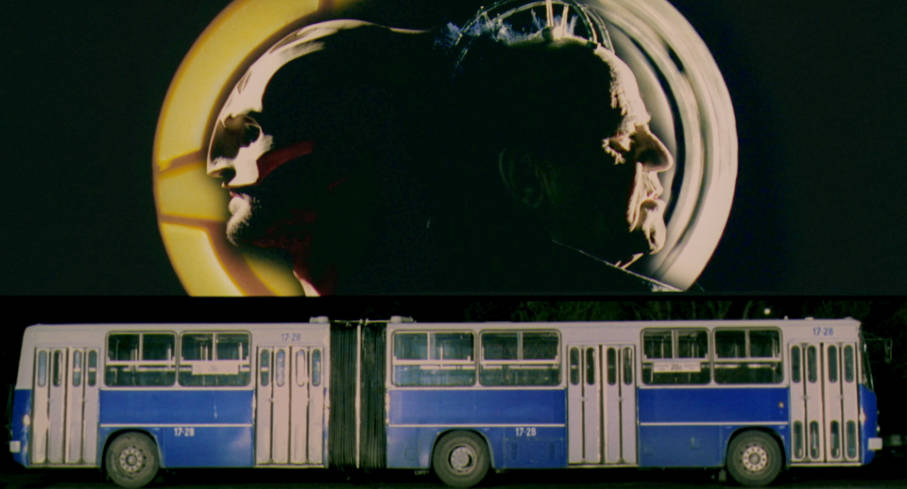
Shaman / Táltosember (22:30)
If you’ve just watched Taxidermia for the first time, I somehow doubt you’d be wondering what sort of film director György Pálfi would turn in if tasked with directing a superhero movie. It certainly couldn’t have been further from my mind when I sat down to watch his 2003 short film Shaman (Táltosember, aka Táltosember vs. Ikarus), which is probably why I initially wondered if I’d put the wrong disc in the player as the film unfolded.
An ordinary and loving family man by day transforms himself into a masked superhero known as Sha-Man at night to do battle with Icarus, an evil supervillain who takes control of a passenger-carrying night bus, which he guides to the depot where he unleashes a whole fleet of carnivorous winged buses and sends them flying towards the sun with the aim of extinguishing it and snuffing out all life of Earth.
There are no character names here, so I can’t identify which actors played which roles, but they all enter into the spirit of a film that is every bit as bonkers as its sounds. It’s also enormous fun, not just for the gleefully silliness of the story and the lively presentation, but also for the creative games that Pálfiplays with the digital medium. This includes an inventive use of split-screen, sometimes eye-catching transitions, and digital effects work that suggests this had a far higher budget than the average short film would attract, something the lengthy roster of names on the end credits would seem to confirm. Colourfully shot by Taxidermia cinematographer Gergely Pohárnok, it’s just the sort of film that Pálfi’s cheerful disposition and above-mentioned claim that movies are fun to make would suggest he always secretly had up his sleeve. I really enjoyed this, right up to the unashamedly sun-soaked Batman-esque final shot.
Erdő (3:27)
A music video of song Erdő by the Hungarian rock band Hollywoodoo, which plays over the end credits of Taxidermia and may also have been directed by György Pálfi, though I’ve been unable to confirm this yet. Structurally, it’s a standard movie tie-in music video, with shots from the film intercut with footage of the band performing, here in what looks like a concrete walled basement. It does have an oddly engaging opening shot of the bulky lead singer, viewed from behind as he quietly bobs his head to the music, and is later seen strapped to the machine featured in the film’s extraordinary climax. Two versions of the video are included here, both the same length (well, as they’re for the same song, they logically would be), the original cut and the director’s cut, the latter featuring some of the more explicit and violent imagery from the film.
Géza Szöllősi’s Artbook (12:21)
A rolling gallery of drawings and paintings by art designer Géza Szöllősi, who created the Little Match Girl pop-up book set in which one of the film’s most troubling sequences is set. Nothing startling, but definitely of interest.
Deleted Scenes (39:00)
39 minutes of deleted or alternative scenes, most of which are bookended by shots from the final cut to identify where they would have originally sat. As stand-alone sequences these are all of real interest, though it’s not hard to see why Pálfi chose to cut them, not because they are in any way flawed or ineffective but because the film flows more effectively without them. In my humble view, his best decision is the first to be featured here, which reveals that the startling climactic scene was originally planned as an opener to introduce a trigenerational story that the film would then have flashed back to. It works so much better in its current form. There are additional scenes here from all three stories, including an unsettling party sequence from the third whose nature I’m not about to spoil here and that is referred to elsewhere in the special features. There’s also 4:3 framed footage of an American eating contest that I presume was faked for the film and is seen briefly playing on TV during the third story, plus a substantially longer, music-free montage of Kálmán and Gizi lovingly enjoying each other’s company. This must have taken an age to film given that each segment only runs for a few seconds and there are over 30 individual setups here, only a third of which made it into the final cut.
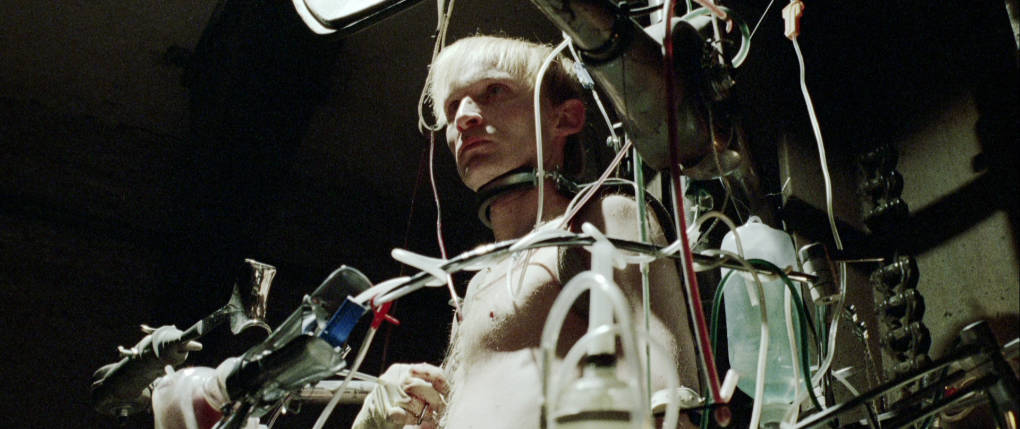
Trailer (2:13)
An international trailer for the film that gives a strong flavour of its tone but not the extremity of some of its content. Then again, how could you show any of that if you wanted that trailer to be widely seen?
Also included with the release disc is a Limited Edition Booklet featuring new writing by Anna Batori, author of The Extreme Cinema of Eastern Europe (2023) and Space in Romanian and Hungarian Cinema (2018), but this was not supplied for review. When my release disc arrives, I’ll update this section.
final thoughts
My first viewing of Taxidermia 19 years ago left me a little unsure what I was supposed to take away from the film but still hugely impressed by director György Pálfi’s boldness, imagination, artistic vision and technical skill, and I was genuinely fired up by the news that it was coming to Blu-ray, complete with all the special features that Tartan’s bare bones DVD had sorely lacked. This time around, everything about the film clicked, including – and perhaps especially – the more outrageous and challenging elements, and my appreciation was then boosted further by the commentary, the Pálfi interview, the making-of documentary, and the deleted scenes. We even get two tonally and stylistically diverse short films by the director as a bonus. Great film, great transfer and some terrific special features, and despite already owning the review disc, I’ve ordered the release version as it’s one that I definitely want in my collection. If you’re up for the challenge or already know and admire the film, this Radiance disc comes highly recommended.
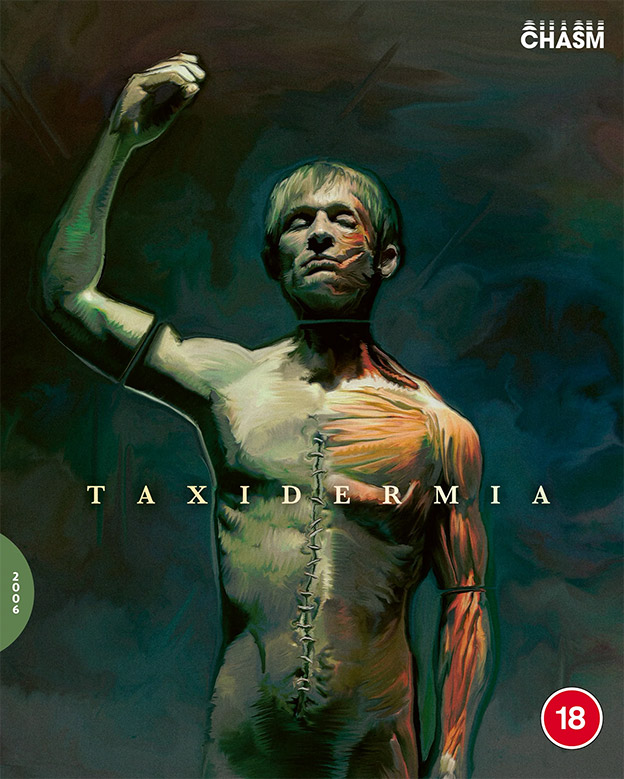
Taxidermia
Hungary / Austria / France 2006 | 94 mins
directed by: György Pálfi
written by: György Pálfi, Zsófia Ruttkay
cast: Csaba Czene, Gergely Trócsányi, Piroska Molnár, Adél Stanczel, Marc Bischoff, István Gyuricza, Gábor Máté
distributor: Radiance
release date: 18 May 2026