
The Survivor
Indicator’s series of Ozploitation releases, on UHD and Blu-ray, produced by Antony I Ginnane reaches 1980’s THE SURVIVOR, directed by David Hemmings and starring Robert Powell and Jenny Agutter. Review by Gary Couzens.
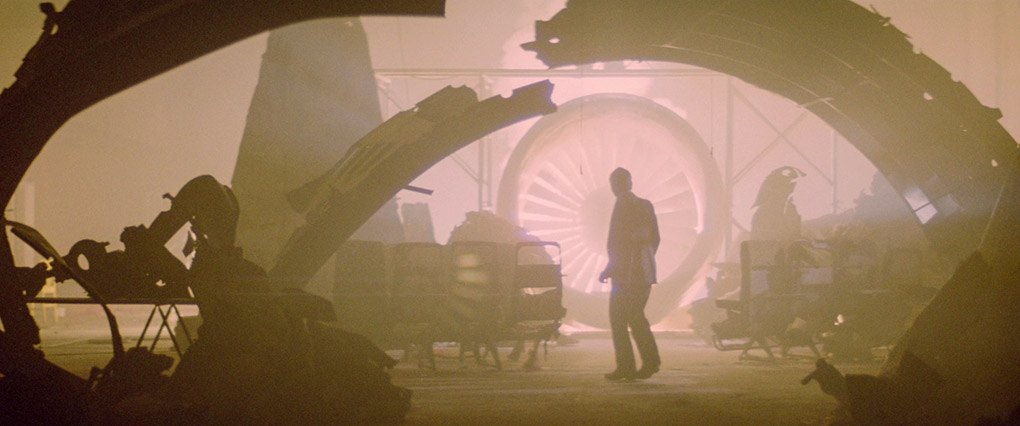
A Boeing 747 takes off and almost immediately crashes and explodes, killing everyone on board except the pilot, Keller (Robert Powell), who walks away without a scratch. Tortured with guilt and at a loss to explain what had happened, Keller is approached by a mysterious woman, Hobbs (Jenny Agutter) who may help him solve the mystery. Meanwhile, beginning with an opportunistic photojournalist, a series of murders begins…
The Survivor was based on, and by all accounts (as I haven’t read it) toned down from, a novel by James Herbert. The screenplay is by David Ambrose, who had begun on television and had caused something of a stir with his 1977 faux documentary Alternative 3. In the same year that The Survivor was made, 1980, he had a writing credit on the timeslip thriller The Final Countdown.
David Hemmings has the directing credit on The Survivor, but the prime mover of the film was producer Antony I. Ginnane. He had begun by making an apparently arty black and white 16mm feature film, Symphony in Summer (1971), his only directing credit and something now apparently impossible to see. After that, he decided he was better suited as a producer – in his words, having several projects on the go rather than concentrating on just one at a time, as a director would need to do – and he produced the sex comedies Fantasm (1976) and its suavely-titled sequel Fantasm Comes Again (1977), directed respectively by Richard Franklin and Colin Eggleston under the pseudonyms of Richard Bruce and Eric Ram, big-screen debuts for both. Ginnane’s next film as producer, the horsey childen’s film Blue Fire Lady (directed by Ross Dimsey, 1977) is another odd fit in his filmography, but after that he embarked on the series of thrillers and horror films which is what he is now best known for. They are central to what has become known as Ozploitation, especially in the wake of Mark Hartley’s 2008 documentary Not Quite Hollywood, of which more below.
Ginnane had given breaks to first-time film directors such as Franklin, Eggleston, Rod Hardy and Simon Wincer, all of whom had cut their teeth on Australian television and who knew how to make their work quickly and efficiently. (Dimsey was also a first-time cinema director, but he had progressed from writing the Fantasm films and before that working with Tim Burstall on such as Stork (1971) and End Play (1975).) David Hemmings’s route to the directing chair was different. He was well established as an actor, having been on screen for over a decade when he played the lead in Michaelangelo Antonioni’s Blowup (1966). He had directed three previous feature films – Running Scared (1972), The 14 (1973) and Just a Gigolo (1978) – as well as two episodes of the TV series Follyfoot in 1973. Once his path crossed with Ginnane’s, he played leading roles in Thirst (1979) and Harlequin (1980). After these, as well as stepping into the director’s chair again, he entered into a business partnership with Ginnane. His company Hemdale, which he ran with John Daly, was one of those attached to Race for the Yankee Zephyr (1981, aka Treasure of the Yankee Zephyr). This was to be directed by Richard Franklin, but when he left the project, Hemmings, who is credited as one of three producers, stepped up to direct as well. The Survivor was developed as a project for him to direct. At a budget of A$1.1 to 1.3 million (figures vary), it was the most expensive film Ginnane had made to date.
Overseas actors had appeared in Australian films before: for example, Richard Chamberlain in The Last Wave (1977). But with The Survivor Ginnane ran into problems with Australian Equity. He was allowed to import Robert Powell (who had starred in Harlequin) and Joseph Cotten but Samantha Eggar and Susan George were vetoed, their roles taken by Jenny Agutter (presumably an honorary Aussie due to Walkabout, shot in the country just over a decade earlier) and Sydney-born Angela Punch McGregor. The latter had only recently added the McGregor to her stage name and this film adds a rare hyphen as well. As Angela Punch, she had won the Australian Film Institute (AFI) Award for Best Actress for The Chant of Jimmie Blacksmith and Best Supporting Actress for Newsfront (both 1978) at the same ceremony. Newsfront was the reason for her being cast in The Island (1980), an ill-fated excursion into Hollywood. Billed below her is Peter Sumner, a well-established actor with a big-screen career going back a decade. On the small screen, he will be remembered by many Australians as a presenter of Play School, the Australian version of the long-running BBC show for pre-school children. Further down the cast is Tim Rice, briefly on screen as a television news journalist during the crash sequence. This acting role (credited, too) is explained by the fact that he was in Australia at the time and was a friend of both Hemmings and Powell.
The result, unfortunately is a bit of a mess. Ginnane and Hemmings decided early on to aim for a more cerebral horror film rather than for gore, believing that was where the fashion was going. His touchstones for this approach were two black and white films from the 1960s, The Innocents (1961) and The Haunting (1963), both like The Survivor adaptations of novels. (There is an argument that supernatural horror particularly lends itself to black and white, the sensory incompleteness being a spur to the imagination in invoking the uncanny. It’s no slight on the cinematography of The Survivor that I can imagine it being made in monochrome, though in the commercial environment of 1980, and with a commercially-oriented producer like Ginnane in the driving seat, I doubt that was ever considered for more than a nanosecond.) There’s a reason why so many horror films go for gore: films which rely on atmosphere and mood require more ability and talent to bring off. For much of its running time, The Survivor is ponderous and more than a little dull.
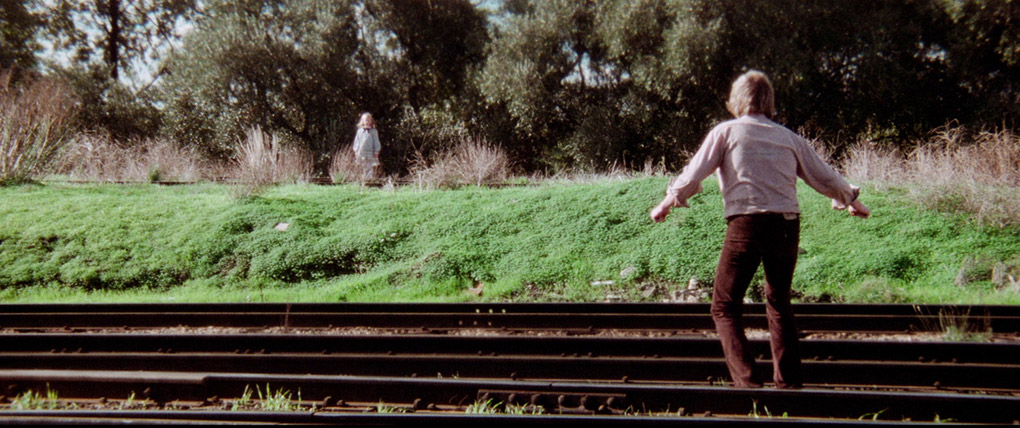
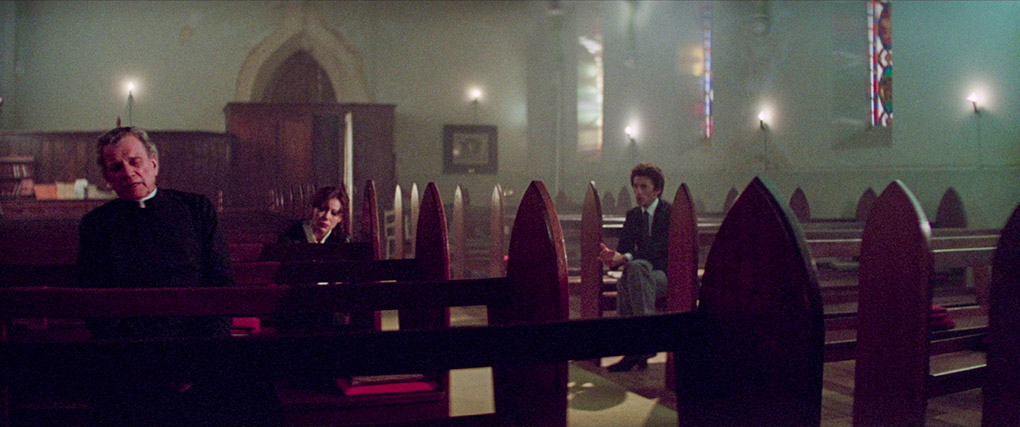
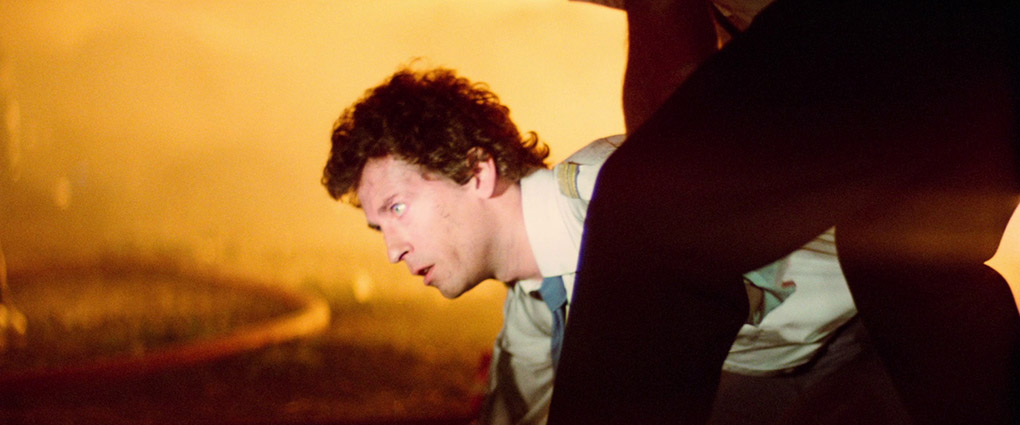
It doesn’t help that even in the longer version (more about that in a moment) a lot of footage seems to have ended up on the cutting room floor. Angela Punch McGregor, who gets third billing for one brief scene (she’s glimpsed briefly in another, where bereaved relatives lay wreaths at the site of the plane crash), seems a particular victim of pre-release editing. Peter Sumner is as well. And there are huge holes in the plot, with motivations ill-explained. Why did the villain plant a bomb on the flight? And who’s doing the killings and why? And you may spot the final revelation a long way off, particularly as some well-known subsequent films have used the same twist. Powell is wooden, Agutter gets to emote in black lace (and has no dialogue until halfway through) and quite what Joseph Cotten is doing is another question. That said, certain scenes do work well: the crash (involving the largest cinematic explosion filmed in Australia to date) and its aftermath are well done. John Seale’s Scope photography is another plus. At the time he had been well established as a camera operator for nearly a decade and a half, and was just moving up to cinematographer. He had shot Brian Trenchard-Smith’s Deathcheaters (1976) and Fatty Finn (1980) and some shorts and television work, but The Survivor was by far his biggest assignment to date.
The Survivor premiered in Adelaide on 9 July 1981. As so often with Ginnane’s productions it did little business on its home turf, but it did pick up four AFI Award nominations: for Jenny Agutter as Best Actress (Judy Davis won for Winter of Our Dreams), Best Sound, Production Design and Cinematography. The latter three were all won by that year’s Best Film, Gallipoli, for which John Seale was in his old job as operator for that film’s DP Russell Boyd. The Survivor didn’t do especially well overseas either. It was the first Ginnane production not to have a US cinema release, going straight to video and cable television. It likewise didn’t see the light of any British projector lamps, It had a pre-Video Recordings Act video release in 1982 and its first UK television showing on BBC1 on 26 November of the following year.
sound and vision
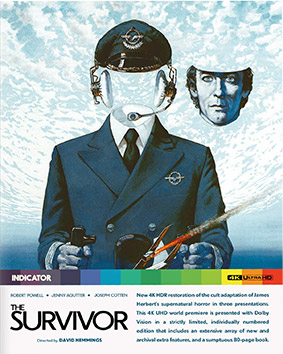
The Survivor is released by Powerhouse/Indicator as spine number 436 in both Blu-ray and UHD editions, the former (the one this review is based on) encoded for all regions. The film was released at 99 minutes, before being edited down to 82, with poor Ms Punch McGregor’s scene being shortened even further. The Survivor bypassed British cinemas altogether, but the short version was released on VHS in 1987 and on DVD in 2003. The longer version was released by Britfilms/Crabtree DVD in 2011. Both of these versions are on this disc, as well as a previously-unseen slightly longer cut, respective running times 81:07, 98:22 and 99:08. The forty-six second discrepancy is in the climactic scene, or chapter 11 in the transfers, and was at the behest of the distributors. In any version, the film has always had a 15 certificate from the BBFC. In Australia it was rated M, an advisory category particularly with regards to under-fifteens.
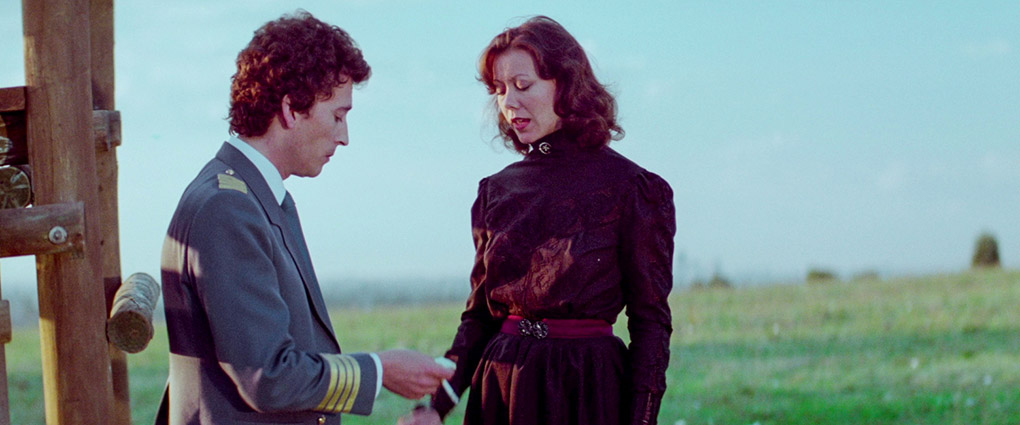
The film was shot in 35mm with anamorphic lenses and the transfer is in the intended ratio of 2.35:1. Many will have first seen this on television or VHS, and at the time these releases would have been panned and scanned. That isn’t necessarily the deal-breaker it would have been for a film a few years or more earlier as in 1980 homevideo was taking hold and increasingly Scope films were being composed with the necessary action in just part of the frame, so the image could be easily cropped into 4:3 without losing necessary picture information. While there are certainly shots which fill the wide screen – the crash and explosion sequence at the start is an example – two-shot conversation scenes usually have the participants in the same part of the frame. As for the transfer, it’s derived from a 4K scan of the original negative which is held by the National Film and Sound Archive of Australia. I’ve not seen this film in a cinema but I’m in no doubt that it looks as good here unless I have the unlikely chance to see a good-condition 35mm print. The colours are strong, the blacks solid (especially in some night-time scenes) and the grain natural and filmlike.
The soundtrack is the original mono, rendered as DTS-HD MA 1.0. Nothing much to say here, given that this is a product of Australian cinema expertise, with dialogue, Brian May’s music score and the sound effects clear and well-balanced. There’s no doubt that if it had been made a few years later it would have gone out in Dolby Stereo, but monophonic it was and monophonic is what it should be. There is also an isolated score option on the longest cut. English subtitles for the hard-of-hearing, on the feature and the promotional film (see below), are optionally available and I spotted no errors in them.
special features
Commentary by Antony I Ginnane and Jaimie Leonard
Commentary by Antony I Ginnane and Katarina Leigh Waters
These two commentaries date from 2018 and 2012 respectively, and I’m writing about them together as they are very similar. Ginnane clearly is motivated to represent himself in latterday discs of films he produced in the 1970s and 1980s, and as such he is all over this disc and also in the booklet as well. His co-commentators tend to be feeds, particularly in Katarina Leigh Waters’s case. As such there’s little you might hear about this film that you don’t hear from elsewhere, and not just from Ginnane’s mouth or word-processor. Some factual errors don’t get corrected. For example, he tells Leigh Waters that The Survivor was John Seale’s first feature as cinematographer (it was his third), that this was David Hemmings’s third feature as director (his fourth) and that Jenny Agutter was “eleven or twelve” when she made Walkabout (she was sixteen).
However, particularly in the Leonarder commentary, you do hear some things that aren’t mentioned elsewhere. John Seale, he says, was recommended by Vincent Monton, who had shot for Ginnane, Fantasm, Blue Fire Lady, Fantasm Comes Again, Snapshot, Thirst and would go on to shoot Race for the Yankee Zephyr, but was not available for The Survivor. Ginnane talks about how his interest in film and filmmaking came from the film society at Melbourne University, where he was a law student. He also talks about Symphony in Summer, which he says cost $10,000 and made $330. He worked as a lawyer for six months before becoming a film producer. He thinks going cerebral rather than gory on The Survivor was a mistake and muses that American International Pictures might have picked it up if Vincent Price rather than Joseph Cotten had played the priest. And, not for the first or the last time, he talks about how he clashed with Australian critics who were sniffy about genre films. In that respect, he says that he made films that David Stratton in particular didn’t like. (He doesn’t say this in the commentary, but Stratton claimed that his Variety review of Turkey Shoot – “a sadistic bloodbath” – cost Ginnane a sale to Malaysia as they banned the film on the back of that review.)
Not Quite Hollywood interviews (22:21)
Mark Hartley’s 2008 documentary continues to be a source for disc releases, with interviews carries out for that film. Here there are two, with a Play All option.
First up is Antony Ginnane (15:15), who begins by saying that following the success of Harlequin, the last of a run of films from original screenplays, his next step would be to adapt a successful novel. To wit, James Herbert’s. With two commentary tracks featuring him, plus appearances elsewhere on the disc and in the booklet, inevitably there’s a big overlap in what he says here and in the other extras. When talking about British company GTO taking the distribution rights to The Survivor, he mentions their success with a number of British films, but he doesn’t mention that they were the original distributor of Picnic at Hanging Rock in the UK, maybe because that doesn’t fit his narrative of his making films with international appeal rather than making specifically Australian stories. He acknowledges that The Survivor was not his most successful film, though due to Robert Powell’s standing in Latin America, it did well there. When talking about his battles with Australian Equity, he is on more contentious ground, suggesting that Equity blocked Samantha Eggar for the role of Hobbs as a snub to David Hemmings, as they had had an affair for a while. Ginnane’s remarks take on a political dimension they don’t elsewhere as he describes Equity as Bolshevik and Trotskyite, its actions supported by more lefty actors and even says that they are evil. There are spoilers in this interview, so watch it after you have seen the film.
After that, John Seale (7:06) expresses astonishment that he was given the job of shooting what was then the most expensive Australian production yet made when he had only shot two previous features. He talks about working with David Hemmings, who was not without his Ribena on set, though Seale suspected it was actually Pinot Noir. Also mentioned are Joseph Cotten’s brief contribution and a trick played on the first assistant director with a stunt corpse during the crash scene.
Cast and crew interviews
There are three, with no Play All option this time. All of them are archival, two of them re-edited for this release.
Antony I Ginnane: Brace for Impact (10:05).
This interview is from 2004. Ginnane continues along the lines of his other contributions to this set, though makes an error in saying this was John Seale’s first feature as cinematographer. He does acknowledge the film’s shortcomings, such as the heavy trimming of Angela Punch McGregor and Peter Sumner’s roles, which they were not happy about. He also acknowledges that The Survivor was his first production not to have a US cinema release.
Robert Powell on James Herbert (3:28)
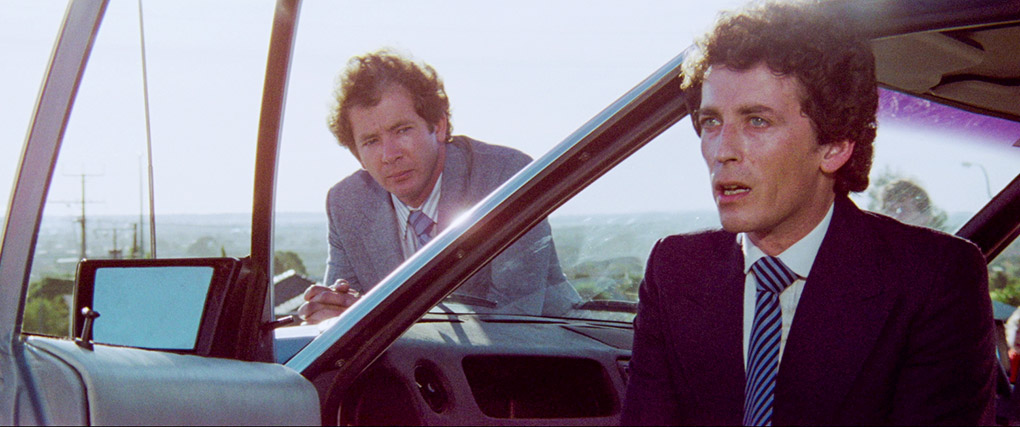
This dates from 2013, and was originally produced by Audible. Powell does talk about James Herbert, who was a friend of his, and why he was a successful novelist. Herbert was, Powell says, an “old rock ’n’ roller”, with his own drums and guitars. However, much of this short item is about the making of audiobooks. Powell certainly has had a lot of experience in this area, and he says that it’s a pleasure giving a reading of a good book, a slog if it isn’t. Ultimately, a good reader needs to be a good sight-reader, being a few lines ahead of the point where his voice is, so nothing comes as a surprise. Above all, he says, a reader shouldn’t be boring. Audiobooks are a type of publishing you don’t hear much about, so this piece is a welcome addition.
Touch of Elegance: Peter Sumner (3:41)
Sourced from a video copy, this is an interview with the actor from the TV show Touch of Elegance, conducted by Margaret Glazbrook. This was broadcast on 9 July 1981, the day of the world premiere at the Hindley Cinemas in Adelaide. Sumner had yet to see the film, not even any rushes during production. That said, he was clearly aware that much of his role had ended up on the cutting room floor as he gets in a couple of digs about this, saying “what’s left of it” about his own performance. Peter Sumner died in 2016 at the age of seventy-four.
Clapperboard: The Survivor (30:04)
Clapperboard, not to be mistaken for the British show of the same name of the 1970s and 1980s which was formative to many a young British film fan, was an Adelaide-based programme. “Why don’t we start the show with a bang?” asks presenter Anne Wills, and we cut to the aircraft explosion. Wills reveals that she was actually in the film for about a second as she was present during that scene, and she made sure to face the camera, but suspects that she might have ended up on the cutting-room floor. (That would appear to have been the case.)
This isn’t a complete edition of the show, but a compilation of extracts relating to The Survivor – you can tell that this is the case with Wills’s frequent changes of dresses. Joseph Cotten talks about how he has been grateful to actually visit Australia, as his previous Aussie cinema excursion – Hitchcock’s Under Capricorn (1949) – went no nearer the country than Elstree studios and backlot. Also interviewed are Peter Sumner and Jenny Agutter. She was based in Los Angeles at the time, and says she would not have been cast in Logan’s Run if that had not been the case. She was in Australia for four weeks for The Survivor, and mentions that Hobbs was a man in the novel. Ralph Cotterill says that he was often mistaken for Hardy Kruger when they worked together on Blue Fin (1978). Angela Punch McGregor tells the story that she was acting on stage when the 1978 AFI A, when she won for both The Chant of Jimmie Blacksmith and Newsfront. She was told that they would let her know she had won at the curtain call, but this didn’t happen so it took her a while to find out that she had won not once but twice.
Promotional film (15:04)
A showreel, or extended trailer if you prefer, put together for showing to potential buyers at Cannes, MIFED and other film markets. This was put together by Brian Trenchard-Smith while principal photography was in progress, so it contains shots, scenes, dialogue and sound effects not in the final film. Some of the music is lifted from other Ginnane productions. Needless to say, this leans heavily into the action, with a fair amount of material from the plane explosion, to the extent that you wonder if it doesn’t misrepresent the film you then later went on to see. This presentation has optional English hard-of-hearing subtitles. There is a little more about this promotional film by Trenchard-Smith in his Trailers from Hell piece (see below).
Behind-the-scenes (21:19)
A compilation of mute footage shot in Super 8mm by Dean Bennett, who would later become a stuntman. Bennett provides a commentary which tends to describe much what you see on screen, though identifying particular individuals as and when they appear is certainly useful.
Stephen Morgan: Elevated Horror (20:29)
Dr Morgan continues his series of introductions to Indicator’s Ozploitation releases with a look at The Survivor. There are spoilers ahead, so watch after seeing the film if you haven’t seen it before. The title of this piece refers to the more recent concept of “elevated horror”, the suggestion that horror films can take on larger themes and not just be exercises in scares and blood and guts (or both), which rather ignores the fact that horror films have always been always able to do this. Morgan covers the dispute with Equity over the importing of overseas actors, making this film as well as Roadgames (1981), with its two American leads (Stacy Keach and Jamie Lee Curtis), a particular sticking point with Australian actors and their union. As the film was shot in South Australia, Morgan, a native of that state, recalls that the filming locations often appear on “Do you remember when…” social-media posts, prompting the memories of people who witnessed part of the shooting. I’d imagine the explosion sequence would be hard to forget if you had been there. Morgan concludes by locating The Survivor, with its distinctly patchy commercial success, at a turning point in Australian filmmaking. As a more modest production (despite its for-the-time high budget) it was soon overshadowed by some bigger films which were soon on the way to success at home and internationally in the coming decade, such as Mad Max 2 (1981), The Man from Snowy River (1982) and Crocodile Dundee (1986).
The Legacy of James Herbert (9:19)
From 2016, this item features Chris Cooke of the Mayhem Film Festival and David Flint of Reprobate magazine talking about Herbert, who had died three years earlier. They make the case that Herbert was more than the poor man’s Stephen King some wrote him off as, though like King he established horror as a bestselling genre in the mid 1970s, being distinctly British while King’s work was rooted in his settings in his home state of Maine. He was adapted for screen rather less often though. Flint talks about the ones which were made for the big screen and the small one, and Herbert’s reaction to them. He was no fan of The Survivor, it has to be said.
Trailer and TV spot
Three items here. First is the theatrical trailer (2:52), which is followed by a reprise from Trailers from Hell introduced and commented upon by Brian Trenchard-Smith (4:45), who was pursuing his then sideline of creating trailers for quite a few Australian productions. “I embrace the digital age , but I miss being able to touch the film, to hold a frame up to the light, caress it gently…those were the days,” he rhapsodises, doing exactly what he says with a strip of 35mm he retrieves from inside his shirt. He talks about the promotional film, confirming if you had any doubt that his tactic was to focus on the film’s big setpiece, even if it is at the start of the film.
Also included is an Australian TV spot (0:27) which concentrates on the action, in particular again the plane crash.
Image and script galleries
Five of them. First off are the promotional images, 156 in total: stills in black and white and colour, Dean Bennett’s invitation to the premiere, and posters in different languages. Then we have the behind-the-scenes shots, again in black and white and colour, ninety-nine of them. David Ambrose’s fifth-draft screenplay follows, two script pages per screen page of which there are fifty-eight. The remaining two galleries are of rather more specialist interest: a spotting list (twenty pages) and the trailer dialogue continuity (five).
Booklet
Indicator’s booklet for this limited edition runs to seventy-six pages plus covers. It starts with “Terror Firma: The Spirit of Elizabeth Will Not Return” by Sergio Angelini. This doesn’t have a spoiler warning attached, but take it as read, as Angelini gives away the film’s reveal in the opening paragraph. He mentions the old days of writing to the BFI’s Information Service or to columnists in magazines like Film Review asking “What’s the film where…?” And The Survivor is just such a film, with Angelini mentioning other films which could answer the same question. That’s a springboard to James Herbert’s original novel, its rights being bought by an independent producer and David Ambrose writing his screenplay. Cut from that to Australia and David Hemmings and Robert Powell committing to The Survivor as the follow-up to the film they were then making, Harlequin. So then we have an account of the film’s production and its later editing down (from an apparent first length of two hours) which caused Angela Punch McGregor and Peter Sumner to complain about how much of their roles had gone by the wayside. This is a useful overview of the film, though it doesn’t cover anything you don’t see or hear in the disc extras.
“Memories of The Survivor” is another extract from Antony Ginnane’s unpublished memoirs, which have featured on all of Indicator’s releases of his films so far. Like the other extracts, this is a useful nuts-and-bolts summary of his experiences making the film, very detailed about the cinema-trade aspects, rather dry and not without an occasional sense of axes being ground.
“Inferno!” is a set report from the Australian TV Times of 7 June 1980, following the filming of the explosion sequence. It’s written by David Parker, presumably the later cinematographer, writer and director, often in collaboration with his wife Nadia Tass, from Malcolm (1986) onwards, who was employed as a photographer by the magazine at the time.
“Joseph Cotten, Hitchcock-era Survivor” is by Don Groves (typoed as Dan Groves in the byline), an interview with the actor from the Sydney Morning Herald of 4 May 1980 (actually The Sun-Herald as that was a Sunday). Not only was Cotten in the country to film The Survivor, he had just heard of the death of Alfred Hitchcock, who he describes as his “best friend”. Cotten had of course starred in Shadow of a Doubt in 1943.This is more about the Hitchcock angle than the film he was about to make, and it ends with the story that Hitchcock had screened Shadow of a Doubt to Cotten’s wife Patricia Medina four years earlier. She hadn’t seen the film before.
Next up is an interview with David Hemmings from the French SF/fantasy genre magazine L’Écran Fantastique(September 1981) by Bernard Boric. This was conducted at Cannes while Hemmings was there to promote The Survivor. The emphasis is on Hemmings’s production and directing work rather than his acting, though in the latter capacity he talks about his lead role in Dario Argento’s Deep Red (1975), though his approach to horror and fantasy as a director was very different to the Italian’s. He met Robert Powell on his first film as director, Running Scared, which was Powell’s first lead role on screen. Hemmings talks about the casting of Jenny Agutter and the decision to make Hobbs a woman rather than a man, though her relationship to Keller is platonic throughout, not something many films would have done. He also mentions Dead Kids, on which he was a producer, and that’s an Indicator release simultaneous with this one.
From the same issue of the magazine, interviewed by the same person in the same location, is Jenny Agutter. Being a genre publication, the interview concentrates on her genre films, so the first time she appeared on its radar was in Logan’s Run in 1976, which Boric calls her first major role. (Walkabout and The Railway Children seemingly didn’t count. Agutter points out that it was her first major role as an adult.) Her then residence in Los Angeles made that role possible for her, and she went on to make Dominique (1979) for the same director, Michael Anderson. She had not been used to the large number of special effects in Logan’s Run, being a stranger to the SF and horror genres up to then. She also talks about her then-forthcoming role in An American Werewolf in London.
final thoughts
The Survivor wasn’t then and isn’t now the most successful of Antony Ginnane’s productions, but the large number of Ozploitation aficionados will still find plenty here to interest them. No complaints about Indicator’s presentation, with more than enough extras to be going on with.
The Survivor
Australia / UK 1981 | 81 / 98 / 99 mins
directed by: David Hemmings
written by: David Ambrose; based on the novel by James Herbert
cast: Robert Powell, Jenny Agutter, Joseph Cotten, Angela Punch McGregor, Peter Sumner, Lorna Lesley
distributor: Powerhouse Films
release date: 30 March 2026