
Lights, Cameron, action!
Richard Rush’s 1980 THE STUNT MAN was ten years in the making and almost went unreleased when the studio didn’t know what to make of the result, but it’s reputation as a key work of American 70s cinema is now set in stone. It arrives on 4K in a dual UHD/Blu-ray package from Radiance on the Transmission label, and is reviewed by long-time fan Camus, with Slarek handling the technical specs and the majority of the special features.
“Man’s universal panic and paranoia, born out of an inability to control his own destiny, to even understand the ground rules by which he is supposed to play. In his fretful search for meaning, he accepts ritual, invents purpose, creates enemies to test his strength against.”
The Stunt Man director Richard Rush
Notes on the screenplay in reply to Columbia’s executives’ responses
That’s all very well, Richard, if you apply your erudite words specifically to Cameron, the fugitive who’s adopted by a maverick film director and coerced to play ‘Burt’ a stunt man who lost his life plying his trade. But part of me thinks that erudition is wasted on the stereotypical movie executive. Given the fate of this extraordinary film (born of all things, from studio indifference), it doesn’t seem possible that a film this good, a film so meticulously directed and so overwhelmingly entertaining could possibly have fallen foul of the oft-heard Hollywood lament “But how do we market it?” To be fair, it is, all at once, a satire, an adventure, an action film (oh boy, and what action) a love story, a black comedy and it’s sometimes casting a searing searchlight on the contradictions and vulnerabilities of the human condition. OK, the last one’s never going to fly or get on the poster but I simply cannot believe this film wasn’t given a wider opportunity to connect with audiences. Studio indifference is a powerful enemy and a gifted artist can only rail against his fate and not manage to improve it against such an antagonist. Granted, the film and its director had – and has – its fans.
In 1981, when asked who his favourite American director was, François Truffaut replied: “I don’t know his name, but I saw his film last night and it was called The Stunt Man“. Renowned critic Pauline Kael was taken by this ‘…virtuoso piece of kinetic movie making.’ And even its leading man could see what this film could become before a frame was shot. Peter O’Toole famously told director Richard Rush, “I am an articulate, intelligent man. I read the screenplay and if you don’t give me the part I will kill you.” So why the hell did it spend a year on the shelf without a distributor? I don’t know!
Despite some extraordinary reviews, the studio still refused to fully release the picture. It could have been the thinking man’s blockbuster. Instead, it’s the thinking man’s could-have-been blockbuster if anyone with the power at the time had the balls to believe in it. Even when Rush showed glowing review after glowing review and evidence of audience testing through the roof, the studio would not budge. To me, The Stunt Man will always be the closing parentheses that brought the glorious Hollywood 70s to an end. And in some bravura style. It’s as if the 70s had a party, got pissed and ended up at 5am on New Year’s Day, 1979 with the screenplay of The Stunt Man. It took all the guts, character, talent and daring of a decade of extraordinary American cinematic accomplishment and dared to combine that sensibility with the elements of a huge action film about the making of a huge action film, an anti-war, war is hell, black comedy. In a rather prescient fashion, the movie ushered in the ‘Action 80s’ by being regarded as something it wholly wasn’t – an action picture. There are explosions, wild stunts and all manner of what could be termed ‘action’ but the movie cannot be so easily pigeonholed. It’s even (to cram in yet another more elusive genre) an intellectual treatise on reality and fakery. The Stunt Man is everything the 70s were, a conglomeration of genres, wrapped up in an insane, singular endeavour, a nod to all that was creatively fecund in Hollywood at that time. All that was about to lay down and die as Arnie, Sly and Bruce all stepped up to the plate. Hasta La Vista… The glories of the 70s gave way to the Austrian Oak who made famous three little words, “I’ll be back,” which was more than could be said of an era of original and intensely creative Hollywood movies of that era.
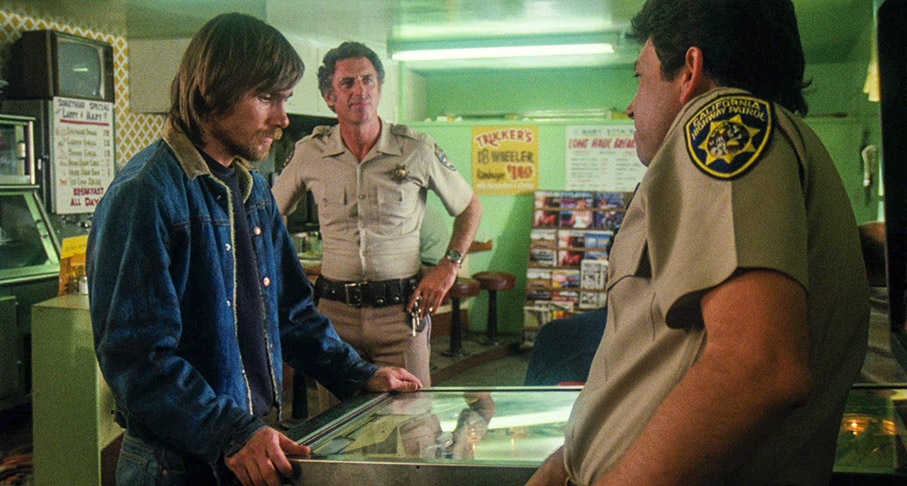
I was utterly hooked from The Stunt Man‘s first moments. On re-viewing, it suddenly hit me hard, so used am I to CG post-production tinkering, that what you see on screen was what was carefully put there by Rush and his talented crew on the day. Cars leave the frame the instant a helicopter enters the shot (it’s almost supernatural that these things were accomplished ‘in camera’ at the time of filming). Given today’s preponderance of CG vehicles, there’s no critical corner where such work can be appreciated now (except perhaps the one Cine Outsider nestles in). If you want to see this kind of choreography of man and machine, watch Apocalypse Now again. Though having said that, Coppola will be the first to admit that instead of having a ‘vision’ and attempting to bend reality to fit it, he simply shot the shit out of reality (eight camera coverage on the attack on the village over three weeks, documentary style) and then let the editors have a crack at it. “Why do you guys all sit on your helmets?” indeed. Rush’s command of his ‘mise-en-scene’ is extraordinary. My translation of that rather pretentious but fun phrase is the directorial canvas. It’s literally ‘putting on stage’. It’s as precise as his screenplay (co-written with Lawrence B. Marcus and adapted from the original novel by Paul Brodeur).
This is how he sets up The Stunt Man, one of the most satisfying openings to a film ever shot.
A buzzard flies off a telegraph pole watched by an old mutt steadfastly licking its balls as the buzzard’s shadow passes over him. We’ll forgive the shadow going from left to right while the buzzard exited the left of frame in the preceding shot. The shadow/dog shot could not be flopped (so left becomes right and right becomes left) because the lettering on the police car that appears in the same shot would be as if in a mirror. Eventually the dog moves and as the police car disappears, a helicopter swings into frame. Two linemen up a pole throw masking tape at another buzzard that then takes off and flies straight into the windscreen of the helicopter. All this is seen from a passenger’s point of view. The unseen occupant takes a bite of an apple, asks the crew to see the incident from the bird’s own point of view and then discards the apple that bounces off roofs and lands on the police car… There is only one slightly duff note in this whole remarkable opening. It’s either the line or the delivery (one of the cops says “Something just hit the roof.” The other replies “So will the chief if we don’t catch this Cameron guy…”). Bravo for plot set up but… The second line delivery is almost too theatrical calling attention to itself when it needed to be ‘thrown away’, like the apple, to maintain the effortless continuity of the plot set up so far. Either that or it’s a really contrived line – still haven’t made my mind up on that yet. It’s an insignificant smudge on a single line on a page of the 1,500 pages of War and Peace.
The sheer physical audacity of setting up everything in this polished jigsaw of a style was intoxicating to me. Not only that but within the next minute, the main character is revealed staring at the lead actress of the movie being shot locally doing a TV ad with a dog and looking almost orgasmically pleased with herself – but you don’t know who she is yet. This is a thundering narrative with barely a pause for breath. Like all great movies,
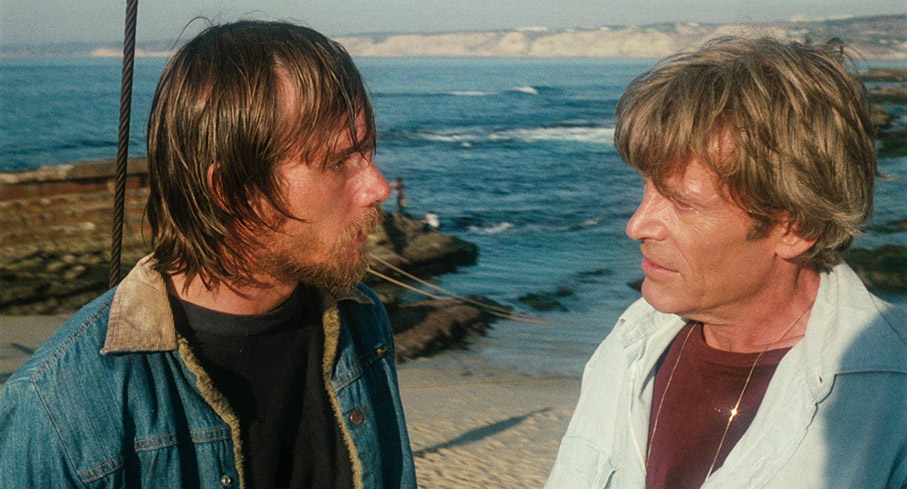
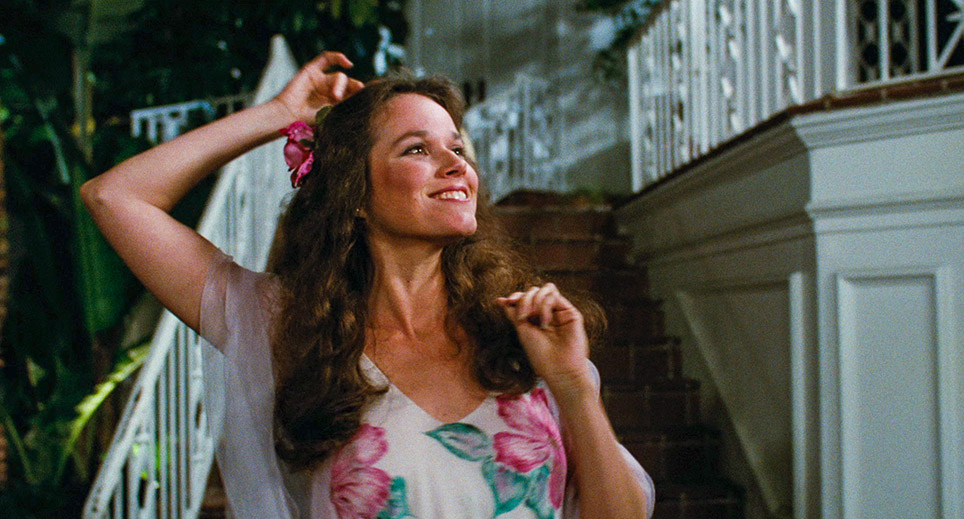
Taking flight, Cameron arrives at a beach (reality verses ersatz nicely planted in frame as an artist tries to depict the ocean as its reality envelops the picture he’s painting). The crew is in full epic mode as first world war planes strafe the soldiers on the beach. As the smoke clears, bloodied and mutilated bodies lay gasping their last. The onlookers react in some horror as the soldiers writhe in their own intestines until of course we hear the word ‘cut!’ This scene is the DNA of The Stunt Man. What is real is always under question, what is fake is always around the corner until Cameron – now in hiding from his pursuers as a stuntman and becoming the serendipitous inspiration to O’Toole’s Machiavellian movie director Eli Cross – falls for Nina. Played by the always superb Barbara Hershey, Nina is the movie’s innocent, the fairy tale princess in silken gauze and flattering, romantic lighting that Cameron gets to woo. How different and unfailingly more profound would her relationship with Cameron have been if one hugely beloved scene had not been cut out (it’s in the “Making of” principal extra). It makes Nina a multi-facetted woman, a real flesh and blood human being whose love for Cameron has wrecked a relationship that she feels honour bound to sever with grace. Apparently, test audiences objected to their leading lady sexually breaking up with another man. What is it about the movies in the US that has crippled mass audience expectations so thoroughly that they can only be spoon-fed pre-digested and oft repeated pap? Such a shame.
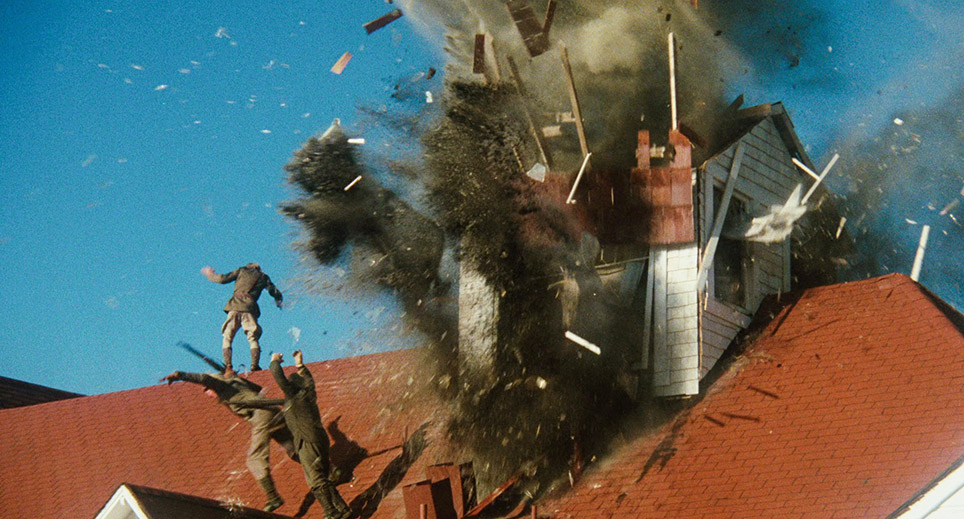
Each supporting role is a minor joy. Alex Rocco, as the put-upon police chief being unsubtly manipulated, spends the entire movie on frustration factor 9.9. Allen Gorowitz plays the movie–within–a–movie’s harassed writer. He shares a close relationship with the crew (I believe this is rare) and is invited to participate even when some raggedy Vietnam vet has become the director’s favourite off whom he now bounces ideas. Then there’s Chuck Bail as the master stunt man who has to show (and throw) Cameron the literal ropes. Every scene with this genial Texan is a particular delight. He becomes Cameron’s mentor, the one who knows the difference between movie fakery and reality. In stunt work, reality is pretty crucial – just watch the rooftop scene and witness one of the stunt men as a German soldier slipping down a roof in slow motion. You can just about make out when his right ankle really did crack. Ouch.
There are so many flourishes throughout the film that convince you that director Richard Rush really did have a vision of the film from the off. The police chief shows the crew at dinner a black and white mugshot of Cameron and as it’s snatched out of his hand, we pull focus to the real Cameron sitting where the image of his younger self was just seconds ago. Rush also uses rack focussing from foreground to background to cut without cutting. The big close up of a thumb pressing a switch and dropping out of frame, racks focus to a small detonation releasing a cable letting a long pole descend to the ground with Cameron hanging on it for dear life. The film is littered with these ‘cuts’ without cutting. I’m surprised this innovative little practice wasn’t taken up by other filmmakers. That said, the editors Caroline Biggerstaff and Jack Hofstra must have had a ball working on this film. It’s full of beautifully executed cuts that convince you that director Rush had a firm hand on the tiller. And even if he didn’t then the editors are both to be commended even more.
Last but certainly not least, composer Dominic Frontiere’s contribution to The Stunt Man is a real highlight. Like all great scores, his work threaded the needle that stitched this sublime movie together. We have the main carnival theme, the propulsive action theme and the love theme. Each is repeated and re-orchestrated throughout the movie and each is note perfect. It’s that thematic repetition that modern film scores tend to avoid that, ironically, makes the score so memorable. I imagine the film would have been a tricky one to spot. Spotting is the process of choosing which moments to score and which to leave to the atmospheres and sound effects. The Stunt Man has so many layers to it that the wrong score would bludgeon them down to the thickness of toilet paper. Frontiere’s work shuffles and ushers those layers before you for your enjoyment. I cannot praise the aptness of the score too highly.
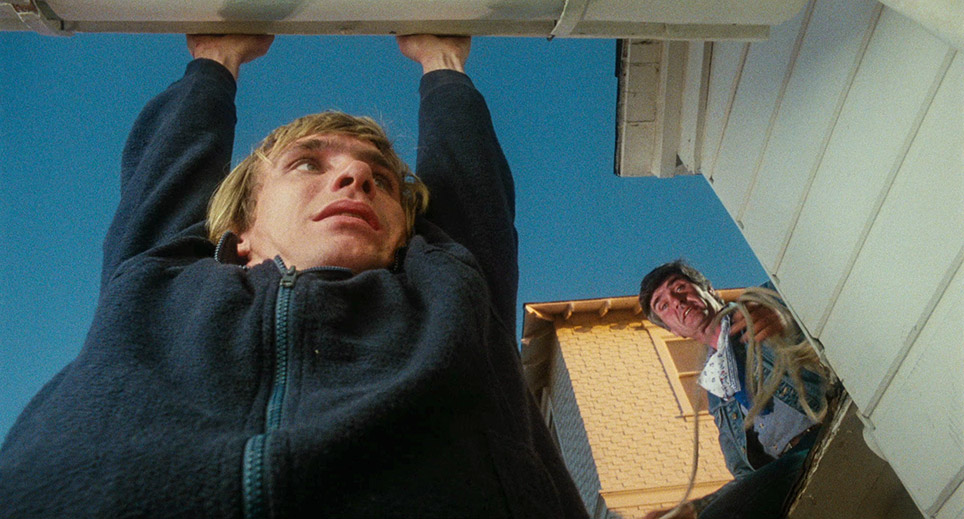
The Stunt Man was an anomaly in Hollywood – it was a studio picture that challenged and continues to challenge audiences. That’s usually left to the independents. It plays so deftly with reality/illusion that it’s almost inevitable that a sizeable chunk of its audience will throw up their hands and scream ‘Enough! Is Eli really out to kill Cameron?’ This is answered (as it should be) in the closing moments. We have become so used to the fugitive’s name that we are bowled over by the pun as Cameron is strapped into the ill-fated Duesenberg for the final stunt. He is asked if he can see the ‘camera on’, a phrase underlined by Rocco’s ‘Camera on?’ Cameron takes this as his last chance as he believes the police chief now knows who he is and drives off thinking he is leaving the world of illusion behind… Alas, no. The finale is as rug pulling as you might expect and as satisfying as you could hope for. If you’ve never heard of this film, this will be the perfect opportunity to see the best version of it. I’ve not seen the 4K version yet (which is covered by Slarek below) but it’s on my birthday list. I cannot wait.
sound and vision
The result of a brand new 4K restoration from original 35mm camera negative by Radiance Films, the transfer on this new UHD release is, to directly reference the film’s extraordinary opening scene, the dog’s bollocks. UHD and Blu-ray discs have both been included here, and while the Blu-ray transfer is absolutely top notch, the Dolby Vision enhanced UHD really has the edge. I’m sure that those with larger screens will be in a better position to judge the bump in resolution, but even on my humble 55-inch OLED an increase in the already impressive detail definition is visible, as is the subtle HDR assisted boost to the contrast range and the richness of the colour palette, which give the 4K image a more tactile feel. The colour itself is pleasingly and even vibrantly naturalistic in daytime exterior scenes, though has a warmer hue in interior scenes that was common in films of this era. Film grain is visible and for the most part is fine (this is clearer on the UHD), save for the opening shot of the buzzard, which clearly underwent frame enlargement in post-production and displays a corresponding increase in grain coarseness. The image is also clean of obvious signs of wear and damage.
The original mono soundtrack is presented on both discs in DTS-HD Master Audio 2.0, but it is also available as a DTS-HD Master Audio 5.1 surround mix. This appears to be a proper remix rather than a simple surround encode, with some subtle but clearly audible direction-specific use of the stereo and surround speakers. Both tracks are clearly presented with a decent tonal range, and while they do lack lower frequency punch, this feels about right for a film of this vintage and adds to the sense that despite its release date, this was a 1970s movie through and through. The dialogue is always clearly audible, the sound effects and music are consistently sprightly, and I detected no obvious evidence of wear.
Optional English subtitles for the hearing impaired have been included, as expected and appreciated.
special features
Many of the special features in this Transmission package have been sourced from earlier DVD and Blu-ray releases, which have been augmented with a new commentary track and a previously unseen interview with Chuck Bail. The coverage of the older legacy extras has been copied over and updated from Camus’s earlier DVD review and are marked (C), while the new and newer legacy features covered by Slarek are marked (S). It should be noted that the majority of the special features are in 1080p and on the Blu-ray disc only, with the UHD containing only the two commentary tracks.
Audio commentary with writer/director Richard Rush and actors Peter O’Toole, Steve Railsback, Barbara Hershey, Alex Rocco, Sharon Farrell and Chuck Bail (C)
This 2001 commentary is a mixed bag, edited from interviews and real time commentaries, scene specific. It’s informative and always compelling but it is a bit of a cut and paste job. It’s noteworthy for the huge respect that each of the principal creatives still had for what was then a 22 year old movie.
Audio commentary with critics Monica Castillo and Christina Newland (S)
In one of the two new special features in this set, critics Monica Castillo and Christina Newland get to grips with a film they nicely describe up front as “amazing and weird and thoughtful.” They contextualise the film in the America of the day and discuss the film’s post-Vietnam subtext, suggesting that the delay in getting the film made is responsible for the decision to change the draft-dodging Cameron in Paul Brodeur’s source novel to a Vietnam vet haunted by his wartime experience. They heap praise on Peter O’Toole and note that this was a special role for him (ranking it alongside his delicious performance as a drunken Errol Lynn-like movie star in Richard Benjamin’s 1983 My Favourite Year, another Outsider favourite), and also champion the work done here by Steve Railsback and Barbara Hershey. They deliver some really interesting analysis of specific scenes and themes, remark on how much of the film is about disillusionment and conclude that it’s one of the great movies about movies.
The Sinister Saga of Making The Stunt Man (114 mins) (C)
Made in 2000 and just shy of two hours, this is an extraordinary documentary for a number of reasons both broadly farcical and intimately human. Richard Rush is a hugely attractive compere, competent pilot and guide to the making of this (his own) movie. There is a sense that if anyone could crow about Hollywood the way in which Rush does, then it’s almost the absolute and correct way a director could gain some sort of ground after his creative efforts were snubbed for so long. It really was the ‘too many notes’ criticisms of the movie and here is Rush to tell us the whole shebang.
Yes, it’s indulgent but tell me how a creative force defends his creative decisions without being indulgent. Rush comes across as a straight shooter (naturally) and is a commanding presence in defence of his own movie. The stuff one learns about movie making is considerable and for this alone, the documentary is worth its weight in bold. But the style? At the time of this documentary’s production, someone had just invented Final Cut Pro (version 1.0) and I just bet the whole thing was post produced on a system that promised limitless effects and green screen/morphing animations etc. It is a product of its time as much as a Russ Abbot title sequence could be. It’s shameless in its shoddy digital compositing but the intelligence and intellectual ideas espoused are so powerful and germane that you tend to forget the twee and the crass. This is – without resort to hyperbole – the best underhanded look at the Hollywood creative process I’ve yet to see. I do have to get past Rush’s assertion that when Hollywood execs were greedy, he could deal. Now that the ego has landed, his troubles are more difficult to articulate. It’s like Oliver Hardy criticizing his bosses for being overweight. But no matter. This is a cracking look behind the scenes and should be embraced by anyone who gives a defecation about the difference between movies and art…
Chuck Bail (10:06) (S)
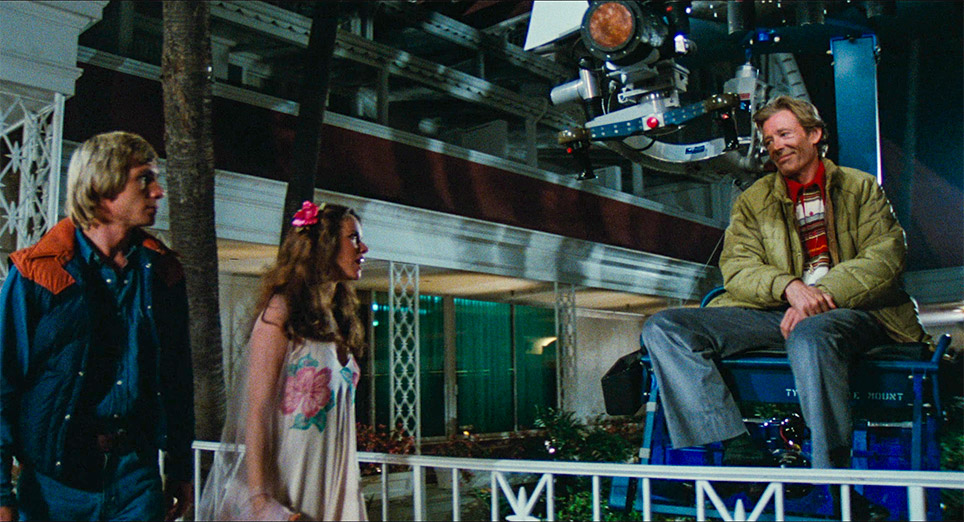
Originally filmed for Craig Railsback’s forthcoming documentary Rush: The Director’s Cut, this consists of never-before-seen interview footage with likeable director, stunt co-ordinator and actor Chuck Bail, who essentially plays himself as the film-within-a-film’s stunt co-ordinator Chuck Barton. He briefly outlines how he went from penniless and homeless ex-Wild West Show performer to TV extra and then stunt man before moving on to his first meeting with Richard Rush on the 1967 Hell’s Angels on Wheels, though the main focus here is his work on The Stunt Man. He explains why an early conversation between Cameron and Eli on the camera crane is his favourite in the film, how notes left for him and Rush by O’Toole and Railsback illustrated their complete commitment to the film, and recalls an early screening at which he was joined unexpectedly by a crowd-shy O’Toole.
The Maverick Career of Richard Rush (34:18) (S)
In this archival interview, originally recorded for Severin Films in 2011, Richard Rush takes us on a trip through his career as a filmmaker, from his abortion-themed 1960 exploitation debut, Too Soon to Love,right through to his later studio success with Getting Straight (1970), Freebie and the Bean (1974) and, of course, The Stunt Man. There are plenty of revealing and engaging comments about the films he has directed and the process of getting them made, including how he found his directing style by deviating from the script on Hell’s Angels on Wheels (1967), having to hire the real bikers from that film to protect the production of the 1968 hippie drama Psych-Out, and the how years of studio rejections were responsible for the decade-long delay in getting The Stunt Man to the screen. He notes that on any project a filmmaker essentially makes three films – the one he writes, the one he directs, and the one he cuts – remembers Peter O’Toole as a joy and one of the best things that ever happened to him, and following his heart attack, learned that the true meaning of final cut is the one that they make in your chest for the bypass. His passion for The Stunt Man and his ten year fight to get it made really comes across here, and he opines – quite correctly, in my humble opinion – that it hasn’t aged a bit.
Peter O’Toole on The Stunt Man (18:46) (S)
Recorded for Severin Films in 2011 when the actor was in his late 80s, this interview with the still suavely dressed Peter O’Toole, in which he looks back at the making of The Stunt Man, is a most welcome and engaging inclusion. He recalls Noel Coward telling him that there are no stars, only the right part in the right play at the right time, and for him Eli Cross, particularly at that time of his life and career, was just such a role. He remembers being approached by Richard Rush at a party and asked to read the script and only agreeing to do so when he learned that Rush directed Freebie and the Bean, which O’Toole adored, and speaks highly of the director’s professionalism and how enjoyable the film was to make. There are a couple of anecdotes about the shoot itself (one of which is repeated by Steve Railsback in his interview below), and he does confirm the oft-repeated rumour that he called Rush after reading the script and told him that if he cast anyone else as Eli Cross, he would kill him. “It’s a bloody fine picture!” he concludes, “Go and see it!”
Devil’s Squadron: Steve Railsback and Alex Rocco (18:59) (S)
Another archival interview originally recorded for Severin Films in 2011, this time with actors Steve Railsback and Alex Rocco, who as well as working together on the film have remained close friends ever since. Railsback recalls landing the role after rehearsing with Richard Rush, then having to wait three years for the finance to be raised because the director refused to make it without him and Peter O’Toole. They confirm a story told by O’Toole in his interview (see above) about fellow actor Allen Garfield falling asleep during the dinner scene and O’Toole quietly leading everyone out and then sharply waking him, and they fondly remember O’Toole standing on his hotel balcony and performing Shakespeare to loudly quacking ducks that would wake them each morning. A story Railsback tells about editor Jack Hofstra being fitted with squibs so that Rush could scare executives into leaving the film alone by pretending to shoot him dead is as alarming as it is ballsy if true, though Railsback also says with sincerity, “That crew would have killed for Richard.”
Barbara Hershey on Nina Franklin (14:23) (S)
Also originally recorded in 2011 for Severin Films is this interview with actor Barbara Hershey, who recalls being completely hooked by an unpredictable script that she couldn’t stop reading, then having to wait for months for Rush to secure the funding and nearly having to abandon it when she was offered another film. Like the other interviewees on this disc, she has nothing but fond memories of working with Peter O’Toole and regards this as her favourite of his many film roles, and she praises Rush as a visionary and a director of great power. She remembers the fight that Rush had to get the film released, insists that she and everyone who worked on it thought it was something unique, and remains proud of it, putting it in her personal top five of the films that she has been in. I’d love to know what the other four were, if only to see if her list in any way lines up with my own.
New Beverly Q&A (17:18) (S)
Filmed from the sidelines in lowish light with a what looks like either a steady handheld camera or a very slightly unstable tripod, this Q&A session with director Richard Rush and actors Steve Railsback and Barbara Hershey was held at the New Beverly Cinema in Los Angeles in 2011 following a screening of The Stunt Man. It seems likely that this was trimmed down from a longer session and most of the questions here are directed to Rush, with intermittent contributions from Railsback and Hershey, which include anecdotes that also feature in their respective interviews on this disc. Rush praises Railsback’s reality as an actor, reveals that the crane that lifts and transports Eli was specifically designed at his request to give the character a God-like presence, and remembers being overjoyed with one of the costumes that O’Toole turned up dressed in one morning for the shoot whilst failing to realise that the actor was wearing the exact same clothes as him (this story also appears in O’Toole’s interview). Once again, this was originally recorded for Severin Films.
Deleted Scenes (5:55) (C)
There are two scenes here. The first, which was titled Sand Pile on the earlier DVD release, underlines the director/writer relationship between O’Toole and Gorowitz. The second, Police Station, is raucous, smart and very much in keeping with the insanity that grips a crew in production (springing out their arrested lead actor with a theatrical performance worthy of Geilgud). The real deleted scene treat is featured in The Sinister Saga of Making The Stunt Man.
Trailer (2:05) (S)
An unsurprisingly misleading trailer that really pushes the film’s action credentials with only a passing nod given to the human drama at its core. Includes plot-spoiling footage from the finale, for heaven’s sake, so definitely don’t watch this before seeing the film for the first time.
Also included with the release disc is a limited edition 40-page perfect bound book featuring new writing from Adam Nayman and Brandon Streussnig, and an archival interview between Kenneth Turan and Richard Rush, but this was not available for review.
final thoughts
A whip-smart, superbly directed and hugely enjoyable film in what is far away its best disc release yet, with a top-notch restoration, a very fine Blu-ray presentation that looks even better on 4K UHD, and a strong collection of the best legacy special features with a sprinkling of equally impressive new ones on top. This one gets our highest recommendation. The Transmission arm of Radiance is shaping up to a be a real favourite here.
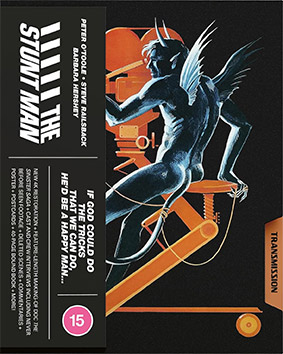
The Stunt Man
US 1980 | 131 mins
directed by: Richard Rush
written by: Lawrence B. Marcus; Richard Rush (adaptation); from the novel by Paul Brodeur
cast: Peter O’Toole, Steve Railsback, Barbara Hershey, Allen Garfield (as Allen Goorwitz), Alex Rocco
distributor: Radiance Films
release date: 23 February 2026