
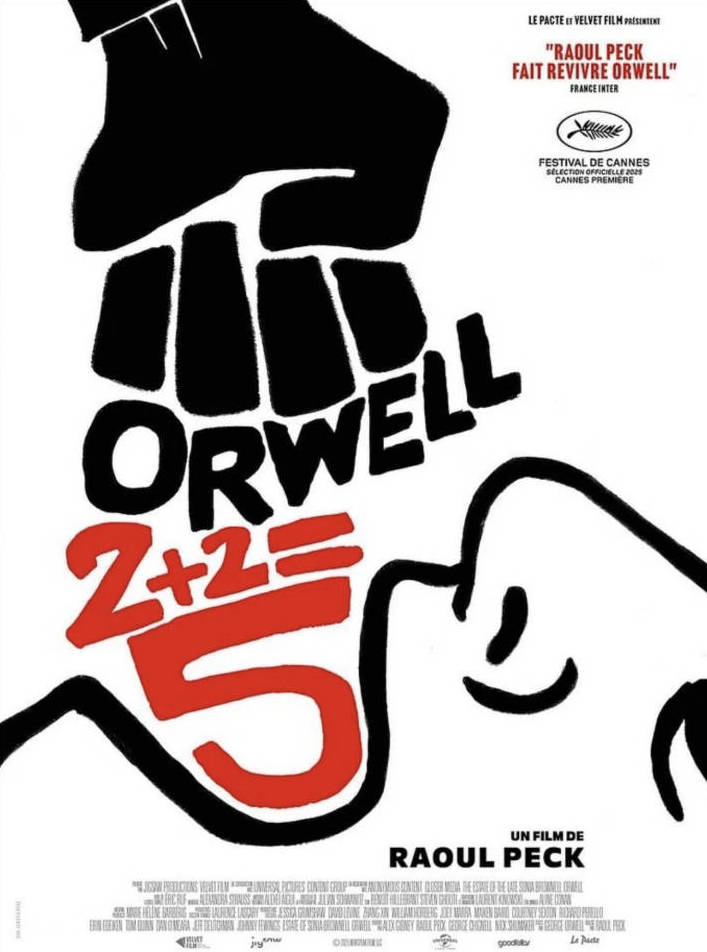
Orwell: 2+2=5
Raoul Peck’s riveting, urgent and impossibly ambitious documentary ORWELL: 2+2=5 scrutinises the authoritarian practices and tendencies of our times, with George Orwell as our guide. Jerry Whyte scans Peck’s busy collage of the dangers we face and probes the gaps in his account of Orwell’s life and work.
“Dare to be a Daniel/Dare to stand alone/Dare to have a purpose firm/Dare to make it know”
Nonconformist hymn, 1873
“Orwell hated the enemies of those whom he loved, whereas Swift could only love (and that faintly) the enemies of those he hated.”
Bertrand Russell
The last words of George Orwell’s last will and testament asked that no biography of him be written. The work was all, he felt, and nothing about a writer’s life was relevant to judgement of it. His widow, Sonia, an assiduous guardian of his interests, honoured his final wish for decades but, as Orwell’s fame grew after his death in 1950 and sales of Animal Farm and 1984 soared, she bowed to pressure. When she commissioned Orwell’s old friend Malcolm Muggeridge to write an authorised biography in the late 70s, he flunked it. He did some research, pecked at the project, and then sat on it. She subsequently appointed Bernard Crick as ‘official’ biographer and, though dying of cancer, lived long enough to see Crick’s George Orwell: A Life published in 1980.
Once the dam had been breached, the biographies poured forth, but still no definitive film had been sanctioned or attempted. In her own will, Sonia Orwell bequeathed the rights to her late husband’s work to his adopted son, Richard Blair. Five years ago, Blair was approached by literary agents A.M. Heath with an unusual request: would he sanction turning over the entire Orwell archive to Universal Studios, with a view to making a film – to be produced by Alex Gibney? Blair signed the project off and Gibney insisted it be directed by Raoul Peck – one of the most politically committed directors at work today.
Heeding Orwell’s injunction that we should let the meaning choose the word and stepping gingerly away from cliché, we cannot say that Raoul Peck was the right man, at the right time, in the right place to make a film about Orwell. What can be said is that having grown up under the dictatorships of ‘Papa Doc’ Duvalier in Haiti and Mobutu Sese Seko in the Congo, Peck understands the need for vigilance and resistance more acutely than most. He further established his credentials as the best man for the job with an always stimulating, sometimes scintillating series of films, in a variety of forms, that scrutinize major figures from radical, principally anti-colonial history.
In Lumumba: Death of a Prophet (2000), Peck paid homage to the fallen Congolese leader, a giant of the Pan-African liberation struggle; in Sometimes in April (2005), he explored the Rwandan genocide; in his celebrated James Baldwin documentary I’m Not Your Negro (2016) he tracked the progress of the civil rights movement and attendant mean-old-white-backlash through the assassinations of Medgar Evans, Malcolm X and Dr. King; in his drama The Young Karl Marx (2017) he explored the relationship between Marx and Engels that led to The Communist Manifesto; and in his TV series Exterminate the Brutes (2021) he drew on Sven Lindqvist’s groundbreaking book on Conrad to excoriate imperial atrocities in the Congo. And more besides.
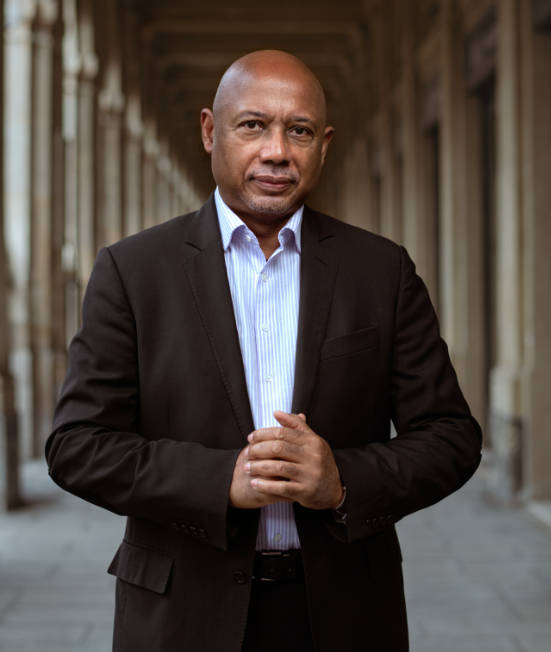
Not bad for a man who was driving New York taxis not so long ago, long before he was elected Chairman of La Fémis (France’s foremost film school) and long before he was appointed Minister of Culture of Haiti. In his riveting, if flawed new documentary Orwell: 2+2=5, the 72-year-old powerhouse attempts to do justice to one of the most complex, politically perceptive and important writers of the modern age. Orwell is the most widely quoted and misquoted author of our age. Both Animal Farm and 1984 have sold millions of copies internationally. Consequently, Peck can have been under no illusions about the scale of the job he’d taken on. He boldly sets out to elucidate Orwell’s insights into authoritarian power structures and practices while simultaneously surveying Orwell’s life and work to see what made him tick. That the film ultimately falls short of the mark should not detract either from the magnitude of the task or the audacity of the undertaking.
Orwell: 2+2=5
The film’s judiciously selected title alone hints at the enormity of the challenges Peck faced when trying to convey Orwell’s complex character and ideas to a lay audience. He hits the bullseye early on with a clip from John Glenister’s 1983 film Crystal Spirit: Orwell on Jura. Ronald Pickup, personifying Orwell more immaculately than any actor before or since, sits in a stranded car with his son, Richard. He sets the boy a simple sum: What is 2+2? When Richard answers correctly, he says, ‘a lot of people will tell you that the answer is five. Usually, they’re called governments’. Ah yes, usually, but not always and not only them. In Orwell: 2+2=5, Peck’s intensive research and astute judgement provide a neat solution to a messy problem by having Orwell urge the boy always to answer four, even under torture and on pain of death. We’ll return to that unhinged sum below because it encapsulates so much of Orwell.
Orwell: 2+2=5 is expertly composed of a dazzling, often dizzying array of archive film footage, graphics, still images, radio and TV recordings, and quotes, lots of quotes. No recordings of Orwell’s reportedly squeaky voice survive but the film is elevated by material gleaned from the Orwell archive and delivered, with sonorous yet intimate gravitas, by Damian Lewis. His expertly modulated readings are by turns gravely solemn and gently melancholic – less orthodox ‘voice of god’ narration, more reminiscent of Olivier’s ‘voice of a sad god’.
This approach is entirely apt as a thread of sorrow runs through the film. Peck expertly interweaves allusive comment on the depredations of contemporary politics and harrowing biographical material, melding the unanswerable case for Orwell’s continuing relevance with the tragedy of his slow death from tuberculosis while completing 1984 on Jura. Peck’s intention, one assumes, is to draw comparison between the decay of Orwell’s body and that of the body politic. It is an imaginative approach to biography, but it betokens an unnecessary straining for effect. It is hard not feel that the time Peck devotes to the sight of TB bacteria under microscopes and the sound of wheezing might have been better spent. In a world of spiralling censorship and self-censorship, misogyny and racism, inequality and war do we really need to know which sanatoriums Orwell was treated in and when?
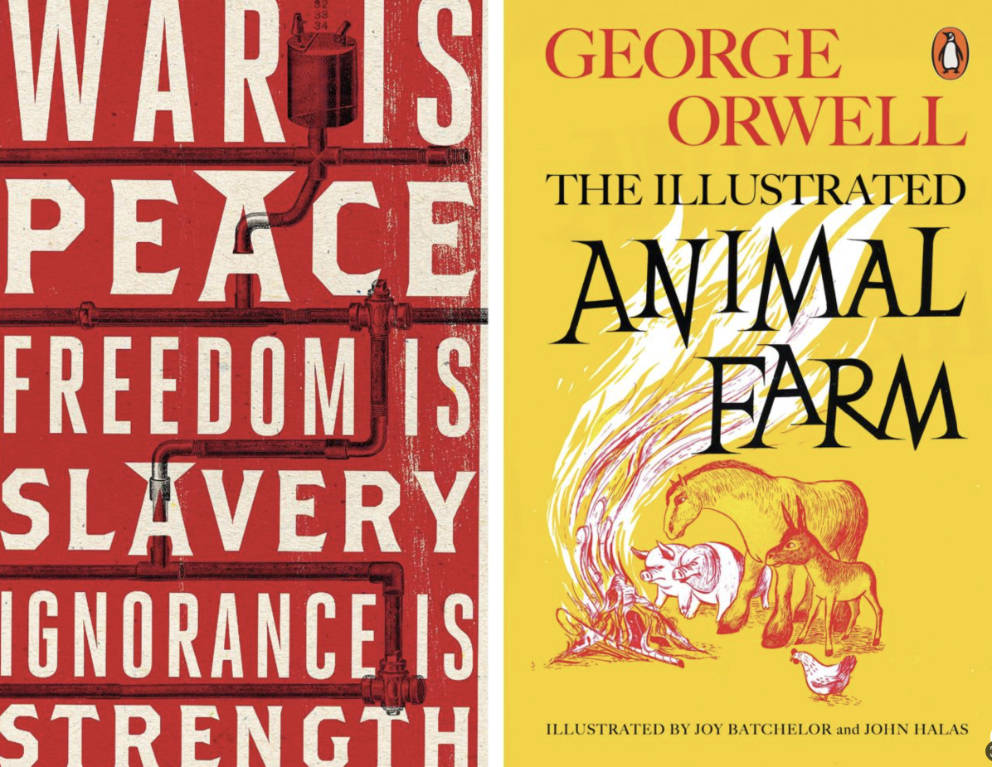
Which is not to say that Peck doesn’t pack a helluva lot into the film. Clips from Michael Anderson’s 1956 film adaption of 1984 (starring Edmund O’Brian) and Michael Radford’s 1984 (starring John Hurt) feature heavily. So does Nigel Kneale’s TV version of 1954 (starring Peter Cushing). Peck also makes good use of Halas & Bachelor’s elegant, animated version of Animal Farm – as did the CIA, who covertly funded the film and secured the rights to it by deploying a Psychological Warfare unit fronted by Howard Hunt (later to become infamous for his part in the Watergate break-in). Peck adds visual icing to the cake of those adaptations by shrewdly including Ralph Steadman’s suitably grotesque ink-and-wash illustrations of the book.
Orwell: 2+2=5 also contains footage from war torn regions such as the Gaza Strip and Ukraine, from despotisms such as North Korea and Russia, and from calcifying democracies such as the UK and USA. Peck also acknowledges the dangers posed by the advent of AI, the post-truth society and surveillance capitalism. He switches between such images of modern control and murder, pop cultural citations of films such as Minority Report and M3GAN, and the ethereal solitude of the Hebridean Island of Jura, where Orwell wrote 1984. It is compelling but it is an accelerating assault of images and ideas that may leave many viewers feeling slightly bewildered, not to say cudgelled round the chops.
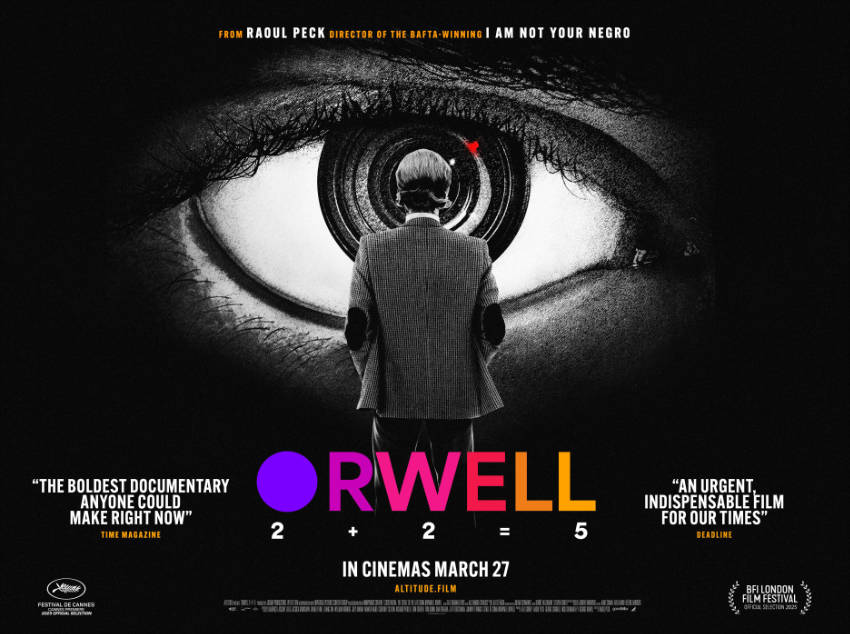
At one point in the film, Peck pauses to consider modern doublespeak and newspeak and the debasement of language we’ve become all too familiar with: Special Military Operations=Invasion of Ukraine, Vocational Training Centre=Concentration Camp, Legal Use of Force=Police Brutality, ‘Anti-Semitism2024=Weaponised Term to Silence Critics of the Israeli Military. Sadly, we can all supply our own examples (Targeted Immigration Enforcement Operation=Forced Repatriation of Global Citizens?) Peck takes another breather when he brilliantly presents a rolling list of books banned and the reasons given for their prohibition. Even during this moment of comparative repose, though, that invaluable information, like much of the film, passes before our eyes so rapidly that it is hard to take in.
Peck’s point about the censorship and the debasement of language is, nonetheless, superbly well made. It is a compliment paid to what Christopher Hitchens called ‘[Orwell’s] commitment to language as a partner of truth’. In a recent BBC Radio panel discussion on the current state of the English language, Christopher’s brother, Peter, argued persuasively that the most important recent development was that English had become less beautiful. It has, but Orwell’s graphomaniacal obsession with clear expression led him to see the bigger picture. Orwell crystallised the political problem of our language better than anyone when he said, in ‘Politics and the English Language’, ‘[It] becomes ugly and inaccurate because our thoughts are foolish, but the slovenliness of our language makes it easier for us to have foolish thoughts’. Or as Umberto Eco put it in his pamphlet How to Spot a Fascist (Harvill Press, 2020):
Ur-Fascism uses newspeak. Newspeak was invented by Orwell in 1984 . . . but elements of Ur-Fascism are common to different forms of dictatorship. All the Nazi and Fascist scholastic texts were based on poor vocabulary and elementary syntax, the aim being to limit the instruments available to complex and critical reasoning. But we must be prepared to identify other types of newspeak, even when they take the innocent form of a popular talk show.
Socialism in our Times
Orwell was on solid ground when he discussed language but all at sea with economics. Aside from a section of Peck’s film that details the vast wealth and numerous companies owned by various media oligarchs, it does Orwell a favour by steering clear of economic analysis. The closest Orwell came to a concrete economic policy proposal was that inequality be reined in by imposing a ten-to-one ratio between richest and poorest. Nevertheless, even when operating outside his areas of expertise, Orwell expressed what he felt with forensic clarity while, characteristically, finding an. Illustrative image to embellish his argument. In his 1935 essay ‘Catastrophic Gradualism’, he says,
Socialism used to be defined as the ‘common ownership of the means of production (distribution and exchange), but it is now seen that if common ownership means no more than centralized control, it merely paves the way for a new form of oligarchy. Centralized control is a necessary pre-condition of Socialism, but it no more produces Socialism than my typewriter would of itself produce this article I am writing.
Orwell’s socialism was moral rather than analytical. It was built around his deeply held notions of common sense, decency, fairness and justice. That irked many an aesthete and intellectual but, hey, there are worse things to base one’s politics on. George Melly said simply that he’d rather be a do-gooder than do-badder. That fearless foe of injustice and scourge of power, Michael Parenti, who died earlier this year, said the thing he loved most – more even than beauty, love and happiness – was justice. We need Orwell, but we also need high-end freethinkers like Parenti more than ever.
In his caustic, often vitriolic study Orwell (Fontana Modern Masters, 1971), Raymond Williams says that financial capitalism – the dominant national and international financial institutions plus their counterparts in transnational corporations – now display many of the hallmarks of ‘Oligarchical Collectivism’. Williams describes a familiar form of doublethink: ‘the radical Right denounces the state at the level of social welfare or economic justice but reinforces and applauds it at the level of patriotic militarism and uniform loyalty’. That, even before the bank bailouts described in modern doublespeak as ‘quantitative easing’, which is to say, ‘socialism for the rich’.
John Steinbeck lampoons that paradox or trick in his impish 1957 satire The Short Reign of Pippin IV. Todd, an American in Paris and heir to a chicken farms fortune, attempts to explain the USA and its politics to the French king:
You might say we have two governments, kind of overlapping. First, we have the elected government. It’s Democratic or Republican, doesn’t make much difference, and then there’s the corporate government . . . the elected government pretends to be democratic, and actually it is autocratic. The corporation governments pretend to be autocratic . . . here’s the funny thing, sir. You take a big corporation in America, say like General Motors or Du Pont or US Steel. The thing they’re most afraid of is socialism, and at the same time they themselves are socialist states. But why?’ (asks the bewildered king, so Todd explains). They don’t do it out of kindness, sir. It’s just that some of them have found out they can produce more goods that way. They used to fight the employees. That’s expensive. And sick workers are expensive. Do you think my father likes to feed his chickens vitamins and cod-liver oil and minerals to keep them warm and dry and happy? Hell, no! They lay more eggs that way.
Burmese Days
Peck freely admits that he came late to Orwell, was initially induced to think of him as a science-fiction writer, and only recently ‘discovered an Orwell from the Third World’. All of which is fine, people have always found the Orwell they want and there are many Orwells to find. Regrettably, the deeper one delves the more one discovers that not all of them are pretty. Peck isn’t interested in the great writer’s flaws though. Orwell 2+2=5 is the work of an initiate whose infectious enthusiasm for his subject leads him gush. The work also of a director keen to unburden himself of his concerns – to the point that he tilts at easy tyrannical targets such as Modi, Putin and Trump. More tellingly, Peck’s intense personal connection to anti-colonial history leads him to focus much, perhaps too much of his attention (and ours) on Orwell’s experiences in Burma (now Myanmar) as a foot soldier of Empire in the Indian Imperial Police.
In a sense that emphasis is all to the good. It was, after all, in Burma, during his five years carrying ‘the white man’s burden’ and working as ‘part of the machinery of actual despotism’, that Orwell came to understand how power structures operate. It was there that he developed his hatred of intellectual hypocrisy and moral corruption. There, too, having realised that the British could not rule India by force alone, that he first grasped the importance to power of psychological manipulation and wilful ignorance. With his own eyes, Orwell saw the master-slave relationship in operation. In his heart and mind, he grasped why the will to obey is more corrupting than the will to command.
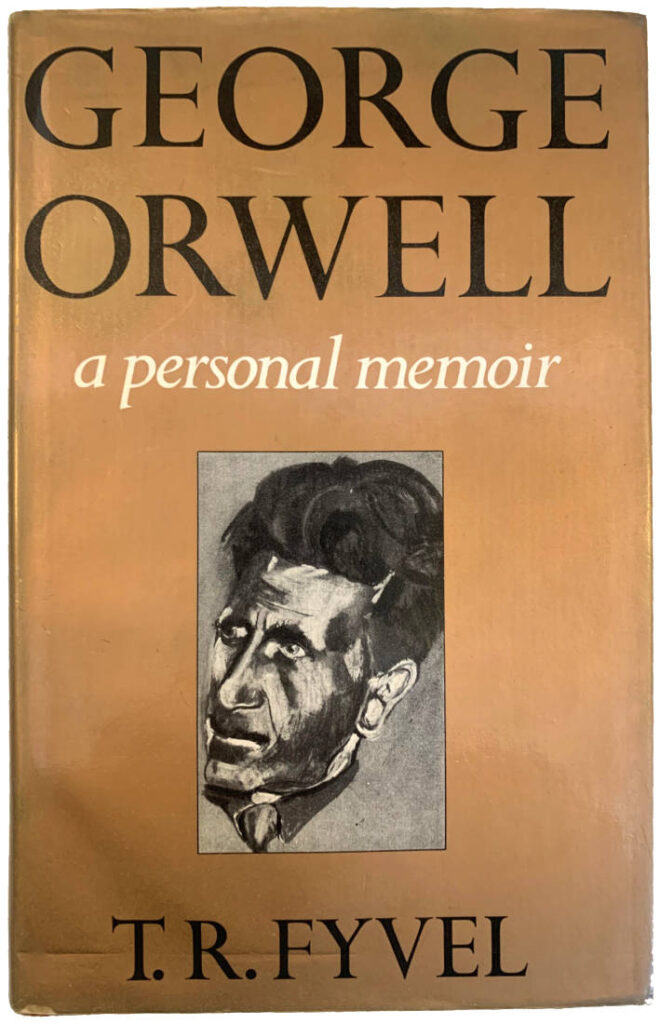
That having been said, Orwell’s Burmese days were just one small part of his learning curve. Peck’s emphasis on them in Orwell: 2+2=5 means he largely ignores the impact of two equally formative periods in Orwell’s life that help explain his contradictory personality and politics: his prep and private school education and, above all, the experience that left the deepest mark on his politics, that of fighting fascism in Spain. It is left to us to fill in the gaps, which is odd as much of the ground Peck covers will be familiar to most viewers: the attack on the White House, the levelling of the Gaza Strip, modern mechanisms of control and surveillance, perpetual war, and so on.
The film might have felt more comprehensive and coherent, for instance, had he reviewed the divisions, evasions, self-indulgence, virtue-signalling and identity politics of the Left and considered the contribution that made to our modern malaise. Doing so might have provided a hostage to fortune and succour to the enemy, as Orwell was accused of doing during the Cold War, but it might also have drawn in those from beyond the community of the righteous who stand in greatest need of elucidation and enlightenment.
By eliding Orwell’s schooldays, Peck sidesteps an opportunity to consider class and toxic masculinity. Although Orwell glibly described his time at Eton as ‘five years in a lukewarm bath of snobbery’, the physical and psychological violence, the beatings and bullying, cruelty and regimentation of his school days surely shaped him. His big-boy-don’t-cry, stiff-upper-lip normative conditioning led to the repression of pain. For Orwell, politics had been debased to the point it was ‘a mass of lies, evasions, folly, hatred and schizophrenia’, but so, we might add, was his own internalizing of the cruelty and manipulations of his schooling.
In his ironically titled essay ‘Such Such Were the Joys’, Orwell presented his prep school, St Cyprian’s, as an institution run like a reign of terror by its headmaster and his ‘satanic’ wife. His time there may, of necessity, have built a strong sense of independence in him but it surely scarred him too. If it persuaded him that he was an outsider who could stand it, it also introduced him to the concepts of hatred and obedience. ‘Whenever one had the chance to suck up,’ he confesses, ‘one did suck up and at the first smile one’s hatred turned into a sort of cringing love’. Attending boarding school was, he felt, like being ‘flung into a world of force and fraud and secrecy, like a goldfish into a tank full of pike’. Much the same might be said of his experiences in the Spanish Civil War, that deeply tragic dress rehearsal for the Second World War.
The Spanish Cockpit
Orwell headed to Spain in the corduroy jacket of his friend Henry Miller, who he had met in Paris en route to Barcelona. He set off as an ardent anti-Fascist and, loosely, as a socialist, but travelled without the baggage of a clearly defined ideological position. He had initially considered joining the communist International Brigades but was turned down by Harry Pollitt, General Secretary of the Communist Party of Great Britain, who felt Orwell’s pronounced upper-class accent would be a hinderance. Finally, through his contacts in the Independent Labour Party, he joined up with the POUM (Partido Obrero de Unificación Marxista), a small anti-Stalinist, neo-Trotskyist group aligned with the much larger, more popular Anarchist columns of the CNT and FAI.
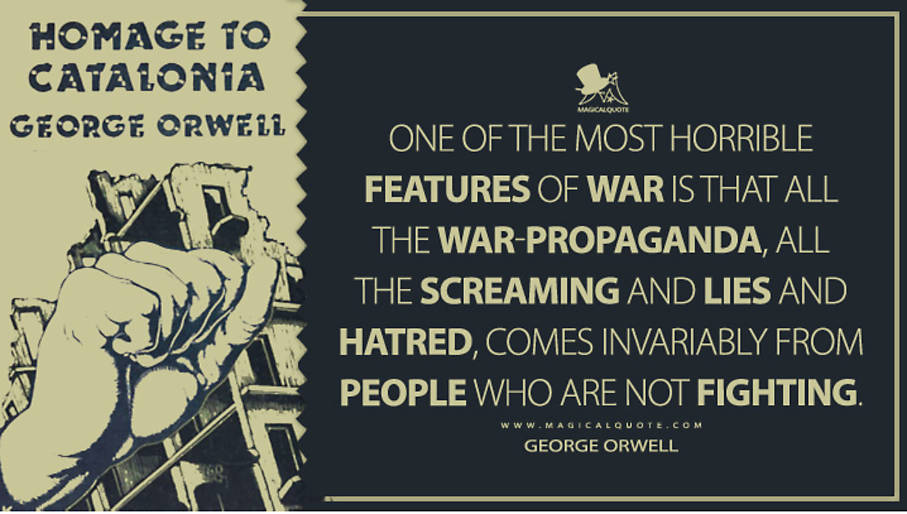
Orwell’s decision to join the POUM nearly cost him his life and would transform his worldview. When Orwell arrived in Barcelona in 1936, he found the city alive with revolutionary fervour. In Homage to Catalonia, he describes a place pulsing with comradeship and mutual respect, where tipping was rejected as anti-democratic, from which the wealthy appeared to have disappeared, ‘a town where the working class is in the saddle’. Peck illustrates the heady atmosphere of those days in Orwell:2+2=5 with a clip from Loach’s Land and Freedom, in which a group of Republicans passionately debate the pros and cons of land seizures. Regrettably, Peck leaves things there, setting aside the debates within socialism that Orwell was embroiled in, maybe to avoid muddying the waters or for fear of scaring the horses.
Things would soon change anyway: the revolution was betrayed, Orwell copped a bullet in the throat, and the POUM and the Anarchists were brutally suppressed by the Communist Party, whose slogan was ‘The war first, the revolution afterwards’. Historians such as Peter Preston argue, with some justification, that because those powers soon be called ‘The Allies’ remained ‘neutral’, because the Republic was poorly armed while the fascists were amply supplied by Hitler and Mussolini, and because the Soviet Union was essentially the Republic’s only lifeline, the Stalinist suppression of the revolution was justified. Orwell himself, as pragmatic as he was idealistic, acknowledged the force of that argument in his essay ‘Looking Back on Spain’.
None of which blinded Orwell, and none of which should blind us to the vicious nature of the Communist purge of political opponents within Republican ranks and, more widely, within the independent international Left. When Victor Serge met the POUM militant Julian Gorky around this time, he explained Communist policy succinctly: ‘After the lies, bullets in the neck’. The POUM were first in line because they opposed the Moscow line in Spain and were almost alone in having spoken out against the Moscow show trials. The party’s leader, Andreu Nin, was arrested, tortured, and disappeared. In the ruthless round-up of dissidents ordered by Moscow, those who weren’t immediately murdered found themselves facing the Spanish equivalent of the show trials – the denunciations, lies, frame-ups, intimidation, torture.
Orwell: 2+2=5 quotes Orwell’s view on the matter: ‘This kind of thing is frightening to because it gives me the feeling that the very concept of objective truth is fading out of the world. Lies will pass into history’. Without Orwell’s intervention many more lies would have done than did. It was a hard slog. Homage to Catalonia was published in April 1938, by the end of the year it had sold just 700 copies. In Spain, Orwell had witnessed revolutionaries denounced as fascists, seen many of his most committed friends murdered as traitors, and lived through times in which an anti-revolutionary, right-wing Communist Party had defended capitalism. He had experienced doublespeak and doublethink and met the Thought Police long before he invented those terms.
Zamyatin
Orwell’s principal inspiration for 1984 was Yevgeny Zamyatin’s comic-dystopian novel We – which its author described as both his most light-hearted and serious book. Written just before Lenin’s death and the horrors of Stalinism hit home, the novel depicts a future surveillance state ruled by The Benefactor (precursor to Big Brother). Citizens follow mathematically rigid schedules, are reduced to mere numbers, live on synthetic food, and obey orders mindlessly. Combining elements of Lenin and Dostoevsky’s Grand Inquisitor, The Benefactor rules over a society that claims to have attained perfection. Conformity and groupthink are in the ascendant and the citizenry have become machine-like, uniform, as blissfully happy as they are ignorant.
As Orwell noted in his review of We (Tribune, 1946), ‘the state’s guiding principle is that happiness and freedom are incompatible’. When rebellion breaks out, the authorities announce that some human beings suffer from a disease called imagination – an idea later taken forward by Ismail Kadare in his brilliant anti-totalitarian satire The Palace of Dreams (Harvill Press, 1981). In We, a ‘solution’ is found: a kind of lobotomy to remove humankind’s last imperfection. Those who refuse to go under the knife are publicly executed by the Machine of the Benefactor. ‘It is this instinctive grasp of the irrational side of totalitarianism,’ says Orwell, ‘- human sacrifice, cruelty as an end in itself, the worship of a Leader who is credited with divine attributes – that makes Zamyatin’s book superior to Huxley’s (Brave New World)’.
Astonishingly, Stalin allowed Zamyatin to leave the Soviet Union in 1931 and he had the last laugh. Writing from the safety of Paris, he says, ‘Once, in the Caucasus, I heard a Persian fairy tale about a rooster that had the bad habit of crowing an hour earlier than the others. This caused the owner of the rooster so much inconvenience that he chopped off the rooster’s head. We turned out to be a Persian rooster. . . So, after the novel was published (in various translations) the Soviet critics hacked me about the head rather fiercely. But I must be solidly built, for my head, as you see, is still on my shoulders’.
Zamyatin targets rampant Taylorism rather than nascent Stalinism, but his focus on the threat to individual liberty of collectivism point to another aspect of the equation that supplied Peck with his title. In his study of Stalinism Assignment in Utopia, a book Orwell read with interest, Eugene Lyons says:
Optimism ran amuck Every statistical success was another justification for the coercive policies by which it was achieved. Every setback was another stimulus to the same policies. The slogan ‘The Five-Year-Plan in Four Years” was advanced, and the magic symbols ‘5-in-4’ and ‘2+2+5’ were posted throughout the land.
In his monograph Orwell’s Victory (Allen Lane, 2002), Christopher Hitchens says, ‘In truth, the idea that two and two make five . . . was suggested by multiple sources . . . Sterne’s Tristam Shandy has a comparable moment of official juggling with numbers, as does Dostoevsky’s Notes From Underground’. Indeed, they do but, by the same token, Burma and Wigan, St Cyprian’s and Spain, Lyons and Zamyatin all guided Orwell towards the final destination of 1984.
Don Quixote on a Bicycle
What of Orwell the man? It has often been said that Orwell’s radical honesty was performative, that he was ‘so honest it makes you think he is dishonest’. In ‘Honest, Decent, Wrong: The Invention of George Orwell’, a remarkably shrewd essay published in the New Yorker, Louis Menand notes that,
Orwell was a brilliant and cultured man, with an Eton accent and an anomalous, vaguely French moustache, who wore the same beat-up tweed jacket nearly every day, made (very badly) his own furniture, and lived, most of the time, one step up from squalor. He read Joyce and kept a goat in the back yard. He was completely authentic and completely inauthentic at the same time – a man who believed that to write honestly he needed to publish under a false name.
It also often said that people become their names. Orwell was christened Eric Arthur Blair and that is the name chiselled on his simple brown tombstone. He once wrote, ‘It took me 30 years to work off the effects of being called Eric.’ Numerous biographers and scholars have argued that ‘Orwell’ was the great writer’s finest creation. Orwell was certainly and in a profound sense a self-made man. As Peck notes in the film, he had, as he claimed, ‘a facility with words and a power of facing unpleasant facts’. He also had a rare capacity for self-criticism and deployed it to face down most of the unpleasant characteristics common to those formed by the same class background, martial tradition and literary inheritance. The Road to Wigan Pier took him far from the comforts of home and his journey was as arduous as it was transformative. As Cervantes said, ‘He who reads a lot and travels a lot knows a lot and understands a lot [El que lee mucho y anda mucho ve mucho y sabe mucho]’.
In ‘Don Quixote on a Bicycle’ (The London Magazine, 1957), an early encomium to Orwell, Paul Potts says that his old friend ‘made one think of a knight errant and of social justice as the Holy Grail’. Others have come to similar conclusions. In the anthology Remembering Orwell (BBC,1984), Orwell’s friend and protégé Jack Common recollects their meeting at a country pub. There Common stands, leaning on a five-bar gate, atop a hill, up which Orwell is cycling. ‘He could have got off and walked the worst gradient. Not he. This Don Quixote weaved and wandered, this side, that side, defeating windmills of gravity till he grew tall on the hill brown and tall too was that Rosinanteof a bicycle, an ancient Triumph that could have belonged to his father’. And then again, there is that hilltop windmill in Animal Farm.
Another friend, George Woodcock, also uses the Don Quixote image in his influential memoir-cum-study The Crystal Spirit (Jonathan Cape, 1967). Orwell’s physical resemblance to Cervantes’ gaunt, lanky knight errant was, Woodcock says, in synch with Orwell’s quixotic nature: his nostalgia for an earlier age, his principled defence of unpopular causes, his chivalrous grace toward those with whom he crossed lances, above all, the embattled isolation common to those who seek and speak truth, regardless of the cost to others or themselves.
Of course, Don Quixote seldom travels anywhere without his sage companion Sancho Panza – much as Dickens’s Mr Pickwick is inseparable from his streetwise sidekick Sam Weller. In his essay on saucy seaside postcards, ‘The Art of Donald McGill’ (Horizon, 1941), Orwell lists Bloom & Dedalus, Bouvard & Pécuchet, Jeeves & Wooster, and Holmes & Watson to emphasise his contention that the ‘the two principles, noble folly and base wisdom, exist in nearly every human being’. Interestingly, Orwell sees clearly that these pairings represent the ‘ancient dualism of body and soul in literary form’, but, surprisingly for one so alert to the temptations of obedience, credulity and servility, fails to note the light they also shed on the master-slave relationship.
‘If you look into your mind,’ he asks, ‘which are you, Don Quixote or Sancho Panza? Almost certainly both. There is one part of you that wishes to be a hero or a saint, but another part of you is the little fat man who sees very clearly the advantages of staying alive with a whole skin. He is your unofficial self, the voice of the belly protesting against the soul’. In a letter of 1936, Orwell upbraids his friend Henry Miller for drifting into ‘a sort of Mickey Mouse universe where things and people don’t have to obey the rules of time and space’. Orwell, who was proud of his ability to use his hands and grasp of animal husbandry, adds, ‘l have a sort of belly-to-earth attitude and always feel uneasy when I get away from the ordinary world’.
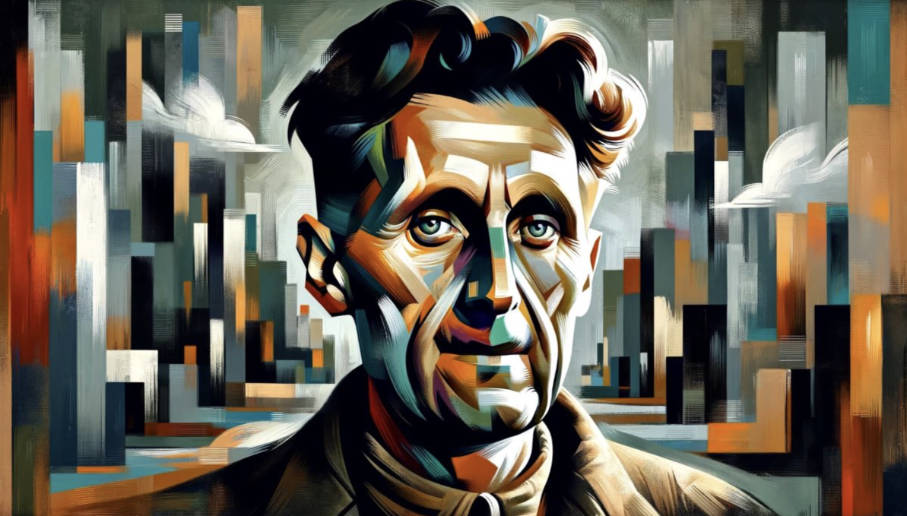
Orwell’s distrust of intellectuals was underpinned by that earthed connection with the physical world we all inhabit. Paradoxically, it was also, I believe, one of the reasons he secretly admired and was influenced by J.B. Priestley – particularly the Priestley of the hugely popular wartime broadcasts, whose soft lilting voice and regular presence in working-class homes Orwell had every reason to be envy. It is part of what led him to develop his famously forensic, unadorned prose style and move away from the purple pretensions of his early novels. George Woodcock felt that such contradictions were more acute in Orwell than most and that ‘the simultaneous presence in his nature of the Don and Sancho gave his personality a fascinating and slightly enigmatic originality that has led since his death to something approaching an Orwell cult’.
Orwell Disrobed
The growth of that cult was accompanied by Orwell’s gradual canonization as a secular saint. We can be sure that he would’ve been uncomfortable, even appalled by both developments. He begins his essay, ‘Reflections on Ghandi’ (Partisan Review, 1949) by saying, ‘Saints should be judged guilty until they are proved innocent’. George Woodcock, for his part, says, ‘Orwell was too solitary to be a symbol and too angry to be a saint’. Woodcock learned of Orwell’s death in early January 1950 from a guest at a party in snowbound Vancouver. ‘A silence fell over the room, and I realised that this gentle, modest and angry man had already become a figure of world myth’. Flicking through the newspaper obituaries after Orwell’s death, that failed biographer Malcolm Muggeridge felt he saw ‘how the legend of a human being was created’.
The legend and myth of Saint George was, as we’ve said, one of Orwell’s finest creations, but he was no saint or if he ever was one, he was made of plaster. There is no mention of his faults in Orwell-2+2=5. Peck sweeps them all under the carpet. Orwell has been accused of antisemitism, cruelty, homophobia, humourlessness, infidelity, misogyny, misanthropy, sadism, treachery, the works. Most of these accusations have been rebutted, most hold Orwell to standards that sadly did not apply in his day, some have been acknowledged, others remain unexamined for the time being.
Pick one: Orwell’s list. The secular consecration of George Bernard Shaw was confirmed when he was awarded both a Nobel Prize and an Oscar. Orwell received no such award but, while the adjective Shavian is seldom deployed today, Orwellian is a term in almost daily use. Orwell included Shaw in his notorious list of those he deemed too politically unreliable to work in the Foreign Office’s Information Research Department (just that). He knew what he was talking about – and so did most people. At Shaw’s Corner, the writer’s old home (now a museum), a row of portraits sits on a mantelpiece. Wedged between Ghandi and Ibsen, are the figures of Lenin, Stalin and, shockingly, Felix Dzerzhinsky, the man who fronted the Cheka, the GPU and OGPU (the first Soviet Secret Police organisations) during the Red Terror. Case closed.
Among the more unattractive habits of our smugly sanctimonious age is that of looking back, complacently, on earlier imperfect ages. We are right to hold our antecedents to account. We often to do so primarily to demonstrate how they failed to act according to standards by which we all too rarely judge ourselves. No such smugness applies to the justifiable feminist case against Orwell, which has been consolidated down the years and continues to be sharpened.
Orwell and Feminism
In 1984, no less, Daphne Patai set the backlash ball rolling with The Orwell Mystique: A Study in Male Ideology (University of Massachusetts Press, 1984)). Hilary Spurling did a grand job of rehabilitating Sonia Orwell in The Girl from the Fiction Department (Hamish Hamilton, 2002). In Wifedom: Mrs Orwell’s Invisible Wife (Penguin, 2023), Anna Funder accuses Orwell of cruelty toward his first wife, Eilleen O’Shaughnessy. Funder says, ‘I’ve always loved Orwell, his self-deprecating humour, his laser vision about how power works, and who it works on’. So much so that she first devoured his books and then six major biographies on the man. And then she read about Orwell’s first wife, and the rest is (poorly written, counter-factual) history.
Sandra Newman can write. Witness her scintillating feminist reworking of 1984. In Julia (Granta, 2023) she claims, by implication, that Orwell’s writing was misogynistic. It gets way worse. D.J. Taylor hints that the reason for Orwell’s departure for Burma may have been more sinister than had previously imagined. Taylor is an admirer of Orwell, an afficionado and enthusiast of the highest order. Not content with having written his superb Orwell: The Life (Chatto & Windus, 2003), he followed that up with the equally excellent Orwell: The New Life (Constable, 2023). Taylor’s second biography makes use of new material and describes a shocking episode not, to my knowledge, mentioned in earlier biographies. In 1921, the Blairs holidayed in in Rickmansworth, Hertfordshire with their friends the Buddicom family. Young Eric Blair was romantically engaged with Jacintha Buddicom. Taylor refers to a walk the couple took on 4 September that year:
Orwell attempted to force himself upon Jacintha, who fled back to the house in tears, with her clothing torn, locked herself in her room, wrote the draft of an accusing letter which she never sent and refused to speak to him for the rest of the holidays . . . Rumour of what had happened swiftly communicated itself to their mothers and caused a lasting estrangement. Jacintha, naturally, links it to Orwell’s immediate destiny. Put bluntly, her later analysis of her relationship with Orwell is based on the assumption that he hoped to marry her and go to Oxford, in not necessarily in that order, and then, rejected by her, settled for East.
That assumption may or may not hold water but, though the evidence is sparse, the clear implication of sexual assault has not been disputed. It feels particularly shocking in the light of the #MeToo movement and the horrifying revelations about the likes of Mohamed Al-Fayed, Jeffrey Epstein, Harvey Weinstein and others. It has long been known that Orwell consorted with prostitutes in Paris and, probably, in Burma. His awkwardness around women, too, has been well documented, including his serial marriage proposals, often to women he barely know. Orwell as sexual predator is a new one though.
Peak Orwell
Like D.J. Taylor, Robert Colls became so fascinated by Orwell that he went back for a second bite of the cherry. His insightful and witty George Orwell: English Rebel (OUP, 2013 focused), as its title suggests, on understanding Orwell through close study of his particular brand of patriotism and often conflicted Englishness. Now Colls has a new book out: George Orwell: Life and Legacy (OUP, 2026) and is busy announcing that Orwell may be done for, dragged down by his real or imaginary infidelities and private life. ‘We live in a time of peak Orwell’, Colls says, and it might be that the only way is down’
As I said a propos of another Englishman with big feet and a bigger heart, Tony Hancock, being human like the rest of us our heroes will inevitably have feet of clay. Being human, we are all imperfect. As Orwell said of Salvador Dali:
One ought to be able to hold in one’s head simultaneously the two facts that Dali is a good draughtsman and a disgusting human being. The one does not invalidate or, in a sense, affect the other. The first thing that we demand of a wall is that it shall stand up. If it stands up, it is a good wall, and the question of what purpose it serves is separable from that. And yet even the best wall in the world deserves to be pulled down if it surrounds a concentration camp . . . Unless one can say that . . one is shirking the implications of the fact that an artist is also a citizen and a human being.
That is not to say that Orwell was a disgusting human being. His many virtues far outweighed by his faults and there is no need, anyway, to claim benefit of clergy for him. Orwell could proudly say, as Charlotte Brontë did, ‘I am no bird, and no net ensnares me: I am a free human being with an independent will’. He was his own man and worked for no god, party or master. His work may not forever stand for him as he’d hoped, but it will live on in his timeless warning against authoritarian the practices and tendencies that sow confusion where he offered clarity and thrive on division where he urged human solidarity.
Peck repeats that warning, loud and proud, abetted by the unprecedented access to the Orwell archive that enabled him to represent him in his own inimitable, immortal words. Orwell understood and felt the need for open criticism and free speech more than any other writer of his generation. He deplored the anti-democratic notions of celebrity and sainthood. A singularly reserved and private man, he would not have welcomed intrusion into his private life. We can be sure, though, that he would have consented to free enquiry into his ideas and would have joined the resistance against the tightening grip of totalitarianism he feared and clearly foresaw.
We are now ensconced in a post-literate age so films like Orwell:2+2=5 are more important than ever. We can no longer be as confident as Czesław Miłosz was, when he wrote The Captive Mind, that the mechanisms of mind control he described will fade from the earth. We can, though, be as confident as he was, when he wrote his poem ‘And Yet the Books’, that the stock of human knowledge, including Orwell’s work, will survive, albeit it in new forms.
And yet the books will be there on the shelves, separate beings/That appeared once, still wet/As shining chestnuts under a tree in autumn/And, touched, coddled, began to live/In spite of fires on the horizon, castles blown up/Tribes on the march, planets in motion/‘We are,’ they said, even as their pages/Were being torn out, or a buzzing flame/Licked away their letters. So much more durable/Than we are, whose frail warmth/Cools down with memory, disperses, perishes/I imagine the earth when I am no more/Nothing happens, no loss, it’s still a strange pageant/Women’s dresses, dewy lilacs, a song in the valley/Yet the books will be there on the shelves, well born/Derived from people, but also from radiance, heights.
Orwell:2+2=5, having hinted at the radiant heights Orwell’s writing reached, concludes with the hopeful sight of protests against the ruling dispensation. Peck insists that the butterfly effect of individual deeds and the potent force of collective action retain their power to change the world. History tells us, as Orwell did, that when anger and hope combine people can move mountains. Another precondition of change is the return of our confidence and, for that we will need to haul Orwell off his pedestal. As Robert Coll says in English Rebel, ‘The greater our trust in him, the smaller our trust in ourselves’.
To end as we began, with Orwell’s last will and testament, we must note a final Orwellian contradiction, that contained in his claim that the work was all and his request that no biography of him be written. Today, knowing what we now do about Orwell’s personal failings, we might challenge his view that the work is all. Despite those reservations, we can still warm, as Raoul Peck must have done, to Orwell’s view that, ‘I do not think one can assess a writer’s motives without knowing something of his early development. His subject matter will be determined by the age he lives in, at least this is true of tumultuous revolutionary ages like our own’. Our times are revolutionary in perilous ways and are certainly tumultuous, so, as Raoul Peck demonstrates in his urgent, messy, indigent, slightly unfocused film, Orwell is more relevant than ever.
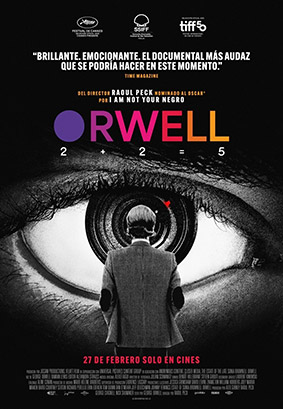
Orwell: 2+2=5
USA / France 2025 | 119 mins
directed by: Raoul Peck
written by: Raoul Peck
cast: Damian Lewis, George Orwell, U Win Khine, Min Aung Hlaing, Augusto Pinochet, Ferdinand Marcos
UK distributor: Altitude Film Distribution
UK release date: 27 March 2026