
The Meltdown / La Perra
Chilean cinema has long punched above its weight and the 70th London Film Festival was graced by Manuela Martelli’s THE MELTDOWN and Dominga Sotomayor’s LA PERRA, Jerry Whyte hails two compatible films that each defy narrative convention while mourning the passing of Chilean maestro Patricio Guzmán, who died a fortnight before the festival began.
The slender topographic slither that is Chile may be sparsely populated but it contains multitudes. Wedged between the verdant Pacific seaboard and the mighty Andes, the ‘country of poets’ is home to the world’s driest desert, the Atacama, and to one of the world’s most vibrant film cultures. The Chilean film industry has grown by 20.5 per cent in the last five years and is notable for the high number of women involved in production. Domingo Sotomayor was the first woman to win the Best Director award at Locarno. She and Manuela Maratelli are characteristic of a sustained challenge to machismo in an industry more amenable to change than most. Chile’s reliance on international co-production funding binds its cinema to the wider world, cements collaborative processes, and reinforces a commendable tendency to diversity.
Necessity being the mother of invention, Chilean films also tend to be tight-knit co-operative affairs. Manuela Martelli was last at the LFF in 2022 with her acclaimed debut feature 1976 – the soundtrack for which, like that for her new film The Meltdown (El deshielo), was composed by her wife Mariá Portugal. A consummate actress, Martelli also has numerous writing credits to her name – including one for Dominga Sotomayor’s 2014 sophomore feature Mar. For her part, Sotomayor, who first appeared at the LFF in 2011 with her debut feature Thursday Till Sunday, worked as a co-producer on Martelli’s 1976.
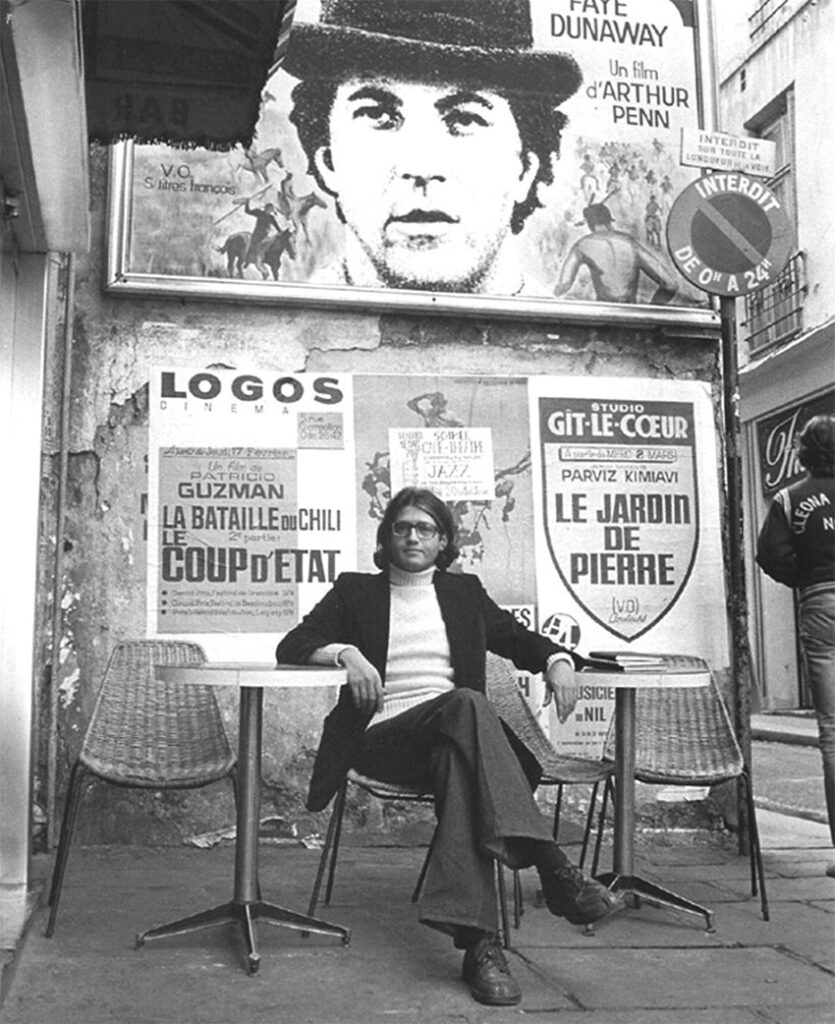
Patricio Guzman
These kind of co-operative working practices were even more essential to Patricio Guzmán when he started out in 1970s, during a time of celluloid scarcity and danger. No discussion of Chilean cinema would be complete without mention of Guzmán, for nobody did more to establish and elevate Chilean cinema’s international standing than he did. Nobody did more, either, to mark and memorialise Chile’s tumultuous recent history than he did.
Throughout his long, distinguished career, the internationally renowned director tenaciously reminded his compatriots and the world of the first 9/11 – the CIA-backed military coup pf 1973 that eviscerated Salvador Allende’s radical experiment in participatory democracy and ushered in the neoliberal era. Guzmán never let us forget that it was not in the frigid minds of the Chicago Boys alone that the destructive dispensation of today was born, but also in the blood-spattered cells of Chile’s National Football Stadium and the Pinochet dictatorship’s many other detention-cum-torture centres.
‘A country without documentary film,’ he said, ‘is like a family without a photo album.’ Guzmán’s images enriched Chile and the human family alike. As early as 1972, in The First Year, he charted the eruption of enthusiasm and joy after the Popular Unity’s electoral victory in 1970 and he never wavered in his commitment to democratic socialism. He will be best remembered for his extraordinary trilogy The Battle of Chile: The Struggle of An Unarmed People (1975-79). Courageously shot under perilous conditions, it stands as an imperishable record of a key pivot point in modern history.
Guzman’s magnum opus chronicles, in reverse order, the construction of popular power by working class Chileans, the violent fascist reaction to the left’s ascendancy, and the brutality of the CIA-backed 1973 coup. Analytical yet passionate, clear-eyed but intense, it is a masterpiece of engaged filmmaking and one of the towering achievements of documentary cinema, Unsullied by ‘voice of god’ narration and ‘expert’ talking heads, The Battle of Chile details a people’s cruelly foreshortened bid to build a better, more just world.
Forced into exile, initially in Cuba and finally in France, Guzmán refused to be cowed and meticulously set the increasingly distorted political record straight in his ‘trilogy of memory’: Chile, Obstinate Memory (1997), The Pinochet Case (2001) and Salvador Allende (2004). While still committed to keeping the memory of Allende’s dreams and Pinochet’s victims alive, his challenge to the falsification of history then broadened out to examine colonialism and the cosmos. In his later trilogy of more elegiac, lyrical and meditative essay-films – Nostalgia for the Light (2010), The Pearl Button (2015), The Cordillera of Dreams (2019) – Guzmán combined astrology, archaeology, ecology, geology, geography, history and politics to cumulatively moving effect.
His melancholic final film, My Imaginary Country (2022), considered the social revolt that swept Chile in 2019. The film is infused with nostalgia for the heady days of Guzmán’s revolutionary youth – a time when all seemed possible, optimism felt like realism, and the politics of hope was on the front foot. Patricio Guzmán never lost hope or surrendered to despair. One of the great filmmakers of our age, he was also one of the kindest, warmest, most generous and gentle man I’ve had the pleasure and privilege to meet. As Carmen Castillo said after hearing of his passing, ‘Farwell Patricio. We will continue to work on the present and wage the battle for memory.’

The Meltdown
Patricio Guzmán and his tiny crew of compañeros were almost alone among their contemporaries in bearing witness to the Allende years. Film stock was in short supply in Chile in the 70s and Guzman was only able to complete The Battle of Chile with the aid of material and equipment covertly supplied by Chris Marker. Many Chilean directors, though, have subsequently followed Guzmán’s lead and trained their crosshairs on tyranny – most notably, Pablo Larraín in his Pinochet trilogy: Tony Manero (2008), Post Mortem (2010), No (2012); and in The Club (2015) and Neruda (2016).
More recently, Manuela Martelli addressed the rule of the junta in her chilling and astonishingly assured debut. In 1976, Martelli relegates the sadistic violence of the Pinochet regime to the margins, the better to render the paralysing pervasive terror that seeped deep into the very bones of Chileans. Her heroine, Carmen (Aline Küppenheim), is as damaged by domestic despotism as by the dictatorship at large. When she places herself in danger by harbouring a fugitive leftist, she begins to join the dots, connect her lived experience as wife and mother to the tyranny beyond the home, and question the stultifying depredations of patriarchy on all fronts.
In her compelling new film The Meltdown, Martelli treats politics more obliquely, switching her attention to 1992 and the period of democratic transition that followed the dictatorship’s demise. Part coming-of-age drama, part political allegory and part murder mystery, the film oozes uncertainty and unease from its outset. We are baffled by grainy footage of a 60-ton iceberg being manoeuvred into a ship’s hold. This rock-hard body of water is, we learn, being transported to the Universal Exposition in Seville as part of Chile’s attempts to rebrand itself as a nation reborn and cut loose from its dark past.
As it slowly melts en route to the expo, Martelli’s allegorical intentions become clear: the diminished tip of the promotional iceberg merely draws attention to a country myopically complacent in its modernity, with a huge mass of hidden history concealed beneath its surface.
Martelli tells her mesmerising and discomforting tale from the perspective of a whip smart nine-year-old girl, Inés (Maya O’Rourke). With her immense dark eyes and delicate elfin face, O’Rourke bears more than a passing resemblance to Ana Torrent – the celebrated child star of Victor Erice’s The Spirit of the Beehive (1973) and Carlos Saura’s Cría Cuervos(1976). Just as Erice and Saura did, Martelli probes the complexity of childhood emotions, the better to explore the chilling evasions of adults. Just as Ignazio Silone did in The Seed Beneath the Snow, she delineates the contorted exertions of a nation emerging gradually from beneath the thawing permafrost of tyranny.
Ice and snow are a powerful symbolic presence in The Meltdown, but they also betoken absence. Inés’s absent parents are complicit in the State’s icy set-piece in Seville, and we meet her father there, talking breezily to camera about the exciting investment opportunities in the new Chile. Meanwhile, back home, the film unfolds against the backdrop of a snow-blanketed wintry landscape exquisitely rendered by cinematographer Benjamín Echazarreta, He also allows a sad, slightly melancholic quality in O’Rourke’s eyes to shine through, filming her in close-up and reflections as she struggles to make sense of the world.
Abandoned at the remote Andean ski resort run by her grandparents and deprived of companionship, Inés forms jejune attachments to staff and guests alike. She finally finds a friend in 15-year-old Hannah (Maia Domagala), the sparky prodigy of a touring German skiing team, but her delight is short-lived. When Hannah suddenly disappears, the finger of suspicion points both at Inés’s libidinous teenage cousin, Sebastián (Lautaro Cantillana), and skiing team coach, Alexander (Jakub Gierszal) – both of whom had dalliances with Hannah.
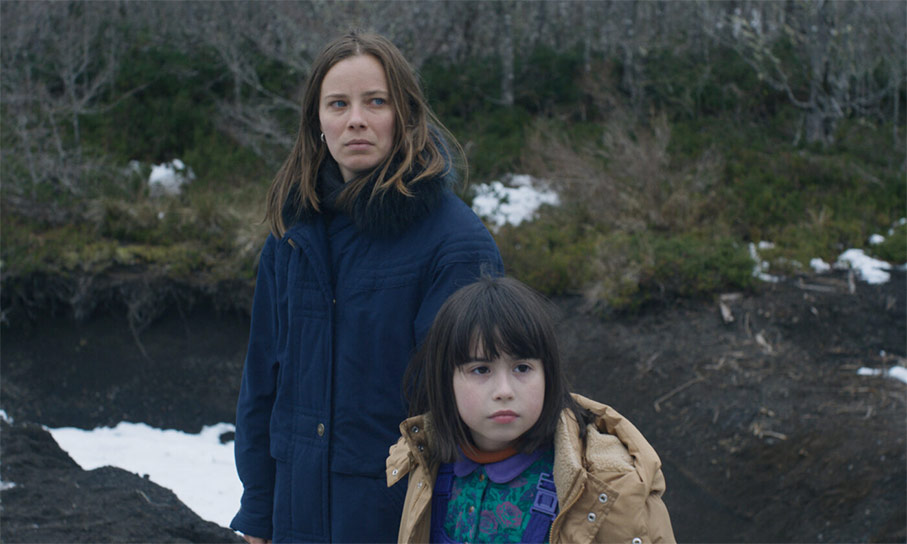
As curious, watchful Inés observes the bewildering adult behaviour around her, she next finds herself drawn to Hannah’s distraught mother, Lina (Saskia Rosendahl). An East German skating champion, she must rely on Inés to be her translator as she embarks on her pained pursuit for answers. Lina is a mother in search of a daughter: Inez is a daughter in search of mother. Although the solid bond between them is based on absence and substitution, it is a sustaining one in the short-term – as surely as was Inés’s friendship with Hannah.
Inés’s relationship with her surrogate mother, produces the film’s solitary moment of humour. Lina approaches a group of schoolgirls and asks them to post missing person fliers at their school. When she sees a discarded flier fluttering on the grass, Lina asks Inés to translate her outburst and tell them that they’re ‘fucking shit’, while they reply that she’s a ‘crazy gringa’.
Hannah’s plight has obvious added resonance for Chileans all too familiar with mysterious disappearances, but Martelli shuns police procedural convention and shrewdly opts, instead, for a phycological investigation into the nature of childhood innocence and the normalisation of grubby adult compromise.
Martelli’s shrewd rejection of neat narrative resolution enables her to disclose a pervasive culture of compromise and silence. By counterbalancing a child’s innocence with adult misbehaviour, she generates an acute tension that intensifies the film’s claustrophobic atmosphere of disquiet and abets her subtle interrogation of a complicity, secrecy and organised forgetting
Inés’s grandmother, Techa (Paulina Urruti), is as determined as her parents to sweep unpleasant facts under the carpet for commercial reasons. Inés was the last to see Hannah alive, witnessed both cousin Sebastián and coach Alexander in the clinches with her, and knows more than she’s capable of grasping. Her grandmother, though, swears her to silence, fearing that scandal might scotch a potentially lucrative deal with visiting Spaniards.
The eerie silence of snow and society persists until the end of the film, and we are left guessing throughout. Only Hannah’s red scarf, revealed by at the advent of spring, affords Inés and the audience the merest glimpse of the truth of what happened to her. Martelli’s laudable refusal of crime drama convention facilitates her forensic investigation into the confused awakening of a perceptive young consciousness. The Meltdown celebrates, with precision and insight, the underestimated perspicacity of the young. Above all though, it calculates the cost to a nation of delaying a reckoning with past trauma,
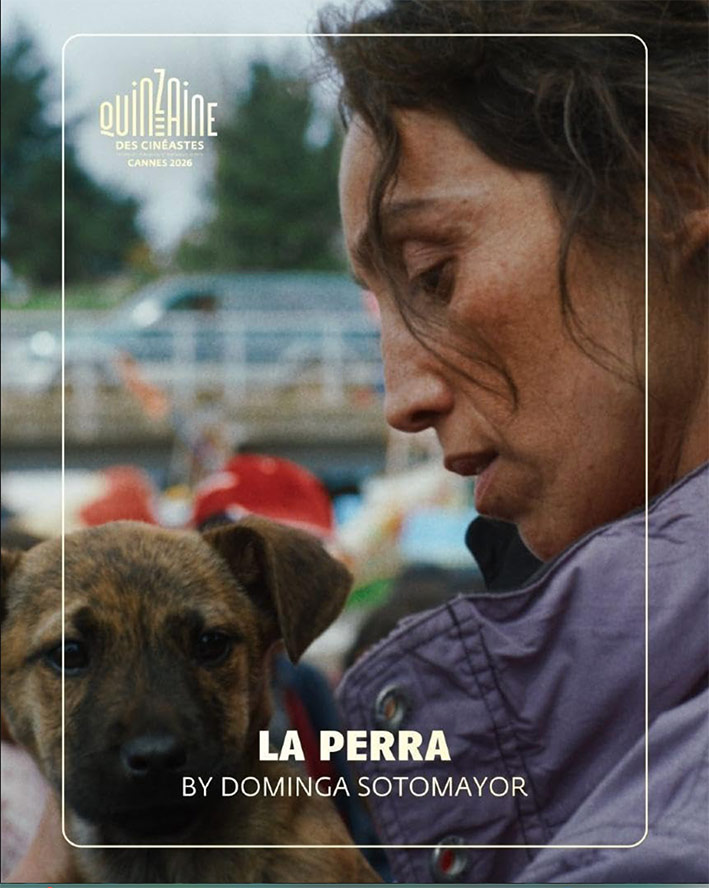
La Perra
Domingo Sotomayor’s equally hypnotic, richly rewarding third feature, La Perra (The Bitch), is another restrained tale of buried trauma, disquiet and disappearances, albeit one of a singular kind. In the film’s opening sequence, the camera skims the surface of the sea – as if scanning it for proof of the dictatorship’s penchant for dropping corpses from helicopters. In fact, a search is underway for a drowning dog which is subsequently hauled to safety.
As in her earlier films Thursday Till Sunday (2012) and Too Late to Die Young (2018), Sotomayor’s focus is on life’s small telling moments, and on the interdependent relationship between people and the landscapes they inhabit. Hers is an intimate, lyrical, deeply personal cinema that operates at one remove, though not aloof from the benighted wider world.
Freely adapted from Columbian author Pilar Quintana’s widely translated 2017 novella of the same name, La Perra is set, in an unspecified period, on the remote, wind-battered island of Santa Maria off Chile’s southern coast. Silvia (Manuela Oyarzún) lives a placid, hermetic life there with her partner Mario (David Gaeta), but she seems troubled. Although her inscrutable angular face gives little away, her eyes seem filled with sadness, she seldom smiles, and tends to keep herself to herself in the ramshackle shack she calls home.
Like others in her close-knit community, Silvia gleans a precarious living from the seaweed and seafood washed up on the island’s rugged, rocky shores. The magnanimous ocean finally offers her not only sustenance but solace in her sorrow: the dog the sea spares from a watery grave leaves a litter on the shore and Silvia, on a whim, scoops up a puppy for herself. She takes it home, names it Yuri after a Mexican singer she’s seen on TV, and comes alive as a bond based on mutual affection and trust, shared space and routines blossoms.
Sotomayor allows to share Sylvia’s new-found delight by filming the vivacious brindled pup as it rolls around, toys with seaweed, barks at horses. Yuri may speak to Sylvia’s maternal instinct and sense of play; she certainly fills a certain vacancy and void in Sylvia, and Mario can only watch on perplexed, perhaps slightly jealous, as their interspecies relationship flourishes.
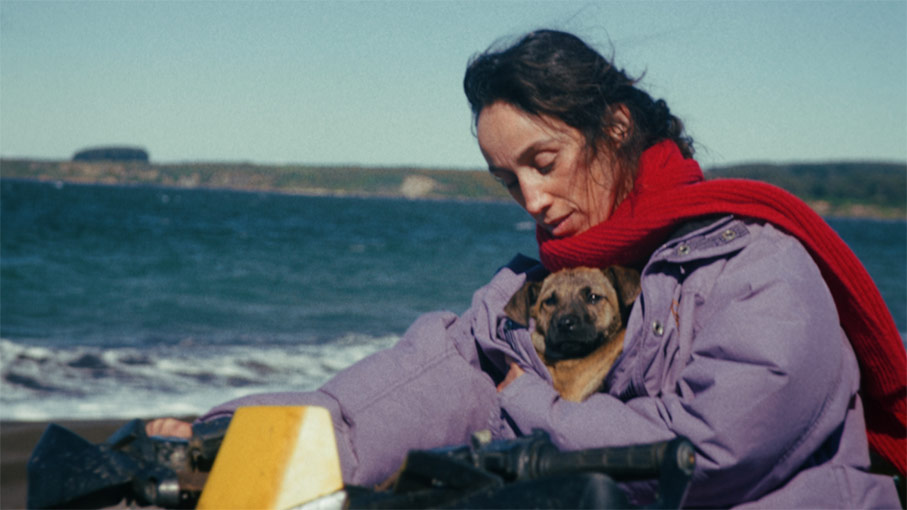
Sylvia supplements her subsistence living harvesting seaweed with a part-time job cleaning an abandoned, half-finished modernist house reminiscent of Casa Malaparte – the setting for Godard’s Le Mepris. It is only there, on her regular round, that Sylvia shows any aggression toward, or impatience with Yuri. In a series of flashbacks, we meet the building’s affluent Brazilian owners and learn that the place is full of memories for her. It is a sacred palace and sanctuary of sorts for Sylvia, and she guards her territory zealously, even against her beloved canine companion.
As the bond between dog and woman deepens Yuri suddenly, unexpectedly vanishes. One New Year’s Eve, presumably spooked by exploding fireworks, she simply disappears. No matter how hard and wide Sylvia and Mario search, Yuri cannot be found. Although she eventually returns, having given birth to a litter of puppies, a bond of trust has been broken and unease remains.
At the film’s midpoint, Sotomayor shifts register in a more extended flashback sequence featuring the same brutalist concrete house. This nominally self-contained section of the film focuses on a traumatic event in Sylvia’s pained past that marked her for life. An earlier disappearance in her youth is, we now realise, the source of the sorrow that we had sensed from the outset.
Throughout The Meltdown, Sotomayor slips fluidly back and forth in time, as if there is something in the island’s elemental, ethereal nature that invalidates conventional distinctions between past and present. She handles flashbacks, once the stuff of avant-garde experiment now of copycat convention, in ways that suggest time operates on parallel planes not linear tracks. Yuri’s disappearance, for instance, inevitably brings Sylvia’s sublimated girlhood trauma bubbling back to the surface and intensifies her preexisting feelings of guilt and grief. Her memories are as real to her as anything in the present.
Sotomayor’s psychological perspicacity lifts the film above the ordinary, but the nuanced script she created with co-writer Inés Bortagaray is not the engine of the film’s cumulative force. Its cumulative power derives primarily from Sotomayor’s rare feeling for landscape and the ways it shapes people and their labour. She productively exploits the island’s rough, raw beauty and the resilient, weather-beaten working people of Santa Maria are as acutely drawn as any character in the film. Sotomayor lingers on the process of harvesting seaweed while Simone D’Arcangelo’s limpid cinematography, expertly renders the variegated blues of sea and sky, the muted greens and browns of seaweed and sand. Finally, La Perra emerges as a compelling and timeless portrait of a people and place as much as a penetrating study of one woman and her dog.
The Meltdown and La Perra would make for an extraordinary double bill, a pairing exemplary both of a vibrant national cinema and a cinema of trauma and memory. Manuela Martelli and Dominga Sotomayor may approach those themes in completely different ways, but they have in common a willingness to take risks, a predilection for the unorthodox that relegates tired narrative convention to the margins, and an appreciation for the part weather and landscape play in human affairs. That their respective films feature a star of the moment (Yuri won the Palme Dog Award at Cannes) and a star of the future (Maya O’Rourke) should help promote that mouthwatering double bill. Whether that happens or not, Chilean cinema will overcome the loss of Patricio Guzmán because its future rests in such extraordinarily capable hands.
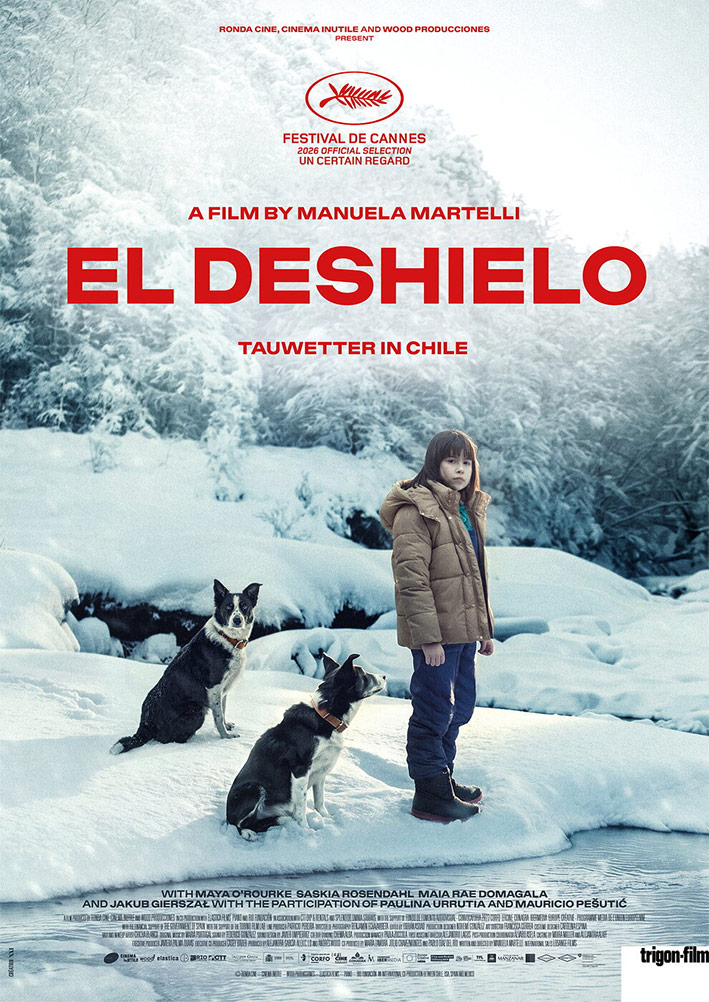
The Meltdown (El deshielo)
Chile / USA /Spain / Mexico 2026 | 108 mins
directed by: Manuela Martelli
written by: Manuela Martelli
cast: Maya O’Rourke, Saskia Rosendahl, Maia Domagala, Jakub Gierszal, Paulina Urrutia
LFF screening date: 13 October 2026
La perra (The Bitch)
Chile / Brazil 2026 | 112 mins
directed by: Dominga Sotomayor
written by: Inés Bortagaray; Pilar Quintana (story)
cast: Selton Mello, Paula Luchsinger, Giannina Fruttero, Paula Dinamarca
LFF screening date: 7 October 2026