
Disguise the limit
Being a film music aficionado can sometimes introduce you to some intriguing, never before heard of films. On Camus’ watchlist for decades was an oddly titled 1963 curio, scored by Jerry Goldsmith, called THE LIST OF ADRIAN MESSENGER directed by John Huston. Camus finally caught up with it… Release the hounds!
Note: A US Region 1 DVD and Blu-ray are the only media on which this film is commercially available. There are no extras listed on either format. I’m reviewing it from a very old recording so this review contains no specifics about picture or sound quality. It’s not exactly prolific on streaming services either. Still, it’s a real curio for its time and well worth a look.
“Of all Huston’s films, The List of Adrian Messenger is the one that deals most literally with people in disguise. George, who describes himself as unexcused evil, hides behind a romantic or heroic mask that falls away when he is forced to face the detective, who operates very much like Freud. The detective penetrates the masks, revealing the evil, and the evil is destroyed.”
filmreference.com1
If you’re wondering what Sigmund Freud is doing in that quote, Freud or Freud: The Secret Passion (also scored by Jerry Goldsmith, three cues of which were re-purposed for Alien, much to Jerry’s chagrin) was the film Huston shot right before Adrian Messenger. That “evil is revealed to be destroyed” is hardly a spoiler. But this film is very interesting for all sorts of unusual reasons. And it is without doubt one of the oddest American films to come out of mainstream Hollywood. In 1963, we are six years away from Dennis Hopper’s Easy Rider upturning all that was supposedly common knowledge about US audiences’ movie tastes in 1969. But in the early sixties. the star system was still a reliable yardstick as insurance against failure so how about this for a line up… (in alphabetical order), Tony Curtis, Kirk Douglas, Burt Lancaster, Robert Mitchum, George C. Scott and Frank Sinatra. In 1963, all of these actors were on fire. Any one of them could have ‘opened’ a movie by dint of their star wattage. But the casting, while impressive and no doubt facilitated by director John Huston’s reputation, is about as disingenuous as Hollywood gets…
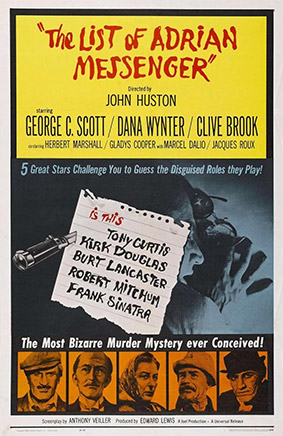
Yes, four of the six are in the film, three of them supposedly made up to hide their chief asset, their recognisability. One of them had a stand-in to endure the hours in the make-up chair to ease his particular burden of being the most made up actor in terms of the number of different, disguised characters he played. But two of the six famous faces make a cameo appearance only after ‘The End’ is announced showing the stripping off of the make-up to reveal the famous faces beneath. These two do not appear in the film itself as their heavily made up roles are played by stand-ins in the actual movie. See what I mean by disingenuous? Kudos to the stars who were slathered in prosthetics who actually played their characters on screen. So why the need for such disguises? In truth, the movie only required one character to be made up to play a series of roles, each one the same murderer keeping his true identity secret. But the gimmick was clearly created as a draw for the audience to see if they could recognise the famous faces hidden under the masks. It’s on the poster… “Five great stars challenge you to guess the disguised roles they play!” In one of the trailers, Burt Lancaster says “I’ll make you a bet that you’ll guess wrong…” Well, that game was rigged. Good luck in trying to figure out who the female fox hunt protester or the gypsy character were because they were played by stand-ins as mentioned. As I said, odd and somewhat underhand.
So, we are in England in the early 60s and we join the upper class strata of the UK, all large, ornate houses, universally male dominated and with a thirst for tradition that is tirelessly promoted in the precocious and frankly obnoxious next generation. If you wanted to argue against white privilege, this film does most of the opposition’s heavy lifting. Know thy place and if you think it’s barbaric to hunt down a fox with forty horses and as many dogs then “…you can get off my land!” “Men were born to hunt and foxes, to be hunted,” is a paraphrase of one of the more distasteful lines in the film. But that said, we’ve really got to edge back 63 years to understand and appreciate the film’s context however dated. Ex-MI5 operative, Anthony Gethryn is asked by a friend, writer Adrian Messenger, to check out a list of seemingly unconnected names and addresses. No clue is given as to why. Messenger is wary thinking that his good friend will make the connections necessary to either dismiss his fears or confirm them.
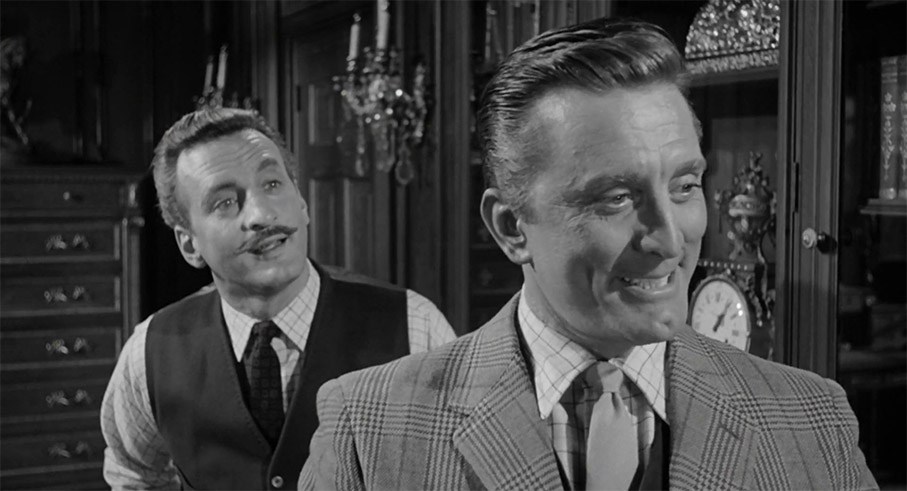
After a thoughtful Adrian Messenger allows a hugely suspicious, heavily made up Reverend to share his weight allowance for a flight, we are immediately wary. We know the Reverend is up to no good because prosthetic make up in the early 60s was as inconspicuous as a tarantula on a slice of angel cake (thank you Raymond Chandler). But perhaps it fooled people long enough to be effective at the time. The Reverend divests his make up revealing himself to be the rotter George Brougham (pronounced ‘Broom’). One mid-air explosion later (a little over the top in the murder game, methinks) and Messenger is dying at sea, a wooden box keeping him afloat barely alive. He regales the only other survivor with all he knows about his list and his suspicions. As luck would have it, the other survivor, Le Borg, is best friends with Gethryn (a convenient coincidence that you shouldn’t think too much about) and the two close friends attempt to unravel the significance of the men on the list of Adrian Messenger…
The mystery at the heart of the film is more than enough to sustain its modest running time and the actors all look like (even in heavy make-up) that they are enjoying themselves. The made-up stars, I’m afraid, look so obviously made-up that it’s a fly of a problem you have to keep swatting off your jam to really enjoy the film. In some ways, these faces reminded me of the deliberately over-the-top prostheses of Warren Beatty’s Dick Tracy. 1990’s Make-up realism after 27 years had considerably improved but in Dick Tracy there was no attempt at realism (the exaggeration of the character’s faces was sort of the point). You knew you were watching men in make-up masks but the suspension of disbelief or lack thereof never derailed the film.
It’s nice to see George C. Scott in such a playful performance and in scenes with his old war buddy, La Borg (“He has engaged La Borg!”) delightfully played by Jacques Roux, there’s a real chemistry and a real friendship very hard to one hundred per cent fake for the screen. Not known for his bad guy roles, Kirk Douglas plays the ambitious, social climbing murderer with some relish. After ingratiating himself into his own entitled family as a distant cousin, he zeroes in on the only eligible female of the piece, Lady Jocelyn Bruttenholm, a widower who is encouraged to find a man by La Borg, who’s all French, promoting romance and happiness for all. Lady Jocelyn is played by one of the very few, immediately striking actresses of her generation, Dana Wynter. I was struck by her presence and beauty in a film made seven years earlier, a stone cold science-fiction classic and one of my favourites in the genre, the original 1956 Invasion of the Body Snatchers. She was dazzlingly radiant as Becky Driscoll and if I remember correctly, that film is full of quite racy dialogue (for the time) between her and Miles Bennell played by Kevin McCarthy. If it’s not too fawning to quote my own words about this stunning actress from my review of Invasion of the Body Snatchers, “I can never forget the dress we see her in at the start of the film. It’s a patterned strapless number with a line of what looks like a silk explosion covering her upper chest. She looks like a gingham Guinness in a curvy cocktail glass and I have never forgotten it. Still Wynters run deep…” The three stars that actually appear in the film under layers of make-up are Robert Mitchum, still recognisably Mitchumesque even with a lazy half-covered left eye. The organ grinder is certainly not instantly recognisable as Tony Curtis and the unmistakable Kirk Douglas manages to maintain his own identity despite his three or four disguises (some of which were played by a stand-in as previously mentioned). His famous dimple was probably the first thing the make-up covered.
I have known people who have participated in fox hunting with horses and most seemed to have treated it as a way to channel a pure equine exhilaration, taking personal risks caught up in the excitement. The quarry was simply the catalyst for the chase and no one I knew ever caught a fox or actually wanted to. This is by no means an excuse for people who really find a traditional and needlessly gory satisfaction in having a defenceless animal ripped to shreds as ‘sport’. Regardless of what you feel about hunting (by all accounts Huston was keen, especially big game hunting), the wide open country sequences of horses and dogs after their quarry is very well shot by Joe MacDonald and well edited by Terry O. Morse and Hugh S. Fowler. Back at the stables, there is one extraordinary shot when the gypsy character gives the young boy Derek (Tony Huston… the director’s son?) a gypsy-trained horse named of all things, ‘Avatar’ and in a sweeping movement, the boy mounts the beast bare-back and rides it straight at a metal gate and both rider and horse almost clear it. It’s a whirlwind of a shot and all I can think of was that any son of John Huston is going to be brought up to be fearless and that the gate had to be made of balsa wood as a hoof dislodges an ornamental spear as it flies over.
Composer Jerry Goldsmith also strongly contributes to the drama of the fox hunt complete with horns, the signature instrument of the redcoats with very strange ideas about what constitutes fun. The cue Beagles and Fox drives the action forward and it’s the highlight of the subsequent 2014 re-release CD and of the whole film. The main theme deftly sets up audience expectations that the film is going to be more light than dramatic, more tongue in cheek than darkly violent despite its murderous narrative. And there’s also a foreshadowing of his violin-led playful and terrifying score for George Miller’s segment of the ill-fated Twilight Zone movie, Nightmare at 20,000 Feet with a goggle-eyed John Lithgow witnessing a gremlin’s claws tearing at the plane’s fuselage. Trivia fans please note that the original Twilight Zone TV episode directed by Richard Donner starring William Shatner aired the same year as Messenger with stock music originally composed by Jerry’s friend and sometime mentor, Bernard Herrmann. Spooky… “Du-du, du-du…”
On that supernatural note, I’ll wrap up underlining how odd this film is and you’ll have to make some effort to hunt it out.
The List of Adrian Messenger
UK / US 2025 | 125 mins
directed by: Chloé Zhao
written by: Chloé Zhao, Maggie O’Farrell; from the novel by Maggie O’Farrell
cast: Jessie Buckley, Paul Mescal, Zac Wishart, James Lintern, Joe Alwyn, Justine Mitchell
UK distributor: Universal Pictures Int (UK)
UK release date: 9 January 2026