
I always get what I want
Don Johnson stars as a drifter who wanders into a small Texas town and a whole heap of trouble in director and co-screenwriter Dennis Hopper’s steamy 1990 neo-noir, THE HOT SPOT. Genre fan Slarek catches up with a film that previously slipped him by and falls for a work that dares to take its time tying the fate of its lead character in Gordian knots.
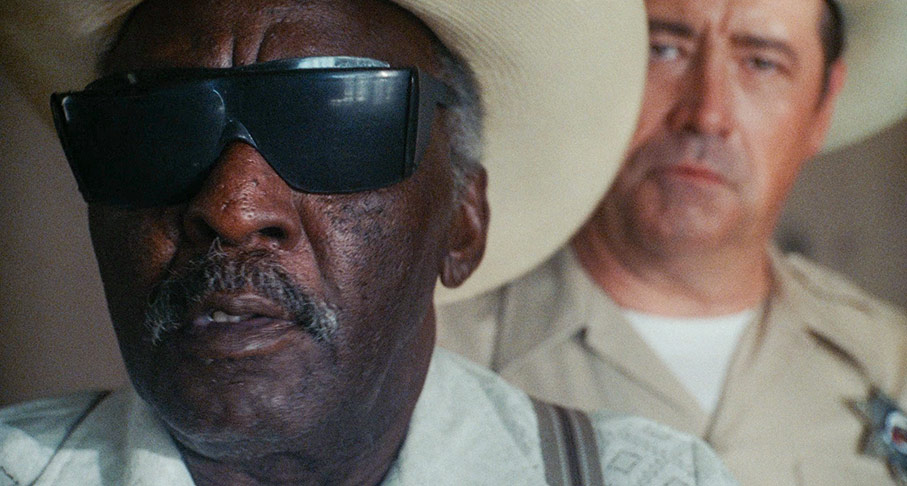
A man wanders into a small Texas town on the edge of the desert on a sweltering hot summer’s day and his eye is drawn to an attractive girl out walking her dog. What reads like the opening line of a corny old joke is instead our introduction to Harry Madox (Don Johnson), an emotionally hollowed-out drifter whose background we never learn about and whose purpose in coming to this location remains opaque. The girl with the dog is 18-year-old Gloria Harper (Jennifer Connelly), who works as an accountant for a car dealership owned and run by George Harshaw (Jerry Hardin, probably now best known for playing Deep Throat in The X Files). Harry casually follows Gloria onto the dealership lot, where he sees George trying and failing to sell a car to a potential customer. Having passed a “salesman wanted” sign on the way in, Harry then approaches the customer and smooth-talks him into buying a different vehicle. The bemused George wonders what the hell is going on, but in the very next scene Harry is installed as the new salesman for whom George has been searching and is refusing to do work that he regards as beneath him. This irritates the hell out of George but doesn’t seem to bother Harry’s easy-going fellow salesman, Lon Gulick (Charles Martin Smith). Harry even dictates when he will take his lunch break, which he uses to drive to the town bank with the aim of opening an account, passing a fire that has broken out at a nearby burger joint on the way. When he enters the bank, he initially finds it deserted but eventually locates the manager, Julian Ward (played by David Lynch’s muse, Jack Nance), who reveals that the rest of his staff are volunteer fireman attending to the burger joint blaze. Simply from the way Harry reacts when he first enters the seemingly empty bank, his edginess when a blind man known locally as Uncle Mort (John Hawker) then arrives looking for Julian, and how he seems to be quietly casing the building and its surroundings when he walks back outside into the street, we just know that he has decided to rob the place and is already planning how he will do it. The fact that too-friendly Julian, in the course of casually chatting with Harry, reveals that they haven’t yet got around to installing the security cameras sitting on a counter only serves to underscore this impression.
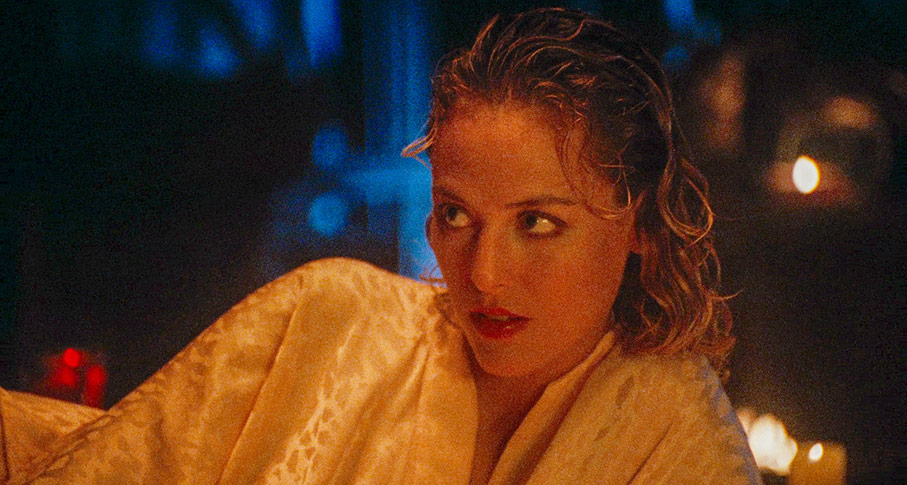
Harry then heads back to work, where George tells him to help Lon wash the cars on the lot, an order Harry causally refuses, further angering George as he departs for his own delayed lunch break. Once he’s gone, Harry takes of his coat and mucks in with Lon anyway, only for trouble to then roll up in a bright pink convertible in the shape of George’s glamorous and amorous wife Dolly (Virginia Madsen), who, after making sure that her husband has gone to lunch, takes an instant interest in the muscular young man stripped down to his vest on the forecourt. She asks him to help her move some goods into an apartment elsewhere in town and does so in such a way that you’d have to be anaesthetised not to realise that it was loaded with sexual suggestion. Although clearly reluctant, Harry agrees to help, and while Dolly doesn’t directly come on to him during the trip, she certainly drops her share of innuendo-tinged hints, and clearly has no intention of letting her attraction to Harry just fall by the wayside. Harry, meanwhile, finds himself increasingly drawn to the more innocent Gloria, who appears to be under the thumb of local sleazeball Frank Sutton (William Sadler), whom she mysteriously covers for when she and Harry are sent to his place by George to either repossess his car or collect on his long overdue payments. Harry’s attraction to Gloria doesn’t stop him from kissing Gloria when he drops into her house at her request to return a hat left at the showroom by George, or from accepting her not so subtle invitation to visit her that night when George is out of town. The two end up in bed, which Dolly takes as the opening cannonade of a passionate affair but which the cold-hearted Harry dismisses as a one-night stand, only to then be seduced by Dolly a second time when he wanders onto showroom lot later that night. By then, he has already made his preparations to rob the bank, and to ensure that it will once again be empty of staff the following day, he engineers a fire in a nearby abandoned building that calls on their services as volunteer firefighters. He then sneaks into the bank, lures Julian into the bathroom, throws a blanket over his head and ties him up. He quickly cleans the place out, though almost gets caught while doing so when Uncle Mort once again wanders into the building in search of its currently incapacitated manager.
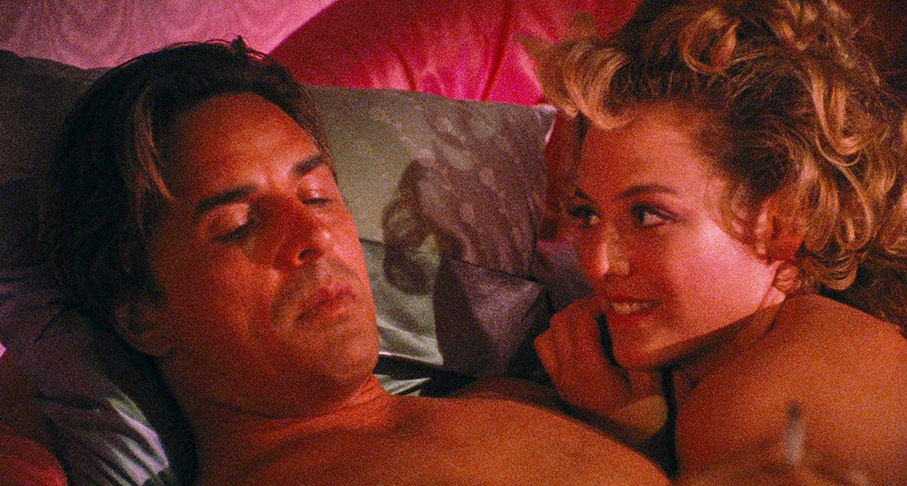
By this point, we’re less than an hour into a film that still has 73 minutes left to run, so the very idea that Harry is going to just pocket the cash and skip merrily on his way is clearly off the cards. You’d also have to be new to the genre not to have twigged by now that we’re deep into neo-noir territory, particularly given the manner in which all of the above unfolds on screen. Opening on semi-abstract shots of shimmering sand dunes that point to both the meteorological temperature in which events will unfold and the emotional and sexual heat that will envelop the two central characters, it aligns us from the start with a protagonist who, whilst not particularly likeable, is nonetheless intriguing from the off. Emotionally hollow, arrogant, amoral, and dismissive of authority, he arrives in the town with no obvious purpose and not a whisper of a backstory – it’s almost as if he was born in the surrounding desert as a grown man and just drove to the nearest peopled location to investigate the opportunities it may offer. This becomes evident not just in his quickly made decision to rob the bank but also in the two sexual liaisons he has with Dolly, to which he commits physically but not emotionally, being not remotely interested in the affair that Dolly now believes is under way and fully intends to keep on the boil. It’s this relationship that really earns the film its noir credentials, from the suggestiveness of their early interactions to the hold that the self-confidently determined Dolly is able to exert on the increasingly reluctant Harry. I should say here that if you are somehow completely new to noir, now might be a good time to skip to the end of this review, as this is a genre in which some character arcs have a degree of inevitability, and any discussion of them would by regarded by noir novices as a major spoiler. For those who know their noir, there’s a pall hanging over Harry almost from the moment that we first meet him. one that further darkens once he gives in to Gloria’s advances, then turns tornado-cloud black when she reveals that George has already suffered two heart attacks and needs an operation, and that it wouldn’t take much to trigger another, possibly fatal cardiac event. By this point, Harry’s slowly developing romance with Gloria appears to be revealing a gentler, more caring side of a man who had previously seemed devoid of emotion, offering a glimmer of light to the dark world that he has chosen to inhabit, one that Dolly looks set to firmly extinguish.
From this point on it seems inevitable that Harry is going to end up trapped like a fly in Dolly’s web, and that her confident assertion that “I always get what I want” was no idle boast. It’s because of this that we end up siding with Harry, despite the fact that he’s not the most likeable of individuals and to some degree asks for much of the trouble that he lands in. He seems to have a low opinion of just about everyone he meets, plainly visible in his “can’t be arsed” attitude to a job that he has only just landed and his refusal to engage with anyone on more than a superficial level, and then only when he wants something from them. When it comes to women, his only real interest is initially how quickly he can bed them, which is doubtless why he forcefully kisses the startled Gloria the first time they are alone together, and why he does likewise with Dolly when he first visits her at her house. The difference between these encounters is that he later apologises to Gloria for this uninvited behaviour, whereas with Dolly the kiss is the culmination of some not-so-subtle encouragement for him to do so on her part. Having led him on, however, the controlling Dolly then breaks away claiming concern over what her spying neighbour might think and presumably say to George. She then heads upstairs to bed, pausing halfway to look suggestively down at Harry and tell him, in a manner that screams innuendo, that he’s a “bad, bad boy.” It’s thus no surprise that he returns there that very evening to effectively finish what he/she has started.
As is made clear in the special features, The Hot Spot had a lengthy gestation period. It began as an acclaimed 1953 novel with the theoretically plot-spoiling title of Hell Hath No Fury by Charles Williams, who developed it into a screenplay with Robert Mitchum in mind to play the lead. This version never saw the light of day, and in the 1980s was revived as The Hot Spot with director Mike Figgis at the helm. At the behest of the producers, who weren’t fans of the Williams screenplay, Figgis substantially rewrote the film and was all set to go with Sam Shepard, Uma Thurman and Anne Archer in the lead roles when a disagreement between Shepard at the producers led to him leaving the project and it quickly fell apart, only to later be revived with Dennis Hopper in the director’s chair. An enthusiast for noir, Hopper went back to Williams’ original screenplay and novel and rewrote the film again with the aim of being true to the spirit of both.
This all came at an interesting time for Hopper, who after many years as a supporting player, scored a game-changing hit with his low-budget directorial debut, Easy Rider, only to then confound audiences, and much of the critical establishment, with his deeply indulgent but fascinating follow-up feature, The Last Movie. By then, Hopper’s cocaine and alcohol fuelled volatility was making it difficult for him to find gainful employment, at least on home turf, and in 1983 he entered a drug rehabilitation program, after which he effectively reinvented himself both as an actor and as a director. His terrifying performance as Frank Booth in David Lynch’s 1986 masterpiece Blue Velvet put him firmly back on the map, and the same year he garnered an Oscar nomination for his role as alcoholic basketball coach Wilbur “Shooter” Flatch in director David Anspaugh’s Hoosiers, which I seem to remember was released in the UK as Best Shot. Two years later he won further acclaim for his direction of the 1988 Colors, in which Robert Duvall and Sean Penn played police patrolmen embroiled in the very real problem of Los Angeles gang violence. He followed this with the erotic action thriller Catchfire, in which he starred alongside Jodie Foster, Dean Stockwell, Vincent Price, John Turturro and Fred Ward (seriously, how is that for a cast?), but after the film was taken out of his hands by the producers and re-edited without his involvement, he had his directorial credit changed to Alan Smithee, the go-to pseudonym employed by directors who wish to distance themselves a project they have lost control of.
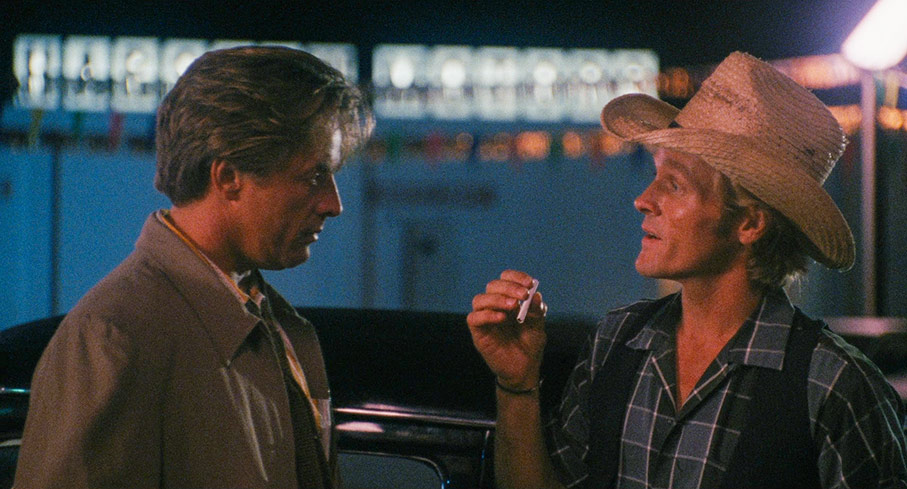
The Hot Spot came at a theoretically perfect time for Hopper, being a project that he felt an affinity for and that he was able shape how he wanted and one on which he appears to have had final cut. It also feels like a confirmation that the wild, drug-addled Hopper of The Last Movie was a thing of the past and has evolved into a consummate professional who could deliver a commercial project on time and on budget. The resulting film was warmly (although, admittedly, in some cases luke-warmly) received by critics, but was another victim of ever-changing audience tastes and was not the box-office hit that was hoped for. Perhaps as a result, Hopper only directed one more feature, the 1994 comedy Chasers, which is not the film any fan of this man’s work would want him to be remembered for. Which is a real shame, as there’s much to admire in the way Hopper elects to tell his story here. What really struck me on my first viewing was his risky decision not to vary the pace significantly throughout, to keep things – no pun on the title intended – simmering without letting them boil over into fast-paced action or explosive set-pieces. Even a physically confrontational scene in which Harry visits Frank one evening to beat some compliance into him doesn’t disrupt the even pace, with only a later even more violent sequence cranking up the intensity to any significant degree. As a storytelling strategy, it really shouldn’t work and theoretically should even feel monotonous, and for some it doubtless will. Yet for me, Hopper’s refusal to hurry things along and to allow events to unfold at a steady pace without sensation or histrionics really pays dividends, giving each twist of the tale the time it needs to sink in and crawl under your skin, making willing viewers increasingly fearful for the fate on an individual who on paper does little to deserve our sympathy but whom I found myself quietly rooting for nonetheless.
The cast is a key draw here, and as actor of considerable experience himself, Hopper clearly knows how to get the best from his well-chosen players. Don Johnson must have seemed risky choice to play Harry, having just come off five years as undercover detective Sonny Crockett on the TV series Miami Vice, but for my money he absolutely nails the role, having the looks and physicality to make him a most believable target for Dolly’s lust, but also convincing completely as a man so emotionally empty that he has nothing but contempt for the world in which he is forced to eke an existence. I’m trying to avoid spoilers (hop to the next sentence to play it safe), but there’s a moment in the final scene involving a kiss that effectively seals his fate (at least for the immediate future) where his reaction – a mix of dread, despair, anger and disbelieving amusement – where Johnson delivers what may be the best bit of acting in a film whose performances are one of its principal draws. Virginia Madsen makes for a gloriously seductive femme fatale, her self-confidence, southern drawl and openly displayed sensuality never pushed to the point where it slips into caricature, which is nicely balanced by Jennifer Connelly’s low-key portrayal of the more innocent Gloria. William Sadler walks a fine line as the unpleasant Frank Sutton, capturing his smiling sleazeball confidence with an almost carefree casualness that somehow makes him even more dislikable, especially as he seems to find a way to bounce back and turn situations to his advantage every time a move is made against him. Indeed, the only actor who comes close to pushing the envelope just a tad is Jack Nance as the town’s friendly and too casual bank manager, Julian Ward, but Nance is such a likeable screen presence that I found myself buying into his portrayal nonetheless. Oh, and if the town sheriff who arrests and then is forced to release Harry for robbing the bank seems familiar, that’s insanely busy (and at 85, still busy) character actor Barry Corbin, so memorable as the disbelieving General Beringer in John Badham’s 1983 WarGames, and as the ageing Uncle Ellis in the Coen brothers’ 2007 gem No Country For Old Men.
Hopper is aided considerably in realising his vision by Swiss cinematographer Ueli Steiger, whose late work in Hollywood included Hopper’s aforementioned final feature, Chasers, comedy hit sequel Austin Powers: The Spy Who Shagged Me (1999), and Roland Emmerich’s big-budget disaster movie The Day After Tomorrow (2004). Steiger does a great job here in evoking the sizzling temperature implied by the title without resorting to overly expressive filtration or shooting everything through a heat haze, despite how easy this would have been to do on the apparently sweltering Texas location. There is an earthy warmth to the colour palette in the daytime scenes, but some of the colours really pop at night, whether it be the exterior blues or the vibrant amber and orange light inside the Harshaw house. Another key contributor is composer Jack Nitzsche (he of Performance, One Flew Over the Cuckoo’s Nest, Blue Collar and many more), whose wonderfully but judiciously rationed bluesy score brings a mood and locational richness to the film, a task in which he was aided by the likes of Miles Davis and John Lee Hooker, who were apparently given the freedom to improvise to some of the on-screen action. I’ll also give a shout to production designer Cary White and costume designer Mary Kay Stolz, who dress the actors and the locations in a manner that makes it feel like this 1990 Texas town has slipped back into the fifties, which, combined with the retro look of Steiger’s colour palette (and perhaps choice of film stock?), gives the whole enterprise an ambiguously timeless feel.
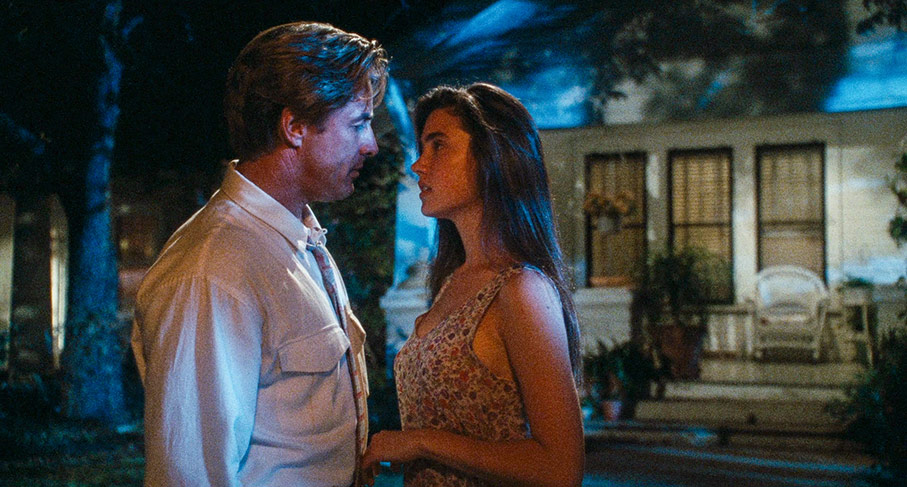
Perhaps it’s the innate pessimist in me, but I am a bit of a sucker for noir and neo-noir cinema, and while The Hot Spot may not be the primo standard-bearer for the latter (we can argue later about what, if anything, is), it ticks all the right genre boxes and does so with style and a degree of restraint that I especially appreciate at a time when overstatement is too often the norm. A well-crafted script gives a fine cast plenty to work with, it looks and sounds great, and Hopper directs with an assurance and understanding of mood and pace that makes it all the more painful that he never got to make more movies in a similar vein. Its a film that I missed on its initial cinema and any home video releases it may have previously had, but one that I’ve already found myself being drawn back to and can see myself revisiting on a regular basis, as much for the authentically noir-tinged dialogue and its delivery as for the story and its handling. There are plenty of very quotable examples, especially in the early exchanges between Harry and Dolly, but one of my favourites comes later when Harry pays a visit to Frank with the aim of putting him straight. “So you’re a tough guy, huh?” Frank mockingly asks him, to which Harry cooly replies, “No, you’re the tough guy. I’m worse.”
sound and vision
The Hot Spot has been released by Radiance as a dual format UHD and Blu-ray package, with the film on both discs but the special features confined to the Blu-ray, freeing up the entire UHD for the 4K transfer. Both discs are sourced from a 4K restoration from the original negative, presented in Dolby Vision HDR and overseen and approved by cinematographer Ueli Steiger. In one respect, analysing the UHD is tricky, as I’ve become increasingly convinced of late that I’m not the best person to comment on one aspect of 4K releases, being of the belief that my 55” OLED screen just isn’t large enough to clearly display the differences in image sharpness between high-quality Blu-ray and UHD transfers, which I know becomes more pronounced the bigger your screen gets. When I can afford to upgrade, I will make the jump to something larger, despite my partner’s conviction that my current TV is as large as such screens needs to be. In other respects, however, my carefully calibrated screen is able to do full justice to well encoded transfers on both formats, and the Blu-ray and UHD disc both meet that qualification here. The image is crisp whilst retaining that film-like feel and photochemical grain that even the best HD cameras still haven’t can’t quite nail, and there’s a richness to the most intense colours and a depth to the shadow detail that is especially attractive on the UHD, thanks in part to judicious use of HDR. Even on my screen I can see that the fine detail is more clearly defined on the 4K transfer, and the image on both discs is close to spotless with almost no visible signs of any previous wear (I think I spotted a single small scratch that lasted barely a frame, but that’s about it). Short version, it looks really good on Blu-ray and great on UHD. (Note: due to technical restrictions, the grabs here are from the Blu-ray.)
The audio track on both discs is DTS-HD Master Audio 2.0 stereo, and this is also in excellent shape, with a clear presentation of a very good sound mix that boasts a good tonal range, clearly audible dialogue throughout and particularly pleasing reproduction of Jack Nitzsche’s bluesy score. There is no trace of any former wear or damage.
Optional English subtitles for the hearing impaired are included.
special features
Dennis Hopper (4:35)
Shot in 1991 for the French TV series Rapido (which I’m sure used to air on UK TV at the time), an energetic Dennis Hopper is filmed walking around Roissy airport, talking as he does so about making The Hot Spot (after a year off editing, he tells us, he can’t imagine anyone else but Don Johnson playing the lead), working with Jack Nitzsche and legendary musicians Miles Davis and John Lee Hooker on the score, the forward-looking aspect of his 1988 Colors, and how much better things are going for him now that he’s been clean and sober for seven years.
Virginia Madsen (7:02)
A 2021 interview, conducted for Kino Lorber, with The Hot Spot’s female lead, Virginia Madsen, who remembers the shoot as a tough one due to the blazing Texas heat, but recalls that Dennis Hooper wore a suit and tie every day and somehow always looked cool. She reveals that she found her way into her character via a single line written by Hopper about her character’s first appearance when he described her as “a ripe peach on the verge of rotting,” to which Madsen responds deliciously, “Oh, how sweet to bite into that.” She talks about Hopper’s approach and how this made her feel closer to him, and how she needed his protection to be more daring. She also admits to not liking her performance but being told by Hopper that she’d watch it again in about ten years and realise how good she was in the film, which happily proved to be the case.
William Sadler (6:24)
Also recorded for Kino Lorber in 2021, this interview with favourite character actor William Sadler was conducted remotely due to the then still active restrictions caused by the Covid-19 pandemic. He recalls auditioning at Dennis Hopper’s house in Venice, California – a corrugated steel construction whose living room you could drive your car right into – and being told by him to keep his performance real whilst simultaneously going as big as he liked and learning to “dance with the camera.” He talks about his character, shooting long takes, and the real abandoned shack that served as his house. He also illustrates how green he was by admitting that it was his suggestion that his character drink an entire bottle of Coca Cola in one go and failing to take on board that they might have to do another five takes.
Nick Dawson (20:24)
An interview with Nick Dawson, the editor of Dennis Hopper: Interviews, conducted exclusively for Radiance in January 2023, which provides some welcome background detail on the film and its long journey from Charles Williams’ novel through two different directors and three screenplays to the version that finally hit the screen. He reads from an email that he received from original director, Mike Figgis, that gives some insight into how his version fell apart, and takes a brief trip through Hopper’s sometimes turbulent career, from his falling out with Henry Hathaway, through his years of abuse and his post-addiction re-invention with Colors (1988), and how his love of noir drew him to this project. He contrasts the Americana of The Hot Spot with the one presented by David Lynch in Blue Velvet (which, of course, gave Hopper one of his greatest roles) and Wild at Heart, notes the ambiguity of the film’s time period, confirms that Hopper wore a suit and tie on set each day, and reveals that he referred to the film as ‘Last Tango in Texas’. He also suggests that, in terms of organisation, the tightly planned and organised The Hot Spot was the complete opposite of the chaotic shoot of The Last Movie (1971).
Duane Świerczyński (22:12)
Also filmed exclusively for Radiance, this time in February 2023, this interview with writer and crime fiction expert, Duane Świerczyński, focuses on author Charles Williams and what Świerczyński describes as his first masterpiece, Hell Hath No Fury, as well as how Hopper’s film adaptation stacks up as a film adaptation. Pretty damned well, as it happens, with Świerczyński wishing that Williams had lived to see The Hot Spot, because he believes that it captures the essence of Williams’ writing like no other film. He charts the development of the movie, including the version almost made by Mike Figgis, and although he does point out the differences between Hopper’s film and Williams’ source novel, he is impressed by how faithful an adaptation it generally is, and even credits Jack Nitzsche’s score as giving the film something the novel could never have.
Trailer (1:50)
A solidly edited trailer that technically contains spoilers that are cut into the flow rapidly enough not to register strongly enough to count as spoilers after all. It ends unambiguously when it comes to how we’re expected to classify the film with the narrator stating, “The Hot Spot. A film noir for the 90s.” You don’t say.
Also included with the release disc is a Limited Edition Booklet featuring writing by critics Elena Lazic on the film, Leslie Byron Pitt on the erotic thriller genre and the film’s place within it, and an archival piece on the film featuring an interview with Hopper by RJ Smith, but this was not available for review.
final thoughts
It won’t click for some, and others may regard it as little more than a middling neo-noir, but for me it worked a treat and ranks as one of Hopper’s strongest achievements as a director, which I have little doubt was due in no small part to the fact that he was able to complete it without the studio post-production meddling that plagued Catchfire. I really enjoyed this film, and its presentation on Radiance’s UHD/Blu-ray combo is absolutely top notch. Warmly recommended.
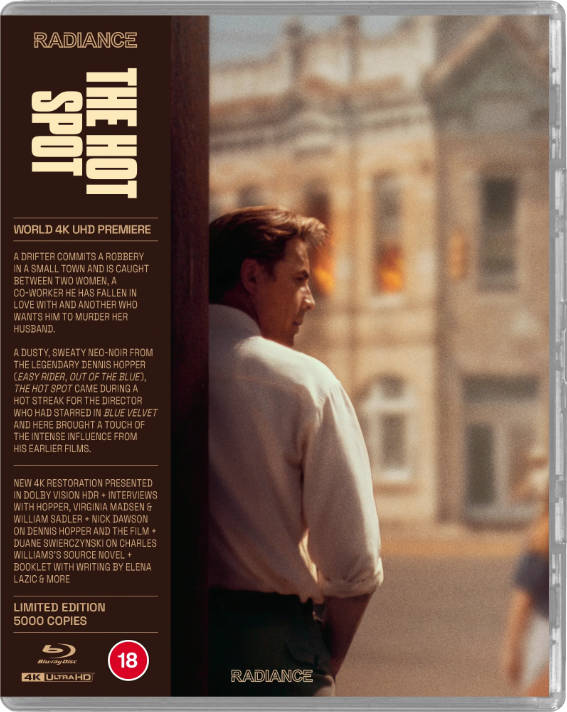
The Hot Spot
USA 1990 | 130 mins
directed by: Dennis Hopper
written by: Nona Tyson, Charles Williams, Dennis Hopper (uncredited); from the novel Hell Hath No Fury by Charles Williams
cast: Don Johnson, Virginia Madsen, Jennifer Connelly, Debra Cole, Jerry Hardin, William Sadler, Charles Martin Smith, Barry Corbin, Leon Rippy, Jack Nance, Virgil Frye
distributor: Radiance
release date: 17 August 2026