
Dead Kids
Indicator’s series of Ozploitation films released on Blu-ray and UHD reaches 1981’s DEAD KIDS (also known as Strange Behavior). Review by Gary Couzens.
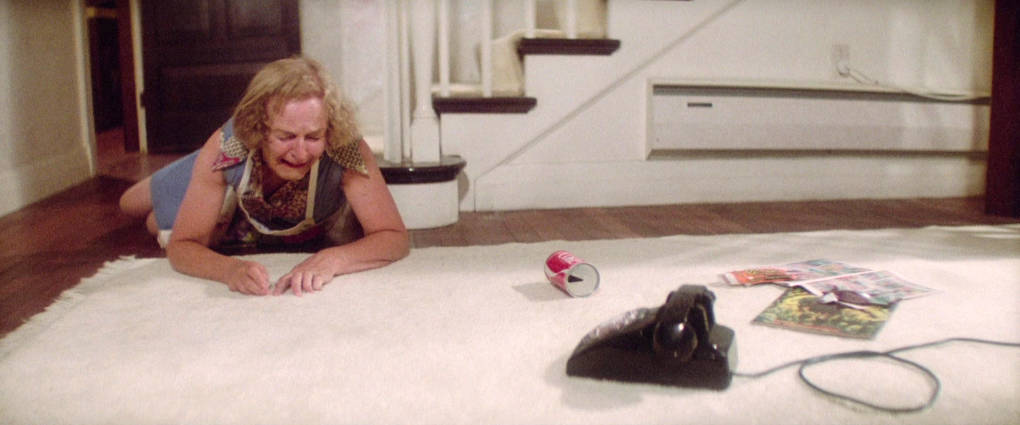
In the small town of Galesburg, Illinois, Bryan Morgan (Bill Condon), the son of the mayor, is murdered in his own home. Policeman John Brady (Michael Murphy) begins to investigate. Meanwhile, John’s son Pete (Dan Shor) sits in on a college lecture given by Professor Gwen Parkinson (Fiona Lewis) which incorporates footage of the late Dr Le Sange. To earn some money, Pete volunteers to be one of Parkinson’s test subjects in order to help pay for his college education…
(A note on the title. The film was released as Dead Kids in Australia and in the UK, but as Strange Behavior in the US, with the American spelling. Unless otherwise indicated, I will default to the Dead Kids title in this review. This film has borne other titles in its time, for more details of which see below and in the “sound and vision” section.)
Dead Kids is a cleverly-scripted horror film, which mixes the slasher film which was in fashion at the time it was made with another horror subgenre which I won’t spell out here to avoid spoilers. It is another in the series of “Ozploitation” films produced by Antony I. Ginnane to be released by Indicator, but while it is an Australian co-production what it isn’t is Australian in spirit. The films Ginnane produced were always aimed at international audiences – they didn’t get much traction with Australians on their cinema releases – and his efforts at importing overseas actors for their name value led to clashes with Australian Equity. This was on the grounds that using non-Australians (usually Americans or British) deprived local actors from work they could just do just as well. On The Survivor (1980), Equity allowed him to use Robert Powell and Joseph Cotten but vetoed Samantha Eggar for the role eventually played by Jenny Agutter. Equity objections to the importation of four actors led to Ginnane’s next production, Race for the Yankee Zephyr (aka Treasure of the Yankee Zephyr, 1981) being shot in New Zealand. That country, near Auckland, was also the location for Dead Kids, though the film is set in the USA. The director and screenwriters were American and so were most of the cast, with the only antipodeans amongst the principals being Australian Arthur Dignam (though Klaus Kinski was the original choice for his role) and New Zealander Beryl Te Wiata.
The people involved behind the screen make up a complex web of cinematic connections. Director Michael Laughlin began as a producer, with a middle initial S in his credits that’s not included here. An American, he worked in London in the 1960s, producing The Whisperers (1967), directed by Bryan Forbes, and the Swinging London frolic Joanna (1968), directed by Michael Sarne. In the USA in the next decade, Laughlin made some contributions to New Hollywood, particularly by producing Two-Lane Blacktop (1971), directed by Monte Hellman, a flop at the time but which has gained considerably in stature over the years. In the same year, Laughlin produced the now-obscure The Christian Licorice Store, directed by James Frawley and written by Floyd Mutrux, and then Mutrux’s directorial debut Dusty and Sweets McGee. Dead Kids was Laughlin’s directing debut.
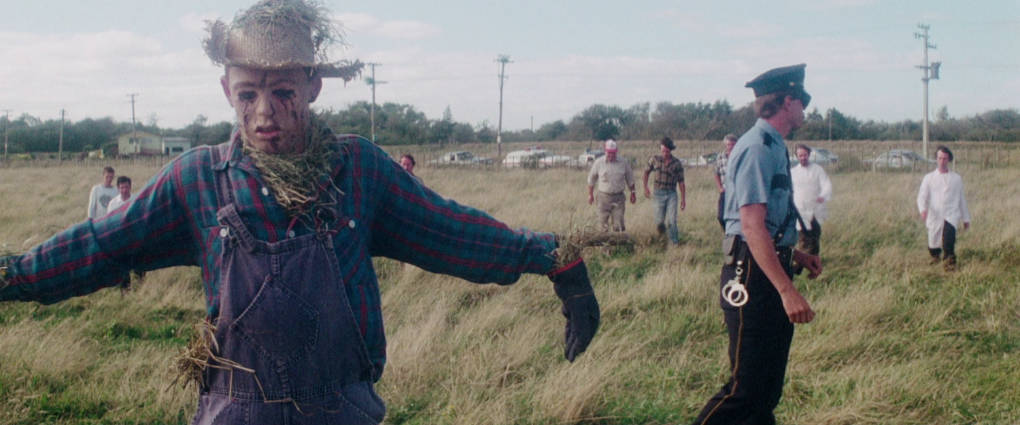
Laughlin had met Bill Condon after the latter had written an article for Millimeter magazine which had impressed him. They wrote Dead Kids together as a film for Laughlin to direct which could be achieved on a lowish budget. Condon also had his only credited acting role as the first murder victim. (He is also the scarecrow in one shot later though, as he points out in his commentary, in panned-and-scanned versions of this Scope film you can’t see him.)
Another extra-cinematic connection with New Zealander cinema is in the presence of production designer Susanna Moore, who also has a small acting role as the waitress at the Steak-’n-Shake. She was Laughlin’s partner at the time and her daughter Lulu Sylbert (from her previous marriage to Oscar-winning production designer Richard Sylbert) also has a small role in the film. Moore was also a writer, and her first novel was published in 1982. Her fourth, In the Cut (1995) was filmed in 2003 by New Zealander director Jane Campion. Editor Petra van Oelffen had previously cut two Ingmar Bergman films (The Serpent’s Egg in 1977 and From the Life of the Marionettes in 1980). On Dead Kids, she is simply credited as Petra, allegedly because she thought that making a horror film was somewhat infra dig. This film was also an early score from the German electronic music group Tangerine Dream.
The cast, as mentioned above, are almost all American, Michael Murphy had made an impression the previous decade with his work for Robert Altman and Woody Allen among others. Louise Fletcher had won an Oscar for One Flew Over the Cuckoo’s Nest, and has second billing despite an underwritten role. Of the younger (mid-twenties though playing college students) actors, Dan Shor and Dey Young had made an impression in earlier films, of which more in their interviews below. Shor is effectively playing a lead, holding the film together well. Young’s role is also somewhat underwritten though. Further down the cast are two Hollywood veterans, Scott Brady and Charles Lane, whose screen careers went back to 1948 and 1930 respectively.
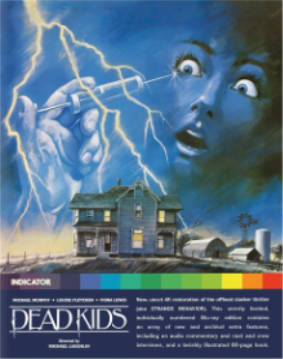
Dead Kids was known during production as Shadow Land (there’s a shot of a clapperboard with that title on it in the behind-the-scenes image gallery on this disc) but as Condon explains in his commentary that was a dummy title in case anyone in charge of locations objected to a film called Dead Kids being shot there. That title was a sticking point in the USA, in part due to recent school shootings in the news, and the film was retitled Strange Behavior when it was released on 16 October 1981. Its Australian release, under the Dead Kids title, was on 11 December 1981 in Melbourne. That was also the title when the film saw the light of day in the UK as a pre Video Recordings Act (VRA) release in July 1982. If Ginnane and David Hemmings had made a decision to go cerebral rather than gory for The Survivor, that certainly wasn’t the case with Dead Kids, though it’s moderate compared to some of the slashers being released at the same time. Even so, the film was caught up in the video nasty furore and found itself one of eighty-two films on the Director of Public Prosecutions’ Section 3 list, titles which could not be prosecuted for obscenity but were still liable for seizure and possible destruction as “less obscene”. (Antony Ginnane blames the video sleeve artwork for this.) After the VRA was passed in 1984, films had by law to be submitted to the then British Board of Film Censors to receive a homeviewing certificate and this was the case with Dead Kids, of which more below.
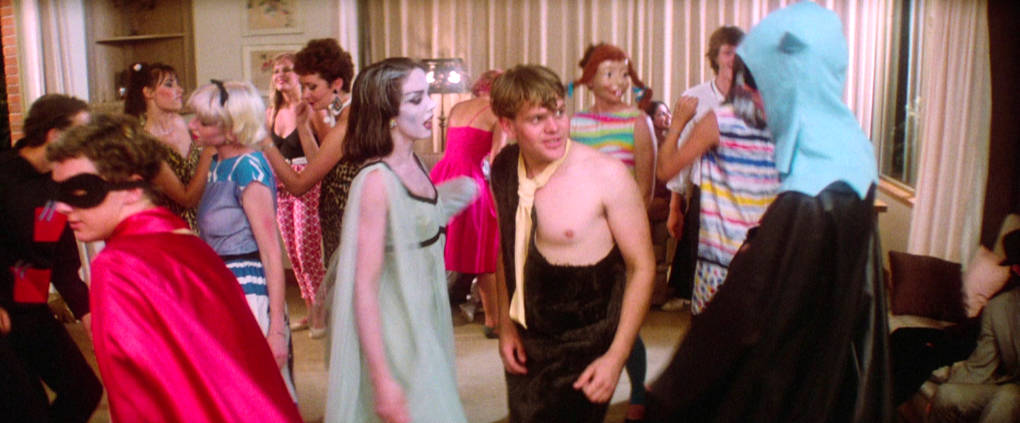
Laughlin and Condon’s next film was Strange Invaders, shot mostly in Canada. Rather than horror, this was a homage to 1950s science fiction, Invasion of the Body Snatchers in particular. It featured many of the same cast and principal crew as Dead Kids. Plans for a third Strange film came to nothing, though. That would have been The Adventures of Philip Strange, a spy thriller set in 1940s New York. Meanwhile, Laughlin directed Mesmerized in 1986, produced by Antony Ginnane and again shot in New Zealand with imported actors (Jodie Foster, John Lithgow and a return stint for Laughlin by Michael Murphy). His final screen credit was as the co-writer of the Warren Beatty-directed Town and Country in 2001. Michael Laughlin died in 2021 of Covid-19 complications at the age of eighty-two. Bill Condon made his own directorial debut with the 1987 film Sister Sister and continues to write and direct to this day. He performed both functions on Gods and Monsters in 1998, winning an Oscar for his screenplay. He also wrote the screenplay for Chicago (2002) and for Dreamgirls (2006), also directing the latter. Other directing credits include the two parts of The Twilight Saga: Breaking Dawn (2011 and 2012).
sound and vision
Dead Kids is released by Powerhouse/Indicator as spine number 434 in both UHD and Blu-ray, the latter (on which this review is based) encoded for all regions. The film is available in two versions on this disc, the original Australian theatrical version (102:01) under the Dead Kids title and the slightly shorter US release version Strange Behavior(99:59).
The film has had a complex censorship history in the UK. Following the passing of the VRA, it was submitted to the BBFC in 1986 as Small Town Massacre. Surprisingly, given the film’s history as a Section 3 Video Nasty, it was passed at 18 uncut. Granted that it would have been panned and scanned, but the material which would later be cut is centre-framed so would have been difficult to have been scanned off-screen. In 1993 it was submitted again as Human Experiments and was cut for 18, which was also the case in 2004 (as Strange Behaviour, note British-English spelling) and in 2008, a release which hedged its bets by being listed on the BBFC website as Strange Behavior – Dead Kids, with the US spelling of the former title reinstated. The contentious material is a scene late in the film where a character is induced to cut his own wrists vertically, considered a more imitable and dangerous suicide method and one less familiar than the horizontal way. (In context, this isn’t a suicide scene, though.) However, in 2026, Indicator have resubmitted the film and it is now uncut at 18, the first time the film has been available complete and it its original aspect ratio in the UK. In Australia, Dead Kids had a surprising M rating on its cinema release, though that’s the rating Ginnane’s previous suspense/thriller/horror productions had had before then and it’s not impossible (though unconfirmed) that the OFLC might have cut the film. For its video release in 1985, this was upped to R 18+. disallowing anyone under that age.
As the film was shot in 35mm with anamorphic lenses, that aspect ratio is 2.35:1 and so it is in that correct ratio on this disc. This film is typical of other Scope features of its time and later, in that the rise of homevideo as a commercial medium caused many filmmakers to compose their shots so that they could be easily cropped (panned and scanned) into 4:3 for viewing on a television set, and that’s certainly the case with this film. The transfer is from a 4K scan of the original negative and the results do speak for themselves, with strong colours and solid blacks.
The soundtrack is mono, as it was in cinemas. (Dolby Stereo didn’t arrive on an Australian production until Mad Max 2, later the same year.) This is rendered as DTS-HD MA 1.0 on both versions, with dialogue, sound effects and Tangerine Dream’s score (plus other music) well balanced. There is also an isolated score option on the Dead Kids version. English subtitles for the hard-of-hearing are available on the feature only, and I didn’t spot any errors in them.
special features
Commentary by Michael Laughlin and David Gregory
This was recorded in 2014 for Severin’s release and plays over the Dead Kids version. It sounds like this was conducted by telephone or similar device, as there’s a noticeable difference in ambience between the two men’s contributions. As Laughlin later says, he was resident in Honolulu. Laughlin begins by talking how he contacted and then met Bill Condon and they wrote the script together. Along with anything else, shooting in New Zealand enabled them to make the film straight away rather than waiting half the year for summer in America. However, the small-town setting was similar to places he knew and that, he feels, benefited the film. After the film was shot, postproduction took place in Melbourne Sydney, then Laughlin took a copy of the film to Berlin for Tangerine Dream to record their score. As well as discussing Dead Kids, Laughlin does talk about his other films. When Joanna was made, he was reluctant to send it to Cannes but 20th Century Fox wanted it to premiere there, so he agreed as long as the film could win a prize. That didn’t happen as the 1968 festival was the one curtailed due to the student uprisings in May that year, and no prizes were awarded. Airports were closed, so Laughlin and his then wife Leslie Caron had to leave France by boat, sailing to Corsica. Other films Laughlin was involved in are mentioned in less detail, though of course Strange Invaders does come up, as does Mesmerized. There are a good few gaps but Laughlin is an engaging speaker, and given that he is no longer with us it is good to have something from him on this disc.
Commentary by Bill Condon, Dan Shor and Dey Young
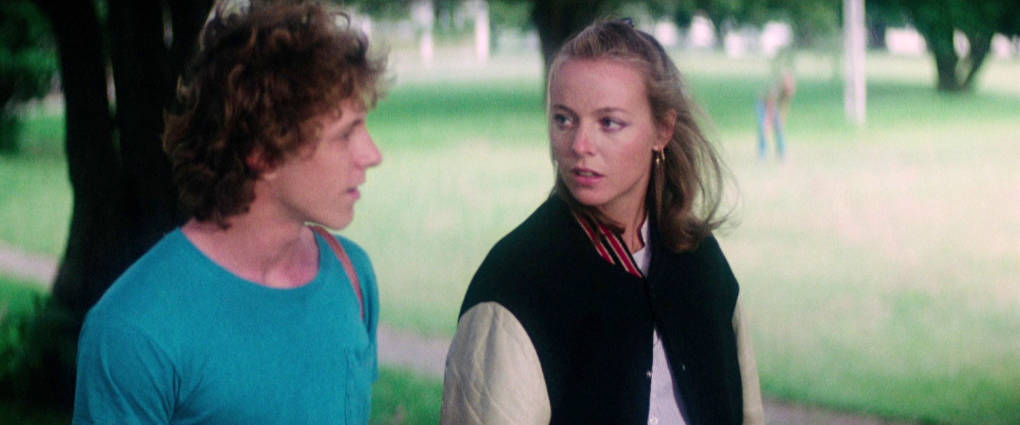
Recorded in 2008, this plays over the Strange Behavior version. Featured are Bill Condon (who tends to lead the chat), Dan Shor and Dey Young. Michael Laughlin was meant to take part, but was delayed in travelling from his then home in Hawaii. Condon talks about his meeting with Laughlin and their plan for making a horror film to be shot on a low budget, and he credits Laughlin with adding the details of small-town life to the film while he concentrated on the genre aspects. Condon commends Laughlin’s direction, in particular his having many scenes play out in master shots, often enabled by the Panaglide, the Panavision company’s recently-developed answer to the Steadicam. Some of the comments do contradict other accounts on this disc, such as Shor’s saying there was no tech guy on set when the syringe scene was filmed, something said tech guy Craig Reardon goes into some detail about in his own interview. Condon elaborates on Fiona Lewis’s claim that her hairstyle in this film influenced that of Sean Young in Blade Runner by pointing out that at the time Lewis was a friend of Joanna Cassidy, who was also in Blade Runner and then the partner of the film’s director, Ridley Scott. Condon says that Dead Kids didn’t have much of a release in the USA, having been picked up by a small distributor, but found an audience on cable TV. That said, he says that Pauline Kael liked the film, and Strange Invaders as well. There’s quite a bit of banter between the three, which makes this commentary worth listening to.
Cast and crew interviews
Six of them, but no Play All option this time. The first three are new to this release.
Michael Murphy: Clever by Half (20:40)
Murphy is very upbeat, claiming a good longterm memory for someone, he says, about to turn eighty-seven. (That establishes the recording date as shortly before 5 May 2025.) He does say that this interview might be the last time he is in front of a camera, but let’s hope not. He begins with a career overview, admitting that he tended to play clean-cut types even if he did aspire to Steve McQueen or Jack Nicholson roles. We have clips from a 1963 episode of Combat!, from the time when he met Robert Altman, for whom he worked several times. Altman had been a World War II veteran but, like many, he hardly spoke about it, but it no doubt informed his cynical worldview. We also hear about Murphy’s collaborations with Woody Allen, which included a double-header of cad roles, in Manhattan and in the same year Paul Mazursky’s An Unmarried Woman. After that, six minutes in, he moves on to Dead Kids. There are spoilers in this piece so I won’t detail them, which come in part from his talking about certain members of the cast, with appropriate clips from the film. Dan Shor said that Murphy was clearly channeling Jack Nicholson in a line he improvised to Fiona Lewis. Murphy showed the film to Woody Allen, who liked it, but distribution deals fell through and the film was picked up by a smaller company and had a limited American release as a result. However, when he saw the film at a later screening with Dan Shor, there was a full house of younger viewers.Fiona Lewis: Lasting Bonds (10:18)
Lewis’s connection to Michael Laughlin was her friendship with Susanna Moore, then Laughlin’s partner. She had previously worked with Laughlin on Joanna, in which she had one line. She reckons that her hairstyle in Dead Kids was copied by Sean Young in Blade Runner. Also talking about Louise Fletcher and Dey Young, she says she is proud of the film as well as others she did, as people seem to like them.Dey Young: An Actor’s Dream (15:21)
Dead Kids was Dey Young’s second film, and she was amazed that Bill Condon had not only seen her first (Rock ’n’ Roll High School, 1979) but that he had written a role in Dead Kids for her. She and Dan Shor made a cameo appearance in Condon and Laughlin’s follow-up Strange Invaders and after that her best-known cinema role was as a snobbish saleswoman in Pretty Woman (1990) and on the small screen in three different shows in the Star Trek franchise.A Very Delicious Conversation with Dan Shor (44:21)
Originating in 2016 and re-edited by Indicator for this release, this interview takes place in Central Park, New York City, in winter. Shor is fond of walking in the Park and of this bench in particular, as he has learned a good few parts while sitting there. The interviewer is Jason Andreasson. As the extended running time indicates, this is more of a career overview than specifically about Dead Kids, though that film is discussed. Shor’s mother was an actress and as a result Shor met an ethnically and sexually diverse crowd she mixed with. At first wanting to be an athlete, Shor soon found out he wasn’t as good as he would have liked to be and drama was just like sport except there were girls there. The diversity of the people around him gave him empathy, he said. A few career highlights are discussed, beginning with The Sport of My Mad Mother (Ann Jellicoe’s second-best-known play after The Knack) being staged as a punk musical. He played the younger version of the title character in the 1979 TV miniseries Studs Lonigan, before becoming Harry Hamlin after two hours of screen time. He also worked the same year with John Huston on Wise Blood. For Dead Kids, he originally auditioned for the role of Oliver, which Marc McClure eventually played, but petitioned for the lead role of Pete and got it. He is a lover of New Zealand and thought that Auckland looked like Los Angeles in the 1950s. Shor reveals that in the scene with the hypodermic syringe, Fiona Lewis was drinking vodka to keep her hand steady. He also discloses that “more than one gay guy” has admired him, especially in his rear-nude scene early on. After Dead Kids, he discusses later work, such as Tron, Bill and Ted’s Excellent Adventure and, similarly to Dey Young, appearances in two different shows in the Star Trek franchise: The Next Generation and Voyager. Playing a Ferengi made for sixteen-hour days, seven of them having the make-up applied and four having it removed. He didn’t mind though, as the amount he was paid, and is continued to be paid via residuals, is more than almost anything else he has ever done.Podcasting After Dark: Dan Shor (13:07)
More Dan Shor, from 2022 in an extract from Podcasting After Dark, audio-only over a black screen. The presenters are Corey Stevenson and Zak Shaffer, This podcast is devoted to horror and action movies from the 1970s to the early 1990s and in a previous episode they had discussed Strange Behavior, as being Americans they knew it as. Shor talks about going with Michael Murphy to a screening packed with fans. He also suggests that Michael Laughlin and Bill Condon first saw him in Studs Lonigan and Wise Blood as they were both “literati” and these were both adaptations of literary novels.
Craig Reardon: The Effects of Strange Behavior (20:45)
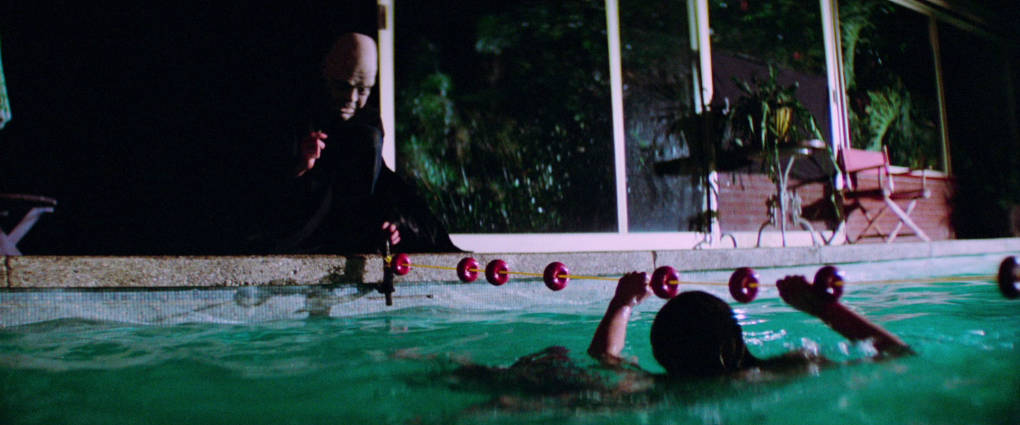
In 2014 (re-edited by Indicator for this release), special-effects man Reardon talks about how he began working for Tom Burman. When Burman was invited to do the effects for Dead Kids he was not able to, so recommended Reardon do the job with some five days’ notice. He was straight off the trans-Pacific flight when he was taken to the studio where the hypodermic-syringe scene was about to be shot, which involved some improvisation on his part before he could finally leave for his hotel room and sleep for a long time. He also talks about the use of face masks (no spoilers) and cites the 1963 John Huston-directed The List of Adrian Messenger as an inspiration for this. Reardon also discusses the making-up of Bill Condon as a scarecrow and admits that some effects were a little disappointing, the vertical wrist-slitting being one. (Also no spoilers, and don’t watch this item before the film.) He also appears on screen in the film, very briefly.
Not Quite Hollywood: Antony I Ginnane (10:51)
Another interview conducted by Mark Hartley for his 2008 documentary Not Quite Hollywood, which has provided extras for many a disc release since. He talks about how he became involved with Dead Kids, which was brought to him by John Daly of Hemdale as something he and David Hemmings could be involved with, even though the script was, he says, “quintessentially American”. But he thought there was no reason why American films could be shot in Australia or New Zealand, and they found an area near Auckland which could pass as an American setting. Unlike Australia, New Zealand had no restrictions on the use of overseas actors. The use of actors like Charles Lane (who had worked with Frank Capra and lived to be 102) helped establish a sense of the American setting. Ginnane says that people who saw the film on television, even those from the real Galesburg, had been convinced the film had been shot in the States.
Antony I Ginnane: Lightning Strikes (4:49)
This originated in 2004 as a Ginnane introduction to Umbrella’s DVD, re-edited and updated by Indicator for this release. He says that Americans watch the film and don’t realise it wasn’t actually made in America. If you didn’t know Dead Kids is one of Ginnane’s favourites of his own productions, you certainly would now: “The film’s a classic,” he says, citing as backup Rex Reed’s comment that it was one of the best horror films he’d seen. Moreover, it’s up there for him with Patrick, Harlequin and his other collaboration with Michael Laughlin, Mesmerized.
Stephen Morgan: Perfect Strangers (17:51)
Dr Morgan’s introduction begins by admitting that for an Australian film, there’s nothing much Aussie about Dead Kids. It’s set in America and the writers and director are Americans, and so are most of the principal cast. Morgan identifies this as a move towards more “Trans-Pacific” film production, something which continues to this day. (The films of the Spierig Brothers, such as Daybreakers (2009) and Predestination (2014) are cases in point: filmed in Australia by Australian filmmakers and with at least some Australians in the cast, but not set there and you’d have to squint hard to find much specifically Australian about them.) Dead Kids came from the era when Australian tax breaks (10B and 10BA) caused an increase in local film production, though with rather mixed results.
Morgan gives an overview of Michael Laughlin’s career, and also the Ginnane/David Hemmings connection which led Hemdale to be one of the production companies and Hemmings to be one of the film’s executive producers. As with other films, Dead Kids had a patchy release and was hardly deservedly caught up in the video nasty furore in the UK and there’s a mention (with clips) of the “sequel” Dead Kids 2 (1996) and Strange Invaders. The never-made third Strange film has a mention too.
Trailers
International trailer (3:16)
US trailer (1:39)
Two quite different ones, the original and rather lengthy one and a much shorter one for the US market with Deep Voiced Trailer Guy doing narrator duties. These are presented in 2.35:1 and 1.85:1 respectively. It wasn’t unusual for Scope films to have “flat” trailers, so that projectionists didn’t have to change lenses and aperture plates back and forth for the sake of a couple of minutes.
Patton Oswalt trailer commentary (3:38)
From Trailers from Hell, and as you can tell from the running time Oswalt doesn’t say very much before the trailer starts and we just have his voiceover at key points. He seems to be fond of the film despite its sometimes wild tonal shifts and concludes, “If you think this trailer is nonsensical and all over the place, well, guess what, so is the movie!”
Image galleries
Two this time. The first is of promotional material, 139 of them: colour stills, black and white lobby cards under both the Strange Behavior and Dead Kids titles, a UK video sleeve as Small Town Massacre and various posters. The second gallery is of ninety-nine behind-the-scenes photographs.
Booklet
Indicator’s booklet with this release runs to seventy-six pages plus covers. After the cast and crew listing, it begins with “Rockin’ and Reelin’ in Auckland, New Zealand” by Paul Duane. He begins by comparing the film with Messiah of Evil (1974) in that it “inhabits its own universe and runs by its own highly specific rulebook”. Duane also drops a before-the-fact David Lynch comparison, in the film’s divide between “wholesome small-town Americana and its hidden underbelly”. He commends Laughlin’s direction which leads into an overview of his career as a producer, which ended with the financial failure of Two-Lane Blacktop, which as rewritten by director Monte Hellman and co-writer Rudolph Wurlitzer was not the car-chase action film Laughlin had first envisaged. Later in the decade Laughlin met Bill Condon. Condon’s love of horror and musicals was reflected in Dead Kids, the latter due to a party scene featuring Lou Christie’s song “Lightnin’ Strikes”. Duane discusses the film’s production and finishes with an account of Laughlin’s later life and death. When he died, his production credit for Two-Lane Blacktop headed most obituaries, but his directing work is worthy of note, especially to horror fans.
Next up is “Memories of Dead Kids”, another extract from Antony Ginnane’s unpublished memoir Some Scenes Objectionable. It’s a runthrough of the film from inception to making and release, including mentioning that Laughlin and Condon had attempted to put together a remake of Cat People (something that Paul Schrader later did in 1982). Laughlin’s Hollywood connections were not in doubt, but could he make a low-budget horror movie in twenty-one days, when he had not directed before? At the time, Ginnane was dividing his time between Dead Kids and Race for the Yankee Zephyr, then also shooting in New Zealand. There were concerns about Laughlin’s favouring of “his group” with some of the New Zealander crew feeling shut out, and that his directing in mostly master shots didn’t provide enough coverage. However, he points out that the film received good critical notices despite its eventual limited release in the USA. As ever, this piece is lengthy and detailed and a little dry, but enough for anyone interested in the subject.
Next up is Michael Laughlin, interviewed by Alan Jones for the February 1984 issue of Starburst. Although they talk about Dead Kids, this is more about Strange Invaders, which had just been released in the UK, but in both cases Jones commends Laughlin for his two valentines to old-style SF and horror. They also discuss the The Adventures of Philip Strange, which Laughlin mentions as forthcoming with a script written.
On to 2015, and extracts from an interview by Vadim Rizov with Michael Murphy for the online magazine Filmmaker. This begins with Murphy’s role in An Unmarried Woman. This interview doesn’t mention Dead Kids at all, saying that after Paul Mazursky’s film and Manhattan for the next four years he was mainly offered parts as “adulterous husbands and cheaters”. His role in Salvador (1986) for Oliver Stone led to a series of roles as ambassadors and senators. He also began to work increasingly on television. He also discusses his most frequent director, Robert Altman, and how Altman and other men he worked for were all war veterans he looked up to. Likewise, on The Front (1976), a film about the McCarthy era blacklist, most of the people involved except him and lead actor Woody Allen had been blacklisted themselves.
Finally is a short interview from the Carroll County Times of 8 January 1982 (author unknown) with Edgar Froese of Tangerine Dream, particularly concerning their latest album Exit, with some discussion of their film soundtracks, for William Friedkin’s Wages of Fear remake Sorcerer (1977), Michael Mann’s cinema directing debut Thief (1981) and the then recently-completed Dead Kids.
final thoughts
Dead Kids (or whatever you prefer to call it) is one of the better Ozploitation films, even though you might have to squint hard to find much Australian about it. That said, there’s no doubt about the package that Indicator have put together for it.
Dead Kids
Australia / UK / New Zealand 1981 | 102 / 100 mins
directed by: Michael Laughlin
written by: Bill Condon, Michael Laughlin
cast: Michael Murphy, Louise Fletcher, Dan Shor, Fiona Lewis, Arthur Dignam, Dey Young, Marc McClure
distributor: Powerhouse Films
release date: 30 March 2026