
Cemented relationships
An assistant district attorney investigating a lethal gun battle in a Palermo office block starts to suspect that the officer handling the case may know more about it than he claims in CONFESSIONS OF A POLICE CAPTAIN, Damiano Damiani’s riveting, politically charged 1971 crime drama. Slarek weaves between corruption and organised crime on Radiance’s typically excellent recently released Blu-ray.
Confessions of a Police Captain, I would suggest, is an intriguingly suggestive title, at least in its English language incarnation. What, you might wonder, could this titular police captain be confessing, and to whom? Is he fessing up to crimes he committed whilst he was in office, or even those of the department under his watch, perhaps to a friend or a lover or even us as curious viewers? Could he be a devout catholic – a real one, not those amoral US government pretenders who commit cardinal sins and then badmouth their spiritual leader for calling out amoral behaviour – confessing his adulterous affairs to his priest? Of course, if you are British and of a particular age, you could perhaps also be wondering if this was a forgotten entry into the cheeky 70s sex comedy series starring Robin Askwith. There’ll be no such mystery if you know and can translate the film’s original Italian title, whose unfussy specificity not only provides an unambiguous answer to the preceding questions but also acts as a spoiler for events that do not occur until late in the film. It’s for this reason that I have chosen not to include it in this opening paragraph or the introduction at the top of the page. I’ll add a spoiler warning before I do so at the end of this review, and if you want to approach the film with the same uncertainty about the nature of the confessions as I had when I first saw it, I’d bypass the offending paragraph and steer clear of the Italian title until after you’ve watched the film.
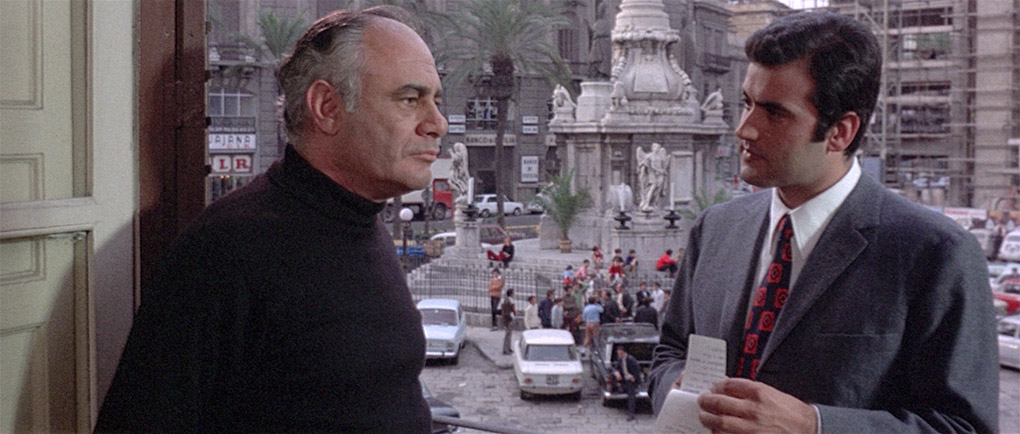
The captain in question is Giacomo Bonavia (Martin Balsam), and the sort of thing he might confess to becomes clear over the course of the film’s first few scenes. As the opening titles unfold, we see him paying a visit to the sort of nightmarish asylum that we like to kid ourselves was the invention of moviemakers but which were once a cruel dumping ground for anyone with even the slightest psychological issues. Here, he has the staff identify an inmate named Michele Li Puma (Adolfo Lastretti), who appears to be just a tad more together than his unfortunate companions and whom Bonavia orders be released as soon as possible. Once free, Li Puma arranges for a large gift-wrapped parcel to be delivered to him in a public place, unaware that his every action is being watched from a safe distance by Bonavia and his subordinate, Lieutenant Gammino (Michele Gammino – the filmmakers didn’t put a lot of effort into choosing a character name here), who seems to be a whisper more apprehensive about whatever his boss has planned but is loyal enough to go along with it nonetheless. At this stage it seems as though they’re waiting for Li Puma to lead them to a bigger fish that they’re keen to fry, but when he emerges from a doorway clothed in a police uniform and carrying the parcel he received earlier, Gammino pauses eating his lunch to casually suggest to Bonavia, “It’s your last chance to stop him.” Bonavia responds with a simple but decisive “No,” and the two head back to the station, where Bonavia flicks through a scrapbook of newspaper clippings outlining the crimes and acquittal of one Ferdinando Lomunno (Luciano Catenacci, here credited as Luciano Lorcas), who for reasons unknown is named Ferdinando Dubrosio in the English language version under review here. Bonavia then says to his subordinate, “Now we wait.” We soon find out what for when Li Puma uses his disguise to bluff his way into Dubrosio’s offices with an overcoat thrown over his arm, under which is concealed the machine gun that we all suspected that the gift-wrapped parcel contained. He then bursts into Dubrosio’s office and furiously sprays his desk with bullets, only to discover that Dubrosio has scarpered and left a trio of gun toting professional gunmen in his place. Everyone involved in the ensuing gunfight is killed, including Li Puma, and who should be sent out to investigate this incident but Bonavia and Gammino, who of course act as if they had no prior knowledge of the intentions and actions of this vengeful criminal. Also on the case, however, and without a vested interest, is Deputy District Attorney Taini (Franco Nero), who initially works with Bonavia but increasingly starts to suspect that the detective may have engineered the whole affair.
Late to the party I may have been, but I quickly become a fan of Italian crime movies from the 1970s, or poliziotteschias they came to be known, thanks in no small part to efforts of UK independent distributor Radiance, which has done a stellar job of releasing a whole range of titles from this subgenre on Blu-ray. Many are a heady mix of crime thriller and exploitation-style action cinema but are often also sporting a biting sociopolitical subtext that takes swipes at everything from police corruption and ties to the underworld to the amorality and criminal behaviour of big business. The stories are told with impressive economy, and the action, when it comes, is usually brisk and brutal, the emphasis being on pace and realism. Although generally set on home turf, many have at least one imported American name actor in either the lead or a key supporting role, and boast titles that range from the plainly descriptive to pulp sensationalist gems such as Shoot First, Die Later (Il poliziotto è marcio, 1974) and Live Like a Cop, Die Like a Man (Uomini si nasce poliziotti si muore, 1976).
On paper, at least, Confessions of a Police Captain certainly fits the poliziotteschi bill, being an Italian crime drama from 1971 in which one of the two lead roles is played by an American actor of note, one who later credited this film with giving his flagging career a welcome boost. Its Italian title is one of the most flatly descriptive of any crime movie I can readily recall (don’t worry, I will get to that later), and after a quietly intriguing opening eight minutes, the drama explodes suddenly into violent action with a shoot-out that leaves all four of its participants dead. While in other genre works this might serve as a content and tone setter for the film to come, here it proves to be little more than a trigger for an investigation that will dominate the remaining run time, one conducted on two opposing fronts by men who should theoretically be on the same side. What slowly becomes clear is that it’s not the rule-breaking Bonavia who is the anomaly here but the honest Taini, a rare figure of integrity in a system that has become corrupted by criminal capitalism, one in which councillors, city planners and civic leaders have effectively been bought by local mafiosi boss Dubrosio. It’s a situation neatly summarised by Bonavia as he converses with Taini on the as-yet incomplete rooftop of the latest shady apartment block build, when he alludes to the bodies that are buried in the cement columns holding up such constructions, and advises Taini that the forces of darkness that really run the city will eventually try to corrupt him too. “You live in a penthouse?” he asks Taini. “I’ve got three rooms on the second floor,” Taini replies. “Sounds kind of small,” Bonavia observes. “One of these days a friend will approach you and offer you the penthouse. Very low rent. You inspire trust. You’d be the perfect tenant.”
It quickly becomes evident that Confessions of a Police Captain is not a poliziotteschi in the generally accepted sense but a dialogue and character-driven crime drama with a potent sociopolitical underbelly, one whose accusations that Palermo governmental institutions and crooked construction deals were tied to mafia money were no fantasy inventions of director Damiano Damiani and his co-screenwriter Salvatore Laurani.1 Given that the film was shot in Sicily by a primarily Italian cast and crew, but all of the dialogue was delivered in English, this may sound like a recipe for a worthy misfire peppered with awkward dialogue delivery made worse by the usual post-dubbing of the actors, but nothing could be further from the truth. Damiani and Laurani’s screenplay (from a story by Damiani and Fulvio Gicca Palli) is intelligent, tightly structured, and that English dialogue is consistently well written, something lead players Martin Balsam and Franco Nero respond to with aplomb. Indeed, there’s an intriguing dynamic between the characters of Bonavia and Taini that both draws on and anticipates a range of cinematic law enforcement pairings, with Taini effectively playing the role of idealistic younger regional newcomer to Bonavia’s seasoned and more cynical old hand. And while Taini is a stickler for the rules and for procedure, that’s something that Bonavia is willing to ignore in his efforts to purge a dangerous career criminal from the streets, one who has effectively become untouchable because of the governmental officials that he has in his pocket.
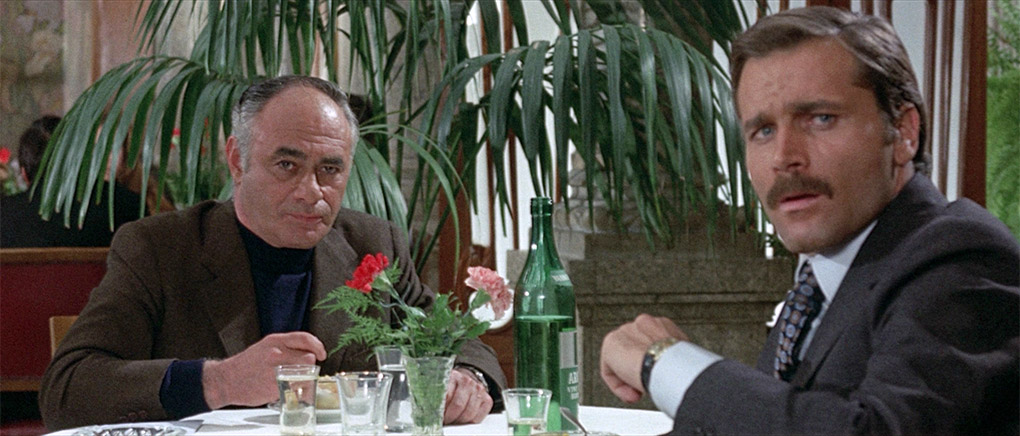
Once Taini realises that Bonavia is probably the one who had Li Puma released in the knowledge that the first thing he would do is try to kill Dubrosio, he becomes an increasingly agitated cat to Bonavia’s initially calm and (perhaps over-) confident mouse. Bonavia clearly regards Taini’s belief in the system as the naivety of a newcomer to a city in which the relationship between the criminal kingpins and the nominal guardians of law and order is very different to what the Deputy District Attorney may have previously been used to. To that end, he does his best to educate him in the specifics of how this city-wide corruption operates, presumably in the hope of persuading him of the perceived necessity of actions that he is careful to avoid openly admitting to taking. As the two men eat lunch at a restaurant in which several local officials are also dining, Bonavia outlines the nature and level of corruption that makes prosecuting Dubrosio for any crime at all nigh-on impossible, which allows him to financially prosper on construction deals that furnish him with the funds to presumably grease even more governmental wheels. Later, he tells him the story, shown in flashback, of union activist Giampaolo Rizzo (Giancarlo Prete), who publicly opposed Dubrosio and called for locals to make a stand against him and paid the inevitable price, and that’s not even the darkest element of this sobering tale. The news that the character was based directly on the true story of 1940s union activist Placido Rizotto really sent a chill through my bones – you’ll have to see the film to really appreciate why. Despite being increasingly at odds, however, Bonavia and Taini do continue to work in their different ways to ultimately similar ends, notably in their dual efforts to locate and protect Li Puma’s sister Serena (Marilù Tolo) before she is abducted or murdered by Dubrosio and his men.
All of this could theoretically make for a well-meaning but overly talky work that would be easy to respect but not exactly compelling to watch, but just as screenwriter William Goldman and director Alan J. Pakula would make a riveting drama from little more than a series of encounters and conversations in All the President’s Men five years later, Damiani and Laurani do likewise with their consistently gripping, reality-inspired tale. A solid supporting cast helps to keep it real, a standout being production manager turned actor Luciano Catenacci, who through his very appearance, his arrogant air of entitlement, and his grinning contempt for the rule of law and those charged with enforcing it makes Dubrosio one of the most memorable screen villains I’ve encountered in some time, and one I found myself really itching to see get some sort of violent comeuppance, something the film makes no promises to make good on. Only Nello Pazzafini (at least I think that’s the actor – he’s credited only as ‘prisoner’) pushes the boundary a little in a wild (though you could argue, appropriately so) turn as straightjacketed asylum inmate Pepe, whom Li Puma tried to strangle when they shared a cell and who unknowingly fuels Taini’s suspicions about Bonavia.
The key reason that this all hangs together so well and flows as swiftly and smoothly as it does is down in no small part to Damiani’s direction, which always serves the story and the performances and rarely draws attention to itself, even on shots whose ambition, organisation, execution and narrative purpose only really hit home on a second viewing. Take the scene in which Bonavia and Taini converse on the open top floor of an under-construction apartment building following the Li Puma shooting. It begins with the camera looking down from the top floor at the site of incident as police carry plywood coffins for the bodies of the deceased, an activity that is being watched by a sizeable crowd on curious onlookers. The camera slowly zooms out and simultaneously tilts up and pans right, revealing just how many onlookers have gathered before giving us a panoramic view of the city and the many apartment blocks that are about to become a key element of the conversation that Bonavia then has with Taini, ending up on a nicely framed image of the two men with a construction crane positioned so perfectly behind them that I almost wondered if Damiani had specifically requested it be placed there. The shot continues as the two men talk, the camera panning with Bonavia as he walks to a pillar to make his point about the disposal of bodies but positioned in a way that perfectly anticipates Taini’s arrival in frame and his movement through it to position himself for the face-to-face conversation that follows. One fluffed line or mistimed camera movement or background action glitch and all that ground level activity would have to have been laboriously reset for a second, third or fourth take.
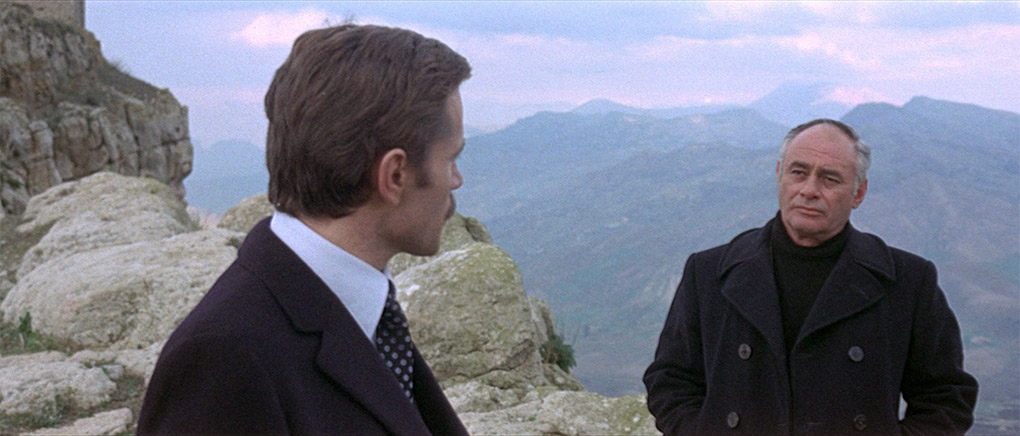
A later four minute sequence that is captured in a single shot (there is one cut-away to Taini to emphasise his response but the shot then continues where it left off) in which the two men get into a heated discussion on a deserted hillside, the camera moving with them as they repeatedly shift position in relation to each other, must have been equally challenging, especially for Nero, who had just that morning taken a phone call bringing news that left him emotionally devastated. Perhaps my favourite camera move is less technically complex but still narratively sublime and occurs when Taini pays a visit to the asylum in which Li Puma was incarcerated to question the doctors we saw being ordered to release Li Puma by Bonavia in the opening scene. Following an introductory pull-back from Li Puma’s case file, we switch to a static wide shot of Taini as he sits across a desk from his interviewees. The doctors stick to the official narrative that Li Puma was considered cured and that they no longer had any good reason to hold him, but the inference is that Taini doesn’t really buy this story and that he may be getting closer to the truth in Bonavia’s absence. When he asks to speak to Li Puma’s former cellmate, they all stand and walk towards the right side of camera, which tracks back with them to reveal that Bonavia was standing casually watching the whole exchange all along, invisibly pressuring the doctors to stick to the story he has presumably ordered to them to tell.
This all unfolds enthrallingly, and there were times when it reminded me of Francesco Rosi’s terrific 1963 Hands Over the City [Le mani sulla città], another film with a highly respected American actor in the lead (Rod Steiger) in which corrupt council officials, the dark side of capitalism and dodgy construction deals are central concerns. Although very different in tone and content, Damiani’s film is of a similar calibre in terms of its drama, its execution, its political concerns and its first-rate performances. To that end, Damiani is aided immeasurably by Claudio Ragona’s handsome scope cinematography, Antonio Siciliano’s waste-free editing, Riz Ortolani’s impactful but sensibly rationed score, and a script that refuses to sugar-coat the grim real-world consequences of this level of corruption and criminality. It concludes on a teasingly ambiguous note that may or may not offer a glimmer of hope for a brighter and fairer future for the region and its people, and in a time when political figures in the UK are accepting cryptocurrency donations from undisclosed sources that are doubtless expecting political favours in return, this 55-year-old film has a potent contemporary ring.
Which brings me, finally, to the issue of the film’s original Italian title, and as talking about it means dropping a major plot spoiler, if you’ve not yet seen the film, I’d bypass the next paragraph and hop straight to the Sound and Vision section below.
Right, as I suggested in the opening paragraph, one of the many pleasures of Confessions of a Police Captain is that I genuinely didn’t know how things would work out for Bonavia or what the nature of the confession of the title might be. There’ll be no such mystery if you know and understand the Italian title, however, which is Confessione di un commissario di polizia al procuratore della repubblica, which translates literally as “Confessions of a Police Commissioner to the State Prosecutor,” which tells us up front at some point or other Bonavia is going to confess his crimes to Taini, and in narrative terms it’s thus only a matter of when. For me, knowing that in advance would have taken something away from the evolving conflict between the two men. That said, the confession in question is not delivered how I would have predicted. The journey to that moment has its share of surprises, and that fact that the film still has some way to go when it occurs should still keep you on the hook for how events will subsequently unfold.
sound and vision
Oh, what to say? There’s an impressive consistency to Radiance releases, and if you already have one of the label’s previous Blu-ray discs of Italian crime thrillers, you’ll have a good idea what to expect from the transfer here. Framed in the film’s original aspect ratio of 2.35:1, this is a clean, stable transfer with nicely graded contrast, solid black levels, crisply defined detail, visible film grain, and a pleasing, largely naturalistic colour palette with a sometimes warm leaning and strong presentation of more vibrant hues.
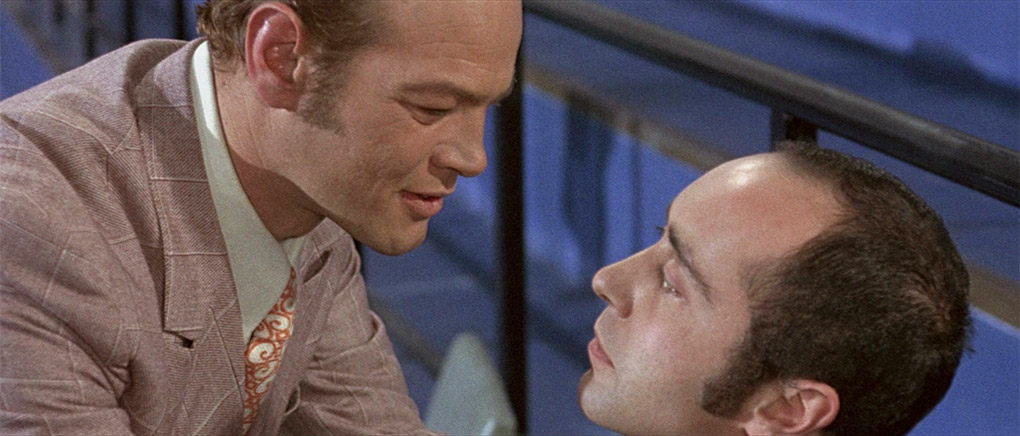
In common with other Radiance Italian crime movie disc releases, the international English and domestic Italian tracks are included, both of which are presented in Linear PCM 1.0 mono. The usual practice for Italian films of this period, many of which featured an international cast, was to shoot the film without synchronised sound and have the actors to deliver their lines in their native language, then dub the English and Italian tracks in post. When reviewing these discs I tend to have to make a judgement call regarding which track works the best, as both will have scenes in which the spoken words do not quite match what the actor is saying. There’s no such issue with Confessions of a Police Officer, as it’s clear from an early stage that all the performers delivered their lines in English, something confirmed by actor Michele Gammino in the special features. As a result, the English language track is definitely the best fit here, and though some of the voices are still likely post-dubbed, I can’t help suspecting that Balsam and Nero were recorded live – if not then their dubbing work is as good as their acting. The Italian track is also solidly performed if you prefer that, and reasonably well matched to the actor’s delivery, though obviously not as seamlessly as the English language track. Both tracks show their age in relation to their limited tonal range, but in other respects are in good shape, with the dialogue, music and ambient sound always clear and showing no obvious signs of wear.
Optional English subtitles switch on by default for the Italian language track, and English subtitles for the hearing impaired are available for the English language track. If you play the film with the English language track enabled but without the SDH subtitles, optional subtitles do occasionally appear to translate written Italian text. This does have its confusing moment, as for reasons unknown to this humble viewer the mafiosi villain is named Dubrosio in the English language version and Lomunno on the Italian track. Thus, while he is verbally referred to as Dubrusio on the English language track, in the newspaper clippings that Bonavia keeps in his scrapbook, his name is printed as Lomunno, which is accurately reflected in the subtitles and initially had me wondering if we were talking about two identical looking members of the same crime family instead of a single individual.
special features
There are four newly shot and substantial interviews included on this Blu-ray, and I do feel the need to give a shout out for the technical and artistic quality of each. All four are impeccably shot and mercifully devoid of that recently trending and infuriating tick of bouncing pointlessly between two very different angles, instead cutting almost invisibly between mid-shot and close-up to camouflage where edits have been made. It’s also clear that the interviewees were put at ease and asked pertinent questions that elicited detailed responses. Full marks here to director and editor Federico Caddeo and cameraperson Edoardo De Fecci of Freak-O-Rama for their handling of the Italian interviews, and cameraperson Jon Robertson and editor George Pursall for the interview with music score expert Lovely Jon. All were filmed between October and December of 2025.
Franco Nero (29:15)
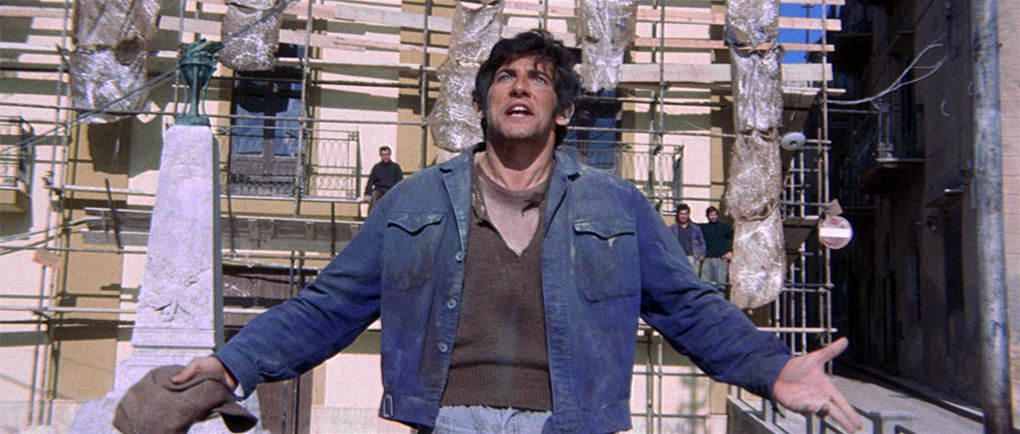
Bagging an interview with a star of Franco Nero’s stature and fame has to be the biggest coup of this release, especially when it’s as engaging and informative as this. Nero recalls first being cast by director Damiano Damiani in a small role in his 1963 The Empty Canvas [La noia], then later turning down a lead role in the director’s 1968 Day of the Owl [Il giorno della Civetta], a decision that he was persuaded to reverse by his wife, who was a huge fan of Leonardo Sciascia’s source novel. Unsurprisingly and appropriately, the main focus here is his work on Confessions of a Police Captain, a film he clearly still holds in high regard. He outlines how they landed Martin Balsam for the role of Giacomo Bonavia at the very last minute after both Anthony Quinn and Ben Gazzara had ideas for the character that did not align with theirs, reveals that the union activist played by Giampaolo Rizzo in the film was based directly on the real-life figure of Placido Rizotto, praises the work of his fellow actors, director Damiani and cinematographer Claudio Ragona, and describes the mafia as “a horrid sickness on our country.” There are also several anecdotes about the shoot, including a touching one involving a phone call he received just before shooting the long one-shot dialogue scene with Balsam. An excellent interview.
Michele Gammino (22:47)
Actor Michele Gammino looks back his feature film debut as Captain Bonavia’s immediate subordinate, a role he was surprised to be offered after Damiano Damiani suggested he try “live” acting when he was working as a dubbing artist on one of the director’s previous films. He confirms my belief that the film was shot in English, a decision that led to him spending the weeks before filming began studying the language, then having to re-learn it all again with the correct pronunciation when he arrived on set, something that Martin Balsam – whom he describes as “a lovely, funny, generous man” – really helped him with. He opines that Damiani didn’t just make a great film but also assembled a great team, has only good things to say about his fellow actors, describes real-world union activist Placido Rizzotto as a martyr of the social revolutionary movement, and assures us that the corruption and fraud that the film depicts was all true of Palermo that that time. He also reveals why he and the character he plays have the exact same surname. Another very fine interview.
Antonio Siciliano (26:49)
The high standard continues with this information-packed interview with Confessions of a Police Captain editor, Antonio Siciliano, who recalls his early film work as a director of dubbing facilities at a small independent company, where he effectively taught himself how to edit film. This eventually landed him his first feature job on The Most Beautiful Wife (La moglie più bella, 1970) for Damiano Damiani, the catch being that that if his work did not meet with Damiani’s approval then he could be contractually replaced with the more experienced (and much more expensive) Nino Baragli. Clearly it did, and he and Damiani went on to work together many more times. He talks in fascinating detail about the importance of editing and dialogue rhythm, about the challenges he faced working with P2 film stock for the first time, and notes that his editing style was shaped in part by Damiani’s insistence that he never wanted to see doors opening or closing in his films – just cut straight to the dialogue and lose the filler. He also reveals that Damiani shot two very different endings for the film, and that the intriguingly ambiguous one that it sports instead was his idea, one that met with the approval of both the director and – after a screening of all three versions – his co-screenwriter.
Lovely Jon (31:00)
Film score expert and Radiance disc regular Lovely Jon delivers a useful look at the career of score composer Riz Ortolani, whom he reveals was as popular on home turf as Ennio Morricone, to whom he frequently compares him, even noting that at one point Ortolani was innovating where Morricone then more famously followed. Ortolani’s work on Confessions of a Police Captain is discussed in some detail, with Jon observing that there are barely 12 minutes of music in the film, but when the music does appear, it hits. His deconstruction of the opening theme and how it relates to the title character is enthralling.
Gallery
78 promotional stills, lobby cards, pages from the Japanese press book (quite a find), and international posters.
Also included with the release disc is a Limited Edition Booklet featuring archival interviews with Damiano Damiani, but this was not available for review.
final thoughts
Another terrific Italian crime drama given a welcome and top-notch Blu-ray release by Radiance, one focussed more on character and plot than action, and one soaked in the politics of corruption and criminality that were a grim feature of the Palermo of the period and have a worryingly contemporary ring. A fine transfer and an excellent set of interviews make this an easy disc to enthusiastically recommend.
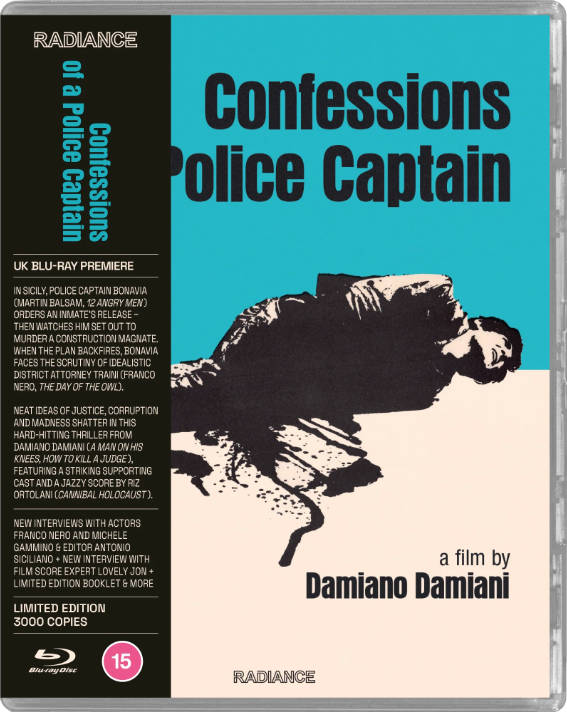
Confessions of a Police Captain
Italy 1971 | 104 mins
directed by: Damiano Damiani
written by: Damiano Damiani, Salvatore Laurani; story by Damiano Damiani, Fulvio Gicca Palli
cast: Franco Nero, Martin Balsam, Marilù Tolo, Claudio Gora, Luciano Catenacci (as Luciano Lorcas), Giancarlo Prete
distributor: Radiance
release date: 20 April 2026