
The Cars That Ate Paris / The Plumber
Peter Weir’s first full-length feature, THE CARS THAT ATE PARIS, comes to UHD and Blu-ray from the BFI, both editions also including his 1979 TV movie THE PLUMBER. Review by Gary Couzens.
THE CARS THAT ATE PARIS
George and Arthur Waldo are driving through the Outback when they follow diversion signs to the small township of Paris, New South Wales. Blinded by sudden lights in the road, Arthur (Terry Camilleri) runs the car off the road. George dies in the crash, but Arthur is taken to the hospital in Paris. As Arthur recovers from his injuries and shock, he comes to know the people of Paris, from the Mayor (John Meillon) downwards. Soon he finds out that there’s something very sinister about this town. The entire economy of Paris relies on luring unwary travellers to their doom and scavenging from the wrecked cars…
In 1973, Peter Weir was a documentary filmmaker employed by the Commonwealth Film Unit, later renamed Film Australia. Outside his work there, he’d made a short called Michael, the opening segment of a three-part portmanteau film called 3 to Go (1971, see below). Also in the same year, Weir made a 52-minute 16mm black and white piece, Homesdale, which attracted a lot of attention. While he was serving out his contract at the CFU, Weir was developing a project originally called Highway, which would in 1973 become his first full-length 35mm feature.
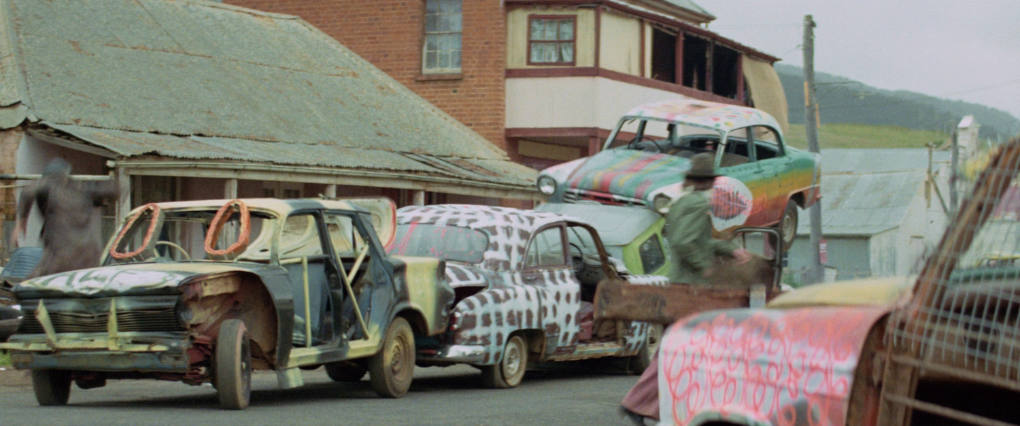
Cars is one of those debut films where the talent is obvious, but the results aren’t necessarily entirely satisfying. The opening sequence is a parody of a TV commercial, in which a couple drive in a car, sipping soft drinks and smoking cigarettes, brand names prominently on display…before going off the road and crashing. The viciously customised cars themselves bear more than a passing resemblance to 1974’s film Death Race 2000. That may be more than a coincidence, as Death Race was a Roger Corman production and Corman almost bought the US distribution rights to Cars. For the record, the late Paul Bartel, director of Death Race 2000, said he didn’t see Cars before making his own film, though Corman came to him with the idea of the cars themselves. Death Race 2000 was then developed from that idea, and apart from the vehicles, the two films have nothing in common. New Line Cinema, the eventual US distributor, cut Cars to 74 minutes from the not exactly bloated 88, redubbed it so that Arthur became an American tourist lost in the Outback, copied the final shot to the beginning so the story plays out in flashback and retitled it The Cars That Eat People. This version sunk without trace. I haven’t seen it, but morbid curiosity says that I might one day. The original version has played in the US since (it’s the only version ever to have been released in the UK), and the film has built up a definite cult following over the years. For his part, George Miller, who at the time had left his medical career and had made his own first films, may well have been watching when Cars was released in Australia. You can see something of the design of the vehicles in the cars in Miller’s Mad Max.
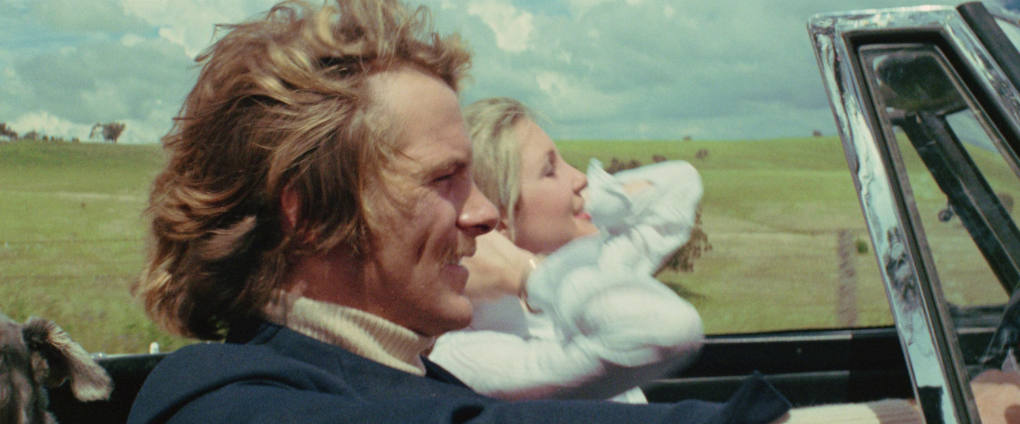
The acting is generally good, especially from John Meillon. There’s a strong supporting cast, many of whom became stalwarts of the Australian Film Revival, including Max Gillies, Chris Haywood, Melissa Jaffer and Bruce Spence. Terry Camilleri, more usually cast in villainous roles, is a deliberately unimposing hero.
Ideas and energy the film has in abundance, but it doesn’t really hang together and certainly isn’t above dragging in places. It’s a grab-bag of genre references and influences, from the SF/horror-tinged basic premise to such scenes as a street confrontation involving Arthur being staged like something from a western, and framed as such across the wide screen. It’s visually ragged, partly due to the low budget, partly due to inexperience. With his next film, Weir began an association with Russell Boyd, a world-class cinematographer. John McLean, the Cars DP, simply isn’t in the same league. He had shot some of the low-budget and now obscure films made in Australia earlier in the decade, such as Demonstrator (1971) and the big-screen version of the then-scandalous TV show Number 96 (1974). Later in his career, which continued until 1990 (though he is still alive, aged eighty-six, as I write this), he worked with Brian Trenchard-Smith on such films as Turkey Shoot (1982) and Frog Dreaming (1986). He had worked with Weir on Wake in Fright (1971) as respectively camera operator and uncredited production assistant, and went on in 1976 to shoot three episodes of the miniseries Luke’s Kingdom which Weir directed. Despite the low budget, Cars was shot in Scope. That wasn’t a first for Australia, as it was preceded by the US/Australian coproduction Adam’s Woman (1971) and, two decades earlier, the productions or coproductions Long John Silver (1954) and the children’s films Smiley (1956) and Smiley Gets a Gun (1958), which were in CinemaScope.
The Cars That Ate Paris is generally more interesting for seeing Weir’s talents in embryo than for itself. The biggest quality leap in his career took place between this film and his next, Picnic at Hanging Rock. Cars fandom has had a boost in recent years by the boom in Ozploitation in the wake of the 2008 documentary Not Quite Hollywood. As a result, Weir is accepted as one of the fold, though Picnic was the more family-friendly period/historical type of literary adaptation that the Ozploitation crowd set themselves against (along with works of “social realism”) despite that film’s commercial success in many parts of the world.
Cars premiered at the Sydney Film Festival on 15 June 1974 and went on general release on 10 October the same year. It was not a commercial success, but soon gathered a cult following. The film was nominated for, and won, one AFI Award, for Bruce Smeaton’s score, which he shared with himself for The Great MacArthy (1975). Best Film that year was Sunday Too Far Away. Cars opened in the UK on 5 June 1975. Its main London venue was the Rialto in Coventry Street, just off Leicester Square and now the French restaurant Cafe de Paris, where it shared its bill with the 1970 comedy The Projectionist. One fan of the film was Stanley Kubrick, who included it in a list of his favourite films. The film had its first UK TV showing on Channel 4, a month after the channel had started broadcasting, on 2 December 1982 and unfortunately panned-and-scanned. This was the second of an unofficial Weir double bill on the channel, as they had shown The Last Wave on 30 November, and those were my first viewings for both films.
THE PLUMBER
Adelaide. Brian Cowper (Robert Coleby) is a university lecturer while his wife Jill (Judy Morris) is at home in an apartment block working on a masters thesis in anthropology. One day, Max (Ivar Kants) knocks on her door. He is the building plumber, he says, making a routine check. But then he stays, and stays, working loudly in the bathroom, even taking a shower there. Brian, about to land a prestigious gig with the World Health Organisation, is dismissive about Jill’s growing anxiety about the plumber…
Not far off what might have been called later a home-invasion film, The Plumber is a tight hour and a quarter, as much a black comedy as it is suspenseful. The conflict between Jill and Max is rooted in class distinctions and gender divisions. Both Melbourne natives, she was the one who went to what appears to have been an upmarket women’s college, and Max at times seems to be motivated by resentment. Peter Weir wrote the script and some of the dialogue, with darker undertones under the surface politeness, is reminiscent of Harold Pinter.
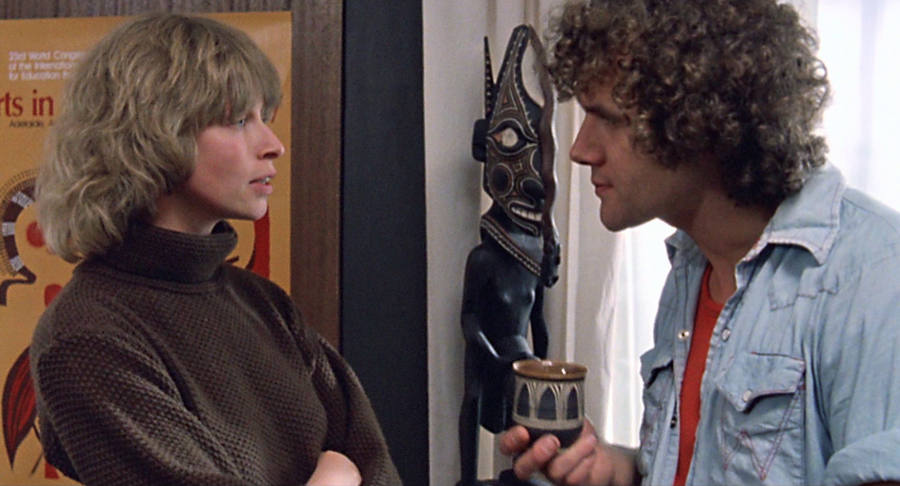
The Plumber was made for Australian television as one of a package of such films made for the commercial channel Channel 9 by the South Australian Film Corporation.. At a time when cinema projects weren’t working out for him, Weir accepted the commission. It was shot quickly (three weeks) in 16mm, with Weir using a cast and crew he had for the most part not worked with before and wouldn’t do so again. (Cinematographer David Sanderson had been the assistant cameraman on 3 to Go. Judy Morris had been in that film too, though not in Weir’s segment: she had played the title role in Judy.) An exception to this was production designer Wendy Weir, in her first credited collaboration with the man she had married in 1966.
The idea for The Plumber had come to Peter Weir when he had taken a taxi ride in the late 1960s. Weir had assumed that the driver was a member of the counterculture, with his long hair and beard, but as their conversation progressed he revealed himself as anything but, being in support of the Vietnam Award. That is carried over into Max, in jeans and a biker jacket, but with a prominent decal in support of the Liberal Party, who in Australian terms were the Conservatives.
The Plumber was first broadcast on Channel 9 on 20 June 1979. Despite its televisual origins – and its almost entirely interior setting, given the low budget – The Plumber was given a short cinema release in the USA in 1981, blown up to 35mm. It didn’t receive that in the UK, being released in 16mm in 1986 non-theatrically (for film societies and the like), which is how I first saw it. It had its British television premiere on 14 February 1987 (or rather, as it started after midnight, the early hours of the 15th) on Channel 4.
sound and vision
The Cars That Ate Paris is released on UHD and Blu-ray by the BFI, with The Plumber on a second Blu-ray disc in both editions. This review is based on the latter. The Blu-ray discs are encoded for Region B only. Cars was given an uncut X certificate on its original cinema release and is now a 15. The Plumber was a 12 on its first submission to the BBFC, on DVD in 2003, but a recent cinema reissue upped its certificate to 15. Among the extras, Michael has been given a 12. Incredible Floridas, being a documentary which wouldn’t earn any certificate higher than PG, has been exempted from certification. As the transfers come from the National Film and Sound Archive (NFSA) of Australia, the two features begin with the standard Australian advisory that “Aboriginal and Torres Strait Islander viewers are warned that the following film may contain images and voices of deceased persons”.
Cars was shot in 35mm with anamorphic lenses and the transfer is in the intended ratio of 2,39:1. The film has never had the most vibrant colour palette any time I’ve seen the film (including once in a cinema, of the current restoration) and that’s reflected in this transfer. Grain is noticeable, but not untoward.
The Plumber, shot in 16mm, is presented in a ratio of 1.85:1. Given the film’s history – a TV movie later blown up to 35mm and released in US cinemas – there are effectively two different audiovisual versions of this film. On television, it would have been shown in 1.33:1 as television sets in Australia and anywhere else were then 4:3. That was also the ratio the 16mm print I saw in 1986 was projected in. Given that Academy Ratio was at the time long since commercially obsolete in cinemas, it would have been shown there in a wider ratio, in America almost certainly in the 1.85:1 as presented here. As I don’t have a 4:3 version available for comparison, the film may simply have been cropped top and bottom or reframed up or down to produce the wider version. Certainly some shots do look a little more cropped than intended, but not obviously so. Also, as Australia’s television service in 1979 was PAL, the film would have been shot at twenty-five frames per second, but this transfer plays at twenty-four fps, as it would have been in a cinema. This does mean that it gains about three minutes in running time, and the soundtrack would be slowed down by about half a semitone, though as I don’t have perfect pitch, I can’t confirm that. With all that said and done, this transfer, from the NSFA Restores programme looks fine. It’s soft and grainy, not surprising given its 16mm source, but colours seem true and it does look pretty much as I have seen it before.
The soundtrack in both cases is the original mono, rendered as DTS-HD MA 1.0 for Cars and LPCM 1.0 for The Plumber. However, there is an additional option for Cars, not accessible via the menu but which can be selected via your remote, in DTS-HD MA 5.1. Weir has often been revisionist regarding his Australian films. The most well-known example of this is his director’s cut of Picnic at Hanging Rock, which is some seven to nine minutes shorter than the original release version (the international cut or the slightly longer Australian theatrical cut). However, this has extended to his soundtracks, with his films originally released in mono – that’s everything in cinemas up to and including The Year of Living Dangerously (1982) – being remixed into stereo or 5.1. I can’t mark this down as this is due to the man who directed the films, but it seems unnecessary. I listened to the mono and sampled the 5.1. There’s very little difference, with the mono mixed slightly louder, and the surrounds mostly used for Bruce Seaton’s music score. As for the tracks, they are the product of Australian technical expertise, even if you take the low budgets into consideration, and dialogue, music and sound effects are clear and well-balanced. English hard-of-hearing subtitles are available for the two features only, and I didn’t spot any errors in them.
special features
THE CARS THAT ATE PARIS
Commentary by Dr Stephen Morgan
Newly recorded for this release, this commentary is by Dr Stephen Morgan, a London-based academic with a PhD in Australian cinema, co-programmer of the London Australian Film Festival, contributor to discs of other Australian films (such as Indicator’s Ozploitation range) and, specific to this film, someone who grew up in a small Australian town rather like Paris. He begins by talking about the place of Cars in the Australian film industry, one beginning to revive after a notable slump in the 1960s. Cars was an early beneficiary of the Australian Film Development Corporation, set up to make more commercial films. The film was made at the time of the global Oil Crisis, which particularly affected Australia as, with its wide-open spaces, it was particularly dependent on the automobile and had a notable car culture as a result. That had a knock-on effect on Australian leisure-spending, along with the arrival of colour television in 1975, likely not the only reason for Cars underperforming at the box office, though a contributing factor to a sharp decline in takings across the board. Morgan also compares the “hospitable violence” in Cars to that in Wake in Fright, released only four years earlier.
While Cars is an Australian film, Weir didn’t set out to making something specifically Aussie, insisting in the story’s universality despite its setting. How far Weir actually achieved that is a good question, given how much the film was de-Aussified for its US release. (Morgan makes a minor slip here: it wasn’t Mad Max 2 which was released dubbed into American in the USA and UK but the original Mad Max.) He cites Jonathan Rayner (a UK academic who has written book on Australian cinema) in pointing out that Weir’s Australian films are on the whole arthouse inflected by genre, but vice versa with his US films.
Much of Morgan’s commentary is concerned with the issues of settler colonialism, of the supplanting of a native (first-nations) culture by incomers. This was reflected in Australian and Weir’s cinema by a period of experimentation (Weir’s earlier short films as well as Cars) followed by one of consolidation (Picnic at Hanging Rock). In Cars, the Aboriginal presence is all but absent, other than the Mayor’s ornament which gets broken. Later in the decade, Australian films did try to engage more with First Nations perspectives, not least Weir in The Last Wave but also such films as The Chant of Jimmie Blacksmith (1978, directed by Fred Schepisi) and Phillip Noyce’s feature debut Backroads (1977) which had considerable input from its co-star, the Gumbaynggir actor, academic and activist Gary Foley. This is a dense commentary which may need more than one listen to unpick it all, but due to this, along with the usual details of the film’s production and of specific scenes and elements, a very worthwhile one.
3 to Go: Michael (31:01)
By the end of the 1960s, Peter Weir was working for the Commonwealth Film Unit, an organisation set up to make documentaries, which he duly did. However, some of the Unit had feature-film aspirations, in particular Gil Brealey who had previously worked on television (directing the country’s first science fiction serial, The Stranger, in 1964/5). Brealey would go on to produce Sunday Too Far Away and direct Annie’s Coming Out in 1984. His idea was to put together a portmanteau feature of three short films of half an hour each, on the vague theme of youth. Michael, written and directed by Weir, was the first to be made, and first to be shown of the triptych, which is why the transfer begins with the overall opening titles of 3 to Go, as the film was titled. (It’s sometimes referred to as Three to Go, but it’s a digit on screen and not a word.) The other segments were Judy, written by Brian Hannant and Bob Ellis and directed by the former, and Toula, written and directed by Oliver Howes.
Michael, shot in black and white 16mm (and intensely grainy it is) begins with a sequence of an armed uprising on Sydney’s Circular Quay with young people facing off against solders. But this is from a film within the film as Michael (Matthew Burton) lives with his parents and works in the city centre. He has a choice between his parents’ lifestyle and political radicalism. Meanwhile, a television programme called Youthquake seeks to understand the younger generation, particularly their tastes for sex and drugs. The film is a somewhat scattershot effort, clearly influenced by Godard. It won the Grand Prix at the AFI Awards (Homesdale won the same award the following year), with the film as a whole picking up the Silver Medallion. It’s not confirmed that it is him as far as I’m aware, but one of the soldiers in the opening sequence resembles Weir.
3 to Go went straight to television, premiering on Channel 7 on 23 February 1979. Following that, the film was divided into its three parts, each playing as supporting shorts in cinemas. To the best of my knowledge, 3 to Go has never been released on disc as a whole, with only the segment made by the one of the three directors who went on to greater fame commercially available. However, Hannant continued to make shorts and two further features: the 56-minute Flashpoint in 1973 and The Time Guardian in 1987, which was a notable flop and is the last film he has made to date. Howes also made shorts and documentaries, but two features as well: Wokabout Bilong Tonten (1974), the first feature made in Papua New Guinea with an all-indigenous cast and dialogue in Tok Pisin (New Guinea Pidgin), and the children’s film Let the Balloon Go (1976). There was a time when you could have constructed your own viewing of 3 to Go when all three episodes were available separately on the NSFA’s YouTube channel (and that’s what I did), but as I write this they are no longer available there. They are rentable from the NSFA’s streaming service NSFA Player, but are geoblocked to Australia.
Incredible Floridas (12:20)
Made for the Commonwealth Film Unit in 1972, directed by Weir and edited by Anthony Buckley, Incredible Floridas is a portrait of composer Richard Meale and his setting of poems by Arthur Rimbaud to music. This documentary crams a lot into a small space and does it well. A voiceover by the composer details his composing of the piece (using woodwind, percussion and strings), then the music itself scores a rapid tour through Rimbaud’s life via photographs and sketches. How much this is a Weir film, other than some horror-movie-like flourishes, is a good question, but as a work for hire it serves its purpose.
My First Film: Terry Camilleri on The Cars That Ate Paris (20:59)
Newly interviewed for this release is Terry Camilleri, now seventy-six as I write this, if retired. He was born in Malta in 1949 but followed his father to Australia with the rest of his family at the age of four. In Melbourne, his father often took him to drive-in cinemas, and it was a showing of Zulu which struck the spark in him that acting was something he wanted to do. Small roles followed, beginning with a corpse in a river in the TV series Homicide. At the Commonwealth Film Unit, he met Peter Weir. He talks about how John Meillon would often play tricks on his fellow actors, such as standing up to reveal he had no pants on. After Cars, Camilleri worked again with Weir on an episode of Luke’s Kingdom. Much later, he was the man watching the show in the bath in The Truman Show, though much of the business he came up with for his small role didn’t end up in the finished film.
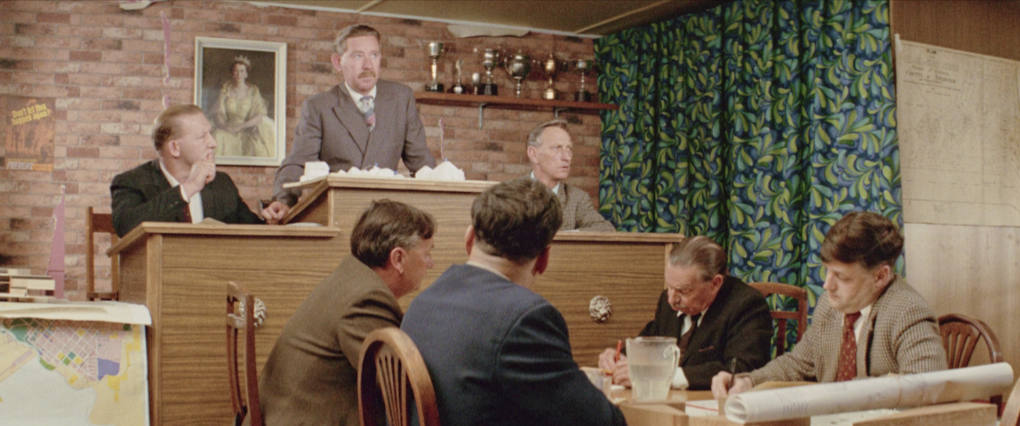
“Nobody Leaves Paris! No One!” (14:47)
This video essay, written and narrated by Chris O’Neill, plays over clips from Cars. Newly produced for this release, it begins with a well-earned spoiler warning, so watch it after you have seen the film. It begins with a brief overview of the state of Australian cinema at the time (interestingly mentioning Jim Sharman as one of the directors concerned, not the first name most would have thought of). Like Stephen Morgan’s commentary, it places the film in its particular place in Australian history, shortly after the end of twenty-three years of government by the Liberals and a period of social change, not least stagnation caused by the world economic slowdown precipitated by the Oil Crisis. O’Neill also discusses the film’s blend of genres, from the horror/SF trappings of what is essentially an arthouse film.
The Guardian Interview: Peter Weir (70:27)
This interview was recorded in 1985 at the then National Film Theatre in London, when Weir’s Witness was new in cinemas. It plays as an alternate audio track, with the feature audio taking over after it finishes. The interviewer (male, unidentified) introduces Weir rather grandiosely as “the antipodean Antonioni and looking like the innocent hero of Fellini Satyricon”. This is an overview of Weir’s career up to this point, beginning with his first visit to London being by ship from Australia, he and others providing their own entertainments due to there being none organised by the crew. His discussion of Cars admits the film was not a commercial success, possibly due to the title being confusing. There’s a bit about each of his feature films to date, beginning with an account of the back-and-forths with United Artists and the South Australian Film Corporation over The Last Wave (with Weir sticking to his guns regarding the open ending). On Gallipoli, he talks about his work with writer David Williamson, and, regarding The Year of Living Dangerously, he discusses the casting of Linda Hunt. With the latter, he describes problems with Muslim groups when filming in Manila, the very presence of a non-local film crew being an affront. Questions from the audience (not always very audible, but the interviewer does repeat most of them) begin at fifty-three minutes. Discussions include Maurice Jarre’s scores and the filming of some scenes like silent films, given the inability of many Australian writers in the early 1970s of writing screen dialogue and actors of delivering them. He ends by talking about the film he was about to make, The Mosquito Coast, originally to star Jack Nicholson but in the event Harrison Ford played the lead. There are one or two audio drop-outs along the way, but nothing too disastrous.
Interview with Peter Weir: The Cars That Ate Paris (11:18)
From 2003, this is one of a series of short to-camera pieces where Weir talks about his films. One of the sections the piece is divided into is appositely called “Learning on the Job”, as that is what Weir says he was doing in his career up to that date. Due to the low budget, he was paid expenses only, but had a percentage of profits (if any) and owned the copyright of the film. At the time, there were no film writers and directors with much experience in Australia, and Weir also learned on the job, with a background in sketch comedy. He talks about how Bob Shaye of New Line Pictures apologised for his company’s re-editing of the film and given that the film was ultimately a failure, finds virtue in that, and wishes other new filmmakers could equally fail nobly.
Interview with Hal McElroy (5:42)
This is from 2008 and part of an interview with co-producer McElroy for Not Quite Hollywood. It’s a short piece but he begins by saying that the priority at the time was to make something he, his fellow producer and brother Jim and Weir were passionate about, rather than aiming at what they thought was commercial. He talks about how the powers that be were sceptical of the film being shown at Cannes, but in the event they relented, paying an economy flight ticket for Weir, with the McElroys having to pay for their own. Once in the South of France, they customised a Volkswagen with plastic spikes they had brought with them and had it drive up and down the Croisette.
Trailer (3:37)
A lengthy trailer which is presumably from the UK release as it’s heavy on quotes from British newspaper and magazine critics.
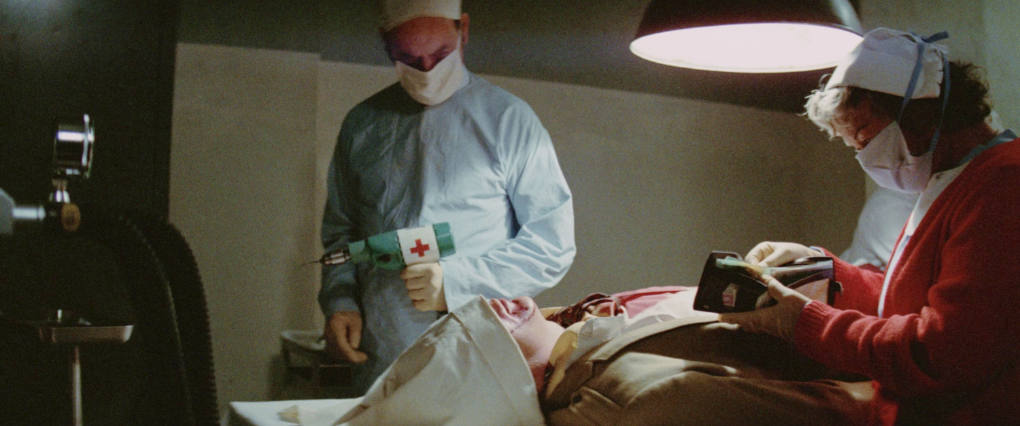
Image gallery (5:00)
A self-navigating gallery which begins with black and white stills of Weir at work in the 1960s, followed by stills (both black and white and colour), plus promotional stills and lobby cards from the British release.
THE PLUMBER
Commentary by Alexandra Heller-Nicholas and Josh Nelson
As with the commentary on Cars, this was recorded specially for this release, featuring the regular Australian double act of Alexandra Heller-Nicholas and Josh Nelson. This is even less non-scene-specific than the Morgan commentary and there isn’t much about the production circumstances, but you can easily find that elsewhere. Instead we have a deep dive into themes, particularly those of the clash of classes, genders and other identity markers. (Nelson recommends we watch, or rewatch, Weir’s later film Green Card as an another, more comedic, exploration of these themes.) This commentary isn’t the only item on this disc to discuss The Plumber (and indeed Cars) in the context of Australian society of the time, in this case a country under Malcolm Fraser’s Liberal government four years after the Governor-General dismissed the previous Prime Minister Gough Whitlam (Labor). Much is made of Max’s liberal (small L) exterior – biker jacket, generally countercultural look – with his actual Liberal (capital L) politics, in particular the jacket adornment of “Liberal = Less Taxes” we see several times on his back. Heller-Nicholas compares him as a particular type of Australian masculinity to John Jarratt’s Mick Taylor in Wolf Creek, though clearly less psychotic and overtly threatening. There is discussion of the myth of Australia being a classless society and of the sexual politics of the film, with Brian only acting on his wife’s behalf when something of his property (the expensive wristwatch she wears, a present from him) is at stake. This is another in-depth commentary which may take more than one listen to unpick it all.
Interview with Peter Weir: The Plumber (7:42)
Again from 2003, this short piece still covers a lot of ground. Weir talks about his inspiration for the film, with both Cars and The Plumber originating as stories he wrote while hitchhiking. He talks about the film’s themes of identity, and how personal taste and money can give you away. The characters had a mixed reaction at the time, with Jill dismissed as a bitch by the projectionist while Weir was doing the sound mixing but Judy Morris receiving letters from women who had been in a similar situation.
Peter Weir’s Dream Within a Dream (18:26)
This new featurette by Polish filmmaker Jakub Duszynski marries outtakes from Picnic at Hanging Rock (some shots not in the final version, often with clapperboards visible) with a voiceover by Weir. He describes how he read Joan Lindsay’s novel and when he met her broke the publicity people’s rule by asking her if it was a true story or not. Weir talks about how his wife Wendy influenced the look of the film – the girls on a picnic would probably have worn their own clothes, but it was Wendy Weir’s idea to have them all wearing white, or rather off-white as true white would have flared on camera. The picnic scenes had to be shot during an hour-long window during the day when the light was right, and Weir made use of varying camera speeds, often alternating shots with dialogue speakers at twenty-four fps (normal sound speed) and listeners at thirty-two. As for the ending, he says that in this case as well as in others, the ambiguous ending was the right ending. Fortunately audiences worldwide (though significantly not American ones) accepted it as such.
Trailer (2:27)
The provenance of this trailer is uncertain, given that it postdates both the 1979 television broadcast and the 1981 US cinema release. It’s probably from the restoration of 2001 (the film’s second copyright date) as it refers to Weir as “the internationally acclaimed director of Witness, Dead Poets Society and The Truman Show,” all of which had been released by then. Note that none of his Australian films get a mention.
Image gallery (3:36)
Another self-navigating gallery, featuring stills, a publicity sheet and an Australian video sleeve, bearing the then-current NRC (Not Recommended for Children) rating.
Booklet
The BFI’s booklet, available with the first pressing of this release, runs to thirty-two pages plus the covers. Following a spoiler warning, first up is Dr Stephen Morgan with “We’ll Always Have Paris: Automotive Abjection and Settler Nationalism in The Cars That Ate Paris” on this “enigma wrapped in a knowing conundrum” as he puts it. Inevitably there will be overlap between this and his commentary, but Morgan ably expands on what he says in the latter. He places the film in the early 1970s cultural nationalism looking for its own stories to tell in the cinema. Weir, working in television and otherwise making short films, was ideally placed to take advantage of this. Morgan points out the contradiction between a film intended not to be specifically Australian but to be universal and the Australian kitsch included in it and humour not far away from the Ocker comedies that audiences flocked to and critics loathed in the cinemas at the time. As Arthur is seen as somehow less than a man due to his failure to drive (having been behind the wheel twice when people were killed, one of them being his own brother), Morgan sees Arthur’s embrace of the legacy of settler nationalism making him a true man. (“I can drive!” he says at the end of the film.) The rest of the essay talks about the film’s release and reception and the alternative version released in the USA.
“Gleeful Anarchy” is a conversation between Peter Weir and his daughter Ingrid, who at the time of Cars lived close to Sofala, New South Wales, where the film was shot. In a brief introduction, she talks about how the area has changed since then, though she had sold that cottage the previous year. Then it’s the interview, divided into separate sections, taking us through the inception of the film, the performances of Terry Camilleri and John Meillon (with whom Weir had previously worked on television). As for the film itself, as his first full-length feature, it’s “a bit of a blur”. This is followed by a reprint of Geoff Brown’s review of the film from the Summer 1975 Sight & Sound and a credits listing.
Then it’s on to Tarah Judah on The Plumber. She makes the point that before he went to Hollywood, Weir was “a very Aussie filmmaker”. As such, Judah links this low-budget TV movie with Cars and Homesdale rather than his other work, particularly the “dream-like mysticism” of Picnic at Hanging Rock and The Last Wave. In its exploration of elements of Australianness, she compares it to such higher-profile films as Don’s Party, My Brilliant Career and The Chant of Jimmie Blacksmith (misspelled here, at least in the PDF version supplied for review), seeing no coincidence that these were made during the period shaped by Gough Whitlam’s Australian Labor Party having been in power. Given that the film is ambivalent about which of Max and Jill we are to sympathise with, Max, for all his air of threat, an epitome of the popular social stereotype, the Aussie Battler up against the odds. The essay is a thorough elucidation of a film which is far more complex than it appears on the surface.
The booklet ends with credits for the short films and other extras, with notes by Weir on Michael and Incredible Floridas and by Jakub Duszynski on Peter Weir’s Dream Within a Dream.
final thoughts
Peter Weir’s first full-length feature film has always been something of a mixed bag, full of ideas and energy but not always integrating its elements entirely satisfactorily. A cult film since it was first released, it’s a bridge between Weir’s earliest experimental work and the “arthouse films inflected by genre” (or vice versa) with which he made his name. The BFI’s release gathers together all you will need, with the presence of The Plumber as a bonus.
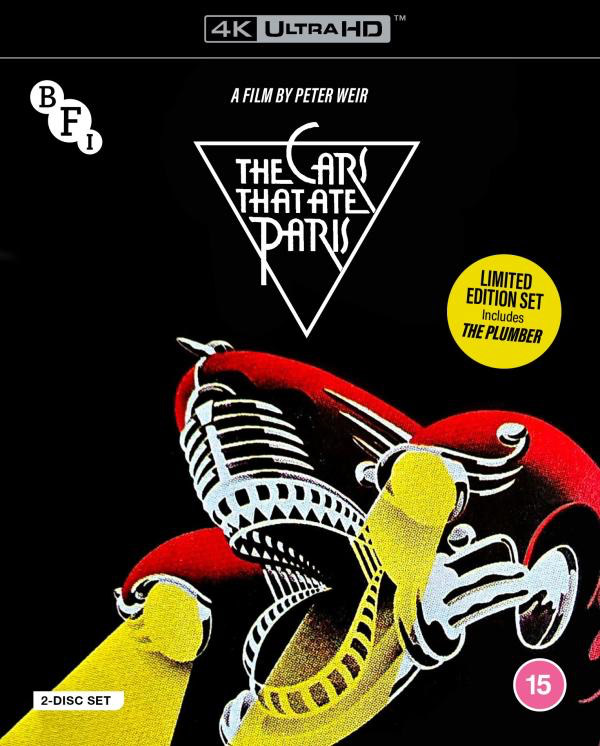
The Cars That Ate Paris / The Plumber
Australia 1974 | 88 mins
directed by: Peter Weir
written by: Peter Weir; from a story by Keith Gow, Piers Davies
cast: John Meillon, Terry Camilleri, Kevin Miles, Max Gillies, Danny Adcock, Bruce Spence, Kevin Golsby, Chris Haywood
The Plumber
Australia 1979 | 76 mins
directed by: Peter Weir
written by: Peter Weir; Harold Lander (story editor)
cast: Judy Morris, Ivar Kants, Robert Coleby, Candy Raymond, Henri Szeps, Yomi Abiodun
distributor: BFI
release date: 25 May 2026