
The Bride Wore Black
François Truffaut strays into Hitchcock territory with THE BRIDE WORE BLACK [LA MARIÉE ÉTAIT EN NOIR], in which Jeanne Moreau avenges the killing of her husband on their wedding day. Review by Gary Couzens.
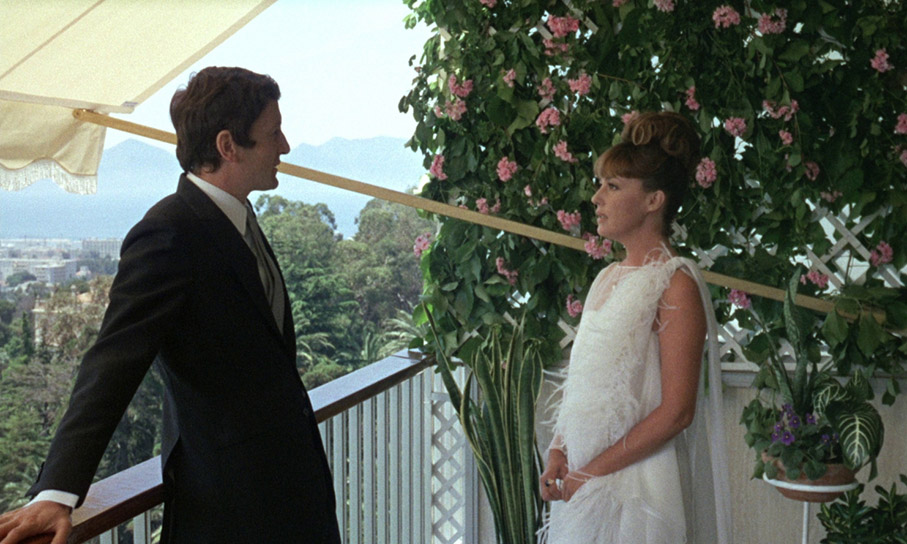
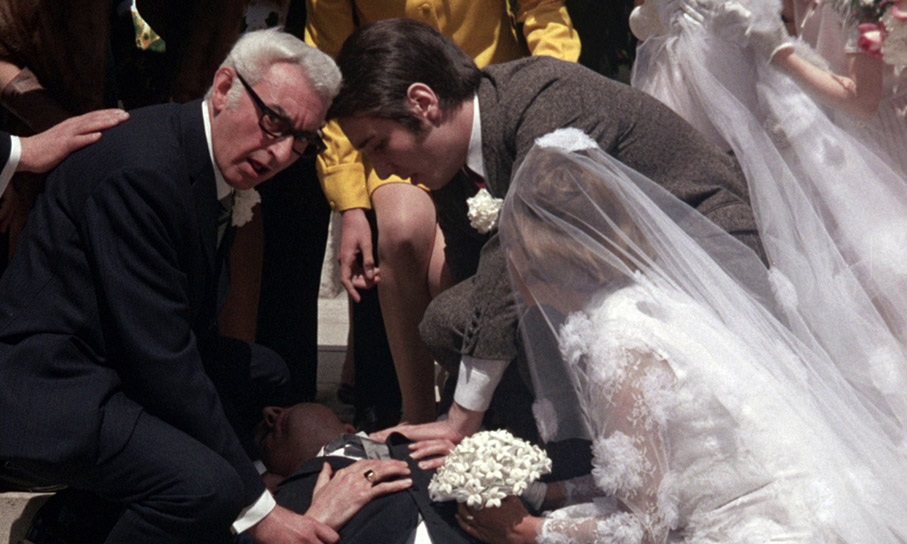
Julie (Jeanne Moreau) marries her childhood sweetheart David, but just as they leave the church after the wedding, a shot rings out and David falls down dead. Fired by revenge, Julie sets out to kill the five men responsible…
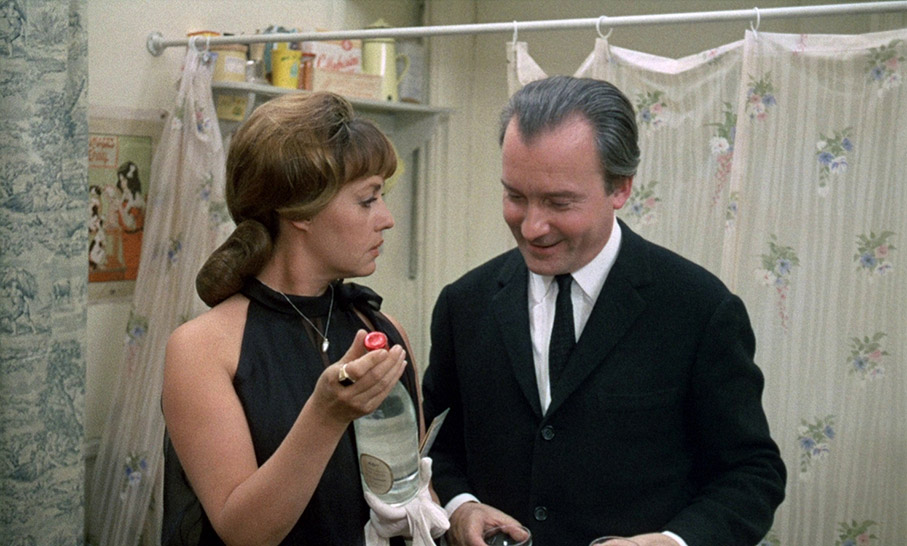
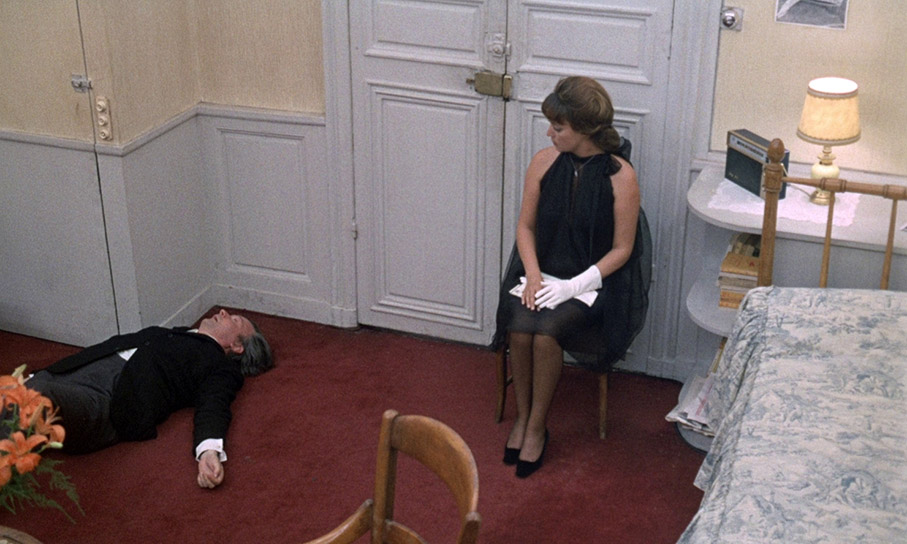
The Bride Wore Black (La mariée était en noir) takes a little while before showing the whole of its hand. It takes two murders (one by pushing over a balcony, another by poisoning) before we have the first flashback, thirty-six minutes in, of David’s killing. Further whys and wherefores will come later in further flashbacks. The film settles into a series of lengthy setpieces, as Julie seeks out the next of the men on her list. The Bride Wore Black has a good few studies of male vanity and entitlement. There is also some prime Sixties sexism, as some of the men are overt skirt-chasers. One of them has a bathroom floor covering made up of numerous false breasts. In fact, their not infrequent stupidity is part of the point. If they were quicker on the uptake, several plot developments would not have taken place.
With a screenplay by François Truffaut and Jean-Louis Richard, The Bride Wore Black is based on Cornell Woolrich’s 1940 novel of the same English title, originally published under the pseudonym William Irish. This was Woolrich’s seventh novel and his first in the “pulp” crime genre which he made his own. Truffaut’s love for crime novels, particularly the hardboiled variety published in France under the Série Noire imprint, ran deep. He had adapted a novel, Down There, by one of Woolrich’s compatriots, David Goodis, for his second feature, Shoot the Pianist (Tirez sur le pianiste,1960). Truffaut visited Woolrich in New York to negotiate the rights for The Bride Wore Black and went away not only with them but also the rights for another Woolrich/Irish novel, Waltz into Darkness (1947). He filmed that, one year and two films later, as Mississippi Mermaid (La sirène du Mississipi [sic]), but that’s another review.
The film came about because, while Truffaut’s previous five features had gained him plenty of acclaim at home, and also overseas if in mainly arthouse/cineaste terms, and his first, The Four Hundred Blows (Les quatres cents coups, 1959) had helped kickstart the major cinematic movement that became known as the New Wave (Nouvelle vague), they hadn’t always been especially commercially successful. This wasn’t unheard of amongst his fellow New Wavers. Indeed, it’s an illustration that the view of a country’s cinema by outsider cineastes doesn’t necessarily match those of the men and women putting down their francs for a night at the movies. So The Bride Wore Black was an intentional genre piece designed to make some money for Truffaut’s production company. Another reason was that Truffaut wanted to work with Jeanne Moreau again, after she had made such an impact in Jules et Jim. In fact, The Bride Wore Black is Truffaut’s first film with an unequivocal female lead. Jules et Jim is a two-male-one-female three-hander and while Françoise Dorléac and Julie Christie had played major roles in The Soft Skin (La peau douce, 1964) and Fahrenheit 451 (1966) respectively, in Christie’s case two of them, they weren’t those film’s protagonists. As the names on Julie’s list, Truffaut cast several major male actors of the time, Michel Bouquet, Jean-Claude Brialy, Charles Denner, Claude Rich and Michel Lonsdale among them, several of whom he would work with on later films.
The Bride Wore Black sees Truffaut straying into Hitchcock territory. Truffaut had been a devotee of the Master of Suspense from his days as a critic, and in 1966 had published his book-length interview Hitchcock/Truffaut. (Hitchcock had himself filmed a Woolrich short story as Rear Window in 1954.) However, in sensibility the two men were quite different. Truffaut lacked Hitchcock’s darkness, cynicism and ruthlessness, and that comes out in this film. (It also does in Mississippi Mermaid, and I’ll go into more detail in that review.) In fact, Truffaut’s Hitchcockian films are not amongst his best. Also, Truffaut’s affinity for children, and his making of several films about them (specifically about boys rather than girls), is also evident. There is a cute young boy in The Bride Wore Black, and you wonder if Hitchcock might have had him disposed of, as he did in Sabotage (1936). Truffaut’s own devotee Steven Spielberg even offed a young boy by means of a shark in Jaws, but he has said that that was something he could no longer do once he became a father. Truffaut by this point was the father of two daughters by his first wife Madeleine Morgenstern, from whom he was divorced in 1965. The cute young boy does enable an unlikely plot turn, which is rendered rather pointless by being resolved in the very next scene.
I can’t speak for the original novel, as I haven’t read it, but the pleasures of The Bride Wore Black the film are in its working out of its intricate plot. Jeanne Moreau’s sometimes opaque persona helps considerably. In this colour film, she is dressed in white or black or a combination thereof throughout. The shooting of the film wasn’t the happiest for Truffaut, as he clashed with Raoul Coutard, his cinematographer. Coutard was a major contributor to the look of the New Wave, particularly with his many collaborations with Jean-Luc Godard, from Breathless (A bout de souffle, 1960) onwards. He had worked with Truffaut on Shoot the Pianist and The Soft Skin. The Bride Wore Black was the last time they worked together. Truffaut also utilised a link to Hitchcock by hiring his once-regular score composer Bernard Herrmann, whose fine score incorporates parts of Mendelssohn’s Wedding March. Amongst the influences the film has had was Kate Bush’s song “The Wedding List” on her 1980 album Never For Ever. It also has similarities with Quentin Tarantino’s Kill Bill, though Tarantino, no fan of Truffaut, said he had never seen The Bride Wore Black.
The Bride Wore Black, a French/Italian coproduction, actually premiered in West Germany on 22 March 1968 and it opened in France and Italy on 17 April and 30 April respectively. It was released in the UK on 1 August, its main London venue being the Curzon Cinema in Mayfair. In 1969, it was shortlisted for the Golden Globe for Best Foreign-Language Film, but lost to the Soviet epic War and Peace.
sound and vision
The Bride Wore Black is released by Radiance on a Blu-ray (spine number 11) encoded for Region B only. In 1968 the film went out with an A certificate and now it’s a 12, in both cases uncut. Les surmenés isn’t on on the BBFC database as I write this, and does not appear to have had UK distribution before this release.
The film was shot in 35mm colour with spherical lenses, and the Blu-ray transfer is in the intended ratio of 1.66:1, the one Truffaut favoured for most of his career from The Soft Skin onwards. There’s nothing much to report about the transfer, which is suitably colourful (Moreau might be dressed only in black and white but other characters aren’t) and grain seems natural. I hadn’t seen the film before this disc, but the film has the rather heightened look of later 1960s Eastmancolour, with skin tones having a slight bias to orange, but that’s in keeping with other films from the period which I have seen, in some cases on 35mm prints.
The sound is the original mono, rendered as LPCM 2.0. The track is clear and dialogue, sound effects and music are well-balanced, so nothing untoward to report. English subtitles are optionally available for the main feature and the French-speaking extras (the Truffaut and Moreau interviews and the short film) and I didn’t spot any errors in them.
special features
Interview with François Truffaut (11:37)
Recorded in April 1969 for the French television programme A vous de juger, hence in black and white, this interview took place after the release of The Bride Wore Black, by a female interviewer (unidentified). It begins with showing the opening credits of the film. Truffaut inevitably starts by declining to reveal the film’s ending and talks about it as an intended second collaboration with Moreau and of finding a way to incorporate in his film the novel’s “meaningful and meticulous structure”. He sees Julie as a rather atypical character, a Countess of Monte Cristo if you like. He also says he encouraged Moreau to play the role like a man. Truffaut also describes his writing process, showing us a copy of the novel complete with notes and crossings-out.
Interview with Jeanne Moreau (4:41)
Moreau is interviewed for French television in October 1969, also in black and white, for L’invité de dimanche. A male interviewer this time, again unidentified. This seems like part of a longer interview, specifically here talking about The Bride Wore Black. She says that Truffaut was very shy in person, often communicating only with notes or via mutual friends. Many of her fellow cast members, such as the men playing her potential victims, were only on set five days at a time.
Appreciation by Kent Jones (15:31)
Newly recorded for this release, film critic Jones talks about the film, beginning with its origins as an intended lowish-budget genre piece intended to make money. Jones isn’t a fan of the original novel, finding it dependent on a gimmick which wouldn’t work in reality. He doesn’t think The Bride Wore Black is especially Hitchcockian either, as Herrmann’s score, good as it its, isn’t truly in synch with the film. Instead, he finds more parallels with other Truffaut films, in particular The Man Who Loved Women from 1977, which had in common with the present film Charles Denner in the leading role. Both are studies in male vanity, in particular of a womaniser. Julie, in one scene in costume as Diana the Huntress of Greek mythology, is seen as an avenging angel, an implicit fatal virgin. (Her marriage was not consummated obviously, though whether she and David ever slept together beforehand we are not told.) Jones also talks about Truffaut’s falling out with Godard, partly due to Truffaut’s urge to make more commercially-intended, conventionally-made films largely devoid of politics, entirely counter to Godard’s practice. Truffaut spoke about the need to have four ideas in any given scene, rather than as so often one idea in four scenes or so.
Barry Forshaw on Cornell Woolrich (8:51)
Also newly recorded for this release, critic and crime-fiction expert Forshaw gives us a brief overview of Cornell Woolrich’s work. Woolrich epitomises the writer once dismissed as a hack now being revered. However, for all his fame, Woolrich did not have a happy life. He was a self-loathing homosexual who had an unsuccessful marriage to a woman, and who lived a reclusive existence with his mother in a hotel, continuing there after her death. Forshaw also talks about Woolrich’s themes, with voyeurism often cropping up, and not least his obsessive protagonists. He dedicated one novel to his own typewriter and said of his own work, “All I was trying to do was to cheat death.” In short, Forshaw says, in order to know crime fiction you need to read Cornell Woolrich.
Les surmenés (24:37)
Written by Truffaut with the film’s director Jacques Doniol-Valcroze and Michel Fermaud, Les surmenés (The Overworked) is a short comedy from 1958. Doniol-Valcroze went on to a further career as a director and actor, in the former capacity mostly on television. This was his second short. Truffaut at this point had made his own second short film Les mistons the previous year but had not yet made The Four Hundred Blows. (His first short, Une visite from 1955, is lost.) The music is by Georges Delerue, who would go on to score ten of Truffaut’s features. We begin with a pre-credit sequence of just under five minutes, in which our narrator (Monique Chaumette) expounds a thesis that overwork is a condition of modern city life, as we have moved away from the rhythms of a more rural society. Catherine (Yane Berry) wins a local typing contest and takes a job as a secretary in Paris, living with her sister and brother-in-law. She juggles the attentions of her boss (Jean-Pierre Cassel) and a man she met on the train (Jean-Claude Brialy). While clearly a professional job of work (shot in black and white 35mm, aspect ratio 1.37:1 which looks correct), Les surmenés is slight, amusing in places, and best seen as an early work in some of its participants’ filmographies. Although it clearly makes no claims to be a feminist work, it certainly shows its heroine up more than once.
Theatrical trailer (1:51)
An American trailer with an English-language voiceover, with no actual dialogue included, presumably to avoid putting people off with the presence of subtitles. (I don’t know if the film was shown dubbed anywhere – it certainly wasn’t in the UK.)
Booklet
The limited edition of this release is now sold out, but it contained a booklet containing archival writing by Truffaut and Moreau and a contemporary article by Penelope Houston. The booklet is not included in the now-current standard edition, so in any case it was not available for review.
final thoughts
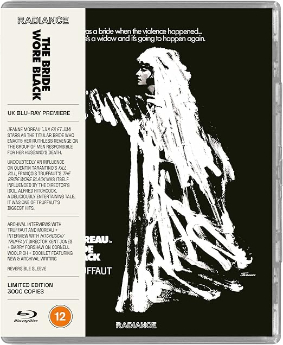
The Bride Wore Black
France / Italy 1968 | 107 mins
directed by: François Truffaut
written by: François Truffaut, Jean-Louis Richard; from the novel by Cornell Woolrich (as William Irish)
cast: Jeanne Moreau, Michel Bouquet, Jean-Claude Brialy, Charles Denner, Claude Rich, Michael Lonsdale
distributor: Radiance
release date: 15 May 2023