
Good grief
“And I have a faith that I hold on to — I’m not a traditionally religious person — but this faith I have as an artist is that if we do the work and we have conviction and we show up every day, something much bigger and older is going to try to speak through us. And whatever that is, is what the world needs. I just want to trust that. Otherwise, I’m lost.”
Director, Chloé Zhao1
Enjoyment in the darkness of a cinema is so wildly subjective. OK, you can see what’s coming… For someone trying to identify what is universally pleasurable is like trying to herd cats wreathed in thick smoke, one arm velcroed to a wall with Iron Maiden at 11 blasting into your vibrating skull via ear buds. Critical approval and widespread public patronage may successfully take an accurate temperature of what may become culturally relevant but I know a lot of people who enjoy being horrified (myself included) and being disturbed (ditto) by a movie. It’s not real horror. In the safety of a cinema, it can hardly be bone dread traumatic. Contradictions on a postcard, please. Besides, we have hands to cover our eyes and fingers to block our ears if things get too hairy. Commercially-minded studios (aren’t they all?) seem to fire scattershot blindly aiming for the zeitgeist’s common denominator while artistic directors make their films to their own satisfaction hoping the right audience will find their work compelling. As screenwriter William Goldman observed “Hollywood films reassure, independent films challenge.”
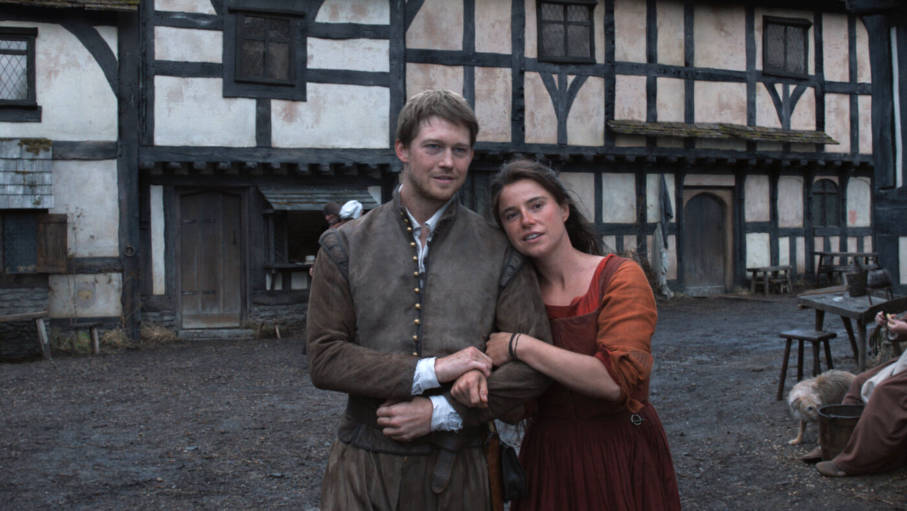
Well, Hamnet is a challenge, no doubt despite being co-produced by, of all people, Steven Spielberg. Moving, yes, affective, certainly but misery and grimness are pushy co-stars and given the story, there is simply no getting around that. Is the exposure to grief and misery pleasurable or even perversely enjoyable? Perhaps not, but it does speak quite directly to the nucleus of the human condition which is more than enough of a reason to make a film. If it weren’t Shakespeare as one of the two leads but some Joe Schmoe, the story would have no reason to exist. It’s the age-old tale… Boy meets girl (with added raptor on her arm). They become the parents of three children. Man leaves family to follow his art as he is suffering for it and his loving wife accepts and understands that he has to go. You only tailor so many leather gloves before recognising your true calling. A tragedy occurs at home. Man and wife are effectively broken by the death of their son not helped by the fact that the father failed to get home in time to say goodbye to his boy. Excuse me for having a human moment. “My boy,” is a phrase that can emotionally slay me as those two words in grief can pierce most empathic fathers’ hearts as it did just now.
Actor Jeff Rawle, playing the father of the doomed Cedric Diggory at the close of Harry Potter and the Goblet of Fire, repeated those words through unbearable grief and that heartfelt performance still stays with me. I am reminded of a story told to the late Donald Sutherland. He was once taken aback by hearing the following adage until realising what was meant by the words… “May your parents die, may you die, may your children die and then your grandchildren…” A shocked look was answered by “What other order would you prefer?”
Jessie Buckley (Agnes always heard as ‘Aness’ on the soundtrack) has been flying high in a number of diverse roles in the course of her 14 year film career with Wild Rose the break out performance where character and actress melded in such a beguiling way. I cannot wait for Buckley in full Elsa Lancaster mode as the new bride of Frankenstein in Maggie Gyllenhaal’s The Bride! (exclamation mark included) arriving in March this year. There cannot be any doubt that an actor’s skill is pushed to the limit in creating believable raw grief. I imagine it’s very difficult to be so vulnerable in front of a disinterested crew with the lens a few inches from your face. But Buckley is fearless. Ever since being at the birth of my son, I’ve found births on screen and their intensity hard to bear. After 24 hours of labour, I’m sure my wife would counter with “YOU found them hard to bear?”. And Buckley makes you feel every contraction in both birth scenes. Yes, there are two of them. We are spared the third due to the second yielding twins. She is compelling, absolutely convincing and at the epicentre of the earned final catharsis. Rarely has a smile been so affecting on screen. Awards are going to pour in. She’s gonna need a bigger mantlepiece… Paul Mescal (no slouch in the acting department himself) complements Buckley’s portrayal as an anguished writer forced by tragedy into a grief stricken father with only his talent to help him bear the loss. The extent of their raw grief does not allow husband and wife to be mutually supportive… because he wasn’t there. It’s not a fair accusation despite the truth but it is very much an accusation from a wife to a husband in the heat of their most dreadful moment.
The character played superbly by Paul Mescal is not often identified as the bard if at all if my memory serves. So you go in having that information pre-viewing. If you know anything about Shakespeare’s life, you’ll know that his twin son dies from the plague. It’s hardly a spoiler as this fact is featured in several of the mainstream critics’ reviews. This tragic event – in the presumably mostly fictional book – is seen as a jet black muse to enable a father to compress his profound grief into an artistic triumph. It really is the perfect antithesis of Shakespeare in Love (was Shakespeare in Grief ever considered as a title?) As to the oddness of the actual title, it’s explained before the film starts with a card saying essentially “We know that if you’ve not read the novel, you’re sitting there thinking why have we misspelled ‘Hamlet’? Well, ‘Hamnet’ and ‘Hamlet’ were considered interchangeable as a boy’s name in Shakespeare’s era. So that’s that sorted then.
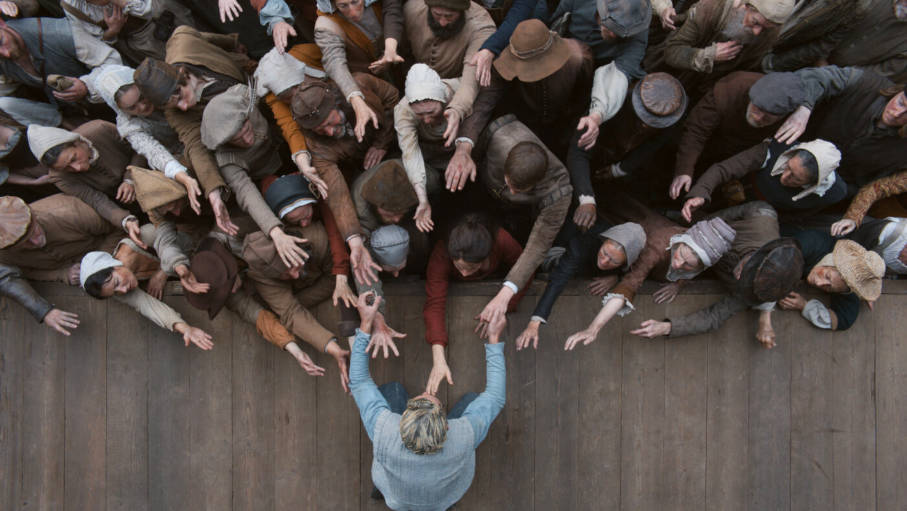
What light (“through yonder window breaks,” sorry, wrong play) was there to be had in this film? Yes, the principal relationship between Will and Agnes had moments of levity and love sandwiched tightly between one grim situation and another. But from me, there were two smiles and a full laugh, the first two bracketed the film. Despite my normal (!) sense of humour, like columnist Robert Crampton’s response to the film, I was the only one who laughed out loud at a line of dialogue that had to be written for laughs. As Agnes worms her way through the crowd upset hearing her dead son’s name spoken on stage, she hears her husbands’ written words for the first time. Echoing every bored child first exposed to Shakespeare, she says “What are they talking about?” In a three-quarters full cinema (good news in itself), not a fellow chuckle was heard. I laughed a little more remembering the great Ken Robinson and one of his stand-up funny education TED talks. He imagined that even Shakespeare had an English teacher who would say in exasperation “And stop talking like that!” The first of the two smiles was at the pre-film classification card that said we were about to experience ‘moderate sex’. At least most of the cinema mumbled some reaction at this admission. My second smile was more of an afterthought. It has been reported by Bill Bryson in his book on Shakespeare, imaginatively titled… uh… Shakespeare, that the bard introduced the first recorded use of 2,035 new words scattered throughout his oeuvre. Google AI confirmed that about 1,700 are still in use today. Now that’s staying power. I imagine a great number of people are oblivious to this fact when saying such phrases as; “in my heart of hearts,” “wild-goose chase,” “break the ice,” “good riddance,” “wear your heart on your sleeve,” “melted into thin air,” “a foregone conclusion,” “the world’s my oyster,” “what’s done is done,” and “neither here nor there.” And that’s just for starters. So my thought was of a Shakespeare virgin who’d barely heard of the man going to see Hamnet and dismissing it as “…a film full of overused, well known phrases and clichés.” Speaking of dialogue, (and what’s done is done…) a lot of it passed me by, not Shakespearean (the quotable Hamlet is nestled into this nation’s DNA) but ordinary English. Again, it could be an older man’s lack of high end hearing.
Critics often use the word ‘earned’ to either forgive or accept an indulgence, a left field event or an out of character moment. Well, here’s the rub as Will might say. To earn or justify what is undeniably a richly powerful, affecting climax, how much time should the filmmakers let the audience navigate the few ups but mostly downs of this family’s story? I went to the cinema with a group of five, all but one over sixty but we seemed to be unanimous, including the outlying 29 year-old, on the walk back to the car. It seemed to be just that little too long. I’m not suggesting this observation is in any way correct artistically or otherwise but even though none of us was disengaged from the drama throughout, you just had a hope that director Zhao might find a way to elicit emotional responses with a little more zip. But perhaps the climax needs the cultivation of about two hours of emotional turmoil to earn the release afforded by the climax. To quote all of my friends, “I’m glad I saw it but I don’t need to watch it again.” Take that as a recommendation or a warning flag. You decide.
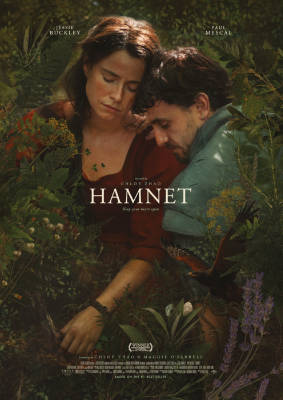
Hamnet
UK / US 2025 | 125 mins
directed by: Chloé Zhao
written by: Chloé Zhao, Maggie O’Farrell; from the novel by Maggie O’Farrell
cast: Jessie Buckley, Paul Mescal, Zac Wishart, James Lintern, Joe Alwyn, Justine Mitchell
UK distributor: Universal Pictures Int (UK)
UK release date: 9 January 2026