
Richards livs1
Director Edgar Wright’s long gestating, more faithful version of Stephen King’s THE RUNNING MAN sneaks in to the last weeks of the far flung future year the story was set in, 2025. Camus is almost afraid to ask but is this what we’re heading for or are we already there?
“I always thought that The Running Man had something to say. (Orwell’s) 1984 was the touchstone I kept coming back to. 1984 is literature. The Running Man, the book, is just an entertainment with that subtext that says “Don’t necessarily trust. Think a little bit about what this media is doing to you. What is it preparing you for?”
Author Stephen King, in conversation with director Edgar Wright
in Sight and Sound Volume 36, Issue1, Winter 25/26
“No advance in wealth, no softening of manners, no reform or revolution has ever brought human equality a millimeter nearer.”
George Orwell
Equality. Its close cousin, equity, has become a third of a modern acronym, the collective name of departments set up in companies all over the world to essentially address personal bias and system-baked unfairness. And DEI’s goal and aims are laudable and desirable. But the gulf between rich and poor in the world is now bigger than it’s ever been. Even Google’s AI’s answer confirms this… “The global gap between rich and poor is extreme and widening, with the richest 1% holding more than double the wealth of 6.9 billion people, while the poorest half own just 2% of total wealth.” We still have to travel a long way before any kind of equality is established on this planet. It’s human nature which we are trying to override, like performing an MOT while the car is doing 85mph… Somewhat difficult. As a number of famous filmmakers (from Mel Brooks to Martin Scorsese) have said independently, movies don’t change anything but they can surely hold up a giant mirror to try and wake us up or at least get some people to dimly accept that something might have to be done to get the tanker of dark inevitability pointed in the right sunnier direction. It’s not exactly a secret that the world today is suffering from rampant authoritarianism, despotism and a level of societal fracturing aided by the propaganda and lies spread on social media platforms. Once the truth dies (or the context in which no one can believe anything they read or see), so do systems of governance. Truth should be a universal constant that we can all acknowledge and use as bedrock for our interactions. Well, even Stephen King (originally publishing The Running Man with the pseudonym Richard Bachman in 1982) and director Edgar Wright can’t solve these huge problems but at least their film can remind people, who may have either forgotten or were never aware in the first place, that broken human societies need repairing.
The first cinematic iteration of Stephen King’s novel, 1987’s The Running Man, directed by Paul Michael Glaser of Starsky and Hutch fame, is a film very much of its time. With a nailed-to-the-80s synthesized score from Harold Faltermeyer, the film jettisons a lot of the novel’s tone, desperation, bleakness and politics and goes all in on the truth coming out with a sprinkle of revenge. Today, it seems almost gauche to feature ‘the truth’ as climactic satisfaction. Today people have a digital rainforest to hack through, and many don’t because while being assaulted with a firehose of media saturated with falsehoods and poison, there’s often no truth guaranteed to be found. Again, as Orwell said “In a time of universal deceit, telling the truth is a revolutionary act.” The violence of the game show is front and centre meted out to some seriously and riotously camp executioners. The film comes over as more an absurd, comic parody of base human nature because it was (then, not now) hard to believe the braying stupidity of amoral, bloodthirsty crowds. It’s oh, so easy to believe now. While I’m happy to watch a pair of talented dancers do their thing on Strictly, I cannot bear being in the room when the crowd is whipped up into a fake frenzy. What is it about crowds?
With Arnold as the star, the film is more a vehicle for the tough, moral strong man he seemed to always play. The post-death Bondian quips, none of which land well, (“He had to split,” caps the death of the chainsaw executioner cut in half from genitals upwards) seem ported over from another time even from the film’s own era. Bless him but Arnold’s never really been an actor but an icon writ sinew and muscle. His character doesn’t have depth just raw strength and it tickled me to hear, before the phrase became a meme, Arnold say to the TV executive Killian “I’ll be back…” three years after he made that line so memorable in the film that cemented his stardom. Star Trek did a similar episode, Bread and Circuses, where TV ratings are high for gladiatorial combat and death on screen. There’s even a Trek misquote in the film, “Mr. Spock, you have the comm,” which should have been ‘conn’, an old nautical word for navigation control. The film also predicts the technology of replacing faces digitally which must have seemed like absurdly futuristic magic back in 1987 and is now almost technically mundane.
The source novel, as is to be expected, has a lot more going on than just braying crowds, the Austrian oak and silly straw men for him to vanquish with a less than amusing quip. King’s everyman, Ben Richards, is desperate. His daughter is dying and his wife is reduced to prostitution to bring some money in for less than stellar medical help. Blacklisted for repeated insubordination, Richards is at the end of his tether. As a father, I can empathise with having a seriously sick child and being powerless to help. It happened once. Once is way more than enough. I’ll do anything in future to avoid that sense of desperate ineffectiveness. Richards signs up to be a human victim to any game show that can bring in cash fast. He agrees to take part in a game where death has the best odds over survival, the most watched TV show globally, The Running Man…
It’s clear from his reverence for the source material that the novel has been in director Edgar Wright’s mind for some time. After Stephen King gave a quote for publicity purposes for the release of Wright’s Shaun of the Dead 21 years ago, the two started corresponding and finally met in 2025 resulting in a very warm conversation printed in the latest Sight and Sound magazine. No filmmaker can stay 100 per cent faithful to a novel but the socio-political subtext is much more pronounced in Wright’s take and while the 1987 version relied on cheap laughs and ridiculous hired killers, 2025’s version could be seen as the Jason Bourne to the camp Roger Moore Bonds. This new one has edges. And some are sharp. And they are very, very welcome.
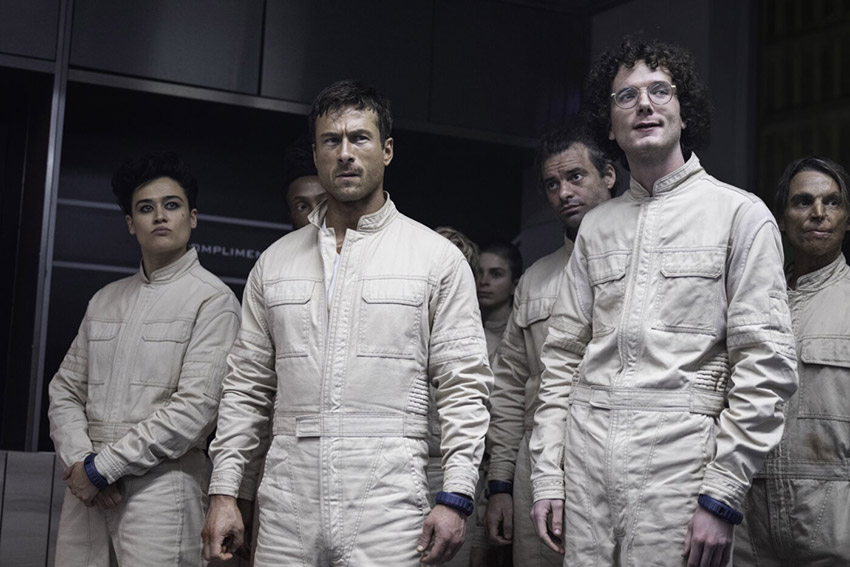
Glen Powell plays Ben Richards, a handsome, square-jawed, ripped and rugged actor who can act well (this is a plus) and who channels Brett Goldstein’s Roy Kent from Ted Lasso, balled fists and incipient violence bubbling under a distressed surface. You may remember him from Top Gun Maverick in which he played, to all intents and purposes, an updated 21st century Ice Man. We just knew he was cool and confident to the nth degree and had the good looks, flying chops and pumped body to back him up. In 2025’s The Running Man, he is desperate to claw in some money to hire a medic who’s able to cure his ailing daughter. But he’s been blacklisted across the construction industry for insubordination and from his character, you just know he was rallying against injustice every single time. Ben would have his hands full in our world in its current state, let alone some imagined future, one we seem to be slowly mutating into. His only option is to apply as a television contestant where humiliation and even murder is sanctioned for ratings. His anger attracts the producer of the global mega-hit, The Running Man and, well, he’s off and running. Powell puts heart into a performance that is mostly suffering when not fighting for his life. And he makes us feel every punch and shock to his body.
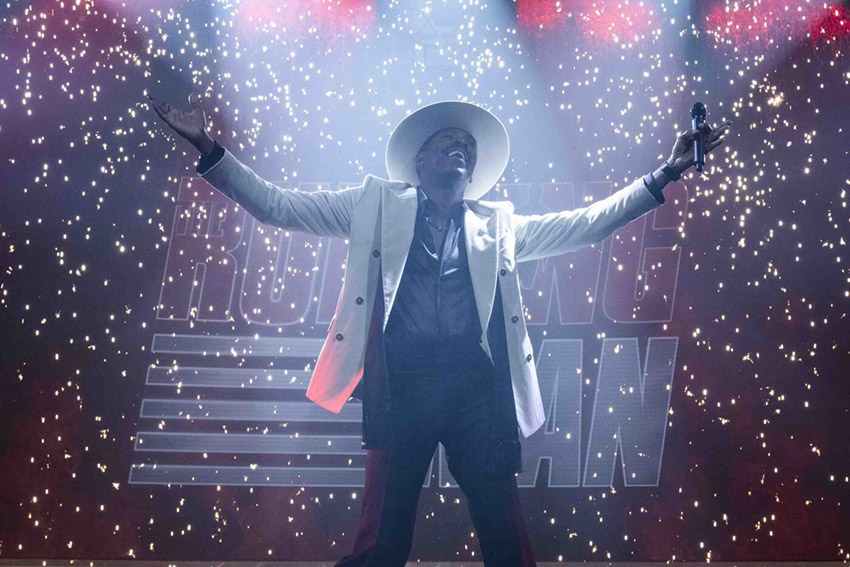
The first thing to note and I think the most germane to its underwhelming box office performance, is tone. The Running Man is a blatant political critique and Wright treats it seriously. His films have, for the most part, performed well enough and reviewed very well to mark him as a director worth betting on each time out of the gate. His biggest hit, Baby Driver, made him a bankable filmmaker but he insists on making original films (“Shame!” roared no one at all) which Hollywood don’t really do any more. I loved Last Night in Soho but it too underperformed. Wright’s comedic editorial style as employed in the Cornetto trilogy (Shaun, Fuzzand World) is muted for The Running Man which demanded a new style of editing and direction, less chop and more chops. You can feel the grip on the reins is more measured and while the action is covered expertly by both director and editor Paul Machliss, there are far fewer editorial fireworks in evidence at transitional points. It’s Edgar Wright so there are always going to be a few playful shifts in scenes; match cuts of a close up of Richards laying down which wipes a passing torturer to his friend Molie (William H. Macy) screaming in agony having his fingers viced and pancaked. There are lots of wipes including a graffiti spray which I thought was giving us an indication of what the neighbourhood was like which was a nice touch. Even nicer was the real reason for the red spray wipe, revealing who was spraying and what. There’s a reminder of a character’s identity as a flashback match cut to said character dragging on a cigarette. But overall, Wright is faithful to the desperate tone of the book so playful The Running Man is not.
We are often reminded that we are watching behind the scenes of a TV show from the leading man’s experience and every now and again, we cut in to show the programme. The unreality and impossibility of playbacks of live events, covered from every conceivable angle, is somewhat mitigated by flying orb cameras (not drones as they have rotor blades) which seem to be everywhere but we are still treated to edited footage which any averagely educated audience could figure out was fake to its roots. I always remember that insert close up of Captain Kirk’s finger jettisoning a pod during Yellow Alert apparently killing a crew member. Even as a child, I thought anyone could edit that close up in to a ‘live’ feed and have it appear it too was the ‘truth’, in temporal and every other way. And footage is altered to suit the suits’ needs painting Richards as a heartless assassin for the crowds to rally against. Like Blade Runner 2049, The Running Man’s world is not as digitally soaked as our own even though there is some supposedly high class, enormously fast digital jiggery-pokery going on. Steve Jobs does not exist in both worlds. It was a buzz to see DV tapes back in action.
Despite Richards reminding those rebels who help him that he cares only for his family, he’s lured into becoming a symbol, the vanguard of an imminent uprising of the impoverished underclass – if he wins. Richards’ own people live in run-down shanty towns. As Richards gains in stature on the game, his people start to rally around him. Graffiti and posters start to spring up, one in particular stood out… “Richard Livs!” (sic). I thought this a rather brilliant way to indicate that this underclass have few outlets of education. And anyone without an education is mired in place as just another ‘dot’ as Orson Welles once described his victims in The Third Man. After being forced to hijack a car and thus also kidnap a middle-class female, Amelia who has believed all the lies and is rightly fearful for her life, Richards points at her designer silk scarf. He reminds her that the money she spent on that one item would have enabled him to fund a doctor’s visit which could have cured his daughter’s illness. It is a point against wealth that is made ad infinitum but plays here as fully character-authentic. Amelia eventually comes around to seeing things Richards’ way after gaping at footage of her doing something she clearly had not done and joins him to atone for her blithe unsympathetic lifestyle. She’s in it for a relatively short period at the close of the film but the actress Emilia Jones makes a real impression. She has the funniest line (earned by this time) as she’s filmed by a flying orb camera hurtling through the sky hoping her parachute opens… I also have to commend Josh Brolin as Killian, the lead executive and creator of The Running Man. He is about as suave, charming and devastatingly heartless as any character seen on screen this year.
Crammed with moments in the details which no doubt will reward repeated viewings, The Running Manmakes all of them count in terms of character sketching or if you’re eagle eyed, light relief. A taxi passes a restaurant named after King’s pseudonym, Bachman’s. King’s wife, Tabitha, is also referenced in the name of a diner, Tabby’s. Keep it in the family, Edgar. Good quality, rugged clothing company Carharrt gets so much product placement, I’m surprised we didn’t get a close up of the label or at least an ad in The Running Man show itself. I happen to be a fan of the company so I’m bound to notice stuff like that. And Powell looks cool as the clothes could still be anchored to the poorer manual worker. The clothes, however great they look, are made for the physically working man so it makes sense for Richards to be outfitted this way. Look who’s the face on the New Dollars banknotes, Powell’s predecessor, Arnie himself. British based American comedian and Radio 4 stalwart, Rich Hall, turns up as a homeless man selling his hat. Nice to see him on the big screen.
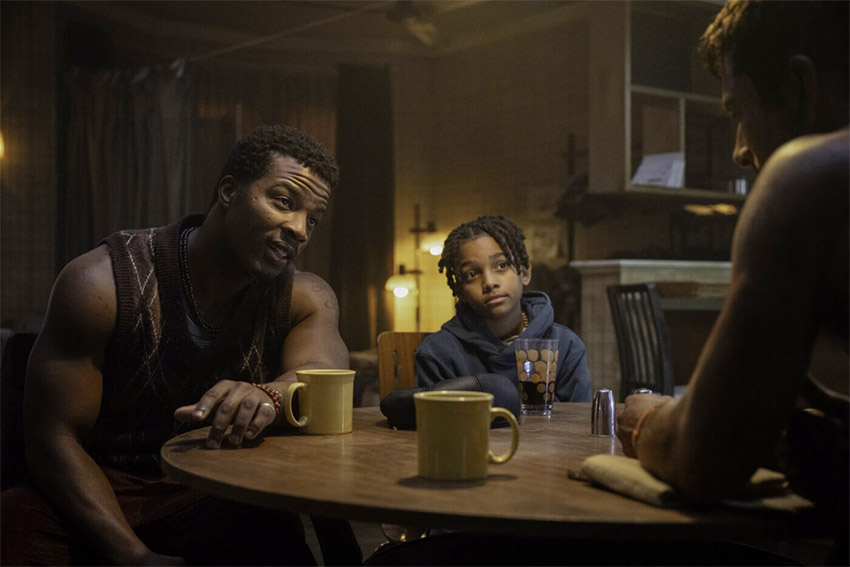
There’s a book called Save The Cat! by Blake Snyder. The subtitle is The Last Book on Screenwriting you’ll ever need. Boiled down, the title refers to the idea that the quickest and most efficient way to secure an audience’s sympathy is for the protagonist to save a cat, pet the cat, be nice to the cat. Let’s conveniently forget Blofeld in the Bond series. But in The Running Man, the working class hero, so short of funds, recognises that there are people still worse off than him and drops a few coins into a busker’s hat. Bear in mind that Richards has been allowed some small budget for survival from the executives. How nice of them. It’s a throw away moment but laced with meaning. On receiving bad news, Richards explodes in rage and smashes a TV monitor. The scene is played out without conventional sound effects, dulling the sound on the first shattering impact, asking the audience to experience the emotional numbing and not the outer chaos and loss. There is an open cupboard at Molie’s (William H. Macy’s) place where Richards is fitted out with different identities. He recognises an explosive substance (“Not for sale…”) and boxes with the initials BFE in the cupboard. This raised a smile. I’m a member of BFE (British Film Editors) and wondered if this was the editor Paul Machliss’ little in-joke. It stands for something else which I won’t spoil here. In closing, the ending of the film differs in significant detail from the ending of the book. Probably commercially driven, I totally agree with the decision to change the ending. There’s a little thing called hope that we all have to cling on to by the tiniest thread.
The Running Man is a solid, thoughtful and left leaning thriller with a vivid subtext of a world unravelling through imminent class war. To my mind, it presents the protagonist’s morality as something I hope audiences find perfectly willing to empathise with. When you create a world this heartless, this authoritarian, this vile, one act of kindness feels like a benevolent rupture in space and time in its context when it should be our ‘normal’. Our own world is divided and norms and truths have been under attack for over a decade not least through the venality of our leaders, the deceptions of bad actors on social media and the practise of editing, visual effects and now tsunamis of AI. As Stephen King reminds us, “Don’t necessarily trust. Think a little bit about what this media is doing to you. What is it preparing you for?” I hope, for all our sakes, we never get as far into the swamp of degradation and the free reign of our worst instincts as featured in the world of The Running Man. I just don’t know what or who might stop that from happening…
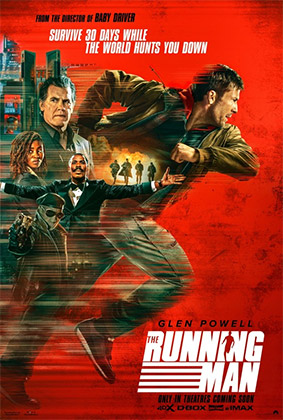
The Running Man
UK / US 2025 | 133 mins
directed by: Edgar Wright
written by: Michael Bacall, Edgar Wright; from the novel Stephen King
cast: Glen Powell, Alyssa Benn, Sienna Benn, David Zayas, Greg Townley, Karl Glusman
UK distributor: Paramount Pictures UK
UK release date: 11 November 2025
- A subtle indication that the poor underclass featured in this film are denied a good education. Educated people question things. That would never do.[↩]