
Bad habits
Gort revisits a nunsploitation title from 1974 that he last watched on DVD 19 years ago and remains unsure about THE SINFUL NUNS OF SAINT VALENTINE [LE SCOMUNICATE DI SAN VALENTINO] but has to hand to Indicator for the quality of the 4K transfer and special features on its recently released UHD.
If you’ve never heard the term nunsploitation, I’d suggest that there’s a gap in your film education. Whether it’s a gap you’ll want to fill will depend on your reaction to the following words: cult, exploitation, historical drama, sex, nuns, lesbian, sadomasochism, religious persecution, church corruption. I think that covers the basics. With that in mind, does the 1974 The Sinful Nuns of Saint Valentine [Le scomunicate di San Valentino] qualify for that badge of delicious dishonour? I’ll let you be the judge, but rewatching the film I have a sneaking suspicion it’s a label that its director Sergio Grieco would prefer not be applied.
I first discovered this film back in 2007 when it was released on DVD in the UK as part of a three-film box set by Redemption, bless ’em, titled Let Us Prey. Ha! You see what they did there? The release was subtitled A Box of Nunsploitation and Sinful Nuns was packaged with the oddball 2000 Sacred Flesh and the 1977 Justine, an adaptation of De Sade that seriously sanitised a novel that would be nigh-on impossible – not to mention unwise – to faithfully adapt for the big screen anyway. When it comes to Sinful Nuns I was, I have to admit, not that impressed, having come to the film hoping for the full-blown nunsploitation pleasures that its title seemed to promise, unaware at the time that its original Italian title, Le scomunicate di San Valentino, actually translates as The Excommunication of Saint Valentine. Not quite as saucy, I think you’ll agree. That said, on paper the English language title is not wilfully deceptive. After all, the main location is a Spanish convent named Saint Valentine, it’s populated by nuns (as these places tend to be), and by Christian traditionalist standards their behaviour is genuinely sinful. It’s just that we don’t get to see much of it. And that, frankly, is a prime reason that most nunsploitation fans will tune in.
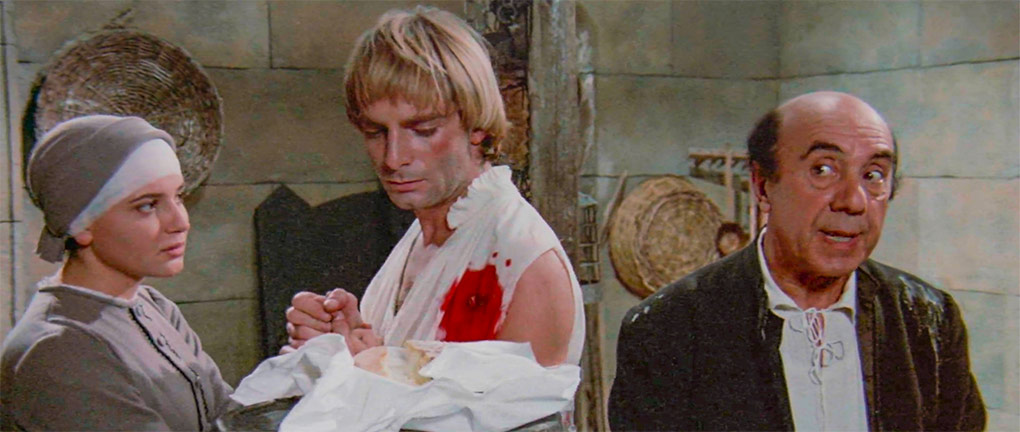
The setup certainly has fruity potential. Accused of heresy and murder, good-looking young Esteban (Paolo Malco) is injured whilst fleeing the soldiers of the Inquisition and takes refuge in the lodge of Joaquin (Gino Rocchetti), the verger of the Saint Valentine Convent in which Esteban’s girlfriend Lucita (Jenny Tamburi) resides. Joaquin acts as a reluctant go-between for the pair, knowledge of which is used by roommate Josefa (Bruna Beani) to blackmail her way into Lucita’s nightgown. When the naughty Josefa is murdered in the corridor by an unseen assailant, it’s Lucita who gets the blame. And when she’s placed in the hands of the Inquisition’s most notorious persuader, Father Honorio (Corrado Gaipa), the deliciously named Abess Doña Incarnación Diez de Montalbo (Françoise Prévost) begins making moves on young Estaban.
It all sounds like the recipe for nunsploitation heaven – a convent, a strapping young man, a sexually frustrated mother superior, a lesbian roommate, and the prospect of naked torture. And if you want to keep on hoping that the movie will deliver on all of these elements then I’d skip to the end, as I’m about to go on a small spoiler binge.
There’s flesh on display here, but less than nunsploitation fans might expect or hope for, and the sex tends to play out on the wrong side of tasteful, thanks to a careful arrangement of bedsheets and bodies and a refusal to get beyond the grappling stage, at least while the camera’s present. One naughty sister gets a topless whipping, and Josefa appears really fond of Lucita’s bed sheets, but don’t get your hopes up for Lucita’s encounter with Father Onorio, as faced with the prospect of being tortured for Jesus, she rolls out a false confession and calmly prepares herself to be burned alive for her heresy. There’s a sense that Sinful Nuns was either unwilling to go the whole hog or was the victim of censorial times in a country where the Catholic church, at least in the early 70s, still had some serious sway.
This leaves the plot to carry the can and it’s not really up to it. Indeed, coming back to the film after a near 20-year break it seems clear that Grieco saw the film more as historical drama than the exploitation work its English language title implies, hence the restraint shown on elements that you’d normally expect to be the film’s raison d’être and a second half in which activity within the convent takes an increasingly back seat. I have to say that our Esteban is not the most enigmatic of leading men, and as a couple, he and Lucita are a pious mixture of chaste and sexually charged, snogging passionately whenever they are left alone but going no further because Estaban respects Lucita too much. That doesn’t stop him sleeping with the Abess in a vain effort to protect his loved one. Credibility takes a dive in the final third, when walled-up nuns need only a couple of days to go all Devils of Loudun in distinctly sub-Ken Russell fashion, while conflicts are brought to an impossibly neat conclusion by a new Grand Inquisitor whose smiling understanding and benevolence suggest that the Inquisition was overseen by Father Christmas.
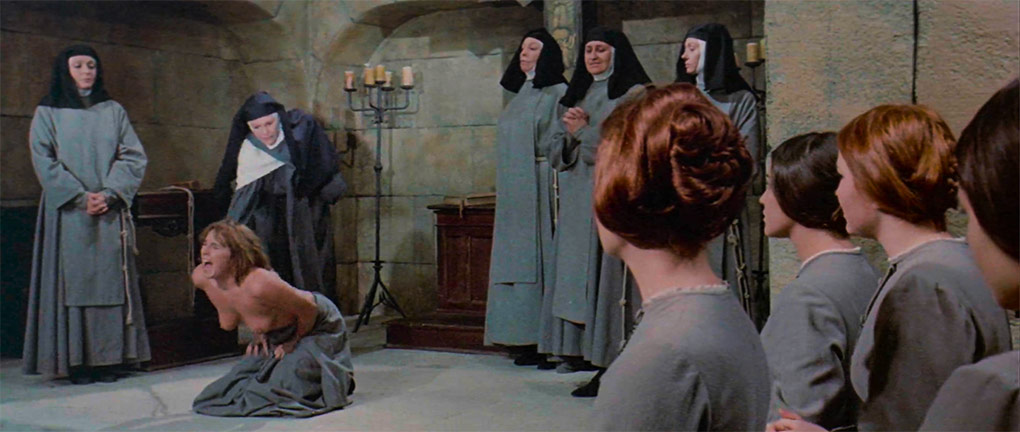
The Sinful Nuns of Saint Valentine moves at a lick and features handsome photography courtesy of first-time cinematographer Emore Galeassi that makes impressive use of the scope frame, and its digs at church hierarchy and the whole idea of bundling your daughter off to a convent because she falls for someone her sniffy parents do not approve of are certainly worth making, if not exactly revolutionary by this point. I certainly found it more entertaining this time around, but still feel that, for the most part, it treads an unexciting and unadventurous genre path to its too-pat finale. It’s certainly not without interest or merit, particularly in the character and actions of the Abess, a rather splendid turn from Françoise Prévost, who creates in her a woman that you might just risk the consequences to be seduced by. But if you come to the film with expectations artificially inflated by the sleazier entries in the 70s nunsploitation cycle and a title that hints at promises it never intended to keep, it’s hard not to agree with the IMDb commentator who said of the film simply, “Sinful nuns…not sinful enough!”
sound and vision
Wow, this is quite a leap. When I first encountered The Sinful Nuns of Saint Valentine it was on DVD in a letterboxed transfer, the lowest of standard definition digital disc resolutions. Within those restrictions, it wasn’t at all bad and was at least in the correct aspect ratio but did have problems with consistency and a couple of blips immediately following reel changes. I’m unsure if the film had a subsequent UK Blu-ray release, but Indicator has leapfrogged over that to deliver its own 4K restoration on UHD (there’s also a Blu-ray edition that I’ve not seen). Putting the old DVD and this new UHD side-by-side is a real night and day comparison, as the 4K restoration here is top notch, delivering a crisp and clean transfer with very good detail definition, a generous contrast range, a warm colour palette, and a very film-like feel overall – you’ll have no problem spotting the film grain here.
The soundtrack is DTS-HD 2.0 mono and once again is a quantum leap over the one on the Redemption DVD, which had a heavy treble bias, some background hiss that was occasionally joined by a hum and intermittently blighted by the odd pop, crackle and even bonk. Here there is a still a small treble bias that gives words in which the letter ‘s’ figures prominently a slight crispiness, but otherwise the track is clear and free of wear and damage, with no background hiss or other errant noises.
Optional English subtitles kick on by default.
special features
Audio Commentary with Rob Barnett
Although titled on the disc as a commentary by Rob Barnett, this is actually a two-hander with Barnett and Adrian Smith, who initially functions as a host and feed man but is soon contributing as much as his commentary companion. I’m just a little torn here, as although I found my interest starting to wane before the end (I listen to a lot of commentaries, and it takes a special talent to keep that information flow arresting for a couple of hours straight), the volume of film and genre related facts delivered here is impressive. There’s discussion about the nunsploitation genre (no surprise, but welcome nonetheless), the delightful news that these films were described as “convent sexy” movies in their day, plus plenty on the lead actors, director Sergio Grieco, composer Coriolano Gori and producer and co-story writer Gino Mordini. We get info on the true story of the Nun of Monza that was the partial inspiration for the story here, and on Bruno Mattei ‘s1980 film The True Story of the Nun of Monza [La vera storia della monaca di Monza], as well as details on the peculiar decision to censor the 1997 re-release of Sinful Nuns to secure a 14 certificate when it was initially released uncut and rated 18.
David Grieco: The Genetics of Celluloid (24:48)
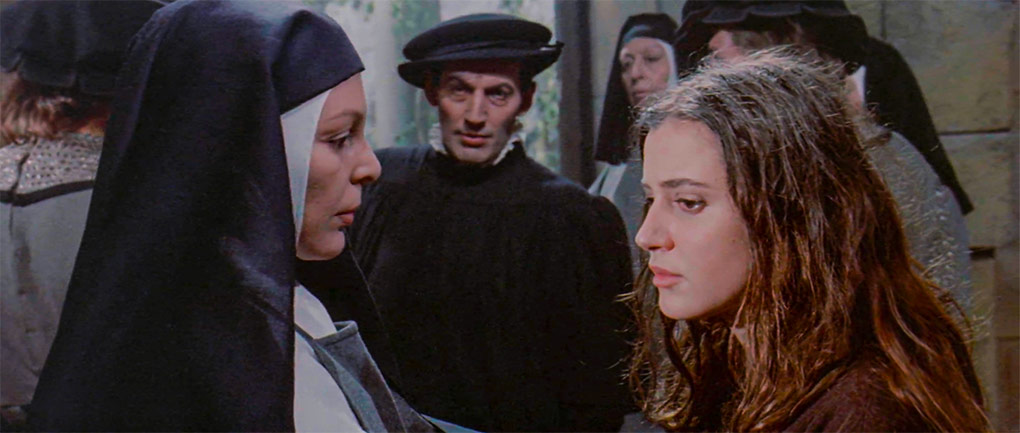
An interview with David Grieco, the nephew of Sinful Nuns director Sergio Grieco and now a filmmaker in his own right. He shares some fascinating details about his family history (as Secretary of the Italian Communist Party, his exiled grandfather Ruggero Grieco led a nomadic life that was partially responsible for his son Sergio entering the film industry), recalls being taken by his uncle onto the sets of films he was shooting, which he stopped doing when he became a film critic. This also saw him delegate the task of reviewing his uncle’s films to his assistant. He reveals that despite thinking of himself as an auteur, his uncle spent most of his career making what he described as “rent-paying films” in a whole range of genres, with the only two films he was proud of being Man of Legend (Il sergente Klems, 1971) and his final film, Beast with a Gun (La belva col mitra, 1977). David’s own journey from writing film criticisms to penning screenplays to eventually directing is also an intriguing one that includes twice almost having his work directed by Bernardo Bertolucci, and his long term friendship with Peir Paolo Pasolini extended to him writing the case for the plaintiff in the trial of his alleged murderer, Giuseppe Pelosi. This featurette was produced by Eugenio Ercolani and Andrea Meroni, both of whom are key to the special feature that follows.
Nuns Upon a Time…in Italy (48:27)
Written and directed by Andrea Meroni, this captivating exploration of what became known as the nunsploitation genre is built around interviews with Killer Nun director Giulio Berruti, filmmaker and film historian Corrado Colombo, the aforementioned film historian, Eugenio Ercolani, actors Martine Brochard, Renato Rossini (aka Howard Ross) and Zora Kerowa, and director Claudio Fragasso. There’s also a brief but relevant audio interview from 2016 with actor Eleonora Giorgi. Berruti paints a less than rosy picture of an Italy in which Catholicism held repressive sway, claiming that even women were forbidden to look at their own genitals, and suggesting that the “naughty nuns” films may have sprung from fantasies that men had about nuns who carried out nursing duties during these oppressive times. Colombo remembers the shock of first seeing nuns portrayed on screen as “beautiful, alluring, fascinating, and quite uninhibited,” and admits to sneaking in to see them at a young age after doctoring his train pass to see Ken Russell’s The Devils. Ercolani makes a case for Eriprando Visconti’s 1969 The Nun on Monza [La monaca di Monza] being the kicking-off point for the genre, notes that its rise in popularity coincided with the launch of other exploitation subgenres in Italy, and remarks how well shot and scored many of the nunsploitation films were. Brochard recalls how she aced an audition for The Nun and the Devil (Le monache di Sant’Arcangelo, 1973) because she was tired after being up all night with her young son, and Kerowa talks about her reaction to having to undress for The True Story of The Nun of Monza. This is just a sampling from so much more. Great stuff.
Image Gallery
Seven lobby cards (coloured in, but not too garish) and three variations of the same poster.
Also included is a Limited Edition Exclusive 36-Page Booklet with a new essay by Miranda Corcoran, an archival article on ‘nunsploitation’, archival interviews with actor Jenny Tamburi, and film credits, but I didn’t have a copy of this for review. I’m sure it’s good. They always are.
final thoughts
Given what I’ve said about the film, I’m going to contradict myself a little now and recommend this release. My gripes with the film itself are personal ones, primarily that it’s not the full-blown nunsploitation work that it repeatedly teases that it could be, a sense of disappointment that is predicted more than once by the knowledgeable folks in the special features. But the disc itself is a rare and rather wonderful thing, a 4K UHD release for a film that I would never have predicted would ever get one. And for all its historical action drama leanings, The Sinful Nuns of Saint Valentine does still meet the nunsploitation stretch test, and how many other films from this subgenre have received such a lovingly careful 4K restoration? In the respect, it’s a disc that deserves to be in every nunsploitation fan’s collection, and the special features alone make it worth a purchase for genre devotees.
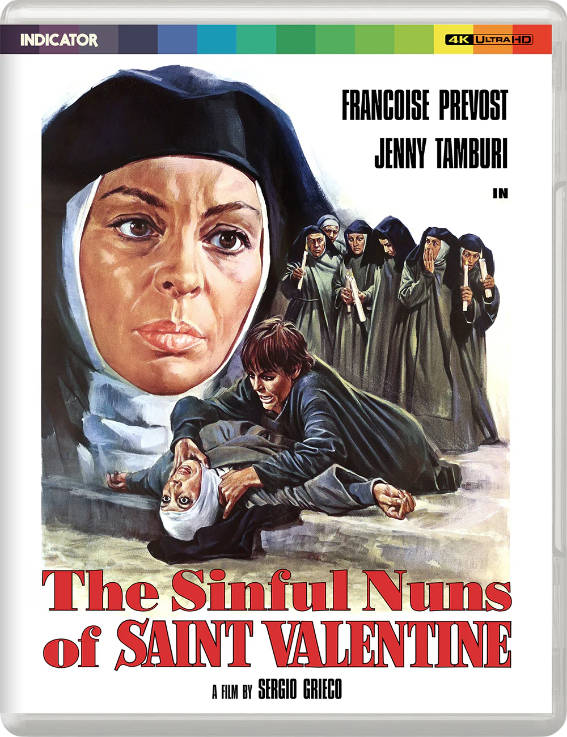
The Sinful Nuns of Saint Valentine [Le scomunicate di San Valentino]
Italy 1974 | 93 mins
directed by: Sergio Grieco
written by: Max Vitali, Sergio Grieco; Gino Mordini, Sergio Grieco (story); loosely inspired by a drama by Victor Hugo
cast: Françoise Prévost, Jenny Tamburi, Paolo Malco, Franco Ressel, Corrado Gaipa, ino Rocchetti, Piero Anchisi
distributor: Indicator
release date: 19 October 2026