
Super Nature
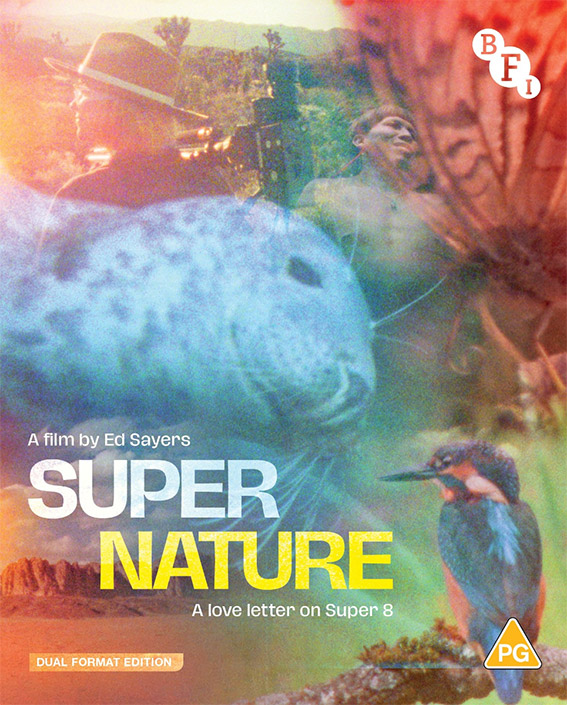
Ed Sayer’s documentary and hymn to the natural world, SUPER NATURE, entirely generated on Super 8mm, is released in dual format Blu-ray and DVD by the BFI. Review by Gary Couzens.
Ever since pictures began to move in the late nineteenth century, filmmakers have used the new medium to capture the natural world. Think of Cheese Mites, as early as 1903, when a man (the director, F. Martin Duncan) takes a magnifying glass to his Stilton sandwich and is alarmed at the sight of the creatures of the title, shot through a microscope in giant detail on the cinema screen. This caused alarm among the dairy-products industry and calls for censorship. Think also of F. Percy Smith, whose output between 1911 and 1945 is well represented on another BFI release, Minute Bodies. Nowadays, nature documentaries are commonplace on television and streaming services, with the work of David Attenborough (still with us at 100 as I write this) being a standard-bearer. So we are used to the natural world on our screens of various sizes, in HD and UHD. But Super Nature, directed and edited by Ed Sayers, is something different. With all that technology now available at a price, this film was generated in the old-school format of Super 8mm, with nothing digital in the shooting of it at all. As Sayers points out, the film might not have been possible to make in the way it was, as Kodak threatened to discontinue all celluloid production. It took Christopher Nolan and other film directors to make them change their mind, and to keep film on film alive.
For Sayers, his introduction to Super 8mm was, as for many of his generation, as an amateur format, often used to shoot home movies and holiday footage in the days when you couldn’t do that on your phone. He set up Straight 8, a filmmaking competition, in 1999. The idea was that people shot a film on just one Super 8 cartridge (between two and three minutes or so), with the only editing in camera achieved by pulling and releasing the camera trigger from shot to shot. That in-camera editing is present with all the films on this disc, though presumably there are Straight 8 productions out there shot in single extended takes. There is no processing by the filmmaker so that the first time they see the finished product was when it was projected to an audience. One contestant was eighty-year-old Frenchman Roger Batteault, who submitted short nature films to Straight 8. One of these was Nature Hunter, which you can see among this disc’s extras, especially a sequence of flamingos against a grey sky. So Sayers had the idea of making a feature film this way, with Batteault’s work up first. As the results came in, Sayers had them digitised so that he could edit them into the finished work.
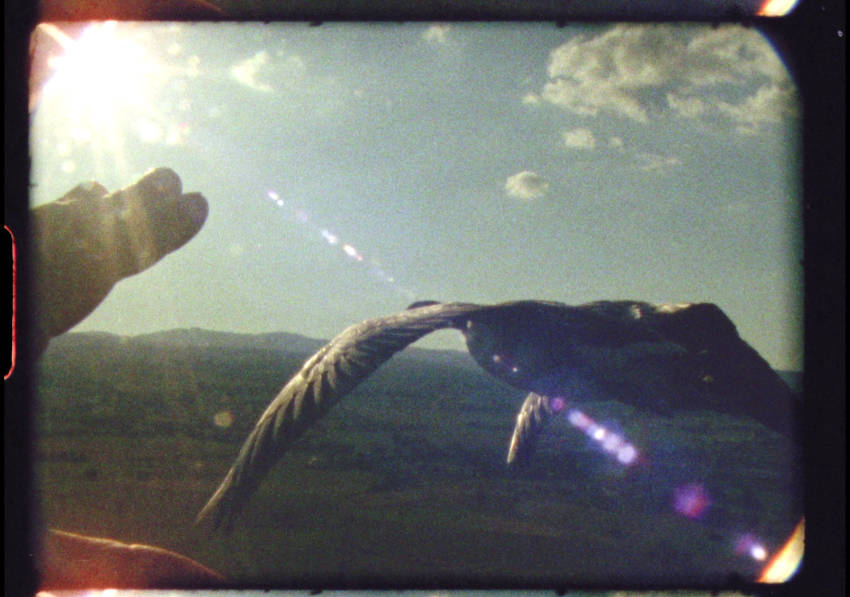
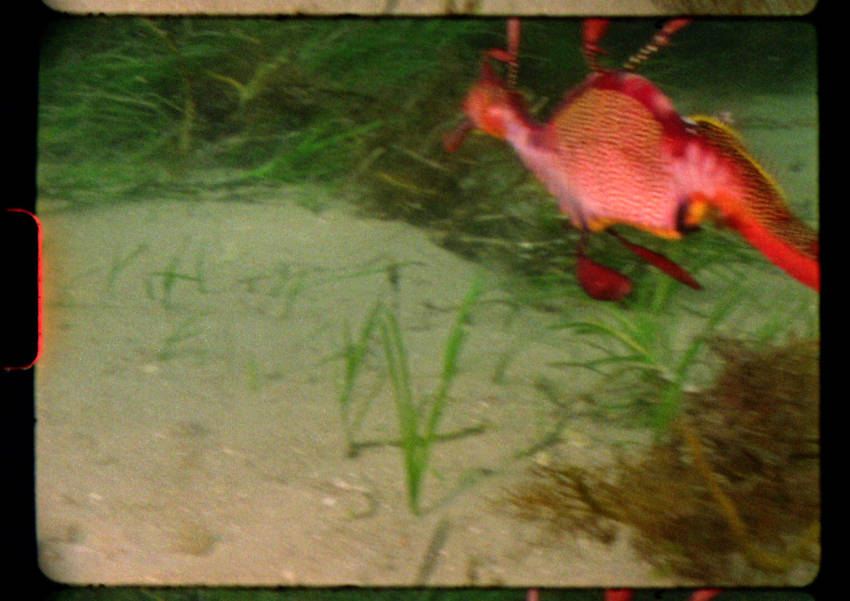
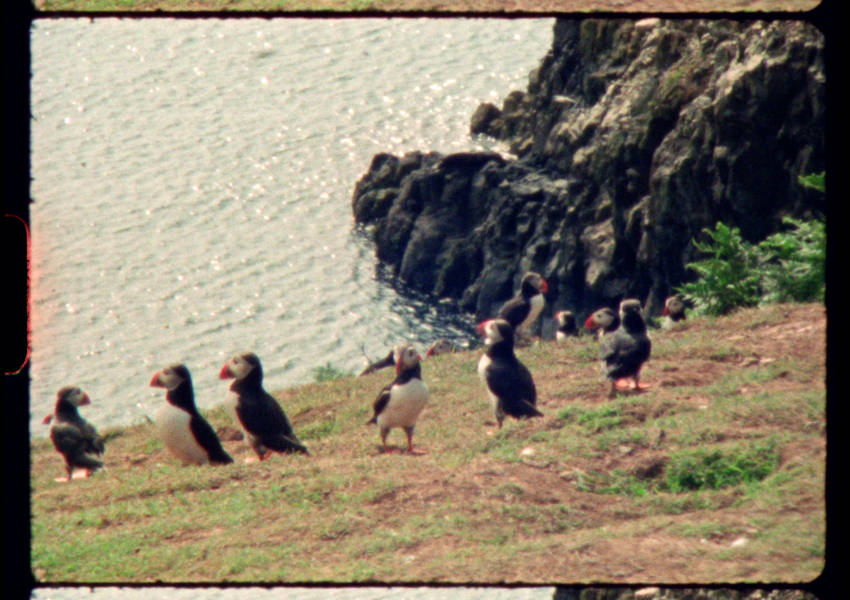
So, in Super Nature, we don’t have the hard focus and the saturated colours of digital but something more vibrantly analogue. The grainy images flicker, and there are occasional spots and scratches. The frame line occasionally jolts into shot and the single sprocket hole per frame sits at screen left, with a fiery orange border like an upended oval total solar eclipse. Super Nature is made up of the work of some forty different filmmakers from all over the world, including members of indigenous peoples having their first experience of filmmaking. As well as Sayers’s narration, we hear from the filmmakers, often speaking their own languages.
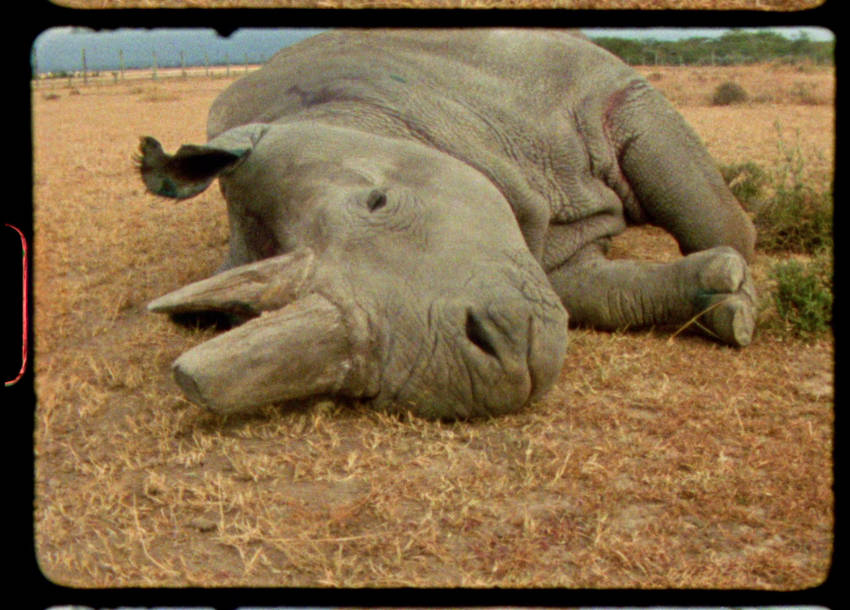
So, from all those different countries – from desert to Amazonian rainforest, from the seaside to up a mountain – we see creatures of all sizes from tiny to giant, as they prowl, crawl, swim and fly. Along the way, we meet the last two surviving Northern White Rhinos, a mother and daughter, Najin and Fatu respectively, who live in a conservatory in Kenya protected by armed guards. Thanks to the preserved semen of now-deceased males, it is hoped to preserve the species for posterity. Meanwhile Fatu has a Southern White Rhino playmate, from a not-endangered subspecies.
Elsewhere in the film, we see the extremes of nature at work, such as lava flows from Icelandic volcanoes. Sayers does contrast the natural world with that of cities, shot in speeded-up motion rather like the acknowledged influence of Godfrey Reggio’s Koyaanisqatsi (1982). That film’s city sequences possibly inadvertently gave an impression of vitality and energy, a little odd in a film whose thesis was that modern life was “out of balance”, and that’s also the case with Sayers’s film. The environmental theme is hard to miss, as Super Nature has so many sights to show us, some of which may no longer be available later in our lifetimes, or our children’s.
sound and vision
Super Nature is released by the BFI in dual-format (Blu-ray and DVD). This review is based on a checkdisc of the former, encoded for Region B only, so the DVD (not seen) will be Region 2. The film has a PG certificate, but the package carries a 15 due to strong language in Goldfish and “gore, horror” in In Love, so any parents wishing to show the main feature to their children should bear that in mind.
The transfer is based on a 2K-resolution master and is in the ratio of 1.41:1. That’s close to the ratio for IMAX, and the film did have some digital showings in that format, with the grain surely being the size of footballs. Given the film’s Super 8mm origins (even the company logos at the start were reshot in Super 8), with it only reaching the digital realm in editing, post-production and release, the film is inevitably soft and grainy, but this does create a texture all its own. It’s quite different to the HD or UHD you might see in a television or streaming nature documentary, and the one sprocket hole per frame is partially visible on the left of the screen throughout.
You have the option of watching the film with a choice of soundtrack mixes, in DTS-HD MA 5.1 and LPCM 2.0 which plays in surround. There is also an audio-descriptive track in Dolby Digital 2.0. None of the footage was shot with synchronous sound so the track is comprised of voiceover and music, with some notably heavy bass in places. There isn’t much different between the 5.1 and 2.0 tracks, so the choice is yours. Three subtitle options are available: hard-of-hearing subtitles, English subtitles translating speech in foreign languages, and none. Given the number of different languages spoken in this film (by my count nine other than English: in order of appearance, French, Spanish, Dutch, Sena-Bajaw, Sámi, Enawené-Nawé, Thai, Punjabi and Icelandic), if you don’t need subtitles at any point, I will be very impressed. Subtitles are also available for the deleted scenes, and there are fixed ones for Cantonese dialogue in Goldfish.
special features
Commentary by Ed Sayers and Rebecca Wolff
This commentary was newly recorded for this release and features Ed Sayers and producer Rebecca Wolff. I’d imagine it might be a challenge to record a commentary for a documentary, and they don’t escape being scene-specific, talking about the filmmakers behind certain sequences. Sayers does touch upon the elephant in the room in that this film might have become impossible to make in the way it was, with Kodak threatening to discontinue all film production (not just Super 8mm) in the push towards everything being digital. However, celluloid film was reprieved and has survived to live another day, Sayers acknowledges the influence of Koyaanisqatsi in the speeded-up city sequences. As well as contrasting city with natural settings, he and Wolff wanted to feature work from all places, up in the air (with the aid of drones) and under the water as well as on land.
Q&A with Ed Sayers (24:16)
Ed Sayers talks with Asif Kapadia, one of the film’s executive producers, after the UK premiere of Super Nature at the BFI IMAX during the 2025 London Film Festival. That is the largest cinema screen in the UK, so quite something for a film generated on Super 8mm. However, Sayers tells us that there have been showings of Straight 8 films at this venue, even though the image produced by an actual 8mm projector would be a tiny part of the screen. It was due to a showing of what became Super Nature that the BFI came on board, with the resulting cinema release and the present Blu-ray. Sayers goes through the process of the film, which began in 2019 and initial budget. By the end of 2021 he had a trailer and proof of concept. Each participant had two or three cameras (as they were often over forty years old and could potentially break down) and between six and eighteen rolls of film. Given the green credentials of the film, Sayers tried to use greener methods to travel to festival screenings, such as trains and boats rather than planes, the former impressing the audience at the Gothenburg Film Festival. There aren’t any questions from the audience, at least not in this recording.
Deleted scenes (3:30)
Four of them, with a Play All option. Given that the finished film is only 82 minutes long, including credits, you wonder if they might have found space for these fairly short bits, but on such small increments are editing decisions made. They are: Jacki and Black Scottish Adventurers (1:05), Steve and the Mushroom Surfboard (0:56), which begins with some frightening timelapse of mycelium growth, with which material Steve endeavours to make an organic surfboard, David and the Purple Emperors (0:48), featuring a hunt for the butterflies of the title, among the rarest in the UK, and Thorbjorg in Grindvik (0:40) as she films those lava flows. All of these have voiceovers except for the last, which is silent other than camera whirr.
Straight 8 Films (13:14)
Four films, extracts from which appear in the main feature, with a Play All option.
Hard Coffee (3:36)
This was made by Forest of Black (one of the production companies involved with Super Nature, including co-producer Beth Allan), A man gets his day off to a start with some heavy-duty substance abuse, the substance concerned being the one in the title. This results in his running through woodlands and country paths and taking a dip in a lake, dressed only in a pair of white underpants. All this to a pounding, bass-heavy score.In Love (2:17)
Made by Dice Rose, this shows a couple by the sea. They are so much in love that she gives him her heart, quite literally. What he next does with it I’ll leave you to discover, but best not during dinner.Rumours (3:40)
From Ollie Birt, the only one of these films with spoken dialogue, or rather voiceover monologue. A young girl muses on the man serving her at a fish and chip shop, which takes a bizarre turn involving a very lo-fi robot and some low-key vomiting, emetophiles beware.Nature Hunter (3:39)
This film by Roger Batteault, or Chasseur d’images in its original French, was the seed from which Super Nature was spawned. This is simple observational stuff of birds, including that flamboyance of flamingos taking flight.
Goldfish (9:07)
This 2007 short was written and directed by Ed Sayers in the relatively hi-tech media of Sony HD and Super 16mm. The relationship of a couple (Michael Fassbender, Caroline Carver) is falling apart. They are observed by two goldfish in a bowl who comment, voiced by Yandis Ying and Terence Lo in Cantonese with fixed English subtitles.
A Day Out in Time (3:35)
Another Straight 8 film, this one from 2012 and made by Ed Sayers. Ed (without his latterday beard) is looking to reschedule a flight due to an injury to his arm and spends a day in London taking in the sights and exulting in his new-found invisibility to everyone around him.
BFI National Archive Films
From the archive, two “super nature” films from days gone by, needless to say in black and white. The Battle of the Ants (12:28) was shot in 1922 at what was then the London Zoological Gardens (now London Zoo) as two ant colonies face off against each other, all shot from above in close-up. This is silent, with intertitles, and presented on this disc mute, so no music score. Every third frame is repeated to respect the original speed of eighteen frames per second. The Nightingale (9:09) was shot near Oxford in 1932, as we observe the nightingale in its habitat, rears its young and sings its well-known song. A sequence showing the nightingale appearing to dance on a branch captured the imagination and was extended with the help of the music score. It even had the honour of being feature in a Punch cartoon.
Theatrical trailer (2:01)
A short trailer which gives you a good idea of what to expect, including critics’ quotes in case you might be undecided.
Booklet
The booklet with the first pressing of this release runs to twenty-four pages plus covers. It begins with Ed Sayers’s director’s statement. This tells of his initial interest in Super 8mm and how he set up the project. Next is “Super Nature is the Super Power” by Adrian Beckingham. This begins by addressing the (metaphorical, not literal) elephant in the room: with so much filmmaking chasing the latest technical advances, why use an old medium, with cameras in many cases half a century old? But by making their films, as he says, the boundary between observer and observed becomes porous, as sense that they – and we – are a part of nature rather than separate from it. And that’s the case whether he or she is filming reindeer in snowy climes, or salmon in the Isle of Lewis or those nearly-extinct rhinos in Kenya, The film asks the question if our planet is a resource to plunder or – along the lines of the Gaia Hypothesis – an organism we disrupt at our peril? Beckingham quotes many of the filmmakers and informs his piece with his own experiences of the natural world.
Next up is Ben Nicholson’s review from the September 2026 issue of Sight & Sound. After a credits listing, we have notes on and credits for the special features.
final thoughts
Super Nature is a remarkable documentary, which parades its proudly analogue credentials to convey the beauty of the natural world and the creatures within it. I can’t fault the BFI’s presentation of the proudly lo-fi film, with an assortment of well-chosen extras.
Super Nature
UK 2025 | 82 mins
produced by: Rebecca Wolff, Ed Sayers, Beth Allan
edited by: Ed Sayers
music by: Alexandra Hamilton-Ayres
distributor: BFI
release date: 23 November 2026