
Making waves
Making a huge splash (in more ways than one) upon its release, Alejandro G. Iñárritu’s DIGGER opened, pissed off many critics, was briefly adored by the very few, and then pulled from a great majority of screens in the US. It was as if the director and star Tom Cruise were guilty of a crime instead of making wildly ambitious art. Camus digs in…
“The original title on the script was “Blah, Blah, Blah,” and that’s what this story is about. It’s about the most scary weapon that all human beings have: the tongue. That’s the weapon. We didn’t want to tell a story about climate change, or about politics. I hope this story transcends politics. We wanted to talk about the human nature of the blah, blah, blah.”
Interview with writer/director Alejandro G. Iñárritu1
Mexican director, Guillermo del Toro, on Digger supporting his fellow director and countryman.
You might be lucky in the UK to find a cinema still showing Digger so this review is a little late to the party but it may well be worth your effort. At the very least, you’ll have seen it and can join the discussion. That said, my nearest independent art cinema, if that’s still a term, has it on for another four days at time of writing. Let’s just say nuance (not a word often used in connection with this film) is much easier to spot on the big screen. Let’s just remind ourselves of what’s on director Iñárritu’s CV… From a quick scan, it’s clear that here is an artist who makes deeply personal films with a canvas (and budgets) evolving steadily larger and larger. No stranger to complex, emotional stories told in a time-fractured manner with complex VFX, he has had great commercial success. And no one wins the most coveted director gong, twice in the space of 372 days, without obviously being a talent to be reckoned with; he snagged two Best Director Oscars in a row for Birdman and The Revenant. To be frank, I was staggered by the vitriol spewed liberally on Digger and its makers a few weeks ago which of course, made it all the more urgent for me to actually see it.
If Digger has committed any sort of crime, it’s simply presenting creative and bold satire in a global environment and culture that is unsatirisable. And, yes. Microsoft Word did not like that word at all, even with a ‘z’. The most powerful man in the world (writing that just makes me weep) just posted on social media that migrants had taken over France and that her leaders should close the borders, fast. The riots in that country have nothing to do with immigration. How do you satirise Trump when his deranged output is light years ahead of the most biting kind? I half expect Private Eye to close its doors. So, what’s all the fuss about? Digger tells the story of a Texas oil baron, Digger Rockwell, isolated in billionaire luxury in an oddly unrealistically verdant Washington DC, keeping his ‘well-past-her-sell-by-date’ cat alive by any means. If anything, this is abject animal cruelty not a health concern driven by love. So, Digger is Mr. Divisive right off the bat. I’ve never seen a cat begging to die as much as Maggie and that’s a testament to how very good this animatronic special effect is. It’s good because the cat had to deliver a performance and does so even though you know it can’t be real. But that sort of fits with the ethos and design of the film. You also know that Tom Cruise has no wispy comb over nor a beer gut. He is overweight, overbearing and over the top and wears his power like a sparking neon sign. His relatives and servants flit around him performing duties but it’s clear that the world (or his perception of it) must turn on his say so. His main man at a Rockwell Arctic drilling station tells him that a methane gas leak could have very serious consequences but of course Digger downplays those and insists his man takes a further, closer investigation (and by inference, tells him to keep drilling). It’s Brian Blessed in Black Adder on receiving bad news… “I like it not. Bring me some other news…” The next thing you know, there has been a massive explosion and an enormous ice shelf is calved off and is heading for northern Europe which will result in the deaths of hundreds of thousands and the displacement of millions. So, inject inescapable and catastrophic truth into the veins of a narrative run by deeply ignorant, scared, powerful and venal people who have somehow clawed their way to the top of the political ladder and see what happens. See what I mean about ‘unsatirisable’? There’s a lot more narrative as Digger and his subordinates (including the President of the United States) try to massage the deadliest reality into a massive media spin cycle that is farcically dependent on the immense icy threat breaking up in warmer waters… They wish. It’s clear that not one of them has taken a dip in the North Sea.
Digger was removed from 2,535 (!) cinemas after its second week in release thereby staunching further marketing and distribution dollars and giving it no hope of breaking even. Its own production company predicted, with short term hindsight, that the film would be a financial disaster. It’s certainly massively underperformed and the budget was high enough for Paramount Skydance (also known as Warner Brothers) to take a big hit especially as Tom Cruise’s deal gives him a cut of the gross before studio costs are recouped on top of his $20 million fee. So, the one thing an unusual, original, artistic film required was removed from it; the potential of building word of mouth. The alarm bells must have been clanging very loudly for the Warners’ executives; an irony not lost on me as the film is about a man who dismisses such warnings so convinced of his own power to shape the world. I would have thought millennials and Gen Zs in fair numbers might have latched on to the film and its themes given the oddness of the world they find themselves living in and how much Digger is torn and born from the abject and depressing chaos of the last decade. Yes, business wise, it was never going to be Avatar but I never thought it would be Ishtar.2
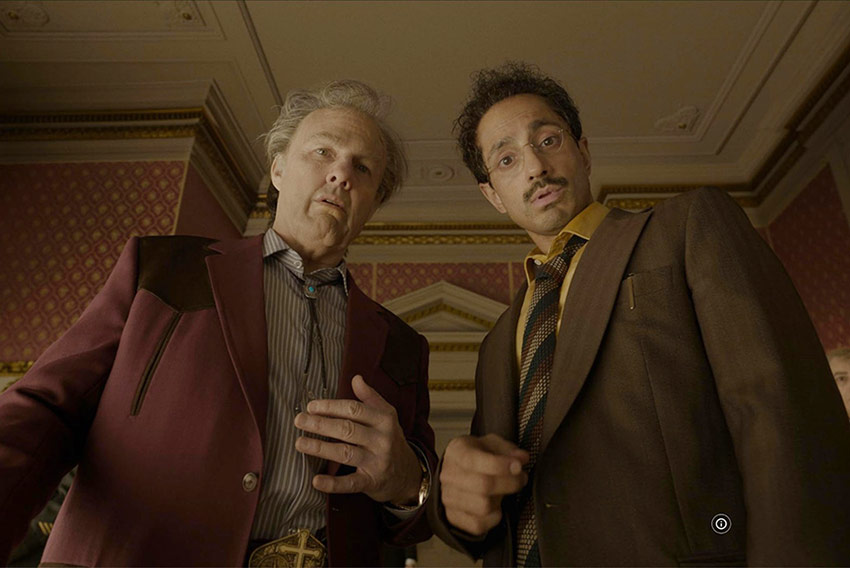
Like Iñárritu’s other work, Digger operates on several levels and as the second act rug pull seems to be a spoiler of a kind, I won’t mention it. But it is cute, in its own way. It’s not exactly the climax of The Sting or Fight Club’s third act revelation but it does change the movie’s gear in a very interesting way. On these two different ‘reality’ levels the narrative plays out as Digger surprisingly encourages his Head of Environmental Safety, Dr. Ganesh to tell European leaders the truth about Digger’s knowing exploitation of the planet. Digger says “I like you, Ganesh. Yeah. You’re never afraid to tell the truth, whatever that is…” The screenplay is dense with layers, subtext and alternative meanings and some of the comedy may not land on a first pass. If such a broad satire could be nuanced, it’s in the area of humour. The awful truth about what has happened at the start of the film and the revelation that hundreds of thousands will die as a result, is beautifully and brutally undercut by Digger’s half-sister Sandra who seems to be more wrapped up in her own affairs, to hell with the imminent deaths of Europeans en masse… As Digger stutters, actually shocked by the news, she yells at him “You can’t do this to me, Digger, not again!” The “to me” brings a smile but the “not again,” made me laugh out loud imagining Digger having a horrendous history of unleashing appalling suffering because of his relentless mining activities. Let’s not even mention simultaneously pissing off his half-sister who’s trying to kickstart her own sustainable energy business. Damn.
There are many things to admire in this extraordinary film. The production design, by Dennis Gassner and Richard L. Johnson, in both realities is remarkable being both theatrical and otherworldly. If anything, it reminds me of the painstaking work of production designers, Magnus Renfors and Elin Segerstedt in You, the Living, directed by one-shot supremo, Roy Andersson. We’re looking at reality skewed through a singular artistic sensibility. Even a bucket catching dripping water has character and purpose in Iñárritu’s film. The cinematography looks both garish and gorgeous often in the same frame. Take a bow, Iñárritu’s go to cinematographer, Emmanuel Lubezki. Edited by Stephen Mirrione and Conor O’Neill, Digger never features any editing choice that calls into question the premise of the film nor calls attention to itself. In editing parlance, the cutting is invisible just as it should be. Unsurprisingly, screens and windows throughout are presented as stepping stones of the narrative sweep and in one instance, Iñárritu shaves what must have been a few million off the budget, playing what might have been a lavish end of the world VFX spectacular on the reactions of the people directly responsible for it. The scene is played for laughs and played well but you can’t help thinking that watching real people die is hardly a spectator sport in a civilised country. This point is more pertinent given the recent announcement of a televised execution in the US. Unsatirisable. Did I mention that?
The colour scheme is also notable being a pastel light teal that serves to foreground its opposite colour, a dark red/orange which in no way coincidentally is the colour of Digger’s suit in pivotal scenes. This is most obvious in the big speech scene when Digger confronts European leaders with, of all things, the truth. The entire audience bleeds into the background as one mass of Hydra-like, teal protest creatures while Digger commands attention, revulsion, hatred and fascination sticking out as he does in his suit like a recently hammer-smashed thumb. I kept flashing on Jack Nicholson’s performance (opposite of all people, a certain Tom Cruise) in A Few Good Men and wondered if Cruise channelled Nicholson in his own moment in the spotlight. The phrase “You can’t handle the truth,” must have occurred to the writers but Aaron Sorkin got there first, and indeed, they are his words. “You need me on that wall… You want me on that wall…” There are many notable crossovers. One bit of schmaltz seems oddly out of place. As noted by co-writer and director Iñárritu, the film is concerned with how language has led us down some very dark paths. There is a character in the film who boards a plane just before a mighty storm whips up. The character’s father is desperate to find news that his daughter is alive and well. This deeply affects his character right up to the end. And what’s her name? Hope. So Hope is loved then Hope is lost and will Hope be found? This was the only un-Digger-like script point I had an issue with. This ‘Hope’ was on-kilter in a movie made almost entirely of off-kilter content.
Brit musician, Cosmo Sheldrake (a Digger-like character name purely by coincidence) has composed the most idiosyncratic film score I’ve heard for a long while. And it’s his debut on the movie scoring stage. His work is very hard to describe because he’s utilising natural bird sounds, instruments I’ve probably never heard of, sound effects making their own music, both natural and synthetic, and the human voice. It’s a staggering achievement that it even works in the film because any film composer would have had one hell of a job coming up with ideas for this staunchly unique movie. Sheldrake had the advantage of the director having listened to one of the composer’s previously released tracks which summoned the mood he was after. That must have been an exciting phone call. The score is quirky without being twee, simple while evoking emotion, sorrowful and yet, light. It’s also darkly comic and yet another aspect of this intriguing film that deserves praise not indifference.
Digger has a fascinating cast culled from all manner of film and TV actors. But let’s address the elephant in the room first. There seems to be an immense schadenfreude online and in the print media in ripping Tom Cruise (for it is he) apart for his portrayal of Digger Rockwell. The über-famous movie star and cineaste with a strong connection to a religion that a lot of people are not sure about, finally gets his comeuppance. Really? For what? Entertaining us for 43 years? Well, no. Let’s divest ourselves of that easily assailable baggage. Cruise stakes a great deal in his agreeing to take on such an unremitting asshole as Digger Rockwell. And he is to be applauded for that decision. Yes, Digger could be perceived as a DiCaprioesque stab at Oscar glory but while true movie stars tend to play themselves or hyped-up variations of themselves which do not attract Oscar’s attention, the star has to stray off a well beaten path to get that attention. I read that Cruise loved Iñárritu’s work from the start of the director’s career. He had him read the script to him and committed there and then. If Cruise doesn’t get at least a nod, it will probably be because of the failure of the film not from any shortcomings in his performance of a ghastly character all too familiar to us at this moment in history.

The supporting cast all gamely put up with the director’s wide-angle lenses that make no one look good. At least one online critic has suggested strains of Terry Gilliam’s Brazil in the mise-en-scene and I cannot disagree. Even more over the top than Digger is President Compson who has several spittle-ejecting breakdowns in the movie. John Goodman seems to delight in his character’s cancer pain giving him the shears to cut his reins. In his final scene, he demands the nuclear suitcase, determined to press the button. He is informed that ‘the button’ is an urban myth and that he has to read three large books before he makes that fateful decision. Goodman howls “I have to read?!” It’s no coincidence at all that this fictional president wears a blue suit, a red tie and a US flag pin. But it has to be said, he doesn’t behave half as badly as the real thing, however much he lurches into, out of and beyond caricature. As caricatures go, Trump beats him, small hands down. I recognise Pip Torrens from the last broadcasted creative work from fallen idol Joss Whedon, The Nevers. Torrens is commanding and instantly recognisable and it pushed me into thinking that this movie was intricately and very specifically cast. Even the extras seem hand-picked for their cranial structures and protruding features. Even faces are a little over the top. Two actors from Russell T. Davies’ first Doctor Who and Torchwood era are instantly recognisable. Corey Johnson bagged himself a Dalek in 2005’s Doctor Who episode named, uh… Dalek while Burn Gorman (who names anyone ‘Burn’?) a Torchwood regular (oh, torch, burn… OK) was last seen by me sinking into the frozen Hudson in The Dark Knight Rises. I imagine his work with Guillermo del Toro put him firmly on Iñárritu’s radar. Both actors make full use of their very limited screen time but both seem to physically fit alarmingly well into the twisted Digger milieu.
The three stand out performances, aside from the leads, were Riz Ahmed as Dr. Nirav Ganesh, a scientist and Digger’s head of Environmental Safety, Sandra Hüller as Emma Rockwell, Digger’s half-sister and business partner and Jesse Plemons as Kenny Rockwell, the rights holder to the play Fossil Fools and Digger’s nephew. Hüller doesn’t get nearly enough screen time despite having great comic chops and we all love Riz Ahmed because in the entire movie, he’s the only one who knows and tells the truth no matter what the cost. In his final conversation with his boss, he suggests Digger’s beloved cat did not appreciate having to sleep with his owner for 30 years and rather than having him killed, Digger perversely respected him more for his honesty. Chameleonic Jess Plemons, so terrifying in Civil War, plays the unifying producer of a play desperate to keep the show on track.
Another core problem so difficult to solve in a film such as Digger is what I’ve come to think of as the ‘He’s Smart Scenario’. Whenever a film character is impressed with another’s intelligence and says so, that intelligence has to be impressive to the audience too otherwise we think both are idiots. Any film that features a work that is supposed to be famous, of extremely high quality and timeless has to be just that and not only within the film. If the audience do not respond the same way as the fictitious audience – which they clearly did not – then you have a problem. There is always the suspension of disbelief you can employ and accept the reverence the ‘work within a work’ is held in and just go with it. I’m being deliberately elliptical because, ‘spoilers’.
Digger may have worked for audiences without Tom Cruise in the lead. Maybe someone, an unknown without the need for too many prosthetics, could have been more believable. Like it or not, Cruise has baggage and while that baggage is meaningless when he’s dangling off an old airplane or riding off cliffs saving the world, it comes into play when he chooses a role far from what powers his star wattage: heroics. Granted, he has range and is capable of being an actor as much as a star. Watch Magnolia, Rain Man and Collateral… The man can act. It’s the audience expectation that’s part of the issue here. Digger may have worked at a tenth of its production cost, the lower budget necessitating ingenious work arounds. Regardless of the multiple ‘what ifs’, I very much enjoyed the film but can understand why others may be less generous. It’s destined for re-evaluation and almost certainly bound to be cultified once it’s discovered on streaming. But you’ll miss a lot of detail on the small screen. There’s no arguing that the film failed in the current marketplace but that’s no indicator or criticism of its quality, stance, daring and artistic smarts. If you love cinema, take a good look and see how broad a church it is… Despite the odds, Digger comes well recommended.
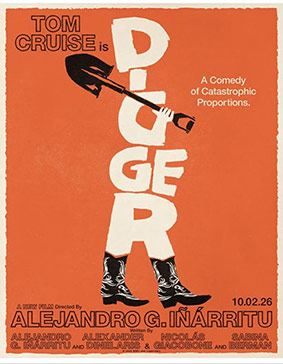
Digger
USA 2026 | 128 mins
directed by: Alejandro G. Iñárritu
written by: Alejandro G. Iñárritu, Alexander Dinelaris, Nicolás Giacobone, Sabina Berman;
story by: Sabina Berman, Alejandro G. Iñárritu, Jez Butterworth
cast: Tom Cruise, Riz Ahmed, John Goodman, Sandra Hüller, Michael Stuhlbarg, Jesse Plemons, Robert John Burke
UK distributor: Warner Bros Entertainment UK Ltd.
UK release date: 2 October 2026
- https://www.businessinsider.com/digger-ending-plot-twists-explained-alejandro-gonzalez-inarritu-tom-cruise-2026-10[↩]
- A notorious box office bomb in 1987.[↩]