
Under the knife
A young man who may or may not have killed a man becomes embroiled in events that involve his wife’s murderer and a police chief neighbour in BUFFET FROID, Bertrand Blier’s surrealistic urban crime thriller, a film in which no-one behaves as logic or tradition would dictate. Slarek stops his head spinning long enough to appreciate Blier’s considerable achievement on Indicator’s recently released UHD.
“For a very long time, at a certain age, between thirty and… well, around my thirties, thirty to thirty-five, I had the following nightmare. I dreamed about being chased by the police. And the I always woke up just as they were going to catch me. But I never knew why. I was a criminal. I had done something very ugly. But it wasn’t in the dream. My crime was not in the dream. There was only the pursuit, and the terrible fear of being locked up. The fear of going to jail.”
Regular readers will know that I kick off my reviews with either a personally related intro or by outlining how the film gets under way in some detail in the hope of giving a flavour of how it got its hooks into me (assuming, of course, that it did). Now, I’ll admit up front that I don’t have a personal history with the films of director Bertrand Blier and have, somewhat criminally, only seen one of his films prior to this one, the 1979 Buffet froid, so on paper that makes the second of those options the logical move here. It’s just… Okay, let’s give this a try and see where it takes us.
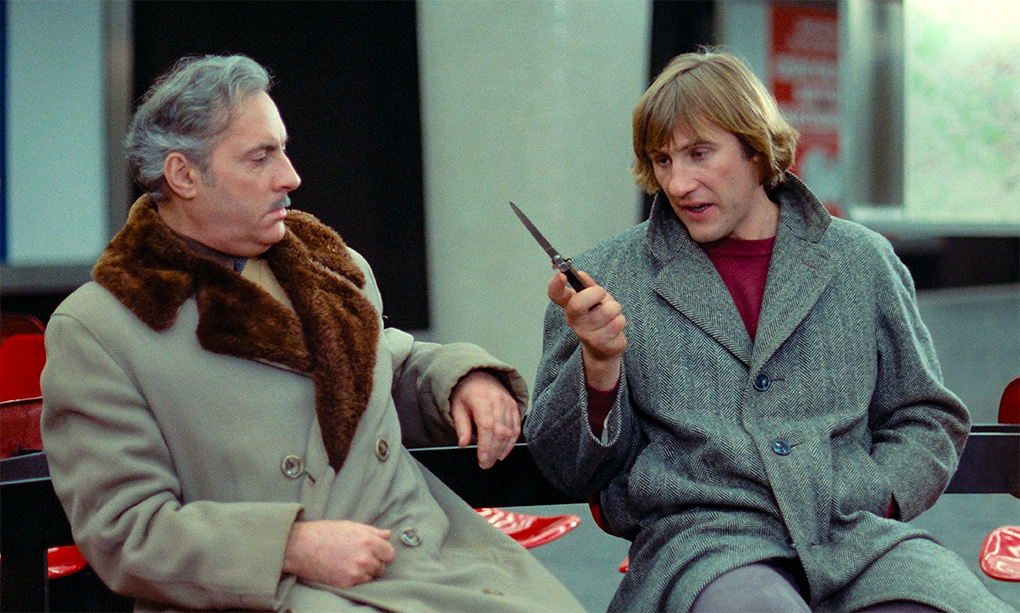
When the accountant’s train finally arrives, he quickly boards it and refuses to let the ever-persistent Alphonse join him in the carriage. A while later, a dejected Alphonse is making his way down a subway when he spots the accountant lying on the floor with his missing knife protruding from his stomach. When Alphonse asks who attacked him, the accountant replies that it was a young man in a coat. “Like me?” Alphonse asks. “Yes,” replies the accountant, adding, “If I were you, I’d run,” to which an incredulous Alphonse responds, “But it wasn’t me! It can’t be!” The exchange between them that follows would be more than a little bizarre in the real world but does provide the first real clue to the nature of the film that is about to unfold. Strangely well aware that he will soon die of his injury, the accountant insists that Alphonse take what money he has on him and use it to drink to his health. He also advises him to take his knife back as he might need it again and his fingerprints will be on the handle.
Alphonse then returns home to the small open plan apartment that he shares with his wife Josyane (Liliane Rovère), who is busy preparing their evening meal when he wanders dejectedly in. He tells her that he has just witnessed a murder and she responds by asking him to wipe the dining table, which he dutifully does. When he admits that he’s worried that he may be the one who killed the accountant, Josyane tells him dismissively to stop talking nonsense, and when he shows her his bloodied knife as evidence, she simply pops it in the dishwasher and tells him to find a proper job. The two sit down for dinner, after which Josyane reveals that the sizeable but otherwise empty tower block in which their apartment is located finally has another tenant, to whom Alphonse feels duty bound to introduce himself. He thus heads cautiously upstairs to this newly rented abode and knocks on the door. It’s answered by a sour-faced man namedMorvandieu (Bernard Blier, the director’s actor father), who invites Alphonse inside with a sideways nod of the head, then pours him a drink and returns to eating a meal from a can he has heated up on a camping stove. When prompted by Alphonse, Morvandieu reveals that he is a widower and that he works as a police inspector. “That’s convenient,” Alphonse tells him, “because I just saw a murder in the Métro.” Morvandieu takes an interest, but when Alphonse tells him that the man was stabbed with his knife and that he is uncertain whether he might have been responsible, Morvandieu tells him calmly, “You don’t look the type.” When the agitated Alphonse offers to show him the weapon, Morvandieu states that he is now off duty and that he has just moved in and is tired and is starting to find the young man annoying, so asks him to leave.
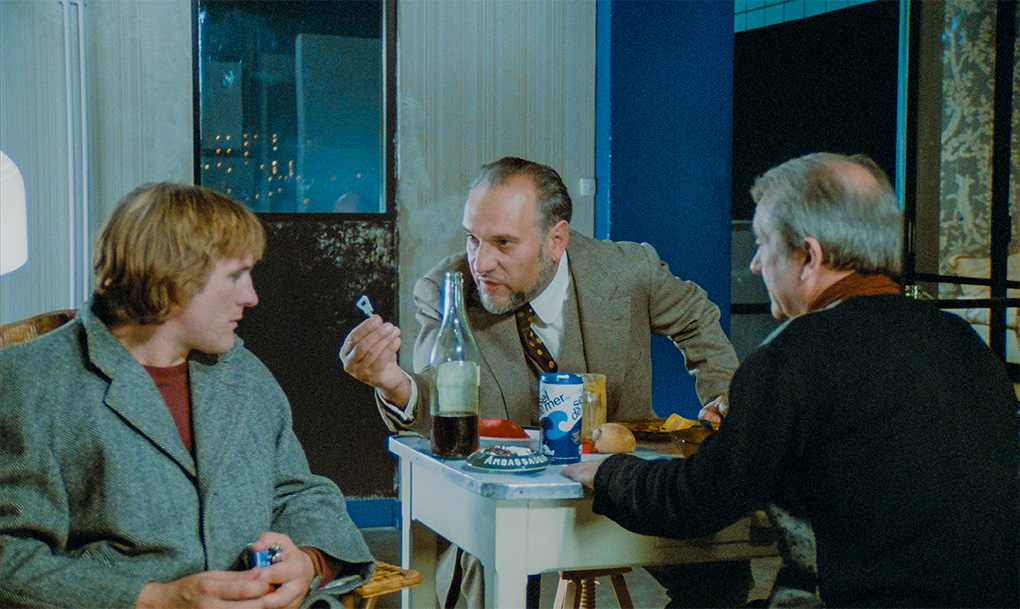
On the basis the above, you may not yet have twigged what sort of film Buffet froid actually is, as I’ve not really conveyed the oddness of how much of it plays out, but what happens next should soon tip you off. Having accepted his wife’s murder with a peculiar degree of resolute calm, Alphonse is eating a basic evening meal in the apartment, still wrapped in an overcoat that feels increasingly like a symbolic shield, when there’s an unexpected knock at his front door. When he cautiously answers it, he encounters a troubled looking man (Jean Carmet), who asks for a few minutes of his time to talk about his wife, immediately revealing that he was the one who killed her. Does Alphonse lose his shit and attack the man or recoil in horror? Not exactly. Instead, he calmly invites the man in, asks him if he’s eaten, and the two sit down and share his makeshift meal. When the Murderer (and I’m going to capitalise the M here as the man is never named and he’s not the only one who takes the life of another in the film and I need to have a way of identifying him) glumly pauses, and reveals that he cannot get the food down because he keeps thinking about Josyane, which Alphonse callously dismisses by telling him, “Oh, do as I do, old man. Forget about her.” When the Murderer then asks to see her room, Alphonse seems more concerned that doing so might upset the man more than he has been so far been about his wife being violently killed, but agrees to indulge him, allowing him to lovingly examine her wedding dress and even showing him a favourite photo of her. When the door buzzer suddenly sounds, Alphonse tells the Murderer not to move, and heads for the front door, pulling the partition that separates the bedroom living room closed behind him. Who should it be but Inspector Morvandieu, armed with a commiserating bottle of wine for the two to share. Instead of claiming he is busy or just heading to bed, Alphonse invites the inspector in, then heads back to the bedroom to inform the Murderer that it’s okay for him to come out because the visitor is a friend. He then cheerfully introduces him to Morvandieu as his wife’s killer and the two men shake hands, then all three then sit down at the small dining table to share the wine. They’ve not long gotten comfortable when Alphonse has to once again answer the door, this time to man named Eugène Léonard (Jean Rougerie), who also has something he wishes to talk to him about. He’s invited in, shares a glass of wine with the others and claims that he witnessed Alphonse plunging his knife into the accountant’s stomach on the Métro, an act that Alphonse still denies that he carried out. It turns out that Eugène is not here to blackmail Alphonse but to engage his services as someone with an admirable skill with a switchblade to rid him of a man who has poisoned his life. Uncertain at first, Alphonse accepts the job but declines the offered payment (“I prefer to keep everything clean”), and the following evening he, Morvandieu and the Murderer head to the car park location provided by Léonard and wait for their unnamed victim to arrive. And believe me, we’re just getting started here.
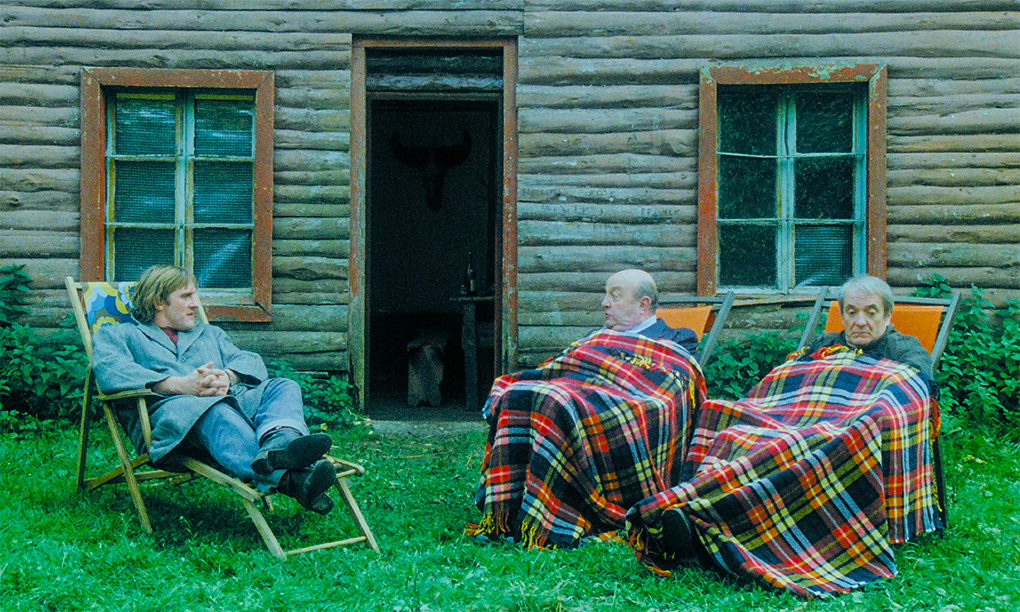
Although, plot-wise, Buffet froid is ostensibly a crime thriller, it’s firmly in the territory of surrealistic black comedy, one in which all the normal rules of narrative and character logic have been cheerfully dispensed with and where everyone reacts to even the most bizarre events and irrational behaviour as you or I might to an average day at home. There’s more than a whiff of The Discreet Charm of the Bourgeoisie era Luis Buñuel to the film’s grounded surrealism (something Blier himself confirms in the special features on this disc), and I’m far from the only one to have felt the blackly comic absurdist influence of Samuel Beckett on the dialogue exchanges. Like Buñuel, Blier’s surrealism grows out of having believable characters treat the seemingly illogical as normal in recognisably real-world locations. Where the two part company is that the odder behaviour in Buñuel’s films often can seem strange because we are unaware of their context or have developed expectations for how certain characters would normally behave. In Blier’s film, real-world logic and expectations are often turned completely on their head, and at times it can feel almost as if when writing the screenplay he would repeatedly ask himself what the audience would expect of a situation and then have his characters do or say the opposite. At times, it’s almost as if he just decided to roll the dice and let chance decide where fate might take them. Blier’s urban landscapes also differ from Buñuel’s in their spooky emptiness, with the principal characters seemingly the only inhabitants of a capital city that even back in 1979 was home to over two million people. In the opening scene, Alphonse and the accountant are the only signs of life on the platform of what became one of the busiest Métro stations in Paris, and after his second encounter with the now dying accountant, Alphonse walks across an empty plaza whose black-and-white design almost mirrors that of the apartment block above it in which he and his wife have for some time been the only tenants. Even when the film does expand beyond the initial confines of Alphonse’s apartment, the sense that the population of Paris has been thinned down to a select few individuals remains, with urban streets and open roadways weirdly clear of cars and pedestrians, unless they have a specific role to play in the unfolding story. Later, when the film makes a sudden startling switch from night and the city to a daylight soaked countryside, this sense of isolation remains – background characters simply have no place here. In terms of technique, Blier also differs from Buñuel, whose straightforward presentation of peculiar events only adds to their surrealistic air, and while Blier also shoots scenes without distracting cinematic frissons, he and cinematographer Jean Penzer make expressive use of expansive wide shots and slow camera moves and zooms that close in on or pull out from characters, often to emphasise their locational isolation.
I have little doubt that some will find Blier’s rejection of logic and his seemingly random, spin-the-wheel approach to plot development unsatisfying and annoying, and this doubtless contributed to the sometimes hostile reviews that greeted the film on its American release (it was far more positively reviewed in its native France). As a lifelong fan of Buñuel’s urban surrealism, however, I had an absolute ball. Yes, the plot development often defies logic, but it does so in a way that is oddly satisfying, in no small part due to its linguistic inventiveness. I’ll freely admit that what little French I can speak was learned in a schoolroom and a language lab half a century ago, but assuming that the translations provided by the subtitles are accurate, or at least true to Blier’s vision and intent, the often poetically logic-contrary dialogue and its expressive delivery prove to be two of the film’s principal pleasures. I also really enjoyed the continuous usurping of expectations – expectations created in part by decades of movie tradition – and at no point was I able to predict where the story would go next, what decisions the characters would make, or who they would encounter along the way. Surprisingly, perhaps, the result is not episodic but has a flow that makes every transition from one peculiar situation to another feel oddly natural and, in a peculiar way, retrospectively logical.
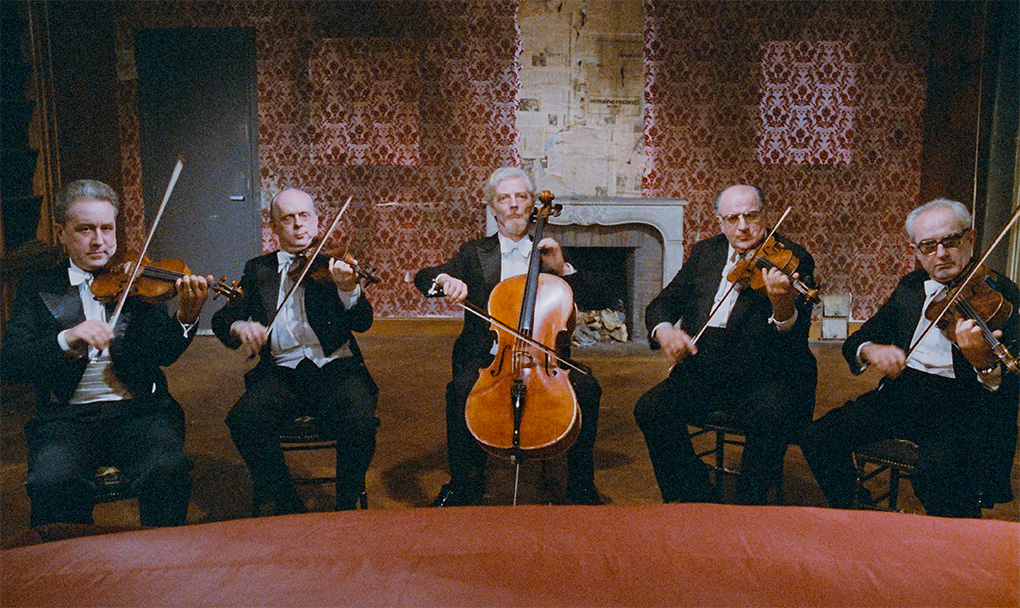
Absurdity is often humorous by nature and here feeds the blackly comical elements of the film as well as delivering some of its most entertaining moments and exchanges. In my case this prompted more amused grins and chuckles than loud belly laughs, but there were plenty of the former and a small but memorable sprinkling of the latter. There are a good many ripe examples to choose from here, some for their unpredictability, others for the darkly comic irony, and the best such scenes dovetail with sublime illogicality into the next. One of the most complex and interlocking of these kicks off when Alphonse, Morvandieu and the Murderer assist the widow (Geneviève Page) of a man that they have killed (by accident, after being tasked to do the job and bottling out) take lethal revenge on a doctor (Bernard Crombey) who sexually assaulted her while she was having a seizure. The three men then carry his body downstairs, load it into the trunk of his medical vehicle and drive it away with the aim of dumping it on waste ground. Seemingly seconds after they depart, however, an emergency call is sent out requesting aid for a cardiac arrest, a call that Morvandieu feels compelled to immediately respond to. This triggers an argument between him and Alphonse – one delivered at amusingly machine-gun speed and ferocity – about the logic of this decision, during which the Murderer excuses himself because he wants to go home and take a nap. When Morvandieu and Alphonse reach the châteaux in which this medical emergency has allegedly occurred, the inspector is horrified by the sound of music being produced by a string quintet upstairs and suggests that they should immediately leave. Before they can do so they are greeted by an elderly hostess (Denise Gence), who takes them upstairs, past a room in which her guests are listening to a musical recital and into an empty bedroom, where she claims that the man suffering the heart attack is Morvandieu and that he needs to be confined to bed. Alphonse immediately backs her up on this, and so insistent are he and the hostess that Morvandieu starts to believe it himself and climbs into bed. Musicians from the recital then file into the bedroom and start playing their stringed instruments to the horrified Morvandieu, whom the hostess and Alphonse leave to his fate, heading into the now thriving party to grab a glass of champagne. As they walk, the hostess suggests that Alphonse should choose his friends more carefully, only for Morvandieu to then reappear, firing his revolver manically into the air and scattering the panicking guests. He locates Alphonse and the two flee the building, arriving outside just in time to see the medical vehicle being stolen by a pair of cheerful thieves. Morvandieu fires a couple shots in their direction, then turns his weapon on the startled Alphonse, whom he angrily chides for dumping him so readily inside the house. When he attempts to shoot him, however, he discovers that gun is empty, but Alphonse still has his knife, immediately turning the tables. This impending confrontation is then interrupted by the approach of a police van, which prompts the two men to put aside their differences and run, only to be apprehended at the gate by the uniformed occupants of a second police vehicle, who immediately have to acquiesce when Morvandieu identifies himself as their boss. He immediately grabs their radio and uses it to order a search for the thieves who stole the medical vehicle, handily shoving the blame for dead doctor in the boot onto them. Does any of this make sense? Oddly enough, when you’re watching, it kind of does.
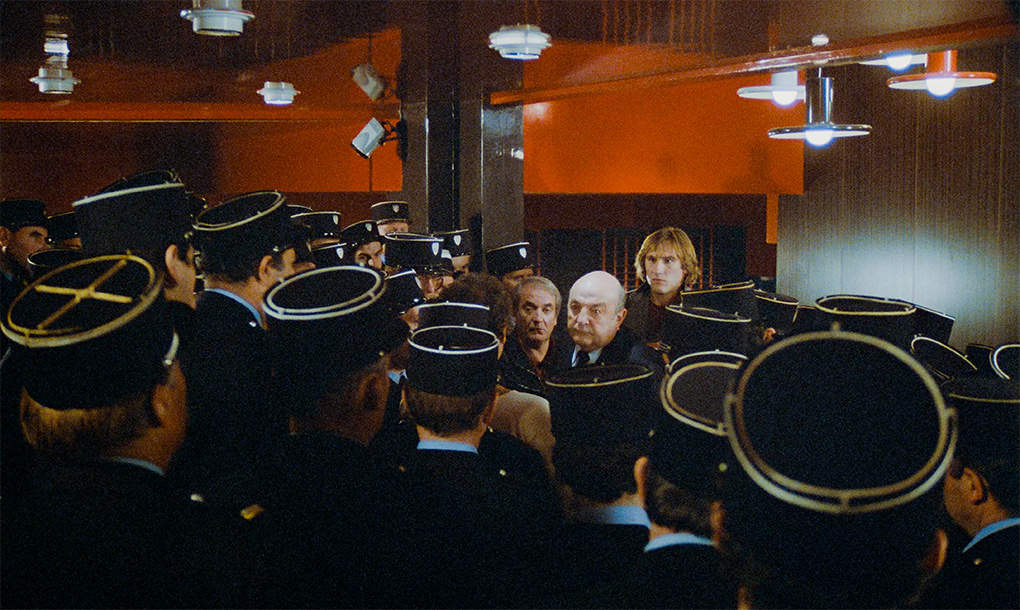
The wittiness of Blier’s approach is as evident in the filmmaking as the dialogue, the performances, and the bizarre turns of the plot, and editor Claudine Merlin deserves special recognition here for the economy of her scene transitions and how they are sometimes used to deliver a visual punchline to an already amusing sequence. A personal favourite comes when Alphonse, Morvandieu and the Murderer return to Alphonse’s apartment and are startled to hear the elevator being operated. As they press the call button and wait for it to arrive at their floor, the scene takes on the air of a horror-tinged thriller, with the tension upped a notch by the fact that the car is empty when doors finally slide open. Morvandieu edges inside (in the film’s only obvious continuity error, he appears to do so twice from two different angles). “Smells of tobacco,” he tells his companions, “And when things small of tobacco, they’re about to smell of trouble. I don’t like it.” The stillness of the sequence then cuts to a scene of utter pandemonium as raging river of uniformed gendarmes pours into the lobby under orders from Morvandieu to comb the building for the interloper, a sequence that has just a whiff of the comical police overreaction in the climax of the John Landis-directed The Blues Brothers from the following year.
The debate over whether a film is racist/sexist/homophobic or is simply portraying characters with these prejudices in order to critique them is a well-worn one that still divides critical opinion. The case for applying the latter to Buffet froidis certainly made in the special features, notably by the learned Sue Harris, whose 2001 book French Film Directors: Bertrand Blier was the first serious literary evaluation of the director’s work. As a female viewer and commentator who interviewed Blier several times and has seen and studied all of his work, she is far more qualified to comment on this aspect of the film than I am. For this hopefully still progressive old viewer it does niggle, but ultimately Buffet froid is a film in whose many pleasures really do outweigh its time-stamped irritations. Some will find the seeming randomness and illogicality of its oddball plot development annoying or distancing, but for my money its melding of the late career works of Luis Buñuel with the comically surreal irreverence of Monty Python and the poetic absurdism of Samuel Beckett makes for a hugely entertaining and often gleefully bonkers brew that works so well because its screenplay, its handling, and the fine performances from its excellent cast all seem to be completely in sync. After my first viewing, I did wonder if the whole thing was intended to be read as an expanded visualisation of the nightmare that so plagues Alphonse or was perhaps even a series of jumbled memories that flash through the mind of a troubled man as he faces his own extinction. One thing it did confirm beyond all question is that I really need to become more acquainted with the cinema of Bertrand Blier.
sound and vision
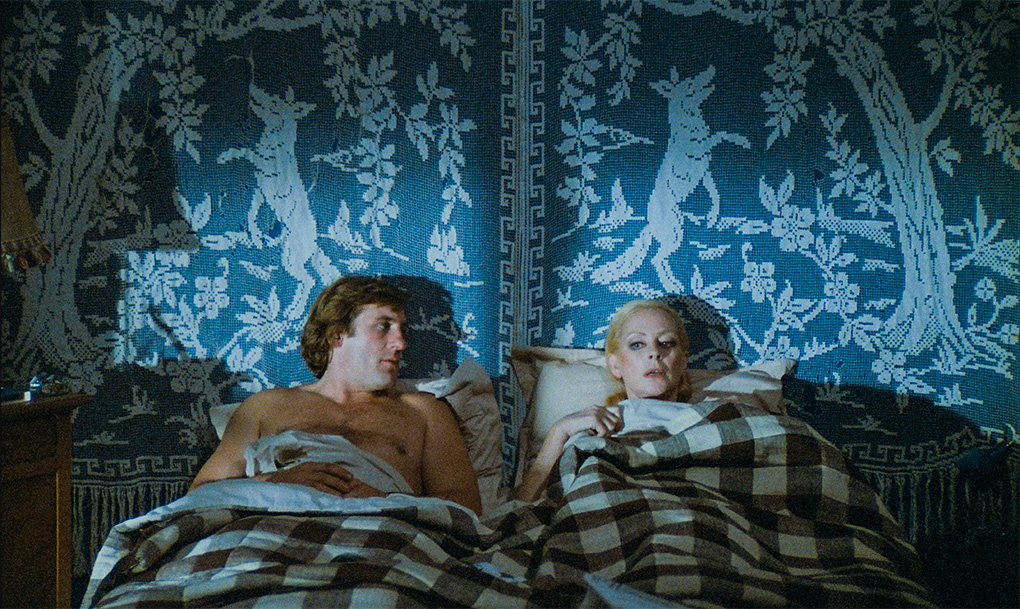
The 1.66:1 transfer on this Indicator UHD was sourced from a 4K restoration produced from the original 35mm picture negative by StudioCanal and graded with Dolby Vision HDR. I do not have the simultaneously released Blu-ray for comparison, but the image on the UHD disc is hugely impressive. This is not a film that makes use of eye-catching imagery or lighting, and the colour scheme has a deliberate earthy dourness to it, but it does have an atmospherically naturalistic feel here, and when brighter colours do make an appearance they have a subtle richness that never feels over-saturated. Detail is sharply defined whilst still retaining that tactile quality unique to 35mm film, and the contrast is very nicely graded, with the HDR lending a welcome hand in lifting shadow detail in a film that is set primarily at night. I spotted no signs of wear, the image sits solidly in frame, and a fine film grain is visible.
The mono soundtrack has also been restored and is presented here as Linear PCM 1.0. The result is very clear with no obvious signs of wear – this is a primarily dialogue driven film whose only music is the diegetic musical performance at the house of the hostess, and this sounds very nice.
Optional English subtitles are activated by default.
special features
Audio Commentary with Nick Pinkerton
Film critic Nick Pinkerton barely has time to catch his breath in this consistently busy and hugely informative 2019 commentary, which delivers a considerable amount of information on all of the principal actors and a few of the supporting players, as well as director Bertrand Blier, cinematographer Jean Penzer, sound recordist Jean-Pierre Ruh, editor Claudine Merlin, production designer Théobald Meurisse, and probably a few others that I didn’t managed to scribble down in my notes. He tellingly describes the work as “a strange film in a filmography of strange films,” provides information on the Paris locations, and comments on the accusations of misogyny in Blier’s films and his handling of the genre roles here. He quotes more than once from the aforementioned book on Blier’s cinema by Sue Harris – a name that crops up again twice in the special features – as well as from a couple of the mixed reviews that greeted the film on its American release, sniping at one in particular when he notes that it was written by “Vincent Canby, reliably full of shit.” Ouch.
Bertrand Blier on Buffet Froid (24:31)
An archive interview with director Bertrand Blier, who fills, lights and smokes a pipe that appears to be as much as aspect of his persona as it was with fellow French director Jean Rollin. He opens by wondering how he was able to write the film in just two weeks, cites Gérard Depardieu as his muse, and doesn’t really help dispel those accusations of misogyny when he says that the film has “little room for women and they are killed immediately so they wouldn’t hinder the story,” then has a good chuckle. Was he joking? Maybe, as he later kicks against this with the claim that women are more mature than men in his films and that the men don’t understand them, adding that the macho attitude is one of the stupidest there is, and that he has a lot of fun with it in his work. He reveals that the opening scene was originally shot with a different actor playing the accountant but it just didn’t work, that his father is something of an aquaphobe and thus was terrified of shooting a scene set on a lake in a rowing boat, and claims that filmmaking is easy when everything clicks, only to then note that it rarely does. He confirms (this was brought up in the commentary as well) that the funding for the film didn’t come through until he won the Oscar for Get Out Your Handkerchiefs (Préparez vos mouchoirs, 1978) and that Alain Sarde was the only producer who laughed while reading it. He also suggests that it is better to have his dialogue performed by accomplished actors, as they can get an audience to believe anything.
Edinburgh Film Podcast: Sue Harris on Bertrand Blier (38:02)
Having listened to Nick Pinkerton quoting from her book on Bertrand Blier, I was looking forward to this Edinburgh Film Podcastinterview with its author, Sue Harris, and it didn’t disappoint. Hosted by Dr. Pasquale Iannone as part of a French Film Festival that included a screening of Buffet froid, this is a fascinating and – especially for those of us relatively new to Blier’s cinema – educational listen, with Harris recalling how she became hooked on his films after a screening of Mercie la vie (which was released alongside this film on UHD and Blu-ray by Indicator), and how she was discouraged from writing about his films by those who regarded him as a misogynist who pushed boundaries too far. She makes the case for the reevaluation of Les valseuses as a cult classic, though admits that Blier wouldn’t have made the film today (he died in January of 2025, the year that this was recorded). She then moves onto Buffet froid, which she intriguingly describes as Blier’s most coherent film and the best introduction for newcomers to his work. There’s plenty more of real interest here.
Theatrical Trailer (2:10)
How do you promote a film like Buffet froid? If you’re the makers of this trailer, the answer seems to be to lean into its oddness and just montage a collection of unrelated snippets together, sometimes using split screen, to give the impression that the film is as bonkers as many will think it is.
Daniel Kremer Trailer Commentary (5:13)
A Trailers from Hell episode featuring filmmaker and film historian Daniel Kremer, who introduces himself as a zombie (seriously), a condition that playing and guiding us through the trailer for Buffet froid apparently cures. He outlines how he got into “strange, outlandish, offbeat, and often foreign cinema” from an early age, and how he first became intrigued by a film that he didn’t see until several years later, and does comment on the film itself when the above trailer is run.
Image Gallery
42 screens consisting of promotional stills, behind-the-scenes photos, lobby cards, a French press book page scan, and posters.
Script Gallery
Scans of the script, two pages per screen over 37 screens. This will obviously be more useful to those with a better command of the French language that me.
Booklet
The lead essay here is by none other than Sue Harris, who remains the leading authority on Blier’s cinema so would absolutely be the logical choice. She briefly charts the road that led to Blier making this film, and explores it with a perception and economy of writing that I can’t help but envy and greatly enjoyed reading. This is followed by extracts from various publications in which Bertrand Blier talks about the film and its making – some of the information here is also supplied in the on-disc extras, but there is still plenty of interest, including his description of Gérard Depardieu as “the only French actor who frightens people without having to play a role.” Finally, we have extracts from contemporary reviews, with French critics noticeably more enthusiastic about the film than their British or American counterparts. As expected, the booklet is as handsomely presented and nicely illustrated with promotional material for the film.
final thoughts
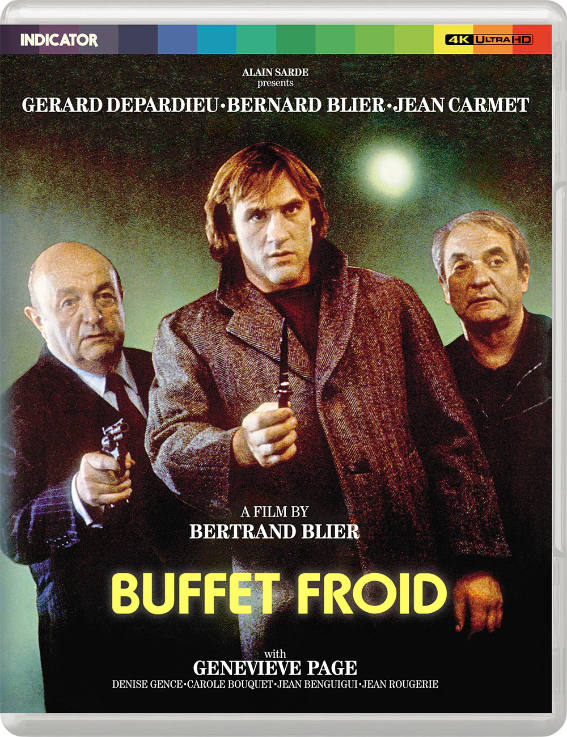
One of those films that I can absolutely understand why some will be frustrated or even annoyed by but that I hugely enjoyed, Buffet froid is a crime thriller run through a blackly comic surrealist wormhole and set in a facsimile of the real world populated only by people who contribute directly to the story, and where no turn of events or dialogue exchange plays out how tradition has led us to expect. It’s handsomely presented on Indicator’s UHD, and I’ve little doubt that the Blu-ray also looks and sounds grand, and both are backed by a reliably solid set of special features. Not for everyone, once again, but still highly recommended.
Buffet froid
France 1979 | 93 mins
directed by: Bertrand Blier
written by: Bertrand Blier
cast: Gérard Depardieu, Bernard Blier, Jean Carmet, Denise Gence, Marco Perrin, Jean Benguigui, Carole Bouquet, Jean Rougerie, Liliane Rovère, Geneviève Page
distributor: Indicator
release date: 24 August 2026