
Pressure
Horace Ové’s PRESSURE, the first British feature film made by a Black director, comes out on Blu-ray from the BFI, following a 4K restoration. Review by Gary Couzens.
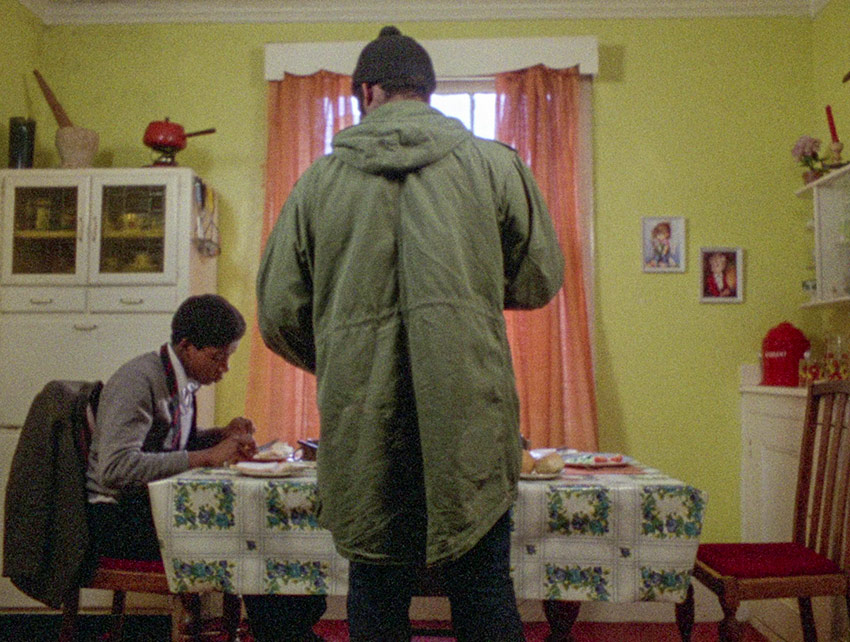
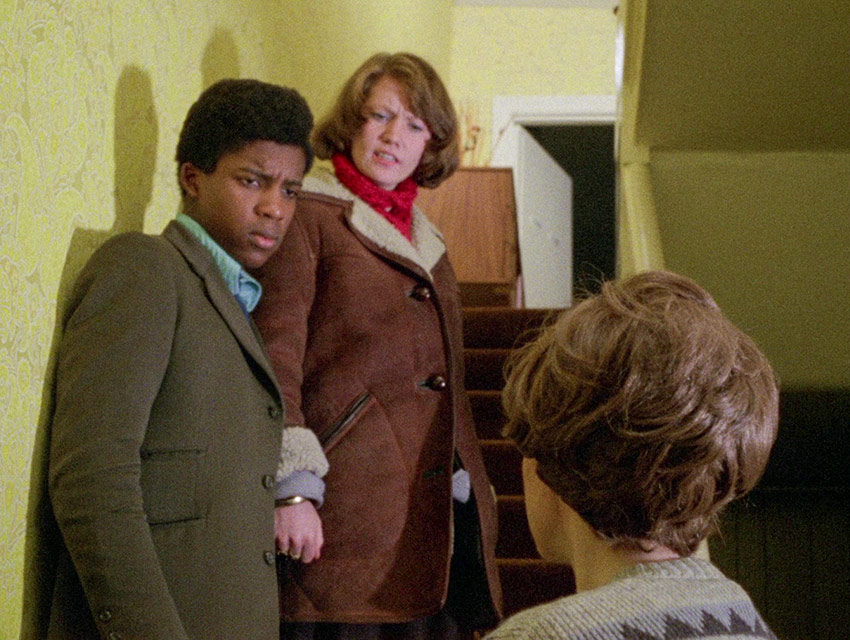
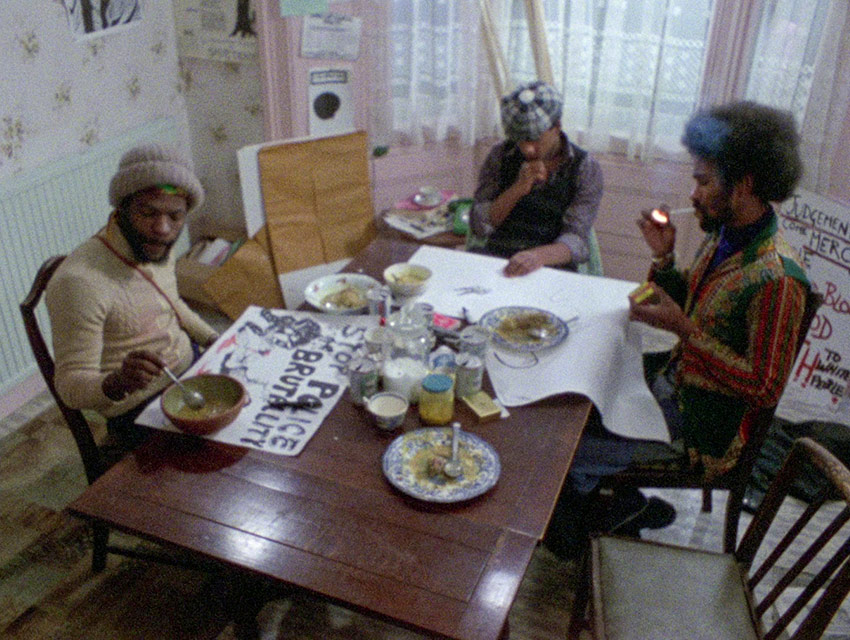
Pressure begins with a succinct illustration of its themes, nothing less than a close-up of bacon and eggs frying in a pan. It’s being prepared for Tony (Herbert Norville), while Capital Radio (featuring the voice of Tommy Vance, credited) plays. But Tony’s older brother Colin (Oscar James) berates Tony for eating white people’s food, listening to white people’s music. (With hindsight, it’s unfortunate that the latter is represented by a poster of Gary Glitter on the wall, but he’d had his commercial peak as a recording artist the year before this scene was shot.) Tony finds himself caught between between two worlds, not fitting in either. When he meets his (white) former school friends, he’s the one turned down for job application after job application as soon as the interviewer realises he is Black. He often has to point out that he was born in England so hasn’t just arrived but there all his life. The same goes for a friendship with Sheila (June Page), who had also been at school with him, a friendship which could possibly be something more, but abruptly curtailed when her landlady throws him out as soon as Sheila brings him home. Meanwhile, the militant Colin becomes even more involved with Black Power politics.
A short note. The publicity material, booklet and the disc menu for this release expurgate the title of Horace Ové’s 1969 documentary which is effectively a second feature on the disc. After some consideration, I will be referring to the film by its full title. The 2005 DVD release had that full title on its cover slip, but times are different now to then, let alone to 1968 when the film was made. There are precedents on this site for reproducing racial slurs where appropriate (see, for example, Slarek’s review of The Dam Busters) and I have elected to do because the film was made by a Black director and is about a celebrated Black writer who says the words of the title during it.
Pressure has a place in history as the first feature film made in the United Kingdom by a Black director. It was shot in 16mm on a tiny budget (too small, as producer Robert Buckler admits) and spent just under three years before it was blown up to 35mm and given a limited cinema release. It was directed and co-written (with Samuel Selvon) by Trinidad-born Horace Ové.
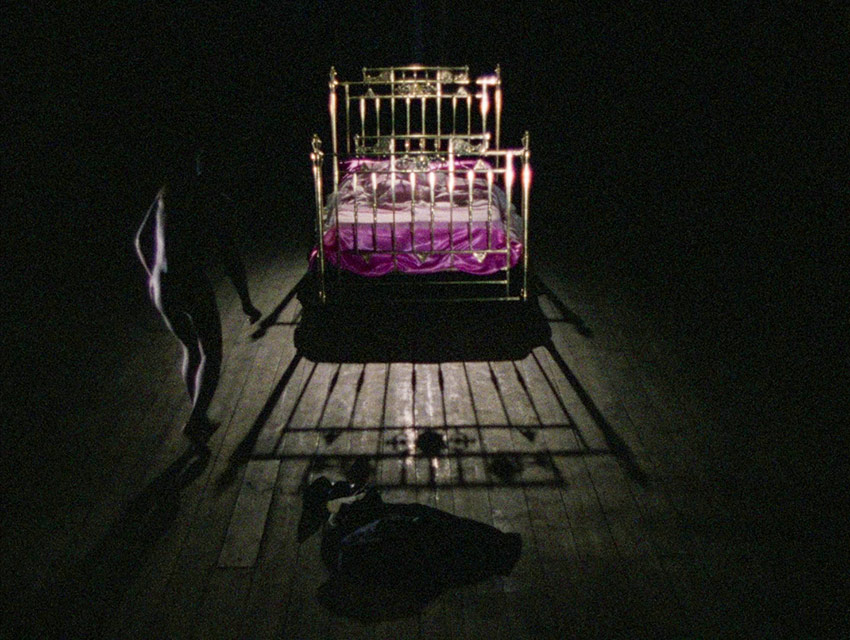
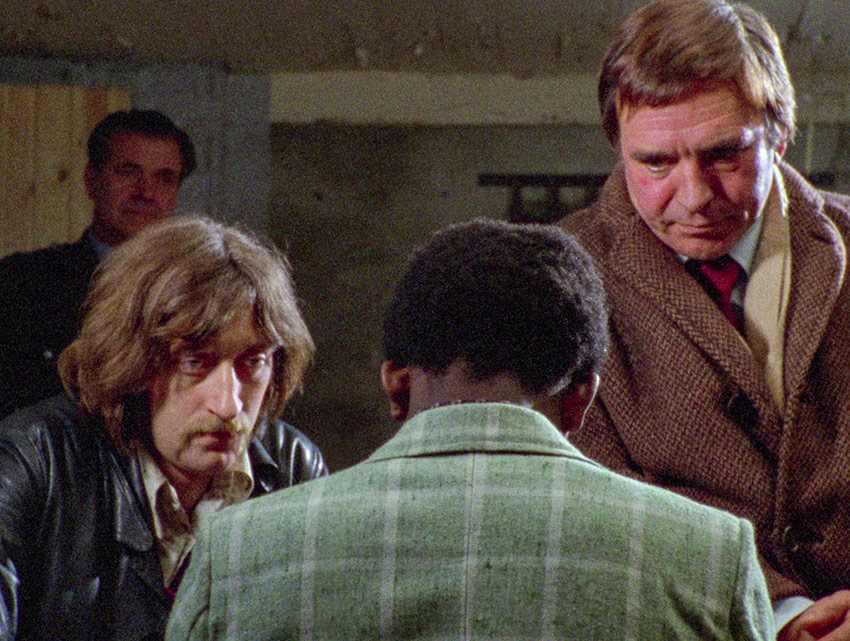
The film is, on the surface, in the long tradition of British social realism, influenced by the French New Wave in taking 16mm cameras on to the streets. And they are real streets, an illustration of London in and around Notting Hill in 1974. They were shot without permits, so the bystanders we see are real bystanders, not extras. Ové’s documentary background is well in evidence. The 16mm photography – shot by Mike Davis – adds to the realism and the grit. But Ové’s eye for a shot is quite evident, and the camera is always in the right place. It’s quite possible to imagine Ken Loach, say, coming up with something like this on the surface, though he would have been an outsider looking in to this culture. (And, at the time, Loach was working on television rather than the cinema.) But that’s deceptive, as we see from a six-minute dream sequence near the end which is like something out of Luis Buñuel, a director Ové greatly admired. The younger cast, including Herbert Norville (around seventeen at the time) were mostly recruited from Anna Scher’s Children’s Theatre, but the adults were all played by professionals. Norman Beaton turns up as a preacher, and T-Bone Wilson, who played the lead in Ové’s 1979 Play for Today A Hole in Babylon (which you can find in the BFI’s Blu-ray release Play for Today Volume 3) has a small role. Ed Devereux (misspelled Deveraux in the credits) is a surprising presence. Best known for his lead role in Skippy in his native Australia the previous decade, he was at the time working in the UK and here turns up as a police inspector.
Pressure was shot in 1974 and completed in 1975, which is its copyright date. It was shown in 1976 at the London Film Festival and was passed by the British Board of Film Censors (as was) in November of the same year. Both of those were as a 16mm print, and I emphasise the gauge to point out the reason why its commercial release was so delayed. The film was set up at the BFI Production Board with an understanding that it would be shot in 16mm but blown up to 35mm for commercial release. However, when the time came, the head of the Board had left and the BFI demurred at the cost of a blow-up. While they were trying to have the film released – it having been made more timely by the Notting Hill riots of 1976 – Robert Buckler had journalists such as Philip Oakes and Alexander Walker to speak on its behalf. Meanwhile, the release of Black Joy in 1977 stole some of its thunder as the first British Black feature film, though that was directed by a white man, Anthony Simmons. Pressure was eventually blown up and was released on 19 February 1978, its main London venue being the Coronet in Notting Hill, not far away from where it had been shot.
Ové had a long career, directing documentaries, television drama (including another Play for Today, The Garland from 1981, episodes of Empire Road and The Professionals, the 1991 miniseries The Orchid House) and one more cinema feature, Playing Away (1987), made for Channel 4. Pressure is certainly not flawless: its rough edges do show, and at the current, presumably definitive, length of 126 minutes, twenty or thirty minutes overlong. Some subplots – such as the scenes with Tony’s former school friends – seem set up simply to make a point and then abruptly disappear. But Pressure is still a work of considerable merit over and above its place in history.
sound and vision
Pressure is released by the BFI on a Blu-ray disc encoded for Region B only. There have been several different running times for the film. When it was passed by the BBFC in 1976 (in a 16mm print) it ran 136:06 but when it was released in 1978 it was 110 minutes (as per the Monthly Film Bulletin in April 1978) and some newspaper reviews gave a time of 103. The present version runs 126:07, including restoration captions, and has to be regarded as definitive. Pressure had a AA certificate (fourteen years old and over) on its original release and is now a 15. Baldwin’s Nigger is a 12. Ten Bob in Winter and Jemima + Johnny are both PG, though the latter was a U in cinemas. Inevitably, as the disc starts an advisory appears: “Contains themes of racism and racist language”.
The film was shot in 16mm – standard 16mm, that is, not Super 16mm. The transfer, based on a 4K restoration from the original negatives, is in a ratio of 1.33:1. That’s clearly the ratio the film is composed for, though 35mm showings would very likely have cropped it into a widescreen ratio, probably 1.75:1. The film’s lower-gauge origins are evident in some softness and noticeable grain, but it’s filmlike.
Pressure had a mono soundtrack in cinemas and that, rendered as DTS-HD MA 1.0, and that’s what’s on this disc. Although it is mono, the subwoofer picks up a fair amount of bass from the reggae on the soundtrack. There is also an audio-descriptive soundtrack available in Dolby Digital 2.0. English hard-of-hearing subtitles are available for both features, the two short films, the trailer and the Horace Ové interview. They do a good job of rendering the dialect in the main feature. I didn’t spot many errors, though one I did is “affixation” for “asphyxiation” in Ten Bob in Winter.
special features
Commentary with Robert Buckler, Herbert Norville and Marc David Jacobs
Newly recorded for this release, this commentary features the film’s producer Robert Buckler and the lead actor Herbert Norville, moderated by Marc David Jacobs. Or rather it’s the first two with Jacobs providing a light touch as moderator. The chat is only rarely scene-specific, with Buckler in particular going into the production of Pressure in some detail. He grew up in Brixton, so saw a lot of Black people around him. He actively sought out Black writers when he was working for Play for Today, originally to be a block of six plays, though that didn’t come about. Pressure (then called The Immigrant) had its origins there when he suggested that Samuel Selvon be one of those writers and it was through another writer that Horace Ové came to his attention. When Buckler left Play for Today, the project lapsed. He raised the money elsewhere, including from the BFI Production Board, and the film went into production in 1974. It had a crew of fifteen and was seriously under-budgeted. Buckler says the script was never timed and what was budgeted for 80 minutes ended up at the present 126. The shooting in the streets without permits almost got the production in trouble for the final shot, as it was an offence to film the Old Bailey, which you can see in the final scene. He also talks about the film’s delay in release and of this restoration, which is definitive, even if he does want to shorten it a bit. (Some images were reversed in the previous DVD, so they are the right way round here.)
This wasn’t Herbert Norville’s first film, but he was a graduate of the Anna Scher Children’s Theatre. Scher had been his junior school teacher and he talks about his first sight of her, leaving him starstruck. Many of the younger members of the cast also came from Scher’s. Norville says that much of the material in the film is what he was living through at the time, aged sixteen or seventeen. He has had a notable career, working with the likes of Alan Parker (Bugsy Malone), Alan Clarke (the feature film version of Scum, The Firm), Mike Leigh (Meantime) and Stanley Kubrick (Full Metal Jacket). Both men’s high regard for Horace Ové is very evident.
Baldwin’s Nigger (45:27)
This is an unadorned record of a talk given by American novelist James Baldwin at the West Indian Students’ Centre in 1968, shot in black and white 16mm. Baldwin (1924-1987) was a major American writer, particularly for his third novel Another Country (1962), which had been a bestseller. Nearly forty years after his death, his reputation is secure, though maybe more in the USA than in the UK. (His second novel Giovanni’s Room, dealing with homosexuality as far back as 1956, had some unwanted prominence due to its featuring in the 1979 trial of former Liberal Party leader Jeremy Thorpe for conspiracy to murder his former lover Norman Scott. Baldwin’s later novel If Beale Street Could Talk (1974) was filmed by Barry Jenkins in 2018.) Baldwin speaks for some twenty minutes before taking questions from the audience – noticeably not an entirely Black one. There are also words from comedian Dick Gregory. The title comes from Baldwin’s words, his response to the question where he was from and not being satisfied with the accurate answer of America. “Wherever I was from in Africa, I couldn’t find out where it was because my entry into America is bill of sale, and that stops you going any further. At some point in our history, I became Baldwin’s Nigger.” His eloquence is without doubt.
Horace Ové on Pressure (35:42)
This was recorded in 2005 for the BFI’s DVD release, with Ové going through his life and career before talking about Pressure. Ové grew up in Trinidad. The island had been loaned to the US as a training base for their forces, so an infrastructure had grown up around this, particularly in young Ové’s case some three hundred cinemas. He even got to know a projectionist, nicknamed No Teeth Harry. In the UK, he entered the film industry by doing extra work – especially in the 1964 Cleopatra, at first in England then off to Rome when Elizabeth Taylor had the original Mark Antony replaced by Richard Burton and the production relocated. While he was in Italy, Ové watched a lot of films, finding the neo-realist classics particularly eye-opening. As well as being a filmmaker, Ové did a lot of still photography, some of which we see in this interview; his eye is very evident. He bonded with Samuel Selvon, as they were both “Trinnies”, though Selvon found himself less able to write about the younger characters in Pressure than the older ones. Ové also talks about some of his other work, such as the 1970 documentary Reggae, A Hole in Babylonand Playing Away.
Horace Ové was knighted in 2022 for services to media. He died on 16 September 2023, at the age of eighty-six.
Pressure Q&A (16:38)
From 2023, and a panel discussion at the BFI Southbank. Dr Clive Awonka moderates, and we have Herbert Norville, assistant producer Annabelle Alcazar, writer Caryl Phillips (who wrote Playing Away for Ové) and filmmaker Rhea Storr. Storr and Phillips make a case for Pressure being more experimental and indeed surrealist (the dream sequence) than it at first appears. There is some discussion of Samuel Selvon, who had written novels on Black themes (such as The Lonely Londoners) and who emigrated to Canada shortly after the film was shot. There is one question from the audience at the fourteen-minute mark, presented as an onscreen caption.
Horace Ové: Reflecting the People – A Career Retrospective (58:27)
As part of the same Ové retrospective is this discussion of his life and career. Annabelle Alcazar appears again, along with TV producers Peter Ansorge and Tara Prem and Marcus Ryder, and moderating duties go to Samira Ahmed. Inevitably there’s some overlaps with other items on the disc and in the booklet, so we hear from Alcazar about Ové’s youth in Trinidad and his taking the opportunity to see a lot of films, not just from Hollywood but Europe too. Ansorge talks about how Ken Loach’s mostly film-shot (16mm with lightweight cameras) Cathy Come Home revolutionised TV drama, taking it in a more cinematic direction, something that someone with a cinematic eye like Ové thrived on. They talk about his working practices, including the links between documentary and drama in many of his films. Channel 4’s Multicultural Department, set up with the channel which launched in 1982, was vital in bringing many Black faces and voices, and writers and filmmakers, on to our television screens . With its abolition under the channel’s third Chief Executive, Michael Jackson, the department was abolished and, Ansorge says, you never saw a Black face on the channel again.
As with many such discussions when they appear on disc, extracts from films and television works are edited out for licensing reasons, but Ahmed does tell us what we are missing, from Ove’s cinema and TV dramatic works, his documentaries and his arts programmes. We end with a clip of Horace Ové himself, also edited out. Questions from the audience begin at forty-seven minutes, in the usual format of onscreen captions.
Restoration trailer (1:30)
I don’t know if Pressure had a trailer originally, and if it did it still exists. This is for the new 4K restoration and it gives a good impression of what you’re about to see, including several critics’ quotes.
Ten Bob in Winter (12:08)
Many BFI releases include short films, sourced from the BFI National Archive, which aren’t specific to the main feature, but reflect on its themes more or less tangentially. Lloyd Reckord’s short film has made at least two previous appearances on BFI discs. You can find it on the 2021 release of The Pawnbroker and before that on their release of Look Back in Anger, in their Woodfall: A Revolution in British Cinema Blu-ray set.
Ten Bob in Winter was made in 1963 for the BFI Experimental Film Fund. Some of its experimentalism may have been forced by circumstances: there’s no direct sound, just a music score and narration provided by writer/director Lloyd Reckord. One sequence becomes a series of still photographs. The film was shot in black and white 16mm, and very grainy it is too. The story is a simple one of a ten-shilling (“ten bob”, hence the title) note and its journey through the hands of three men, reflecting on class prejudice in the Caribbean community in West London. Jamaican-born Reckord (1929-2015) was primarily an actor, and in the history books for being one of the participants in the earliest known interracial kiss on British television, in 1959. He was also a stage director but this is one of only two occasions he directed a film. The other was another short, Dream A40, two years later. The BBFC banned it for its gay theme, the kiss this time being between two men.
Jemima + Johnny (29:56)
Another film with a thematic connection to the main feature, Jemima + Johnny (often referred to as Jemima and Johnny, but it’s a plus sign on screen) has also done BFI extras duty before. It can be found on their release of A Dry White Season.
Made in 1966 and shot in black and white 16mm, Jemima + Johnny takes place in Notting Hill. This was an area of London marked by racial tensions, which had led to the race riots of 1958. Due to deprivation, racial prejudice thrived and we see a leaflet from the White Tenants’ Association saying “Beware! Black Menace. Protect your Neighbourhood.” Five-year-old Johnny (Patrick Hatfield), the son of a white nationalist, befriends Jemima, the similarly-aged daughter of a newly-arrived Jamaican family. The film follows their adventures during a day, with little dialogue (the two central characters aren’t actually named on screen, except in the credits) and a music score dominated by a guitar played by composer Bill Bramwell. While its message is clear – the conflict between parents not being inherited by their children, with some reconciliation implied by the events of the film’s climax – it’s conveyed without being heavy-handed.
The film was written and directed by South African-born Lionel Ngakane, who had been in exile from his home country since the 1950s. He wouldn’t return until after the abolition of apartheid. Jemima + Johnny won a prize at Venice in 1966, making it the first Black British film to win a festival award. Ngakane didn’t direct again, though he continued to work as an actor, such as in A Dry White Season, where he was also a technical advisor. The Black South African actor Zakes Mokae appears as a blind man crossing the road.
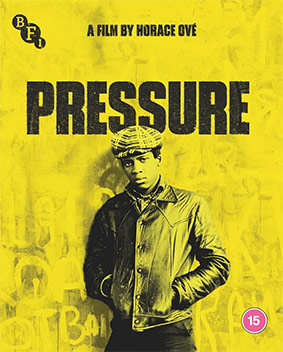
Booklet
The BFI’s booklet runs to thirty-two pages plus covers. Following a spoiler warning, we begin with “Under Pressure” by Arike Oke. She discusses the fact that the 1970s generation of Black people (of African or Caribbean heritage) were the first one, after Windrush, to grow up in British society. The title Pressure aptly describes what many of them felt. Although Black people had been in Britain since at least Roman times, the previous decade had seen many African and Caribbean nations gain independence, including Horace Ové’s native Trinidad and Tobago in 1962. Ové and Selvon, as they wrote the film, wanted to show the situation of young Black men like Tony, and the way that he and Tony negotiated the various demands on them. She sees predecessors to Tony in such films as the little girl Jemima in Jemima + Johnny and other films. Tony wants to fit in: he’d rather eat egg and chips than West Indian food, and he shares a KFC with Sheila as they go out. Oke also looks forward to other films like Burning an Illusion, directed by Menelik Shabazz, though that film centres on a woman. (Shabazz visited the production of Pressure, and as a result his film became the second British feature film from a Black director.)
After a cast and crew listing, Zak Ové, Horace’s son, talks about his father, in a piece reprinted from the Black Film Bulletin supplement of Sight & Sound in 2021. Back in 2019, Zak had curated a tribute to Horace at Somerset House in London. He talks about the roots of Horace’s life and career and creativity, based in a search to find the “one image”, in both still and moving pictures in pre-digital days. One thing that Horace gave his son was a love of Trinidad Carnival, a revolutionary force in that country and its fight for independence. Zak talks about Horace’s style of filmmaking and the influence of the Black community in West London that Horace was a part of in the 1960s.
Kevin Le Gendre contributes “The Music of Pressure”, which begins with the title song, co-written by Horace Ové and performed by Boy Wonder and The Sisters. Ové was certainly aware of what was going on in Black music at the time, having made a fifty-minute documentary on the subject for the BBC, Reggae, broadcast on BBC2 on 26 March 1971. However, the music we hear in Pressure is more wide-ranging, from gospel in church, to guitar-based rock and funk. Le Gendre ties this in to what was happening offscreen in music. Le Gendre is up again with a four-page profile of Sam Selvon. This begins with a description of his and Ové’s research for Pressure, including interviewing young Black West Londoners. Selvon had arrived in the UK from Trinidad and worked as a novelist, dealing with West Indian culture in post-War Britain from inside, including an accurate depiction of their speech. This is reflected in Pressure as well, with its mix of Caribbean, African-American and British colloquialisms.
Also in the booklet are credits for and notes on the extras. This includes an essay by Milo Holmes on Baldwin’s Nigger, and the booklet has advisories that he (and Kevin Le Gendre above) refer to that film’s title in full. Katy McGahan provides notes on Ten Bob in Winter and Ellen Cheshire on Jemima + Johnny. There are also plenty of stills.
final thoughts
There have been British feature films made in the last fifty years by Black directors, male and female, but Pressure has its place in history as the first of them. Not unflawed but with merits exceeding its demerits, it stands as part of Horace Ové’s significant career in the British film and television industry. The BFI’s extras and booklet as ever do a very good job of placing it in context.
Pressure
UK 1976 | 126 mins
directed by: Horace Ové
written by: Horace Ové, Samuel Selvon
cast: Herbert Norville, Oscar James, Frank Singuineau, Lucita Lijertwood, Sheila Scott-Wilkinson, Ed Deveraux
distributor: BFI
release date: 14 September 2026