
The Mahabharata
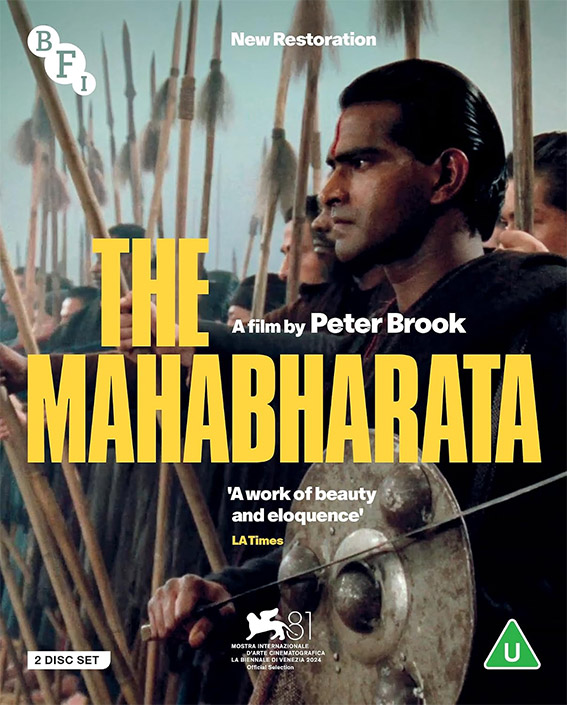
Peter Brook’s screen version of his stage production of the Indian epic THE MAHABHARATA, is released by the BFI as a two-disc Blu-ray release. Review by Gary Couzens.
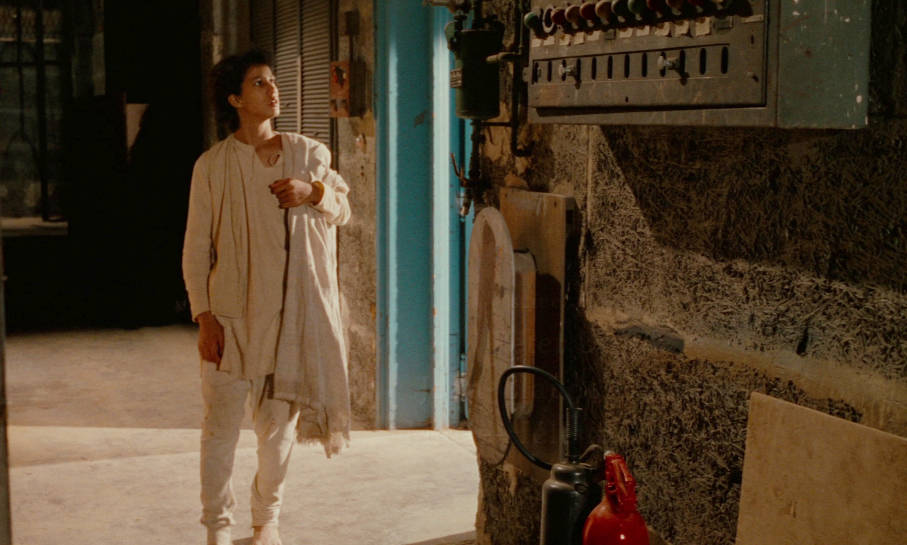
The Mahabharata is a huge story, with dozens of characters, but the outline is easy enough to follow. We begin with a young Indian boy (Antonin Stahly-Vishwanadan) in what may be the present-day theatre where the story will take place: there’s a contemporary fuse box on a wall. The story is told by Brahmin sage Vyasa (Robert Langdon Lloyd) and the elephant-headed god Ganesha (Bruce Myers, who also plays the role of Krishna). The story is one of conflict between two families, both descended from gods and royalty, the Pandavas, five brothers, and the Kauravas, a hundred brothers born from one large ball Gandhari (Hélène Patarot), wife of the blind king Dhritharashta (Ryszard Cieślak), gave birth to. Duryodhana (Georges Corraface) challenges the Pandava king Yudhishthira (Andrzej Seweryn) to a game of dice and wins everything, sending the Pandavas into a twelve-year exile, from which they return intent on war…
The original poem, in Sanskrit and compiled between the third century BCE and the fourth century CE, is one of the two great Hindu epics, along with The Ramayana. It is one of the longest poems in existence, comprising 100,000 verses (couplets, so 200,000 lines) with prose passages, in eighteen parvas (books), totalling some 1.8 million words, about fifteen times the length of The Bible. It is central to Hindu tradition and culture, with many of the numerous characters being household names. Almost as soon as it was possible to adapt the epic into another medium, it has been done, with film versions made in India as long ago as 1920. Outside the present version, the best known – to Western eyes at least – is the ninety-four-episode television series Mahabharat, broadcast between 1988 and 1990. It has been broadcast in the UK and released on DVD. Some 190 million people in India watched the final episode. There have been other versions since, including a series broadcast in India in 2001 and 2002, and another in 2013 which is India’s most expensive animated film.
Peter Brook (1925-2022) was one of the most influential theatre directors of the twentieth century. He began to work for the Royal Shakespeare Company with a production of Love’s Labour’s Lost in 1946. Some of his work in the 1960s attracted considerable controversy, such as Peter Weiss’s Marat/Sade in 1964 and Denis Cannan’s anti-Vietnam War US(meaning both “us” and the United States of America) in 1966. However, he has had a parallel career as a film director. Some of his films are derived from his stage work – Marat/Sade filmed in 1967 and US as Tell Me Lies in 1968. In 1971 he made a version of King Lear with Paul Scofield, whom he had directed in the role for the RSC in 1962. Other films were adaptations from other media than the stage, including the French-language Moderato Cantabile (Seven Days…Seven Nights in the UK) from the novel by Marguerite Duras, and most notably the 1963 version of Lord of the Flies, still the best version of William Golding’s novel.
Brook first became aware of The Mahabharata in the late 1960s. He and writer Jean-Claude Carrière took several years to convert the epic poem into a feasible stage play. The final production was staged in a quarry in Avignon, France, in 1986. The entire play ran nine hours with two intervals. Originally performed in French, the production travelled the world at first in that language and then later in English. This formed the basis of the present version, which was shot in the Joinville Studios in Paris. While Carrière is credited for the play, he, Brook and Marie-Hélène Estienne are credited for the screenplay. The cast is from sixteen countries and different races. The one Indian in a principal role was Mallika Sarabhai in the role of Draupadi. The original plan was for a six-hour cinema release, but that understandably proved unviable, so the present version emerged: a three-part version for television running five and a half hours. That’s the iteration on this disc, and it premiered on France’s Canal+ on 24 January 1989. In the UK, it was shown on Channel 4 on 9 December of the same year, in one long broadcast including commercial breaks, beginning at 7.30pm and ending at 1.25am on Sunday. A 171-minute cinema version was released in London on 26 December 1990, playing at the Barbican.
Brook’s screen version is an intended halfway house between a stage production and a more conventional film, which would probably be unaffordable due to its epic scale. So it does little to disguise its studio origins, but goes beyond what the stage could do, as there are live animals – particularly horses – in sight. The multiracial and multinational casting is intended to turn this specifically Indian work into the universal story it is, and as such is successful with no one seeming out of place. As such, the five and a half hours pass quickly, though most will do what I did and watch it an episode at a time. Especially in this restoration, the film looks sumptuous, shot in 35mm by William Lubtchansky and with set and costume design by Chloé Obolensky, adapting her stage designs for the film. While no doubt the original stage production lives on in the memories of those who saw it, this is as good a digest of it as you are likely to find.
sound and vision
The Mahabharata is released by the BFI as a two-disc Blu-ray, both discs encoded for Region B only. The first two episodes, “A Game of Dice” (100:37) and “Exile” (97:55) are on Disc One, with the third episode, “War” (133:09) and the extras on the second disc. The running times include opening and closing credits for each episode, which have been redone to take account for the restoration, so they have two copyright dates, 1989 and 2026. The Mahabharata was given a U certificate for its cinema release in 1990 and its VHS release in its current miniseries form in 1995. As it has an existing homeviewing certificate, it hasn’t been resubmitted and retains its U. However, I suspect it wouldn’t retain that if it were submitted now. The violence is admittedly stylised, but includes shooting with arrows, spearings and a thumb-severing. There are also some sexual references and one “shit” and one “piss”, though referring to the bodily functions rather than being swearwords. It’s unlikely many people reading this would think this would have any appeal to young children, except maybe in Indian households. Pageant of the Sun-God had a U certificate in British cinemas in 1934, though as a documentary it has been exempted from classification on this disc.
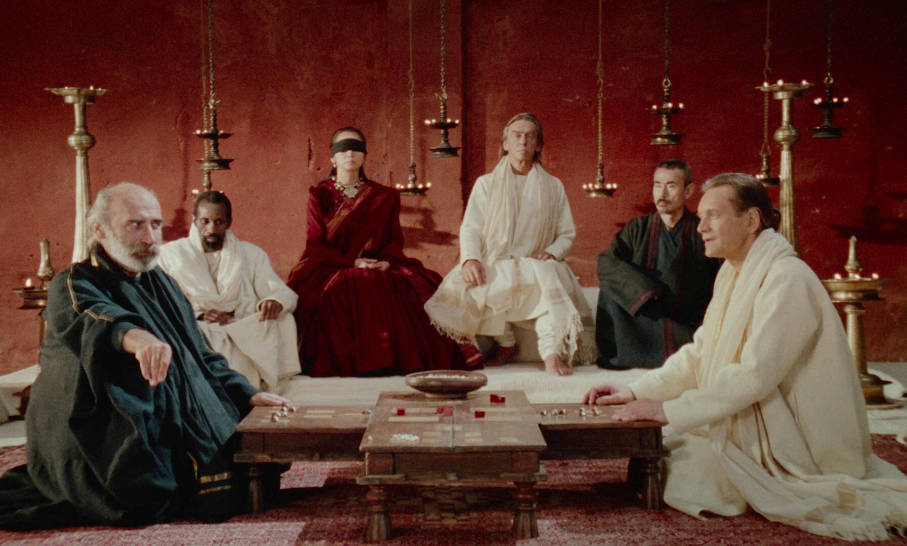
The film/series was shot in 35mm colour, and the present transfer is derived from the 8K restoration carried out in 2026. The feature-film version was entirely scanned and restored in 8K, while the additional material in this miniseries cut was restored in 4K. The transfer is in the intended aspect ratio of 1.66:1. Given that I am watching this is 1080p, there’s very little to say, as you have to wonder how much higher a resolution you can scan and restore a 35mm production in than 8K. As such, there is a lot of colour depth with strong blacks and shadow detail. No doubt a 4K disc would surpass this but as that hasn’t happened this will do very nicely.
The sound mix in cinemas was Dolby Stereo, which has been restored and remixed into DTS-HD MA 5.1 for this release. The surrounds are often used for Toshi Tsuchiotori’s music score and some direction effects, with the subwoofer filling in the low end in places. There are two sets of subtitles optionally available: English hard-of-hearing and French. The English subtitles for the French dialogue in the Brook by Brook documentary are fixed.
special features
My Father’s Legacy (35:22)
This interview with Simon Brook is new to this release. He begins by saying that it’s hard to talk about his childhood, though it appears to have been very much affected by both parents being in the arts. (His mother was the actress Natasha Parry.) He and his sister Irina travelled widely as children due to Peter Brook’s international career. Peter Brook first heard about The Mahabharata in the late 1960s and he and Jean-Claude Carrière consulted a Sanskrit scholar as well as reading the vast epic. (Simon Brook also read the work, though in a shortened children’s version.) Simon did work with his father on the Mahabharata project, first the stage version and then the screen one, and describes how Peter Brook found a “third way” to tackle the material, one between a conventional cinema film and the theatre. However, over the years, the resulting film largely vanished, due to rights complications with the now-bankrupt French producers. He began to work with his father on the restoration, though he died before it could be completed. The restoration began with retrieving all the cans of picture and sound negatives from the various laboratories they were held in. Some of them had to be baked to make them usable. Originally the intention was to restore in 4K, but Simon was alerted to the possibility of 8K being developed in Japan. There were only four 8K (actually 9.3K) scanners in the world, and hard drives had to go back and forth, the vast amount of data (450 terabytes) causing the existing software to have to be modified. The prospect of the film being shown in a Classics slot in Venice in 2024 meant that the cinema version was prioritised, the remainder of the miniseries version following. The resulting version has had at least one showing projected in 8K – something which didn’t make much difference in sharpness and detail over 4K but much greater colour depth, making it almost three-dimensional when watched.
Making the Mahabharata (54:37)
Made in 1989, this is a more in-depth piece than the featurettes you didn’t then find on VHS, with DVD and its extras a decade away. There are interviews by cast and crew to camera (no one identified on screen, unfortunately) interspersed with behind-the-scenes footage and extracts from the finished work. It begins with a comment from Jean-Claude Carrière which sets the tone: “Everything which is, is in The Mahabharata and everything which is not in the poem is nowhere.” One particularly significant interviewee is Mallika Sarabhai, who plays Draupadi. She sets the work in context for an Indian audience. It’s so much a part of Indian culture that it’s almost taken for granted, and at first she thought the script was not up to the task, particularly in its depiction of the women characters. Though always regarding herself as a feminist, she says that living with Draupadi for so long, on stage (in both French and English versions) and on film, radicalised her. She says that if she had had anything to apologise for in the production, as an Indian and as a woman, she would have left. Sarabhai also gives us an overview of the major storylines during extracts from the film. Carrière and Peter Brook talk about the difficulties of adapting such a vast work, with Brook saying that he found solutions for the film he wished he had found for the original play.
Brook by Brook (70:26)
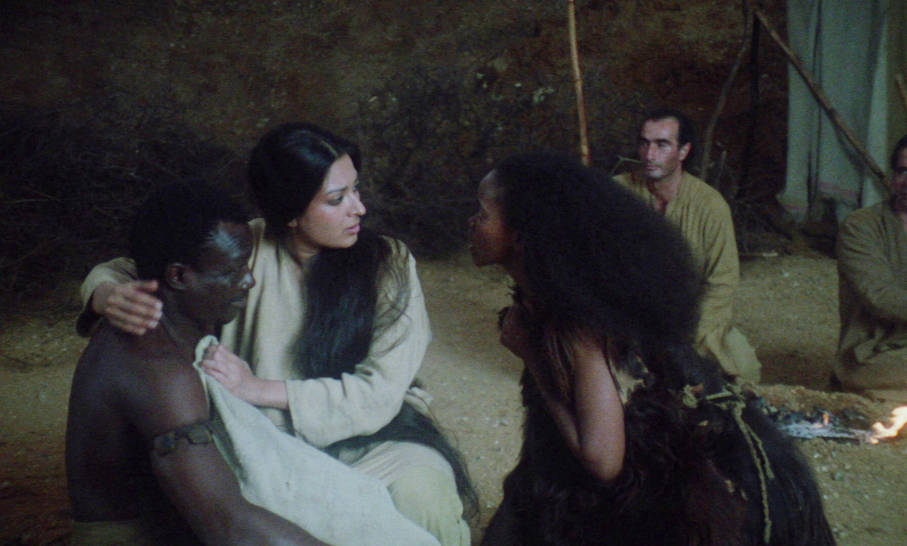
From 2002, this is Simon Brook’s tribute to his father. While Brook Senior’s legacy is on the stage and screen, we begin and end with him partaking of another artistic activity, namely playing the piano. We hear of his outlook – he doesn’t like living in the past – and his theories of acting (as a non-actor himself) before we tackle his life and career. He was born in London in 1925, the second son (five-year-older brother Alexis turns up), his father also called Simon, his mother Ida, Lithuanian Jewish immigrants. We see an extract from a film Peter made at university. No doubt to avoid clutter and maybe for licensing issues, we do see some clips from the films he later made – including Lord of the Flies (1963) and Marat/Sade (1967, shot in fifteen days) as well as The Mahabharata – though maybe some of the less-often-seen ones we only see as posters or advertisements would not have gone amiss. There are scenes of the family at home, looking through photo albums and Alexis and Peter visiting the house in Chiswick where Peter was born. Peter says he has made two types of film, those he enjoyed and those he didn’t and his aims to make of the theatre and the screen a more experimental space. Much of this documentary is in French, with Brook senior and junior even conversing in that language for some of it – perhaps explained by the French financing. To adapt the title of the film Peter made in 1979 (which isn’t mentioned here), this is a portrait of a remarkable man.
Trailers
Two of them, the original theatrical one from 1989 (1:35) and a restoration trailer (1:26). I’m putting them that way round as it seems – at least on the review checkdisc – that there is an error in the menu with the link to the 1989 trailer going to the restoration trailer (which flags the 8K restoration at its end) and vice versa. Both are much the same, short assemblies of scenes and action from the serial.
Pageant of the Sun-God (8:43)
From 1934, this short documentary (in black and white) is features the celebrations of His Highness the Maharana of Udaipur. As that credit would indicate (“no prince in India is held in more esteem”, as per the narration), this film, directed by Geoffrey Barkas, is very much an authorised version of what is intended to show the sights of this far-off land to UK cinema audiences who would almost certainly never get to go there, with creatures like elephants they would likely only seen in captivity at zoos. It was made as number two in a series of seven items for the supporting programme of cinemas called Secrets of India. It begins with a narrator (and someone’s finger) talking us through a map as to where Udaipur is and we are soon watching a procession, a military band, a state barge, and much of the city’s ancient architecture. No doubt colour was unfeasible – this was made a year before the first three-strip Technicolor feature was released – but there is still enough spectacle to keep the audience watching for nine minutes before the film they had paid to see was shown. Going by the transfer, the original materials this has been derived from have clearly seen better days, but while there are plentiful scratches, it’s still quite watchable.
Booklet
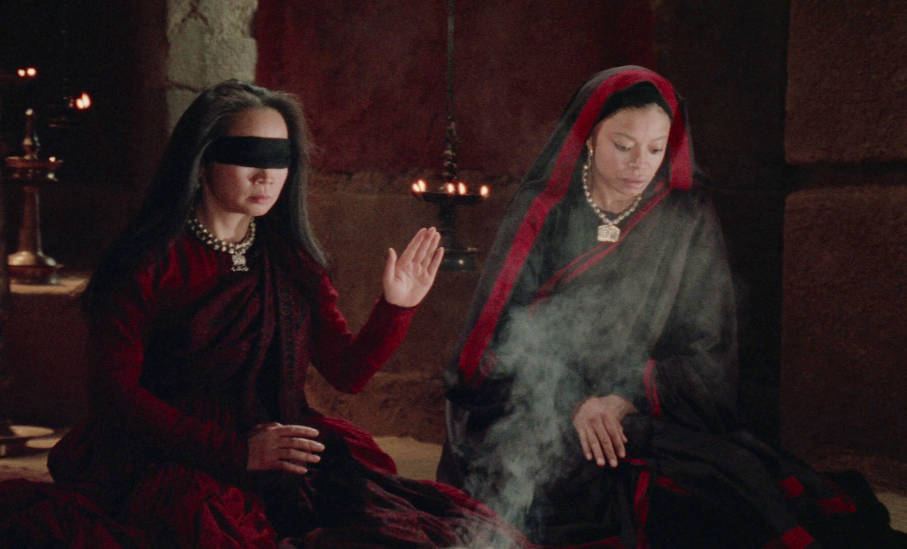
The BFI booklet with this limited-edition release runs to thirty-two pages plus covers. It begins, following a spoiler warning, with “The Great History of Mankind” by Jean-Claude Carrière, who begins by saying that it is possible to translate the title as the title of his essay. He discusses the epic’s possible roots in history or myth, or both, and as a teaching of life lessons in politics, morality, society and religion. He recounts how when rehearsals for the stage production began in 1984, the play had been written but it constantly changed. The story had to be streamlined, with stories within stories having to be jettisoned. However, the screenplay kept the ambivalence as to whether certain characters are men or gods, or both. As the booklet points out, Carrière is best known for his screenplays for Luis Buñuel, but his collaborations with Peter Brook were far longer, over thirty-four years.
Next we have “The Sleeping Dragon” by Peter Brook, derived by a talk on 19 April 1990 at The Asia Society in New York, on the occasion of the film and video releases of The Mahabharata. With the long-nurtured project out in the world, on stage and now television and cinema, Brook says that this is likely the last time he will be talking about it. When he and Carrière first encountered the epic, a sleeping giant was his impression of what he was about to tackle.
“The Mahabharata – Why Not?” is by Ravi Jain and Miriam Fernandes. The second half of the title is the name of their Toronto-based theatre company, who produced a different version of the story in 2023. They quote Akram Khan, one of the cast of Brook’s production, who says that on the first day of rehearsal Brook told the ensemble to perform their usual daily tasks in slow motion, to change their relationship with time. This was their experience in adapting The Mahabharata, which took them ten years. Both Indians whose families had migrated to Canada, they were aware of the story, including the television serial and comic-book adaptations. Their perspective on the story changed over the ten years – taking in the #MeToo movement, Black Lives Matter and the Covid pandemic – as they adapted the story, not least in a way to distinguish it from Brook’s production.
“A Towering Achievement” is a short piece by Georges Corraface, who is (with hindsight) one of the best-known names in the cast, as he played the title role in Christopher Columbus: The Discovery (1992), one of two films released to mark the five-hundredth anniversary of the discovery of America, and the lesser of them. He talks about how, after some six months of rehearsals, Brook took him and much of the cast on a journey to India, where they were welcomed warmly.
After a cast and crew listing, there are brief notes on and credits for the special features, Then there is an extensive note by Simon Brook on the restoration of the film. There are also plenty of stills.
final thoughts
The Mahabharata is one of the great epics of ancient world literature, one central to Hindi culture in particular. Given that stage productions, necessarily live, only exist in people’s memory and other accounts unless they were recorded, Peter Brook’s take on the story happily now exists in this version, now restored with several very useful extras.
The Mahabharata
France / UK / USA / Denmark / Sweden / Netherlands / Finland / Belgium / Iceland / Norway / Ireland / Japan / Portugal / Australia / West Germany / Austria / Spain / India 1989-90 | 318 mins
directed by: Peter Brook
written by: Peter Brook, Jean-Claude Carrière, Marie-Hélène Estienne; from the play by Jean-Claude Carrière
cast: Erika Alexander, Maurice Bénichou, Amba Bihler, Lou Bihler, Urs Bihler, Ryszard Cieslak, Georges Corraface
distributor: BFI
release date: 10 August 2026