
Upsetting a president
How’s this for a pitch? A movie based in its own mid-70’s era showcasing very recent events that a majority in the US was either sick to death of or bored with. It has zero action, just conversations. Nothing explodes; no one is killed; It’s just talk, talk, talk. So how is ALL THE PRESIDENT’S MEN so damn riveting? Camus doorsteps the 4K release from last February…
“And it also seemed, with what objectivity I could bring to it, to be well directed and acted, especially by the stars. It won a bunch of Oscars (including Best Adapted Screenplay for Goldman himself – Ed.) and numberless other awards besides. And if you were to ask me, “What would you change if you had your movie life to live over?” I’d tell you that I’d have written exactly the screenplays I’ve written. Only I wouldn’t have come near All the President’s Men…”
Screenwriter William Goldman, Chapter 9
of his 80’s movie memoir Adventures in the Screen Trade
Imagine being hired to adapt a best-selling, contemporary non-fiction story about two reporters whose steadfast and penetrating work over years finally brings down a corrupt American president and his cohorts. The true and complex story is densely packed with myriad characters and conversations. Screenplay draft after draft is written and it becomes a greenlit project with two major stars, one of whom is the producer of the film. The studio is nervous. But if the book’s authors had not been sued, then the studio backing it was unlikely to be sued too, as long as the screenwriter sticks to the book which he most certainly did.
At the eleventh hour with shooting imminent, you are invited to meet the producer and one of the original reporters. Your spirits are high because you feel this is an important story which you’ve all but cracked for the screen. You enter the room, say hullo and then… silence. On the table, like a tarantula with Covid, sits another screenplay, written by one of the reporters and his then girlfriend.1 The producer urges you to read the ‘new’ screenplay. Well… Celebrated screenwriter William Goldman called that the worst movie experience of his professional career and for good measure called out producer and star Robert Redford for his “gutless betrayal…” The awful irony of winning the Oscar for his efforts prompted me to dig out his acceptance speech on YouTube.2 Terse, yes. Barbed, no. Goldman was a pro and he wasn’t about to disrespect people whose work made his own work shine, people who well may employ him again. But he was off the stage in a real hurry. And he was so very far from smiling at his good fortune. I’ve never seen an Oscar received so reluctantly.
One of Goldman’s first scenes, which didn’t survive the multiple director-pleasing drafts, was of the burglars attempting to break into the Watergate Hotel complex where the inciting incident occurs. Except they didn’t manage to get into the building. They were successful only after several attempts. Goldman wanted to surprise people with something they probably didn’t know. But there was so much to cram into a normal movie’s running time, so those not widely known opening scenes fell by the wayside. The movie starts with 17 seconds of a silent, off-white screen. As an audio-visual shock, a metal hammer falls with a thunderous sound, a typewriter smashing out the letters like thunderclaps; ‘June 1973’. Part of me wishes that the off-white first shot could have had that same close-up texture of the actual paper we cut to being typed on but perhaps that was too much of a giveaway of what was to come. A guard at the Watergate Hotel discovers a door lock taped over and calls it in. The police respond to a suspected break in at the Democratic National Committee headquarters situated in the apartment complex at the luxury hotel. A group of formally besuited men inside are warned by their watch man in the building opposite that there are people in the building. They go radio silent which includes a close up of a walkie talkie being switched off. This is performed in such an obvious, amateur and overstated manner that it always makes me wince. It’s the only tiny fly in an otherwise supreme ointment. The police are led by a Sergeant Leeper, an early part for F. Murray Abraham who took the world by storm eight years later as Salieri in the film version of Amadeus.
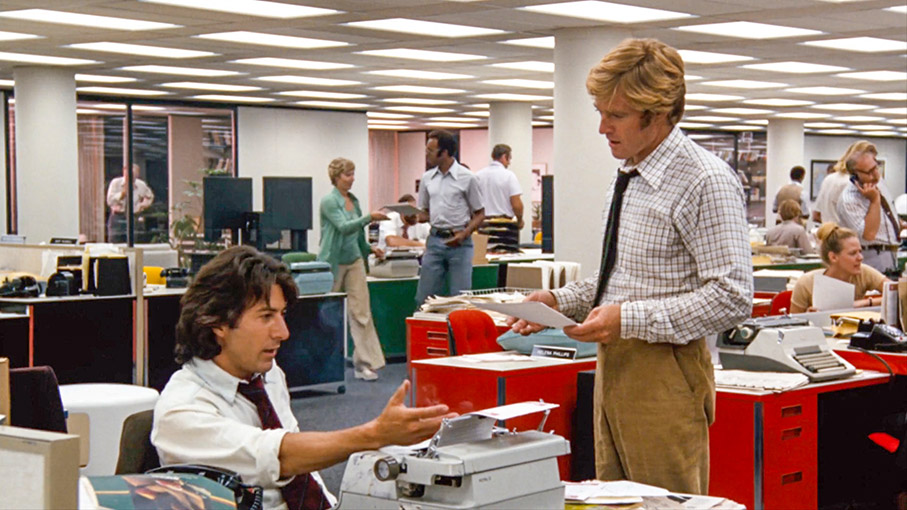
The police find the burglars hiding under a table all of whom end up in the dock. Sent to cover the arraignment, junior Washington Post reporter Bob Woodward (played by producer and co-star Robert Redford) has his curiosity piqued. Some of the burglars are linked to the White House and the CIA from testimony and initial clues in their address books. Woodward pulls at the thread of this unlikely information and starts to investigate this, quite frankly, unbelievable series of connections. Around the corner in the vast, open-plan office of the famous newspaper recreated in two sound stages right down to the trash in the bins, sits another reporter, Carl Bernstein. Seriously, the actual trash of the real newspaper was transplanted into the set in Los Angeles. Bernstein surreptitiously takes Woodward’s work and “polishes it.” The two men clash, albeit in a civilised way. A dyed in the wool Republican and his professional peer, a left-wing firebrand, are forced to team up and work on the story, whatever that story would turn out to be.
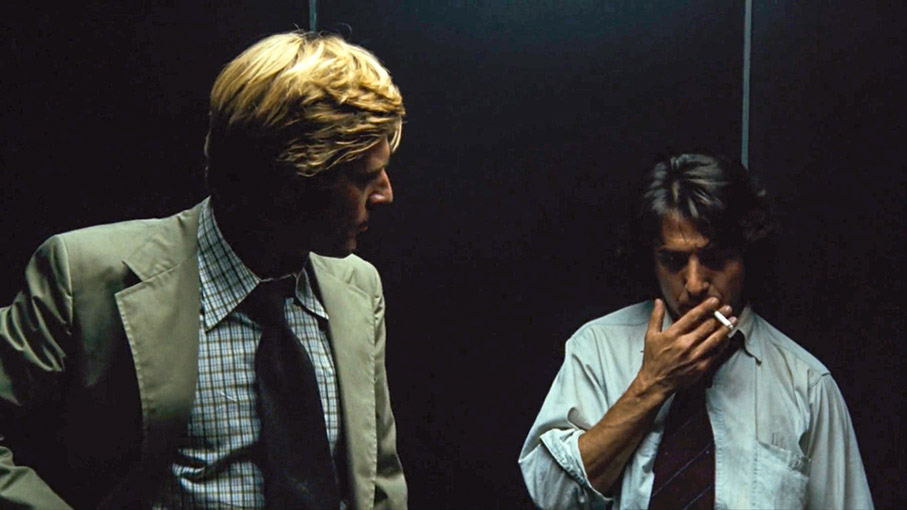
This was another issue with the narrative and, by definition, the adaptation too. At the start of the Watergate coverage, no one knew how this story would end or even if it was anything worth reporting. Most Hollywood films set up a goal for the hero/heroine and all roads lead to their struggle to get there. Woodward and Bernstein had no idea of the almost inconceivable years of criminal skullduggery perpetrated against the democrats that Nixon and company had illegally set in motion and paid for with an unlawful multi-million-dollar slush fund. So how to solve this narrative’s lack of ‘goal’? The filmmakers, or perhaps it was the idea of screenwriter Goldman, came up with an ingenious solution. Both reporters were to be as flummoxed as the audience as they started their investigations. We get to share their confusion, impatience, frustrations and small victories (and crushing misjudgements). The cover up of criminal behaviour is never overt but Redford and Dustin Hoffman (playing Bernstein) are such a dogged and likeable pair – their strengths and weaknesses complement one another’s – that we are with them all the way. They don’t know that the biggest story of their lives – and arguably the biggest news story the U.S. had ever experienced up to that time – was waiting for them, bit by tiny bit, to uncover it. They just happened to be very determined, hungry young journalists with a respect for the truth who loosed a golden arrow at the very pinnacle of American political power. And hit the goddamn bullseye.
Director Alan J. Pakula had some pretty impressive films under his belt. As a young producer, he made To Kill A Mockingbird and as he moved into directing, he became known as ‘an actor’s director’, garnering Oscars for many of his featured cast members. After Goldman found out that he was now writing for Pakula’s approval, he was warned by Warren Beatty (who had starred in Pakula’s superb The Parallax View) that the director doesn’t like to be ‘deprived of any riches…’ In other words, Goldman was in it for the long haul. Whatever remained of Goldman’s work, he had every reason to be proud of his efforts. He confirmed earlier in the quote at the start of this review that very little seemed to have been changed from his final screenplay and one of those changes was Hollywood bullshit from the ‘other’ screenplay. In its day, in 1976, I avoided the film, uninterested in politics as I was fifteen and still raving about Jaws… I came to the film many years later and over the last four decades it has crept defiantly – if that’s not a contradiction – into my relatively small container of potent favourites, those few titles that I seem to be able to watch time and time again with no adverse response to over familiarity. It’s the reliance on familiarity that makes them special. And as I said, it’s a movie that features conversations after conversations. Just extraordinary. Having said that, a contemporary of President’s Men released five years later in 1981 is a very significant film to me for all sorts of reasons and it was one conversation in one place. Please see my review of My Dinner With Andre.
If All The President’s Men has a superpower, it’s that truly stunning cast. Every actor in every part registers strongly and stays with you. We are dealing with mostly compromised and frightened people being forced to keep secrets and that fear is never far from the surface. Personal favourites are, unsurprisingly, the leads. Redford and Hoffman are hugely talented performers that both share charisma of different kinds and a strong focus. During a six minute technically challenging take (explained why later in this review), Redford gets his lines wrong while switching phone calls and is able to make it seem like a genuine mistake the character would make given all the names both men are dealing with every day. Redford’s star wattage is burning so brightly at this time in his career and his laudable left leaning political commitment was also served well by this project. Hoffman has always been a class act and can hold the screen just as powerfully as his strikingly handsome co-star. I remember reading that Redford auditioned for the Hoffman role, Benjamin Braddock, in The Graduate. The director, Mike Nichols politely turned him down. Braddock was something of a loser and a failure with the opposite sex. Nichols asked Redford if any woman had refused his advances. Redford said, “What do you mean?” thereby proving that he would be fatally miscast in the role that made Hoffman famous. And here they are together keeping this thrilling investigation on the rails and barrelling along. It’s hard to pick out other individual performances when all of them are so on the money but I’ll point out a few of my personal favourites.
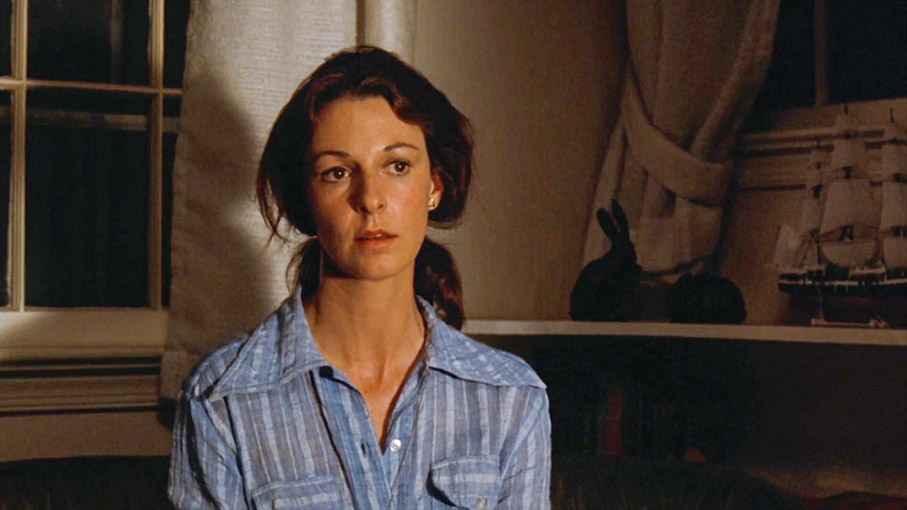
Hal Holbrook plays ‘Deep Throat’ (or Mark Felt, FBI deputy director, now known after revealing his identity in 2005), with a suitable air of cloak and dagger shenanigans. His job is to guide Woodward, confirming the accuracy of the duo’s reporting but only in his last appearance in the film, giving in to his friend’s need “to know what you know,” does he realise that it’s all or nothing. Holbrook is shaking as the flood of information starts to pour out of him. Robert Walden plays Donald Segretti, the head of the double-cross, or ‘rat-fucking’, as the subversion of the democratic candidates under orders from Nixon’s White House was known. He is now a broken man. Off the record, he has a genuine personal encounter with Bernstein and realises he has cut short his professional life for falling in with a crooked president’s requirements after getting out of the army. There’s a video record of the real, contrite Segretti hearing on YouTube and it’s fascinating to watch.3 His emotional arc in just one scene of the movie proves that Walden could make a big impression in mere minutes. In a number of scenes, Jane Alexander as The Bookkeeper is the beating heart of those wanting to do the right thing but unable to. Her scenes with Hoffman, who’s prising everything out of her he can get, are heartbreaking and when the reporters return to fake her out with a trick to make her think that they know something they don’t, you feel so sorry for her when she asks the question “Who told you about Porter?” Her response to the fake out was the confirmation the reporters needed. She also gives her oblivious sister such a look of frustrated disbelief when her sibling offers the unwelcome Bernstein a coffee. Both reporter and source are photographed with the stairs’ railings acting as metaphorical prison bars. These strong acting moments stay with you and are enormously affecting even after multiple viewings.
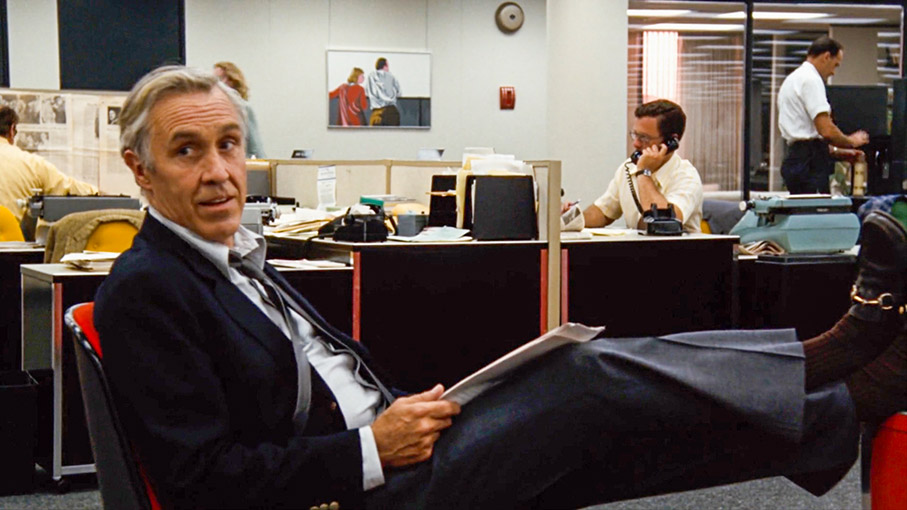
Jason Robards got the Oscar for Best Supporting Actor playing Washington Post editor, Ben Bradlee. And he deserved it. Gravitas and authority must be grown into an actor and Robards was well qualified. Nice to see Buffy Summer’s Season Four nemesis, Maggie Walsh, as played by Lindsay Crouse, as a reporter doing Woodward and Bernstein a reluctant favour and check out that 70s hairstyle! This was her movie debut and what a way to start a film career. But by far the most oleaginous and deeply hissable performance by a supporting player (Richard Nixon excepted only ever seen on a TV screen) was Polly Holliday playing Miami Investigator Dardis’s secretary, Tina in the original script but referred to as Ma’am (or Miriam) by Ned Beatty as Dardis. Bernstein has set up a meeting, flown to Florida to meet with Dardis and he is given the run around by a woman so clearly faking sympathy for Bernstein whom she seems to loathe right off the bat, armed with a fake smile that exudes sadistic pleasure derived from borrowed power. The bullshit that screenwriter Goldman called out from the ‘other’ script is the scene in which Bernstein cons the secretary into leaving her desk so he could crash Dardis’s office. The look of pure disgust and contempt she gives Bernstein as she finds him in Dardis’s office is damn near perfect. Every actor in every role in this magnificent movie is oh so memorable and so wonderfully performed.
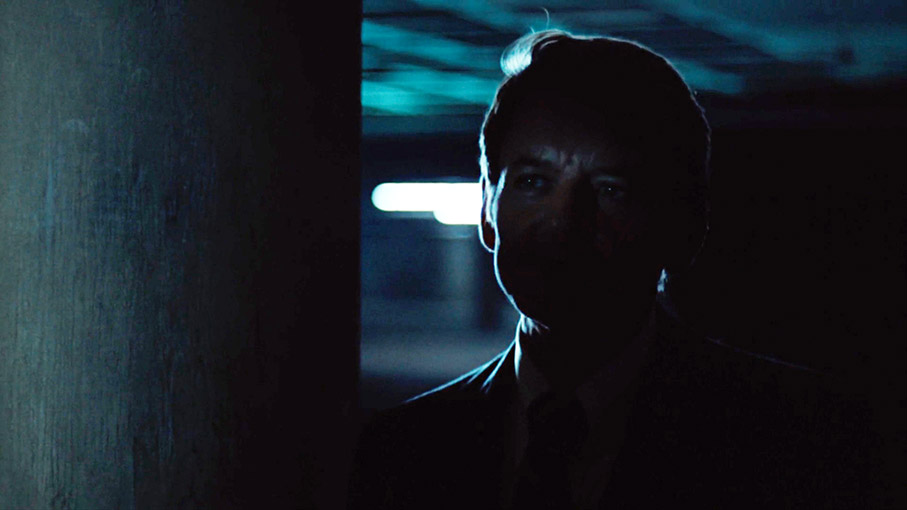
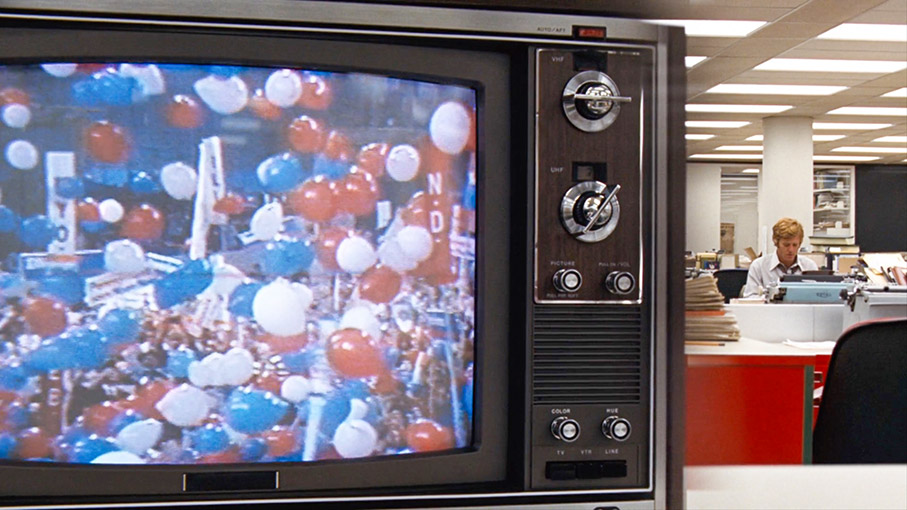
Cinematographer Gordon Willis and composer David Shire elevate the film further with their masterful contributions. Willis, aka ‘the Prince of Darkness’ is not afraid to light perilously close to underexposure. I can imagine a 14-year-old David Fincher watching one of the car park scenes and writhing with pleasure at the teal hue throughout this moment. Perhaps this is where he discovered his visual antidote to Sony TV’s healthy pink grading that he so hates. Technically, there is something very interesting about the way mid shots and close ups are handled in the film in the newsroom set. While Redford is in focus in the foreground, there is some bokeh (the out of focus aspect unique to the particular lens being used) between him and the background which too is sharp. This is impossible with a normal lens. A split diopter is a semi-circular piece of glass that covers half the lens making one half near-sighted and the other far-sighted. Only the slight bokeh visible at the join gives the effect away. 48 minutes in is a long hold on Woodward talking to Kenneth H. Dahlberg about an errant cheque. Over six whole minutes, (count them) the camera tortoise-zooms in settling on a tight close up of Woodward who’s just had a major breakthrough. It’s astonishing but only if you are aware of how it was achieved.
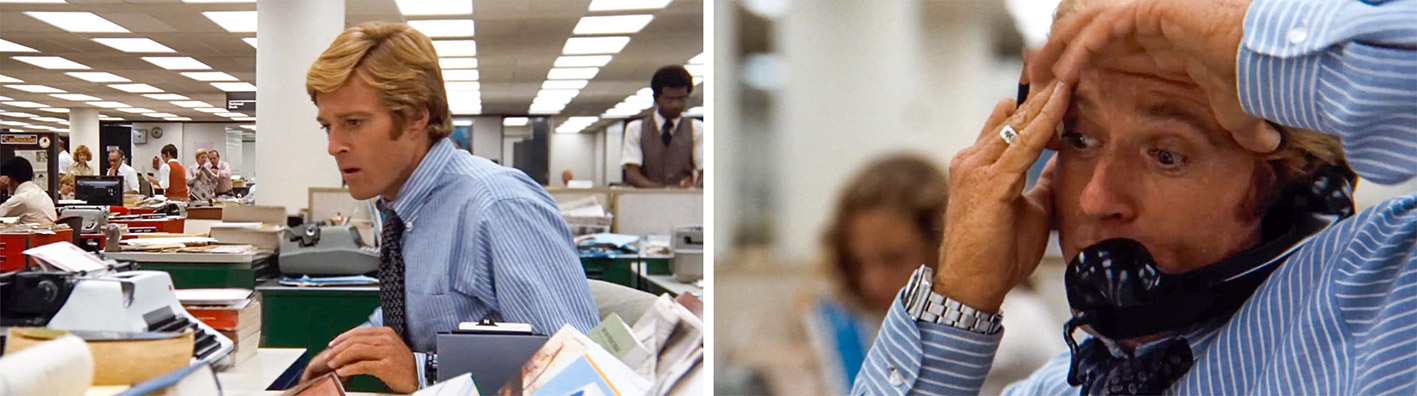
I was almost certain this was not an optical creep in, that is, a decision made in post-production. Today the film editor can perform a resize on a shot, something not possible in the film-based editing rooms of the mid-70s. Hence the required use of the optical printer. But there is no tell-tale enlargement of film grain. If that is the case, it was camera operated and somehow the split diopter was moved away from the main lens as the zoom took place… Over six minutes! It just doesn’t seem humanly possible to make that technical movement. And apparently Willis himself slid the diopter out of frame on its own calibrated track after his assistant froze with, one assumes, the pressure of screwing up. Ralph Gerling operated the camera which meant he had to zoom in about 86% from the starting frame over six minutes! God knows how many takes it took. Even Google AI has no idea. The shot is an absolute marvel of both technical skill and acting ability and yet it’s so understated. At 1 hour, 12 mins and 30 seconds, you can see the split diopter now sits at the top half of the lens throwing the roller of the typewriter out of focus and the top half of frame of the newsroom is sharply in focus. 30 and 46 seconds later there are shots of Redford in the background with a TV foregrounded with Redford jump cutting at these timings while he types and yet the TV image stays in real time. Why would those jump cuts be necessary? To quote a certain Mr. P. W. Herman, “I don’t know!” I suppose the fact that I haven’t noticed these very strange jump cuts for 40 years means they worked.
So how do you approach a musical score for such a talk fest? Dave Shire had scored Francis Ford Coppola’s The Conversation and also a personal favourite, The Taking of Pelham One Two Three. New York has never been written a more New York score. And now nothing could be more dissimilar than a political thriller set in that very different city, Washington DC. Shire’s score (the CD of which is selling for between £100 and £140 on eBay, sheesh) is a brooding question mark of a score which highlights the work but is never needed to evoke emotion the way a conventional score would. It is sparse and contains repeated thematic material which is partly why it’s so memorable. There are no fanfares or orchestral feats of virtuosity. It is a score that gently propels the film and is a perfect fit and one of the few scores that is less effective as a stand-alone score without the film it was written for which should never surprise anyone. I think James Newton-Howard is the finest film composer working today (he may have retired) but while his score to Paul Greengrass’s News of the World is sublime, his score for Greengrass’s next, The Lost Bus is practically unlistenable (a fire trapped bus inspired him to write deliberately uncomfortable beds of terror) but, I suspect, it works wonders for the drama. Let’s not forget Pakula’s film editor, Robert L. Wolfe, Sam Peckinpah’s editor of choice. An editor’s contribution can sometimes be overlooked with a famous director at the helm. “Doesn’t the editor do what the director tells them to do?” Oh my, no. A director and editor collaborate and often, despite the hierarchy, there’s an equality of creative power shared by both of them. An editor is the first audience and can have a creative opinion very different from the director and it’s their job to communicate that. Yes, the main job is to chivvy the director’s vision on to the screen in the best possible way but it’s another creative mind brought to bear on the material which in its uncut form is just hours of people talking in different places. But the editor is also the audience throughout the editing and has a loyalty to the film itself. If cuts have to be made to make the movie better (and one of those shots is the most expensive one in the film) then out it goes. The rhythm of the film is very much the creation of the film editor and the rhythm of All The President’s Men is masterful.
So how is the film such a tense and riveting piece of cinema and why does some pertinent aspect of it depress me so much? The answer curiously is the same. So, finally let’s address the awkward fact, the Republican elephant in the room if you will. There was a certain nostalgic ache that I get in my gut watching and rewatching this first-class film. Both book and film assume that the grandest office in the land in the early 1970s, hosting the President and all of his men, should uphold the very highest of American ideals (honour, truth and justice should be in there somewhere) as a shining beacon for the world to see. God forbid these men would never, ever mislead or outright lie to the people they were voted in to serve. You are so way ahead of me already, it’s embarrassing. One might say you’ve trumped me… The work of Woodward and Bernstein is temporally locked in the 70s. Two enterprising young reporters, through dogged professionalism, luck, guts and intelligence and (most important of all) persistence, took down a venal government that had broken so many laws using its power as a shield. The one thing Woodward and Bernstein had on their side was their adherence to the truth and an observed and publicly accepted moral rectitude. People then in public office were terrified if found wanting in any one of those aspects. As a public official, if you lied in the 70s or if you did something sinful or unlawful, you were fair game for respectable reporters to tear you down. The excitement of justice being sought, worked tirelessly for and won over a few hours with drips of evidence soon amounting to an impenetrable torrent is immensely satisfying to most sane, moral people. It matters not one whit that we know they succeed. It’s all in the how and like most narratives (forgive me for borrowing a comic’s old catch phrase), it’s the way it’s told. You may know the punchline but great storytellers keep our attention and investment.
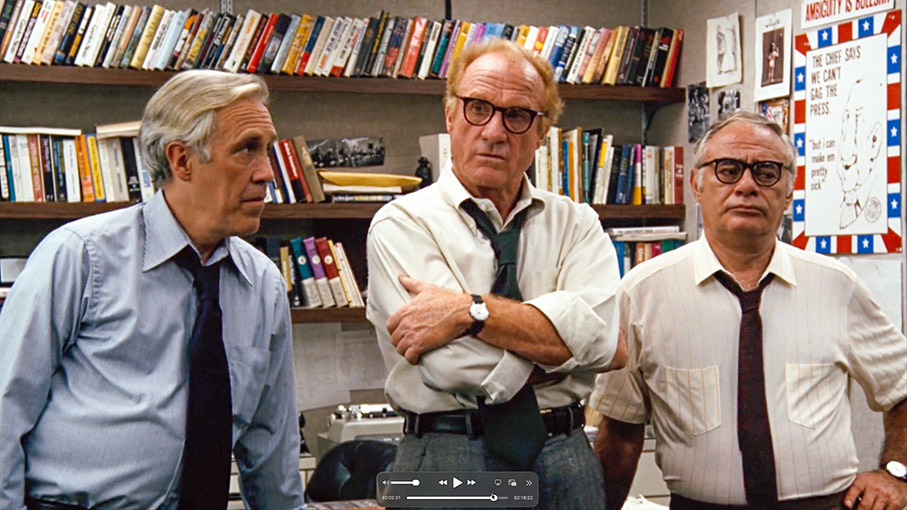
And you know the most depressing thing of all? Now, 53 years later, it’s the sinful, lying crooks who can take the reporters down. The lesson of All The President’s Men seems to be “It was so much better in the old days when truth meant something,” and as a legacy, that is not inspirational. “Great then, shit now,” doesn’t help. Yes, as noted in the Special Features, fledgling reporters get to see this movie as a beacon of integrity but there is no integrity to impress upon some of the most powerful public officials today. This is how democracies die and are dying. All The President’s Men was a gamechanger in its time. Even today, over half a century later, any scandal big enough for people or the press to care about gets a ‘gate’ added to its name. The film still packs a powerful punch but, dare I say, it seems almost quaint now in the era of a President who lies (no pun intended) more during one round of golf than Nixon did in his whole career. I have read a great deal of books on American politics since 2016 when his clown car parked next to 1600 Pennsylvania Avenue and am firmly of the opinion that if you want to understand Trump, look no further than Commander In Cheat by Rick Reilly. It is a psychological profile of Trump the golfer with a jaw drop every page. It is so astonishing that a man can behave this way and still think of himself as a winner. His philosophy is “If I have to cheat to win, then I cheat.” He doesn’t seem to have the wit to realise that if you cheat you’ve already lost. And if you’re going to cheat, cheating at golf in sport is the ultimate shame, an aspect of character Trump almost gleefully lacks along with many others that make up a decent human being. Caddies at a certain club nicknamed him ‘Pele’ because he was always kicking his ball out of the rough on to the fairway. That’s one of a few hundred habits that will disgust anyone with a sense of morality let alone sportsmanship. Even Bob Woodward has written two books on Trump but they are books of astonishment, astonishment that the American powers-that-be have done so little to stop the harm this man doing to the world let alone the U.S. It’s depressing that the truth has so little value in our current political climate. The man is so unfit for office and his fellow GOP politicians too craven to correct this ghastly mistake of a human being, it’s almost farcical in the worst and most dangerous way. America is in thrall to a child with overwhelming power and it feels like we’re living in an episode of The Twilight Zone. If climate change doesn’t eradicate the human race too soon, historians of the future will regard this period in our history as The Age of Dumbfounded. Had the founding fathers of 1776 been alive to witness this state of affairs, and not struck dumb while spinning in their graves, we may have been spared this calamity. Then again, democracy is the will of the majority. No one wrote in the Constitution that the majority cannot be trusted. And smart people are still letting this happen.
Just a few more thoughts before we move onto the Special Features. I wonder why it was so necessary to Photoshop both Redford and Hoffman into looking like plastic avatars of themselves for the cover of the 4K slip case. How many more people will buy the disc based on the idea that plastic faces sell more discs? The story told in the film by Deep Throat about Gordon Liddy putting his hand over a candle until his palm burns seemed to be a direct steal from David Lean’s epic, Lawrence of Arabia with Lawrence pressing out a match flame. The trick is ‘not minding that it hurts’. But apparently Liddy trained himself to bear third-degree burns. Was he so small a man that a feat of self-immolation propped up a defective ego? It was supposed to prove how tough he was. It certainly proves what an idiot he was. That memorable shot starting on the reporters checking the library slips and then moving up into the ceiling of the Library of Congress would have been perfectly smooth today without the need for two dissolves. But a perfect shot wouldn’t have been half as satisfying. It’s been well documented that Goldman’s script only covers the first seven months of the Watergate investigation. He argued that audiences around the world all know how the story ended. So, I went back and re-read the book and as is Jeff Bezo’s mighty Amazon’s habit, another Woodward and Bernstein book was suggested on my Kindle. The Final Days charted an all too intimate account of the months leading up to Nixon’s reluctant resignation. It seemed almost supernatural how much detail was captured, probably all culled from interviews from the major and minor participants. And like the original book and movie, this giant tome was unexpectedly exhilarating. When I saw nine hours plus as the time needed to read it, I sighed (at least a physically heavy book tells you it’s going to take time) but while I could put the Kindle down, I read with gusto and got to know the self-deluding Nixon better than I had before and was oddly grateful for that gift. People are human. Who knew? To quote a comic version of the praise “I couldn’t put it down,” I remember a German reader saying about J. K. Rowling’s fourth Harry Potter book, The Goblet of Fire, clocking in at 640 pages; “I couldn’t pick it up.”
All The President’s Men is a stone-cold classic of 70s cinema, a profound detective story of great moment and a beacon of hope for a morally compromised world, a world of a generation buried in black mirrors with no ability to reflect, no reality to trust, deaf to anything not available on social media. I wonder, if indeed societies exist in a cyclical fashion, whether we will ever go back to a world where the truth means something and is necessary for any meaningful communication and is the foundational bedrock that makes better people of us all.
sound and vision
Sourced from a new 4K scan of the original camera negative (always the greatest source) and presented in the 1.85:1 aspect ratio, the 4K format, extracting every detail from the 35mm celluloid original, is specifically designed to be watched from a certain distance. Get too close and the original 35mm format grain is clear to see. That said, get the distance right, then this is really the best-looking version of the film that I have ever seen. It’s been explained to me that resolution is not the be all or end all of great picture quality. The lens, focus, exposure and film stock have a lot to do with that judgement. Some shots in some movies in 4K look worse than the Blu-ray. I dare not say worse than the DVD but sometimes a standard definition format can forgive all manner of compromised technical aspects in higher resolutions. But not so in this case. As mentioned before in our 4K reviews, film grain makes us very happy.
The DTS-HD English 2.0 Mono soundtrack has no tell-tale hiss betraying its age but then who knows what technical magic Dolby have done to reduce extraneous noise.
There are subtitles in English (for the deaf and hard of hearing) as well as 11 other subtitle options in French, German SDH, Italian SDH, Spanish (Castellano and Latino), Dutch, Danish, Finnish, Norwegian, Swedish and Mandarin (Traditional).
special features
The 4K Ultra HD release includes a mix of new featurettes and archival extras, though it notably omits Robert Redford’s audio commentary and the full-length Behind the Story documentary from previous Blu-ray editions. So, hold on to your older Blu-ray…
All the President’s Men: The Film and Its Influence – A retrospective feature looking at the movie’s legacy with current CNN reporters (07.56)
CNN Anchors Jake Tapper and Dana Bash confirm the realism of the movie. Bash misses the hubbub and noise of the pre-digital newsrooms, an aspect so ingrained in the film, it’s hard to imagine the story working in a quiet place. They discuss the relationship between Woodward and Bernstein and how the actors brought a tension to their screen interactions. Goldman’s script is mentioned as well as Deep Throat. They concur that the fact we are still interested and fascinated by the Watergate scandal is a testament to the enduring power of the movie. No argument there. Bash finishes on saying how inspirational the film was to her personally. But as mentioned in the review, how is the fourth estate managing against the most powerful man in the world who happens to make Watergate and the lies during the cover up seem like the work of woeful underachievers. Things have changed so very much that this man still has any authority on this planet is a nonsense of political will.
Woodward and Bernstein: A Journalism Masterclass (7.36)
News anchors Tapper and Bash (that’s got to be a great name for a TV series) delve into what made Woodward and Bernstein such good reporters. Both anchors reveal that they have relationships with the older reporters (Woodward is 83 and Bernstein is 82 in 2026) and highlight their differences in background and approach to the work. There’s a great point made that the book had the opportunity to give context to the bite size stories from the newspaper at the time.
Woodward and Bernstein: Lighting the Fire – An archival 2006 standard definition featurette focusing on the real-life reporters (17.53)
First thing that strikes you is the John Williams main theme for JFK as the underscore. OK. Renowned reporters give up their stories of being inspired by Woodward and Bernstein who appear in this extra, older and wiser. Among the reporters featured are Greg Krikorian, reporter, Linda Ellerbee, journalist, the famous Walter Cronkite, CBS News anchor and Oliver Stone director. The change between 1973 and 2006 is touched upon. Would 2006 be able to support such an investigation and have it as significant news given the media ocean we are all sailing on. It’s not got much better two decades on. “Television is about not offending the viewers,” (Ellerbee) and makes a great point about investigative journalism now not being cost effective You can’t fund something if it may come to nought! That’s not the American way. Quite a few good points raised in this extra, alarmingly the idea that Watergate would not have been exposed if it happened today (or 2006 but especially today) because both reporters would have gone to jail for not revealing their sources taking them out of the story completely.
Telling the Truth About Lies – An archival standard definition 2006 piece exploring the background of the scandal and film (28.21)
Nice to see William Goldman as an interviewee. If the scars were deep, I wouldn’t have blamed him for staying in the shadows. But this doc was made thirty years after the film was released. Hoffman is one of the interviewees and his nuggets about the making of the film are fascinating (especially Redford’s idea that both actors learn each other’s lines so they can interrupt each other and seem like one reporter). But Hoffman’s quote you come away with is his joke to the camera team and director, “Make me look handsomer than Bob!” Lovely to see Redford and fellow cast member Jane Alexander have their tuppence worth and finally seeing what Gordon Willis looks like was a nice surprise. But director Pakula had died in 1998 at the age of 70 in a freak car accident but his cast and crew pay him lots of compliments. Hoffman, a lover of improvisation, said that not many directors would give him that free a rein. It’s a solid making of and respectful of the work itself and the work that went into it.
Out of the Shadows: The Man Who Was Deep Throat – A 2006 standard definition featurette discussing FBI informant Mark Felt/Deep Throat (16.21)
Edited from the interviews, with the same roll call of interviewees as the previous extra feature, Woodward and Bernstein start by describing the mysterious man, high up in the executive branch who guided Woodward through the labyrinthine crimes of the Nixon administration. We get a potted history of Mark Felt, a Hooverite when Head of the FBI, J. Edgar Hoover used to leak information as a matter of course. Hoover died a month before the very first Watergate story was published in The Washington Post. I certainly didn’t realise the level of corruption in the FBI regarding Nixon’s criminality. One of the participants nods in the direction of information overload and that statement was made 20 years ago. I think it can be agreed that things have got significantly worse. Judith Miller is brought up, a New York Times reporter who was jailed for not giving up one of her anonymous sources, sometimes the backbone of investigative reporters’ hunt for information.
Jason Robards on Dinah! – A vintage 1976 standard definition television interview clip with actor Jason Robards (07.09)
This is a gentle conversation between host Dinah Shore and Jason Robards. Robards admits to having seen the film four times and each time he was riveted. Sounds familiar. Redford is mentioned as the man behind the whole enterprise. It seems so intriguing that the book is announced before the book and reporters were globally famous. This interview came out the same time as the movie so this is hardly surprising. Deep Throat gets a mention. Dinah seems to have inside information on the identity of Deep Throat. She tells Robards she’ll tell him afterwards because “I’ve known all along…” Really?!
final thoughts
Seemingly a snapshot of an alien planet where people cared about truth and justice in their world, All The President’s Men reminds us that we cannot let those standards slip and we seem to have done just that. But as a political thriller, there is none finer. Brilliantly written, directed and performed with extraordinarily evocative cinematography and a perfectly aligned score, this is a classic well worth catching in its best home iteration yet. Thoroughly and enthusiastically recommended. You got that, right?
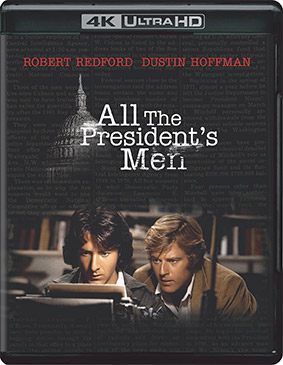
All the President’s Men
US 1976 | 138 mins
directed by: Alan J. Pakula
written by: William Goldman; based on the book by Carl Bernstein, Bob Woodward
cast: Dustin Hoffman, Robert Redford, Jack Warden, Martin Balsam, Hal Holbrook, Jason Robards, Jane Alexander, Meredith Baxter, Ned Beatty, Stephen Collins, Penny Fuller
distributor: Warner Bros.
release date: 16 February 2026
- I have no wish to demean anyone with the dismissive description of ‘girlfriend’. It was Nora Ephron, not an untested writer and responsible for some extraordinary work… Goldman and Ephron did eventually bury the hatchet. https://en.wikipedia.org/wiki/Nora_Ephron[↩]
- https://www.youtube.com/watch?v=sXg6Z2iR5b0[↩]
- https://www.youtube.com/watch?v=YFX-btaf2fo[↩]