
Józef through the looking glass
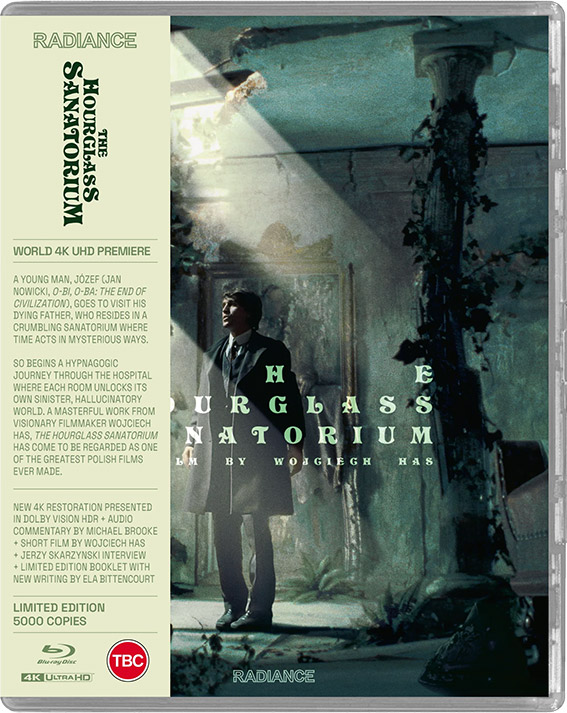
A man visits his terminally ill father at an isolated sanatorium, where the fragmentation of time and space takes him on a journey into his own subconscious in Wojciech Has’s mind-bending and visually sumptuous 1973 THE HOURGLASS SANATORIUM [SANATORIUM POD KLEPSYDRĄ]. An initially bemused but consistently mesmerised Slarek is pulled happily into the dream world by Radiance’s new UHD/Blu-ray dual format release.
If I was asked to describe the initial setup of director Wojciech Has’s 1973 The Hourglass Sanatorium [Sanatorium pod klepsydrą] and keep it as simple as possible, I could cover the basics with the following sentence: a man named Józef (Jan Nowicki) travels by train to a remote sanatorium in which his father resides, only to be told by the lead physician, Dr. Gotard (Gustaw Holoubek), that he has died. Sounds simple enough, and I’ve no doubt you were able to imagine how this unfolds, based in part on the number of train rides you’ve seen in movies and even taken yourself over the years and the consultations you’ve had with medical professionals. The thing is, no matter what images you are able to conjure, I can almost guarantee that they won’t come close to playing out as they do in the first 12 minutes of Has’s extraordinary and often mind-boggling film.
So let’s look at that introductory 12 minutes again, but this time I’ll describe how things play out in the film in more detail. It begins with an almost monochrome image of bare tree branches, over which a silhouetted bird in flight has been composited. Right from the start it seems clear that the background and the bird are moving at different speeds, and as the bird flaps its wings in almost interlaced slow motion (anyone who edited PAL video before the arrival of HD will know that one), it seems to be going nowhere. When it does start to move forwards, the camera pulls back to reveal that this almost animated skyscape is the view through the window of what I initially assumed was a run-down shack, inside which various individuals, mainly men, sit wide-eyed and motionless like deactivated androids, their faces suggesting that they were switched off at a moment of complete exhaustion. Some are lying on the floor staring into space, while a dazed woman reclines with her arms dangling by her side and her blouse so torn and ragged that it leaves her bare-chested. It was only when the ominously discordant strains of Jerzy Maksymiuk’s unsettling score gave way to the familiar clickety-clack of train wheels on tracks that I realised this was the interior of a railway carriage. The fact that I was unable to immediately twig this is hardly surprising given its dilapidated state. The wooden interior is old and tattered and topped with a ceiling whose paint appears to have been peeling away for years, and straw is scattered around the floor, making the carriage interior look more like a stable than a mode of public transport. The presence of an Orthodox Jewish man holding on tight to what looks like his most prized possessions lends the whole thing a somewhat more sinister air, suggesting a terrible destination that the passengers are being transported to against their will. And then there’s that view through the window, which instead of passing horizontally as logic would dictate, slowly rotates as if the train or the world outside is spiralling through space. Shuffling through the carriage dressed in a shabby trench coat and with a candle-powered lamp attached to his chest, meanwhile, is a blind train conductor (Mieczysław Voit), who stops when he reaches the ornate seat in which the aforementioned Józef is uncomfortably sleeping and wakes him to inform him that the train is approaching his destination. When the train slows briefly, Józef quickly disembarks and makes his way through a snowy landscape towards the isolated asylum. It’s worth noting that at this point we still don’t know who Józef is, where he is heading, or why.
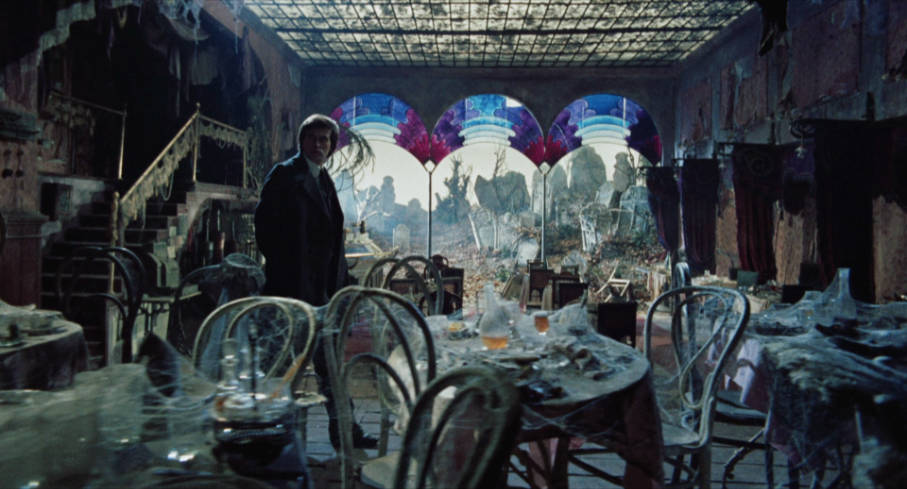
When he arrives at the large old building that appears to be his destination, Józef has to edge round a high crumbling walkway to reach a tall set of iron double doors that open to reveal that the way through is blocked by what looks like a mountain of tombstones. He instead enters the building through a large, shuttered window, which deposits him in a large room looks as if it has been abandoned for decades. The walls are worn and stained, fallen masonry intermittently peppers floor, worryingly large cracks snake across ceiling, and the whole thing is in the process of being reclaimed by nature. It’s the sort of place that Joel and Ellie might have come across on their post-apocalyptic cross-country trip in The Last of Us, had the series been directed by Jan Švankmajer or the Brothers Quay. After some fruitless searching, Józef eventually finds a nurse (Janina Sokołowska) when she darts into the corridor from one of the rooms, quickly closing the door behind her and rapidly fastening her clothing in the manner of someone trying to cover up the fact that they’ve just had an illicit quickie with one of the patients. Józef tells her that he booked a room by telegram, but the nurse tells him that everyone is asleep and that she’ll check him in when the doctor wakes up. The surprised Józef points out that evening is still a long way off yet, to which the nurse replies, “They sleep all the time. You didn’t know?” She then adds perplexingly, “Besides, night never comes here.” She then advises him to wait in the restaurant downstairs.
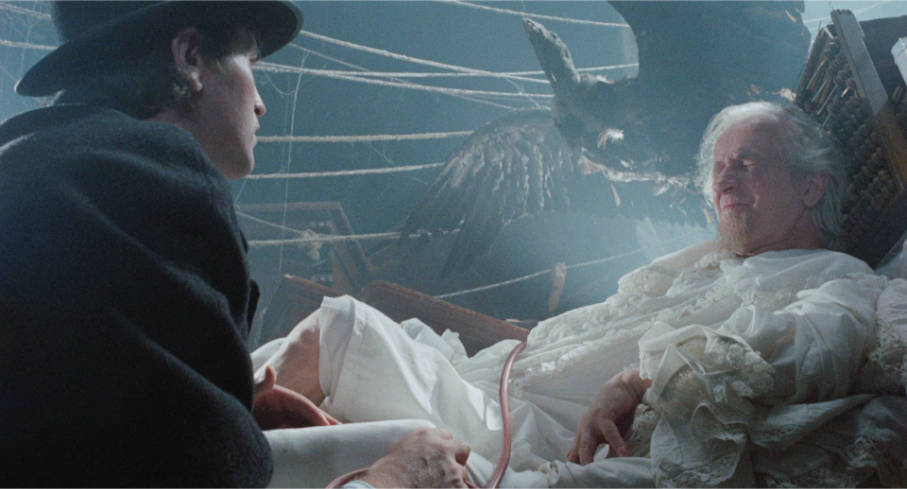
The restaurant in question is even dingier and every bit as long-abandoned as the room through which Józef first entered, yet sitting on a cobweb-strewn counter is a platter of fresh fruit, below which is a selection of fresh cream cakes, one of which the hungry Józef helps himself to. Before he can eat it, however, the nurse reappears and tells him that the doctor will see him now. Józef thus returns to the room through which he made his entrance to meet with Dr. Gotard (Gustaw Holoubek), and it’s only here that we first learn that Józef’s father is a resident of this decomposing hospital when Józef asks the doctor if he is still alive. Gotard replies reassuringly, “Of course,” but then adds mysteriously, “I mean to an extent allowed by the situation.” If this sounds confusing, try to get your head around what comes next. “You know, just as I do,” Gotard begins, “that from the perspective of your home, your homeland, your father is dead. This cannot be reversed. His death casts a shadow on his existence here.” Although this may seem like a definitive statement, it does somewhat contradict Gotard’s initial claim that the man is still alive. I was fully expecting Józef to be as confused by this statement as I was, but instead he asks Gotard, “But he doesn’t know or suspect?” which prompts Gotard to respond, “Don’t worry, our patients don’t suspect a thing,” whilst making an impromptu examination of Józef’s head. He then takes Józef to see his father, Jakub (Tadeusz Kondrat), who is lying on his bed in what could be either an unconscious or a deceased state. Gotard then explains, “The trick is that we moved back time. Time is late here by an interval which I can’t precisely define. It all boils down to relativity. Here, your father’s death hasn’t occurred yet. But he met with his death in your country.” “So my father is dead?” Józef asks, “or is he close to death?” “No, no. You don’t understand,” Gotard replies. “We reactivate past time with all its possibilities. Including recovery. We let our patients sleep for a long time. We spare their vital energy. They have nothing better to do anyway.” He then suggests that Józef have a lie down and leaves him with his father. All clear? Oh, you don’t know the half of it.
If I seem to have gone into excessive detail here, it’s because I wanted to give a flavour of the complexity and sometimes brain-scrambling strangeness of Jerzy Has’s extraordinary film (and believe me, I’m still only skimming the surface of these sequences). If I did likewise for every scene, this review would be delayed until 2027 and run for long enough to give our hosting server a computational hernia, yet to describe what follows in a manner that at least pays lip service to coherence and do full justice to the awe-inspiring visual and thematic complexity of each sequence would probably require me to do so. It’s partly for that reason that I’m not going to try. If it’s a literary description of what unfolds that you’re after then I gather you could do no better than read the novel on which the film was based, Sanatorium Under the Sign of the Hourglass by Bruno Schulz. Despite not having read it, I can absolutely guarantee that my own attempts at prose would fall way short of the writings of the man who originated the story. But there’s another reason that this would prove inadequate, and that has to do with manner in which the narrative is cinematically interpreted, the sheer poetry and visual inventiveness of which no mere description that I could supply would do justice to.
The Hourglass Sanatorium is a genuine, full-blooded surrealist work, one whose non-linear narrative has the fractured and interpretive logic of a dream through which memories of Józef’s childhood and young adulthood have been filtered. The setup certainly has a science fiction whiff to it, with Gotard’s claim that the hospital has moved back in time in a way that allows for alternative paths forward having a ring of multiverse theory, a centuries old proposition that didn’t really gain scientific traction until the 1990s. This claim is seemingly confirmed when Józef looks outside to see himself arrive and open the doorway that was previously blocked by tombstones and watch himself be led through it by young boy that turns out later to be his childhood friend Rudolf (Filip Zylber). It’s hard to be sure which incarnation of Józef we follow from this point on, as he revisits episodes from his past, sometimes with Rudolf with his prized postage stamp album at his side. In several of these episodes, Józef reverts to the child he once was but continues to be played by adult actor Jan Nowicki, a device previous employed by Dennis Potter in his 1965 TV play Stand Up, Nigel Barton and that would later prove central to his 1979 Blue Remembered Hills. In this guise, Józef returns to his early days in the crowded and lively Jewish community in which he was raised, a time when his father was very much alive and active, when young Józef was captivated by the overt sexuality of redheaded servant girl Adela (Halina Kowalska) but had a serious crush on the pretty Bianka (Bożena Adamek), who now appears to be living inside a dream in a walled-off area with her late mother.
I’m just sampling here from a cornucopia of visually striking, sometimes haunting and often brain-scrambling surrealistic vignettes that dovetail into each other in a way that makes not an ounce of real world sense but somehow feels logical within the dreamscape that Has and his collaborators have created. Each scene is meticulously designed and photographed, and all are directed with an attention to detail and cinematic flow that swept me along even when I had no real idea what was going on and could make little sense of what was being said, a peculiar but oddly compelling blend of head-scratching confusion, repeatedly piqued curiosity and wide-eyed wonder. To get the point across, and despite claiming above that I was not going to do so, allow me sketch out a couple of scenes and how they interconnect in detail to give a flavour of the manner in which these sequences play out on screen. Only a flavour mind, as how they are visually realised and performed is a crucial aspect of their ability to grip a willing viewer, even if – and probably when – you find yourself struggling to fully comprehend what you are watching.
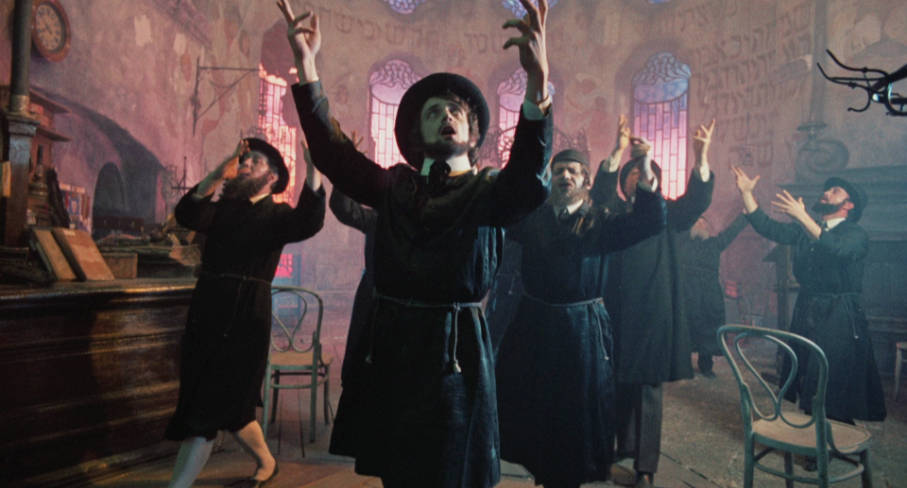
After entering the asylum with Rudolf, the adult Józef finds himself in his childhood family home, where he accuses his upset mother (Irena Orska) of spreading lies about his father, an accusation that she denies before reminding Józef of a time when Jakub went missing for many days and then wondering if he is still alive somewhere. She suggests to Józef that he skip school today, which Józef responds to by pointing out that he is no longer a boy, a claim that his mother immediately dismisses. She then sends him out to open the family shop and heads upstairs, and Józef exits the building through a large and cobwebbed metal door into an empty and seemingly moonlit cobblestone square lined with rustic buildings that is soon revealed to be located within a cavernous hall. He quickly comes across a familiar bed as its male occupant wakes from sleep fully dressed, and as he prepares for the day ahead, Józef descriptively comments on his actions in the manner of a narrator, words to which the man directly responds in a conversational manner. Other Jewish men also rise from beds and hammocks that are not walled off from the street, some of whom engage in religious and philosophical discussions, and as the sun rises, one man’s prayer gradually evolves into an increasingly exuberant Yiddish chant that all of the awakened men join in and dance in unison to. Even the initially confused Józek is eventually swept along by this, his own praises to God delivered in voice-over as the activity within the street increases in density and complexity, peaking at the level of a big-budget Hollywood musical. It’s worth noting that the whole sequence – from the moment Józef enters the street up to this point – is captured in a single, constantly mobile but impressively understated camera shot. Once you realise this (and I didn’t at first), the organisation, blocking, cinematography and choreography of the sequence is genuinely breathtaking.
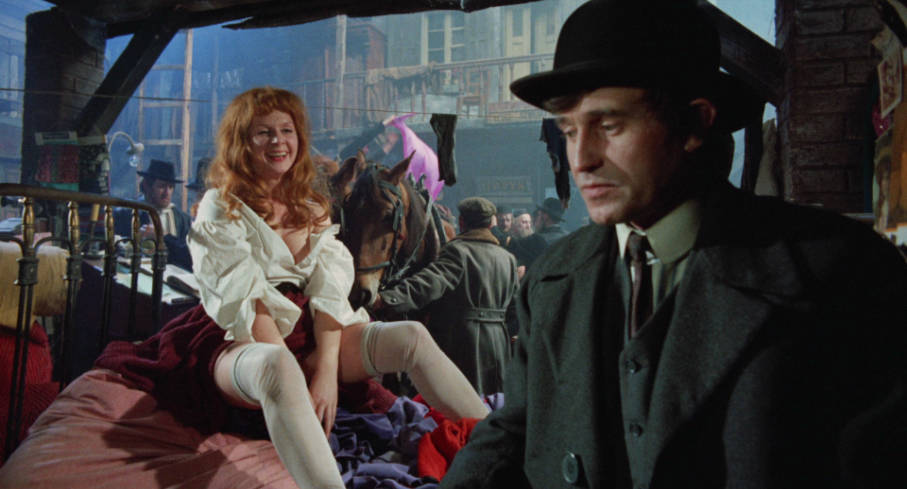
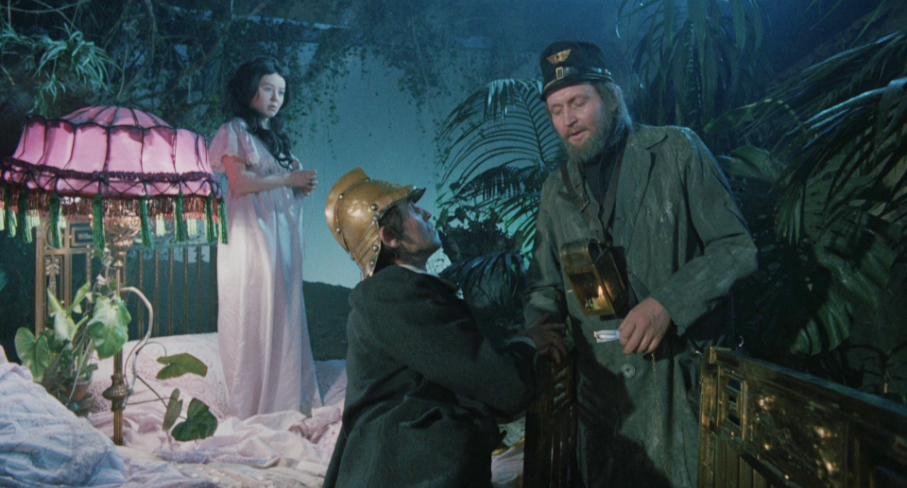
Three men then encourage Józef to climb with them a ladder to an upstairs balcony, where they all peer lustily into a room in which the erotically radiant Adela is lying on her bed in her nightclothes. When she spots the men, she rushes over to the window and forcefully opens it, knocking most of them into the street below, but grabbing “our little Józef” by the scruff of his neck and laughingly pulling him into the room. Her assumption that he got lost on his way to school confirms that the adult Józef has now returned to childhood and is being seen by others as the boy he once was. Adela tweaks his nose and pulls his hair and verbally mocks him and the others who like to ogle her. As she slips behind a screen to dress, Józef becomes fascinated by a brass fireman’s helmet on display in her room, which he dons and checks out in a dressing table mirror whilst pulling a range of faces, then elects to wear for the next 35 minutes of the film, whatever the location and situation. So caught up does he become in this activity that he fails to even notice Adela’s partial nakedness as she pops back and almost leans into his line of sight to grab collect a couple of hairpins. A few seconds later, however, he is standing by the screen like the adolescent boy he has now become and peeking through the hinge gaps to catch a glimpse of Adela’s body as she strips off to wash. I won’t even try to deconstruct the conversation that the two subsequently engage in – which includes comments about the rejuvenating colours of fireworks that firefighters eject, the raspberry juice that Adela makes and carefully rations, and the notion of poor hair growth as divine retribution – as even a couple of rewatches later, I’m still largely in the philosophical dark.
Józef then becomes fascinated by a large and tattered book whose yellowed interior seems to consist of pages torn from magazines and newspapers. In his enthusiasm to collect pages that have fallen onto the floor, he crawls under Adela’s bed, where he discovers a sleeping man, who wakes and informs him that he’s late and that there is no juice left but that he does have some rose preserve instead, which he forces into an initially appreciative but then disgusted Józef’s mouth. Józef then hears someone knocking and looks to the far end of the bed to see a Dr. Livingston style explorer peering at him. It turns out he’s looking for Jakub, and Józef identifies himself as Jakub’s son, the man seems delighted and encourages him to come out from under the bed so that the two can talk. When he does so, he is no longer in Adela’s bedroom but an unidentified East European hillside town, where he is introduced to two native-dressed individuals named Honduras and Nicaragua, one of whom presents Józef with a large egg that he claims will hatch better if sat on by a Belgian hen. “Or,” he suggest to Józef, “you can do it yourself.” In no time at all, Józef is surrounded by carnivalesque costumed individuals that include his father, who dismisses his book as a myth and tosses pages from it into the air, then he and Józef use a page each as receptacles for food being dished out by local vendors instead.
This is just a ten minute sampling from a film that maintains this level of ming-boggling surrealistic storytelling for two glorious and equally dense hours. That the shifting nature of time is a key theme should not come as a complete surprise, while the country, culture and time-hopping nature of Józef’s journey appears to be inspired in part by the postage stamps in Rudolf’s treasured album. The presentation of humans as inactive mannequins – first with the motionless passengers on the train on which Józef arrives, and later as a menagerie of historical figures, which appear to be automatons but could in truth be mechanical prisons for human souls – is initially more mysterious if no less dreamlike. The fact that Józef later sets these figures free could be read as a sly call to revolution at a time when Poland was still under controlling communist rule.
Does it make sense? Not really. Does that matter? In the case of The Hourglass Sanatorium, not a jot. I should admit that I’m speaking from the personal perspective of someone with a lifelong love of surrealism, and for whom this film’s initially impenetrable surface layer provided the sort of head-scrambling thrill that I haven’t experienced since I sat down in the dark at the Scala cinema in the late 1970s to watch David Lynch’s glorious mindfuck of a debut feature, Eraserhead. Yet as it was with that film, rewatch The Hourglass Sanatorium and a degree of structural order is revealed to be guiding what on a first viewing can feel a little like a visionary director just letting his imagination run amok. It’s also impossible to resist the urge to find meaning in (or perhaps impose meaning on) what can initially feel random, something that the film itself – in the obvious care, sometimes epic scope, ambition and attention to detail with which every sequence is staged and filmed – slyly encourages. And make no mistake, even if it leaves you scratching your head, the cinematic pleasures this film delivers are substantial, and while we may not initially comprehend the meaning and purpose of a scene, its precise and consistently confident execution makes it clear that the director absolutely does. Even when it seems not to be making narrative sense, it makes cinematic sense, if you get what I mean, in the discomforting decay of Andrzej Płocki and Jerzy Skarzynski’s astonishing production design, in the dreamlike beauty and deep focus wide shots of Witold Sobocinski’s colour cinematography, in Jerzy Maksymiuk’s haunting score, and in the drive and invention of Wojciech Has’s direction.
The popular critical term ‘dream logic’ (I’ve used it a fair few times myself) may seem contradictory, given that what’s most striking about the dreams that we are able to remember is the seeming randomness of their content and their apparent absence of rationality. Yet, when you’re experiencing them, they seem to make perfect sense. This is primarily due to the simple fact that when you’re asleep, you have no idea that you are dreaming, and thus even the most preposterous or frustrating event makes perfect sense when you’re in this world. But there’s more. It’s long been established that the content of our dreams is not random at all but directly influenced by our daily lives, our memories, our fears, and our desires, what Sigmund Freud referred to as our ‘day residue’, and these seemingly irrational narratives and fantasies thus have their roots in the logic and reality of the waking world. It’s something that so few filmmakers take on board when trying to recreate the feel of a dream on film, throwing random strange imagery at the screen instead of getting to grips with the true nature of dream logic. In films like Un Chien Andalou, L’Age d’Or, Eraserhead and Lost Highway, Luis Buñuel and David Lynch showed that they understood this and how to cinematically recreate it, and with The Hourglass Sanatorium, Jerzy Has absolutely nails it. A common feature of dreams when revisiting a location from your past is that the place will look and feel different from how it really was, something we tend to only realise in that annoyingly brief period between waking and completely forgetting what it was that we dreamt about. Dreams also do have their own otherworldly narrative flow and can switch location and tone on a whim in a way that doesn’t feel odd at all when you’re in the land of nod, but which can seem as arbitrary as a roulette wheel spin if you are able to recall the details when you wake. Thus, when Józef revisits places and people from his past and is confronted by more peculiar or fantastical elements, they rarely faze him, and he is similarly accepting of the sudden locational and temporal switches, some of which circle him back to places and situations that he has already visited. That these scenes are played straight – albeit with a sometimes engagingly whimsical edge – also feels true to how we interact with our dreams, which we accept as reality while we are in them, however skewed from real life they often are.
Which, of course, raises the question of whether what unfolds in The Hourglass Sanatorium the result of the time-shifting nature of the institution as claimed by Dr. Gotard, or is being dreamt in its entirety by Józef. If it’s the latter, then the issue of where the Józef’s real world ends and the one conjured up by his imagination begins become relevant. If this is a dream, then it seems likely to me that he feel asleep on a regular train even before the timeline of film began and the dream that unfolds was triggered by his anxiety about his father’s health, their past relationship, and episodes from childhood. Yet if this is so, then we never see Józef’s world as it really is, and the final scene can’t help but suggest that this is less a dream on Józef’s part than the last set of jumbled life reflections of a man on his death bed. If you prefer the science fiction-inflected take suggested by Dr. Gotard, then the idea that the sanatorium is a vessel for temporal disruption also holds water. That said, if the strangeness of the opening scene is to be taken at face value, the sanatorium’s reality disruption would seem to extend beyond its walls and into the train that brings visitors to this remote location and especially to its blind conductor, who intermittently pops up in Józef’s travels and whose role in the story has just a whiff of Michael Winner’s 1977 The Sentinel about it. I’m saying no more.
Whichever you choose, it matters little in a work whose surrealist sensibilities are so completely baked into its DNA that any real attempt at clarification would feel like a betrayal. I don’t need to know why Józef experiences what he does any more than I need to know what triggered all birdlife to turn on humans in Alfred Hitchcock’s The Birds or the dead to rise from the grave and start munching on the living in Dawn of the Dead. The Hourglass Sanatorium does not tell a story in the conventional linear sense, instead providing the pieces for the viewer to assemble one by taking us on a trip through Józef’s subconscious. And what a trip it is, a mesmerising, mind-bending melding of memory, history, dream imagery, regret, desire, anxiety and a whole lot more, realised on screen with an artistry, vision and ambition that suggests that director Has was born to make this movie.
sound and vision
The result of a new 4K restoration from the original camera negative and presented in Dolby Vision HDR, The Hourglass Sanatorium is presented here as a dual format 4K UHD and Blu-ray set by Radiance. Both discs were supplied for review, and thus I was able to compare the two side by side. I’ve not seen the previous DVD and Blu-ray releases from Mr. Bongo Films, but the restoration and transfer here is consistently impressive on both formats, and I’m willing to bet that the UHD is the best the film has ever looked on home media. Both transfers are clean and stable with good sharpness and detail definition, though as you would expect, the 4K transfer has the edge on this score, but that’s not the only area in which the UHD wins out. The wider contrast range facilitated by the Dolby Vision HDR results in a transfer that is noticeably brighter on the UHD than its Blu-ray counterpart, providing improved shadow detail without burning out the highlights. The brighter colours of the film’s palette are also richer and more vibrant on the UHD, though I should note that one shot where the blue hued mist of the UHD looked greyer on the Blu-ray (I used the same player and TV for both discs) appeared closer to the UHD on frame grabs I pulled from the Blu-ray (and for technical reasons, the grabs here are all from the Blu-ray) when viewed on my correctly calibrated Apple monitor.
The Polish language soundtrack is presented as DTS-HD Master Audio 1.0 mono on both discs and sounds fine. Dialogue and sound effects are clear, with only minor tonal range restrictions, and Jerzy Maksymiuk’s haunting score sounds consistently good. I detected no damage of obvious signs of wear.
Optional English subtitles kick on by default.
special features
Audio Commentary by Michael Brooke
There can be few people more qualified to provide a commentary for The Hourglass Sanatorium than East European cinema expert Michael Brooke, who curated a comprehensive retrospective of the director’s work in 2025 titled The Long Strange Trips of Wojciech Jerzy Has, which was hosted by the BFI, the ICA and the Kinotech of Polish Film Festival in London. That said, if you come to this commentary hoping for complete clarification of what unfolds on screen you’re going to be out of luck, as right at the start Brooke makes a point of quoting his own 2009 Sight & Sound review of the film’s first UK home cinema release, in which he described it as “a midnight head-swiveller to rival El Topo and Eraserhead.” Sounds about right. What we do get in abundance is background information of the filmmakers, the actors, source novel author Bruno Schulz and the other Schulz works from which elements of the film are sourced, as well as specific cultural and historical elements that might otherwise fly over the heads of non-Polish viewers. The range of subjects covered is vast and includes the crucial role played by colour in the film, the influence of Citizen Kane’s deep focus cinematography, other Polish filmmakers who have tackled Jewish themes, the negative Polish critical reaction to the film on its release, and the more positive response in France when it was smuggled out of Poland and entered into the 1972 Cannes Film Festival, where it won the Jury Prize and was nominated for the Palme d’Or. Brooke also makes the odd heartfelt comment on the artistry of the film, at one point pausing to exclaim, “Now this shot, I mean, wow!” A hugely informative and enjoyable companion to the film.
Accordion (12:08)
Made in 1947 and also known as Harmonia, Wojciech Has’s debut short film tells the story of a young boy (Tadeusz Owczarek) who lives in poverty with his brutish father (Kazimierz Dejunowicz) and has become fascinated with an accordion on display in the window of a local antiques store. When left alone one day, he raids his father’s coin tin, takes off his leather boots and his coat and offers them all to the antiquarian (Edmund Biernacki) in exchange for the accordion. It’s not enough, but when the antiquarian spots a medallion that the boy wears around his neck that is probably an heirloom, he takes that and the boy walks away with his treasured instrument. Back at home, he dreams of being such an accomplished musician whose accordion playing captivates local children and prompts villagers to dance, a wish fulfilment fantasy that is painfully shattered when his drunken father returns home.
A deceptively simple story that resonates through its subtextual commentary on poverty, familial abuse, and the potential for mental and even physical escape that art in one form or another can offer the creative mind. It’s handsomely shot in Academy ratio black and white by cinematographer Adolf Forbert, with particularly expressive use of facial close-ups, and plays out almost as a silent film, with no spoken dialogue and a soundtrack consisting solely of post-production sound effects and composer Zygmunt Wiehler’s emotive score. A quietly captivating piece.
Jerzy Skarżyński (15:01)
An archival interview with Wojciech Has’s regular production designer Jerzy Skarżyński, conducted by Professor Jerzy Wójcik in 1997 as part of a series titled Język Filmu (Cinematic Language). The main focus here is not The Hourglass Sanatorium but one of Skarżyński’s most notable earlier collaborations with Has, the 1965 The Saragossa Manuscript [Rekopis znaleziony w Saragossie], which he refers to specifically when discussing the importance of space in visual art, the influence of literature, and selecting the right objects to place within a scene. This last point develops into a philosophical discussion when Wójcik produces an example of two objects that the passing of time has melded into one. There are plenty of extracts from The Saragossa Manuscript, which despite their uninspiring quality proved intriguing enough to make me immediately want to see that film. How fortunate, then, that Radiance is also releasing it on UHD and Blu-ray in September with a new 4K restoration from the original camera negative, though that news did make me wonder why an interview that focusses almost exclusively on the earlier film was not included on that disc instead of this one.
Also included is a Limited Edition Booklet featuring new writing by critic Ela Bittencourt and archival writing from Annette Insdor, but this was not supplied for review.
final thoughts
A film that is likely to frustrate as many as it captivates, and one that most will likely find themselves more than a little bemused by even if they were as mesmerised by its time-hopping and broken mirror storytelling, hauntingly realised visuals and engaging performances as I was. The Hourglass Sanatorium is, at least for this humble viewer, challenging, ambitious, adventurous and imaginative storytelling at its most cinematically bewitching, and a hell of an introduction to the cinema of Wojciech Has, if also, I gather, a somewhat atypical one. This UHD/Blu-ray package from Radiance may not be overloaded with special features, but Michael Brooke’s busy commentary is excellent, the inclusion of Has’s debut short film Accordion is more than welcome, and the Jerzy Skarżyński interview proves to be seductive primer for the upcoming Radiance dual format release of The Saragossa Manuscript. What really sells this release is the film itself, which is presented in a top class restoration that looks really good on Blu-ray but even better on UHD. Obviously not for everyone, but for the willing, this release comes highly recommended.
The Hourglass Sanatorium [Sanatorium pod klepsydrą]
Poland 1973 | 119 mins
directed by: Wojciech Has
written by: Wojciech Has
cast: Jan Nowicki, Tadeusz Kondrat, Irena Orska, Halina Kowalska, Gustaw Holoubek, Mieczysław Voit
distributor: Radiance
release date: 3 August 2026