
Death becomes him
A 1974 horror movie that unites genre stars Vincent Price, Peter Cushing and Robert Quarry might sound like a winner from the get-go, but not everything completely clicks in Jim Clark’s underseen MADHOUSE. Gort revisits the film for the first time in decades on Eureka’s new Blu-ray and experiences pleasures and frustrations in equal measure.
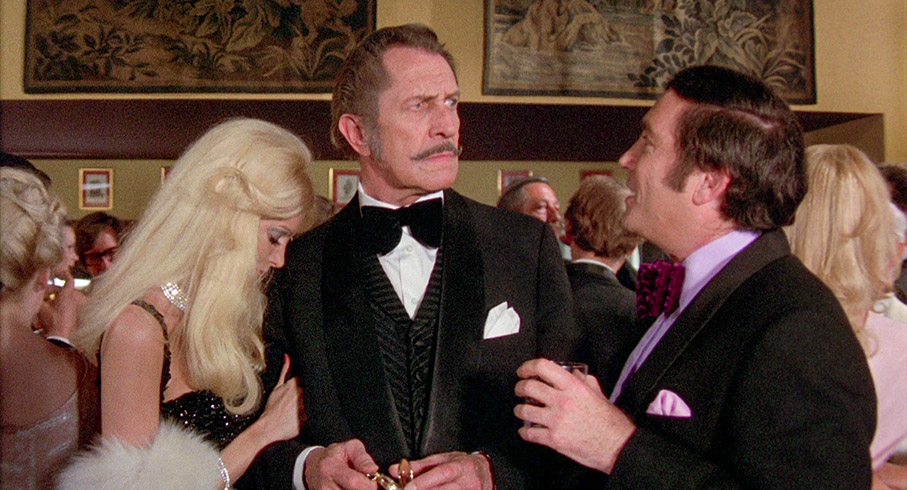
Things are going swimmingly for celebrated horror star, Paul Toombes (Vincent Price). Dr. Death, the skull-faced serial killer he has played in four successful movies, has made him a household name, and now he’s throwing a New Year’s Eve party to celebrate the completion of the fifth film in the series with colleagues and associates, including his close friend and Dr. Death screenwriter Herbert Flay (Peter Cushing). After a well-received screening of the film, Paul announces that he has asked his glamorous and much younger girlfriend Ellen Mason (Julie Crosthwait) to marry him. She responds by presenting him with a gold pocket watch with the words “Darling PAUL all my love ELLEN” engraved on the inside. Aw, that’s sweet. What could possibly spoil such a perfect evening? Ladies and gentlemen, meet Oliver Quayle (Robert Quarry), who clearly has no time at all for Paul and seems especially put out by his marriage proposal to Ellen. “He’s on the make and she’s on the take,” he uncharitably mutters to his female companion. Well, as long as he keeps his sour grapes to himself, we should be alright and… oh, no, there he goes. It turns out that Oliver is a producer of what he likes to call “adult films for art houses,” and he’s only too happy to tell the previously unaware Paul that Ellen used to be one of his most popular performers. “She was one of the best when it came top stripping and getting down to the hard action,” he tells Paul with an insufferably self-satisfied grin, then inferring he and Ellen were also once a couple. Who, exactly, invited this spiteful git to the party? Ellen is understandably upset, but Paul does himself no gentlemanly favours by expressing his disgust at this information about her past, assuring her that he can kill her career and making unfair inferences about how she got the money to buy the gold watch. Ellen rushes upstairs to her bedroom in tears, unaware that an unidentified, black caped and black-hatted figure is pulling on leather gloves and selecting a very sharp knife a nearby room. After quietly entering Ellen’s bedroom, the dark-dressed figure slowly approaches her from behind as she sits at her vanity table, only to dart through a pair of curtains into a side room when she seems to sense his presence. Quite why they do this is beyond me given what they are planning, and the noise they make beating such a hasty retreat really piques Ellen’s curiosity. She gets up and approaches the curtains to investigate, only for them to be pulled suddenly apart by the black-dressed figure, whom we now see is wearing a skull-shaped mask in a Halloween costume imitation of the makeup that Paul wears in the Dr. Death movies. Freeze frame on Ellen’s terrified scream.
One set of opening titles later, we return to the party for the dawn of the new year and that bloody awful song that everyone feels compelled to sing when midnight rolls around. Everyone except Paul, who’s lying unconscious upstairs on his bed in a presumably hungover state, from which he then wakes to be confronted by the sight of a pair of black gloves and a knife resting next to him on the bed. He may not remember seeing them before but we certainly do. All apologetic about his earlier behaviour, he enters Ellen’s bedroom to find her once again sitting at her vanity table. He approaches her from behind, making his excuses for earlier, but as he over to kiss her a gentle kiss, her decapitated head falls off and rolls onto the floor. Unsurprisingly, Paul screams in horror (and it’s quite a scream), attracting the attention of everyone at the party, all of whom scurry upstairs for a gag-inducing front row view of this horror.
All signs point to Paul being the killer, but despite being acquitted in the subsequent trial, he remains unsure whether he did or did not didn’t commit this heinous crime. His career in ruins, he flees the country and checks into an American psychiatric hospital and quickly falls off the celebrity radar. Then, 12 years later, he gets a surprise call from Herbert, who’s agreed to write a Dr. Death TV series for the BBC to get himself out of a financial hole. Trouble is, it looks like it’ll only get greenlit if Paul agrees to play the title character. Uncertain about doing so but keen to help his good friend in his time of apparent need, Paul heads back to the UK on a cruise ship, a journey on which his is seriously pestered by an aspiring young actress named Elizabeth Peters (Linda Hayden). Actually, pestered is putting it mildly, as this girl is the very definition for a stalker, entering Paul’s cabin when he’s in bed one evening with her cleavage prominent and sitting provocatively on his bed, then threatening to cause a scandal by inferring that the two are having an affair when Paul tells her to leave. She even nicks his gold watch when his back is turned, a precious possession that for some reason Paul fails to notice is missing. Paul boots Elizabeth out anyway, but when the press gaggle around him as the ship reaches shore, she sidles up beside him and flashes a starry grin in an effort to suggest that the two are an item. She even plonks herself in Paul’s car after they dock, only to be wearily ejected by its understandably irritated owner.
To help shield him from eyes of the story-hungry press, Herbert invites Paul to stay at his country cottage. Paul is certainly happy to see his old friend, but can’t help but notice that he doesn’t seem quite as financially strapped as his correspondence has suggested. Once they get on to talking about the show, Herbert suggests that Paul watch some of the old Dr. Death films to help him get back into character. Paul isn’t keen but ultimately agrees, but while watching a sequence in which a character is hypnotised, he drifts off into a trance-like sleep. It’s then that Elizabeth confirms her stalker status by arriving at Herbert’s cottage and entering the grounds in the hope of harassing Paul for a part on the new show. When she spots what she believes is him in his Dr Death costume, she follows him into the adjoining woodland but gets a pitchfork in the throat for her trouble from what appears to be the very same individual who beheaded Ellen 12 years earlier. The murderer then picks up her body, drops it into a rowboat and pushes it out into the watery mist.
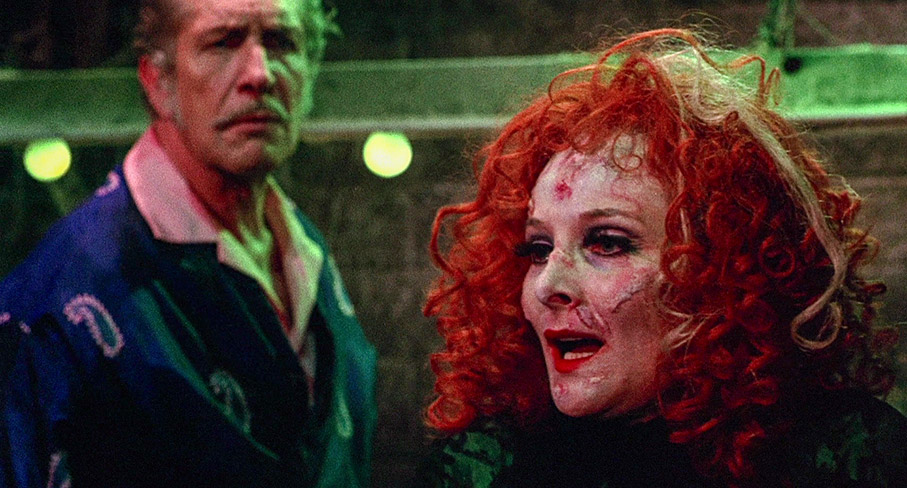
A short while later Paul is woken from his bedroom slumber by the crack of thunder from an approaching storm and goes exploring with the sort of ornate candelabra that instantly recalls the Roger Corman Poe films in which Price starred, extracts from which are being repurposed here as his Dr. Death movies. He’s drawn by the sound of music to an improbably large and gothic cellar, where he is startled to discover that his former Dr. Death co-star Faye Carstairs (Adrienne Corri) is living in relative seclusion with an unpleasantly large cluster of spiders. She reveals that after Ellen’s murder put the kibosh on any future Dr. Death movies, it not only ended Paul’s career but Herbert’s as well. Faye married him more out of sympathy and friendship than love, a wobbly basis for a marriage that quickly turned sour for them both. Faye started playing around and picking up random men, then one night was beaten by a group of them and put into a car that was set on fire and pushed down a hill, leaving her facially disfigured and triggering a complete mental breakdown. I’m not bloody surprised.
The next day, two kids who are fishing by the riverbank land the catch of their life when they accidentally hook the boat in which Elizabeth’s body was dumped. The police are promptly called, and the girl’s foster parents Alfred (Ellis Dale) and Louise (Catherine Willmer) are interviewed by the detective tasked with solving the case, Inspector Harper (John Garrie). The pair lay on the grief, but as soon as the Inspector’s back is turned, they’re exchanging scheming grins. It’s later revealed that they found Paul’s pocket watch on their daughter’s body, and plan to use it to blackmail Paul into… No, no, no. Hang on a minute. We can presume that the police were called before the parents, and since the girl was obviously murdered, the cops certainly wouldn’t allow anyone – even her parents (and especially not these two) – to start digging through her pockets and removing items. Indeed, the first thing that the police would likely have done is search Elizabeth’s pockets themselves for any clues to her identity, and once that was established the inscription on the watch would clearly indicate that it was not hers and would thus be considered a vital clue in the investigation. A small thing this may seem, but a whole plot strand hangs on this shiny timepiece, and this is not the only time I found myself doing a small double take over the film’s sometimes shaky logic.
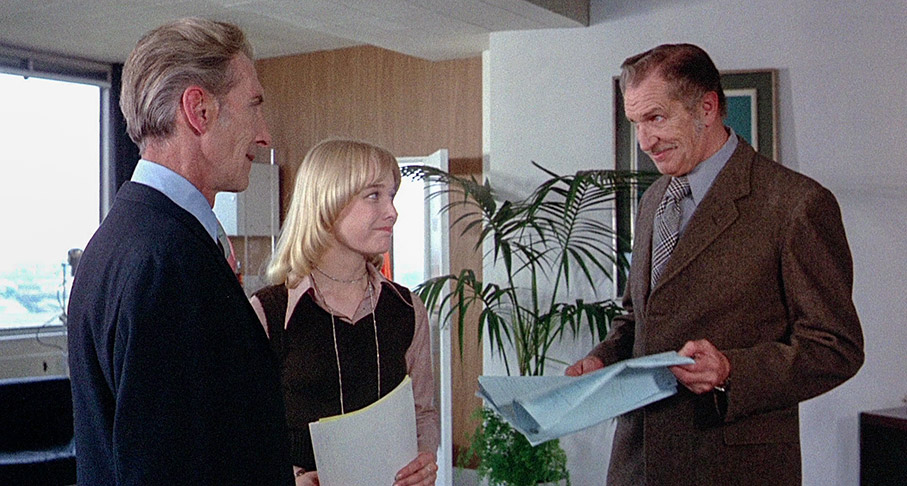
As this is unfolding, Paul is arriving at the BBC production office to discover that the Dr. Death series is being produced by none other than Oliver Quayle, whose disagreeable personality has not improved with age or mellowed in the slightest. Even worse, he insists that his young girlfriend Carol Clayton (Jenny Lee Wright) be cast as Dr. Death’s assistant, a role that had no place in any of the films. Although outraged by this ludicrous proposal, Paul has little option but to play along but blows up at Carol when she fumbles her lines on their very first shot. Later, at a horror-themed fancy dress party (which has a couple of in-jokes for the genre faithful), a drunken Carol confronts Paul about the way he has been treating her and angers him by bringing up the death of his late fiancée. Now, what do you think happens to her a short while later?
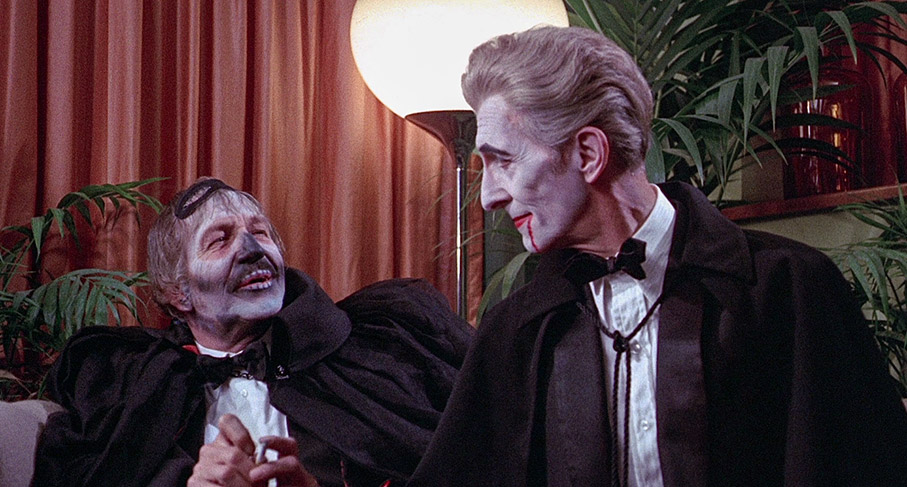
If this all has a structurally familiar ring, then that’s because it has since become structurally familiar. As is pointed out by just about everyone in the special features – and frankly should be self-evident to all horror fans – Madhouse not only borrows from prior and contemporary genre trends, it also unknowingly anticipates what lay just around the corner. The influence of Italian giallo cinema is obvious from the first kill, where the unidentified killer dons black leather gloves and takes sharp knife from a custom-made case, which the murderer keeps in one of those traditional black doctor’s medical bags that only makes an appearance in the one scene. To cement the giallo connection, the stalking of the intended victim is initially shot handheld from the killer’s point of view, and in common with many gialli, the identity of the killer is not revealed until the finale, and you can bet your bottom dollar that it ain’t gonna be the one who looks the most obviously guilty. More surprisingly, the film drops a whopping great hint about who the murderer might really be less than a third of the way in, albeit a hint that only announces itself as such on a second viewing. In common with several notable gialli, the film also anticipates the 1980s slasher cycle, featuring as it does a masked killer of initially uncertain motive who is stalking and dispatching individuals in violently creative ways. One is decapitated, one is hung from a gym rope, another is pinned to a wooden fence with a pitchfork through their neck, one is crushed in the TV studio by a prop that has no good reason whatsoever to have such overpowered hydraulics, and two are dispatched in unison when a sword is thrust simultaneously through both of their bodies. There are also a few nods to the Roger Corman Poe films in which Price appeared, not just in the clips used but also the set design and lighting of the gothic cellar in which the unfortunate Faye now resides.
So, given its influences, its A-list lead players and the template it helped to draft for the cycle of genre films that would soon follow, does Madhouse deliver as horror movie, at least for this rapidly ageing devotee? Well, yes and no. Admittedly, when I first watched the film many years ago, I did so with a slightly prejudicial eye. I lived and breathed horror as a teenager and remember enjoying Angus Hall’s novel Devilday (whether I still would is a different matter), on which the Madhouse screenplay and its many rewrites were based, and recall being disappointed back then by the many changes that were made to the story and the characters in the film. Coming back to Madhouse with the novel now a faded memory, I’m more receptive to its pleasures, but am still not convinced that it really hangs together. Working strongly in its favour are the three lead players, each of whom had genre pedigree by this point. Price is on fine form here and gets the chance to show more of his range as an actor than he too often did, letting rip a mouth-gapingly horrified scream on discovery his decapitated fiancée, looking convincingly dazed when under the hypnotic spell of his projected movies, going full cheerful bonkers in the fiery climax, and smilingly sniping at Faye when she attempts to ball him out with the line, “Your drama school accent is slipping.” His conversations with the disfigured Faye show an admirable level of restraint and are genuinely touching. Cushing is as reliable as ever, and the chemistry between him and Price makes me wish they had more scenes together and that his character had a large role in the unfolding drama. Quarry is the comparative newcomer here, the first of the two Count Yorga films having hit cinemas just four years prior to the release of Madhouse. He’s still good casting, playing Oliver Quayle as a smugly self-satisfied arse in a regrettable position of authority, jealous of Toombes for bagging his former girlfriend and contemptuous of his talent as a result. Adrienne Corri plays Faye with crazy spider lady relish, but never overplays what is ultimately a tragic character with a genuinely grim backstory. I really liked Natasha Pyne as show PR rep Julia Wilson, the most likeable and selfless character in a film in which just about everyone else has issues of one sort or another and also enjoyed John Garrie as the very 1970s cop (glasses, wavy shoulder-length hair, flowery tie) Inspector Harper, even if he ends up dropping out of the story as the police investigation is sidelined to the point of being forgotten. I was a little less keen on the performances of Ellis Dale and Catherine Willmer, who play Elizabeth’s exploitative foster parents with the sort of exaggerated opportunistic sleaze that would be more at home in a sitcom than a horror thriller.
Madhouse was directed by Jim Clark, a former editor of serious repute whose prior credits include The Innocents (1961) for Jack Clayton, Charade (1963) for Stanley Donen, and Darling (1965) for John Schesinger. He’d directed a few shorts before Madhouse, plus the 1966 family film The Christmas Tree, the offbeat 1970 Marty Feldman comedy Every Home Should Have One, and the limp 1972 sex comedy Rentadick. Believe it or not, that last one was co-written by Monty Python’s Graham Chapman and John Cleese, whose original title was Rentasleuth and who were so dismayed by the rewritten (by John Fortune and John Wells, no less) finished film that they had their names changed on the credits to Jim Viles and Kurt Loggerhead. Clark’s direction here is an uneven but intermittently effective mix of the functional and the creative, though the passing of time has had its wicked way with some aspects, with the raging river of slasher movies that followed seriously diluting the impact of kills that may once have seemed a lot more tense and alarming (I genuinely can’t recall how I reacted when I first saw the film all those decades ago).
There is one other inspired moment that unknowingly anticipates a modern horror classic. It’s a sequence that I can’t comment on without delivering a mother of a spoiler, but as no-one in the disc special features seems to have made this connection, I can’t let it pass unremarked on. Thus, if you’re new to the film and are planning to see it, you should probably hop forward to the next paragraph and come back to this one later. Are we good? Let’s hope so. Don’t say I didn’t warn you (and Madhouse is not the only film whose climactic scene I’m about to spoil). The moment in question occurs once the killer has been unmasked and a manic Toombes has died in a climactic fire that he instigates in the Dr. Death TV studio, a scene that riffs a little too heavily on the finale of previous year’s Theatre of Blood, a gem of a film that gave Price one of his best and most personally satisfying roles. The sequence in question has the killer watching the recording that Toombes made of his fiery denouement (he’s watching it on film even though it was shot on video on the studio’s TV cameras – oh, never mind) when the on-screen Toombes suddenly turns and walks towards the camera, and in a sleight of edit moment steps out of the screen to directly confront his tormentor. As is noted in the special features, it’s the only supernatural element in an otherwise reality-based murder-mystery, but crucially it anticipates the now famous climax of Nakata Hideo’s 1998 masterpiece Ringu when Sadako crawls out of a cursed video recording through the TV screen. I’m not going to claim that Clark’s more primitively executed twist is as skin-crawlingly startling as Nakata’s, but it’s still really effective and may well be the film’s most inventively chilling twist.
In the end, Madhouse both entertains and frustrates, playing a little like a collection of interesting and often engaging components that don’t really gel into a satisfying whole. Mind you, it’s hard to lay the blame for this at director Clark’s door, as having completed his cut, this multi-award winning editor suffered the indignity of having the film taken out of his hands and re-edited twice by two different parties in two different countries. It’s doubtless this that prompted Clark to abandon directing and return to his original craft, and given that his subsequent films as editor include (deep breath) Day of the Locust (1975), Marathon Man (1976), Yanks (1979) and Honky Tonk Freeway (1981) for John Schlesinger, The Killing Fields (1984, for which he won an Oscar) and The Mission (1986, Oscar nominated) for Roland Joffé, and Vera Drake (2004) and Happy-Go-Lucky (2008) for Mike Leigh, I can’t help aching just a little for the original Clark edit that we’ll never get to see.
sound and vision
This Eureka Classics release marks the UK debut of Madhouse on Blu-ray, and while there isn’t a whisper about the restoration and transfer in the press release (I gather the release disc is not accompanied by a booklet, which might have revealed more), it looks pretty darned fine. The picture is sharp (sharp enough to reveal the cord used to move one of the artificial spiders in the cellar), the contrast feels spot on, the black levels are solid, and the colour grading is pleasing, bringing a richness to brighter hues and a natural feel to skin tones when the lighting permits. The image is largely clean, with just the odd spot of dirt or damage (can’t be sure which) on single frames here and there, and our beloved film grain is visible but not distractingly so. The clips from the Corman Poe films are loaded with scratches – not sure if this is an artistic choice just the condition of the prints that were supplied for usage. Knowing American International, it’s probably the latter.
The Linear PCM 2.0 soundtrack is clear and free of damage and obvious signs of wear, though inevitably lacks the tonal range of a more modern production.
Optional English subtitles for the hearing impaired are on board, as expected.
special features
Audio Commentary by David Del Valle
Author and film historian David Del Valle delivers a pleasingly balanced blend of background information and opinion, highlighting aspects of the film that work for him whilst also repeatedly criticising what he regards as its weaknesses. He doesn’t pull punches on this score, admitting to being a fan but describing the script as confusing and the film itself as a catalogue of missed opportunities, and at one point even calling it sloppy. As someone who has interviewed both Robert Quarry and Vincent Price on several occasions, he comes armed with recollections and anecdotes from the horses’ mouths to enrich his extensive research. Subjects covered include the actors, director Jim Clark, American International Pictures bigwig James H. Nicholson, Angus Hall’s source novel, the script problems that led to Quarry rewriting his dialogue and being asked by his equally unhappy co-stars to rewrite theirs too, the borrowings from Italian giallo cinema and the ways in which it pre-empts the 80s slasher cycle, and a whole lot more. An involving and educational listen.
Introduction by Stephen Laws (8:38)
Horror novelist, interviewer, reviewer and lifelong horror movie fan Stephen Laws has none of David Del Valle’s qualms, admitting that he loves the film and that his only gripe is its very generic title. He talks about the script and how the actors were particularly irritated by producer Milton Subotsky’s daily rewrites, which conflicts slightly with the archive documentary below, where Subotsky is quoted as saying that AIP-installed associate producer John Dark was the one responsible for these disliked revisions. Like Del Valle, he praises actress Adrienne Corri, and signs off by revealing, in the manner of someone sharing a bit of little known trivia, that horror titans Vincent Price and Christopher Lee share the same birthday and that Peter Cushing’s occurs the following day. Seriously, I thought that was common knowledge amongst horror fans.
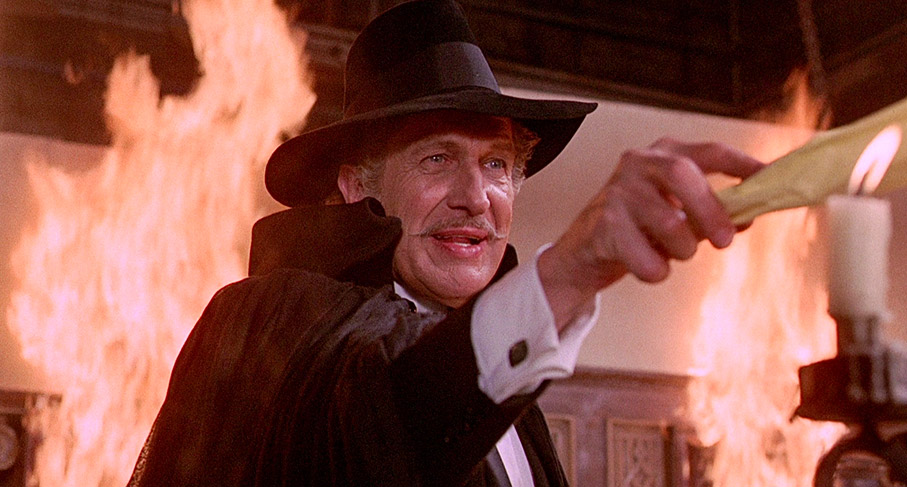
The Revenge of Dr. Death! (10:52)
An archival documentary from 2015 on the making of the film, produced and directed by Daniel Griffith and engagingly narrated by Randy Turnbull. I’m guessing this was created for an earlier disc release and is built around interviews with David Del Valle (he of the commentary above) and screenwriter and film historian C. Courtney Joyner. The two men discuss the process of adapting Angus Hall’s novel for the screen, including the changes made to the book and the multiple rewrites, with associate producer John Dark identified as the chief villain of this aspect of the production. It’s confirmed here that the film was edited three times, first by director Jim Clark, then by producer Milton Subotsky and editor Clive Smith, and then again in Los Angeles by unnamed individuals at AIP, a cut that Subotsky described as “a horrible mess” and is presumably the one that we have today.
Original Theatrical Trailer (1:48)
An almost quaintly dated trailer that starts with a scrolling caption warning those of a nervous disposition to turn away, then assaults our ears with a montage of just about every scream in the film, with brief pauses for the soberly serious narrator to tell a porky about the killer’s identity.
Stills Gallery (8:05)
A rolling gallery of crisp black-and-white promotional stills, a smattering of colour ones, German lobby cards, press book pages and posters.
final thoughts
Madhouse is a film that I don’t love but do rather like, as much for the films that it unknowingly predicts as for its boffo lead players and the fact that it has just enough entertaining and inventive moments and sequences to hold the interest. It’s good to see it getting a UK Blu-ray release at long last and Eureka has done a typically solid job with this one. Good transfer and engaging special features. The film certainly has its enthusiastic fans and is definitely worth a look for the horror faithful.
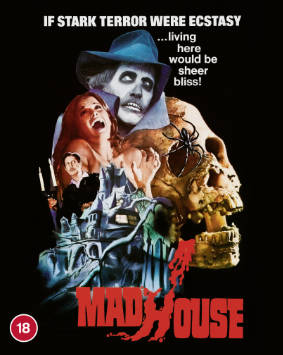
Madhouse
UK / USA 1974 | 89 mins
directed by: Jim Clark
written by: Ken Levison, Greg Morrison; Robert Quarry (dialogue and text, uncredited); based on the novel Devilday by Angus Hall
cast: Vincent Price, Peter Cushing, Robert Quarry, Adrienne Corri, Natasha Pyne, Michael Parkinson
distributor: Eureka Classics
release date: 22 June 2026