
Pink Narcissus
James Bidgood’s PINK NARCISSUS, a landmark in experimental gay cinema, has a Blu-ray release from the BFI. Review by Gary Couzens.
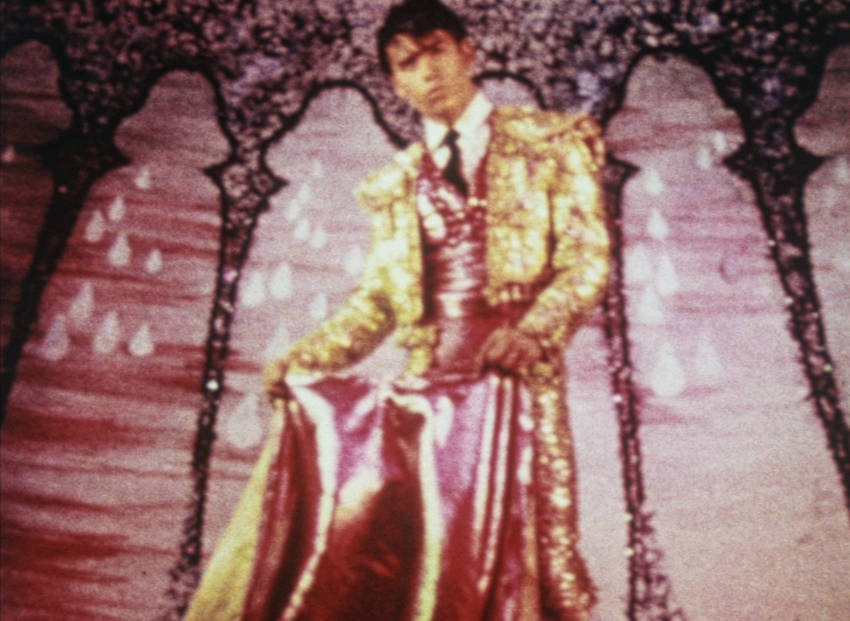
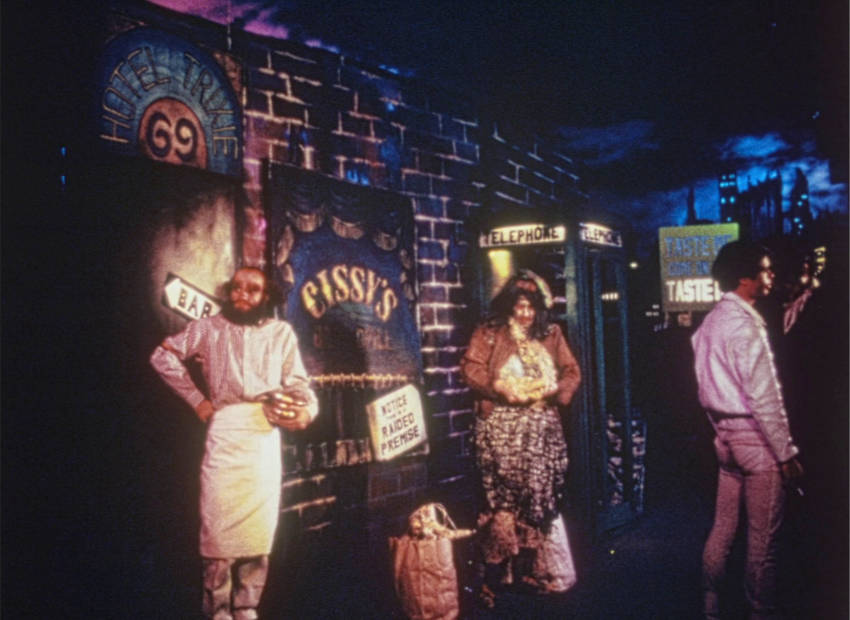
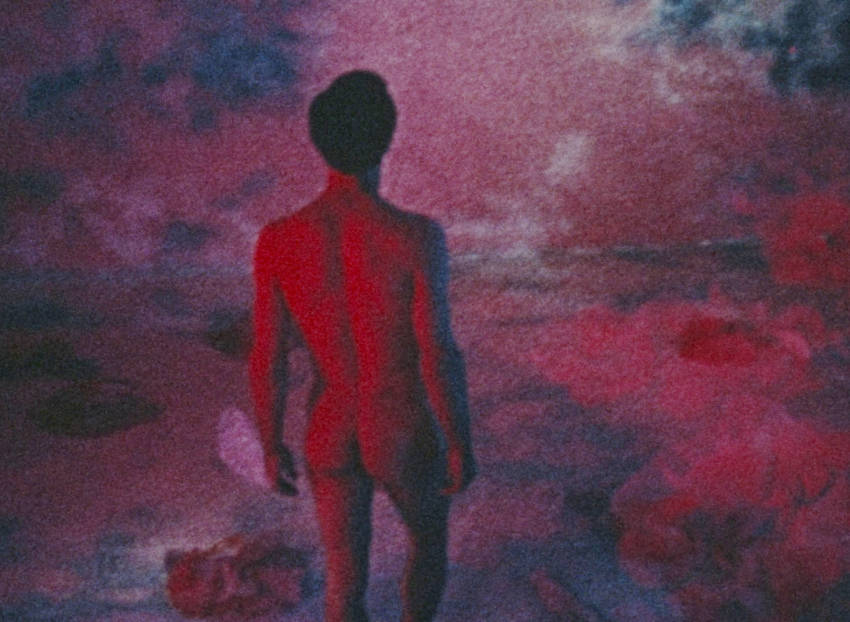
Pink Narcissus is a major one-off in American cinema, in experimental and gay cinema most particularly. Running just over an hour, it was the only feature film made by James Bidgood, shot over seven years, mostly in Super 8mm with some 16mm, the large part of it in his small New York apartment which allegedly smelled of garbage and cat litter. The film is non-narrative, with no spoken dialogue, and it follows the dreams and fantasies of a beautiful male hustler (Bobby Kendall – a pseudonym, his real name unknown), which play out various different scenarios, involving matadors, dancing boys, exotic slaves, bikers and a rough encounter in a public toilet. The smaller-gauge camerawork (by Bidgood, who made much of the film single-handed) gives the film its lush, if very grainy, look, with Bidgood’s experience as a costume designer well to the fore. The cramped venue where the film was shot is not always apparent, especially in the opening sequence where the camera tracks through a “jungle” with a full moon in the sky…all done in a room which was approximately nine feet wide.
James Bidgood was born in 1933 in Wisconsin. The films he saw as a child and teenager which particularly marked him were the 1939 Wuthering Heights, the 1940 The Thief of Bagdad and the musicals of swimming star Esther Williams. At the age of eighteen he moved to New York, sometimes having to sleep on park benches. He performed in drag for a while, under the name Terri Howe, and later in the decade attended the Parsons School for Design. He worked as a photographer, specialising in art shots of men, aiming to extend the genre of gay male erotic photography. Some of his photographs appeared in fitness magazines with titles like Muscleboy and The Young Physique, much read or rather looked at by closeted or not-so-closeted gay men. He began to make Pink Narcissus in 1963, funding it himself. It was originally intended as a series of “loops” he could sell via mail order before developing into the feature it became. His lead actor, Bobby Kendall, was a model and hustler, actually straight but not above being gay for pay. From time to time, Kendall left the production so some shots of him feature stand-ins. He also had lost most of his hair towards the end of production, so has a hairpiece in parts of the film.
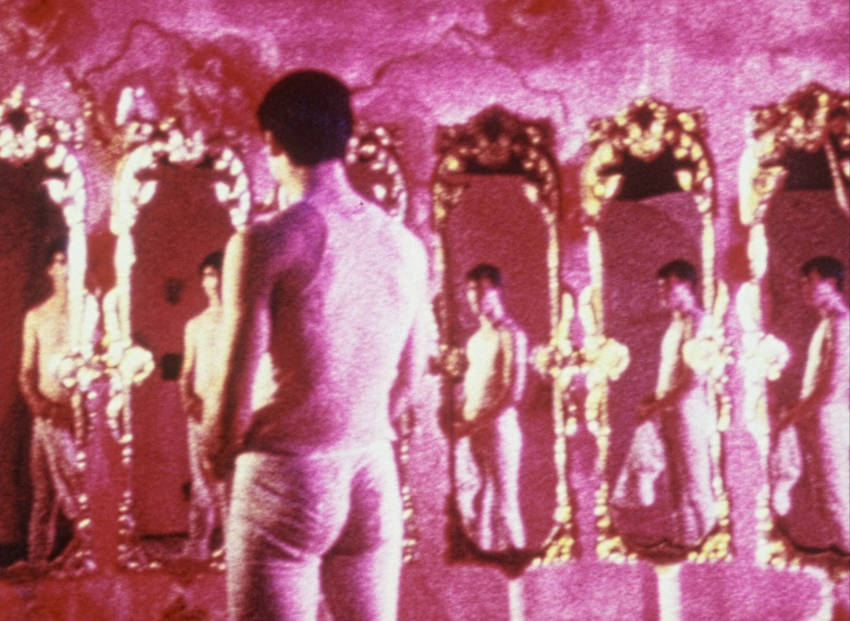
Later in the 1960s, the film received some financing from investors, but that turned out to be a mixed blessing. In return for gaining the rights, the distributor Sherpix put some money into the production but they edited the film against Bidgood’s wishes. So he took his name off it, the credit calling him “Anonymous”. Sherpix used this in their publicity, which caused many to speculate as to who the anonymous filmmaker was. Some suggested Andy Warhol, others Kenneth Anger. You can certainly see Anger in the film. That’s not so much the Anger of more overtly homoerotic works (such as Fireworks (1947) and Scorpio Rising (1963)), but perhaps Anger’s more abstract works such as Inauguration of the Pleasure Dome (1954), with its emphasis on movement and costume and colour, though to more ritualistic ends in Anger’s film. Pink Narcissus is more sexually explicit, with some scenes – well-endowed dancing boys and a to-camera ejaculation shot – which no doubt would have tested the limits of what could be shown at the time it was made, however underground. Another film Pink Narcissus reminded me of is Ron Rice’s short film Chumlum (1964), not so much for homoerotic content, though it has some, but in its aesthetic, shot in colour, rooted in costume, with multiple veils augmented by multiple superimpositions. Whether Bidgood saw this film is unknown, but it may be the case that some of the strategies in Pink Narcissus were simply in the air, particularly in the 1960s in the New York underground cinema.
At some point, Sherpix were to have reverted the rights to Pink Narcissus to Bidgood, but the company went under in 1974. The fact that Pink Narcissus survives, let alone can be restored, is due to the efforts of Michael Lumpkin, who saw the film in 1984 and bought a print and the rights in 1989. Bidgood was not identified as the maker of Pink Narcissusuntil 1998 when writer Bruce Benderson tracked him down to his flat in Manhattan. After that, the film has been released on VHS, DVD and now, following a 4K restoration, Blu-ray. Artists have attested to its influence over the years, with Peter Strickland making his own short homage, Blank Narcissus (Passion of the Swamp) in 2022. James Bidgood died on 31 January 2022 from complications of Covid-19, aged eighty-eight.
sound and vision
Pink Narcissus is released by the BFI on Blu-ray, the disc encoded for Region B only. The film has a well-earned 18 certificate.
The transfer is in the original ratio of 1.37:1 and is derived from a 4K restoration based on a 35mm internegative and print. (The original negatives are long lost.) However, Pink Narcissus was originally shot in colour in Super 8mm and 16mm and frankly it looks it, from the softness and lack of resolution, not to mention the plentiful grain. The original materials have developed (or acquired) a fair amount of damage over the years, with noticeable scratches in places. However, given the film’s circumstances, this is going to be as good as it gets.
The soundtrack is the original mono, rendered as LPCM 2.0, with the opening Strand Releasing ident playing in stereo. There’s no spoken dialogue in Pink Narcissus, and the soundtrack is mostly made up of classical pieces (Mussorgsky’s Pictures of an Exhibition featuring several times), other music, including one pop song (with vinyl crackle on the soundtrack) and parts of radio broadcasts. English subtitles are optionally available for the feature and the James Bidgood interview among the extras. These do help in identifying the music pieces used as well as rendering the few spoken words and the sound effects, though there is inevitably a lot of “(energetic harpsichord music)” and the like.
special features
Interview with James Bidgood (33:31)
This interview was conducted in 2007 and previously appeared on the BFI’s DVD release of Pink Narcissus. Bidgood, then seventy-four, was interviewed by Brian Robinson of the BFI. He begins by describing his early life in Wisconsin, and his fascination with films and his experiences in New York City, and then the making of Pink Narcissus. Bidgood’s take on the film is that all gay men are narcissists. He also talks about the dispute with the film’s producers which resulted in his taking his name off the film. He’s proud of the review (in Screw magazine) which listed Pink Narcissus as one of the ten worst films then showing, alongside Fellini Satyricon. There’s a small bit after the end credits where he asks Robinson if boys are getting more and more beautiful…or is that just their age?
Q&A with John Waters and Kelly McKaig (8:15)
This is the first of three items recorded at screenings of Pink Narcissus. This one took place on 15 June 2025 at the Provincetown Film Festival. As the end credits of the film appear on the screen behind him, John Waters is joined on stage by Kelly McKaig, a friend to James Bidgood and his assistant in his last years. McKaig first met Bidgood in 1999 and worked with him until his death. He credits Michael Lumpkin of Strand Releasing for the fact that the film still exists, let alone was able to be restored. Before then, the film had mostly circulated in ropey VHS copies. They also speculate about what might have happened if the film had been shown in the early 1960s, particularly when such works as Scorpio Rising and Jack Smith’s Flaming Creatures (1963) had attracted obscenity lawsuits.
Pink Narcissus with Jonathan D. Katz introduction and Q&A (38:57)
This was recorded in 2011. This showing of Pink Narcissus formed part of a programme of queer-themed screenings and the beginning of this piece gives us a preview of those about to come up at the venue. James Bidgood had done introduction duties here before, in his case to The Thief of Bagdad. Ira Sachs begins his piece by paying tribute to academic and historian Katz, who then introduces Pink Narcissus. Ten minutes in, we cut to the Q&A after the film. Taking part are Katz, Sachs and Bidgood, The latter says that he had no idea of the audience when he made the film, and is a little askance when he hears that for some it’s a “whack-off” movie. He is often funny when he tells anecdotes about the film’s making, including the urinals made of styrofoam (or papier-mâché, as accounts vary) and the fact that Bobby Kendall’s costumes shrunk when they were ironed, something he took a while to notice. He denies some suggested influences: Cocteau for one, whom he says sounds like a bird. He dislikes the term “queer” as it suggests something abnormal, but is willing to embrace “poof”. In response to a question from the audience, Bidgood also talks about how he met Bobby Kendall several years after the film, in 1980, then two or three times after that before losing touch. Kendall’s whereabouts are unknown, but he would be around eighty if still alive.
Introduction by Todd Wiener (23:31)
This introduction preceded a showing of Pink Narcissus at the BFI Southbank in London as part of LGBT Flare in March 2026. Todd Wiener was representing the UCLA Film & Television Archive’s Outfest Legacy Project to restore and preserve many films in queer cinema history. This item is a lot more detailed about James Bidgood’s life than anything else on the disc, including his relationship with Alan Barr, which ended with the latter’s death from a brain haemorrhage in 1985. Due to depression following his bereavement, Bidgood destroyed some of the materials of Pink Narcissus that he had in his possession. Wiener also gives a detailed account of the film’s making, its release and its preservation and restoration. Also included are extracts from interviews, including the BFI one with Bidgood also included on this disc, and some before-and-after restoration comparisons.
Restoration trailer (1:00)
A trailer which manages to give a good impression of the film in under a minute, without including anything too work-unsafe, though there are one or two bare arses included. Also included are quotes, not from critics but from filmmakers: Gus Van Sant, Guy Maddin and John Waters.
Image gallery (3:02)
Photographs by James Bidgood, from the art-photography side of his career and inevitably much higher resolution than his feature film. And they do look very good indeed.
Booklet
The BFI’s booklet with the first pressing of this release runs to twenty-eight pages plus covers. After a frankly redundant spoiler warning, the booklet begins with “An Archangel’s Gift from a Queer Otherworld” by Alex Davidson. This is the usual overview essay in a BFI booklet, taking us from James Bidgood’s childhood in Wisconsin, via his arrival in New York City and the making of and influence of his one feature film. Davidson ends with a quote from John Waters: “Pink Narcissus is a completely realised vision of one madman. And I say that term with great respect.”
“Bidgood and Beefcake” by Rupert Smith (reprinted from 2007) looks at the world of gay-aimed “physique magazines”, to which Bidgood widely contributed. There were constraints at the time: nudity fine, full-frontals not, whether tumescent or detumescent. In Smith’s words, the photographs that Bidgood took loved the dressing up just as much as the undressing, and the props are as much part of the effect as the naked male pulchritude, in colour when much similar work was monochrome, more androgynous than the hyper-masculine look that other photographers aimed for. Some of Bidgood’s photographs are available in the gallery on this disc and are reproduced in the booklet. It seems that not all the magazines’ readers appreciated the work.
“The Filmmaker Who Won a Tony Award Over a Dozen Times While Bathing” by Michael Kowalinski. This is an interview with Bidgood first published in Butt magazine in 2010. Bidgood is on good form, kvetching about how he has never had much luck in his life and career, though he has to “make do” rather less than he used to. Photography has become more explicit and “shocking” than he was used to and no doubt liked and decries a lack of glamour. He admits that he has been a dreamer all his life. Bidgood suggests that the interview should end with a nurse entering with meds and an enema bottle, saying, “It’s time for Mr Bidgood’s nap now!”
After this is a cast and crew listing for Pink Narcissus and notes on and credits for the extras on the disc. There are also plenty of stills.
final thoughts
Pink Narcissus is a fascinating one-off, as much for the poverty-row circumstances in which it was made, as for its achievement. It bears the scars of its long gestation and its unsympathetic distribution at the time and simple print damage, to survive as a landmark of American experimental cinema, and of gay cinema made before Stonewall and LGBT liberation.
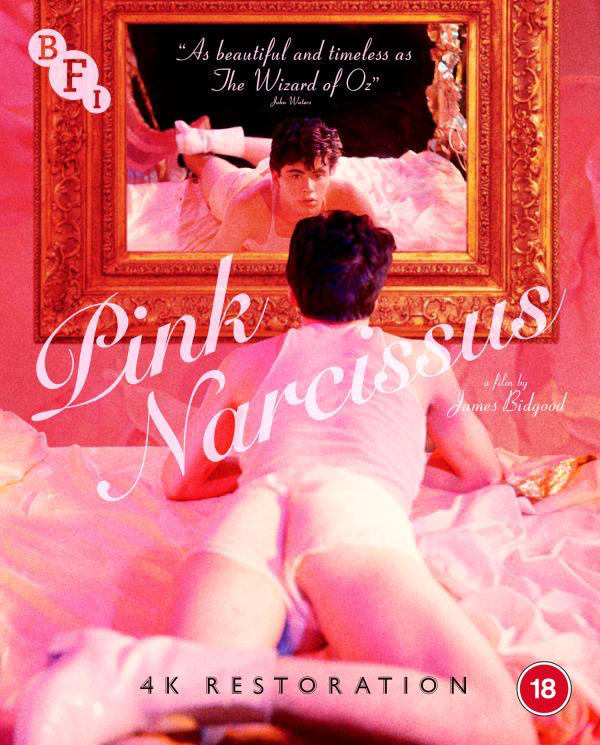
Pink Narcissus
USA 1971 | 65 mins
produced by: James Bidgood [as Anonymous]
written by: James Bidgood [as Anonymous]
cast: Bobby Kendall, Don Brooks, Charles Ludlam [uncredited]
distributor: BFI
release date: 15 June 2026