
Getting it in the neck
How a young boy might react and see the world if his parents and other authority figures fell under alien control is explored with genuine vision and style by director and production designer William Cameron Menzies in his 1953 genre classic INVADERS FROM MARS. A typically late Slarek takes a walk to the sandpit with the BFI’s recently released UHD.
When I was a young lad, there were two types of film that were guaranteed to scare the living piss out of me, but in a way that was, without question, a key factor of my developing love of cinema. The first was the Universal horror cycle of the 1930s, films that I was theoretically shielded from seeing by protective parents who remained blissfully unaware that I was on good enough terms with their regular babysitter to be allowed to stay up late and watch them in their absence. The second was the run of alien invasion and atomic mutation movies from the 1950s, particularly anything set in close to a desert region, or films in which friends and loved ones either fell under the control of aliens or were replaced by alien replicas. These were easier for the pre-teen me to see because my parents did not believe they would be as potentially traumatising as outright horror films, seemingly unaware just how scary the idea of discovering that your mother and father had been replaced by identical looking and sounding creatures of alien origin could be for an insecure pre-teen child. These films may have scared me witless, but I quickly became obsessed with them and would spend hours drawing the alien creatures that we did get to see. A particular favourite was, and remains to this day, Jack Arnold’s 1953 gem It Came from Outer Space, which was scripted by Harry Essex from a short story by the great Ray Bradbury. In it, the citizens of a town on the edge of the Arizona desert are replaced by shape-shifting aliens, a storyline that neatly combined the two things that rattled me most about these movies in a single deeply unsettling but mesmerising package.
Like a good many people of my age, I first saw most of these films for the first time on TV, and in black-and-white even if they were shot in colour because that’s the television we had when I was a kid. Man, typing that really made me feel old. There were a few notable exceptions, which I either missed when they had their TV airing (if indeed they were shown at all), or because my dad, who controlled the only television set in the house, wanted to watch something on another channel when they were broadcast. Years later, just months after I’d left film school with no clue what to do with my diploma, the National Film Theatre (now BFI Southbank) ran a season of 50s American science fiction films, and despite being seriously short of cash, I repeatedly made my way into London to see almost every one of them. How could I not? I was fired up by the chance to see so many of the films that had haunted my childhood and more on the big screen, in their correct aspect ratios and, if that was how they were filmed and first shown, in colour! It’s here that I first saw Edward L. Cahn’s 1958 It! The Terror from Beyond Space in a then rare print that was missing the end of each reel (which included the very end of the film) after Twentieth Century-Fox had allegedly pulled all known prints from circulation in an effort to prevent plot comparisons being made to Ridley Scott’s recently released Alien (1979). It was also my first exposure to William Cameron Menzies’ 1953 alien invasion and takeover gem, Invaders from Mars.
I’m going to make a rash assumption here and speculate that most if not all of you reading this have seen Menzies’ film at least once, and if you haven’t and you have a fondness for 50s American science fiction cinema then I’d quit this review now and go give it a watch, as I’m going to spoil the hell out of the storyline. This will include revealing how the film ends, which is frankly unavoidable if I’m going to talk about why the film’s distinctive and reality-bending visual style works so well in the context of what unfolds, and I absolutely am. If you are new to the film and are planning on purchasing this BFI UHD, I’d also steer clear of the special features until after your first viewing, and that even means also avoiding their titles, a couple of which also assume that you know how the story plays out.
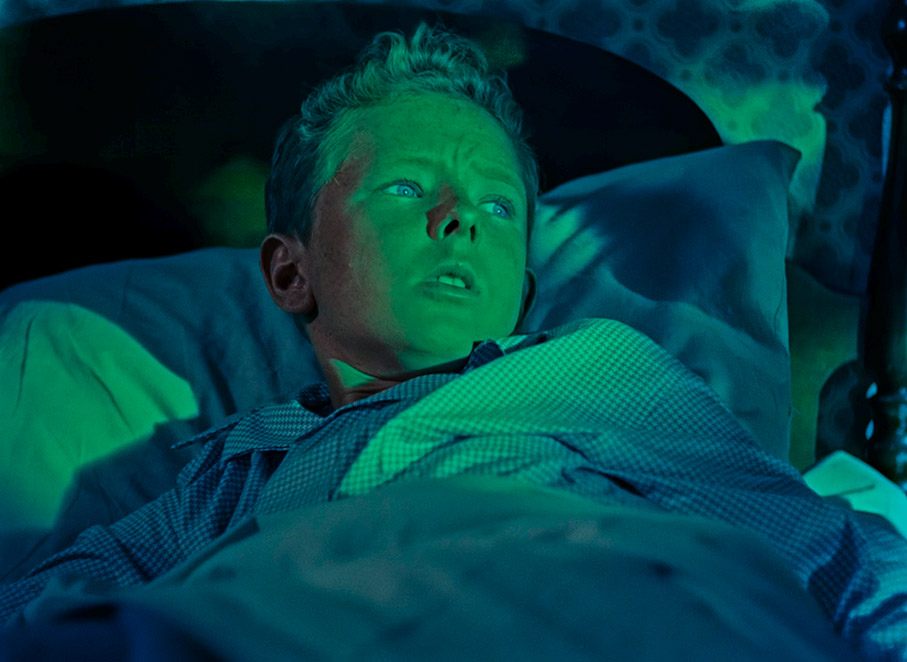
The basic premise will be a familiar one to anyone with even a passing knowledge of 50s science fiction cinema and kicks off in an intriguing and pleasingly economical manner. At 4am one morning, young David MacLean (Jimmy Hunt) is woken by the alarm clock he has set so that he can engage in some time-specific star gazing using the telescope he has fixed to a tripod at his bedroom window. Despite his efforts to stifle it with a pillow, the jangling alarm proves loud enough to wake his parents, and when his father George (Leif Erickson) enters David’s room and finds the boy peering through his telescope at this ungodly hour, clearly not for the first time, their interaction says much about their relationship and shared interest. “Do you know what time it is?” George asks in an only mildly reprimanding tone. “I know,” replies David, “but Orion’s in its zenith and it won’t happen again for six years.” Instead of the expected “that’s all very well but…” response, George gives an enthusiastic “Move over!” and rushes to join his son and marvel at what the night sky has to offer. In the end, it’s David’s patient but level-headed mother Mary (Hillary Brooke) who smilingly brings this activity to a halt and convinces both of these amateur astronomers to go back to bed.
An hour and a half later, a storm is raging outside and David is woken again, this time by a combination of loud thunderclaps and a mysterious light in the sky. When he goes to his bedroom window to investigate, he sees what looks like a flying saucer descend to Earth and disappear behind the hill that sits behind their house, a saucer that we alone then watch bury itself under the sandpit beyond, leaving no trace visible of its arrival. Understandably, David rushes to his parents’ room to tell them what he has seen, but on seeing nothing from David’s bedroom window, George initially assumes that his son has been dreaming, but when he questions him further there’s something about his manner that suggests he may not be completely ready to dismiss the boy’s claims. When he returns to his own bedroom, it becomes evident from the conversation he has with Mary that George works for the government in some secret capacity and that there have been rumours that might give some credence to David’s claims. George thus decides to go out to the sand pit to investigate, and as he approaches, a circle of sand opens up, accompanied by a strange sound, and George mysteriously disappears from view.
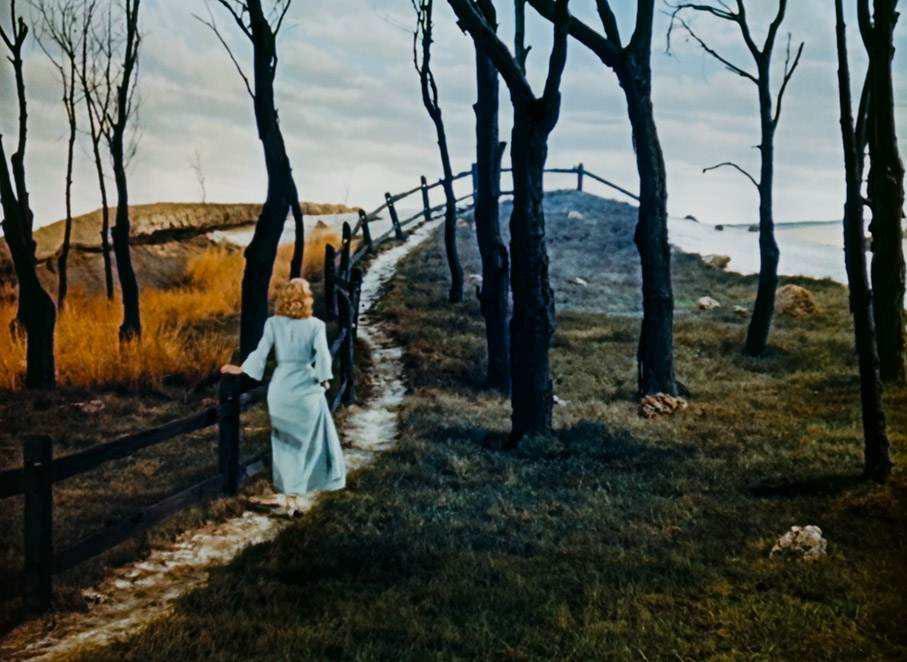
The following morning, George has still not returned home, and Mary thus walks cautiously up the path to the sand pit to investigate, but when the sound from the previous evening reoccurs, she takes fright and hurries straight back to the house. Wisely, she immediately contacts the police to report her husband’s disappearance, and in a nicely written dialogue exchange that also reveals a little more character detail, the two policemen who answer the call – Blaine and Jackson ((Charles Cane and Douglas Kennedy, both uncredited) – try to make light of the affair. “Look, no offence,” Blaine suggests, “but you know how these scientists are sometimes,” to which Mary replies firmly, “My husband is a designer, an engineer, not a comic book professor.” The cops then climb the hill to the sand pit to investigate, and on initially finding nothing are about to turn back when they discover a torch that handily has George’s name printed on it. When they split up to look for further evidence, the sand opens again and Jackson disappears into the resulting hole, followed shortly after by the concerned Blaine. It’s then that George unexpectedly returns home, but he’s not the same man. Gone is the friendly joviality of the previous evening to be replaced by a cold unfriendliness that borders on hostility. When Mary reveals that the police are out looking for him and asks what happened, he growls, “I wish you’d please learn to mind your own business,” and angrily tells David not to start that “flying saucer nonsense” again. It’s then that David spots a small, bloodied scar on the back of his father’s neck. When he asks about it, George claims that he caught it on a barbed wire fence, and when David points out that there are no such fences at the sandpit, the furious Geoge hits him hard enough to send him sprawling. It’s then that Blaine and Jackson return from their search, and it becomes immediately evident that they have been similarly affected and that they also have scars on the back of their necks. In another nice bit of direction, their scars are not shown, but as they stonily converse with George, David quietly shifts position to eye them up from behind and his expression tells us all we need to know.
Invaders from Mars was one of the first science fiction films built around the concept of humans being taken over by visiting or invading aliens, being released in the US just a month before It Came From Outer Space had its premiere and three years before Don Seigel’s masterful Invasion of the Body Snatchers hit cinema screens. Understandably popular in their day, these films have since been famously reinterpreted as socio-politically inspired tales in which the alien takeover of trusted figures and loved ones plays as a metaphor for communist indoctrination at a time when ordinary Americans were being warned that even the most respectable-seeming member of the community could be a communist agent or sympathiser looking to destroy the American way. An alternative reading – one that Jack Arnold favoured for It Came from Outer Space – has communism replaced by McCarthyism at a time when the lives of good and creative people were being destroyed by the House Un-American Activities Committee hearings, and you just never knew who would be willing to shop you for having even once shown sympathy for a left-leaning cause. Today, the subtext has shifted again, as seemingly rational family members, friends and neighbours are sucked down conspiracy theory rabbit holes or surrender any semblance of critical thinking they once had to swallow and regurgitate whichever propagandist lies the political grifter of the hour is able to plant in their heads. That they are often arguing against their own interests without even being consciously aware that they are doing so gives an extra layer of bite to the alien invasion and mind control metaphor.
Whether these subtextual readings registered or not, the 1950s was a time of rampant social and political paranoia that fed into these films and transformed them into potent and unsettling science fiction tales. The sense of isolation that is so essential to all good horror tales is also a key component of these films, as a single individual becomes aware of what is happening and initially struggles to convince others of the legitimacy of their seemingly wild claims. Invaders from Mars scores a home run on this score by making the isolated individual in question a young child. Children lack any sort of societal authority, and parents the world over will have doubtless experienced at least one occasion when they had to humour but ultimate dismiss some of more imaginative claims made by their offspring. That’s certainly the case with David, for whom matters worsen when he sees his young neighbour Kathy (Janine Perreau) disappear into the sandpit. Just as he is frantically telling her understandably concerned mother what he has just witnessed, Kathy returns home, now a coldly inexpressive robot of a girl, save for the bone-chilling smile that crosses her face when her mother scolds David for making up such terrible stories. I like that it is once again inferred rather than openly stated that it was she who set fire to their house just prior to her reappearance.
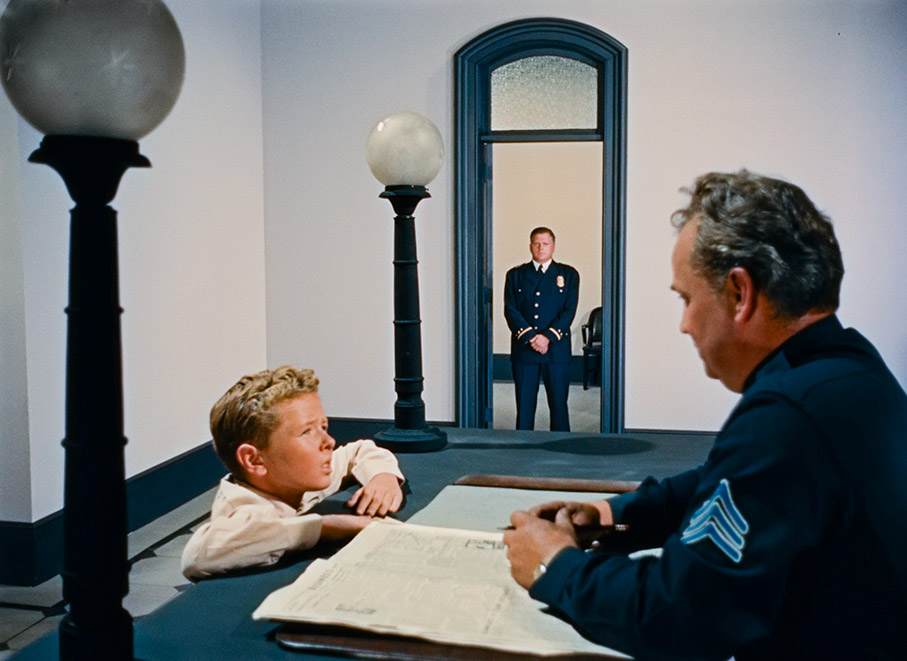
When David tries to report what he has seen to the police, his young age again proves a barrier to belief, and by this point Police Chief Barrows (Bert Freed) has also been transformed (it’s left to us to assume that he was led to the sand pit on a ruse by officers Blaine and Jackson) and orders that the boy be locked up in a cell. Concerned by David’s distressed state, Desk Sergeant Finlay (Walter Sande) asks Health Department psychiatrist Dr. Pat Blake (Helena Carter) to visit the station and talk to the boy. After confirming several details of David’s claims and establishing with his friend, local astronomer Dr. Stuart Kelston (Arthur Franz), that he is not prone to flights of imagination, Dr. Blake starts to believe his story. When his mother shows up at the station to collect him, David is initially unaware that she has also fallen under alien control and seems willing to accompany her home, but when his father also appears, David starts to panic, and the now concerned Dr. Blake responds by insisting that David remain in her care for further evaluation. She takes him to Kelston’s observatory, where the good doctor not only believes all of David’s claims, but makes some remarkably accurate predictions about the nature of the aliens in question. From this point on things move at an improbable speed, and in no time at all the Pentagon has been convinced that there is an alien craft buried in the sandpit and has mobilised enough troops and armaments to invade a small country. All of this plays as if 30 minutes of plot development was crammed into ten for expediency and without a care for the logic of how this would actually play out. Except…
If you haven’t seen the film then this is your last chance to bail, as it’s time to discuss how the film ends and how this changes how the preceding events can, and for my money (and that of several of the contributors to this disc) should, be perceived. As those who have seen the film (at least in its original and now default version) will know, following the perhaps inevitable military defeat of the aliens, David wakes in his bed to discover that this has all been a dream. Comforted by his parents, he returns to his slumber, only to be woken a short while later by the arrival and descent into the sandpit of the very same spaceship from his dream. When I first saw the film, I’m fairly sure a let out a small groan at this, as the “it was all a dream” conclusion was already regarded as the weakest of finale plot-twists, having been the subject of widespread mockery when it was employed in the TV series Dallas to dismiss all of the events in the show’s ninth season as a dream in order to bring a character who was killed at the end of season eight back from the dead. But once you buy into this twist in Invaders from Mars, so much of what has gone before starts to fall more convincingly into place. You can read what you like into the fact that David’s kindly and upbeat parents are transformed into emotionally cold and abusive guardians who plan to do him harm, and it certainly gives a new slant to the kindly Dr. Blake’s decision to take the boy into protective custody. The speed with which Drs. Blake and Kelston believe David’s story and to how simple it proves to be to convince the Pentagon to mobilise the military also feels a lot more plausible when you view these events as the imaginings of a young boy in a dream fed by his daytime experiences, hopes and anxieties. From this viewpoint, it also makes sense that David is the one who realises that aliens have landed and are abducting and transforming those around him, and that late in the story when he and a party of soldiers are trapped in the underground alien caves, he is able to help free them by operating the Martin ray gun to clear a rockfall, casting David as the resourceful hero in a story of his own imagining. That the whole thing then starts playing out for real does initially seemingly cast this dream as a premonition of actual events, but more disturbingly also suggests that he is now trapped in a never-ending nightmare loop of the sort made famous by the brilliant 1945 horror anthology, Dead of Night.
Crucially, the dream narrative also lends logic to Menzies’ consistently extraordinary production design, whose simultaneously expressionistic and surrealistic sets feature doors that are unfeasibly tall, corridors that are impractically lengthy, and single-coloured walls that are often strangely bare, sometimes framed in a manner that recalls the deep perspective surrealist paintings of Georgio De Chirico. Visually and artistically striking, each is shaped as it might be seen through the eyes of a small boy feeling powerless in a world constructed primarily by and for adults who seem like giants to someone of this age, but especially as is David might imagine it as part of the increasingly troubling nightmare in which he is trapped. This explains the long walk from the police station entrance to the isolated reception desk, one that sits high on a podium that towers over young David’s head, or the jail cell that consists of nothing more than a barred room with featureless walls and an unidentified light source that expressionistically bathes the cell interior and its occupant with the shadows if the bars. Intriguingly, only his home (and that of his immediate neighbour, very little of which we see) is shown to be proportionally normal, a place of safety and normality that is completely overturned when his father is transformed into an unfeeling and abusive monster.
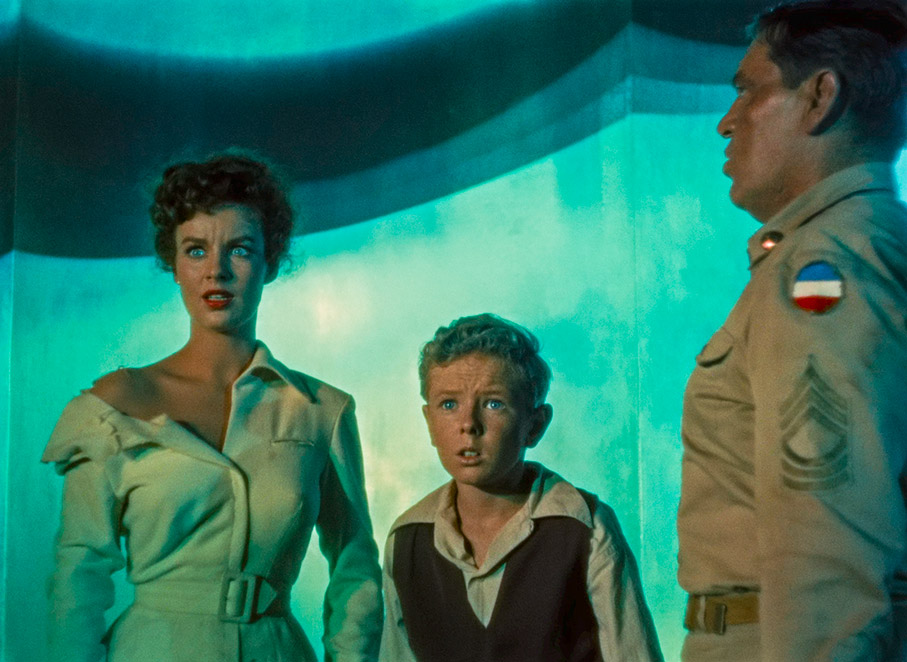
The film is not without its share of small but still notable weaknesses. That the synthetic humans – or mutants (pronounced “mute-ants” here) – who lumber around defending the alien ship and doing the Martin leader’s bidding are obviously just very tall men in slit-eye masks and furry suits is likely to illicit sniggers from some (it certainly did at the aforementioned NFT screening). There’s also the issue of the decision by producer Edward L. Alperson to artificially extend the running time in Menzies’ absence with too much military stock footage and by repeating shots of the mutants running around the caves and firing their rock-melting ray gun, sometimes flopping the image in the hope of making it look a different shot (you’re fooling no-one). Yet even as the early spooky intrigue gives way to military action, Menzies’ vision and imagination continues to shine through. Some today may smile at the sight of the golden headed, torso-less, tentacled and telepathic Martian leader (played by little actor Luce Potter), but I can absolutely guarantee that had I seen this film as a child, I would have been haunted by this creature and would have ended up drawing it repeatedly, much as I did with the aliens in It Came from Outer Space. And the low angle shot looking up at unconscious Dr. Blake through the glass table, on which she is laying face-down as the rotating probe that will drill into the back of her head and plant the Martain control device descends towards her, is one of the most unsettling and memorable in all of 50s science fiction cinema. Kudos also to uncredited score composer Mort Glickman for the eerie single-chord ethereal choir that accompanies the opening and closing of the sandpit traps, which really does feel like something from another world.
As is so often the way with cult genre cinema, Invaders from Mars was remade in 1986 by none other than The Texas Chain Saw Massacre director Tobe Hooper. Co-written by Dan O’Bannon and Don Jakoby, it featured Hunter Carson as David, Timothy Bottoms and Laraine Newman as his parents, and Karen Black as the single sympathetic adult. There’s no question that Hooper brings his own recognisable style to the project, and he does create an effective atmosphere of building dread in the early scenes, even if his film sometimes crudely shouts where the original more effectively whispered. Stan Winston’s alien creature designs are rather fun, and John Dykstra’s visual effects are top notch (the whirlpool of sand that sucks its victims into the caves below is superb), but the simple fact is that when you have film that’s as atmospheric, visually inventive and compellingly handled as Menzies’ original, even a competent remake is going to be viewed in a comparatively negative light. It doesn’t help that Hooper’s take starts to lose its way long before the chaotic and intermittently almost comical finale. Indeed, Menzies’ film is still regarded as a highlight of 50s science fiction cinema and proved to be hugely influential on a whole generation of respected filmmakers. These include such luminaries as Steven Spielberg, George Lucas, John Sayles, Don Coscarelli, John Landis, Joe Dante and Martin Scorsese, the last of whom paid tribute to the film by recreating the fenced sandpit hilltop set for the nostalgically dreamy opening sequence of his 1974 Alice Doesn’t Live Here Anymore. As for me, I still treasure it and remain to this day bowled over by the sheer audacity of Menzies’ production design and how those extraordinary sets are framed and lit by cinematographer John F. Seitz, whose CV includes so many classic titles that it would be hard to to pick just two or three to list as prime examples. My only regret is that I didn’t first see it as a young fan of alien invasion movies, when I have no doubt that it would have both delighted and frightened me in equal measure, and would certainly have convinced me to steer well clear of the sand dunes that I merrily played on during our annual family holidays to the Cornwall seaside.
sound and vision
The transfer on the BFI’s UHD release of the film was sourced from a 4K restoration carried out by Ignite B.V. and Roundabout Entertainment. The accompanying booklet provides the following details about the restoration:
The 4K restoration of Invaders from Mars was undertaken from the best surviving film elements and is presented in its original aspect ratio of 1.37:1.
The original 35mm camera negative preserved at the UCLA Film & Television Archive formed the primary basis of the work, accounting for approximately 65 per cent of the feature. Missing material was sourced from a 35mm SuperCinecolor foreign print held by the National Film and Sound Archive of Australia (NFSA) and a second foreign print from the George Eastman Museum, both exhibiting varying degrees of colour instability and physical wear.
Further sections, particularly unique to the domestic version, were derived from a SuperCinecolor print held by the George Eastman Museum on behalf of a private collector. A 1976 Eastman reissue print, also from the UCLA Film & Television Archive, was consulted only where no superior material survived. All elements were scanned in 4K resolution and subject to stabilisation, dirt and scratch removal, and sympathetic colour grading to achieve a consistent presentation while respecting the limitations of the original materials.
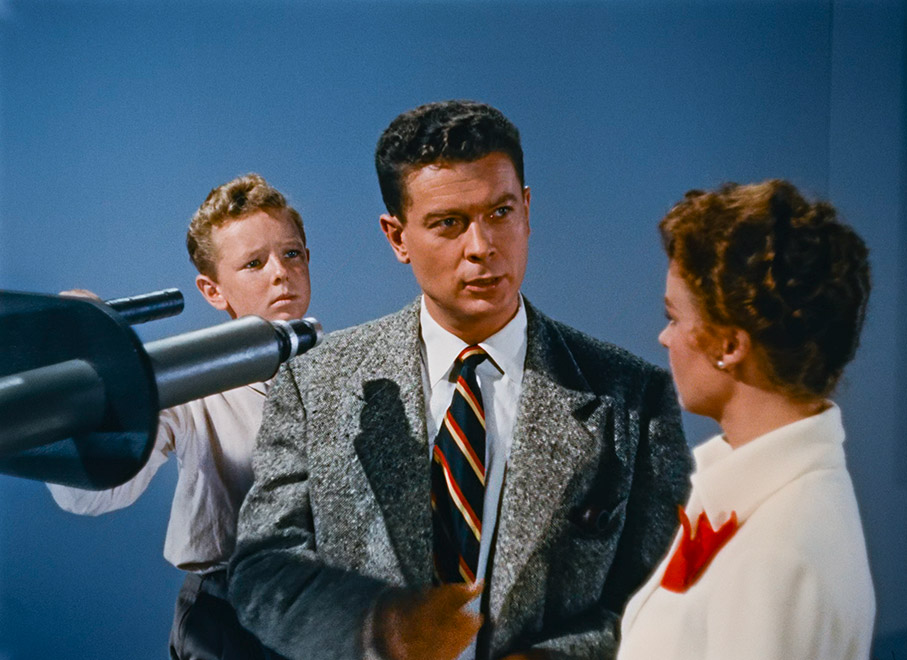
For a long time after my big screen introduction to the film, I had to be content with the VHS recording I made when it was screened on TV before later upgrading to an imported DVD. In both iterations, one thing that always struck me was how unrealistic the film’s colour palette seemed. Indeed, there are times when the image bore a resemblance to those hand-coloured lobby cards for black-and-white movies of old. There was also some fluctuation in the image sharpness, with many shots looking crisp and others looking a little soft. I was initially a little surprised that both of these features are also present on this new 4K transfer, but the clear care and work that has gone into the restoration seems to confirm my long-held suspicion that the almost comic book panel colour palette was part of the film’s original aesthetic, one shaped in part, I suspect, by the then relatively new SuperCinecolor process in which it was filmed. The fact that some shots are still visibly softer than others may well be down to the material used for this restoration being drawn from five different sources, but again this may well have been a feature of the film all along. I can’t say for sure, but I’m guessing that the best material was primarily sourced from the original 35mm camera negative, and this looks really good, with sharply rendered detail, bold presentation of colour, and a visible fine film grain. Surprisingly, there is no Dolby Vision HDR, but the contrast is very nicely graded nonetheless, and the image is clean of dust and obvious signs of any former wear. It’s without question the best I’ve ever seen the film look, at least since that first NFT screening, and all these years later I can’t remember a thing about the condition of the film print that was projected.
The soundtrack was restored, we are informed, from the best available optical sources and is presented here in its original mono configuration as a Linear PCM 1.0 track. The inevitable, age-related restrictions to the tonal range aside, it’s in fine shape, with no signs of serious wear, and clear presentation of the dialogue and that eerie alien choir.
Optional English subtitles for the hearing impaired have been included.
special features
Audio commentary by film historians Kim Newman and Barry Forshaw
Two of my favourite genre film commentators explore what makes Invaders from Mars unique even within the realms of body-snatch science fiction cinema of the 1950s. They note the film’s influence on a later generation of directors, discuss its distinctive visual style and how it tells its dreamlike story from a child’s point of view, and opine that a central message of the film is that you should not trust authority figures, particularly your parents or the police. Details are provided on a few of the actors and director and production designer William Cameron Menzies, there is some discussion about Tobe Hooper’s 1986 remake, and the two make a persuasive case for the carefully composed artificiality of Menzies’ approach making complete sense in light of the film’s final scene, a point on which we are in absolute agreement. There’s plenty more of real interest here.
Not Just a Dream: Designing Hope in Invaders From Mars (15:49)
A video essay by filmmaker Nic Wassell that examines what he nicely describes as “a complete symbiosis between camera and set design,” intriguingly and perceptively deconstructing individual scenes and even specific shots. He points out that Menzies repeatedly breaks the 180º rule – something I was surprised that I had not picked up on – highlights the expressionist and surrealist elements, and suggests that this is a film about hope rather than fear, hence the title of this piece.
A quick note from a place of petty personal prejudice about the next set of special features. All of the following interviews, plus the restoration featurette, have the Ignite Films stamp on them and were all produced specifically by the Ignite for its 2023 US UHD release. When it comes to the interviews, I have no problem whatsoever with the content, which is consistently engaging and often informative, or the camerawork and lighting, which is top class, but as someone who has a real bug up his arse about the recent trend for filming interviews from two completely different angles and cutting randomly between them, to have interviews shot from threedifferent angles for no logical reason did wind me up a bit. The pain is eased somewhat by its relatively limited use and not the fact that the editor does not bounce between the angles in an overly distracting way.
William Cameron Menzies: Architect of Dreams (16:26)
William Cameron Menzies biographer James Curtis provides details of Menzies’ early life and film career as a production designer, which peaked with his Academy Award-winning work on Gone with the Wind, which apparently was the film for which the term “production designer” was first coined. He talks about the development of Invaders from Mars, the film’s use of colour, the disappearance of Menzies’ apparently meticulous storyboards just before filming began, and his final feature, Around the World in 80 Days (1956). The text that is displayed when you select this feature describes it thus: “William Cameron Menzies’ biographer, James Curtis, interviews Menzies’ eldest granddaughter, Pamela Lawson”, but Curtis talks as if being interviewed himself for 13 minutes straight before Lawson makes an appearance, and two minutes later she’s gone. Brief though it is, her contribution is still worth hearing.
Jimmy Hunt Saves the Planet (10:30)
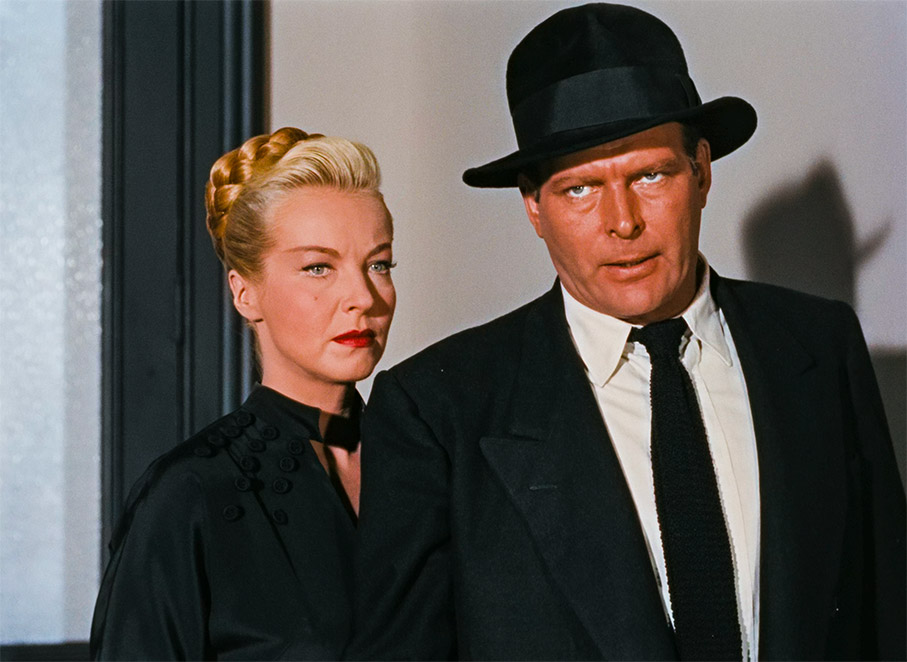
Former child actor Jimmy Hunt, who plays David in Invaders from Mars, is interviewed against the exact same background as James Curtis in the preceding special feature, again with the three camera setup that sets my teeth on edge. It’s nonetheless worth tolerating this for the content, as the cheerful Hunt has plenty of engaging memories of the shoot. These include being accidentally hit by Leif Erickson after missing his mark, the news that Luce Potter – who plays the Martin leader – went to school with his mother, and that actor Billy Curtis – he of Alfred Hitchcock’s Saboteur (1942), Clint Eastwood’s High Plains Drifter (1973) and many others – stood in for him whilst Menzies was setting up shots.
Terror From Above (22:23)
Directors John Landis and Joe Dante, editor Mark Goldblatt, visual effect artist Robert Skotak, and film preservationist Scott MacQueen recall their first viewing of Invaders from Mars and the impact it had on them in their youth, and explore what makes this particular film stand out from the 50s science fiction crowd. That the film was designed to have the look of a child’s nightmare combined with the panels of a comic book is discussed, as is the communist and atomic age paranoia subtext and the use of stock footage and repeated shots to expand the movie in Menzies’ later absence. Some useful information about the production is delivered here, and several interesting and pertinent points are made, including the observation that the sound made by the spaceship has been changed for its end-of-film reappearance (I hadn’t noticed this), and that the idea of being pulled underground in the sand pit was, for a young Catholic boy, akin to being dragged into hell.
Restoring the Invasion (6:49)
A member of the restoration team outlines, through voice-over, the challenges he and his colleagues faced when restoring Invaders from Mars and how they overcame them, with before and after comparisons of individual sequences, which includes the later added observatory scene detailed below. Always a useful special feature, even if some of the worst ‘before’ examples are weaker than any print I’ve previously watched of the film, though I do appreciate that the examples here are in their raw scanned state before any grading has been applied.
European Ending (2:52)
An alternative ending used on European prints of the film that alters the editing of the climax, reverses a recycled shot from the opening scene, dispenses with the whole “it was just a dream” twist, and effectively casts Pat and Stuart as Jimmy’s substitute parents.
Original theatrical trailer (2:19)
The original trailer is in such sparkling shape – included pin-sharp and boldly coloured textual graphics – that I did wonder if this was a reconstruction of that trailer using shots from the restoration of the film and newly struck graphics. Love the over-the-top carnival barker narration.
Re-release trailer (2:18)
The very same re-release trailer that plays in full in the Ernest Dickerson introduction detailed above, which does make this standalone inclusion feel just a little redundant.
TCM Festival Introduction (7:01)
Filmmaker John Sayles, for whom I have the utmost respect, provides an engaging appreciation of Invaders from Mars to accompany its screening at the Turner Classic Movie Festival in Hollywood. There’s no on-screen indication of the year that this took place, but the request from the host that audience members only remove their masks to eat gave me a fair idea of when this was shot even before I read in the booklet that it was 2022, the same year that the other Ignite special features were filmed.
Ernest Dickerson on Invaders From Mars (4:35)
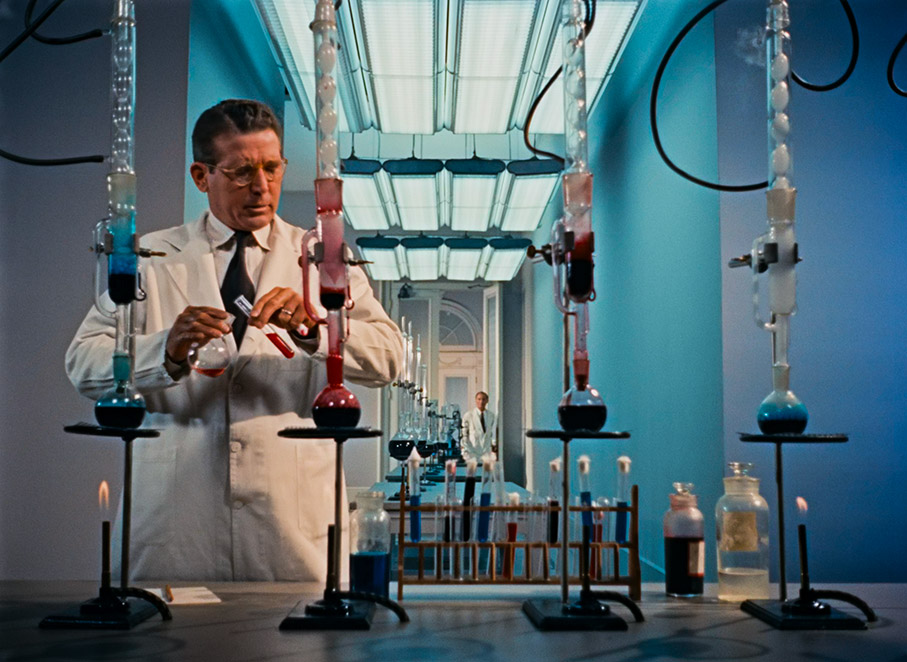
Filmmaker Ernest Dickerson provides an enthusiastic introduction to the psychedelic and sinisterly scored and edited re-release trailer for the film, which then plays out in full.
European Observatory Sequence (8:51)
Filmed six months after the film first opened and a year after production closed, this extra scene was shot at the request of foreign distributors to further lengthen the running time. It was in KTTV Studios in Hollywood on 2 September 1953 in the manner of a TV show, with none of Menzies’ eye for camera placement and design, and edited to disguise the fact that this extra eight minutes consists of just 15 long camera lakes. The textual introduction from which I gleaned that information also lists several visible continuity errors, which include, most obviously, the fact that David’s hair is noticeably shorter. Interesting for its attempt to legitimise the notion of UFO sightings, it’s visually artless and does go on for long enough to feel like the padding it is, and is bookended by shots from the original cut of the film to indicate where it was located.
Image Gallery (6:01)
A rolling image gallery consisting of often immaculate quality promotional photos (including some posed portraits), posters, and press book pages, the text of which is pin-sharp in 4K, plus a comic book rendition of the film that appears to have been part of that press kit. I want this.
Booklet
The lead essay here is by Dr Deborah Allison, senior programmer and head of independent exhibitor services at Picturehouse Cinemas, and an associate research fellow at De Montfort University’s Cinema and Television History Research Centre. Rather than analysing the film and deconstructing specific scenes, Allison focusses on the writing, production, release and critical reception of the film, as well as the political situation that helped to give it birth and does so in most engaging and educational manner. Every bit as entertaining and informative is the essay that follows by Barry Forshaw, who also accompanies Kim Newman on the commentary track detailed above and is author of the BFI book The War of the Worlds. Here he examines the rise of the 1950s alien invasion movie, highlighting key works and exploring their various socio-political subtexts. How it cheered me to read him champion Gene Fowler Jr’s 1958 I Married a Monster From Outer Space, which scared me silly as a kid and was one of the films that prompted me to fall in love with these movies in the first place. Full credits for Invaders from Mars (as ever minus the year of production and running time) are provided, as is a brief review from the November 1954 issue of Monthly Film Bulletin, one that lightly mocks aspects of the film whist grudgingly accepting that it will likely please its target audience. Key credits for all of the special features (where the year and country of production and running time are included) are followed by the above-quoted details about the restoration.
final thoughts
A personal favourite from a period in which paranoia-inspired American science fiction cinema was at its peak gets a hugely impressive UHD release by the BFI. A strong restoration and transfer and a very fine collection of special features – some new, some licenced from Ignite – that cover just about all the hoped for bases make this a must-have for fans of the film and this beloved subset of the genre.
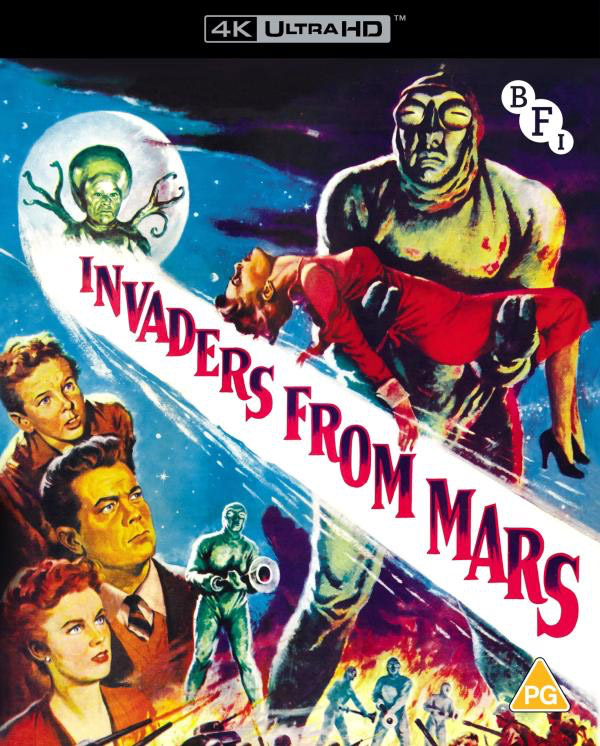
Invaders from Mars
US 1953 | 78 mins
directed by: William Cameron Menzies
written by: Richard Blake; John Tucker Battle (story, uncredited)
cast: Helena Carter, Arthur Franz, Jimmy Hunt, Leif Erickson, Hillary Brooke, Morris Ankrum
distributor: BFI
release date: 11 May 2026