
Red Beard [Akahige]
Akira Kurosawa’s RED BEARD [AKAHIGE], his final film with Toshirō Mifune, comes to Blu-ray from the BFI. Gary Couzens goes to see the doctor.
In nineteenth-century Japan, a young ambitious doctor, Yasumoto (Yūzō Kayama), is taken on by an the older Dr Kyojō Niide (Toshirō Mifune) who is nicknamed “Red Beard” because of the colour of his hair. (Yes, in a black and white film.) At first Yasumoto resents being stuck in a small charity clinic in a poor region of Japan, but under Niide’s guidance he learns the value of his work.
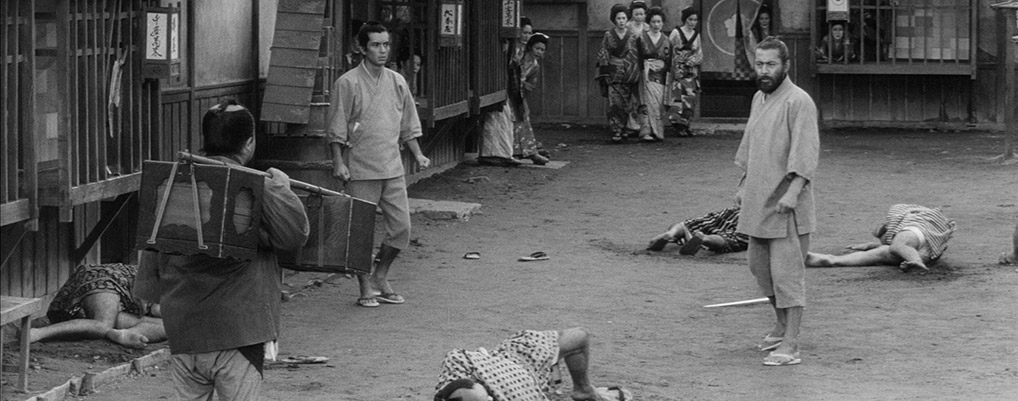
Red Beard (Akahige), released in 1965, was Akira Kurosawa’s twenty-fourth film as director. The director saw it as the culmination of his work so far, but with hindsight it began the most significant hiatus in his career. In its setting (the Edo period, 1820s) it is something of a halfway house between the samurai films Kurosawa is generally most celebrated for (particularly Seven Samurai (Shichinin no samurai, 1954)) and his contemporary-set films (such as Ikiru, 1952). At 185 minutes including an intermission, it is Kurosawa’s longest film other than the 207-minute Seven Samurai. Red Beard was at the time the most expensive film produced in Japan, taking two years to make. The village was a giant set constructed for the film. The result is an engrossing, though certainly overlong, film that is surprising in quite a few ways.
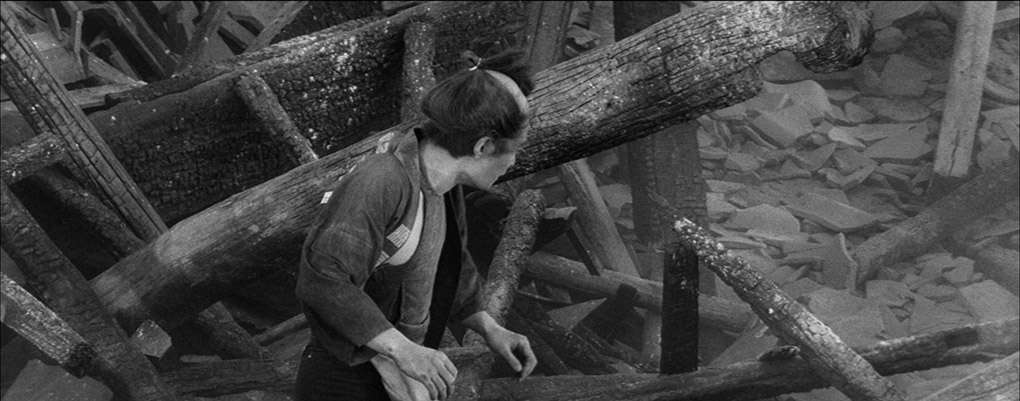
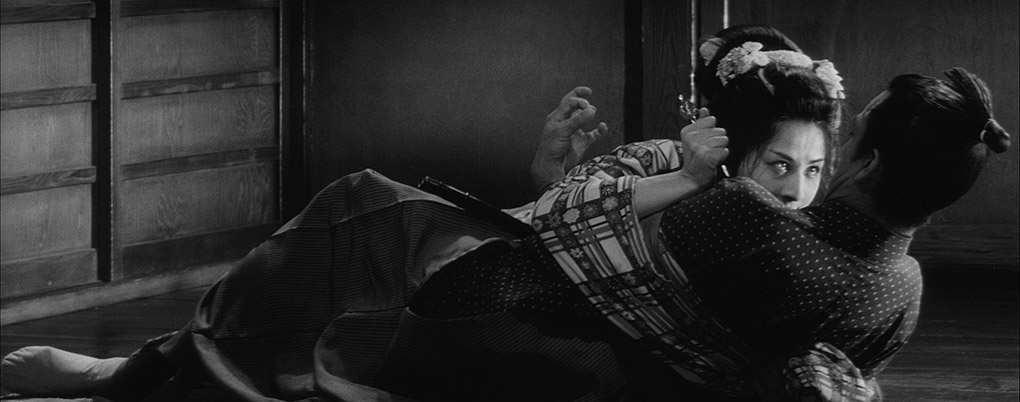
With a screenplay by Masato Ide, Hideo Oguni, Ryūzō Kikushima and Kurosawa, Red Beard is based on the 1958 novel The Tales of Doctor Redbeard (Akahige Shinryōtan) by Shūgorō Yamamoto, whose work had been the source of Kurosawa’s earlier Sanjuro (1962) and later Dodes’ka-den (Dodesukaden, 1970). The film follows the novel in devolving into a series of episodes centring on particular patients at the clinic, as Yasumoto, trained at the medical school in Nagasaki and aspiring to the position of the personal physician of the Shogunate, is at first resentful of being posted to this rural backwater, Niide’s clinic. Over the course of the film, in his interactions with the men and women of the village, he matures and comes to realise the suffering that surrounds him and his ability to treat it. One patient is “The Mantis” (Kyōko Kagawa), a woman locked away, with only Niide allowed to treat her, and believed to be mad. Her story reveals depths of abuse, sexual included. Another is a dying man, Rokusuke (Kamitari Fujiwara), who has a secret regret. Sahachi (Tsutomo Yamazaki) tells him a story of his dead wife, with his memories of an earthquake – and later, her memories to him of the same earthquake, so enabling a flashback inside a flashback. There is also Otoyo (Terumi Niki), a twelve-year-old girl sold to a brothel.
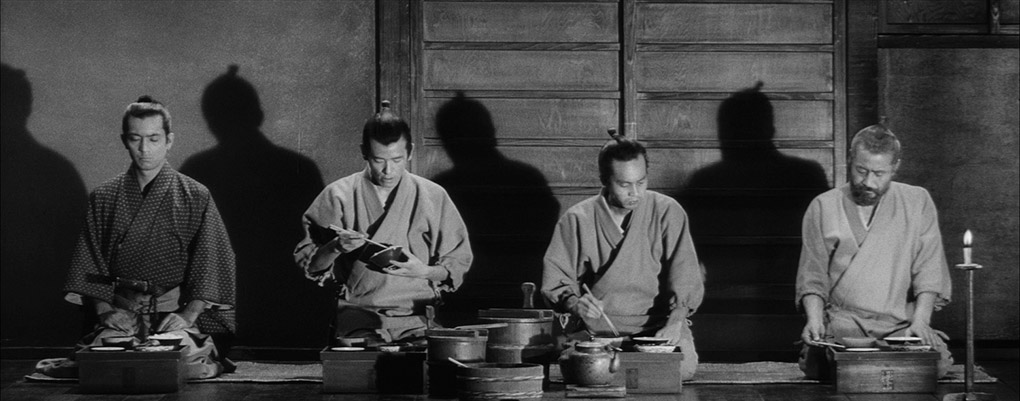
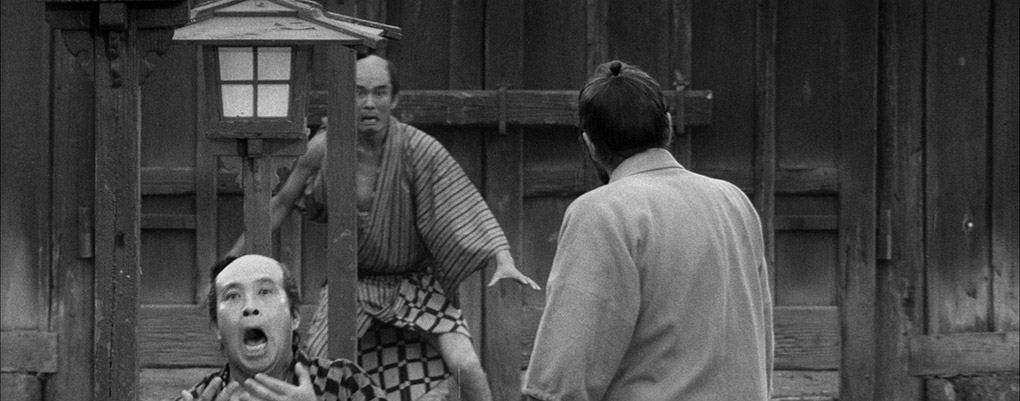
The film graced by a dynamic performance from Mifune, in his last film for the director. Heavy-set and bearded, his hair in a top-knot, he’s often still, but when the role calls for it, he’s light on a feet, especially in a brutal fight sequence (complete with bone-crunching sound effects) just before the intermission. Kurosawa’s direction uses many of the techniques he had developed over the years, with some scenes shot in long takes and edited together from the input of multiple cameras. Filmed in black and white Scope, Red Beard does give a strong picture of its place and time. Kurosawa makes full use of the wide screen, including many shots with three or even four characters side by side across the width of the frame. Panning and scanning this film would be not only be ruinous but likely to make parts of the film incomprehensible, but that’s how people might well have seen this film on television.
For 1965, some of the film’s content is unusually tough. We have an operation scene (with the patient, female, fleetingly nude) which results in Yasumoto fainting. This is also one of the earliest films I know of to deal with the subject of child sexual abuse. (Another was Samuel Fuller’s The Naked Kiss, which the then British Board of Film Censors (BBFC) rejected outright in 1964 and which still bears an 18 certificate.) And, although we’re a long way away from his samurai films, that fight sequence is notably violent.
Red Beard opened in Japan on 3 April 1965 as a roadshow presentation, no doubt with the four-track magnetic stereo soundtrack which had been recorded for it. It went on general release on 24 April. The film played in competition at the Venice Film Festival in August/September that year, with Mifune winning Best Actor and the film the OCIC Prize. The winner of the Golden Lion was Luchino Visconti’s Sandra (Vaghe stelle dell’orsa, also known as in English as Of a Thousand Delights). Red Beard also won the Golden Spike at Valladolid in 1967 and was a nominee for the Golden Globe Award for Best Foreign-Language Film (the winner being Fellini’s Juliet of the Spirits, which had also been in competition at Venice). The film was a considerable success in Japan, but less so elsewhere. It had a somewhat mixed reception when it opened in the UK on 1 December 1968. David Watkins in the Monthly Film Bulletin (January 1969) described it as monumental, but Penelope Houston in The Observer (17 November 1968) called it “a kind of Japanese intellectual’s ‘Emergency Ward 10’” and concluded that “Impressive though this might often be I do not find it actually endearing”.
With hindsight, Red Beard marks an end point in Kurosawa’s directing career in several ways. It was his last collaboration with Toshirō Mifune and score composer Masaru Sato. Red Beard was his final film (of six) shot in Scope with anamorphic lenses, with later films shot with spherical lenses and no wider than 1.85:1 except the Soviet-made Dersu Uzala (1975), shot in 70mm at a ratio of 2.20:1. It was also Kurosawa’s final film in black and white. Other major Japanese directors had made films in colour in the previous decade (Mizoguchi beginning in 1955 with Princess Yang Kwei Fei (Yōkihi), Ozu with Equinox Flower (Higanbana) and Naruse with Summer Clouds (Iwashigumo), both in 1958) but apart from the two shots of pink spot-colour smoke in High and Low, Kurosawa had continued to favour black and white. In 1965 monochrome was soon to become obsolete in Western commercial cinema, and no doubt in Japan too, and even international auteurs had to get with the programme. Kurosawa’s next film, Dodes’ka-den, was his first in colour throughout. But a more important endpoint was the fact that Kurosawa had made twenty-four films in twenty-two years, and had worked as an assistant director for seven years before that. But he would not make another film for five years and would only make seven from 1970 to 1993. During that hiatus, he was fired from the multinational film about Pearl Harbor, Tora! Tora! Tora! (1970), for which he would have directed the Japanese sequences. After Dodes’ka-den, Kurosawa co-directed a documentary for television, Song of the Horse (Uma no uta, 1970) and in 1971 made an unsuccessful suicide attempt.
Red Beard had UK television showings of 2 December 1998 and 11 March 1999, both on the Film Four channel, though I don’t know if either broadcast was widescreen or panned and scanned. It had a cinema reissue in 2002 and a DVD release in 2003 from the British Film Institute, who have now upgraded it to Blu-ray.
sound and vision
Red Beard is released by the BFI on Blu-ray, the disc encoded for Region B only. The film was passed uncut with an X certificate (then, sixteen and over) by the then British Board of Film Censors in 1968 for cinema release and for its cinema reissue and for homeviewing it became a 15. I can’t see that Mother or District Nurse were ever certified by the BBFC, but as they are documentaries with nothing likely to trouble a U or PG certificate, they have been exempted for classification on this disc. The transfer begins with an advisory from the BFI: “contains scenes of domestic violence or abuse, harm towards children, suicide and theme of sexual violence”, which is a more specific list of potential issues than the BBFC’s “some strong violence”.
The film was shot in black-and-white 35mm with anamorphic lenses. The transfer, based on Toho’s 2K restoration, is in the aspect ratio of 2.55:1. That was the original ratio of CinemaScope just over a decade earlier, which had been then released with magnetic soundtracks. A few years later, CinemaScope became 2.35:1 with an optical soundtrack, and that was the basis of other Scope processes like Panavision. As Red Beard was released with a magnetic stereo soundtrack (in showcase venues at least) this may explain the wider ratio, though most people would have seen the film with an optical mono soundtrack. The transfer looks good, with blacks, whites and greys seemingly as they should be – there’s more greyscale in this film than very black blacks or white whites. The transfer includes the intermission (the only Kurosawa film to have one built in, other than Seven Samurai) which begins at the start of chapter nine at 111:42 and continues with music over a black screen until 117:05. If you want to skip past this, you’ll have to use the fast-forward on your remote, as the second part of the film still begins within chapter nine. After the end title fades, there are fifty-three seconds of music playout over another black screen until the copyright notice appears at the very end.
As mentioned above, Red Beard was first released with a four-track magnetic stereo soundtrack, a left-centre-right-surround configuration. (I haven’t been able to determine if the film was ever shown in stereo in the UK, but I suspect it wasn’t. The main London venue on its first release was the Essoldo in London SW3, which is now the Everyman Chelsea.) This is rendered on this disc in DTS-HD MA 5.1 or LPCM 2.0. In practice, much of the film is monophonic with some separation in Masaru Sato’s score and some directional effects especially in the earthquake scene. English subtitles are available, on as default but optional if your Japanese is good enough, on the feature and the It Is Wonderful to Create featurette.
special features
Commentary by Kenta McGrath
Newly recorded for this release is a full-length commentary by Japanese/Australian critic and filmmaker Kenta McGrath. This is a long film, but McGrath fills the time admirably. This is mostly a scene-specific commentary, with much less on the film’s production and reception, but doesn’t fall into the trap of simply describing what we can quite easily see on screen. McGrath does give some details of the original novel and how it differs from the film. He does talk about how the film’s themes tie in with other work by Kurosawa, for example that of a young greenhorn mentored by an older figure, here respectively Yasumoto and Niide. McGrath discusses various techniques Kurosawa uses in Red Beard: the extensive deployment of long (telephoto) lenses, which flatten perspective – making the parting scene on the bridge longer, for example – while also maintaining deep focus in many scenes. Also, the use of voiceover (sparing) and flashback, the filming of several scenes in lengthy takes edited together from the input of multiple cameras (done in some scenes of High and Low, for example), and the use of “catch-light”, giving someone’s eyes a glow from reflecting light into their eyes, requiring the actor not to move. (There are good examples of that in Ikiru, when Watanabe almost literally sees the light.) Kurosawa gave score composer Masaru Sato a copy of Beethoven’s Ninth, giving him the hard task of emulating the great man in his own score. McGrath even spends half of the intermission talking about intermissions, taking a break for the rest of time until the second part of the film starts.
Akira Kurosawa: It is Wonderful to Create – Red Beard (22:05)
Another of the featurettes made by Toho in 2002, deepish dives on each one of the features Kurosawa made for the company, including contributions from the man himself as well as cast and crew members who were still alive at the time. All contributions are in Japanese, naturally, and a slight issue is that interviewees are identified by Japanese captions, they aren’t subtitled into English, though they would be simultaneous with the subtitles translating the words they speak. Some of this is covered by McGrath’s commentary and other extras, such as the elaborate (and expensive) set design and the use of catch-light, but there is useful information to be had.
Introduction by Alex Cox (14:14)
This introduction by Alex Cox, from 2003 and included on the BFI’s then DVD release. follows the form of other such featurettes on BFI discs on other Kurosawa films. The first nine minutes is the same in all of them, with Cox providing an overview of Kurosawa’s life and career from start to end. Then he talks specifically about Red Beard, its production and style – and it’s more faithful to its source text than Kurosawa was in Sanjuro, for example. Cox does make a few comments on what he sees as inherent sexism in the film, but also commends Kurosawa for his choreography of the fight scene – something he himself tried to emulate and found distinctly difficult.
Toshirō Mifune in Conversation (60:52)
From 1986, Mifune is interviewed at the then National Film Theatre in London as part of the venue’s series of interviews sponsored by the Guardian newspaper, our host being critic David Shipman. Mifune talks through an interpreter; early on, she asks if the microphone is working. Shipman comments that Mifune is rather smaller in person than he seems on screen (he was actually 5’ 8½”). Mifune says that he is “just an ordinary person, not a giant” and Shipman commends him for his modesty. We have an account of Mifune’s early years, including his World War II service, and his accidental entry into the film industry. He didn’t like his early performances, finding them too “full-blooded”. He has no preference for historical subjects like Red Beard over contemporary ones, taking what he was given. He made 130 films over some forty years, including fifteen with Kurosawa, and he talks about their parting of the ways, in part due to Mifune moving into production and having other business interests. Shipman talks about questions from the audience, but we don’t hear any, and Mifune ends with the one English phrase he knows: “Thank you very much”. This plays as an alternate audio track over the feature, with the film soundtrack taking over after it ends.
Theatrical trailer (3:52)
A lengthy trailer which shows us extracts from the film a section at a time, and also includes shots of the orchestra recording the score.
Treasures from the BFI National Archive (44:31)
As so often on a BFI release, we have extras derived from their archive holdings, not specific to the film at hand but picking up on some of its themes, in this case the medical aspects. They are under a sub menu and there is a Play All option.
Mother (16:02)
From 1947, and shot in India by director Paul Zils, Mother follows a social worker bringing ideas of modern childbirth to a rural village. The voiceover describes India as a peasant country with eighty percent of the population living in (then) some 700,000 villages. Devi has been trained in new ways, sometimes as basic as clothing babies in clean nappies rather than rags. “Strong babies, like good crops, are the product of knowledge, hard work and care.” That’s not the only rather platitudinous comment we hear, as another is “Ideas, like crops, have their harvest time, but a good harvest means that difficulties have been met and overcome.” And we end with “Just as a good monsoon spreads its benediction over the thirsty land, so good ideas must be spread to minds made receptive through proof of their goodness.”Doctor’s Dilemma (1:06)
A short public information intended to prepare people for Monday 5 July 1948 and the launch of the UK’s National Health Service. We need to do our part and to sign up with a NHS doctor’s practice.District Nurse (27:22)
Made in 1952, four years after the foundation of the NHS, this short film begins by saying that the presence of the Health Service, funded by taxes and free to all at the point of entry, has eased many people’s anxieties over their health. Some 10,000 district nurses were now part of the NHS and this film follows two of them, Jane Simmons and Mary Jones, as they do their rounds in a community of some 4000 people. Mrs Davies is expecting her sixth child and she and her husband are looking to move into a new low-rent house for the space. The nurses, who have delivered ten babies over the last six months, assist with her home birth. Another visit is to a ninety-year-old man who is unable to walk and is bedridden. He is helped with washing though, when the nurse is called away, before returning later she leaves him with a pipe, no doubt not approved practice nowadays. This film was directed by Indian-born Sarah Erulkar, who had an extensive career in documentary (and one feature drama, the Children’s Film Foundation production The Hunch from 1971). She started at the Shell Film Unit, and District Nurse was her first film after leaving and going freelance. For more about Erulkar, see the BFI’s DVD release The Camera is Ours: Britain’s Women Documentary Makers, which features another of her films and an interview with her.
Booklet
The BFI’s booklet, available with the first pressing of this release, runs to twenty-eight pages plus covers. Following a spoiler warning, it begins with “Cold Hands, Warm Heart” by Hayley Scanlon. Her piece begins the way the film does, with Yasumoto being introduced to the Koshikawa clinic as a build-up to the introduction of Red Beard himself. Scanlon sees him as a possible analogue of Kurosawa, who was known to be dictatorial on set. For an overview essay, there is little about the film’s production and reception but is an analysis of the film’s themes, as evidenced by each of the patients we see.
“Masuru and Akira: The Music of Masterpieces” by Charlie Brigden approaches the subject from another angle, namely the collaboration between the director and his regular composer Masaru Sato, who also scored several Godzilla films for Toho, beginning with the second, Godzilla Raids Again (1955). Sato was an admirer of Fumio Hayasaka, who had worked with Kurosawa, including on Rashōmon (1950). Sato saw Hayasaka as a mentor and took over from him when he died during Kurosawa’s I Live in Fear (1955). Sato scored eight more films for Kurosawa, of which Red Beard was the last, often melding Western influences, such as jazz, with Eastern ones. Kurosawa required him to take note of the last movement of Beethoven’s Ninth Symphony in his score for Red Beard. Brigden suggests that Kurosawa might have preferred to use existing pieces (rather like Stanley Kubrick did in 2001: A Space Odyssey) but was unable to do so for copyright and budget reasons, hence the use of composed scores. Sato and Kurosawa did not work together again after Red Beard, though Kurosawa approached him for Kagemusha (1980) but Sato declined. Sato’s final film was After the Rain in 1999, the year he died, from a script by Kurosawa, who had passed the year before.
“Kayama Yuzo: A National Superstar” by James-Masaki Ryan is a look at the life and career of the film’s second lead. He had become a big name in Japan earlier in the decade, with his lead role in Young Ace in College (Daigaku no wakadaisho, 1961), including singing the title song and so becoming a pop star as well. Red Beard sees him in a rather different role. 1965 was a big year for him, with another hit film in Electric Young Ace (Ereki no wakadaisho), a big hit with that film’s title song, and a meeting on that film with the woman who became his wife. Kayama was less successful in the 1970s, with the end of his Wakadaisho film series and financial problems. Still alive as I write this at age eighty-nine, he is retired from acting and singing, but made an appearance in 2025 at a tribute concert for his friend, the late musician Shinji Tanimura.
As well as a cast and crew listing, there are credits for the special features, though no notes on the short films. However, there is another piece, “Medical Professions on Screen: Post-War Public Information Films” by Yuriko Hamaguchi. As this piece is in the booklet for a Kurosawa film, it begins by pointing out how many of the man’s films centre on doctors, Red Beard included. Then Hamaguchi goes on to the three short films on this disc, with the films made by the Central Office of Information, which included those on medical subjects. Then, with the founding of the NHS, we have Doctor’s Dilemma and the need to register with a GP under the new system. Then on to District Nurse, made by the COI for the Foreign Office, intended to encourage recruitment of nurses from the Commonwealth, though the two nurses we see are clearly English. And then to Mother, which is compared to Red Beard in that it shows someone trying to bring modern medical techniques to play in a rural area.
final thoughts
Red Beard has an expansive, epic feel to it, despite the smaller-scale subject matter, and it holds the interest well despite the three-hour length. It’s unlikely to be thought one of Kurosawa’s very greatest films but it’s a considerable one, and is well presented by the BFI on Blu-ray.
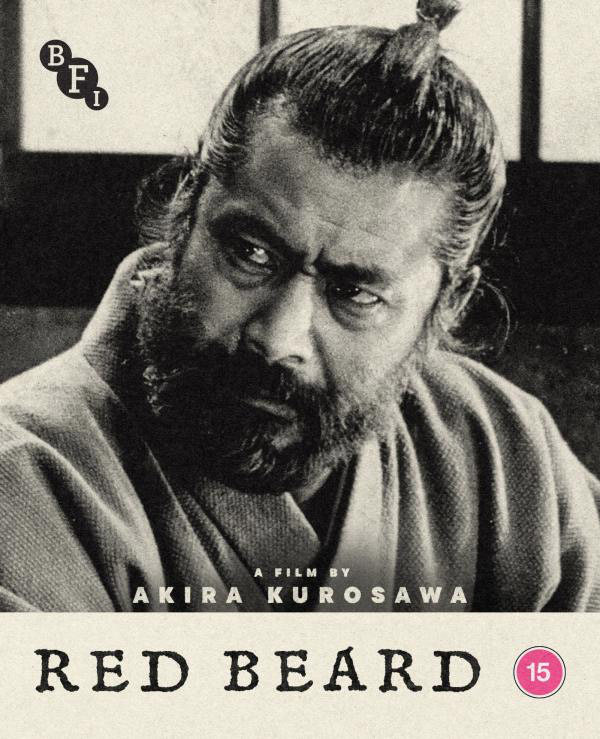
Red Beard [Akahige]
Japan 1965 | 185 mins
directed by: Akira Kurosawa
written by: Masato Ide, Hideo Oguni, Ryuzo Kikushima, Akira Kurosawa; Shugoro Yamamoto (original story)
cast: Toshirō Mifune, Yūzō Kayama, Tsutomu Yamazaki, Reiko Dan, Miyuki Kuwano, Kyōko Kagawa
distributor: BFI
release date: 11 May 2026