
The Chronology of Water
Kristen Stewart’s feature directing debut, THE CHRONOLOGY OF WATER, a memoir of trauma and healing, is released on Blu-ray by the BFI. Review by Gary Couzens.
The Chronology of Water is based on fact, specifically the memoir of its central character. It’s a film very hard to discuss without spoilers, though I have kept these to a minimum.
“I thought about starting at the beginning. But that’s not how I remember it. It’s all a series of…fragments. Repetitions. Pattern formations. When there are no words for the pain, let your imagination change what you know.”
With this voiceover, The Chronology of Water sets out its stall from the outset. Directed and with a screenplay by Kristen Stewart, her feature-film debut in both capacities, the film is adapted from the memoir by Lidia Yuknavitch (played onscreen by Imogen Poots), which was published in 2011. While the film’s trajectory is roughly chronological, the film is fragmented, cutting back and forth in time, as Lidia’s past and her memories bear on her present. And that past was one of abuse, at the hands of her father Mike (Michael Epp). Lidia’s older sister Claudia (Thora Birch) also shares the abuse, to which their mother Dorothy (Susannah Flood) turns a blind eye. Lidia escaped to College on a swimming scholarship. However, her past plays out in addiction, destructive behaviour, toxic relationships (with both men and women, including fraught marriages) and further trauma such as a stillbirth. However, writing, including the production of the memoir on which this film is based, gives her a path towards healing, as much as that might be possible. After the preamble in which the voiceover above (which is delivered by Dylan Meyer, not Poots) features, the film is divided into five Roman-numeralled and named sections.
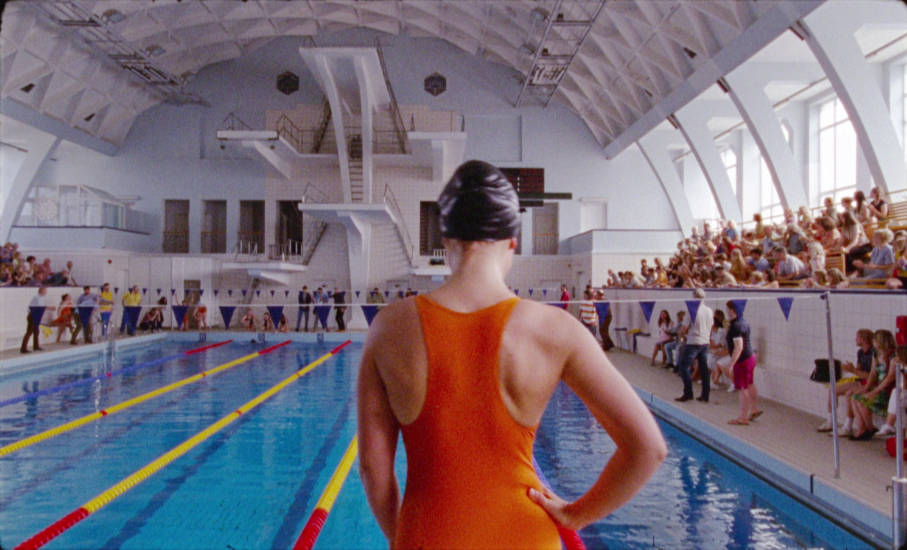
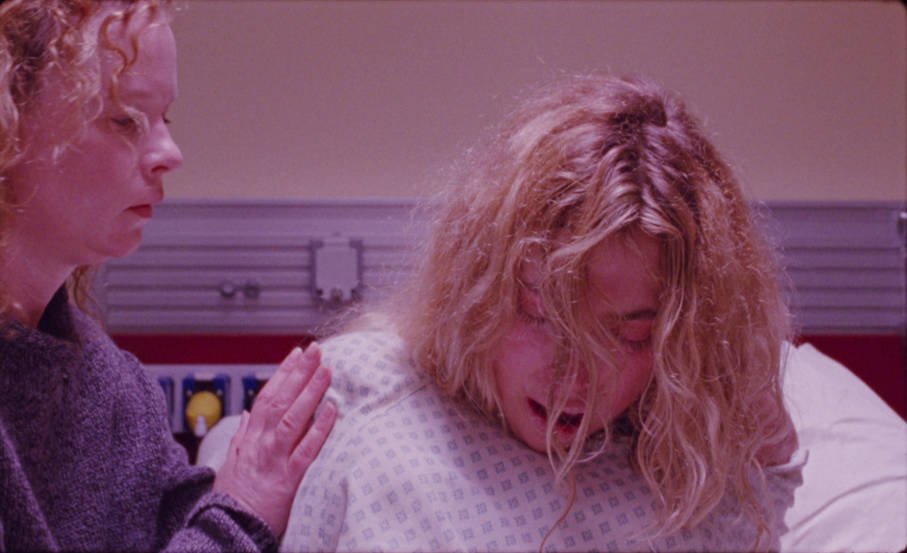
At the centre of the film is a fearless performance from Imogen Poots, who is in every scene except those where Lidia is a child (where Anna Wittowsky takes the role) or toddler (Angelika Mihailova). Other characters come and go: Jim Belushi makes an impression as Ken Kesey (author of One Flew Over the Cuckoo’s Nest and Sometimes a Great Notion), who becomes a writing mentor for Lidia as she takes his classes at the University of Oregon. Second-billed Thora Birch impresses in her scenes. You have to pick up on the passing of time, but you can work out that Poots plays Lidia from teenage to forty.
The film is vivid in its presentation of some aspects of female experience, with imagery of blood and water prevalent, the latter a healing force. Stewart and Poots spare us little, though sexual abuse is thankfully strongly implied rather than shown on screen. Corey C. Waters’s cinematography, shot in Super 16mm, is intentionally raw, often grainy, with he and Stewart often favouring big close-ups. Mike, whose abuse splinters Lidia’s childhood, is rarely seen full frame, Paris Hurley’s often discordant score aims to unsettle and it does. The Chronology of Water is not an easy film, to say the least, as it may well need more than one viewing to piece it all together. It’s not a comfortable film and for some possibly a triggering one, but it’s an often impressive one.
The Chronology of Water premiered at Cannes in May 2025, where it played in Un certain regard and Stewart was nominated for the Camera d’Or (best first feature). The film won the Revelation Prize at Deauville in September the same year.
sound and vision
The Chronology of Water is released by the BFI on a Blu-ray encoded for Region B only. The film has an 18 certificate. The BFI have added an advisory at the start of the film, that it “contains scenes of domestic violence and abuse, harm towards children, sexual violence and infant death”. That’s an accurate and far more specific advisory than the BBFC’s “strong sex”, though to see it you would have had to acquire the disc and be about to watch the film. Caveat emptor all the same.
The film was shot in Super 16mm, the transfer is in the intended ratio of 1.66:1. The film is certainly grainy, not surprising given its celluloid origins. I hadn’t seen the film before this disc, but I’m not in any doubt that this is what you would have seen in a cinema via a DCP.
The soundtrack comes with two options, DTS-HD MA 5.1 and LPCM 2.0, which plays in surround. There isn’t a great deal of difference between them, so use the one most appropriate to your setup. There is also an audio-descriptive track in DTS 2.0. Dialogue, sound effects and the score are well balanced. English hard-of-hearing subtitles are available for the feature, the two interviews and the trailer, and I didn’t spot any errors in them.
special features
Interview with Imogen Poots (7:48)
Imogen Poots is interviewed at Cannes in 2025, by a female interviewer who isn’t identified on the disc or in the booklet. Poots sees the film as “the ripping open of a body” and the script a “living document”. She says that Stewart wanted to make something different in her directorial debut and that the film is very much about female experience of a particularly bloody kind. Stewart involved her in the filmmaking process, allowing her to see a rough cut of the film for her comments. Poots didn’t meet the real Lidia Yuknavitch during the film’s making though did receive notes from her. She also praises the film’s cinematographer, Corey C. Waters, the “honorary gal” in this otherwise very much female-led production.
Interview with Kristen Stewart (8:30)
With the same interviewer, Kristen Stewart talks about the difficulty of making this film, very much a hard sell due to its lack of a conventional three-act structure and maybe confronting subject matter. There are, she says, only small amounts of money available to make a film like this. (She doesn’t go on to say this, but this is no doubt reflected in the ten – count them – company idents which appear at the start, even before you get to the captions noting its playing in Un certain regard at Cannes and its prize at Deauville. The film was shot in Latvia and Malta.) She says that Yuknavitch’s book makes you jealous of someone who has figured out how to listen to themselves if you haven’t started yet yourself. Stewart praises Imogen Poots, whose body is very much the onscreen subject matter of this film. She does say that even if you don’t have a literal relationship to abuse of whatever kind, it’s important to speak plainly about these things and not simply allude to them.
UK trailer (1:34)
The trailer for the BFI’s UK cinema release of the film. This does give a good impression of the style of the film, though gives it more of a sell by citing its festival appearances (not just Cannes and its Deauville prize, but its selection for the London Film Festival as well) and putting critics’ praise on screen.
Image gallery (1:43)
A self-navigating gallery which begins with two poster designs, followed by stills, all in colour, some from the film and some taken on set.

Booklet
The BFI’s booklet, available with the first pressing of this release, contains twenty-eight pages plus covers. It begins, following a spoiler warning, with an essay sharing the film’s title by Savina Petkova. This takes its cue from the line “memories…are stories”, and takes its cue from the published memoir (which I have not read) which isn’t simply narrated but one where Yuknavitch “writes through [Petkova’s emphasis] her own experiences in a fragmented, iterative fashion”. Petkova analyses the film’s visual style, sound design and editing. Ultimately, she says, in the film “everything occurs and recurs in Lidia’s body”, seeing it as part of a feminist project of taking women’s bodies seriously.
After a six-page credits listing, there follows an interview with Kristen Stewart conducted by Jen Yamato, film critic for The Washington Post. Stewart talks about how she read Yuknavitch’s memoir and found that its voice encouraged her to find hers, in translating it to the screen. She had acted since childhood, and her experiences with being directed led to an interest in in the technical side of filmmaking, and she had wanted to direct for a long time. However, she felt she wasn’t ready until she found the right film to make, but now that she has, she very much wants to do it again. The script was written over eight years, while she continued her acting career. At one point she threatened to leave acting if she could not make this film, acknowledging that it is certainly a hard sell. Writing continued throughout the film’s production and editing, as she wanted it to find its own structure.
This is followed by Rachel Pronger’s review from the March 2026 issue of Sight & Sound, plus details of the special features. There are also plenty of stills.
final thoughts
The Chronology of Water is a sometimes difficult, singular but often powerful film, telling a story of trauma and attempts to heal. It is a film which may well need more than one viewing to parse all of it, and the BFI’s extras and booklet (if you pick up part of the first pressing of this release) go some way to elucidating it.
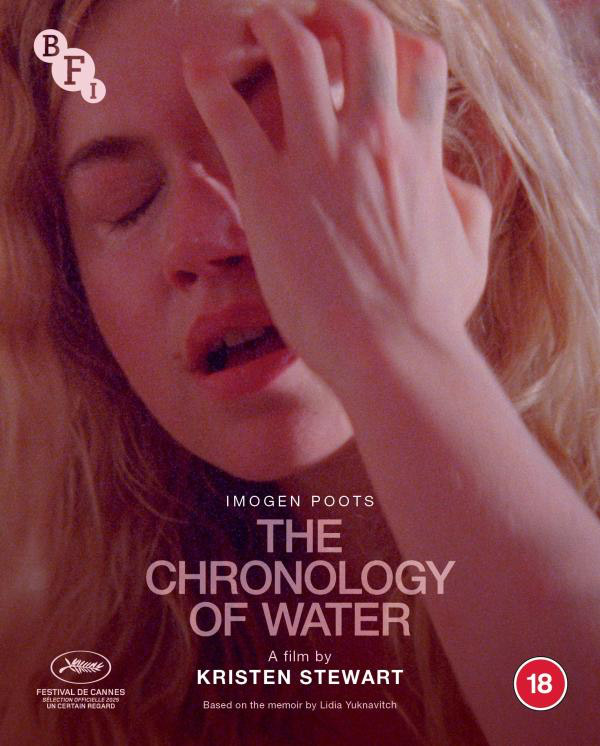
The Chronology of Water
USA / France / Latvia 2025 | 128 mins
directed by: Kristen Stewart
written by: Kristen Stewart
cast: Imogen Poots, Thora Birch, Susannah Flood, Tom Sturridge, Kim Gordon, Michael Epp, Jim Belushi
distributor: BFI
release date: 27 April 2026