
The Blue Trail [O Último Azul]
Gabriel Mascaro’s THE BLUE TRAIL is a laid-back dystopian fable that challenges the cult of youth and celebrates the immense possibilities of the Third Age. Jerry Whyte admires Mascaro’s enchanting tale of one indomitable woman’s quest to realize her wildest dreams.
“The years teach much which the days never know“
Ralph Waldo Emerson
Gabriel Mascaro’s spellbinding fourth feature The Blue Trail carries us up the world’s largest river and deep into the world’s largest rainforest. The Amazon is the glistening thread that weaves together the lyrical vignettes of Mascaro’s delightfully meandering aquatic ‘road’ movie. In a Brazil of the near future, we follow 77-year-old Tereza (Denise Weinberg) on her quest for self-fulfilment. Her life-affirming journey upriver entails escape from a fascistic state that forcibly retires senior citizens it deems past their sell-by date. To be precise, the state retires – and then systematically removes them from public sight, much as our own growth-productivity-property-youth-obsessed culture does. Mascaro takes issue with that.
In The Blue Trail, the state’s logic seems benign: our honoured elders have served the nation well, the propaganda machine proclaims, and can now rest on their (literal) laurels. Smiling government officials fix tawdry faux-gold laurels to their doors – like the crosses that once denoted the presence of plague victims. They are declared to be part of a ‘national living heritage’ and are awarded mass-produced medals for reaching retirement age (my grandad got a watch).
In fact, senior citizens are routinely rounded up in state-sponsored ‘wrinkle wagons’, processed in regimented holding yards, and transported to an obscure place, far from sight, called ‘The Colony’ – never to return. Whether Mascaro intentionally cites Florian Gallenberger’s 2016 drama The Colony/Colonia here or not, the clear reference to Colonia Dignidad will resonate with those who know the history of Latin American fascism and Operation Condor.
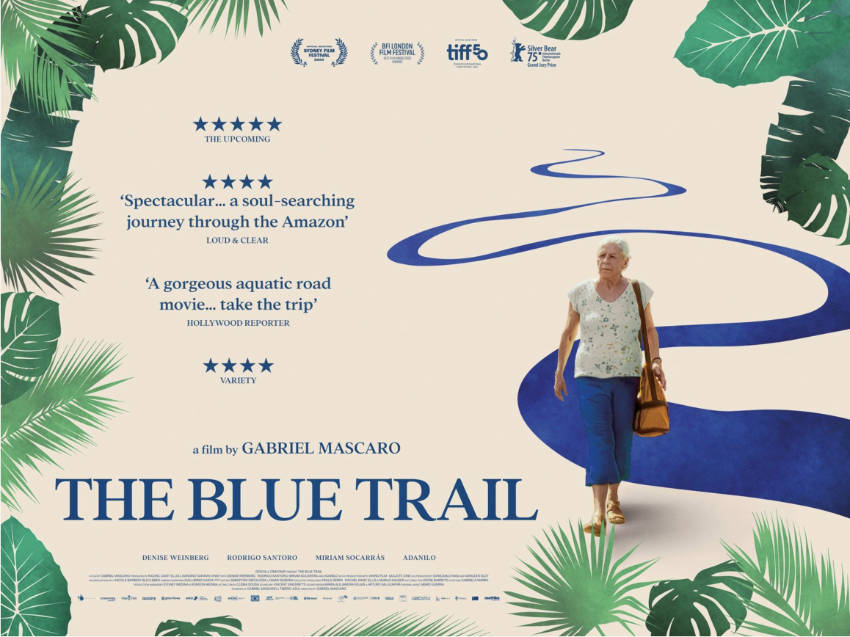
While The Blue Trail flows gently, following the bends and curves of the Amazon, the twists and turns of Tereza’s tale, it also inevitably contains an apt undercurrent of menace. For Mascaro’s ageist dystopia will be all too recognisable to Brazilians, both as a reflection of lamentable modern realities and reminder of the military dictatorship that disfigured their country between 1964 and 1985.
Jair Bolsonaro may now be behind bars but other admirers of the toppled dictatorship remain at liberty. Although Mascaro has no interest in bringing the debts of history into play, the ghosts of the disappeared hover over his film just as they did over the dictatorship. To Brazilians, ‘The Colony’ will have clear implications.
Mascaro suggests that resistance to tyranny is fertile, if not in the favela graffiti that impotently demands GIVE ME BACK MY GRANDAD, then certainly in the defiance of those, like Teresa, who insist on the superiority of dignity over compassion, refuse to acquiesce in the foreclosure of their human possibilities, and burst vibrantly alive in the struggle against the cruel snuffing out of their lives.
Tereza embodies the idea that the Third Age, far from being a period of creeping terminal decline, is a time of perpetual growth and adventure, a time to realise unfulfilled dreams. She refuses to be stereotyped, stigmatized, patronised and put out to grass. Indeed, her daring, vivacity, sly wit, and capacity for joy increase in direct proportion to the trials, humiliations and indignities she faces.

We first meet Tereza in her workplace, a bleakly antiseptic abattoir. Despite this soulless environment, she clearly values her independence, seems happy with her lot, and even sneaks time to dance playfully, as if in flight, in the cold store’s frosty fog. One day though she is summoned to the boss’s office – to be informed that the age of retirement has been lowered to 75 and she is now redundant. She must make way for youth and the future and, please, return her overalls on the way out into the eternal silence of history.
Tereza’s cheerful workmate Esmeraldina (Rosa Malagueta) advises acceptance and compliance, and she scoffs at Tereza’s determination to fulfil her wish to fly before she is carted off. That proves easier said than done anyway. Tereza has her lifesavings (secreted in a tin in her barraco), but she is now officially the ward of her daughter, Joana (Clarissa Pinheiro), who refuses to vouch for her mother when she tries to book a commercial flight. Undaunted, Tereza sets about achieving her wish by any means necessary.
Having learnt that illicit flights can be chartered upriver in remote Itacoatirora, Tereza hires louche but kind-hearted smuggler Cadu (Rodrigo Santora) to take her there in his rickety boat. The Bogart-Hepburn relationship in John Huston’s The African Queen (1951) is evoked and reworked delightfully, and Mascaro insinuates a similarly understated sexual tension between Cadu and Tereza. Throughout the film, Mascaro acknowledges that older citizens, too, have their erotic desires and sensual needs – a fact too often elided in cinema.
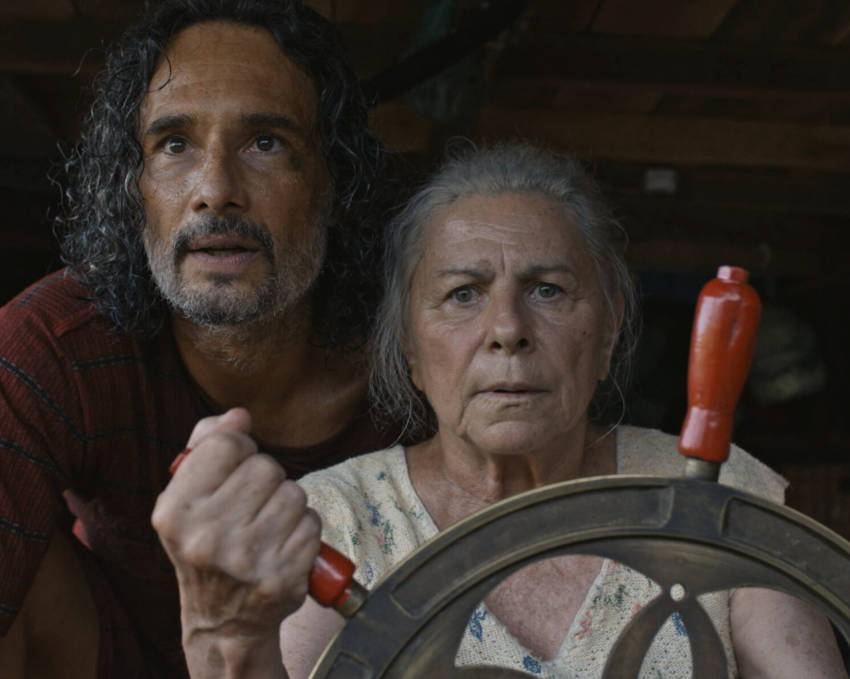
Mascaro also inserts a note of magic realism in the form of an elusive legendary snail, the mucus blue trail of which acts as a magical elixir or iridescent hallucinogen when dropped into a human eye. When Cadu, no stranger to intoxicants, first drifts off into ecstasy and then burns up, Tereza helps him back to earth. He is a troubled soul though and veers off on a quixotic search of his long-lost love.
Before departing on his own quest, Cadu leaves Tereza in the safe, if laughably incapable hands of Ludemir (Adanilo). An inveterate gambler, he is also the owner of a grounded ultralight that he promises to repair, at a price of course. Time and again, Mascaro reminds us what happens when pernicious behaviour and insidious, ideas are normalised, when trust breaks down and people turn against each other – with some on the make, some in touch, still, with their capacity for decency and human solidarity.
Tereza’s encounters people at their best and worst but always strives, as the saying goes, to be her best self. She expands her knowledge and horizons as she travels. Just as Cadu taught her how to operate a boat, Ludemir provides her with a useful tip about betting – one she will later use in the trippy climactic scenes in the Golden Fish, a gambling den where fortunes are won and lost. Before she risks her all there, Tereza’s adventures lead her to her soulmate, Roberta (Miriam Socarrás), an irreligious and lovable hustler of a similar age known as ‘The Nun’.
She sells electronic bibles, has long-since bought her freedom, and provides Tereza with the idea of doing likewise. In exchange, Tereza introduces her new-found friend to the legendary blue snail and its trail as they dance the night away. The deepening bond between the two women, predicated on the palpable chemistry between Denise Weinberg and Miriam Socarrás, provides the film with its most enthralling scenes. How rare and refreshing it is to see older women on screen revelling in their earthy sensuality, their bodies revealed with an intimacy and respect they are so rarely granted.
The Blue Trail is pitched somewhere between two Brazilian gems from Walter Salles: Central Station (1998) and his more recent I’m Still Here (2024). Fernanda Montenegro won a Best Actress Oscar nomination for the former, her daughter Fernanda Torres won one for the later (Torres thus becoming the only the second Brazilian woman to be nominated for an Oscar – after her mother). In the former, an older woman embarks on a journey of self-discovery; in the later, an older woman resists an authoritarian state; in The Blue Trail, Tereza does both. I’m Still Here was remarkable in featuring Torres and her mother Montenegro as Eunice Paiva in middle-age and later life. Factor in Denise Weinberg and the wonderful sight of three supremely talented women playing strong women fighting and winning against all odds units and elevates all three films.

More generally, Mascaro’s film lacks the purposeful political punch of Kleber Mendonça Filho’s Bacurua (2019) and The Secret Agent (2025). It is worth noting the exemplary work of Casting Director Gabriel Domingues in both the later and The Blue Trail. Both these films are lifted by their superb supporting casts of odd-balls, rebels and outsiders. We must pause here, too, to salute 79-year-old non-professional actor Tânia Maria. In The Secret Agent, she steals every scene in which she appears as Dona Sebastiania, the gutsy matriarch who provides a safe house for leftists on the run. Here is another name to add to our roll call of extraordinary Brazilian women who prove that advanced age cannot curb aptitude and ambition.
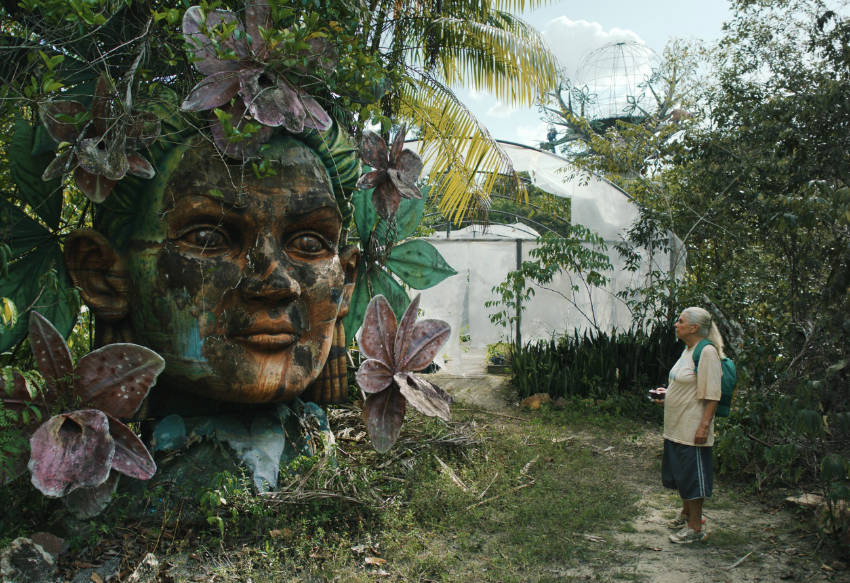
To pick up The Blue Trail again, Mascaro compensates for a blurring of political focus that often threatens to sink the film by better exploring the visual riches of the natural environment and the utopian possibilities of friendships – be they of the fleeting kind that nonetheless leave indelible mnemonic traces or those more profound and substantial ones solidly built to last. In The Blue Trail, the Amazon’s lush elemental beauty is beautifully rendered by Guillermo Garza’s crisp cinematography while Memo Guerra’s ingenious, if overly whimsical soundtrack plays like a cooling breeze on the heavy-hanging heat of the film’s more muted politics.
Mascaro’s positive focus on the wonders of nature and interpersonal relations at the expense of realpolitik ultimately enriches the film. Much of the film was clearly improvised which lends it an intimacy and immediacy more painstakingly scripted films can lack.
It feels, though, as if his initial intention to excoriate the contemporary marginalisation of older citizens gave way, during shooting, to a dawning sense that he might best highlight that crime against humanity by demonstrating own Tereza’s vibrant humanity.
Despite Mascaro’s obvious affinity for the kind of Brazilian films cited above, he steers closer to the transcendental cinema of Japan with its unhurried-pacing, sparse dialogue and sense of flow (an affinity, incidentally, also present in the 2024 animated film Flow). His clear rapport with Japanese cinema goes beyond the coincidence that so many Japanese films address the opportunities provided by an ageing population, but his subject matter must have led him on. In Chie Hayakawa’s provocative dystopian drama Plan 75 (2022), for example, Japan deals with this ‘problem’ by providing curated plans for voluntary euthansia. When citizens reach 75, they are invited to apply for assisted suicide, with a sweetener of 100,000 yen to spend as they choose. They are, in essence, bribed to die. It is a chilling view of a future, but we may be heading there or thereabouts.
In Hirokazu Kore-eda’s After Life (1998), by contrast, the state provides an unusual social service: the deceased are asked to select their happiest memory – which is then staged, filmed and enshrined as an eternal memory. We’re closer to The Blue Trail here. As Mascaro’s film ends, Tereza rests easy on the rails of Roberta’s boat, gazes serenely at the restless rolling Amazon, turns her gentle face to the sun, lets her long grey hair play in the soft breeze, and seems, finally, content. In the short 89 minutes of the film’s duration alone, she has acquired memories enough to last for eternity. She seems to have achieved her dreams, but we sense she is devising new ones. After all, as Gabriel Mascarano adroitly demonstrates in this enchanting fable, old age is merely a new beginning not a full stop.
The Blue Trail
Brazil / Mexico / Netherlands / Chile 2025 | 85 mins
directed by: Gabriel Mascaro
written by: Gabriel Mascaro, Tibério Azul; Murilo Hauser, Heitor Lorega (collaborating writers)
cast: Denise Weinberg, Rodrigo Santoro, Miriam Socarras, Adanilo, Rosa Malagueta, Clarissa Pinheiro
UK distributor: MetFilm Distribution
UK classification date: 2 April 2026