
Arsenic and white lace
Joan Fontaine stars as a married woman with ambitions to climb the social ladder by targeting a wealthy bachelor in the 1947 IVY, where what starts as a romantic drama takes an altogether darker turn. An initially uncertain Slarek soon found himself riveted by what subsequently unfolds on Indicator’s recently released Blu-ray.
Ivy is one of a handful of English language forenames that has a common meaning outside of its role as an identifying moniker. As anyone with even a small garden knows, in nature ivy is a creeping plant that climbs walls and winds itself around just about anything that sits still for long enough, clinging to every surface it touches with a persistence that if refined could probably be used to glue airplanes together. It also has a famously rash-inducing strain whose Latin name is toxicodendron radicans but is more commonly known as by the almost boringly descriptive name of poison ivy. Is any of this relevant to the 1947 film under discussion here? Could be…
As someone who has never been a devotee of classic Hollywood era romantic drama, the first 30 minutes of Ivy repeatedly wrong-footed me into thinking that this was precisely what I was being served up. The title sequence alone scores a few points on this front, unfolding in that popular Hollywood fashion that has the lead actress’s name written large in cursive script, while the title is presented in the sort of overly decorative flowery font that desktop publishing first-timers tend to pick when creating a promotional leaflet for a local gardening centre. All of this plays out over a still life image of a decorative branch of ivy cradling a vase-shaped stone ornament and is set to the sort of lush musical overture that feels designed to loudly announce the film’s romantic intentions. Then, as the sequence concludes, something unexpected happens, as the previously light toned ivy is ominously silhouetted, the vase-shaped ornament transforms into a human skull, and the romantic strains of Daniele Amfitheatrof’s score (I’ll be coming back to that in a while with real enthusiasm) take a more sinister turn.
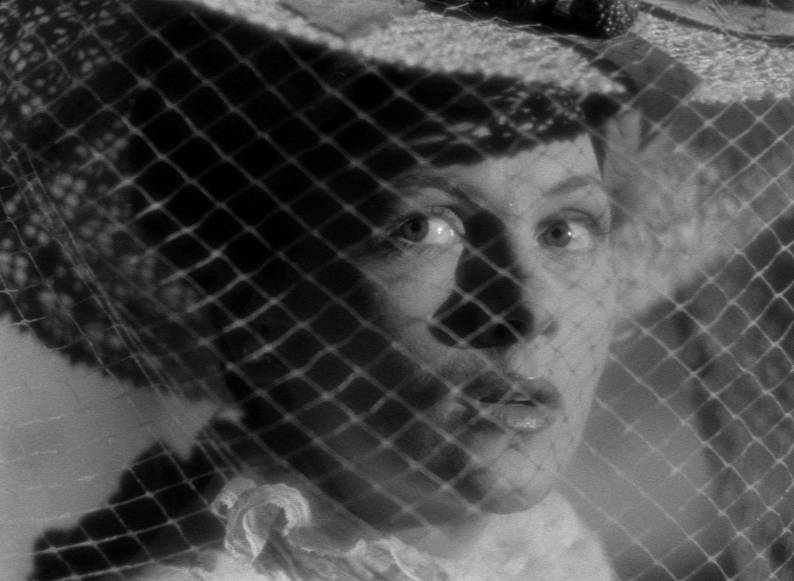
The film itself begins in intriguing fashion, as a well-dressed young woman whose clothing signals the film’s Edwardian setting (blink during the opening wide shot and you’ll miss that her path is crossed by a black cat, a famously superstitious portent of bad luck) arrives at the door of a terraced house and rings the bell with all the apprehension of someone who is unsure about the wisdom of doing so. As she looks around uncertainly, a balding, middle-aged man with thick glasses and spectacular sideburns appears on the basement stairs below and looks enquiringly up at this presumably unexpected visitor, who tells him in a huskily nervous whisper, “I came to see Mrs. Thrawn. Mrs. Arundell gave me the address.” The man responds by silently disappearing inside, then a few seconds later opens the front door and gestures for the woman to enter. He then heads upstairs, leaving the woman to look anxiously around, and she seems to be on the verge of bottling out and departing when the man looks down and politely invites her to join him. When she reaches the landing, the man charges her a fee of one guinea and directs her to take a seat on one of two pitch black chairs, then sits down on the other side of the room and starts to play background music on a harpsicord while the woman continues to act as if coming here may have been a big mistake. Seriously, had this film not been made in Hay Code era Hollywood in 1947, I’d have sworn that the woman had come to this address for an illegal abortion. In case you hadn’t already guessed by now, the woman in question is the titular Ivy (Joan Fontaine), and nothing is quite what it seems to be here.
But 1940s Hollywood this is, and Matilda Thrawn (Una O’Connor, whose extraordinarily framed introductory close-up could almost have been lifted from a psychological horror tale – no wonder Ivy looks so terrified when she sees her) is not a backstreet abortionist but a fortune teller, a charlatan profession whose shifty practitioners are too often presented as the real deal in movies. After the usual waffle about an upcoming life change ahead and coming into money, Matilda gets unerringly specific with her advice, telling Ivy that she should break up, not with her husband, but the other man that she is currently seeing, advising her to do it today to avoid bringing him misery and shame. She also suggests that it’s best to be done with the old love before getting involved with the new man she claims will enter her life in a matter of hours. When Ivy asks what else she sees, Matilda’s expression changes to one of barely controlled alarm (full marks to O’Connor for conveying this so subtly in such a claustrophobically tight facial closeup) and she brings the consultation to an abrupt end. This doesn’t bother Ivy, who, having now heard what she wanted to hear, leaves the premises happy at the prospect that a wealthy new beau is set to enter her life. As Matilda watches Ivy walk away, the man with the glasses and sideburns, who I’m guessing is Matilda’s husband, asks his wife what she saw. “I saw terrible misfortune,” Matilda tells him. “Evil influences are gathering.” Given the implications of such a prediction, you’d think I’d have been ready for the turn the drama later takes, but once the film settles comfortably into romantic drama mode, the very idea that it could undergo what almost counts as a switch of genre frankly slipped my mind. As a result, when it occurred, I got a genuine and darkly pleasurable jolt.
When we meet her next, Ivy is in the best of spirits as she attends an open-air gathering atop the cliffs of Dover with her cheery husband Jervis (Richard Ney) and their well-to-do friends. It turns out that they’ve all gathered to watch a British attempt to be the first man to cross the channel in one of these new-fangled aeroplane thingies, which is scuppered when real-life pioneer aviator Louis Blériot arrives from France in his own craft just seconds before our boy is due to take off. A very likely story indeed. Before this occurs, Ivy is captivated by the arrival of the wealthy Miles Rushworth (Herbert Marshall) and catches his eye. The two instantly hit it off and Miles invites Ivy to accompany him to get a closer look at this piece of British wishful thinking aviation history.
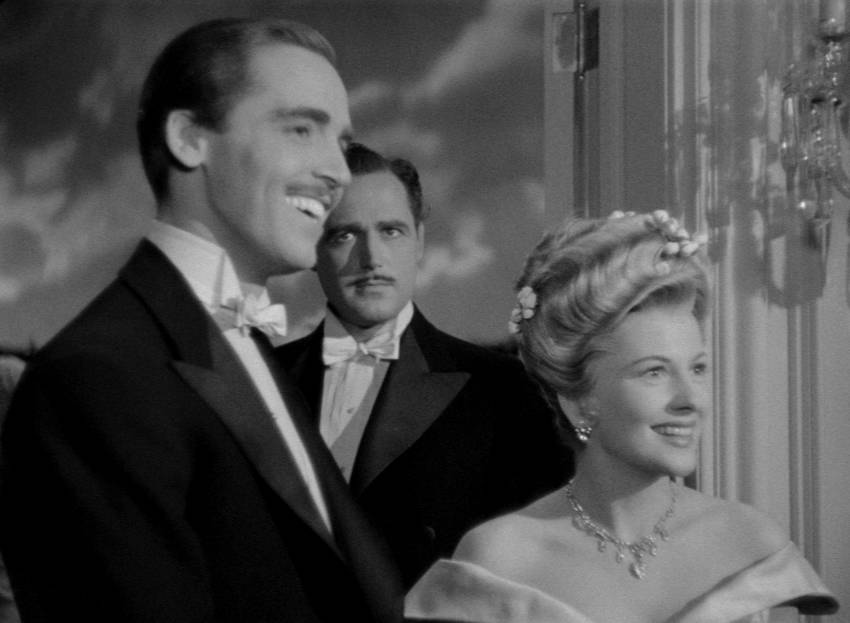
It’s after this that we get the next not-what-it-seems moment as Ivy and Jervis arrive home, not to the country estate that their handsome clothing and company of friends suggests but a dowdy apartment that is all they can now afford. It seems that they frittered what money they had away, and Jervis has been unable to secure a new job, a situation that he cheerfully tries to make the best of but that clearly frustrates Ivy, for whom true happiness appears tied to her ability to spend freely on anything that takes her fancy. Whatever else they’ve had to sell, they appear to have hung onto their finest clothes to keep up appearances and continue attending social events, the next of which is also attended by Miles, this time in the company of his girlfriend Bella (Molly Lamont). Also present is Ivy’s on-the-side boyfriend Dr. Roger Gretorex (Patric Knowles), a cheerless individual who reacts with sullen jealousy at Ivy’s easy-going relationship with the ever-smiling Jervis. Despite stringing both along, Ivy has already set her sights on Miles, whom she charms into giving Jervis a job, entrancing him enough to see the couple invited to join him and his friends on a month-long yachting party before Jervis starts in his new position. When the holiday concludes and the other guests head for shore, Ivy remains on board radiating subtle seductive signals that result in Miles buying her an expensive handbag (this will play a crucial role later) and even impulsively kissing her when the lights to his private cabin are blown out by a storm. Again, expectations are then usurped when the power is quickly restored and Ivy sits waiting for Miles to make love to her, only to have him instead say that he has always drawn a red line when it comes to other men’s wives and that he is ashamed of his actions. Having already set her sights on marrying him, however, our Ivy isn’t about to give up on her plans. There just remains the problem of what to do about a husband who still dearly loves her and won’t hear a word about divorce, and a boyfriend so doted on her that he refuses to accept that she wishes to end their affair.
What happens next takes this review into spoiler territory, so if you want to go into the film without foreknowledge of how things play out, skip to the final paragraph of the review itself (or click here to do so automatically). I will endeavour to keep the spoilers in question to a minimum, but to discuss what transforms a serviceable tale of love and adultery into a darkly compelling noir, I do have to get into the specifics of how and why.
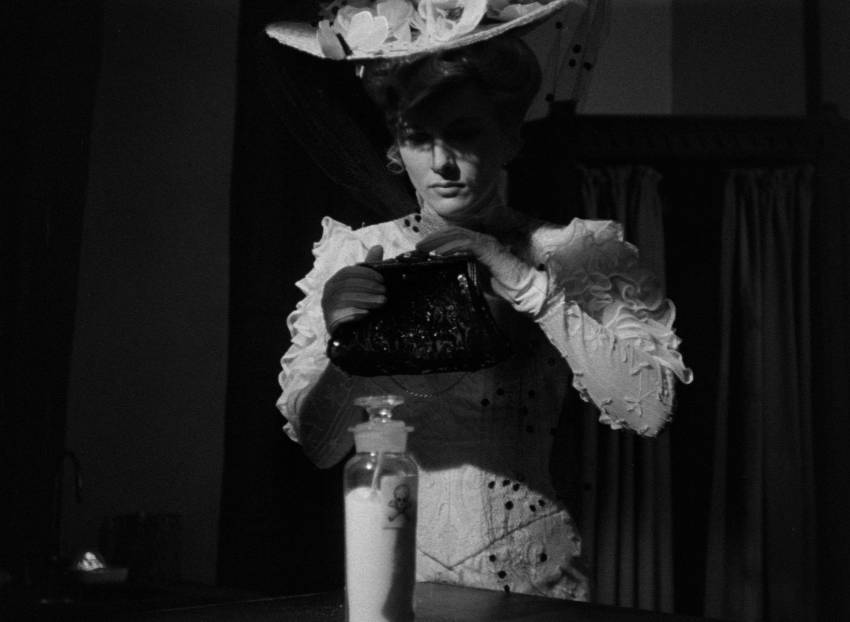
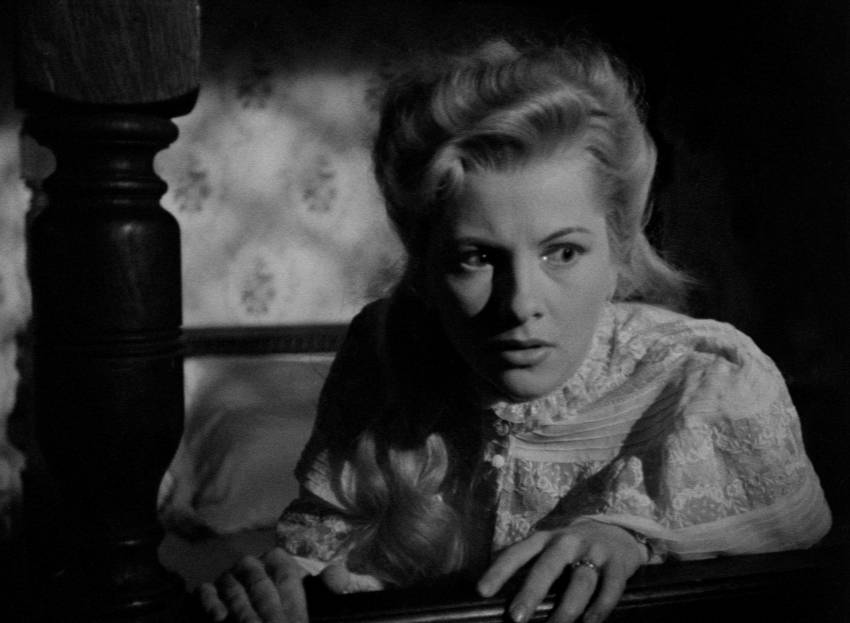
Everything changes for Ivy after she has an argument with Jervis and pays one of her surreptitious visits to Roger, whom she meets at the surgery attached to his house, and she is forced to hide when Roger’s maid Martha (Sara Allgood) arrives unexpectedly with urgent news of a serious accident requiring his immediate presence. As Roger prepares his medical bag, he instructs Martha to grab a jar of antiseptic from the back of a packed medicine cabinet, and as the two hurriedly depart, several of the jars moved from the cabinet by Martha are left sitting on the table below, one of which contains arsenic powder and is clearly labelled as a dangerous poison.1 In the single short sequence that follows, what has previously played out as a relationship drama switches genre in a heartbeat to become something considerably darker, as Ivy spots the jar, briefly but expressively mulls over the consequences of what she seems to be considering, and then slowly approaches it as if drawn to it by some demonically invisible force. This is also where composer Daniele Amfitheatrof moves into a different gear entirely, accompanying Ivy’s slow movement towards the fateful jar with a disquietingly jangly, almost carnivalesque tune that if I’d have sworn was from a 1970s giallo thriller had I heard it as a standalone audio recording. This theme becomes a signature tune that reoccurs in one form or other whenever the arsenic that Ivy spoons into the secret cameo clasp on her handbag is put to use or is shown to be having a negative effect. It was only on my second viewing of the film that I realised that this was the very same tune that Matilda’s husband was playing on the harpsicord during Ivy’s opening scene consultation with Matilda.
Audience response to unfolding events is intriguingly complicated by how individual characters are portrayed and how they relate to each other. I can’t help suspecting that we’d be quietly cheering Ivy on when she decides to poison Jervis were he a mentally and physically abusive control freak who makes Ivy’s life a living hell. Instead, he’s probably the nicest guy in the film, devoted to Ivy and finding an upside to almost every situation. Seriously, while Roger remains jealous of his marriage to Ivy and her interest in Miles, Jervis remains cheerfully oblivious to Ivy’s indiscretions, regarding Roger as a trusted friend and Miles as a likeable and stand-up guy. Indeed, his good humour only really falters when Ivy deflects a bill collector by sending him to Jervis’s new workplace, embarrassing him in front of others and potentially putting his position at risk. Ivy even manipulates his frustration at this to her advantage with an explosion of crocodile tears designed to cast her as an unworthy failure in the hope of convincing her husband to grant her a divorce. It’s when this ultimately fails to have the intended effect that she runs to Roger and stumbles across an altogether darker solution to her problem.
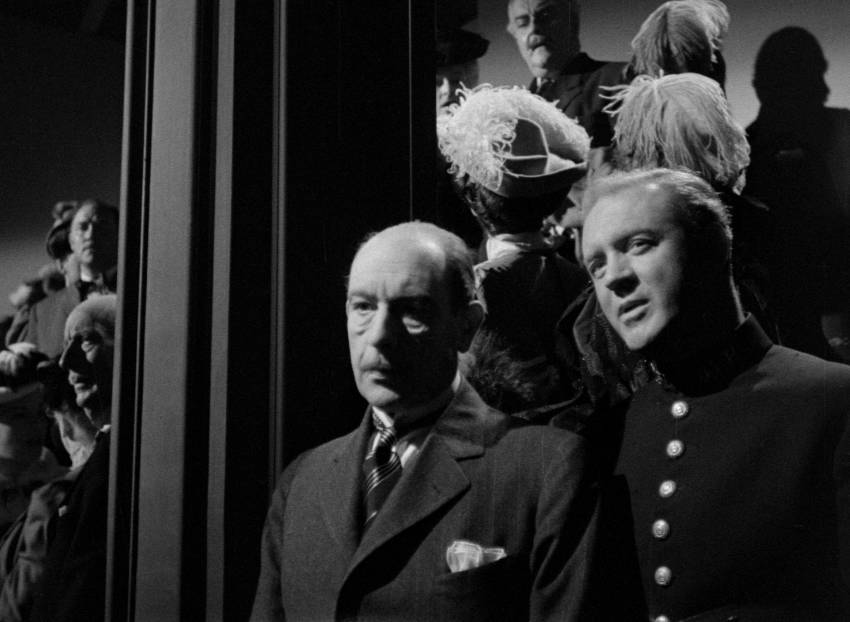
Ivy herself proves to be an even more complicated figure, seemingly driven to murder and later to framing someone else for the crime, not as an act of self-defence but simply to procure the partner she now desires, having worked her way through two men and tired of both, her sights now set firmly on the material benefits that marriage to a man of Miles’ wealth and position would bring. On paper, this should cast her as an unlikeable villain, but as played by Joan Fontaine she becomes a figure of dark fascination, someone I found myself rooting for whilst simultaneously hoping to hell that she’d be found out in time to stop an innocent party being sent to the gallows. Fontaine really is excellent here, fully aware of how much or how little an actor needs to project in order to register on camera, which she uses to communicate Ivy’s thought processes, uncertainties, fears and desires with sometimes bewitching subtlety and fully believable conviction. The result of this split allegiance in regards to her character saw me equally torn when it came to Inspector Orpington (Cedric Hardwicke), a soberly dogged police detective whom I initially worried would see through Ivy’s well performed grief, only to later be in his corner when he elects to continue investigating even after verdict against an innocent party has been delivered and the sentence passed.
As is pointed out more than once in the special features on this disc, director Sam Wood was never afforded the status of many of his contemporaries and became as well known for his extreme conservatist views and fervent anti-communism as for his body of work as a filmmaker. I’ll be honest and admit that I previously knew him primarily for three very different films, the Marx Brothers comedies A Night at the Opera (1935) and A Day at the Races (1937), and the original film adaptation of novelist James Hilton’s romantic drama Goodbye Mr. Chips. That he was able to deliver one of the finest screwball comedies and one of the best Hollywood tearjerker dramas alongside this belter of a period noir is a testament to his talent and diversity as a filmmaker, however shifty his politics. He’s aided immeasurably here by cinematographer Russell Metty, a master of his craft whose CV includes of The Stranger(1946) and Touch of Evil (1958) for Orson Welles, Magnificent Obsession (1954), All That Heaven Allows (1955), There’s Always Tomorrow (1956) and Written on the Wind (1956) for Douglas Sirk, Spartacus (1960) for Stanley Kubrick, and The Misfits (1961) for John Huston, to name but a few. Metty’s use of light and shadow here is genuinely masterful and often as expressive as the actions of the characters, as is his impeccable use of the Academy frame, and this is absolutely one of those noir-soaked monochrome dramas that I just could not imagine working as well in colour.
Despite those early indicators of the direction the drama would eventually take, I remained a just little detached from the story and characters for the first 30 minutes of Ivy, but from the moment Ivy spots the fateful bottle in Roger’s surgery I was utterly gripped, and watching the film a second time I had a far greater appreciation of what director Wood and his top-flight cast had achieved during the course of this extended setup. That the film plays so riskily with audience allegiance and refuses to openly cast Ivy as either a deeply wronged woman seeking escape or a devil in a white dress lends the drama a maturity shaped by early Hitchcock regular Charles Bennett’s screenplay (which was adapted from Marie Belloc Lowndes’s novel The Story of Ivy), director Wood’s confident handling, Fontaine’s nuanced performance, Metty’s moodily suggestive cinematography and Daniele Amfitheatrof’s evocative score. It also cannily, if perhaps unintentionally, suggests that when love and compassion are pitted against avarice, there’s a worrying chance that the latter will ultimately win out.
sound and vision
I’ve often wondered what the technical difference is between a restoration and a remaster, but when it comes to Indicator Blu-ray releases, I see the term remaster most commonly used when the digital master used for the transfer was supplied as is from the studio from which the film was sourced, as opposed to a full restoration in which Indicator has been directly involved. The real giveaway lies in the description of the transfer in the accompanying booklet, which is a single short sentence in the case of a supplied remaster, whereas with a full restoration we get far more detail about the process, right down to the amount of dust and dirt removed and even the names of the software used. That the only information provided about the presentation here is a seriously lean “Ivy was sourced from Universal’s HD remaster” makes it clear that the transfer on this Blu-ray hails from the former camp. While such an outline reveals nothing about the process involved or what materials were the basis for the remaster in question, the transfers on past Indicator releases where this has been the case have usually been of a high order regardless, and in the ways that are important, that’s very much the case with the 1080p presentation of Ivy on this release. Yes, there are a couple of signs that this is a remaster rather than an in-house restoration, with several specks of dust and the occasional brief small scratch remaining, but the image is otherwise clean and stable, with no obvious jitter or signs of more serious damage. Similarly, while the picture is generally crisp and the detail clearly defined, there are a small number of shots that are visibly softer, which in the case of the opening wide shot is likely due to it being sourced from a print that includes a dissolve from the opening titles. Where the transfer really shines is in its contrast grading, which handles the whites of Ivy’s dresses and gowns with real finesse and without a whisper of burn-out, while the dark suits worn by the male characters display solid black levels without eating away at important detail.
The original mono soundtrack has also been remastered as a Linear PCM 1.0 track, and while inevitably restricted in its tonal range, is otherwise clear and free of obvious signs of serious wear or damage.
Optional English subtitles for the hearing impaired have been included, as expected.
special features
Audio Commentary with Eloise Ross
Australian academic and curator Eloise Ross examines the film and its title character from a feminist perspective whilst also discussing key personnel involved in the film’s making and highlighting the effectiveness of specific scenes and elements. She notes that the huge commercial success of Rebecca (1940) gave credence to the notion that woman’s literary fiction could be built around a victim, an observer, or even the murderer instead of the detective, as was often previously the case. She also observes that there were several gothic films around this time focussing on women in patriarchal spaces, and is not the only one here to remark that Sam Wood was a conservative activist who made some interesting films but who never attracted the critical attention afforded to his peers. There’s a lot on Joan Fontaine, but also a shout for cinematographer Russell Metty – whose work here Ross describes as ‘flawless’, a point on which I’d have to agree – and some interesting background information on uncredited stuntwoman Polly Burson, whom she describes as the queen of western stuntwomen and whose CV really is something to behold.
The Unappreciated Director: Neil Sinyard on Sam Wood and Ivy (19:13)
Writer and film historian Neil Sinyard provides a thoughtful appreciation of a director he also describes as a curiously neglected figure, a point that he illustrates by citing the authoritative film compendiums from which he was excluded, despite the fact that his films amassed an impressive 34 Oscar nominations between them. He reveals that Marie Belloc Lowndes’s source novel (which I confess to having not read) was set in postwar Britain rather than Edwardian times, praises the cinematography, production design, music score, casting and direction, and reveals why the film didn’t make much of an impression on release but now looks to be director Woods’ standout feature of the 1940s.
Suspense: ‘The Story of Ivy’ (27:10)
A 1945 adaptation of Marie Belloc Lowndes’s source novel produced for the radio thriller series Suspense and presented as a recounting of events by the title character for a magazine article about events that play out in the story’s second half (I’m being coy on specifics to avoid ruining things for those who opted to skip the spoilers in the above review). The storytelling is inevitably compressed and (over-) simplified to squeeze what played out over 100 minutes in the later film into less than half-an-hour (which includes a couple of pauses to promote the programme’s sponsor and to sell war bonds), and the characterisations lack the nuance the film would inject. Jervis in particular is completely different here, with no sign of the good-humoured and perennially upbeat husband of the film – here Jervis is portrayed as a sullenly resentful man who is bitter that Ivy has spent all of their money, and who openly accuses her of something he remains completely unaware of in the screen adaptation. There are also crucial differences in things play out with Miles that I’m not about to reveal here.
Theatrical Trailer (0:31)
If you’re one of those people who really hate it when trailers include a walloping amount of spoiler-littered footage from the later stages and even the climax of the films they are promoting (guilty as charged), you’ll have no such issues with this almost blink-and-you’ll-miss-it one for Ivy, which runs for a mere 31 seconds and only tells us that the film stars Joan Fontaine and that the titular Ivy is both beautiful and dangerous. Not the most persuasive of pitches.
Image Gallery
47 screens containing often pin-sharp promotional stills – including plenty of posed studio portraits and some behind-the-scenes photos – lobby cards and posters.
Booklet
The lead essay here is by freelance critic, curator and film historian Pamela Hutchinson, and it makes for an enthralling and informative read. Her coverage of the film includes details on source novel author Marie Belloc Lowndes, the character of Ivy, Fontaine’s portrayal, her fractious relationship with her sister, Olivia De Havilland, and how relocating the story in an Edwardian setting aligns the film with other gaslight noir works of the period. Next up is a welcome if anonymously authored piece on author Marie Belloc Lowndes, which greatly expands on the snippets provided about her elsewhere in the special features. It mentions of some of Lowndes’ other published works, the most famous and most-filmed of which is The Lodger, and usefully includes extracts from The Story of Ivy, on which this film was based. This is followed by a piece on the film’s producer, William Cameron Menzies, who is today primarily remembered as a top production designer and director. His rise to Hollywood prominence is explored through extracts from several articles, with continuity and factual information provided by text whose author is once again not credited. Finally, there are extracts from some of the critical responses of the day, which lean towards the positive, with the film’s presentation impressing even when the content is less highly praised. Full credits for the film have also been included, and the booklet is illustrated with promotional material.
final thoughts
I always get a kick when I become initially convinced that a film is not going to really work for me, only for it to then take a left turn that steers it right down my alley, so to speak. Charles Bennett’s well-structured screenplay is captivatingly directed by Sam Wood, who is aided immensely by Richard H. Riedel’s production design, Orry-Kelly’s elegant costumes, Daniele Amphitheatrof’s score, and a string of fine performances for a first-rate cast, notably Joan Fontaine on impeccable form. Indicator’s Blu-ray features a solid transfer and some excellent special features, and thus comes warmly recommended.
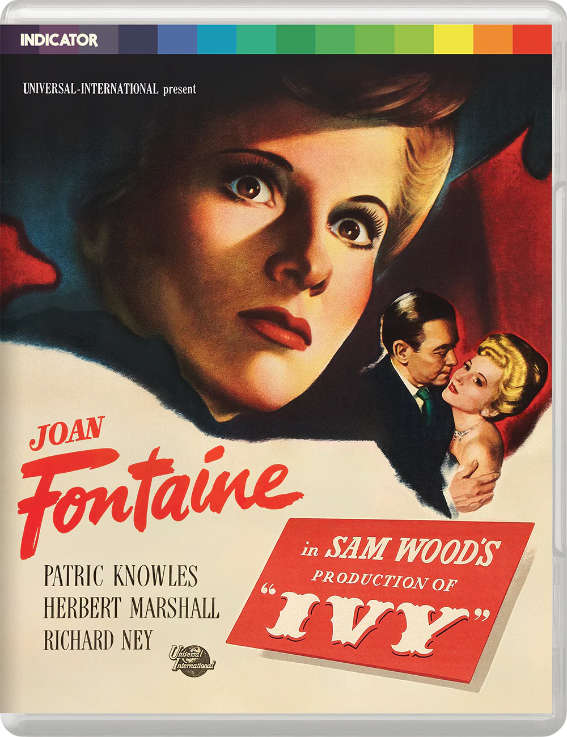
Ivy
USA 1947 | 99 mins
directed by: Sam Wood
written by: Charles Bennett; from the novel The Story of Ivy by Marie Belloc Lowndes
cast: Joan Fontaine, Patric Knowles, Herbert Marshall, Richard Ney, Cedric Hardwicke, Lucile Watson, Una O’Connor
distributor: Indicator
release date: 30 March 2026
- If you’re wondering why a doctor would have arsenic in his medicine cabinet, in small and carefully regulated dosage, arsenic-based drugs were once used to treat a range of conditions.[↩]