
Children’s Film Foundation Bumper Box Vol 6
The sixth CHILDREN’S FILM FOUNDATION BUMPER BOX, a three-disc DVD release from the BFI, includes nine films from 1954 to 1980. Review by Gary Couzens.
This is the BFI’s sixth Bumper Box showcasing the output of the Children’s Film Foundation (henceforward, CFF). I have previously reviewed volumes three, four and five for this site. As usual, there are nine feature films (running between fifty minutes and an hour each) in this set, made between 1954 and 1980. If you ever went along to a Saturday Morning children’s picture show in that time (I didn’t, mostly because my local cinema would have required a bus for me to get there, in case parental chauffeuring wasn’t available) you may well have seen some of these films. Other than cinema viewings and maybe some showings in school, you could have tested your powers of observation from an extract from a CFF film on Screen Test, which I remember from when Michael Rodd still presented it. (As a suggestion for future CFF releases, how about an interview with him? He is still alive as I write this.)
Films were made for children before there was sound, though the powers that were did worry that mainly American fare wasn’t quite in keeping for British children. The CFF was born from the former Children’s Film Department or Unit, Later it became the Children’s Film and Television Film Foundation, given that many of their films were being shown on the small screen and some were made for it. The loss of the Eady Levy (which earmarked ticket money for British film production), the coming of home video, and Saturday morning television such as Multi-Coloured Swap Shop and Tiswas, sent Saturday Morning Picture Shows into decline. The CFF was basically a releasing company for the many small producers who made their films for them. Those films often showcased young actors at the start of their careers (along with many child actors who never progressed to adult careers or indeed acted again), and gave breaks to filmmakers at the start or end of theirs.
So, settle down in the stalls and let’s begin…
MYSTERY ON BIRD ISLAND
We’re in the Channel Islands, Alderney to be precise. Brother and sister Marion (Mavis Sage) and John (Vernon Morris) are on holiday. After a conflict with local siblings Jeanne (Jennifer Beech) and Victor (Nicky Edmett) as to whose beach it is, they join forces when they discover that a gang of smugglers are using the nearby island of Burhou to stash their contraband, and also to steal bird eggs to sell to high-end restaurants across the land.
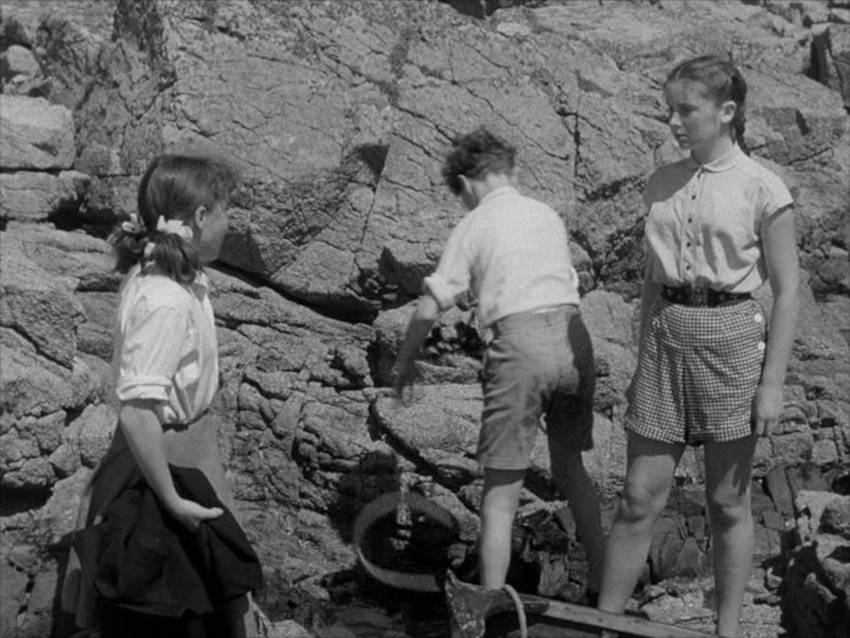
One feature of the CFF’s output over the years is the use of attractive locations, not always in the UK – in this case outside it but in a British Crown Dependency. Mystery on Bird Island dates from 1954. Burhou is a real island, used as a bird sanctuary, with no permanent residents and visitors banned from 15 March to 1 August each year, and this is likely the only film ever shot there. The island dominates the first half, with the second involving the hearing of a petition to install a bird-watcher there. Among the adults, Alexander Gauge makes a good Sidney Greenstreet-esque villain. Of the children, Mavis Sage, aged twelve or thirteen here, acted until the end of the decade and died in 2021. Jennifer Beech never acted again, but Vernon Morris and Nicky (later Nick) Edmett went on to adult careers.
ONE WISH TOO MANY
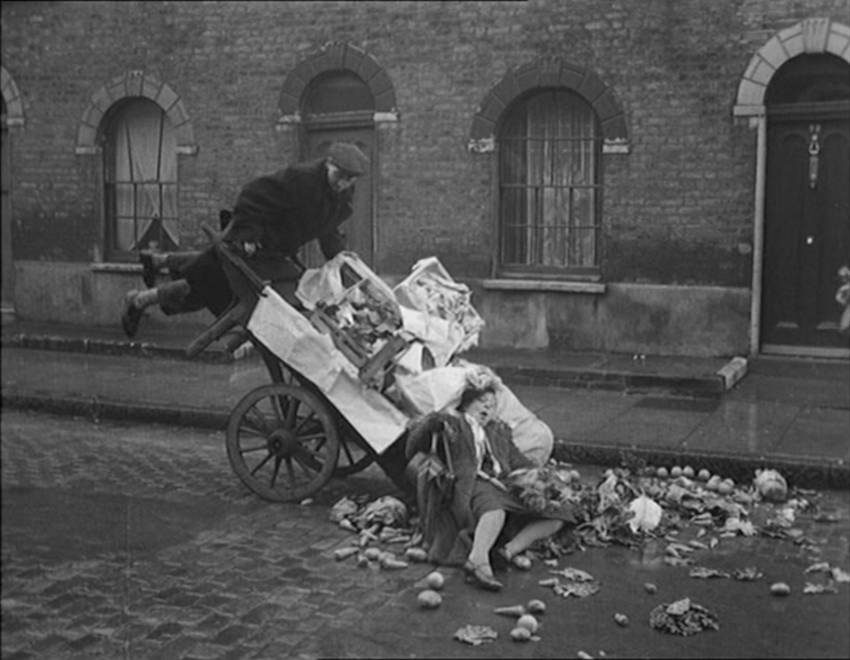
One Wish Too Many, from 1956, takes us from a monochrome Channel Islands to a monochrome Bermondsey in the East End of London, with an opening wide overhead pan taking in a fair amount of lingering bomb damage along with the Thames wharves which are no longer there. Schoolboy Peter (Anthony Richmond, not the cinematographer who would work with Nicolas Roeg among others, but a child actor who had a career from 1954 to 1959) finds a glass marble, which – surprise! – grants him wishes, as long as he rubs it in a certain way. Hijinks at the expense of teachers and school bullies are all very well, but things escalate from there.
Some inventive, if rudimentary, special effects help a lively piece – like Mystery on Bird Island, with writing contributions from CFF stalwart Mary Cathcart Borer – that no doubt delivered for its intended audience. Given the CFF’s usual penchant for ensemble casting – aware that both boys and girls would be watching – Peter is paired with landlady’s daughter Nancy (Rosalind Gourgey, her only screen role). One Wish Too Many won the award for Best Children’s Film at the 1956 Venice Film Festival.
THE CAT GANG
Shot in Lymington, Hampshire, The Cat Gang (1958) has a common CFF ensemble of two boys and a girl, though in a gesture towards changing times, the girl wears trousers throughout instead of the usual skirts or dresses. Sylvia (Francesca Annis), Bill (Jeremy Bulloch) and John (John Pike) live in the fishing village of Lyddington, and one of their pastimes is making a map of the place. When a stranger comes to town, you can tell he’s a wrong ’un because he almost runs over Sylvia’s cat Tiger. He has a cat’s head on his car bonnet – a mascot, not a real one, you may be glad to hear. They see cats carved into trees and a wire leading up to the cliffs, and a signal light on top of the Church of St Thomas the Apostle. Yes, it’s another gang of CFF smugglers.
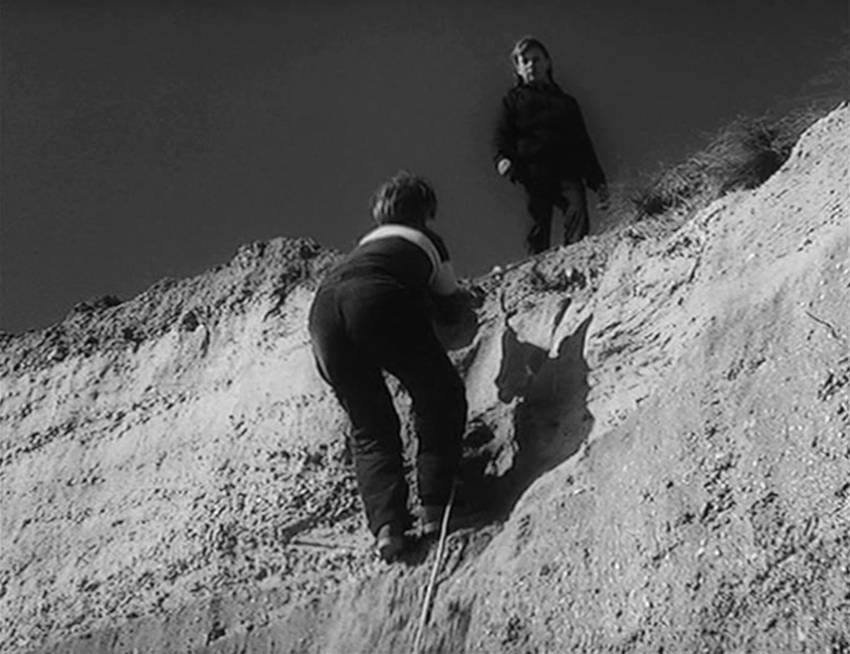
You can often tell which of the young actors in CFF productions would go on to sometimes distinguished adult careers and which of their often stage-schooly fellow cast wouldn’t see out their teens on screen, if they ever acted again. So here we have Francesca Annis in her debut and Jeremy Bulloch in his third film but the first in which he was credited. (He was a boy jumping into water in A Night to Remember and a hotel pageboy in Violent Playground (both 1958).) The following year, 1959, they were both uncredited schoolchildren in Carry on Teacher. The Cat Gang is a well-done story with interest for cat lovers and fans of vintage cars. The Monthly Film Bulletin (February 1959) was much less impressed though. They were often well-disposed towards the CFF’s output but found this one of their failures. Time has been kind to it.
ROCKETS IN THE DUNES
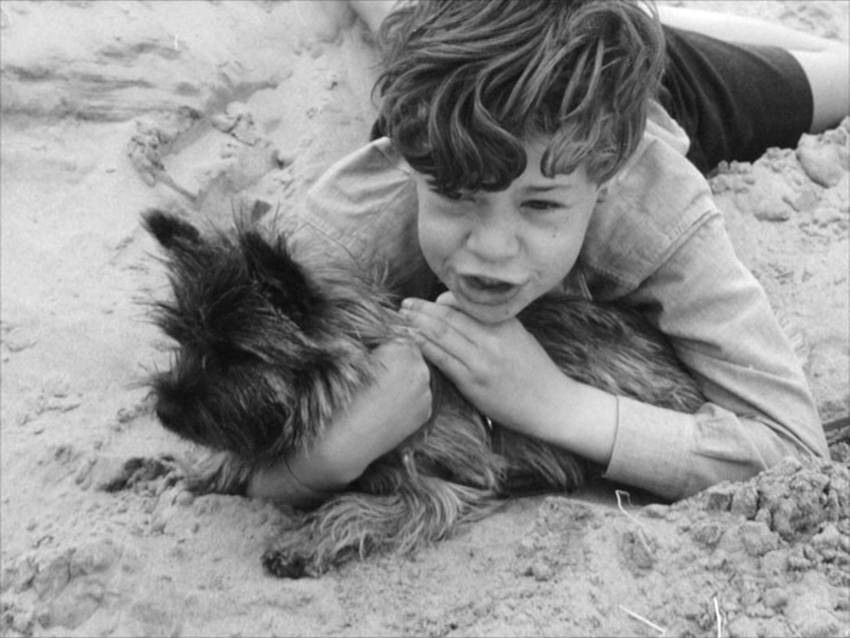
And it’s holiday time again, in Croyde, Devon, and the summer months give us a bigger ensemble than usual – four boys and two girls, plus a Cairn terrier called Bimbo. In 1960, gender division was back in force, with the girls back in skirts and their pastimes including toffee-making while the boys fix bicycles. And there’s another dispute over whose beach it is: theirs, or the army who are doing exercises there. The principle of Chekhov’s Gun applies, though here it’s Chekhov’s Unexploded Bomb, which leads to a tense finale with Bimbo nearly blowing everything sky-high. The children have to raise thirty-three shillings to enable a meeting at the village hall so that a petition can be heard to preserve the beach, and the girls’ toffees and even Bimbo become bargaining chips.
Christopher Witty, a child actor who went on to become a motor-racing journalist, has the central role of the youngest boy, Joey. Among the adults is Hilary Mason, who a decade and a third later was the blind psychic in Don’t Look Now, as three of the children’s mother.
DAVY JONES’ LOCKER
With this film, from 1965, the CFF pushed the boat out in more ways than one. It features extensive location footage from Malta, as well as plenty of underwater action too, and to make the most of it is also the first film in this set to have been made in colour. However, the production values do tend to weigh down a slim plot. Lieutenant-Commander Matthews (Anthony Bate) teaches skin-diving off the Maltese coast to his son Derek (Stephen Craig). Some children on holiday ask to be taught too, among them Susan (Susan George). However, her brother Spike (Michael Wennink) has other plans.
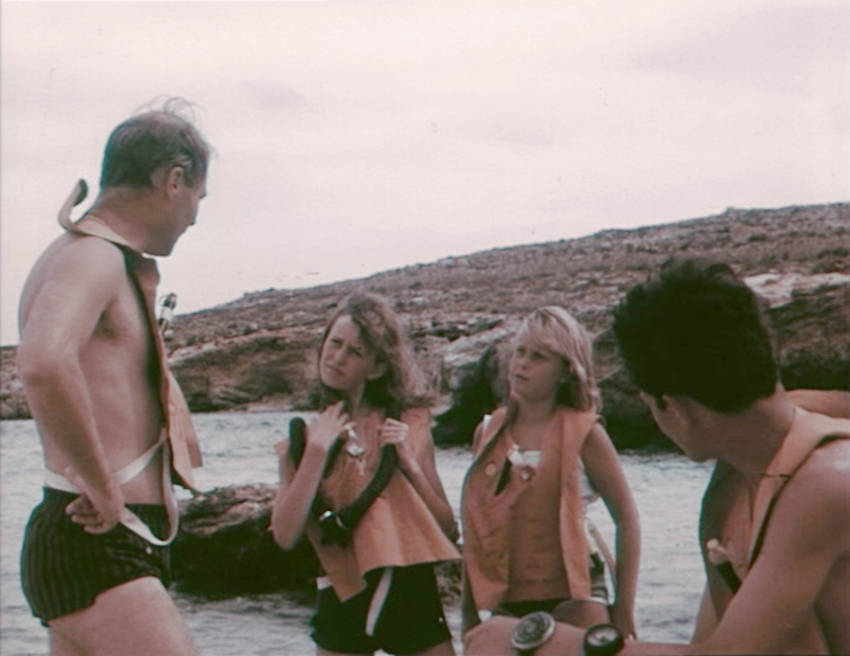
Susan George was fourteen or fifteen when she made this film, having made her debut in black and white the previous year in another CFF film, the award-winning Cup Fever (which can be found in the first of the BFI’s Bumper Boxes). She was a few years away from the sexy reputation she would have, in films from The Strange Affair (1968) onwards. The film does begin with a harder edge than usual for a CFF production of its time, but the threat isn’t all that intense and a bit too easily resolved. The scenery, both above the water and under it, is the main attraction.
LIONHEART
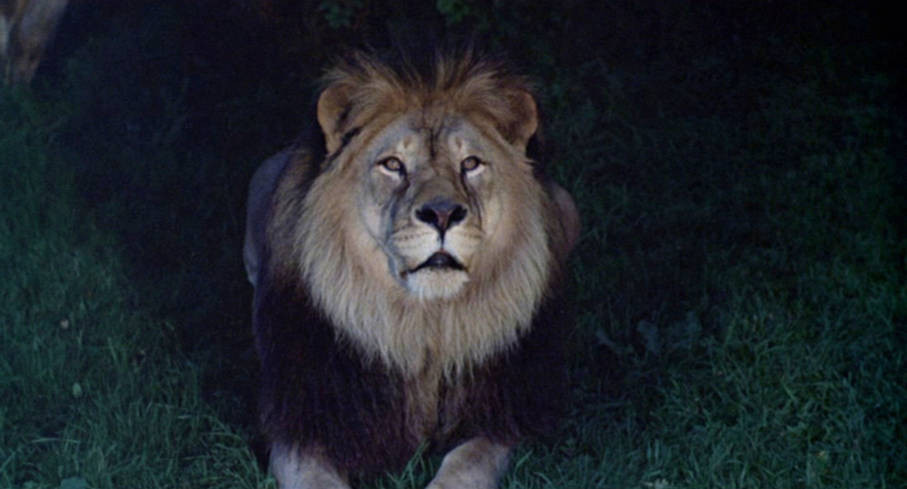
The last thing young Andrew (James Forlong, son of director Michael Forlong) expects to see in the back garden is a lion called Simba (who has top billing, though that’s because the cast are listed in order of appearance). But that’s what he does find, Simba having escaped from a circus in nearby Tonbridge. Andrew, with the help of his friend Robert (Ian Jessup) and the older Belinda (Louise Rush), hides Simba in the stables. Meanwhile, a group of hapless soldiers are on the hunt for the missing apex predator…
Anyone who worked for the CFF was surely aware of the adage never to work with children and animals – the first were a given, the latter often involved too. In this case, a well-trained big cat who is only in shot with anyone else in one scene, for obvious health and safety reasons. Lionheart, attractively filmed in Speldhurst, Kent, is a little slight, but that means just for once that just under an hour is about right, so it’s neither overstretched nor undernourished. The plot does stumble over the need for Andrew not to tell his parents that there’s a large carnivore (which could happily snack on one of them if he put his mind to it) on their property, nor does anyone think to look inside. Granted, his motivation is so that Simba won’t be shot by the soldiers, but if he had done the sensible thing the film would have been about five minutes long.
Lionheart is less of an ensemble piece than other CFF films, with Andrew sole lead for about a third of it, and the usual mix of boys and girls – here, two boys and a girl – only kicks in when Belinda arrives halfway through. Among the adults, Joe Brown (the rock ’n’ roll singer and guitarist, still with us) is the main comic relief as Private Worms, and also in the cast are a hammy Wilfrid Brambell with a thick accent as the family groundsman, Jimmy Edwards as the local butcher, and Irene Handl and Leslie Dwyer as the owners of the circus from whence Simba came. Among the children, Ian Jessup has only one other credit, in a 1994 episode of The Bill, assuming that’s not someone else with the same name. Louise Rush had made one film four years earlier and would act for five more years, including the decidedly family-unfriendly 1972 Stanley Long production Sex and the Other Woman, She died in 2006. James Forlong, eight or nine here, acted in two more CFF productions directed by his father: Raising the Roof (1972) and Hijack! (1976). He became a journalist and in 2003, after having been fired by Sky News for allegedly faking a news story, he took his own life. He was forty-four.
SMOKEY JOE’S REVENGE
Smokey Joe, in case you are wondering, is a traction engine which may – it’s implied more than once – be sentient to some extent. At least Debbie (Kay Humblestone) has a bond with it. She and her friends Jim (Nicky Cox) and Tom (Danny Martyne) acquire it from Mr Williams (Robert Dorning) who is glad to be rid of it. However, the children spend their time restoring and repainting Smokey Joe with an eye to entering it in the County Championship.
Mildly diverting stuff, energetically performed by the cast, which includes Gareth Thomas as a policeman who upholds the laws of the land but knows how to bend them if needs be. That’s useful when none of your principals are old enough to have a driving licence. Robert Dorning hams it up as the villain of the piece. Fans of old steam engines – who might be purchasers of another consistently selling BFI disc line, the British Transport Films – will notice quite a few specimens on display. Meanwhile Smokey Joe turns out to be partial to sweets, can say a few words and chase after the wrong ’uns in the cast.
BLACK ISLAND
Every once in a while, the CFF would come up with a film which doesn’t soft-pedal the tension and threat in a thriller (while still remaining within, then, U-certificate bounds) and doesn’t play for laughs. An example is The Hostages(1975), which is included in the fifth Bumper Box, and another is this one, made in 1978. On a school trip, Michael (Martin Murphy) and Joe (Michael Salmon) disobey the teacher’s instructions not to go into the forest next to the big field they are to explore for an hour. They find themselves on a shore and a boat, which sinks, but they find themselves on a small offshore island (shot on Osea Island in the Blackwater Estuary, Essex, also a location for both the 1979 television and 2012 cinema versions of The Woman in Black). However, they come across two criminals Jack (Michael Elphick) and George (Allan Surtees) who are using the island as a hideaway…
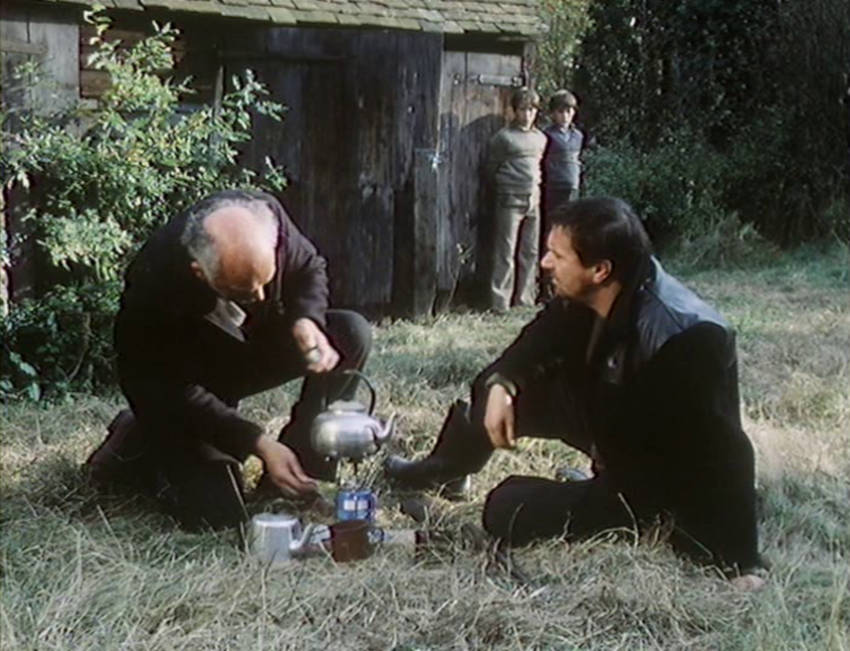
The two men, Elphick especially, play this completely straight and are genuinely threatening, with George sometimes mediating between his colleague and the two boys. That extends to threats of death at times. Meanwhile, the police are looking for the boys, including flying helicopters over the island. The film was directed by Ben Bolt, son of Robert. His only other cinema feature was The Big Town in 1987, made in the USA and starring Matt Dillon, and otherwise he worked on television. Bolt died in 2025, the day after his seventy-third birthday. If Black Island were twenty or so minutes longer, and given a normal cinema release rather than being confined to Saturday Morning Picture Shows, I suspect it might have a greater reputation in its small way.
DANGER ON DARTMOOR
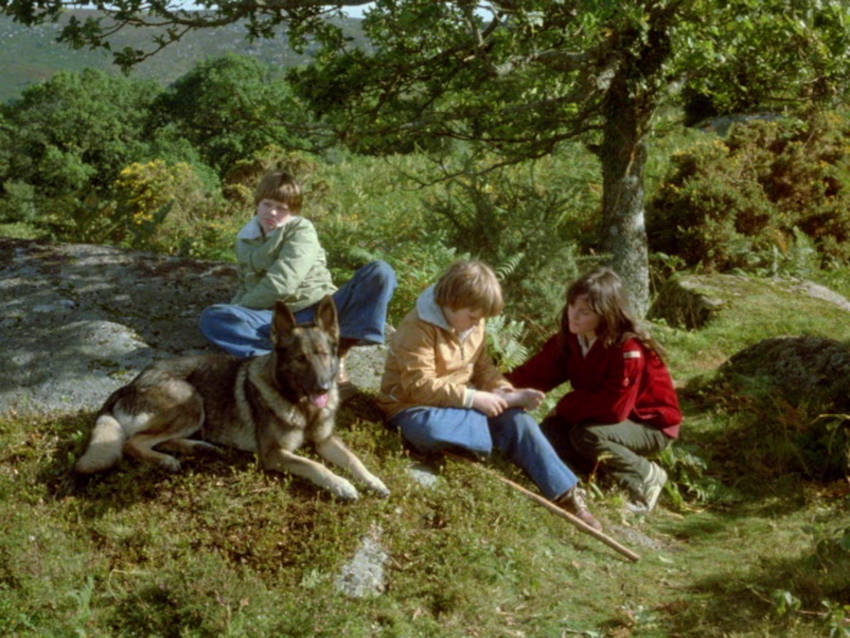
And here’s another. Robin (Marcus Evans) and Jonathan (Simon Henderson) aren’t looking forward to a visit from cousin Louise (Debby Salter) and they were not nice to her when they last saw her, four years before. But she’s now thirteen and quite the equal to them. Meanwhile, there’s an escaped convict (Barry Foster) on the run and hiding out on Dartmoor, and a dog is killing sheep on the moors too…
Danger on Dartmoor was directed by David Eady, but the notable name among the crew is Audrey Erskine Lindop, who wrote the story and screenplay with Dudley Leslie, her husband. She was a popular novelist of her day, but on screen she joins a notable number of dots. Her first screenwriting credit was in 1948 on the melodrama Blanche Fury and she also has writing credits on The Tall Headlines (1952) and The Rough and the Smooth (1959) and her novels formed the basis of three more films: The Singer Not the Song (1961), I Thank a Fool (1962), and I Start Counting (1970). Danger on Dartmoor was her and Leslie’s final credit.
The film is played completely straight, with Foster’s criminal not quite as threatening as Michael Elphick’s in Black Island but not to be trifled with either. Further down the cast are such notables as Patricia Hayes, Michael Ripper and Sam Kydd, and a well-trained dog called Demon. It’s a sign of the CFF moving with the times that, while children not long before this would have been using log tables and slide-rules at school, now Louise has a pocket calculator and it plays a part in the plot.
sound and vision
Children’s Film Foundation Bumper Box Vol 6 is a three-DVD release from the BFI, each disc, with three feature films and two shorts, encoded for all regions. Every film, feature or short, in this box set received a U certificate on its original release, but changing standards and sensitivities mean that this set carries a PG, which is for Davy Jones’ Locker,Lionheart, Black Island, Danger on Dartmoor and the short films Forest Pony, The Magnificent Six and ½: Billy the Kid and The Chiffy Kids: Room to Let. Our Magazine No. 6 is exempted from classification as it’s documentary material, though it bore a U on its original cinema release. The reasons stated on the sleeve for all this are “mild threat, violence, dangerous behaviour”.
As these are PAL DVDs, the films play at twenty-five frames per second instead of the cinematic twenty-four, so lose about two minutes of running time per feature, and if you have perfect pitch (I don’t), the soundtracks, music scores especially, will be raised by half a semitone.
The films are presented in a ratio of 1.33:1 apart from Lionheart, which is 1.85:1 and anamorphically enhanced. I’ve said it before and will no doubt say it again, but these were 35mm productions made for commercial cinemas, and the British industry started framing its output for widescreen in 1953. Much after the mid-1950s, commercial cinemas such as the ones these films played in could no longer show the old Academy Ratio. The oldest feature in this set dates from 1954, so is on the cusp of the changeover, but I’d go so far as to say that all nine in this set were intended for widescreen. Non-theatrical showings in 16mm (such as in schools) and on television would have been 4:3, so they were mostly shot full-frame for that reason. Giveaways include the headroom visible in just about every shot and sometimes barely perceptible tilts up and down to keep things in shot, which would not have been necessary if the films were actually intended for Academy Ratio. (There are two notable examples of the latter in One Wish Too Many – a lampshade at 18 minutes and a clockface at 34.) As Lionheart shows, and other films on past box sets did, watching the film it its actual intended ratio makes it seem more cinematic and not televisual.
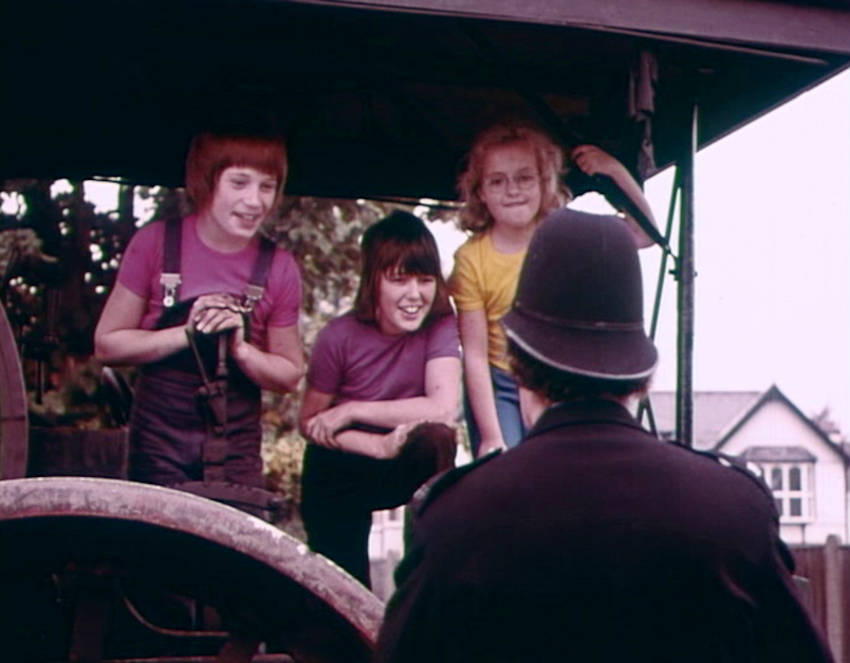
The films are sourced from the best available materials held by the BFI. The one in the worst condition is the first colour film, Davey Jones’ Locker. The source has clearly faded, with a noticeable magenta bias throughout, and it seems to have been transferred from a projection print as it is overly dark (no shadow detail in some scenes, especially ones backlit by the sun) and contrasty, and there are also cue dots where the reel ends would be. The same applies to Smokey Joe’s Revenge too, though to a lesser extent. With the other films, presumably mastered from earlier generations of source material, the pictures are sharp and colourful, with contrast and greyscale in the black and white films on point. There are some examples of minor damage, such as scratches and speckles, but nothing too untoward.
The soundtrack is mono in all cases, rendered as Dolby Digital 2.0. Not much to be said here: these were the work of men and women who were as much professionals as the rest of the crew, and dialogue, sound effects and music are clear and well balanced. Lipsynch occasionally wanders due to evident postsynching, but this isn’t too distracting and is inherent in the source material anyway. There are no hard-of-hearing subtitles on any of the films.
special features
Forest Pony (22:01)
In the British Film Industry, colour took over and black and white became largely commercially obsolete in the mid 1960s. Although they had started making films in colour by then, the CFF continued to produce monochrome as late as 1967, which was the year that colour television arrived in the UK and three other European countries (see Calamity the Cow, in the third Bumper Box Set). So why is this 1972 short in black and white? The answer is that this is a re-edited version of the first three episodes of a serial from 1949, Riders of the New Forest, which had been made by the Rank Organisation and had been donated to the CFF. Clearly the CFF didn’t have an issue with recycling old – and indeed, black-and-white old – material even in 1972: that was the year when they revised and reissued their 1954 Adventure in the Hopfields (see also the third Bumper Box). No doubt many of the audience were too young to have seen too much black and white material at the cinema, as most late-1960s examples were restricted to older audiences. However, the majority of them in 1972 would still have black and white television sets at home.
The film’s provenance is unfortunately rather obvious in the clothing and vintage cars, and the fact that more than half of the running time has been removed leads to a rather stop-start rhythm to the in-the-present-form rather perfunctory plot, with narration employed to plug the most obvious gaps. This is one for the more forgiving CFF connoisseurs. No follow-up was made, so the final two episodes of Riders of the New Forest remained on the shelf. Presented in 1.33:1 as this does date back to Academy Ratio days, though 1972 cinemas would have projected it cropped into their usual widescreen ratio. But I suspect their main aim was to keep the boys and girls quiet until the main feature started.
Five O’Clock Finish (17:50)
Another appertiser in the Saturday morning’s offerings, this one from 1954. Peter Butterworth has featured in short films in past Bumper Boxes in his character of Dickie Duffle, but here he plays a character actually called Butterworth. There’s not much difference between them, however. Here he is a mechanic charged with repairing a motorcycle and returning it to its rich owner by the five o’clock of the title. Little dialogue, but slapstick shenanigans ensue. Butterworth has refined his clowning act by now, though he’s obviously echoing Chaplin and Stan Laurel and looking forward to Norman Wisdom.
The Magnificent Six and ½: Billy the Kid (16:40)
If you were in your local fleapit on a Saturday morning in the 1960s and 1970s, as well as the main attraction you would see a supporting programme including one-reelers like this. The Magnificent Six and ½ are a gang of children, five boys and two girls, whose hideout is in a junkyard. The half of the title is the youngest, Peewee (Kim Tallmadge). If that sounds familiar, this was basically the source of the TV programme Here Come the Double Deckers!, which premiered and ran for seventeen episodes in 1971. Due to the success of The Magnificent Six and ½ – a series of six, made in 1968, followed by two more series – the idea was pitched for television. Rejected as lacking international appeal, the premise was tweaked and The Double Deckers, which was co-produced by the television arm of 20th Century Fox, was the result. So we have the rather larger child, called Stodger (Lionel Hawkes), seen eating a sneaky banana and not the doughnuts his less-than-PC Double Decker equivalent was named after. In a piece of colour-blind casting certainly not typical of the time, one of the boys is black, and he’s played by Brinsley Forde, the one of the regulars to become a Double Decker, before he was the vocalist and guitarist of Aswad.
In Billy the Kid, the title character is a goat, not inviting the kids to live deliciously, but the antics you might expect do take place. It’s broad, slapsticky stuff, shot in and around the streets in Borehamwood, with exaggerated sound effects for hopeful comic impact. But it kept the audience entertained while they waited for the main feature to start.
The Chiffy Kids: Room to Let (18:27)
After the Magnificent Six and ½ ran off into the sunset, along came The Chiffy Kids, in a series made in 1976. It doesn’t do much to vary the formula: there are five kids instead of seven, and if you hadn’t seen previous instalments, the song over the opening credits would introduce you to them. Once again, the smallest, “the one we all adore” (if you say so), is a girl with a nickname, here Magpie (Tracy Strand). In Room to Let, a tramp (Alfie Bass) has commandeered the gang’s headquarters and they try their utmost to eject him. The only other credited adult in the cast is Irene Handl, making her second appearance on this disc, as an old lady being helped across the road in one scene.
A CFF Production: Johnny on the Run (12:18)
Not for the first time, a Bumper Box Set includes a documentary on a film not actually included. So if you want to see Johnny on the Run (1953), it’s one of the three included in the BFI’s 2014 DVD set Runaways. It can also be watched in HD as an extra on the BFI’s now-out-of-print Blu-ray release of Cosh Boy. This look at the film, with substantial extracts from it is presented by Edward Molony with contributions from Professor Robert Shail, who points up the social comment that’s included in the plot. He also mentions that, especially at this early stage of its existence, the CFF worked on very small budgets and often hired people at the start of their careers, in this case director Lewis Gilbert. There are also a few words from an actor of similar age to Edward Molony, Jonah Paull.
Our Magazine No 6 (10:30)
Saturday mornings at the pictures leavened the thrills and laughs with a little bit of education. This was the sixth Our Magazine, from 1954, and it follows the usual magazine format, four brief items in just over ten minutes, taking us halfway round the globe and back again. We start in Southport with the soap-box derby, then down to Africa and a trip down a gold mine, helmets in case of rock falls but uncle still has to ride on the winch rope as there’s no room for him in the car itself. Then over to New Zealand and children feeding trout, then back to home base as we follow Tony and Gillian as they go round the Battersea Pleasure Gardens, something we’re told by the narrator that few children have been able to do.
Booklet
The BFI’s booklet, available with the first pressing of this release, runs to twenty-eight pages plus covers. Disc producer Vic Pratt takes the lead and contributes the opening essay and notes on all the features and all but one of the shorts. This is along the lines of what he wrote on previous Bumper Box sets: a big emphasis on kitsch, plenty of appeals to nostalgia (he’s a self-proclaimed child of the Seventies, though I suspect younger than me) and shout-outs to particularly notable music (the score of Smokey Joe’s Revenge features, he says, “trumpets, Hammond, Fender bass, flutes and fuzz guitar”). He also points out examples of trains and the like, for those curious who may be the buyers of the BFI’s British Transport Films discs. This does lead me to suspect that the audience for this release are nostalgic adults rather than the children they were originally made for, and today’s children might view these films as something out of the Ark, some of them in black and white even.
Elsewhere in the booklet, Chris Witty talks about his acting career, of which the lead in Rockets in the Dunes was a part, and not even his first film. (At the age of six, he was the son of Margaret Leighton and Ralph Richardson in The Passionate Stranger (1957).) Jason Gurr gives an account of the making of his documentary on Johnny on the Run. And, for those like me whose first encounters with the CFF came from rounds on the quiz show Screen Test, Trevona Thomson provides twenty questions on the films (plus two bonus ones) just to see if you were paying attention. No conferring!
final thoughts
This sixth CFF Bumper Box, two years after the fifth, is a release which knows its audience, which I have to assume is an adult one rather than children. To what extent said adults do show these films to their own children is a matter for market research. Yet that market is obviously there or the BFI wouldn’t have put out six of these sets, plus other CFF releases. It’s the same with the many volumes of British Transport Films, a relatively unsung line which also pays a good few bills and enables riskier stuff to be released. As such, if you have any of the earlier CFF sets, you know what to expect and you get it, as well packaged as these films are likely to be. The best films here are pacy, well made and stand up well, though ideas of pacing and social attitudes and language can be of another time. The CFF archive is large enough for me to expect Volume Seven in due course.
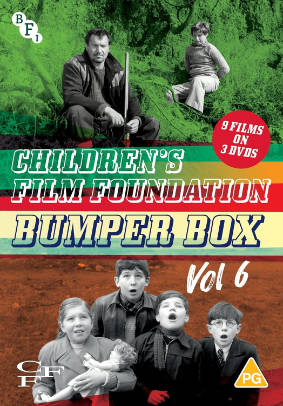
Children’s Film Foundation Bumper Box Vol 6
Mystery on Bird Island
UK 1954 | 55 mins
directed by: John Haggarty
script by: John Haggarty
cast: Mavis Sage, Vernon Morris, Jennifer Beech, Nicky Edmett, Roddy Hughes Bronson, Alexander Gauge
One Dish Too Many
UK 1956 | 53 mins
directed by: John Durst
written by: John Eldridge (screenplay); Mary Cathcart Borer (adapted for the screen)
cast: Anthony Richmond, Rosalind Gourgey, John Pike, Terry Cooke, Gladys Young, Sam Costa
The Cat Gang
UK 1958 | 48 mins
directed by: Darrel Catling
written by: John Eldridge (screenplay); G Ewart Evans (original story)
cast: Francesca Annis, John Pike, Jeremy Bulloch, John Gabriel, John Stacy, Paddy Joyce
Rockets in the Dunes
UK 1960 | 55 mins
directed by: William Hammond
written by: Gerard Bryant; based on the book by Lois Lamplugh
cast: Christopher Witty, Gena Yates, Heather Lyons, James Luck, Peter Wood, Gordon Adam
Davey Jones’ Locker
UK 1965 | 57 mins
directed by: Frederic Goode
written by: Wally Bosco
cast: Anthony Bate, Elizabeth Bradley, Susan George, Michael Wennink, Stephen Craig
Lionheart
UK 1969 | 56 mins
directed by: Michael Forlong
written by: Michael Forlong, Alexander Fullerton; from the novel by Alexander Fullerton
Smokey Joe’s Revenge
UK 1974 | 54 mins
directed by: Ronald Spencer
written by: Patricia Latham; Wally Bosco (original story)
cast: Kay Humblestone, Nicky Cox, Danny Martyne, John Barrett, Robert Dorning, Margaret Lacey
Black Island
UK 1978 | 53 mins
directed by: Ben Bolt
written by: Peter Smith, William Humble; based on a story by Peter Van Praagh
cast: Martin Murphy, Michael Salmon, Michael Elphick, Allan Surtees, Norman Tipton
Danger on Dartmoor
UK 1980 | 54 mins
directed by: David Eady
written by: Audrey Erskine Lindop, Dudley Leslie
cast: Marcus Evans, Simon Henderson, Debby Salter, Barry Foster, Patricia Hayes, Jonathan New
distributor: BFI
release date: 6 April 2026