
Upon my soul
A struggling artist buys a talisman that transforms his fortune without realising the true nature of the deal he has struck in the fascinating horror-tinged Faustian drama from 1943, THE DEVIL’S HAND [LA MAIN DU DIABLE]. Slarek keeps an appointment with a bureaucratic Old Nick with Eureka’s typically fine new Blu-ray.
When an avalanche cuts off access to the isolated Hôtel de L’Abbaye, the various guests gather in the dining room to gripe about how long they have to wait for dinner and what the innkeeper will serve them. When the sound of gunshots is heard outside, the innkeeper investigates but sees nobody and dismisses it as the work of smugglers again. With little to occupy them until the evening meal is served, the guests encourage one of their number to tell the scary tale that he promised to relate the previous evening. He’s only just started when there’s a knock at the door, which when opened reveals a nervous-looking man named Roland Brissot (Pierre Fresnay), who is carrying a small parcel that looked to me like a loaf of bread wrapped in string and brown paper. How wrong I proved to be. He also has a prosthetic left hand, something he angrily berates the guests for staring at, even though the hand is covered by a leather glove and does not look immediately artificial. He’s clearly very agitated and reacts with defensive hostility to any questions and angrily snaps at the innkeeper’s wife when she lightly and innocently lays a hand on his mysterious parcel.
It turns out that Roland has not arrived at the Hôtel de L’Abbaye by chance and he wants to know if the old, ruined abbey on the hill above has a cemetery and is clearly disappointed when the innkeeper assures him that it does not. He takes a room anyway and is halfway up the stairs when the front door opens again and two armed policemen enter. They announce that they’re looking for a strange man dressed all in black who is carrying a coffin-shaped box. This news really puts the wind up Roland, who is even more rattled when the policemen’s dog starts furiously barking at him. A short while later, dinner is served, and despite initially claiming he wanted no food, Roland comes downstairs for a meal anyway and takes a table apart from the other guests, still with his paper-wrapped parcel in his hand. This makes him the target of quiet gossip amongst the other guests, with one even suggesting that he’s a heroin addict. Now that’s not something I expect to hear in a film made back in 1943, particularly one produced in a country that was then under German occupation and for the German run Continental studio.
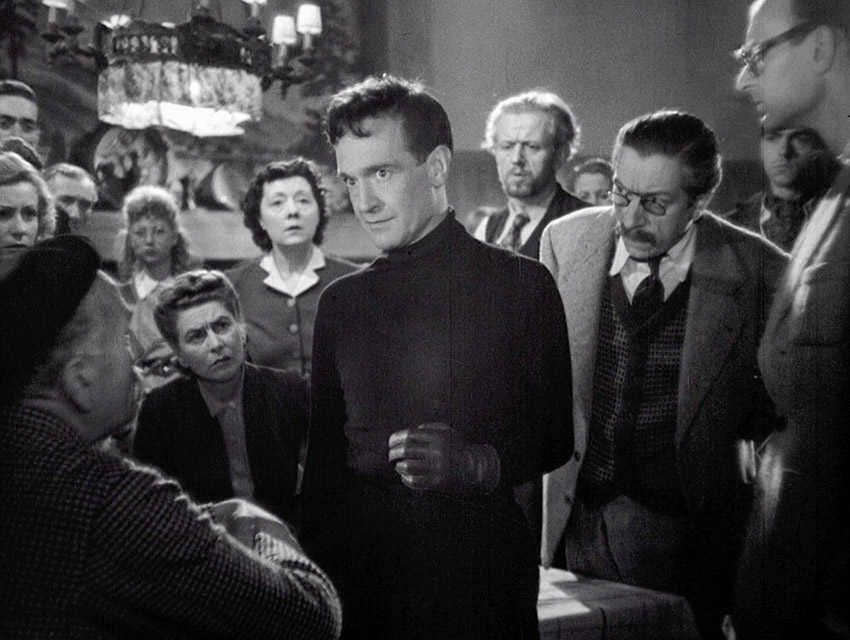
Given that nobody knows that he is at the hotel, Roland is further rattled when the house phone rings and the anonymous caller asks specifically for him, but when he takes the call he’s met only with silence. A sudden blackout alarms everyone except the innkeeper, for whom this appears to be another common occurrence, but when the lights come back on, Roland discovers that his preciously guarded parcel has vanished, which throws him into an accusatory panic. Although still distressed, he eventually calms down and agrees to tell the others the story of how he lost his hand and what brought him to this remote location.
All of the above and more is covered in a busily textured and waste-free ten minutes of screen time, with much of the rest of the story unfolding as a lengthy flashback that eventually circles back to Roland’s arrival at the Hôtel de L’Abbaye. His tale begins back when he was a struggling artist bristling with ideas for paintings that no gallery was interested in exhibiting. One day, when looking to buy a pair of gloves to feature in a future painting, he hits it off with newly employed saleswoman Irène (Josseline Gaël), who agrees to model for him, and in no time at all the two are a couple. A short while later, however, Irène has become weary of Roland’s lack of ambition and failure to find success, and in a restaurant one evening she breaks up with him and leaves. As Roland sits alone in a despondent stupor, he is approached by the establishment’s chef, who tells him of a talisman that transformed his fortune that he is willing to sell to Roland for the paltry sum of one sou (effectively, a penny). Sceptical though he initially is, Roland nonetheless follows the chef upstairs, despite being loudly warned not to buy the talisman by the kitchen hand as he does so. The talisman in question turns out to be a severed left hand, one that responds to commands issued to it by the chef, and is stored in a box that is the exact shape of the parcel that Roland was carrying when he entered the Hôtel de L’Abbaye. The chef explains how his culinary skills were completely transformed by his ownership of the talisman and how its power is transmuted into the left hand of anyone who possesses it, a claim he has already slyly demonstrated by casually rolling a cigarette with a single graceful movement of his own left hand. He admits to Roland that that he’s now desperate to sell because if he fails to do so before he dies, his soul will spend eternity in hell. It’s a claim that the still cynical Roland does not take seriously, even though we all know he absolutely should. When the chef starts talking enthusiastically about how the talisman could awaken previously unseen skills in an artist, however, Roland becomes intrigued enough to purchase it from the wildly grateful chef.
With the talisman in hand, Roland then heads for home, but his attempt to take a horse-drawn taxi hits a wall when the horse bolts as soon as he opens the cab door. He thus elects to walk, and when pestered by a persistent sex worker (again, this film was made in 1943…) he rebuffs her approaches and is challenged by her burly pimp, whom he knocks cold with a single punch with his left hand. When he enters his apartment, his dog runs away in fear, and almost without realising he rolls a cigarette using the exact same one-handed technique previously employed by the chef. He crashes out and sleeps in late the next morning but wakes to find that he has painted a whole string of darkly themed pictures that he has no memory of creating. They nonetheless impress the hell out of Irène, who apparently wasn’t serious about leaving him after all and is convinced that reputable art dealer named Gibelin (Guillaume de Sax) will buy them, despite his having never shown an ounce of enthusiasm for any of Roland’s work before. Buy them he does, and in no time at all things start really looking up for the painter, and all would be well were it not for the ordinary-looking little man (Palau) who keeps popping up to smilingly remind Roland of the potential consequences of the deal he didn’t even realise he had made.
There can be few reading the above who do not twig that The Devil’s Hand [La Main du diable] is a variation on the centuries old German folk story Faust, a story in which an individual is persuaded by the Devil to sell his soul either for intellectual, physical or material gain, depending on which version of the tale you consult. As well as literary interpretations, it’s been the basis for some notable film adaptations, my personal favourites being the cinematically glorious 1926 Faust by German maestro F.W. Murnau and the 1941 Hollywood production The Devil and Daniel Webster, which was directed by German émigré William Dieterle, who coincidentally had a prominent supporting role as an actor in Murnau’s film. Dieterle’s take illustrates how the tale has been worked and reworked over the years, being based on a stage play adaptation that was based on Stephen Vincent Benét’s 1936 short story of the same name, which in turn borrowed the name of its mischievous Devil, Mr. Scratch, from the similarly titled and Faust-influenced 1924 short story The Devil and Tom Walker by Washington Irving.
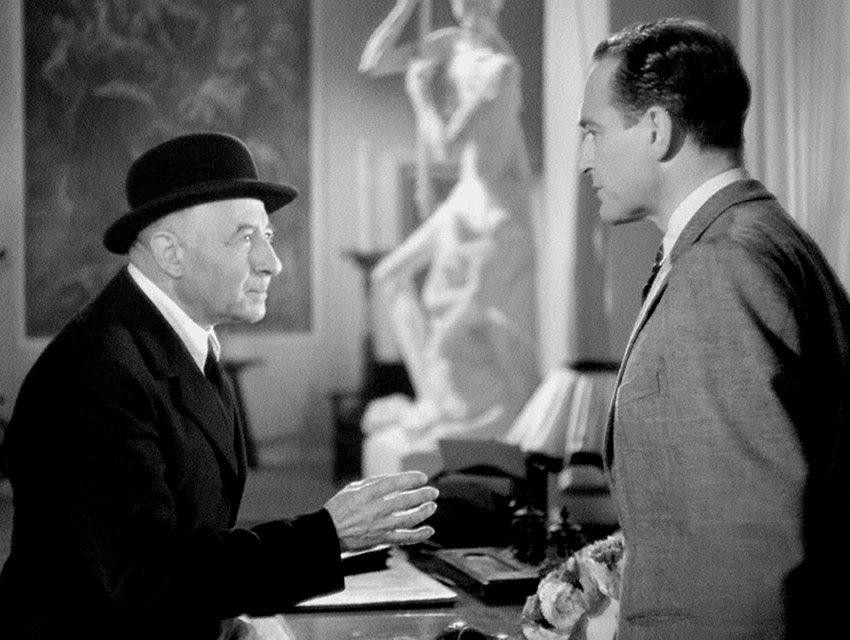
A key aspect of what made Dieterle’s film so memorable lay in its unconventional portrait of The Devil, who is wonderfully portrayed by Walter Huston as an ever smiling and mischievous trickster who cajoles penniless farmer Jabez Stone into selling him his soul in exchange for earthly wealth, success and happiness. It’s a similar story with The Devil’s Hand, whose Satan is about as far from the red-skinned and horned demon of legend as you could imagine, being portrayed instead as a perennially cheerful, middle-aged bureaucrat dressed in a black suit and bowler hat and carrying a briefcase. The appropriateness of this attire becomes clearer when Roland starts to have doubts about the deal he has made and this ‘Little Man’ (this is how he’s listed in the credits) gives him the chance to buy back his soul, with the proviso that he’ll lose everything he has since gained and that the monetary cost of this purchase will double every 24 hours, a mathematical quandary that the hesitant Roland fails to realise the full implication of.
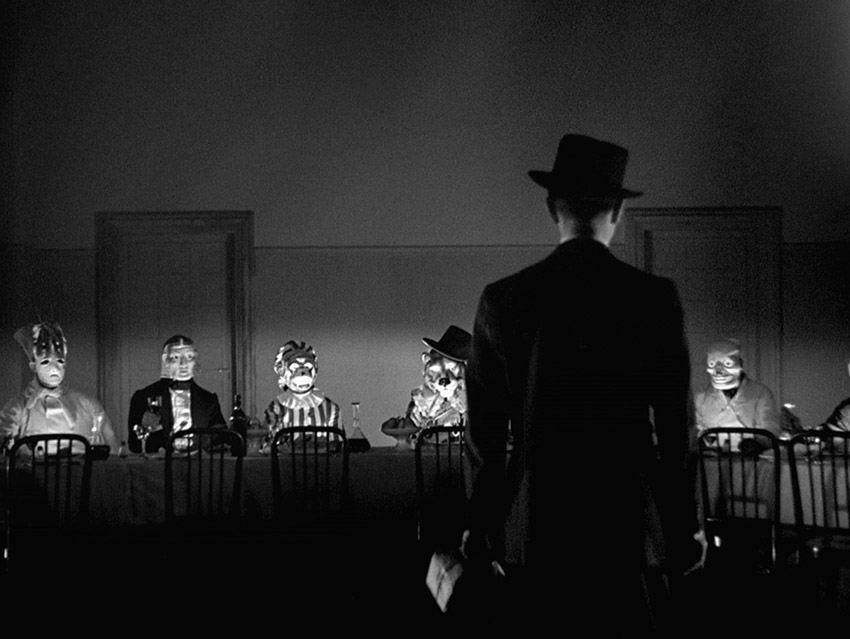
The Devil’s Hand was adapted for the screen by Jean-Paul Le Chanois from the 1927 novel of the same name by Gérard de Nerval, and was directed by Maurice Tourneur, and if you’re not instantly familiar with his work but that last name rings a bell, there are a couple of good reasons for that. Many of the films that Tourneur made both in his native France and across the pond in Hollywood have since been lost, but he made enough of a mark on the American film industry to earn a star on the Hollywood Walk of Fame. That said, the passing of time has seen his achievements overshadowed by those of his son Jacques, whose impressive filmography includes horror classics Cat People (1942), I Walked with a Zombie (1943) and The Leopard Man (1943) for producer Val Lewton, as well as Outsider favourite Night of the Demon (1957), and even the 1963 comedy-horror The Comedy of Terrors. On the evidence of The Devil’s Hand, you can’t help wishing that his father had dabbled with the genre more frequently, as while not a straight up horror, there are several horror-inflected sequences that really deliver and climax in a strikingly designed, photographed and directed late film dive into carnivalesque surrealism, an extraordinary series of expressively stylised sequences whose opening shots have the look of a test run for the ceremonial scenes of Eyes Wide Shut (1999) using masks and costumes from the finale of The Wicker Man (1973). Just about every commentator I’ve read has highlighted the influence of W.W. Jacobs’ celebrated short story The Monkey’s Paw on the film, and while this may be a stretch, I did wonder if its proposal that the cursed individual could free themselves from the Faustian arrangement by selling the talisman to someone else for less than they paid for it was a partial inspiration for the transferable curse central to David Robert Mitchell’s It Follows (2014).

Judged purely on its own merits, The Devil’s Hand is an imaginative, smartly executed and consistently absorbing slice of horror-tinged fantasy cinema, but is all the more so for being made under the watchful eye of a not exactly friendly occupying army. It’s hard, after all, not to read the film’s presentation of the Devil as a smiling bureaucrat as a smuggled message about the benign face of evil, and the fate that befalls Roland as a warning about the dangers of collaboration. It’s partly this that kept me rooting for Roland and hoping he’d wake up and smell the sulphur, a loyalty to the character that is most sorely tested when the dopey bugger is on the brink of buying back his soul, only to then hesitate because his beloved Irène enters the room. It’s here that the metaphoric elements of the film still have a very modern ring. By this point, even Roland has become acutely aware that the loyalty of the woman he loves is tied to the material gain that his deal with the Devil has gifted him, and the fact that he has to contemplate whether losing both is worth spending an eternity in Hell seems to me to tell you all you need to know about the innate amorality of the super-rich.
sound and vision
Presented in 1080p from a restoration by the Gaumont Film Company, the 1.33:1 image here may not be reference quality, but it’s still an impressive restoration and transfer, and it’s a testament to how remarkable the best such restorations have looked in recent years that I would judge one as good as this to be just shy of top tier. The contrast is nicely graded and has a pleasing degree of punch, with beefy black levels and no burn-out on whites, and the image detail is generally well defined. The transfer is clean, though very faint traces of former wear are just visible in some shots, a few of which have just the smallest amount of jitter, something most will not even notice unless they’re looking for it. The best material is in excellent condition, and a film grain is visible throughout.
The original mono soundtrack is presented here as Linear PCM 2.0 and despite the expected age-related tonal range restrictions, the dialogue, music and sound effects are always clear. If you crank up the volume, a small amount of background hiss and fluff can be heard, but at normal listening levels this should not be an issue.
Optional English subtitles for the hearing impaired have been included.
special features
James Oliver Commentary
Film critic James Oliver delivers an enthralling commentary on a film that he champions up front as one of the great examples of French fantasy cinema. He outlines the restrictive political situation under which the film was made, delivers an impressively concise history lesson on the German occupation of France during WWII and the work of Continental films, and provides details on the development and production of The Devil’s Hand and the personnel involved. He even shares the intriguing news that this film and I Walked with a Zombie – which was directed by director Maurice Tourneur’s son Jacques – premiered in their respective countries on the very same day. There’s so much more of real value here. Excellent.
The Devil’s in the Details – Fantastic French Cinema Under Occupation (18:31)
An absorbing and educational new video essay by film historian Samm Deighan that explores how French cinema was forced to adapt during the dark period of German occupation and how this led to a rise in fantasy cinema, with special attention paid to Marcel Carné’s 1942 The Devil’s Envoys [Les visiteurs du soir] and, of course, The Devil’s Hand. Deighan makes the point that the film is not merely a variation on Faust and notes the influence The Monkey’s Paw and the connection to The Devil and Daniel Webster, as well as what is described here and by James Oliver in his commentary as “hand horror,” a subgenre that also includes the likes of The Hands of Orlac [Orlacs Hände] (Robert Wiene, 1924), Mad Love (Karl Freund, 1935) and The Beast with Five Fingers (Robert Florey, 1946).
Continental: French Cinema in The Devil’s Hand? (46:08)
A 2010 documentary by Pierre-Henri Gibert that explores the experience of working for Continental films when France was under Nazi occupation, built around interviews with screenwriter Jean Cosmos, film restorer Serge Bromberg, film historian Pierre Billard, cinematographer turned director Alain Choquart, and The Devil’s Hand producer Alfred Greven. The discussion itself is interesting, with Greven’s first-hand experience being the most valuable inclusion, but with film clips limited primarily to The Devil’s Hand, talking heads do tend to dominate, which does make the piece feel longer than it actually is. An attempt to liven this up with that annoying trick of filming interviewees from two very different angles and cutting purposelessly between them – which here crosses the line of action every time, making it look as if the interviewee is suddenly talking to a different person – did not go down well with this particular viewer. The content is still absolutely worth the effort, though.
Also included with the release disc is a Limited Edition Collector’s Booklet featuring new writing on director Maurice Tourneur by French cinema expert Barry Nevin, but this was not supplied for review.
final thoughts
A fascinating, arrestingly handled and consistently involving Faustian tale whose fantasy horror elements build to an extraordinary sequence in which reality takes a back seat to surrealism before circling back to the opening scene for a surprisingly downbeat finale. Eureka does well by this remarkable film with a very fine restoration and transfer, an excellent commentary, a fine video essay, and a documentary whose worthwhile content overrides any small qualms I might have about the presentation. You also get a booklet that I haven’t yet seen but which I’m sure will make for interesting reading. Really enjoyed this one, and the disc itself thus comes highly recommended.
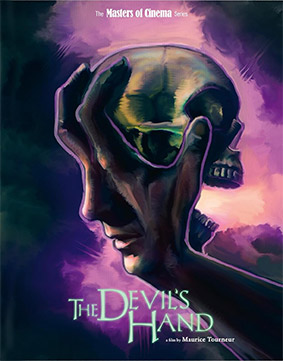
The Devil’s Hand [La Main du diable]
aka Carnival of Sinners
France 1943 | 81 mins
directed by: Maurice Tourneur
written by: Jean-Paul Le Chanois; based novel by Gérard de Nerval
cast: Pierre Fresnay, Josseline Gaël, Noël Roquevert, Guillaume de Sax, Pierre Larquey, Gabriello
distributor: Eureka
release date: 16 March 2026