
Negatives
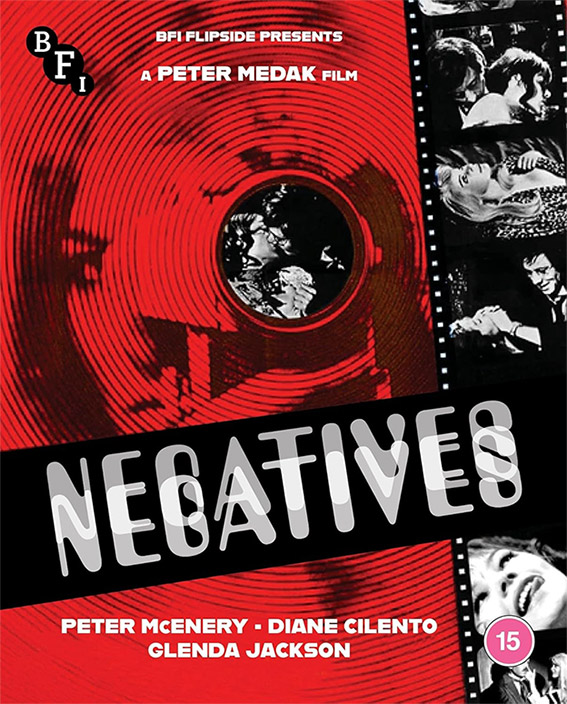
Erotic gameplaying with Peter McEnery, Diane Cilento and Glenda Jackson in NEGATIVES, the debut feature of Peter Medak, made in 1968. The BFI have released it on Blu-ray as Flipside number 53. Review by Gary Couzens.
London. Theo (Peter McEnery) runs an antique shop with his wife Vivien (Glenda Jackson). Outside business hours, their erotic life is based in cosplaying (to use a term not current when the film was made), specifically his playing the well-known murderer Dr Crippen and she either his wife and victim Cora or his mistress and accomplice Ethel Le Neve. Then into their lives comes German photographer Reingard (Diane Cilento) who moves in to their spare room. She sees a likeness in Theo to another man from the early twentieth century, World War One flying ace Manfred von Richthofen, the “Red Baron”…
Negatives was written by Peter Everett and Roger Lowry (a pseudonym of director Peter Medak, in a smaller font than Everett’s name), based on the former’s novel. That was published in 1965, having been written in three weeks, and it won the Somerset Maugham Award. It was the feature directing debut (after some television work) of Hungarian-born Medak. The film is an oddity, very much a product of the late 1960s, a hermetic three-hander (with Maurice Denham turning up in three scenes as Theo’s hospitalised and dying father) almost entirely shot in the studio. The rooftop was a set built on the backlot at Shepperton Studios. Actual locations included Fulham for the antiques shop and near Heathrow for the scrapyard where Theo acquires his plane to live out his Red Baron fantasy. The film was shot over seventeen days, beginning in March 1968. Ultimately this is a piece about a love (or otherwise) triangle, the dialogue evoking a Pinteresque power struggle between the two women over the rather passive Theo, played out in their competing fantasies for him.
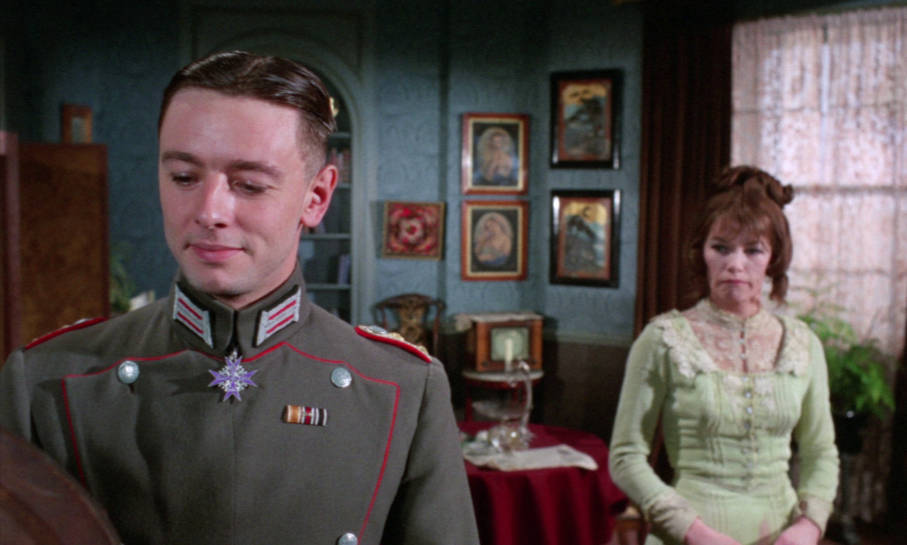
The film is of its time in the way it’s directed, with Medak employing a lot of close-ups, not forgetting big close-ups (watch how Vivien’s beauty spot swaps from one cheek to the other, though). Also in the way it’s edited as Barrie (credited as Barry) Vince explains in his interview on this disc, with sequences involving hard, aggressive cross-cutting, including jagged memory flashbacks. That was something that was in the air at the time – it’s not as extreme as, say, Performance (filmed the same year, 1968) but certainly in that ballpark. Ken Hodges’s camerawork has that heightened look of many a late-1960s Eastmancolor shoot, with the red that Theo has the plane painted particularly vivid. The three lead performances are strong. Negatives is certainly intriguing, but what it isn’t is at all emotionally engaging: it’s a story of strange people told at arm’s length. The production design, particularly in the antiques shop, is full of the renascent Victoriana which was in the air in 1968. With the Crippen material, make that Edwardiana as well. The film does assume some knowledge of the Crippen case, it having been a major cause célèbre nearly sixty years before this film was made.
What the film also wasn’t, was especially commercial. It was made for Paramount, to whom Medak was under contract, but they declined to release the result. The film was passed by the then British Board of Film Censors on 6 August 1968, submitted by the production company (Kettledrum Films) rather than its eventual distributor. It wasn’t released until 5 April 1970 (following a European premiere late the night before, with a Q&A featuring Glenda Jackson) and its main London venue was some way out of the West End, the Essoldo in Chelsea. Someone who did see it was Ken Russell, according to Medak, who cast Glenda Jackson in Women in Love as a result – though unless he saw the film before release or while it was in production this is a little doubtful, as his film was in cinemas before Negatives. The film had a brief later run in 1970 as the second half of a double bill with a reissue of Accident (1967), quite a good pairing with hindsight, as both are stories of brittle powerplays between men and women. (Accident had an A certificate, though, so the X-certificate Negatives would have prevented any under-eighteen cineastes from seeing the double bill.) The film did better on its American release though, having premiered in New York in October 1968.
Negatives has not had a release on video or disc before now, and its only UK television showing was on Channel 4 on 24 June 1988 – or rather the early hours of Saturday 25th as it started after midnight. So this is the sort of film the BFI Flipside label was set up to spotlight, films which have fallen into neglect since their release, limited or otherwise, and which have frankly not been easy to see at all for many years. Negatives remains a Sixties deep cut, a footnote in the careers of those involved, who would all go on to bigger and more high-profile things. Medak’s next film was A Day in the Death of Joe Egg (1972), from the play by Peter Nichols, and then he made The Ruling Class (1972), written by Peter Barnes, also based on a play, which features an all-guns-blazing Oscar-nominated performance from Peter O’Toole.
sound and vision
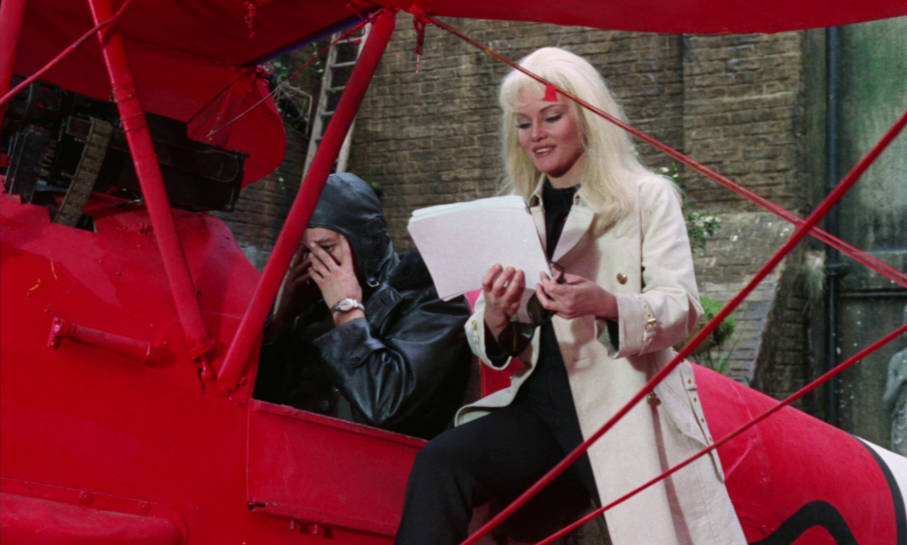
The film was shot in 35mm Eastmancolour and the Blu-ray transfer is derived from a remastering of a 4K scan of the original negative. It is presented in the ratio of 1.66:1. It’s a colourful film, those reds especially, and blacks are solid and grain natural and filmlike.
The soundtrack is the original mono, rendered as LPCM 2.0. Not much really to say about this: the dialogue and sound effects are clear and are well-balanced with Basil Kirchin’s fairly spare score. English subtitles for the hard of hearing are available on the feature only. There are a couple of errors I picked up – “Uhlands” for “Uhlans” (at 35 minutes) and “N’est pas?” for “N’est-ce pas?” (at 45).
special features
Commentary by Tim Lucas
Many of the extras on this disc are carried over from Severin’s Blu-ray release, including this commentary from 2025. Given that Severin are an American company, Tim Lucas begins by talking about its fate with the American censor, hovering between an R and an X before ending up as the former. Lucas gives a thorough account of the film’s making. He also talks about the lives and careers of the principal cast and crew, managing to make this more than simply reading a list of titles from the Internet Movie Database. On a personal note, at the age of ten he not only knew who Peter McEnery was but wanted to be him.
Audio interviews with Peter Medak (89:35)
This item is two separate interviews with Peter Medak both carried out in 2024, joined together at 49:54. First up, recorded in March, is the late Lee Gambin, an interview carried out shortly before his death. This is presented as a monologue by Medak, with Gambin’s questions edited out and just a few responsive noises from him off-mike. This is followed by a brief piece by Severin’s David Gregory paying tribute to Gambin, then Gregory himself in November 2024 at Medak’s home, with some interruptions by a dog. This interview is a back and forth between the two men.
In both of these interviews, Medak is mourning the recent passing of Glenda Jackson. He owns up to “Roger Lowry” being himself under a pseudonym, as he didn’t want to have his name on the credits twice and being conscious of how “terrible” his English is. (At the age of eighty-six at the time of these interviews, he says he’s still learning.) Peter Everett wrote the first draft and “Lowry” rewrote it. Medak says that Everett was a little difficult and may have wanted to direct the film himself, and he marvels that he was able to do that himself. He confesses to a Bergman and Buñuel influence and though the latter should have made the film. He tends to be effusive in his praise of the people he’s worked with. As well as Negatives, he talks about his later films Romeo is Bleeding, The Krays and Let Him Have It. There is also a discussion of Stephen Lewis, who has a small role in Negatives and who had written and acted in Sparrows Can’t Sing (1964), on which Medak was assistant director to Joan Littlewood, before his later fame as Blakey in the television sitcom On the Buses and its three spin-off feature films. He feels that if you can make one notable film a decade you’re doing well, and he considers his first three to be perfect, all of which were shot by Ken Hodges. In the Gregory interview he says that Negatives had some trouble with the BBFC, with John Trevelyan wanting to make cuts – the film was passed uncut eventually and it’s hard to see what you could cut, given the adults-only audience. There are a few errors – Medak credits the play of Marat/Sade to Peter Brook rather than author Peter Weiss, though it was Brook who produced the stage version where Medak first saw Glenda Jackson and directed the 1967 film version.
These interviews play as an alternative audio track to the main feature and when they finish the film’s audio takes over for the last seven and a half minutes.
False Positive (10:41)
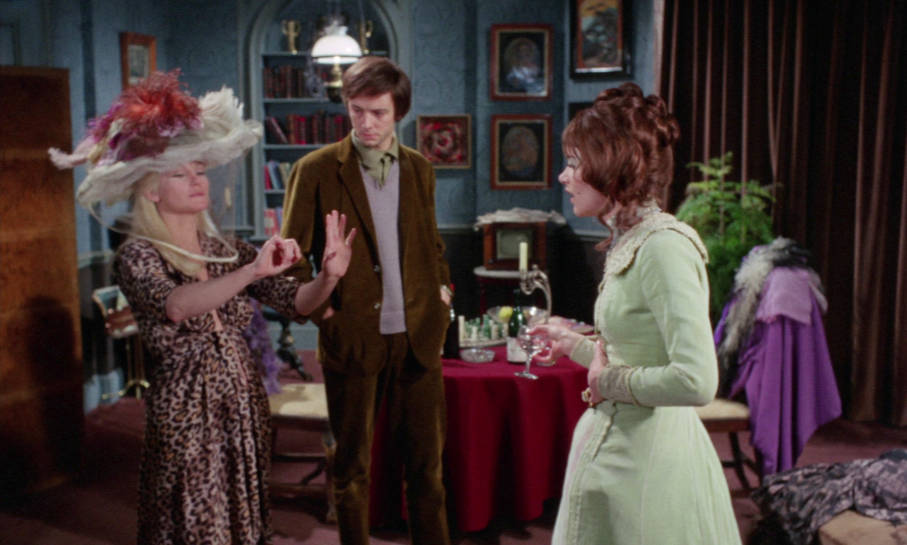
This interview with Peter McEnery by an offscreen Dr Josephine Botting, her questions edited out, is new to this release. He read the script of Negatives after acting in a French film (which he doesn’t name, but it was I Killed Rasputin (J’ai tué Raspoutine), 1967) and thought that playing a very introverted character made a change from the extrovert one he had just played. He has had quite a career in France as well as his one at home, having worked with Roger Vadim and Jane Fonda in The Game is Over (La curée) back in 1966. He talks about the making of the film, mostly in the studio with the rooftop being in the backlot, though the antiques shop was in Fulham and the scrapyard where he found the biplane near Heathrow. He didn’t have many dealings with source author and co-writer Peter Everett, sensing that he disapproved of him for some reason. He does make an error by saying that Negatives was Glenda Jackson’s first film, as she had been in Marat/Sade in 1967 and had had uncredited bit parts in This Sporting Life (1963) and The Extra Day (1956).
Editing Negatives (30:48)
In the spotlight is editor Barrie Vince, in his nineties, in an newly-made interview. Negatives was Vince’s third feature film as editor, he says (it was actually his fifth). Vince credits John Boorman, with whom he went to school, with his breaking into the film industry. He suspects that Boorman put a word in for him to producer Judd Bernard when he was putting Negatives together, as Bernard had produced Boorman’s second feature Point Blank (1967). He also credits Peter Medak with knowing what he was doing on his own first feature, as he found the film very easy to edit. The extended running time allows him to go into detail, breaking particular scenes. Editors are principal crew members we don’t often hear from in disc extras, so this is recommended to filmmakers out there. Vince quotes an online review which was one of the few to mention his contribution, describing it as “exhibitionist”, though Vince says that the style of hard intercutting was very much à la mode in 1968, when the film was made. Twenty-two minutes in, following a fade to black, Vince talks about Basil Kirchin’s music score. Kirchin was another Boorman connection, having worked on the director’s first feature Catch Us if You Can (1965). He asked Peter Medak what type of music he wanted, and the reply was “semi-classical”, which resulted in a theme featuring piano and a treble or soprano recorder. Vince describes the film’s recording session when a jazz combo, in sunglasses and (he possibly slanderously suggests) likely high, and the discordant result was exactly what wasn’t wanted and it wasn’t used.
Positives from Negativeland: Scrapbook from a Grand Debut (15:43)
Peter Medak at home, showing us the large scrapbook he kept for Negatives, as he does for all his films. Claude Chabrol at one point was to film Negatives, but somehow he says he got the job for his first feature. He also shows us stills and press cuttings from A Day in the Death of Joe Egg (1972).
The Doctor Will See You Now (23:43)
Over to Dr Clare Smith, curator of the Metropolitan Police Museum, who gives us a run-through of the life of Dr Hawley Harvey Crippen. This starts with his birth in the USA, his practice as a homeopathic physician and practitioner in New York City, where he met and married his second wife Cora. In the UK he worked as a distributor of patent medicines while Cora had a career as a music-hall singer under the name of Belle Ellmore. He met Ethel Le Neve, and they became lovers. Then, in 1910 Cora disappeared. Crippen and Le Neve fled and sailed to Canada, with the latter dressed as a boy and pretending to be his son. However, people on board did notice signs of affection between them not in keeping for a father and son. However, by then Cora’s torso had been found and the ship’s captain recognised Crippen from the newspaper reports. Crippen’s arrest was the first to be enabled by modern wireless technology and Chief Inspector Walter Dew of Scotland Yard travelled in a faster ship and apprehended him on board. Crippen was tried and executed later that year.
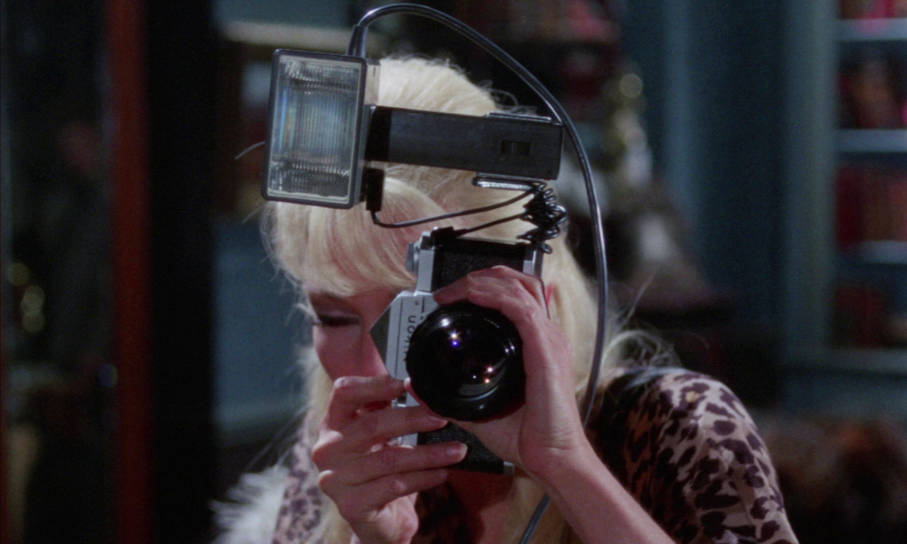
Smith goes through this in some detail, illustrated by still photographs and newspaper cuttings, and scenes from the 1962 film Dr Crippen, starring Donald Pleasence as the doctor, Coral Browne as Cora and Samantha Eggar as Le Neve. She also shows us other examples of the case’s impact on popular culture, including a clip from 1970’s Carry on Loving. Smith also highlights the way that Negatives is an early example of Peter Medak’s interest in true crime. He would go on to make in quick succession The Krays (1990) and Let Him Have It (1991), the latter the story of the Derek Bentley case.
Image gallery (2:45)
A self-navigating show of stills, all in black and white.
Booklet
The booklet with the first pressing of this BFI release runs to twenty pages plus covers. It begins after a spoiler warning with “Negatives Exposed” by Dr Josephine Botting. She covers the film from its inception and its differently successful releases in the USA and the UK. There is some more about Peter Everett, who seems to have got along with practically nobody on this film and the one he set up and did direct after leaving this production (The Last of the Long-Haired Boys, made and BBFC-certified in 1969 but never released). Botting explores the themes and style of Negatives, and points up the coincidence that it was in cinemas at the same time as Entertaining Mr Sloane (1970), which also featured Peter McEnery at the heart of an unconventional threesome, though male/male/female rather than female/male/female. She does conclude that the film is one to appreciate rather than like.
After a cast and credits listing for Negatives, William Fowler is next with a biography of Peter Medak, the films he highlights being The Ruling Class, The Krays and the ghost story The Changeling (1980). Fowler points out that Medak went up the ranks of the film industry fast when, newly in the UK after leaving Hungary in the wake of the 1956 uprising, beginning by sweeping floors and being a message boy. The seeds of The Krays may have been sown early on, as the twins were around during the Sparrows Can’t Sing shoot. Medak relocated to Hollywood in 1963 and worked in television there before returning to the UK two years later for the big-scale coproduction for the small screen, Court Martial. After he became a film director on Negatives, he worked on both the big screen and the small, with episodes of The Persuaders and Space: 1999 on the latter. A bad experience on the Peter Sellers film Ghosts in the Noonday Sun (1974), with Sellers firing everyone except him and the suicide of his then wife meant he didn’t direct again for four years, returning at the end of the decade. Fowler also discusses some of Medak’s recurrent themes, an element of artifice and playacting and an interest in true crime both being present in Negatives.
The booklet is dedicated to the memory of Lee Gambin. It also includes notes on and credits for the extras and plenty of stills.
final thoughts
Peter Medak may regard his feature directing debut as a perfect film, but audiences and many critics didn’t agree and the film has been out of circulation for a long time. So kudos to the BFI for releasing it as part of their Flipside line and there are several useful extras.
Negatives
UK 1968 | 98 mins
directed by: Peter Medak
written by: Peter Everett, Roger Lowry
cast: Peter McEnery, Diane Cilento, Glenda Jackson, Billy Russell, Norman Rossington, Steven Lewis, Maurice Denham
distributor: BFI
release date: 16 March 2026