
Get Carter
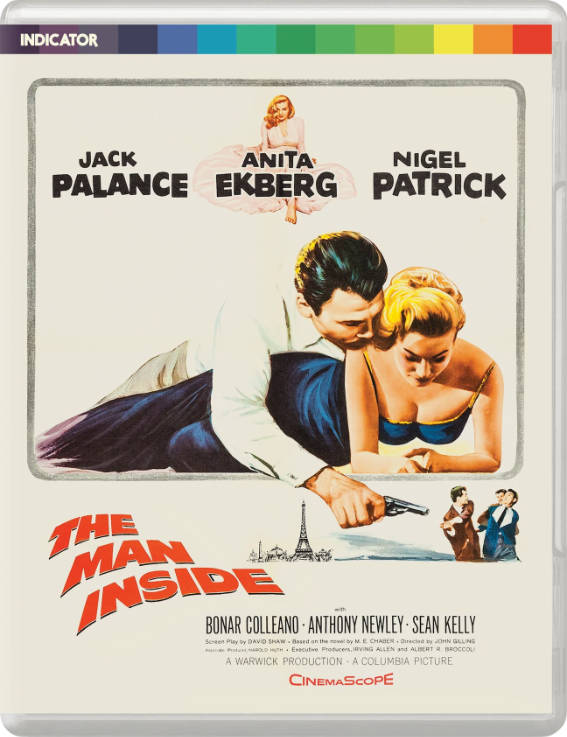
A mild-mannered bookkeeper steals a valuable gem and is pursued across Europe by professional investigator Milo March in THE MAN INSIDE, director John Gilling’s adaptation of the novel of the same name by M.E. Chaber. Slarek finds himself in two minds about the film but has no such qualms about Indicator’s typically strong Blu-ray.
Mild mannered English bookkeeper Sam Carter (Nigel Patrick) works for an accountancy firm whose long-standing clients include a gemstone company located in a large New York office block run by one Robert Stone (Gerard Heinz). How’s that for a bit of nominative determinism? It’s clearly something that Stone himself was well aware of, hence his decision to name his company The House of Stones. One lunchtime, when Stone is alone in his office inspecting his latest collection of diamonds, Carter arrives to discuss a concern he has about the firm’s accounts. When Stone enters his walk-in safe to retrieve them, however, Carter locks him inside and helps himself to the diamonds on Stone’s desk and his prized possession, an immensely valuable gemstone known as the Tyrahna Blue. Stone immediately presses a button that triggers a flashing warning light on his desk, prompting Carter to hurriedly gather his spoils and depart, but as he enters the elevator to exit the building, he passes Stone’s secretary on her way back from lunch. On entering her boss’s office, she immediately sees the flashing light and triggers an alarm that prompts the overly chatty elevator operator stop the car and attempt to return it to the floor on which Stone’s office is located. Carter tries to stop him, but when the operator shakes him off, Carter pulls a gun, coldly shoots the man dead, and makes his escape.
As Carter has been visiting the firm for fifteen years (he was greeted on friendly first-name terms by both Stone’s secretary and the elevator operator), the authorities are fully aware who committed the crime but have no idea where he currently is or even what name he might soon be travelling under. With the police getting nowhere, the insurance company that underwrote the Tyrahna Blue hires respected investigator Milo March (Jack Palance) to track Carter down and retrieve the gemstone before he is found by the professional criminals that they know are already on the trail of this enterprising amateur. March is met at the airport by insurance company representative Franklin, and yep, that’s our beloved Sidney James sporting an American accent in his days as a character actor before he struck comedy gold. When Milo and Franklin question Stone about the theft, he likens his own obsession with the Tyrahna Blue to one a man might otherwise have for a beautiful woman, even suggesting that Carter effectively eloped with the gemstone. “I don’t condone him stealing it,” he tells the two men, “but I can understand why he did it. He took it because he fell in love with it.”
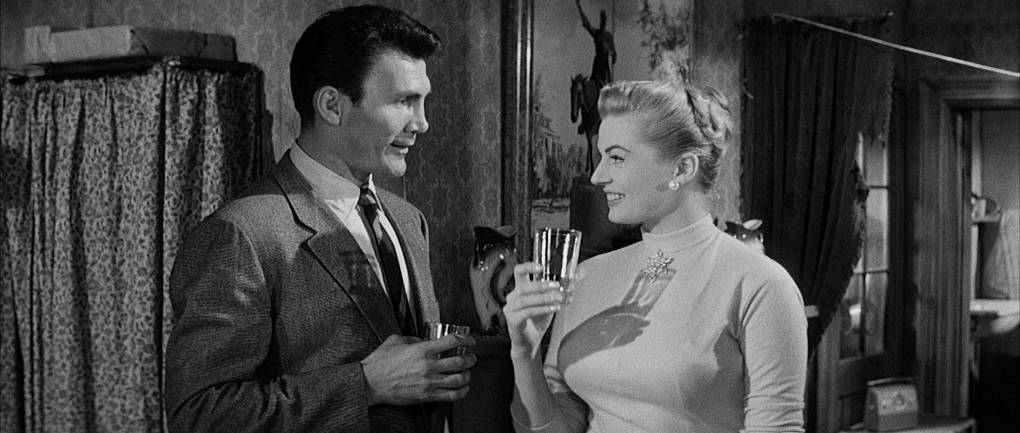
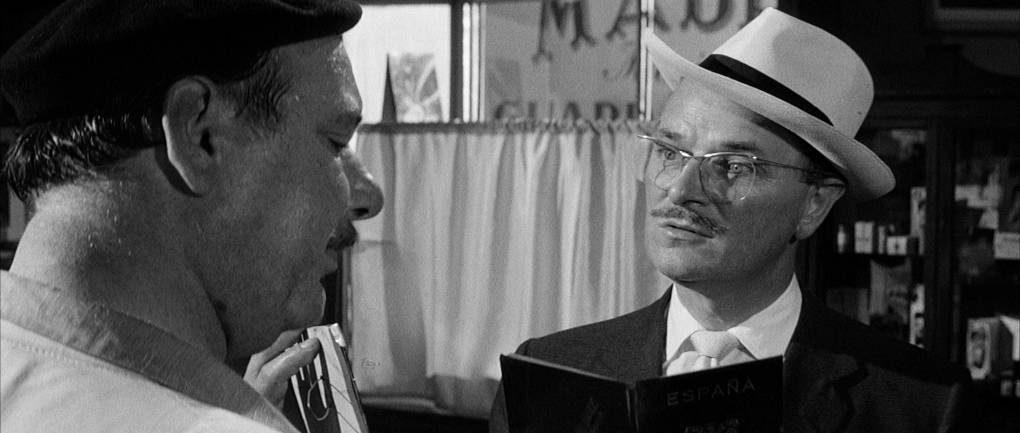
From here, Milo and Franklin head to Carter’s apartment, where Milo does battle with physically and verbally pushy landlady Mrs. Frazur (an entertainingly infuriating Josephine Brown) and discovers that the apartment has already been re-rented to statuesque blonde Trudie Hall (Anita Ekberg), who – and there’s really no ignoring this – is dressed and photographed in a manner that feels deliberately designed to emphasise the size of her breasts. I guess I shouldn’t be surprised that this was also made a feature of the poster artwork. Milo, of course, is captivated by Trudie’s beauty (and figure), and in the process of slyly chatting her up, he picks up a clue to Carter’s later whereabouts that he won’t realise is a clue at all until the plot requires him to do so. While in the apartment, he hands his car keys to a pestering Mrs. Frazur to lend to a man whose vehicle he has inadvertently blocked in (these were clearly more trusting times), but the moment the man in question turns the ignition on Milo’s car, it spectacularly explodes. It would seem that the criminals chasing the Tyrahna Blue are determined to stop Milo getting to Carter before them. After going outside to check on the damage, Milo returns to the apartment to find that Trudie has scarpered, but thanks to the grouchy Mrs. Frazur he picks up a second clue, one that leads him to imprisoned painter Vasco Lopez (Alec Mango), who, under pressure, points Milo in the direction of a Lisbon based forger named Tristão (Eric Pohlmann). By this point, however, Carter is already in the process of procuring a forged passport under a new name from Tristão, but when the forger realises who his client is and what the jewel he has stolen his worth, he foolishly attempts to blackmail him in a scene that foreshadows a similar sequence in Fred Zinnemann’s superb The Day of the Jackal (1973). By the time Milo lands in Lisbon, Tristão is already dead, news that prompts Milo to attend his funeral and buy information from a local organ grinder, who is played by the always lovely Donald Pleasence (whose surname is misspelled as Pleasance in the film’s opening and closing credits). At this point, I should note, we’re still only a third of the way through this 89-minute movie.
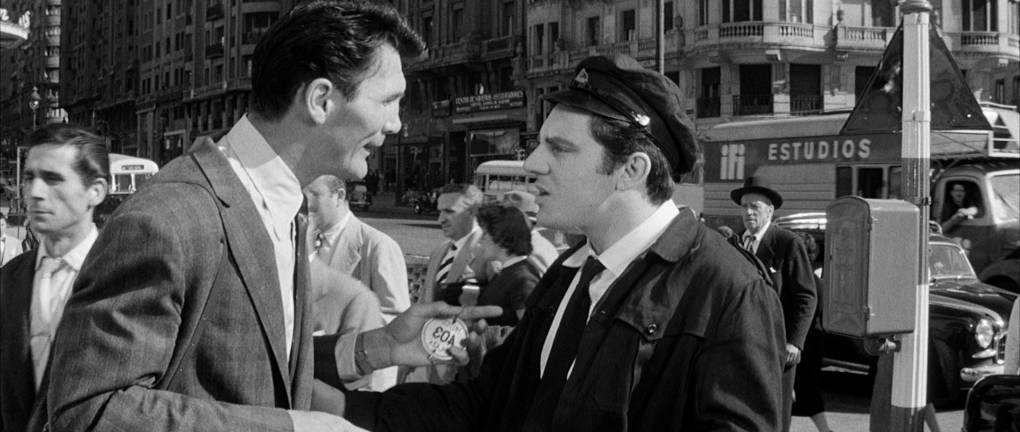
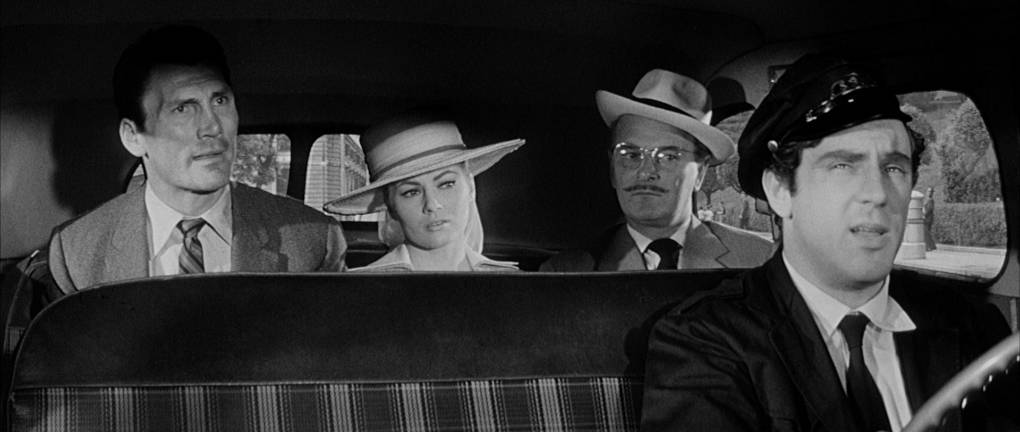
Things complicate with the reappearance of Trudie, who it turns out is pursuing the gem for her own very personal reasons, while a tip from the lips of a dying man points Milo in the direction of Madrid, where he teams up with local taxi driver Ernesto (Anthony Newley) and gets violently assaulted by the coolly thuggish Lomer (Bonar Colleano) and Rizzio (Sean Kelly), two of the professional criminals who are also hot on Carter’s tail. The plot then takes an interesting and unexpected turn when a chance event – one that is only later revealed to have logic at its core – sends Carter right into Ernesto’s arms, with the result that Milo tracks him down far earlier than would be normal for such a globetrotting pursuit. Despite now knowing who Carter is, however, Milo cannot show his hand until he has the location of the Tyrahna Blue, and so attempts to pass himself off as an American tourist who has had a little trouble with the local law in order to form a casual bond with his prey, one that stretches credibility a tad but did keep me wondering just whether Carter is as convinced of Milo’s story as he on the surface appears to be.
All the ingredients for a crackling little crime drama/thriller are here, but for me this promise is only partly borne out by the resulting film. The interiors may be studio sets but the country-hopping plot delivers some genuine location work in New York and Spain (the latter apparently standing in for Lisbon, Madrid and Paris), which gives the film as sense of scope and scale that I doubt was reflected in the doubtless tight budget. Jack Palance cheerfully commits to the role of investigator Milo March, Anita Ekberg provides the glamour whilst also scoring the odd nicely delivered line, and Nigel Patrick walks a neat line between suspicion, cold calculation, and an increasingly troubled sense of self-preservation. The supporting cast is particularly noteworthy here, featuring as it does the likes of Donald Pleasence, Sid James, Anthony Newley, Eric Pohlmann, Josephine Brown, Alfred Burke, and the menacing bad guy double act of Bonar Colleano and Sean Kelly, the latter of whom has one of those rictus smiles that tells you all you need to know about the pain he is about to inflict.
The direction, by Plague of the Zombies and The Reptile director John Gilling, keeps things moving without ever drawing attention to itself, and David Shaw’s screenplay, which is based on the novel of the same name by M.E. Chaber (the pen name of Kendell Foster Crossen), intermittently demonstrates some noir ambitions, notably in the back-and-forth between Milo and Trudie during their first apartment meet. Sure, it may not be in the ballpark of the crackling “There’s a speed limit in this state, Mr. Neff” exchange between Fred MacMurray and Barbara Stanwyck in Billy Wilder’s 1944 noir masterpiece, Double Indemnity (then again, what is?), but the banter here still managed to raise an amused and appreciative smile. The film is also captivatingly shot in monochrome CinemaScope by later James Bond cinematographer Ted Moore, one of whose two camera operators was a young man with quite a future ahead of him named Nicolas Roeg.
Yet despite a plot that begins as an international pursuit and develops into a sly battle of wits, one that did hold my interest throughout, I never really found myself gripped by The Man Inside the way I normally would expect to be by a film with this cast, this story, this director, and I curiously can’t quite put my finger on exactly why. That Ernesto has a sleazy side that has him eyeing up every attractive woman and fired up at the sight of a young couple kissing on a train (he even gives the guy a “get in there” fist pump, for heaven’s sake) does play a little to the Latino stereotype of the day, though I will say that Newley otherwise avoids overplaying a character that it would have been easy to caricature in a manner that would have modern audiences wincing. The old predictable favourite of a character telling someone to meet them in an hour at a specific place so that they can relay important information, only to then be killed before that meeting can take place, gets another outing here, and there are a small sprinkling of story elements that I found a little hard to swallow even within the framework of the film.
In the end it’s an engaging enough, enjoyably performed international jaunt with a spattering of effective sequences, all of which peak in a 20 minute finale in which all of the relevant players are brought together on a boat train from Paris to London. Whether you swallow the sudden change of mind that feels engineered to deliver an ending that satisfies both the ‘crime cannot pay’ movie dictum of the day and audience expectations for a teased romantic union is another matter entirely (I did not). But for all my uncertainties, I’ll freely admit that the pleasures are there, my favourite being one that could slip by unappreciated on a first viewing. It occurs when Milo forces his way past the aggressively protesting Mrs. Frazur into the hallway of the apartment building in which Carter used to live. As the towering Jack Palance smilingly confronts the far shorter Josephine Brown, his head briefly clips the glass lampshades above, prompting Brown to break her loud flow momentarily to quickly mutter, “Gee, you’re tall, ain’t you?” before returning to her angry protestations. It’s a throwaway moment that absolutely feels like an improvised line in response to an unexpected interaction with the set dressing that could easily have derailed the shot had the actors broken character, which they happily do not. If it wasn’t and was actually a planned aside after all, then full marks to Brown, Palance and Gilling for selling it as the delightfully unscripted moment that it plays as.
sound and vision
The only info provided on the 1080p transfer on this Blu-ray is that it was sourced from an HD remaster by Sony, but as we’ve come to expect from Indicator, it’s a damned good one. Framed in the film’s original CinemaScope ratio of 2.35:1, the image ticks all of the hoped-for boxes for a black-and-white transfer, being clean, stable in frame, with well-balanced contrast that delivers inky black levels and no burn-outs on highlights, with only some very slight brightness flickering detectable on a couple of scenes. Whilst perhaps a whisper shy of reference quality, the picture is still crisp and the detail is clearly defined, something especially evident in facial close-ups and the final act wide exterior street shot of the Paris train terminal.
The original mono soundtrack was also remastered and is presented here as a Linear PCM 1.0 track. As expected, the tonal range is not exactly expansive, especially at the bass end of the spectrum, but the dialogue is always clear and there is no noticeable trace of wear or underlying hiss or fluff.
Optional English subtitles for the hearing impaired have been included.
special features
Audio Commentary with Barry Forshaw and Kim Newman
Two of my favourite commentators return to discuss a film that is absolutely in Forshaw’s wheelhouse, given that his published books include Brit Noir : The Pocket Essential Guide to British Crime Fiction and Film & TV and British Crime Film: Subverting the Social Order, though Newman has once again really done his research and is able to match his colleague’s knowledge at every step. As ever, the two make for a lively and informative critical double act, and while they do intermittently comment on what’s taking place on screen, their prime focus is the personnel involved in the film’s making, including detail on the actors, cinematographer Ted Moore, score composer Richard Rodney Bennett, source novel author M.E. Chaber, and director John Gilling, which briefly sees them disagree on the merits or otherwise of Gilling’s. 1966 The Reptile. They reveal (I say reveal because I was previously unaware of this but I’m sure some reading this will not be) that the source novel was one of a whole series featuring investigator Milo March, which I was not surprised at all to learn that Newman has read and rather enjoyed. Forshaw, on the other hand, admits to only having read The Man Inside, which he states with a clear lack of enthusiasm did not inspire him to seek out the other books in the series. Forshaw also highlights two elements of the film that he doesn’t really buy (I’m with him on both), and the final 20 minutes prompt an interesting debate about the specific appeal of films and sequences set aboard moving trains. Great stuff.
Slam-Bang Entertainment: Vic Pratt on Warwick Films (10:23)
Immensely knowledgeable film historian Vic Pratt looks back at the commercially successful independent production company Warwick Films, from its formation at the hands of American businessmen Albert ‘Cubby’ Broccoli and Irving Allen though to its folding in 1960 following the critical acclaim but box-office failure of Ken Hughes’ The Trials of Oscar Wilde. He defines the company’s no-nonsense style and how it effectively set the template for how action films could be made in the UK, and gives special attention to the 1953 The Red Beret (Warwick’s first feature), the 1956 Safari, and the 1956 Zarak, which also gets discussed in the commentary. It is, of course, noted that when the company was dissolved, Broccoli formed Eon productions with Harry Saltzman and went on to make a fortune producing James Bond movies.
Image Gallery
68 screens featuring monochrome promotional stills, black-and-white and acid trip coloured lobby cards (or front-of-house stills as we British cinemagoers used to know them), press book pages, and international posters.
Booklet
Professor of British Cinema at De Monfort University, Josh Billings, delivers plenty of useful information on the lead players and filmmakers, as well as offering his opinions on the pleasures of black-and-white CinemaScope, views with which I found myself in hearty agreement. He accurately states that the film’s cinematographer, Ted Moore, “went on to shoot the first four Sean Connery James Bond films between 1962 and 1965, as well as the first two outings with Roger Moore in 1973 and 1974,” but oddly omits to mention that he also shot the sixth Connery Bond film, Diamonds Are Forever. Not for the first time, my inner semantic gremlin also feels the need to point out the technical term ‘pan’ refers to a sideways movement of the camera on a fixed mount, and you thus cannot “pan down” as way too many commentators now claim – that particular movement is called a tilt. Sorry, that’s been one of my pet gripes for years, and it takes nothing away from what is an otherwise fascinating piece.
Up next are extracts from two articles on Warwick Films, both from the late 50s, the first being a piece on the partnership between producers Irving Allen and Albert R Broccoli for the May 1956 edition of Kinematograph Weekly by none other than the above-mentioned Josh Billings (well, I presume it’s the same individual – it would be one hell of a coincidence if not), while the second is a report from the set of The Man Inside by Bill Edwards for the May 1958 edition of the same publication. Both make for most interesting reading.
This is followed by extracts from articles about leading man Jack Palance written after he and his family moved to the UK, which include revealing quotes about the move and the actor’s bad guy screen image from Palance himself. Also included is a snippet from Nicolas Roeg’s autobiography about Palance on the set of The Man Inside.
Finally, we have sometimes very brief extracts from contemporary reviews, with Anthony Newley’s performance and the cinematography prompting the most praise. Full credits for the film are also included, and the booklet is illustrated with promotional stills and artwork.
final thoughts
The Man Inside
UK 1958 | 89 mins
directed by: John Gilling
written by: David Shaw; based novel The Man Inside by Kendell Foster Crossen (as M E Chaber)
cast: Jack Palance, Anita Ekberg, Nigel Patrick, Anthony Newley, Bonar Colleano, Sean Kelly, Sidney James, Donald Pleasence (as Donald Pleasance), Eric Pohlmann, Josephine Brown
distributor: Indicator
release date: 23 February 2026