
Strongroom
Vernon Sewell’s accomplished B-movie from 1962, STRONGROOM, has a restoration and a new release on Blu-ray from the BFI, including among its extras his film from the previous year, The Man in the Back Seat. Review by Gary Couzens.
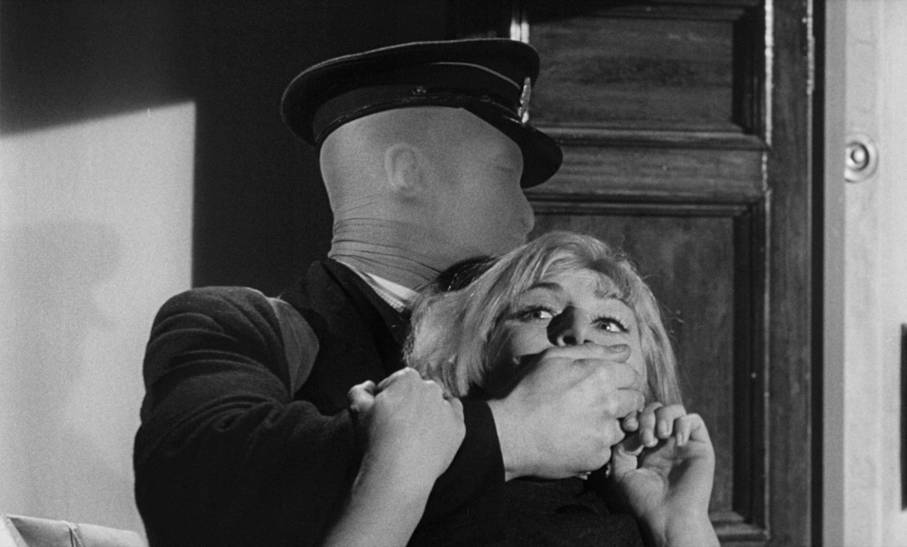
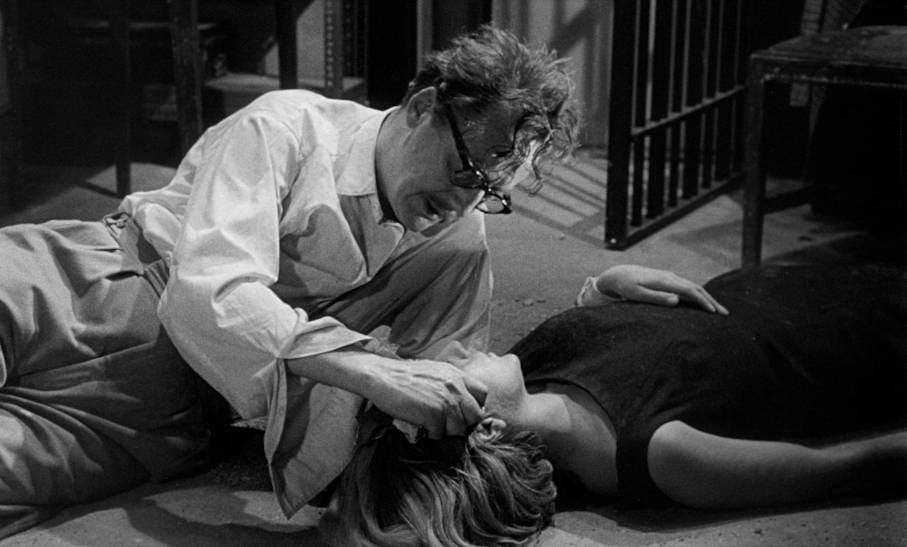
A Saturday morning, the start of a Bank Holiday weekend. Griff (Derren Nesbitt) and brothers Len (Keith Faulkner) and Alec (Morgan Sheppard) wait outside the local branch of Eastern Counties Bank, their plans to rob it nearing fruition. However, they don’t realise that manager Mr Spencer (Colin Gordon) and secretary Rose Taylor (Ann Lynn) are working out of hours, she looking to finish in time to catch the 12.30 train for a weekend away. The three men force their way in, overpowering Spencer and Rose and locking them in the bank vault. However, as they escape they have second thoughts – the two in the bank strongroom won’t last until Tuesday when the bank is next open, and they could face a murder charge, which carries the death sentence. So they split up, Alec planning to call the police and leave the vault keys for them to find. But Alec has a fatal car accident. So how can Spencer and Rose be rescued before they suffocate?
Strongroom, shot at Twickenham Studios and on location locally in 1961 and released in 1962, was directed by Vernon Sewell at a time when he was regularly making what were then called B features, often around an hour long (though Strongroom is a little longer, 79 minutes or four reels in old money rather than three), designed to play in support of larger-budgeted features or as half of a double bill. As with the quota quickies of previous decades, many of the best of these films stood out then and stand out now, often turning out better than the films they played with, even if you came for a comedy and ended up watching a noirish crime thriller like this one. Sewell made films in several genres: supernatural stories such as The House of Mystery (1961) and Ghost Ship (1952) – and The Man in the Back Seat, also on this disc, certainly borders on if not qualifies as a horror film – crime thrillers, also a social-problem drama about racism, The Wind of Change (1961).
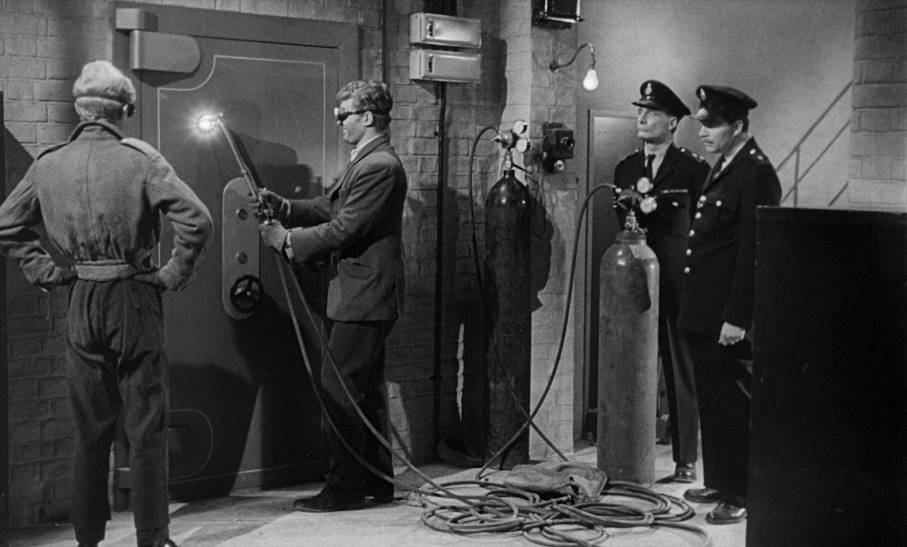
The present film begins like a heist movie, though one thing that distinguishes it from that subgenre is that the planning happens before the start and the execution is over and done in the opening few minutes. What follows is British noir, as one bad decision leads to another, and fate closes a trap around our hapless protagonists. Will they succeed in freeing their two captives, or will it be too late and they face being “topped”? You’ll have to watch the film to find out. You do wonder, as a possible nitpick, that if Spencer and Rose do die, that a defence lawyer might try to claim their attempts to resolve the situation would count as mitigating circumstances, or if the charge should be manslaughter anyway. The fact that capital punishment was still in force would have to be changed for an updated version of this film. There’s also a frisson that a contemporary audience would not have had: as Griff tries to cut through through the vault door, there’s another layer of asbestos to go.
The script is written by Max Marquis and Richard Harris, from a story by the latter. Harris, not the actor and still with us as I write this, had been a prolific television writer since the previous decade and was also a radio and stage playwright. This is Marquis’s only cinema writing credit and, like Harris, he worked extensively on television. However much you credit Sewell for the success of Strongroom, it’s their very tight script which forms the basis of it. Even it its relatively short running time, it takes pains to provide a little more character than you might expect, particularly the scenes in the vault between Spencer and Rose, whose almost entire runtime is made up of two-hander scenes, but also such minor characters as the two charladies who turn up unexpectedly at the bank. As key-factory head Snape is called at home, he and his wife are about to go out to the local cinema. Mrs Snape demurs saying that if she goes to the pictures, she wants to see the whole programme. So you hope she might have been in time to see Strongroom sometime in 1962.
Sewell’s direction is economy itself, often staging his confrontations mostly in single takes, two-shots or more, instead of cutting back and forth as other directors might have done. He reserves that for particular key points, such as two significant appearances by the police. The editing was by John Trumper, and more of him elsewhere on this disc, see below. Basil Emmott’s black and white cinematography is excellent too. Johnny Gregory’s music score is sparingly used, mostly some ominous martial drums over the opening credits. The final shot has considerable impact.
Strongroom opened at the Leicester Square Theatre in London (on the site of what is now the Odeon Luxe West End) on 24 May 1962, as the support to the Freddie Francis-directed comedy Two and Two Make Six. However, people soon realised that the second feature was at least as good as the main one if not better, and some listings made a point of top-billing it. Advertisements emphasised this as well, some of them quoting the Sunday Telegraph: “Leaves us gasping!”. Sewell certainly felt he’d done a good job, later describing his own film as “terrific”. By then, having made four films in the space of a year or so, he was on to his next. As his work from the time is viewed again and reassessed, Strongroom is a vital part of it.
sound and vision
Strongroom is released by the BFI on a single-disc Blu-ray encoded for Region B only. The film had an A certificate without cuts on its original release. It has a homeviewing PG certificate dating from 2008. As the film hasn’t been resubmitted, that certificate stands, though Strongroom was given a 12A certificate for its recent cinema reissue, the reason being “mild threat”. The Man in the Back Seat was also an A on release, also uncut; its homeviewing certificate does not appear on the BBFC database at the time of writing. That’s also the case with the short films, though The Awakening Hour was a U with cuts in 1957. (Details of cuts are unlikely still to exist for a film that old, but my best guess is the close-up of a knife preceding a stabbing. If so, the copy on this disc is uncut.) A Test for Love and After Dark, both made as public information films, were released at the time non-theatrically so didn’t go before the BBFC.
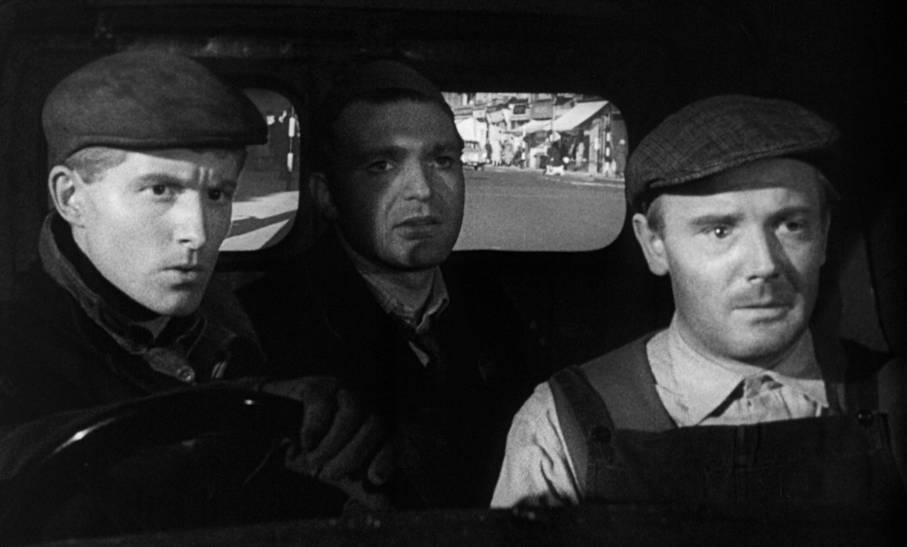
Both feature films were shot in black and white 35mm. The transfer for both films is in the ratio of 1.66:1. Strongroom is a 2K remaster from a 4K scan of a 35mm finegrain duplicating positive. (A new 35mm archive print was also struck, and I saw it at its premiere at the BFI Southbank’s Film on Film Weekend in London in 2025.) Blacks and whites are solid, with greyscale and contrast looking on point. The Man in the Back Seat is from a SD master, upscaled to 1080p.Inevitably this isn’t quite as sharp, noticeably in the more darkly-lit scenes, but given that it’s shown this way rather than not at all, there can be little grounds for complaint.
The soundtracks are the original mono, rendered as LPCM 1.0 for the main feature, DTS 2.0 for The Man in the Back Seat and the other short films, in the case of Footpads a music score for a silent film. Nothing much to report here, with dialogue and sound effects clear and the sparse music score as it should be. English subtitles are available for the hard of hearing on Strongroom only. They are pretty much accurate, though “narc” should be “nark” (meaning an informer. However, at least on the review checkdisc supplied, the subtitles disappear 72 minutes in, so anyone reliant on them would have a problem for the final six or seven minutes of the film.
special features
The Man in the Back Seat (57:23)
Released in 1961, The Man in the Back Seat was the film Vernon Sewell made just before Strongroom. It was a busy year for him, which also saw the release of House of Mystery and The Wind of Change, both like this second features of around an hour plus or minus a few minutes. Like Strongroom, The Man in the Back Seat features Derren Nesbitt (Tony) and Keith Faulkner (Frank) as half of a credited cast of four. The other two are Carol White as Frank’s wife Jean and Harry Locke as Joe, the title role. The film also uses the services of editor John Trumper.
Joe is a bookmaker, charged with depositing the takings from the local dog track. Tony and Frank mug him and knock him unconscious but soon realise that the money is in a case chained to Joe’s wrist, which they can’t remove. Hence a night of various attempts to remove the case and leave Joe behind, but that’s far easier said than done.
At only 57 minutes, The Man in the Back Seat is a taut piece of work. What those who had spent some of their hard-earned wages to see the comedy Dentist on the Job in 1961 made of it is a good question, but it does hark back to the days when it often paid to be in your seats for the supporting feature or stay behind after the main one had finished. The Man in the Back Seat is not only a British noir, with fate again closing in on Tony and Frank, but for reasons I won’t reveal it takes us into the borderlands of horror. All this in a film made at Beaconsfield Studios with much night shooting in the local streets. Much of that is due to Joe, with Harry Locke having quite a lot of presence despite almost no dialogue (all of it near the start) and spending most of the running time unconscious. Carol White does her best with a more limited nagging-wife role. Nesbitt and Faulkner reverse their dynamic in the later film, with Frank being the more easily-led one and Nesbitt being as cold as ice. But all to no avail. The script was by Malcolm Hulke and Eric Paice, who would become better known for their work on the small screen a decade or so later, Hulke for Doctor Whoespecially, Paice as one of the two writers for the first three series of The Brothers, and in both cases much more besides.
The Man in the Back Seat opened in London on 2 July 1961, and the distributors clearly thought they had something on their hands, billing it as “the most THRILLING supporting feature in years!” The film did receive good critical notices, with the unsigned reviewer of the Monthly Film Bulletin despite some reservations calling it “the best British crime feature for some little time”.
Commentaries by Dr Josephine Botting and Vic Pratt
The team of Botting and Pratt provide a commentary for both features, newly recorded for this release. They can be listened to in either order (though not before seeing the films themselves) though it’s clear that The Man in the Back Seat track followed that for Strongroom, as they refer back to their thoughts on the main feature on this disc. Themes recur, with both of them noting little details that add to our understanding of the characters, and our sense that they all have lives beyond what we see on screen. There are other parallels between the two. Both films are, on the face of it, heist movies where a vital part of that subgenre, the scenes of planning said heist, are elided, and in fact take place before the film even starts. Botting refers to the Hatton Garden robbery of 2015, done over Easter weekend in 2015, and wonders if the man in charge had seen Strongroom, as he was old enough to have done. They also pay attention to the supporting cast, all of them uncredited in the case of The Man in the Back Seat, but there isn’t too much undue quoting of IMDB filmographies. In the case of that film, they also talk about the writers’ careers, with Hulke being a former Communist and Paice being more establishment, and how is reflected in this and other films and television. Pratt has even traced the route of the number 44 bus, and thinks that The Man in the Back Seat is Sewell’s masterpiece. They both see both films as part of a tradition that was coming to an end, with stories like this more likely to turn up on television as the decade progressed, and of course no longer in black and white just a few years later.
John Trumper BEHP interview (157:54)
Longstanding editor John Trumper, who cut both the feature films on this set and one of the shorts, is interviewed by John Legard and Dave Robson for the British Entertainment History Project on 17 February 1992, as Legard tells us at the start. At the time, Trumper was a few weeks short of sixty-nine and had retired from editing in 1982. (He would receive one more credit, Boyfriends in 1996.) As usual with the BEHP, this is an oral history of a participant in the British film industry, taking him from his birth in 1923. Trumper’s father was a GP and his maternal grandfather had also been a doctor, so he might have been expected to follow them into the medical profession. The first film he remembers seeing was the 1934 The Scarlet Pimpernel. He founded a film society at school and took advantage of the passing of King George V to show Battleship Potemkin, which had been banned before then and still was by the BBFC. He also shot a film at school, and afterwards wrote to Anthony Asquith and was allowed to watch him at work. Asquith advised that he apply to the Crown Film Unit, and he was assistant editor of A Diary for Timothy (1945), directed by Humphrey Jennings. He assembled some of Jennings’s out-takes to produce the ten-minute short Myra Hess, though he wasn’t credited. His first editing credit was for the short film Instruments of the Orchestra the following year. (You can find it on the Hilary and Jackie BFI Blu-ray.) An attempt to direct a film ended when he was replaced after a week. He feels his abilities lay elsewhere.
Trumper goes through his career, including his collaborations with such directors as Vernon Sewell, Lance Comfort, and his work for the company Group 3, founded by pioneer documentarian John Grierson. He became known later in the 1960s and in the 1970s for such bigger films as The Italian Job (1969) and Get Carter (1971) and work on television. He’s an engaging speaker, and this extra shows that some of the lesser-heralded members of the crew can provide some of the best stories, often those which haven’t been told many times before. John Trumper died in 2004 at the age of eighty.
This interview plays as optional audio tracks over Strongroom. That’s tracks, as due to its length, twice that of the feature, means that it is split into two parts. These are labelled on the menu 1923-1962 and 1956-1992. That overlap is not an error, and is explained by the fact that Trumper jumps forward at the end of the first part to talk about Strongroom and, more briefly, The Man in the Back Seat.
Footpads (0:35)
This short film from 1896, just a single shot taken by a fixed camera, is credited as the first British crime film. It has done extras duty before, most recently on the BFI’s release of Brannigan. We see a mugging on a rainy night in Ludgate Circus, actually a painted backdrop with lights behind holes recreating the flashing electric BOVRIL VINOLIA sign in the background. This film has been attributed to Robert W. Paul and photographed by fellow pioneer Birt Acres, but this hasn’t been proven conclusively. Presented in 1.33:1 with a music score, “Curious Case” by David O’Brien.
A Test for Love (27:11)
Vernon Sewell made his feature directing debut with The Silver Fleet in 1943, for The Archers, produced by Michael Powell and Emeric Pressburger. Before then he had worked extensively with Powell, and had been among the crew who had travelled to Foula to make The Edge of the World (1937). Before that first feature, he directed four short films, of which A Test for Love, also in 1937, was the second. It’s a dramatised documentary (none of the cast are credited) telling the story of shopgirl Betty, who goes out with Jim, but Jim, to her friend Sally’s lack of surprise, intentions were not to pop the question but to have his way with her. So Betty pays for her “one slip” with a case of venereal disease. You have to imagine a little nervousness about this topic, as the bacterium in question is never named except once in print, on a prescription. So I’ll not spare the long-dead Betty’s blushes: it’s gonorrhoea. (This wasn’t unprecedented, though. Back in 1933, the British Social Hygiene Council distributed the Canadian/American film on the same subject, Damaged Lives, without a BBFC certificate and with audiences restricted to the over-sixteens.) A little rough and unpolished compared to Sewell’s later work, but it’s interesting as an illustration for social attitudes of the time. This is another short film which has done extras duty elsewhere, and in fact it was recently found accompanying Sewell’s 1956 film Spin a Dark Web, which is one of the six included on Indicator’s Columbia Noir #7: Made in Britain set.Presented in its original ratio of 1.37:1, in a rather battered and soft transfer, but at least it’s available.
The Awakening Hour (20:30)
The Awakening Hour, from 1957, written, produced and directed by Donovan Winter, is a curiosity. With no dialogue – just music and some diegetic sound – it’s a combination of a mini “city symphony”, the city being central London, and a perfunctory drama of a robbery and stabbing, with the police in hot pursuit. As such it’s more of interest now as a glimpse of the London of nearly seventy years ago, from shots of Trafalgar Square and Covent Garden market, amongst others. Films on at West End cinemas included a reissue of Charles Chaplin’s The Gold Rush, Bob Hope and Katharine Hepburn in the comedy The Iron Petticoat and also The Last Man to Hang, which you can also find in Indicator’s British noir box set, so that dates shooting to circa September 1956. This is presented in 1.33:1, though 1957 was well into the widescreen era and this was a 35mm film made for showing in commercial cinemas. Given the headroom in most shots, this would have been intended for and indeed shown at a wider ratio, most likely 1.75:1 or 1.66:1.
After Dark (13:55)
On to 1979, and the only item on this disc in colour. This is a public information film in which Colin Welland sits behind the wheel of his car and advises us of road safety when driving at night. Directed by Mike Dodds in grainy 16mm (which is how it was mostly likely shown to audiences), its presence on this disc is due to its editor being John Trumper. Presented in its no doubt intended ratio of 1.33:1.
Booklet
The BFI’s booklet with the first pressing of this release runs to twenty-eight pages plus covers. It begins, with a spoiler warning, with “‘The Most Competent Man I Have Ever Known’: Vernon Sewell and the British B Film” by James Bell. This starts by saying that the type of B film that Strongroom epitomises was in its twilight years when it came out in 1962, with television well established and the film industry aiming at more lavish productions to keep audiences coming to cinemas. British B films had evolved from the quota quickies of decades past, low-budget films churned out to fill the second half of double bills, but in so doing giving opportunities to filmmakers who would go on to bigger, if not always greater, things. The Wall Street Crash had put paid to Sewell’s business ambitions, so he took a job at Nettlefold Studios, taking on as many jobs as he could. Bell talks about his association with Michael Powell, then also working very productively in quota quickies, which led to his becoming a director. The quote that gives this essay its title comes from Powell’s autobiography. However, his tastes moved away from the prestigious A features being made (he turned down Madonna of the Seven Moons, made by another director in 1945) and signed up with B-movie producer British National. Less money was available, to say the least, but Sewell did have inherited wealth as a safety net. He made films in a variety of genres, but was often drawn to small-scale claustrophobic subjects, of which the two on this disc are fine examples. After a brief discussion of The Man in the Back Seat and Strongroom, Bell briefly covers his later career, finding that nothing matched the economy and precision of these two. Sewell died in 2001, aged ninety-seven.
After a credits listing for Strongroom, Barry Forshaw contributes “British Crime Films of the Sixties”, a genre whose reputation, he says, continues to grow. The films contained a fair amount of social comment, with even the upper classes turning to crime, for example in The League of Gentlemen (1960). On the other hand, films often paid attention to working-class characters, often in an uncondescending way, especially given that most directors were middle-class and above. Forshaw looks at some of the directors working at the time, several of them born abroad such as Joseph Losey (American) with films like The Criminal and Wolf Rilla (German) and others, and how their films illuminate the national character. He also considers some less successful examples, from the end of the decade when the genre was in decline. Forshaw considers the 1960s a golden decade for the British crime film.
The rest of the booklet includes credits for and notes on the special features, including a lengthy piece by Forshaw on The Man in the Back Seat, plus Ros Cranston on A Test for Love, Forshaw again on The Awakening Hour and Tony Dykes on After Dark.
final thoughts
Strongroom harks back to a time when a second feature was worth turning up early for, or staying behind for, ensuring that you got your money’s worth in what were then not the one-and-nines but the two-and-sixes (on average). It’s also a key film of Sewell’s, who was in a purple patch at the time, and attracted notice even against more heralded filmmakers working on bigger-budgeted fare. The BFI’s Blu-ray has added value in his earlier film The Man in the Back Seat and some worthwhile short films.
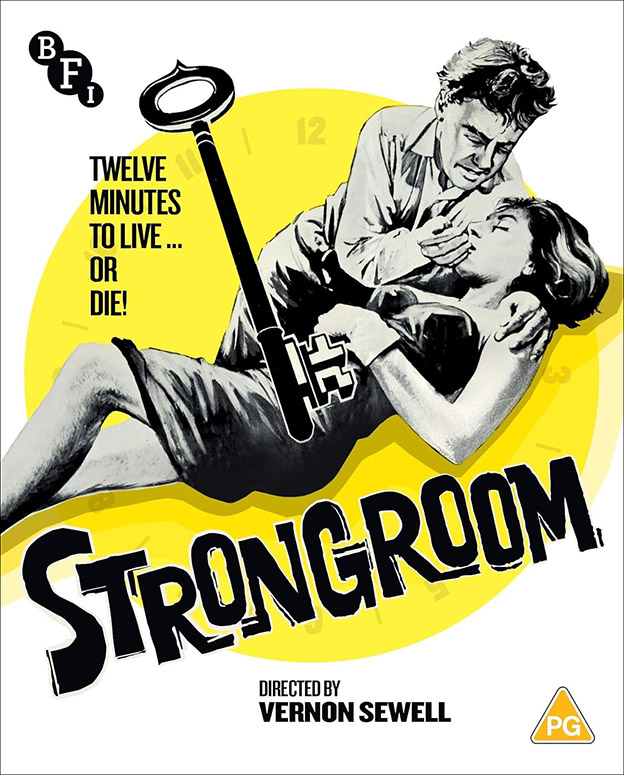
Strongroom
UK 1962 | 80 mins
directed by: Vernon Sewell
written by: Max Marquis, Richard Harris
cast: Derren Nesbitt, Colin Gordon, Ann Lynn, Keith Faulkner, Morgan Sheppard, Hilda Fenemore, Diana Chesney
The Man in the Back Seat
UK 1961 | 57 mins
directed by: Vernon Sewell
written by: Malcolm Hulke, Eric Paice
cast: Derren Nesbitt, Keith Faulkner, Carol White, Harry Locke
distributor: BFI
release date: 23 February 2026