
Wuthering Heights
Emerald Fennell’s stock-in-trade is revenge intrigue with a smear of soft-porn perversion. Her high camp take on Emily Brontë’s Gothic firecracker should sizzle with transgressive heat but is curiously cold, conservative and phlegmatic. All artifice and no soul, it is a fleeting thing of the moment. If it is a sign of our times, Jerry Whyte wonders what it signifies.
Emily Brontë
Jonathan Simons
Whether we like it or not, the popular appetite for watching films in cinemas is not what it was. Nevertheless, gales of comment occasionally swirl around certain controversial films, which reveal the fault line in society and can consequently act as cultural lightning rods. Such rare films can generate debate that fans out beyond cinemas to engage a wider public, and reflect, even shape public discourse. That, in turn, can generate increased revenue. Such was the case with Greta Gerwig’s Barbie – which benefitted at the box office from widespread discussion about whether it was an urgent rebuke of patriarchy or faux-feminist trash, a subtly satirical critique of commerce or a covert ad for consumption. Such has been the case, too, with Emerald Fennell’s impatiently awaited third feature, Wuthering Heights.
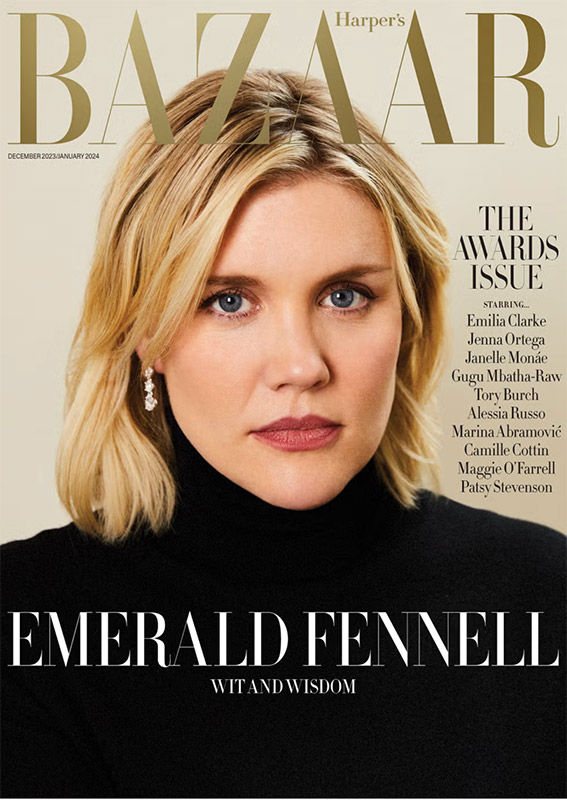
Already firmly established as a hugely talented, sassy-smart maverick, Fennell needed no introduction. Her cultural impact has been as immense as her carbon footprint and her tart, irreverent previous work speaks for itself. Yet her heavily abridged ‘re-imagining’ of Emily Brontë’s darkly complex, deeply subversive novel was heralded by a promotional campaign that reductively rebranded it as ‘the greatest love story ever told’ and featured rage-bait teaser content, brand-tie-ins, a titillating trailer, glossy posters recalling Gone with the Wind, Valentine’s Day launch screenings, and often gauche and disingenuous soundbites.
Fennell provocatively claimed that her singular interpretation of the novel was shaped by her own visceral response to first reading the book at 14 and that she wanted to honour the novel’s ‘primal, sexual’ undertones.
Whether you perceive that as the real deal or oxymoronic cant will depend not only on whether you view Emerald Fennell as a straight-talking innocent or a wily operator. Most people who cared to listen simply shrugged their shoulders and took it all with a pinch of salt. Novelist Heather Parry was more forthright than most: ‘Why am I supposed to give a fuck what an agonisingly posh woman from London thought Wuthering Heights was about when she was a teenager?’ Fair point, I thought, but that leaves many questions unanswered.
Might Fennell’s pre-release comments have been pre-prepared PR guff conceived to second-guess, and shield against criticisms of the film as dim salacious pap? Might Fennell have slyly pitched for a succès du scandal? Can you manufacture lucrative dissent with a coldly calculated promotional campaign? Sure you can, with a marketing budget reported to have topped $85 million and associated product deals in place. You don’t need a calculator to tell you that’s a heap of (wasted) money. Given that Fennell’s Saltburn was a resounding commercial success, it’s no wonder the studios were embroiled in a bidding war before shooting began. How many great independent films can you make with an Emerald Fennell budget? Who gets to make films and who doesn’t?
There was sufficient heft around the issues at stake to ensure that battle lines were immediately drawn around Fennell’s film. Hostilities broke out between one party shouting ‘Lighten up Sourpuss! It’s just a bit of fun’ and another yelling ‘Switch on your brain. You’ve been conned!’, between those caricatured either as navel-gazing pedantic purists or witless philistine voyeurs. We chose our side, notably over the fraught subjects of class and race that Emily Brontë raised in her book – matters that were glibly characterised either as posh-washing or white-washing, and which Fennell deletes or, better say, repudiates in Wuthering Heights.
Pure Spirits
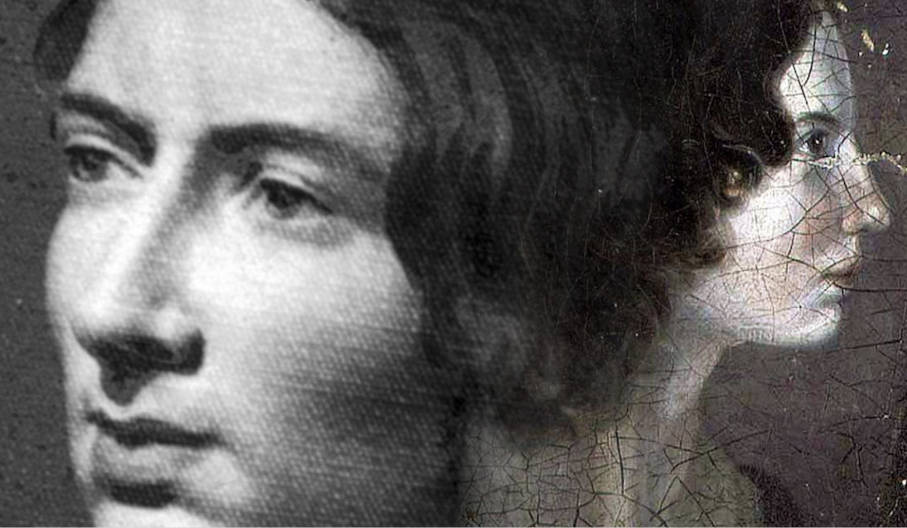
A declaration of interest seems appropriate at this point. Although of Liverpudlian stock, I spent a few of my formative years in a mill village in the Aire Valley, not far from Haworth. At approximately the age of 14, I developed an intense, almost romantic interest in the Brontë sisters. They fired my teenage imagination and inflamed the jumbled feelings of adolescence. Looking back on it, I suppose they provided me with a fanciful respite from the boisterous, rough-and-tumble lasses we boys played with in the village. A bookish, slightly dreamy lad, I saw the Brontë’s as pure spirits. With little or no guidance from Mr French, my English teacher, I developed an abiding love for Charlotte’s Jane Eyre and Emily’s solitary but superb fable. On summer days, I’d cycle over t’top to read their books where they were written and when I later read Juliet’s Barker’s monumental life of the Brontë’s, my youth surged back to me.
None of which had prevented me from contentedly lapping up William Wyler’s 1939 MGM adaption, Coky Giedroyc’s excellent 2009 TV version or Peter Kosminsky’s 1999 one – all of which cover the whole novel, not just its first half as Fennell does. Cinema needn’t condense if it chooses not to. Solutions can be found. As Wyler said to Laurence Olivier in 1939, ‘There’s nothing you can’t do on film’. Aye, lad, nowt.
Despite a fondness for luxuriously long, immersive films (the recently departed, much-mourned Béla Tarr’s Sátántangó springs to mind), I favoured Andrea Arnold’s stripped-back pointillist 2011 gem over the myriad earlier adaptations. Not only because it featured a multiracial cast of locals and the first Black Heathcliff (ah, the salutary tale of James Howson), but because it respectfully represented a raw, wild landscape of elemental beauty that I recognised, and which shaped the Brontë sisters as surely as their tumultuous times did.
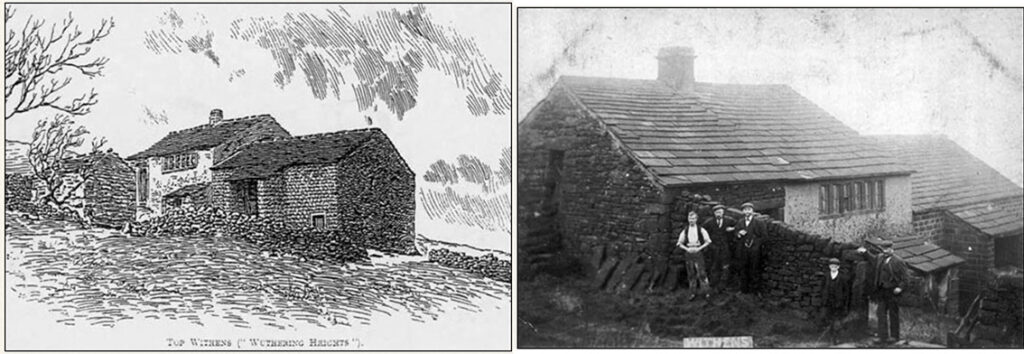
Nobody except perhaps John Cowper Powys and Thomas Hardy wrote more vividly about landscape than Emily Brontë. Call me a purist (when did purity become an insult?) but, as moorland landscapes are a vital element of the book, surely it makes sense to profit from their raw, austere allure when adapting it. Fennell’s film – with its lacquer, latex and plastic – is (cast aside) bereft of natural beauty. She doesn’t linger long on the Yorkshire landscape and Wuthering Heights itself seems to have plummeted into a Welsh slate quarry. Fennell enlarges the cramped hovel that would have hugged the hills above Haworth but it looks as if it’s been marooned on a back lot with discarded sets from The Cabinet of Dr. Caligari or Lord of the Rings.
The Plot Thickens
Emerald Fennel was under no obligation to adhere rigorously to Bronte’s schema. She (sort-of) made it plain that fidelity to the novel was not her objective. We can, though, legitimately ask why anyone would adapt a book if they’re inclined to disregard its essential purposes and premises, not to mention many of its most important characters. Fennell does that; therefore critics and spectators alike are within their rights to ask where that leads. Is her version racist? What does it say about Fennell’s approach to class? What’s all the fuss about? To answer that we’ll first need a brief recap of the book’s often perplexing plot. There will, after all, be some lucky souls who await the unforgettable experience of reading Bronte’s inimitable book for the first time. There are others, luckier still, who have not yet seen Wuthering Heights.
1801. On a visit to Liverpool, kindly landowner Mr Earnshaw happens upon a vagrant street urchin and brings him home to remote Wuthering Heights. Earnshaw’s uppish son, Hindley, immediately takes against the ‘gypsy’ boy and torments him. Earnshaw’s daughter, Cathy, bonds with the lad. She calls him Heathcliff and adopts him as her ‘pet’. As the years pass, the youngsters develop a wild, albeit unconsummated love for one other. Hindley returns from university with a wife, Frances, and forces Heathcliff into servitude. Frances bears Hindley a son, Hareton, but dies in childbirth. Mrs Earnshaw dies. Seduced by a mirage of wealth and status, Cathy marries the owner of nearby Thrushcross Grange, Edgar Linton. Persecuted Heathcliff is devastated and flees, vowing vengeance.
Three years later, Heathcliff returns, having made his fortune overseas, we know not how. Still burning with undying love for Cathy, he is consumed by an unquenchable thirst for revenge on both the Earnshaws and the Lintons. After Mr Earnshaw dies, Heathcliff destroys Hindley and seizes control of Wuthering Heights. He then marries Edgar Linton’s sister, Isabella – to cruelly revenge himself for what he sees as Cathy’s betrayal of their love. After a series of clandestine meetings, Cathy and Heathcliff are, though, eventually reconciled. Hindley dies. Isabella dies soon after bearing Heathcliff a sickly son, Linton Heathcliff.
Cathy bears Edgar Linton a daughter, also named Cathy, but then dies of consumption. Edgar Linton dies. At Wuthering Heights, Heathcliff treats Hareton as badly as Hindley once treated him. With a weather eye on Thrushcross Grange, he determines that his son shall marry young Cathy Linton. His plan succeeds but Linton dies of a wasting disease soon after the marriage. Despite having seized control of Wuthering Heights and Thrushcross Grange, Heathcliff never recovers from Cathy’s death. Even his drive to vengeance falters. He dies, broken-hearted, and is buried next to Cathy. Despite their initial mutual hostility, Cathy Linton and Hareton Earnshaw, the next generation, fall in love and plan to marry.
No Pockets In A Shroud
I hope that skeletal precis emphasises the ubiquity of death and disease in Wuthering Heights. At the time of its publication, in 1847, the Irish famine was at its height and Haworth was a fetid, isolated village with a harsh micro-climate, negligible sanitation, overcrowded housing, and an impoverished population. Such brutal social conditions stunted growth (Emily Brontë was just four feet tall) and foreshortened lives (mean life expectancy level of just 25 years). Tuberculosis or consumption was rife in the late Georgian and early Victorian period and claimed all the Brontë sisters except Charlotte. Their home, the parsonage, faced an overcrowded graveyard – from which the fluids from decomposed corpses flowed into the local water supply and water table. Haworth was less a postcard-pretty, picturesque village than a disease-ridden death trap.
Partly due to such social conditions and a pre-existing ‘moral economy of the poor’, Haworth also lay at the vortex of a rising tide of working-class radicalism. This drew on the earlier struggles of dispossessed West Riding handloom weavers, religious nonconformists, temperance advocates, and anti-slavery activists. These disparate single-issue campaigns fed into the growth of friendly society, trade unions and the broad-based Chartist movement. An anonymous poem, ‘Father, Who Are the Chartists?’, published in the Northern Star in 1844, gives a flavour of the times:
Millions who labour with skill my child/On the land, at the loom, in the mill, my child/Whom bigots and knaves/Would keep as their slaves/Whom tyrants would punish and kill, my child// Millions whom suffering draws, my child/To unite in a glorious cause, my child/Their object, their end/Is mankind to befriend/By gaining for all equal laws, my child// Millions who ever have sought, my child/For freedom of speech and of thought, my child/Though stripp’d of each right/By the strong hand of might/They ne’er can be vanquished or bought, my child// Millions who earnestly call, my child/For freedom to each and to all, my child/They have truth as their shield/And never will yield/Till they triumph in tyranny’s fall, my child.
The Brontë sisters may well have read that poem as the Northern Star was a local paper, but they would not have needed to read it or Friedrich Engels’ 1845 survey The Condition of the Working Class in England to know which way the wind was blowing. Their father, Patrick Brontë, already skittish from earlier encounters with the Luddites, kept flintlock pistols to guard against insurrection. He fired them each day – to keep them fine-tuned, also perhaps as a warning to persons unknown, and he taught Emily to use them. As physical force Chartism took root, revolutionary violence as well as death was in the air in Haworth.
Fennell admitted, fair play to her, that playing Camilla Parker Bowles as ‘a chain-smoking posho standing in the corner making cutting remarks’ came all too easily for her. We wouldn’t expect her to register the novel’s underpinning social conditions and political events in her film. She might have hinted at them though. It’s a shame, because they help explain how a largely self-educated young virgin who barely left her remote village and died aged 30 was able to produce one of the most explosive, transgressive and radical books of her age. Fennell guts the novel of its political and historical context. She strips it bare and shrinks it, reducing it to a boy-meets-girl revenge rom-com devoid of class.
The Brontës would have been acutely aware of, would have felt, even smelt the economic and political turmoil on their doorstep. They will have discussed some of the questions of class and race that filter into the novel but are elided in Wuthering Heights. After all, Patrick Brontë was himself an Irishman, and it is no accident that vulnerable Heathcliff is found in Liverpool – a centre of slavery and home to a huge community of Irish migrants. He is a victim of the class system and systematic racism, an outsider, the other. While his ethnic ambiguity scares the bejasus out of all at the Heights and the Grange, he is as likely to have been envisaged as Irish as a ‘Gypsy’ or a ‘Lascar’. Although the vocabulary of racism was especially fluid 1847 it always translated as ‘not one of us’.
Casting Off
Fennell’s decision to cast Thai-born Hong Chau as Nelly Dean and Shazad Latif, an actor of Pakistani descent, as Edgar Linton suggest she anticipated accusations of casual racism. Chau and Latif give pitch-perfect performances, but they are hamstrung by a puerile script and disastrous directorial decisions. In the novel, Nelly is a plain-spoken housemaid, Yorkshire born and bred: in the film, she is a disinherited aristocrat who acts as Cathy Earnshaw’s Lady’s Companion. In the novel, Edgar Linton is a down-home landowner of limited means: in the film, he is a haughty toff with seemingly unlimited wealth. It is as if the pantomime season were upon us once again. Oh yes it is! Twist the novel out of shape, if you must. Turn it on its head by all means. If you do, though, expect a reaction from those who prefer depth to shallowness, substance to style
Although the film’s club-pop soundtrack jars, special mention must be made of Olivia Chaney’s haunting rendering of 19th century folk ballad ‘The Dark-Eyed Sailor’. This judicious choice alone earths the film in Emily Brontë’s era and hints at the unrestrained mythic passions that so shocked her sister Charlotte and early Victorian society. In her neat primer, The Brontës and their World, Phyllis Bentley says: ‘The ferocity of feelings described does not, however, alarm the reserved Yorkshire people, who secretly believe – not without cause – that they could be just as wild if they cared to let themselves go’.
By contrast, Suzie Davies’ extravagant rococo sets and Jacqueline Durran’s florid froufrou costumes may reference films like Cocteau’s La Belle et la Bête and Victor Fleming’s Gone with the Wind, but their ostentatious frippery feels completely inappropriate to Brontë’s milieu – if entirely apt for Fennell’s rickety school-play performance of the book. All of this would be merely laughable and a wee bit sad, if it didn’t disembowel Brontë’s subtle reflections on racism and finely calibrated commentary on class distinctions, if it didn’t neuter her fundamental guiding premise. A bit more respect would not have gone amiss.
We could more readily forgive Fennell her ahistorical evisceration of Brontë’s pioneering masterpiece, if only her film weren’t so flat and formless. All she offers is cheap thrills and, so we are told again and again, steamy sex. She’s like a spoilt colleen in mummy’s shoes, delightedly squealing ‘Pooh! Pooh!’ to shock daddy. We can concede her right to play fast and loose with the book while still lamenting the irreparable damage done to her own film by her asinine missteps. Without the underpinning architecture of class and race, without Hindley and Hareton, the characters of Cathy and Heathcliff are hollowed out, their molten passion is extinguished and the whole rotten, creaking, tottering structure of the film comes crashing down in ruins.
Fennell’s handling of Joseph, the novel’s bible-bashing servant, has equally disastrous consequences for the film’s fragile coherence. In the novel, he speaks a broad West Riding dialect, rendered phonetically by Emily Brontë and deemed by modern linguists to be unerringly accurate to the local vernacular of the day. This is important because language codifies the hierarchies of class in Wuthering Heights. Heathcliff’s acquisition of wealth and property hoists him up the slippery ladder of social status and transforms him from plain humble ‘Heathcliff ‘ to socially elevated ‘Mr Heathcliff’. Joseph’s hard-edged working-class tones are contrasted to Edgar Linton’s polished cadences.
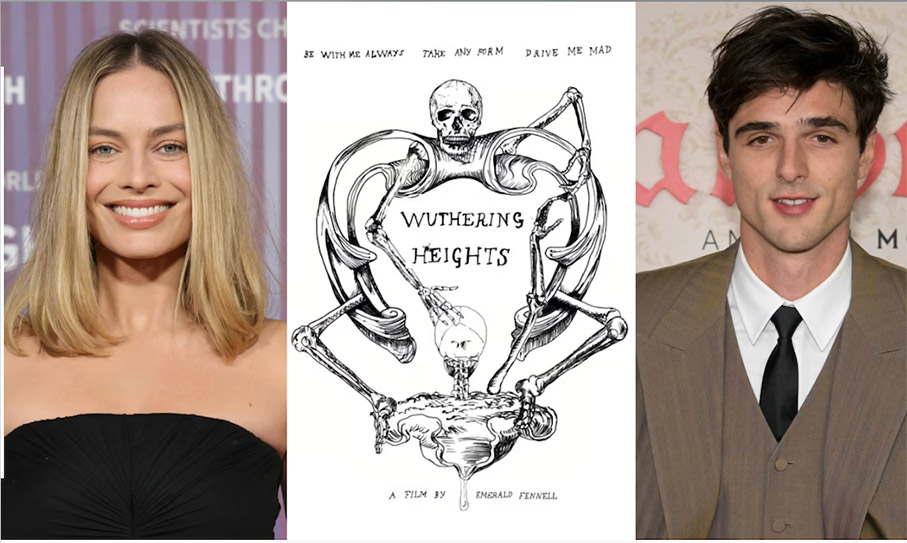
Fennell allows handsome Jacob Elordi a stab at vernacular, at least, but denies Margot Robbie’s Cathy her roots and any linguistic edge. It was Charlotte Brontë who began the regrettable process of taming Emily’s semantic radicalism, by editing Wuthering Heights after Emily’s death, but Fennell takes the sanitization of Bronte’s thorny, muscular language further. As she plays around, she flattens things out. Jacob Elordi makes a passable attempt at a Yorkshire accent, Nelly loses hers, Joseph slips into the background – except when used in a gratuitous BDSM scene. Hindley, a vital symbol of class power in the book is melded with a wine-sodden Mr Earnshaw but essentially dispensed with. Hareton, a vital mirror image of Heathcliff in the excised second half of the novel, also vanishes. In a note accompanying a curated selection of adaptations, the BFI says, ‘The best adaptations capture the mood of the original’. I wish they’d told Emerald Fennell that before she bowdlerized Brontë.
Margot Robbie
For this reviewer the casting of Margot Robbie as Cathy Earnshaw was Fennell’s big mistake. It is not just that Robbie is too old to play young Cathy that irks, though the heightened intensity of first love is consequently lost, it is that she speaks like a Duchess and is dressed like a Queen. Think The Queen of Soul, and Aretha Franklin’s famous quip about Taylor Swift: ‘Great gowns, beautiful gowns’. Good luck, we might add, on the wind-battered moors and shit-spattered streets of Gimmerton in that dress. Robbie’s RP accent is another woeful error. Emily Brontë’s Cathy is a wild Yorkshire tomboy. Fennell’s Cathy is a petulant madam from the start. As played by bonny Charlotte Mellington, she recalls Cammie King as Bonnie Blue Butler in Gone with the Wind.
And then Robbie bursts forth, all corset and teeth, and things go from bad to worse. There’s no denying that Robbie can act, up to a point. She was in her element opposite the excellent Colin Farrell in the cheesy A Big Bold Beautiful Journey and perfectly cast in Barbie. There’s no denying, either, that she has perfect teeth and a well-formed face, but her sun-drenched smile is inappropriate for Wuthering Heights.
There’s a delicious scene in Tarantino’s Once Upon a Time in Hollywood in which Robbie, as Sharon Tate, watches herself on screen in the 1968 b-movie The Wrecking Crew. We’re watching Robbie watching Tate watching Freya Carlson. A similar intertextual layering process occurs when we watch Robbie as Cathy as Barbie. She brings her Barbie baggage with her here. Sadly, if inevitably, to the detriment of character complexity and narrative subtly.
Speaking of her decision to cast Robbie, Fennell said: ‘It’s difficult to get that supersized star power. Margot comes with big dick energy. That’s what Cathy needs’. Does she now? In the event, Robbie’s Cathy simmers and pants, simpers and pouts, beats her wee fists on Heathcliff’s manly chest, and squeals ‘Put me down! Put me down!’ as he chucks her over his shoulder and carries her off. Yeah gods, Mills & Boon and Ken Russell!
Alison Oliver as Isabella Linton fares no better. Although she steals the show in certain scenes and generates the film’s only successful comic moments, her character is as cartoony as Robbie’s. Isabella demurely plays with her dolls and ribbons before enthusiastically submitting, we are led to believe with relish, to Heathcliff’s sadomasochistic treatment of her. The joy of sex takes many forms, of course, but Fennell’s perspective on gender doesn’t stack up any better than her attitudes to class and race.
The decisions and elisions alluded to above betray Emerald Fennell’s own class prejudices. So does that hanging scene, which is followed by images of a ‘mob’ rutting in the street. Fennell’s tendency to fetishize the working class as lethally covetous sexual deviants and the rich as prim jibber-jabbering prigs was equally evident in Saltburn, despite its mock-radical Eat-the-Rich ending. If Fennell’s anti-democratic, recidivist snobbery doesn’t explain why she elected to make a cross between a brash pop-video and a vapid frock-schlock TV series, it is surely the reason she tried to make a Jane Austen out of an Emily Brontë and why her slick, over-stylised, witless film falls apart at its sumptuous seams.
Promises Promises
It would be interesting to know more about the behind-the-scenes production process. Fennell and her marketing team promised much (BDSM! Seething passion! Shattered taboos! SEX!) but, to take them at their word, it was all disappointingly limp and flaccid. Long before the film opened, a ‘leak’ revealed that the opening scene would feature a hanged man with an erection. It did, but the stiffy in question and the ensuing posthumous ejaculation are played for laughs and back-of-the-bike-sheds schoolboy smut. Might Fennell have been lent on by big brand backers or reined in by executives at Warner Bros after test screenings?
What was holding Fennell back? Maybe we must bow to Fennell’s obvious intelligence and assume that she toned things down to honestly represent her 14-year-old self’s view of sex – as per her PR claims; maybe she even did so to acknowledge Emily Bronte’s status as a lifelong virgin. Whatever her reasons, Wuthering Heights feels false, lame and compromised in comparison to Saltburn – which, despite its pig-ignorant politics, was undeniably daring, original, inventive, good unclean fun.
Defending Fennell’s decision to assign the roles of Cathy and Heathcliff to Robbie and Elordi, the film’s Casting Director, Kharmel Cochrane, said: ‘You really don’t need to be accurate. It’s just a book’. There are times, as the gift mugs say, I wish more people were fluent in silence. That crass comment felt like a slur calculated to rile those who revere the Brontës and their work; a slur, too, on the value and prestige of literature. Given the (largely fruitless) labour of the talented folk involved in the making of Wuthering Heights, we could be forgiven for wondering how she’d feel if we said, ‘Pah, it’s just a film’ or, better still, paraphrased Jean-Luc Godard to say, ‘This is not a just film, this is just a film’.
A Philistine Dark Age
We eagerly await the publication of James Marriott’s, The New Dark Ages: The End of Reading and the Dawn of a Post-Literate Society. A fine Times columnist, Marriott has tracked this trend and its deleterious impact on public life and the body politic. In the context of the hullabaloo surrounding Wuthering Heights, his is a timely intervention. Kharmel Cochrane’s comment stands with Fennell’s film to graphically demonstrate the timbre of the philistine culture that has emerged in TikTok era. Fennell makes popcorn cinema for a pop-and-porn-saturated pictorial culture. It may be stretching things to describe her as the stalking horse for a dumbed-down age of unreason, but there are clear reasons why she has quickly become a household name and that Wuthering Heights may embody the zeitgeist more than any film since, say, Barbie.
Reviewing the film in The Independent Clarrisa Loughrey says: ‘Our modern literary crisis has found a new figurehead in Emerald Fennell’s Wuthering Heights. It is Emily Bronte’s 1847 classic for a culture that’s denigrated literature the point where it’s no longer intended to expand the mind but to distract it’. Fennell’s demonstrable lack of respect for the complexity in Wuthering Heights certainly chimes with what we know about the alarming crisis in reading levels. That decline is closely linked to rising levels of inequality but, while reading is most markedly in free fall in the Global South, it is in retreat everywhere (with notable exceptions in the Arctic North) for everyone (though Gen Z appears to be bucking the trend). Easy access to books is a precondition to reading them everywhere. Small screen time eats into time for books for everyone.
Writing in the early 20th Century, when nobody predicted the decline of books, Walter Benjamin said, ‘Those who do not learn how to decipher images will be the illiterate of the future’. Books may appear an odd subject to consider on a cinephile website (They’re just books, right?), but the decline of literacy levels is closely connected to those of cine-literacy. And the class dimension of both problems leads us back to Fennell and her approach to cinema. We can be sure that if folk are being denied access to books and the skills to read them, they are unlikely to gain or be granted access to cameras. Consequently, filmmaking becomes an increasingly elitist craft, which leads to an increasingly elitist film culture, which further widens huge gulfs of class, gender and race.
We are trapped in a vicious circle. It is difficult to build a more democratic, just and sustainable society without an informed citizenry. The decline in reading endangers our collective ability to analyse, contextualize, and evaluate ideas and information. Conversely, increasing literary sophistication seems to lead to increasing political sophistication, and reading drives social mobility. Yet more than 180 public libraries have been lost in the last ten years. We should not be reliant on projects like The Dollywood Foundation to furnish young minds with books.
Cultural Capital
Once called ‘the Universities of the People’ publicly funded libraries were the seedbed from which flowered the great autodidacts of their day. In the absence of a local public library, one such, Aneurin Bevan, cut his teeth in the Tredegar Workmen’s Institute Library, part of an extensive network of libraries set up by Welsh miners. In 1938, he said:
The people are excluded from forming a judgement on various matters of public interest on the grounds that expert knowledge is required, and that, of course, the people cannot possess. The debunking of the expert is an important stage in the history of democratic communities because democracy involves the assertion of the common against the special interest . . . The first weapon in the worker’s armoury must be a strongly developed bump of irreverence.
When recent permanent library closures were mapped onto the government’s Indices of Multiple Deprivation (a system that ranks areas according to income, social conditions and other poverty measures), poorer areas were four times more likely to lose a library than more affluent ones. Which is to say that those with most need and reason to challenge an unjust status quo are deprived of the skills and resources to do so. The skills, for example, to read the report of UN Special Rapporteur Philip Alston on extreme poverty in the UK – which found that 14 million people were living in poverty, of whom 1.5 million were destitute.
A study commissioned by the Reading Agency found that half of British adults no longer read regularly simply for pleasure, let alone embark on demanding reading to equip themselves with knowledge and understanding. Nine million adults in England are functionally illiterate (defined as an inability to read short texts and comprehend basic vocabulary. The sobering slide towards illiteracy is even more marked in the US, where over 20% of adults are functional illiterate (some studies have it as high as 50%). Coincidentally, among North Americans aged 17-19 reading daily decreased from 60% in the late 1970s to 16% by 2016.
George Bernard Shaw said, ‘England and America are separated by a common language’. Now, we might say they’re united by a common decline in language. Those time-worn conversations about why boys didn’t read books are returning, in more sinister form. As literacy levels have plummeted, attention spans and sentences have become shorter. Such is our collective reliance on digital devices that keyboards are replacing paper and pens, and we may soon lose the ability to write.
Meanwhile, academics complain that the problem they face today isn’t that literature students aren’t literary but that they are barely literate. Professor Jonathan Bate says that if people lose the ability to read complex prose (like Emily Brontë’s) they also lose the ability to grasp complex ideas that ‘allow you to see nuance and to hold two contradictory thoughts together’ (Cf. Wuthering Heights). Orwell considered such matters in his perceptive 1945 essay ‘Politics and the English Language’:
Most people who bother about the matter at all would admit that the English language is in a bad way . . . Our civilisation is decadent and our language – so the argument runs – must inevitably share in the general collapse . . . Now, it is clear that the decline of a language must ultimately have economic and political causes . . . But an effect can become a cause, reinforcing the original cause and producing the same effect in intensified form, and so on indefinitely. A man may take to drink because he feels himself a failure, and then fail all the more completely because he drinks . . . [The English language] becomes ugly and inaccurate because our thoughts are foolish, but the slovenliness of our language makes it easier for us to have foolish thoughts.
Something similar can be said about cinema. If we laud and lap up only what we are spoon fed, we may be disenfranchised and become that bit dumber. If we settle for big budget films (like Wuthering Heights) that value wham-bam, quick-fix spectacle over subtlety, we may lose our ability to see and think straight. Orwell concluded his essay on an optimistic note: ‘One cannot change this all in a moment, but one can at least change one’s own habits, and from time to time one can even, if one jeers loudly enough, send some worn-out and useless phrase . . . into the dustbin where it belongs’. And where Emerald Fennell’s dim, disappointing, glossy failure of a film belongs.
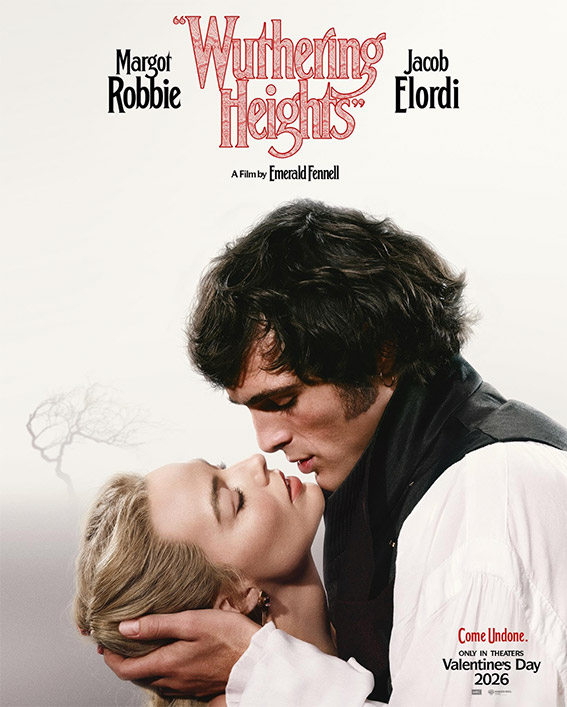
Wuthering Heights
US / UK 2026 | 136 mins
directed by: Emerald Fennell
written by: Emerald Fennell; from the novel by Emily Brontë
cast: Margot Robbie, Jacob Elordi, Hong Chau, Shazad Latif, Alison Oliver, Martin Clunes, Ewan Mitchell, Amy Morgan
UK distributor: Warner Bros Entertainment UK
UK release date: 13 February 2026